 Login
Astronauts Could Grow Their Own Medicines in Space Using Plants
10 June 2026 at 19:29
 The pharmaceutical cabinet of the future might look a lot like a garden.
 The pharmaceutical cabinet of the future might look a lot like a garden.
On Tuesday, NASA announced the crew for the Artemis III mission, which is scheduled to be flown no earlier than summer 2027. As part of the announcement, space agency officials also discussed plans for the crew to dock with both a Blue Origin lander and a SpaceX Starship lander during the spaceflight in low-Earth orbit.
The presentation, although informative, still left open key questions about the landers' readiness and what exactly they'll look like. After the crew announcement, Ars sat down with Jeremy Parsons, NASA's Artemis program manager, to answer some of these questions.
This interview, conducted at NASA's Johnson Space Center, has been lightly edited for clarity.
© NASA/Aubrey Gemignani

Company opens Virginia office, announces $4 million pre-seed funding
The post UK startup Applied Atomics to enter US market with focus on military space mobility appeared first on SpaceNews.
A rare meteorite found in the Sahara Desert has revealed evidence of a giant ancient world that once existed in our solar system but later disappeared. Scientists believe this lost world formed about 4.5 billion years ago, during the early days of the solar system. It may have been as large as the Moon or […]
The post Rare Sahara meteorite uncovers a hidden planet from the early solar system appeared first on Knowridge Science Report.
Spacecraft propulsion startup Arkadia Space has signed a deal to provide thrusters for a satellite being built by Reflex Aerospace.
The post Arkadia Space to supply thrusters for Reflex Aerospace satellite appeared first on SpaceNews.
Proponents see offshore launch as an answer to crowded ranges, military resilience concerns.
The post Spaceport crunch reviving interest in sea-based launch appeared first on SpaceNews.
Massachusetts Institute of Technology (MIT) engineers are testing a new category of advanced-propulsion “electrospray” thrusters that combine the benefits of modern chemical and electrical thrusters used to drive satellites and other spacecraft into one hybrid system.
The team behind the novel propulsion technology said that electrospray thrusters could allow mission planners to design smaller, more nimble satellites and spacecraft capable of performing faster, more powerful maneuvers or slower, more precise adjustments, depending on mission requirements.
Launching rockets into space still requires chemical thrusters, but once spacecraft and satellites reach orbit, engineers continue to develop novel propulsion methods that are more efficient than chemical propulsion technologies. Given the strict weight requirements of spacecraft launches, finding alternatives to chemical propellants has opened up a wider range of mission profiles.
Among the most common alternatives to chemical thrusters are designs that combine electrical energy with small amounts of propellant to produce small but sustainable thrust. Although electric thruster designs require less fuel, saving significantly on launch weight, they also lack both the power and the rapid, quick burst performance of chemical thrusters.
According to study author Amelia Bruno, a former postdoc in MIT’s Department of Aeronautics and Astronautics (AeroAstro), combining chemical and electrical propulsion into a single system is “the best of both worlds.”
“This opens the door for small satellites to do even more science, more observations, and more interesting missions, all on a smaller and cheaper platform,” Bruno explained to MIT News.
Study co-author Paulo Lozano, the Miguel Alemán Velasco Professor of Aeronautics and Astronautics at MIT, agreed, noting that combining both technologies could enable a CubeSat mission to Mars “where they could make the journey slowly, using electrospray thrusters.”
“You could then use your chemical thrusters to quickly move to look at interesting features,” the professor added. “You could have a lot more flexibility to do a lot more things.”
According to a statement detailing the new electrospray thruster’s design, the ones developed by the MIT team are about the size of a thumbnail. Each thruster is also placed directly above a small fuel reservoir. For the MT electrospray thrusters, the fuel is an ionic liquid propellant, a liquid composed of salts that remain dissolved in a solution.
“Ionic liquids are very stable and can even remain a liquid in space, which not a lot of materials can do,” Bruno explained. “And it’s basically a sea of ions, which is why we base our technology around it, so we can pull those ions out into an electrospray.”
When a spacecraft’s battery delivers an electric charge to the fuel reservoir, the ions within the fuel also become charged. The thruster’s design channels the charged particles from the reservoir and through the thruster tips, expelling them into space.
Although the team has tested several types of ionic propellant in its electrospray propulsion thrusters, Bruno and Lozano have collaborated with the U.S. Air Force to synthesize an all-new ionic liquid propellant, which they are calling the Advanced SpaceCraft Energetic Non-Toxic propellant, or ASCENT.
Originally designed as a “green” alternative to extremely hazardous hydrazine rocket fuel that has been the staple in the rocket industry for decades, Bruno notes that ASCENT “happens to be an ionic liquid mixture.”
“And we said, hey, that’s the stuff we typically use,” the researcher added. “Theoretically, this should work. Let’s go figure out how.”
To test their electrospray design, each tested thruster was attached to a small reservoir about the size of a single Lego brick, and then the reservoir was filled with ASCENT. Next, electrospray thrusters were mounted on opposite sides of a traditional CubeSat.
To simulate the microgravity environment of Near-Earth Orbit, the team placed the thruster-equipped CubeSat on a MagLev stand. The team noted that the MagLev in Lozano’s lab is installed inside a large vacuum chamber. This design allows the researchers to fine-tune the environment to best mimic the conditions in space.
During a series of tests, the team applied varying voltage levels to the electrospray thrusters. As expected, the reaction produced a spray from the thruster nozzles, which spun the CubeSat around on the MagLev stand like a freely spinning top.
During each thruster firing, the team measured the amount of thrust produced. This data, combined with the voltage and fuel data, allowed the team to calculate ASCENT’s fuel efficiency during continuous operation. Some tests lasted up to 100 hours.
When the MIT group evaluated the results, they first determined that the choice of ASCENT was correct, as it successfully fueled each electrospray thruster. Even more significantly, the tests revealed that the readily available chemical propellant was equally efficient as conventional ionic liquids.
“Compared to our normal electrospray propellants, ASCENT can provide similar performance in terms of thrust,” Bruno explained. “Now that we know our thrusters work with ASCENT, we can start thinking of all the ways we can make them even better.”
When discussing the benefits of their successful electrospray thruster tests, Lozano noted that a spacecraft with electric and chemical thrusters can share a single fuel tank. Due to its compact design, this hybrid electrospray thruster could be mounted on a small satellite.
Fortunately, the team won’t have to wait long to see their thruster in action. According to the research team, whose work was partially supported by NASA, their design will be incorporated into NASA’s upcoming Green Propulsion Dual Mode mission scheduled to launch in November. The Green Propulsion Dual-Mode mission will carry a briefcase-sized CubeSat with a primary chemical thruster and specially designed electrospray thrusters, making it the first attempt to combine electrical and chemical propulsion in a small spacecraft.
“This will be the first time that a satellite will have a shared propellant tank,” Lozano explained.
Although a large portion of proposed electric propulsion missions that might employ the new electrospray thruster are designed to explore deeper into the Solar System and beyond, Lozano also highlighted the technology’s possible applications closer to home. For example, satellites equipped with both technologies could rapidly respond to environmental or climate changes in real time with a speed and efficiency unavailable with current propulsion options.
“Say there’s a storm coming, and you’d want to deploy your constellation of small satellites to observe over one location,” the researcher explained. “You could choose to send them quickly or slowly, depending on the nature of the observation.”
“And the only way to do that is if you have two propulsion systems, which is now possible,” he added.
Although the mission will not launch before November, Bruno noted that a successful test could allow engineers to consider missions they never thought possible.
“Now that we know our thrusters work with ASCENT, we can start thinking of all the ways we can make them even better,” the researcher explained.
The study “Performance Characterization of Electrospray Thrusters with Energetic Ionic Liquid Monopropellant” was published in the Journal of Propulsion and Power.
Christopher Plain is a Science Fiction and Fantasy novelist and Head Science Writer at The Debrief. Follow and connect with him on X, learn about his books at plainfiction.com, or email him directly at christopher@thedebrief.org.
New mathematical research suggests dark energy may not be needed to explain the accelerating expansion of the universe, challenging the foundations of the standard cosmological model. Mathematicians are questioning whether dark energy is actually responsible for the universe’s accelerating expansion. In a new study published in Proceedings of the Royal Society A, researchers at the [...]Astronomers have discovered the earliest known flickering quasar, a powerful object powered by a supermassive black hole. The discovery is helping scientists learn more about how giant black holes formed so quickly in the early universe. A supermassive black hole sits at the center of almost every galaxy, including our own Milky Way. When these […]
The post Astronomers discover the earliest flickering black hole ever seen appeared first on Knowridge Science Report.
Scientists believe an unusual LIGO detection may be evidence of a primordial black hole, potentially linking these long-theorized objects to the mystery of dark matter. Scientists at the University of Miami believe they may be closing in on evidence for one of the most elusive objects in the universe: primordial black holes. While definitive proof [...]
Just two months after Artemis II's record-breaking trip.
"We only know it existed because a few fragments of it happened to land on Earth."
The new undergarment is built to keep astronauts cool, breathing and moving.Paleontologists have identified a new species of meiolaniform turtle from northern Patagonia, Argentina, that lived during the Maastrichtian age, just before the asteroid-triggered mass extinction that wiped out all non-avian dinosaurs.
The post Fossil Discovery in Patagonia Reveals New Species of Horned Turtle appeared first on Sci.News: Breaking Science News.
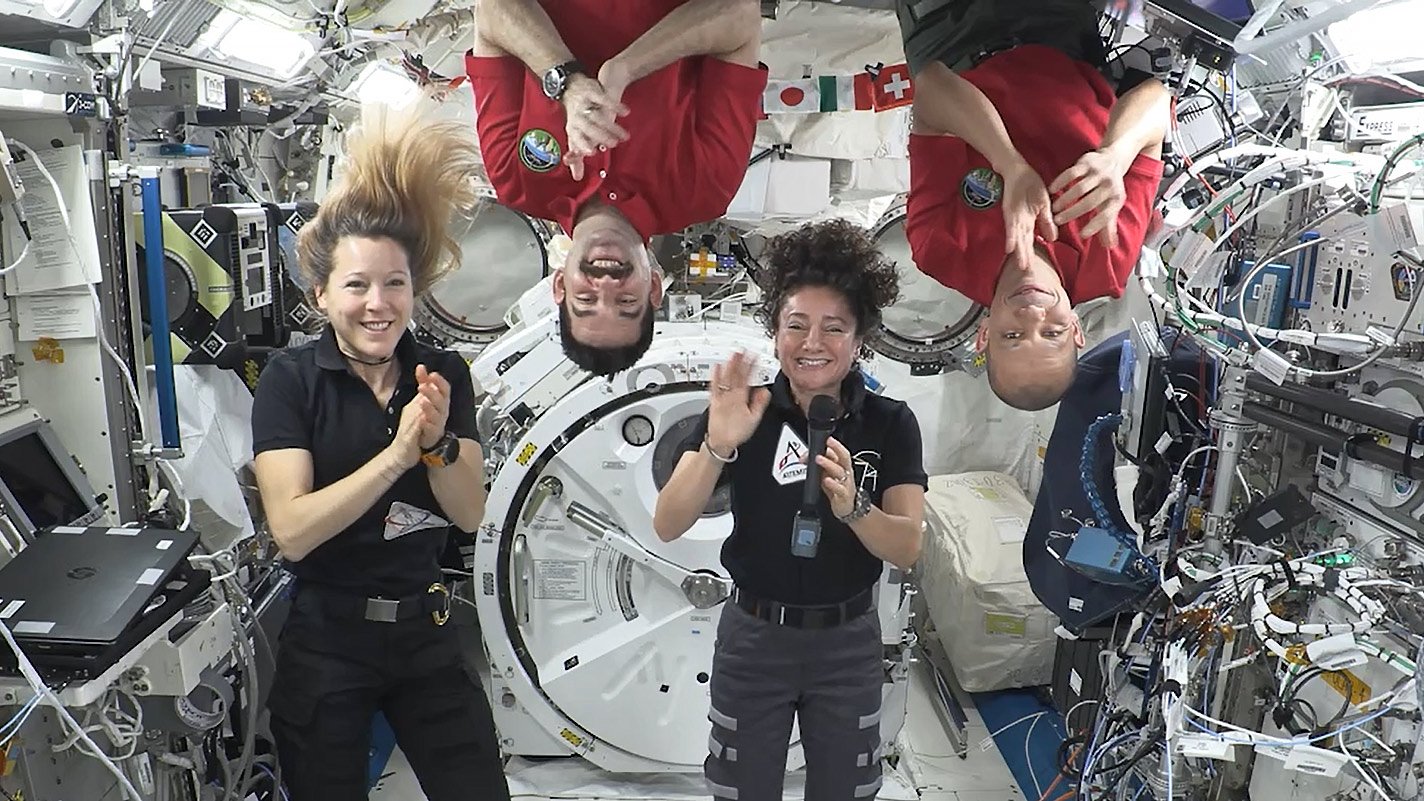
Microbiology and human research were the main scientific focus aboard the International Space Station on Tuesday to protect health on and off the Earth. The Expedition 74 crew members also worked on advanced research hardware and sent down a congratulatory message to the Artemis III crew, who were named during an announcement from the Johnson Space Center in Houston.
Some common bacteria have shown an increased resistance to antibiotics in the space environment potentially affecting an astronaut’s ability to fight an infection. Flight engineers Jack Hathway of NASA and Sophie Adenot of ESA (European Space Agency) explored the antibiotic-resistant organisms inside the Kibo laboratory module’s Life Science Glovebox and the Harmony module’s maintenance work area by processing the microbial samples and preparing them for DNA extraction and analysis. Doctors will use the data to understand how microbes adapt to microgravity possibly informing countermeasures to reduce the risk to astronaut health and protect patients on Earth.
NASA flight engineers Jessica Meir and Chris Williams partnered together loading a CubeSat-packed small satellite orbital deployer into Kibo’s airlock that will soon be placed into the vacuum of space. The Japanese robotic arm will grapple the deployer and point it away from the orbital outpost where it will safely deploy the shoebox-sized satellites into Earth orbit. A series of tiny satellites will be released for public and private research, including the Hokushin-1 CubeSat that will test space technologies such as radio frequency, propulsion, and solar arrays.
Roscosmos cosmonauts Sergey Kud-Sverchkov and Andrey Fedyaev worked on a pair of different investigations on Tuesday to continuously monitor how weightlessness affects the human body. Kud-Sverchkov, the orbital outpost’s commander, strapped an acoustic sensor around his neck that recorded his rapid exhalation to learn how living in space affects the respiratory system. Fedyaev wore a set of cuffs attached to his arms, wrist, and fingers measuring his blood pressure for a microgravity cardiac experiment. Roscosmos flight engineer Sergei Mikaev was back on artificial intelligence research studying new tools to boost crew efficiency and communications aboard a spacecraft.
Four of the station’s astronauts also sent down a message congratulating the four new Artemis III crew members commander Randy Bresnik of NASA, pilot Luca Parmitano of ESA, and NASA mission specialists Frank Rubio and Andre Douglas. The four flight engineers each spoke a few inspiring words with Meir stating, “Congratulations, Artemis III and godspeed on the journey ahead.” Watch the crew message on @Space_Station X.
Learn more about station activities by following the space station blog, @space_stationon X, as well as the ISS Facebook and ISS Instagram accounts.
Get the latest from NASA delivered every week. Subscribe here.
The post Crew Works Microbiology, Advanced Tech and Congratulates New Artemis III Crew appeared first on NASA Science.
