Sports in the United States look very different than they did when the nation was founded 250 years ago, according to Mark Dyreson, professor of kinesiology and history at Penn State. But one thing has remained constant—sport has played a vital role in shaping and reflecting the country's culture and values, he said.
Few would have predicted Morocco's success at the 2022 Fifa World Cup. Heading into the tournament, they were ranked 22nd in the world and had never progressed beyond the round of 16.
A new study by Mannheim Business Administration professor Hartmut Höhle examines the reactions of actual victims of the Cambridge Analytica scandal on Facebook over a longer period. Its key finding is that, despite being affected by data fraud, users remain on the platform.
Big Talks for Little People, an innovative child mental health support program, has helped alleviate bullying that had been reported by students in Out of School Hours Care (OSHC), according to a new study conducted by Flinders University researchers.
Amid growing public concern about the radicalization of young people, there is a widespread misconception that radicalization logically and inevitably progresses to violence.
Luxury brands have increasingly embraced internet memes in their social media advertising campaigns. For example, Gucci's #TFWGucci campaign demonstrated how luxury brands can incorporate memes into their digital communication strategies to capture consumers' attention. Memes—digital content that spreads rapidly through sharing, imitation and adaptation across online communities—have become a popular way for brands to engage consumers.
The words "tick-tock," "hiss" and "screech" are examples of onomatopoeia because they imitate the sounds they represent: the rhythmic ticking of a clock; an angry cat, or a slowly deflating bike tire; a high-pitched scream. Onomatopoeia is a type of sound symbolism.
Est-il vraiment nécessaire de se doucher tous les jours ? Entre les normes de notre société et la réalité médicale, le juste équilibre est parfois difficile à trouver.Cette semaine dans Futura Santé, on va aborder une question d'hygiène quotidienne qui suscite pas mal de débats, même parmi les...
Magnetic fields may be the hidden force bringing both newborn stars and giant black holes together. New computer simulations suggest that magnetic fields play a crucial role in helping pairs of young stars form. The findings could explain why binary star systems are so common throughout the Milky Way and may even offer clues about [...]
Incorporating more plant-based proteins could help people save on their grocery bill, but new research has found that it's not so simple when it comes to choices at the supermarket. Simon Fraser University researchers peeked into more than 87,000 grocery carts in Canada and Finland to study how much price influenced the type of protein people bought: animal-based or plant-based. Researchers discovered that while the price had to be right, having a variety of options also played a role.
Il y a cinquante ans, un résultat mathématique de Condorcet est retrouvé et réinterprété : le théorème du jury. Son analyse nous donne des pistes pour penser la démocratie de manière plus ample qu'on ne le fait souvent.
Americans rarely marry outside of their race or class in a nation where residential segregation is relatively common. It is a dynamic widely viewed as a contributing factor to income inequality and intergenerational social mobility.
NASA’s Artemis II Moon Mission Research Continues on Earth
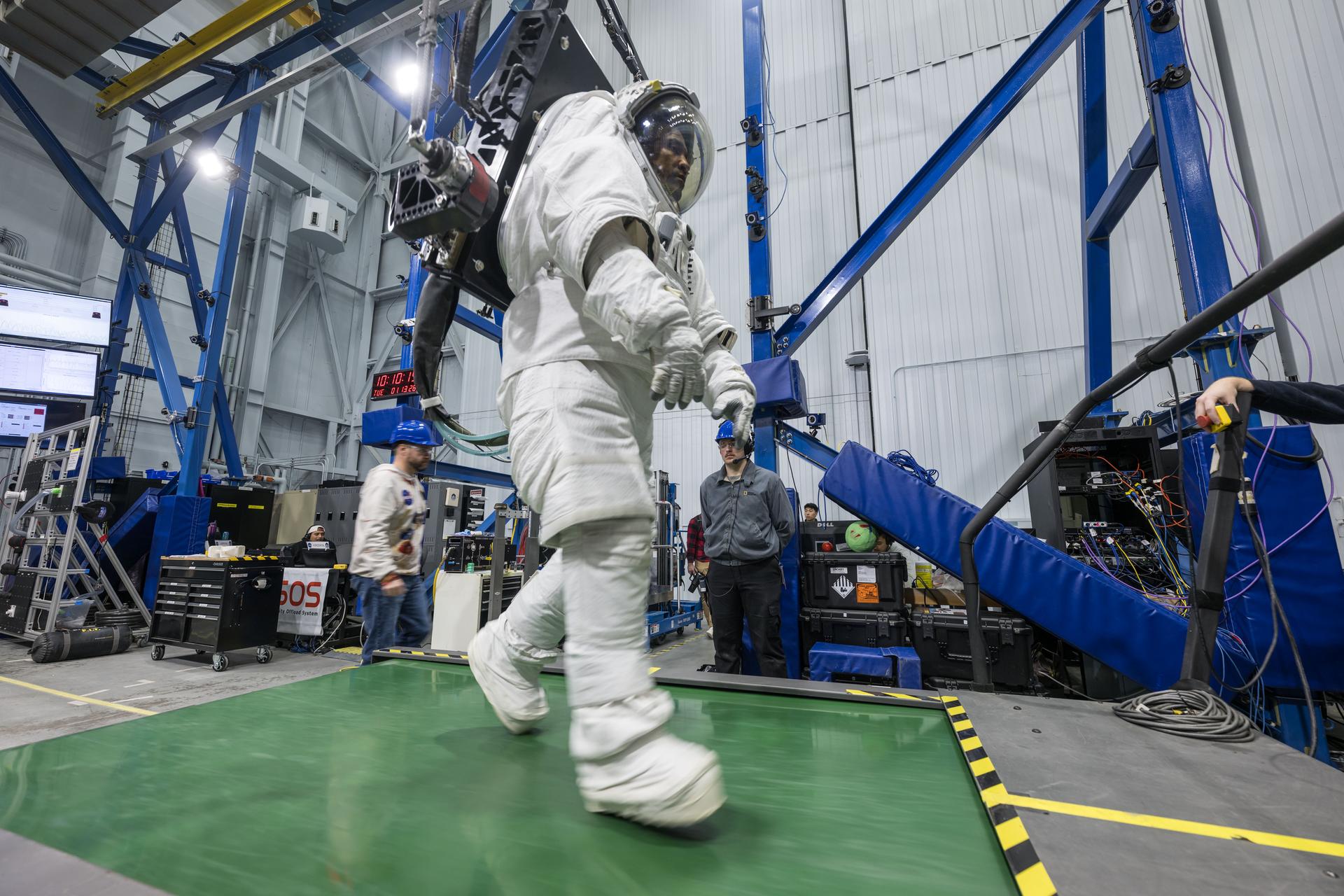
Artemis II astronaut Victor Glover walks on a treadmill while in a space suit harnessed to NASA’s Active Response Gravity Offload System at NASA’s Johnson Space Center. Glover is simulating a walk on a planetary surface while in a suit that has been offloaded to lunar gravity. Artemis II astronauts completed this and other suited tasks before their mission launched and within a few days of landing, giving researchers a chance to assess how quickly upon landing crews’ bodies adapt to a different gravity. Results will help scientists better understand how soon after landing crews can complete mission-critical tasks on the surface of the Moon or Mars.
NASA/Robert Markowitz
Since NASA’s Artemis II crew members safely splashed down in the Pacific Ocean on April 10 after their record-setting mission around the Moon, science teams have been busy collecting more data and combing through observations collected on the test flight. Results from these science investigations will help support safe human exploration of deep space and provide a blueprint for how future missions will conduct science on the lunar surface as NASA builds a Moon Base and develops an enduring human presence there.
Postflight crew health, performance data
In the hours, days, and weeks after landing, the Artemis II crew members, NASA astronauts Reid Wiseman, Victor Glover, Christina Koch, and CSA (Canadian Space Agency) astronaut Jeremy Hansen, contributed critical data to help the agency understand how the human body reacts to spaceflight. Collecting this data as soon as possible after landing was important to understand how the body adapts from microgravity to Earth’s gravity. The data will inform NASA’s understanding of how quickly crews can complete mission-critical tasks after landing on a planetary surface like the Moon or Mars, where there won’t be landing support personnel to assist.
Within a day of splashdown, researchers collected a suite of data for the Artemis II Spaceflight Standard Measures study, which is part of a larger effort across the astronaut corps to gather a baseline set of health measurements on blood pressure, heart rate, eye health, and motor control. Crew members also completed a mini obstacle course, which included lying down, standing up, unfurling a rope ladder, ladder climbing, and more, to assess how their bodies were adapting to Earth’s gravity.
Once the crew returned to NASA’s Johnson Space Center in Houston, researchers guided them through further medical check-ups and tests of motor control. Over the next several days, the crew completed obstacle courses wearing spacesuits offloaded to lunar gravity, which is roughly one-sixth the force of Earth’s gravity. Researchers are now analyzing this data to gain insight into how crews may perform as they adapt to the gravity of a planetary surface.
As part of the Immune Biomarkers study, researchers are comparing blood and saliva samples collected after the Artemis II splashdown with samples collected preflight and during the mission. Among other topics, the study investigates whether and how dormant viruses reawaken in astronauts’ bodies while in space.
Some crew members completed postflight cognition tests and a simulated manual spacecraft docking task to assess motor control for the ARCHeR (Artemis Research for Crew Health & Readiness) study. This, combined with data collected through a wrist-worn device while crew members were in space, is used to understand the effect of space hazards on well-being and performance.
Initial data collections for Artemis II health studies concluded 45 days after splashdown. However, medical teams will continually monitor astronaut health throughout the Artemis II crew members’ lifetimes.
Once this data is processed and anonymized, information will be available for scientists to study the effects of spaceflight via a request to NASA’s Life Sciences Data Archive. The results from this work could lead to new technologies and studies that help predict the adaptability of crews on future missions to the Moon and Mars.
Analyzing astronaut-derived organ chips flown around Moon
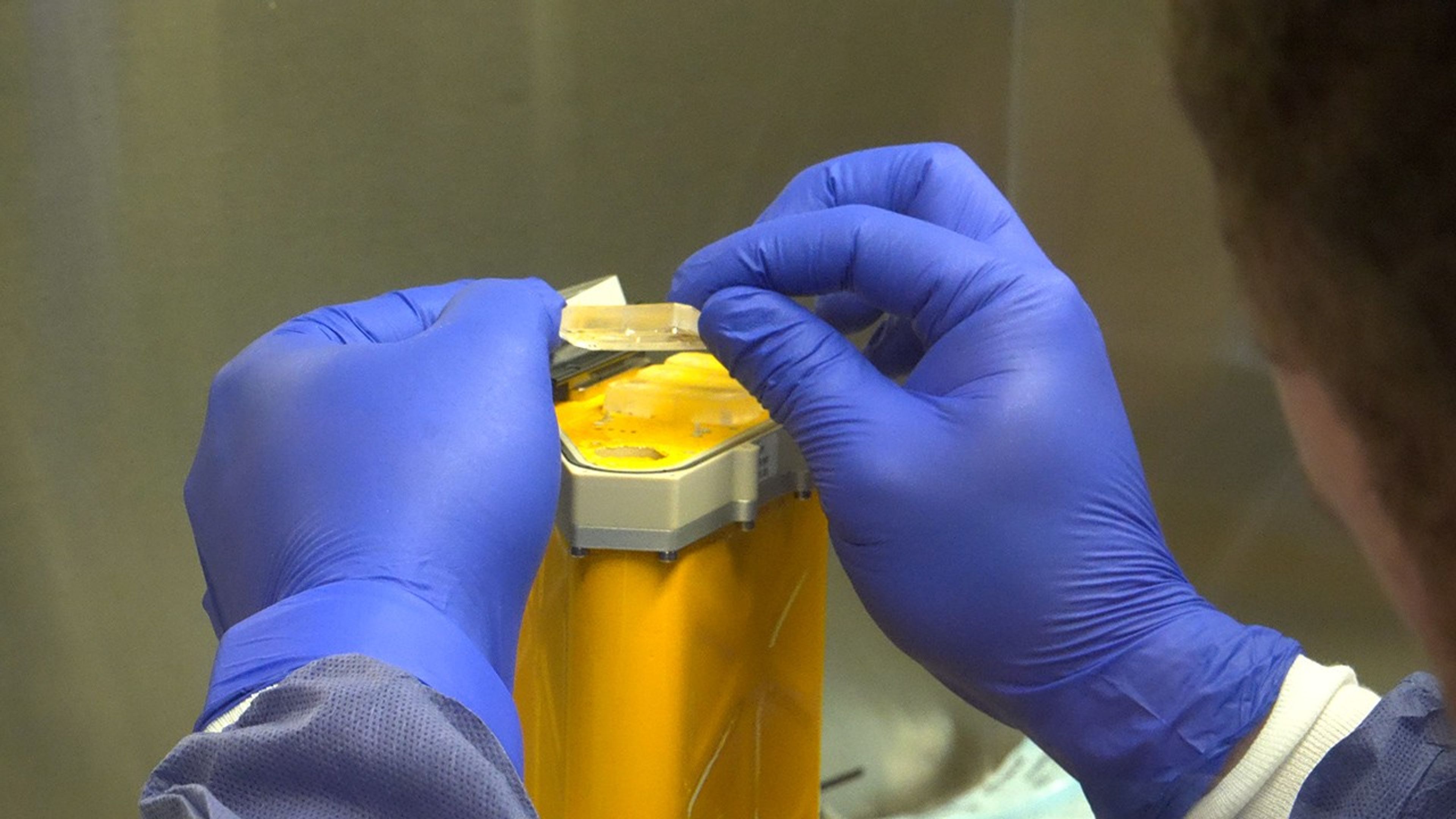
A scientist handles AVATAR organ chips following their journey around the Moon aboard Orion. The chips contain cells from each astronaut and are being prepared for detailed analysis.
NASA
Organ chips from NASA’s AVATAR (A Virtual Astronaut Tissue Analog Response) investigation are being analyzed at chip developer Emulate’s laboratory in Boston. The organ chips included bone marrow cells from each Artemis II astronaut. They flew around the Moon with the astronauts, and now researchers are studying these organ chips to determine how deep space radiation and microgravity affect human health at the molecular level.
Scientists are comparing the chips flown aboard the spacecraft to ground controls and crew blood samples using advanced techniques, including single-cell RNA sequencing. The analysis will characterize how organ chips model individual responses to spaceflight, which is data that could allow NASA to send future astronauts’ AVATAR chips ahead on missions to develop personalized medical kits. The researchers plan to share early findings at scientific conferences while full analysis continues.
Lunar imagery, audio for data release
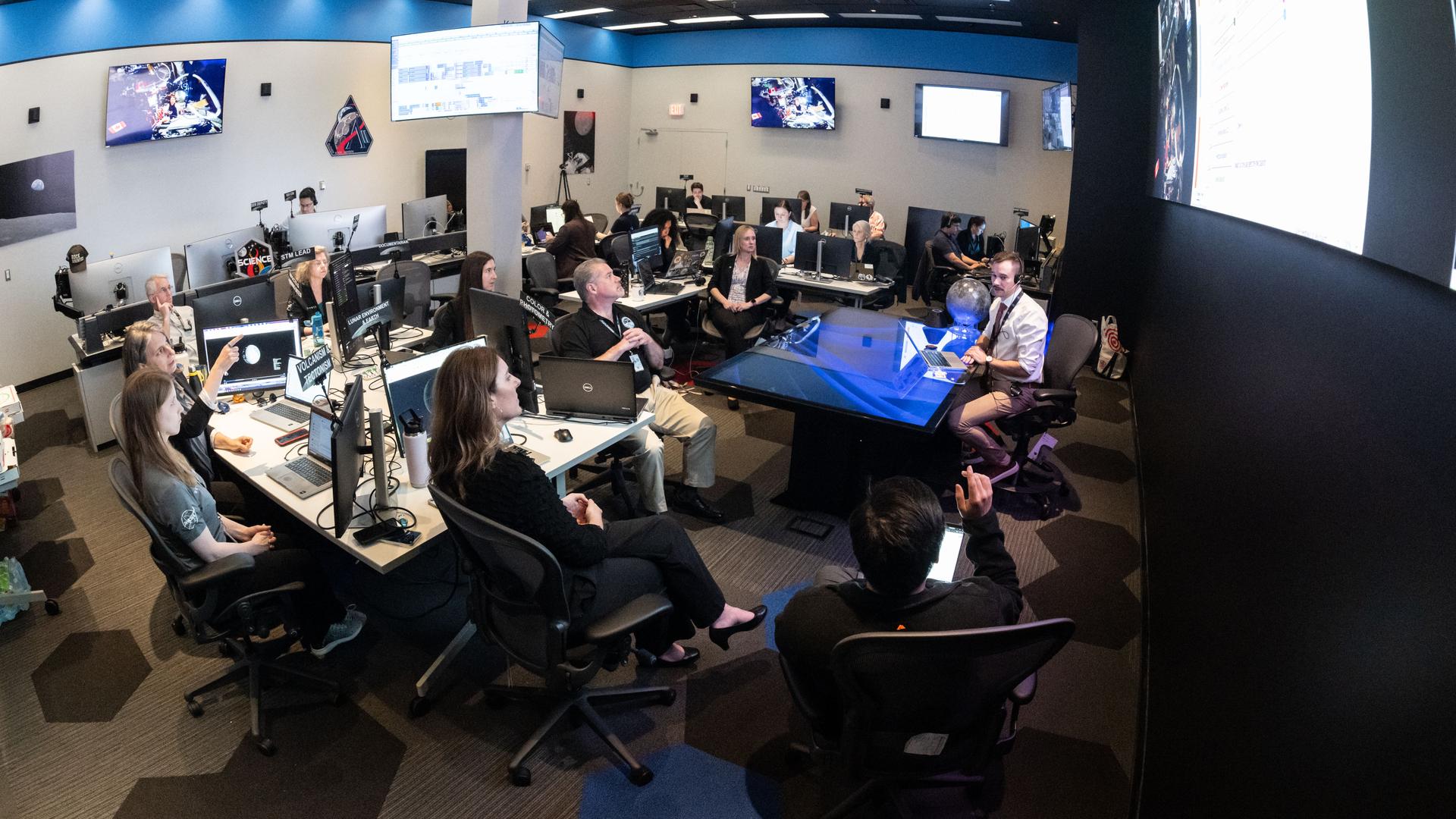
In this April 3, 2026, image, the Artemis II lunar science team is shown working in the Science Evaluation Room in the Mission Control Center at NASA’s Johnson Space Center in Houston. The team is putting together a plan of science observations for the Artemis II crew, which was headed toward the Moon aboard Orion. As they passed the Moon at closest approach on April 6, the crew applied the geology skills they learned in the classroom and in Moon-like environments on Earth as they photographed and described nuances of geologic features such as impact craters, ancient lava flows, and surface cracks and ridges. The crew noted differences in color, brightness, and texture — details that provide clues to surface composition and history.
NASA/Bill Stafford
On April 6, the Artemis II crew members studied features on and around the Moon for nearly seven hours during Orion’s closest approach to the lunar surface. Their work was guided by a minute-by-minute observation plan developed by the Artemis II lunar science team.
Scientists are reviewing the data collected from the mission, which includes images, video, and audio files, to release a report of their initial data interpretations later this year. The report will cover observations of impact flashes, variations in color on the lunar surface, and the shape and texture of faults and ridges. The team also will publish a report on how Artemis II lunar science observations were planned, organized, and executed for the benefit of future Artemis missions.
NASA will publish more than 100 science-related audio recordings with transcripts, as well as approximately 11,500 Earth and Moon image and video files from the mission science campaign, with accompanying data. While many of these images already are public, these records will be available through NASA’s Planetary Data System, a public archive of data from all of NASA’s planetary missions. To get the data ready, the team is converting files into standard formats that anyone can easily open and add information to make the data searchable in NASA’s archive for generations to come.
For more information on NASA’s Artemis II science efforts, visit:
Pour cette semaine du 1er juin : Une IA armée d'un laser s'attaque aux moustiques tigres, des micro-diamants révèlent l'existence d'une planète disparue, les épices de votre placard pourraient transformer votre santé, le mystère du dernier repas d'Ötzi refait surface 5 000 ans plus tard, et un...
Climate-Only Models Likely Underestimate Species Extinction, Study Finds To accurately predict species’ distributions and risk of extinction, models must include more than just climate, according to new UArizona research. Mikayla Mace Kelley Today University Communications 7441156692_edfdac8bbf_b.jpg Piñon pine forests near Los Alamos, N.M., had already begun to turn brown from drought stress in the image […]
Scouting Ancient Supermassive Black Holes A team of researchers led by University of Arizona astronomers will use NASA’s James Webb Space Telescope to examine three active supermassive black holes, their host galaxies and their neighborhoods to better detail these distant objects and the conditions of the early universe. University Communicationss and Space Telecope Science Institute […]
Vaccines, Asteroids and Puppies: The Top UArizona Stories of 2021 From tracking the origins of the COVID-19 pandemic, to learning how puppies communicate, University of Arizona expertise in a variety of fields made international headlines in 2021. Today University Communications 2021.jpg Business and Law Campus News Health Science and Technology Social Sciences and Education Adaptation […]
Les carnets de tatouages d’Alexandre Lacassagne, pionnier de la médecine légale, ont été retrouvés, restaurés et dévoilés par l’Université Lyon 1. Ils sont consultables en ligne sur Gallica ( BnF).

 Login