❌

Normal view

Detecting New Icy Molecules Around a Newly Forming Star with JWST

31 March 2026 at 17:00

Large Magellanic Cloud

Editor’s Note: Astrobites is a graduate-student-run organization that digests astrophysical literature for undergraduate students. As part of the partnership between the AAS and astrobites, we occasionally repost astrobites content here at AAS Nova. We hope you enjoy this post from astrobites; the original can be viewed at astrobites.org.

Title: Protostars at Subsolar Metallicity: First Detection of Large Solid-State Complex Organic Molecules in the Large Magellanic Cloud
Authors: Marta SewiΕ‚o et al.
First Author’s Institution: NASA Goddard Space Flight Center
Status: Published in ApJL

Stars and planets form when clouds of molecules collapse in on themselves due to the overwhelming force of gravity (which, relatable). This process is quite mysterious, as these clouds will only live for a couple million years before collapsing, and the newly forming protostars only live for about half a million years before becoming main-sequence stars.

But we are able to find some protostars in the Milky Way and in the Small and Large Magellanic Clouds near us, and observing the molecules around these protostars can help us understand how protostars form.

To look for molecules around protostars, astronomers take spectra of the protostars in the infrared, which is a wavelength region where molecules emit a lot of light. As better instruments are being built, astronomers are more often able to look for what are called complex organic molecules, which are carbon-bearing molecules with at least six atoms.

These complex organic molecules can be detected in different states: most detections have been of gaseous molecules in and around protostars or planet-forming disks, but they can also be found in a solid state on the surfaces of dust grains in the interstellar medium in a galaxy. In this state, they are called complex organic molecule β€œices.” These β€œices” were rarely found pre-JWST, but since its launch, detections have been more numerous, mainly in the Milky Way. Observing these complex molecules on the surfaces of dust grains tells us more about protostellar dust chemistry, which is an important but still mysterious aspect of star formation.

In this study, researchers look outside of our own galaxy to explore the complex organic molecules in the Large Magellanic Cloud (LMC). The LMC is an interesting place to look for these molecules because it has lower metal content (i.e., elements heavier than hydrogen and helium) than the Milky Way, as well as a harder radiation field. This means photons flying around in the LMC generally have higher energies than photons flying around in the Milky Way, and elements like carbon, oxygen, and nitrogen are less abundant. This is important because these conditions are more similar to what typical galaxies were like in the early universe. Thus the LMC is a better test bed to look at protostars than the Milky Way if we want to understand how stars formed in the early universe.

The authors of this study have found signatures of complex organic molecules in protostars forming in the LMC. They focus on the protostar ST6 in the LMC, shown in the right image in Figure 1. They used JWST’s Mid-Infrared Instrument to take spectra of the region around ST6.

Large Magellanic Cloud and N158

Figure 1: The LMC (left) and a zoomed-in view of region N158 (right) containing protostar ST6, the focus of this study. In the inset panel of the right picture, contours of carbon monoxide emission are shown. [SewiΕ‚o et al. 2025]

Spectroscopic Signatures of Molecules on Dust Grains

The researchers used the Python tool called dEcompositioN of Infrared Ice features using Genetic Modelling Algorithms (ENIIGMA) to fit the spectroscopy. This code compares the spectra to laboratory data of these complex organic molecules at the temperatures we see in the LMC. The authors fit for complex organic molecules they might expect to see, and they detect methanol (CH3OH), acetaldehyde (CH3CHO), ethanol (CH3CH2OH), methyl formate (HCOOCH3), and acetic acid (CH3COOH); of these, acetaldehyde, ethanol, and methyl formate have never before been detected outside of the Milky Way. Interestingly, this is the first time acetic acid has been definitively detected in any astrophysical environment. The spectral contribution from each molecule is shown in Figure 2; all the individual contributions added together make up the observed spectrum.

spectrum of the protostar ST6

Figure 2: Model fits to the spectrum of the protostar ST6 using the code ENIIGMA. Molecules and their fitted emission are given in the legend. [SewiΕ‚o et al. 2025]

These detections provide evidence that these complex organic molecules can be produced on the surfaces of dust grains. Further, their detection in the LMC provides evidence that these molecules can be produced in β€œharsh” environments like the LMC, with lower metal content and harder radiation fields.

When the authors compared the abundances of these ices to other protostars in the Milky Way galaxy, they found that the abundances are slightly lower around the LMC protostar. This may happen because the dust temperatures are generally higher in the LMC due to the higher-energy photons, which affect the chemistry happening on the dust. Some species they found, however, do have similar abundances to the Milky Way protostars, indicating that the harder radiation field of the LMC does not affect how these species form. Finding more complex organic molecules in the Magellanic Clouds will help us understand further how these compounds form on dust grains and how the galactic environment may affect their formation.

Original astrobite edited by Shalini Kurinchi-Vendhan.

About the author, Caroline von Raesfeld:

I’m a third-year PhD student at Northwestern University. My research explores how we can better understand high-redshift galaxy spectra using observations and modeling. In my free time, I love to read, write, and learn about history.

The post Detecting New Icy Molecules Around a Newly Forming Star with JWST appeared first on AAS Nova.
Mapping a Molecular Building Block in a Pre-Stellar Core

13 February 2026 at 17:00

Taurus Molecular Cloud

To probe the chemistry of cold pre-stellar cores, researchers investigated Lynds 1544 and made the first-ever spatially resolved map of methanimine β€” a simple molecule that may be involved in the formation of amino acids in space β€” in this environment.

Astrochemistry at Work

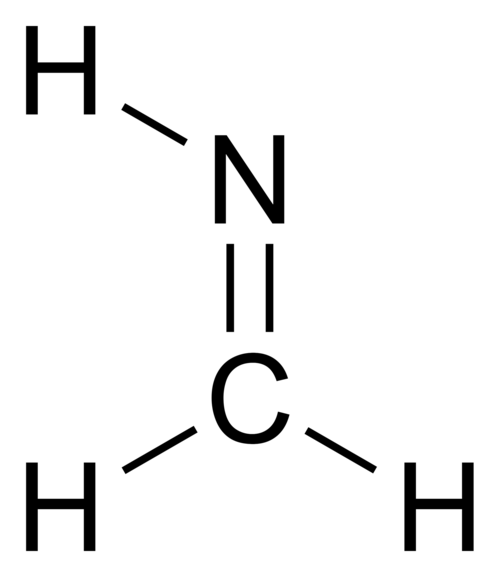
chemical structure of methanimine

The chemical structure of methanimine, CH2NH. [Ben Mills]

Peering across the galaxy, astronomers have discovered a broad and growing array of molecules, revealing the rich chemistry taking place everywhere from molecular clouds to protoplanetary disks. A central question in astrochemistry is where, when, and how molecules form in space, and how molecules might survive the various phases of star formation and be incorporated into newborn planetary systems, where they could play a role in the construction of complex organic molecules necessary for life.

Today’s research article, led by Yuxin Lin (Max Planck Institute for Extraterrestrial Physics), focuses on a molecule called methanimine (CH2NH). CH2NH is the simplest molecule in a class of nitrogen-containing compounds called imines, and it’s thought to be an important stepping-stone in the creation of amino acids.

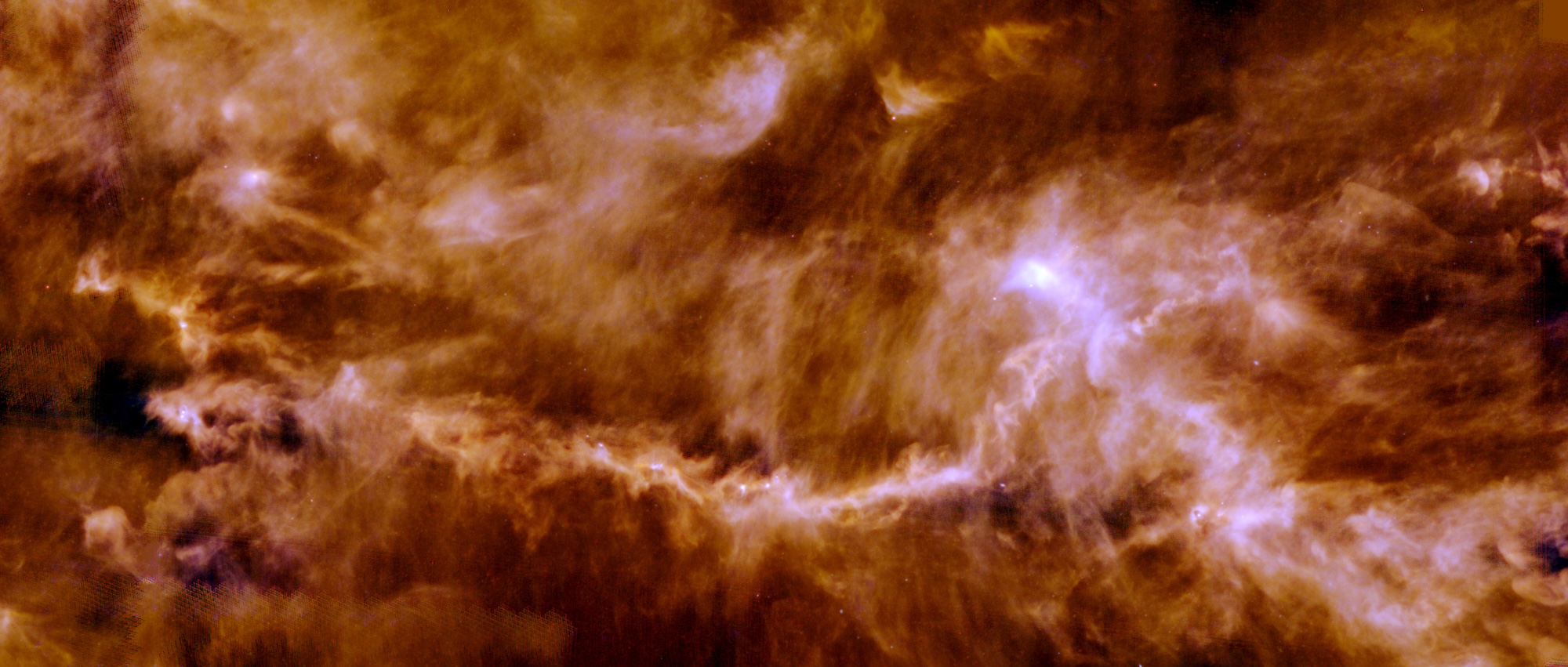
Taurus Molecular Cloud

A Herschel Space Observatory view of the Taurus Molecular Cloud, where L1544 resides. This star-forming region is about 450 light-years away. [ESA/Herschel/PACS, SPIRE/Gould Belt survey Key Programme/Palmeirim et al. 2013]

First Spatially Resolved Map

Lin and collaborators searched for CH2NH within Lynds 1544 (L1544), a pre-stellar core in the nearby Taurus Molecular Cloud. Pre-stellar cores β€” condensed, gravitationally bound clumps of cold gas within a molecular cloud β€” represent an early stage in the process of star formation, just before the gas collapses to form a protostar.

L1544 has been the subject of many astrochemical investigations, and previous studies have revealed that it contains a complex, chemically differentiated envelope surrounding a dense core in which many chemical species have frozen out onto dust grains, leaving the gas depleted of these species.

Using the Institute for Radio Astronomy in the Millimetre Range 30-meter radio telescope, Lin’s team mapped the distribution of CH2NH across L1544. This isn’t the first time that CH2NH has been detected in a cold pre-stellar core, but it’s the first time that the molecule has been mapped in a spatially resolved way in such an environment. This allows researchers to compare the distribution of CH2NH to other molecules in the core and build an understanding of the chemistry behind its formation.

The Chemistry of CH2NH

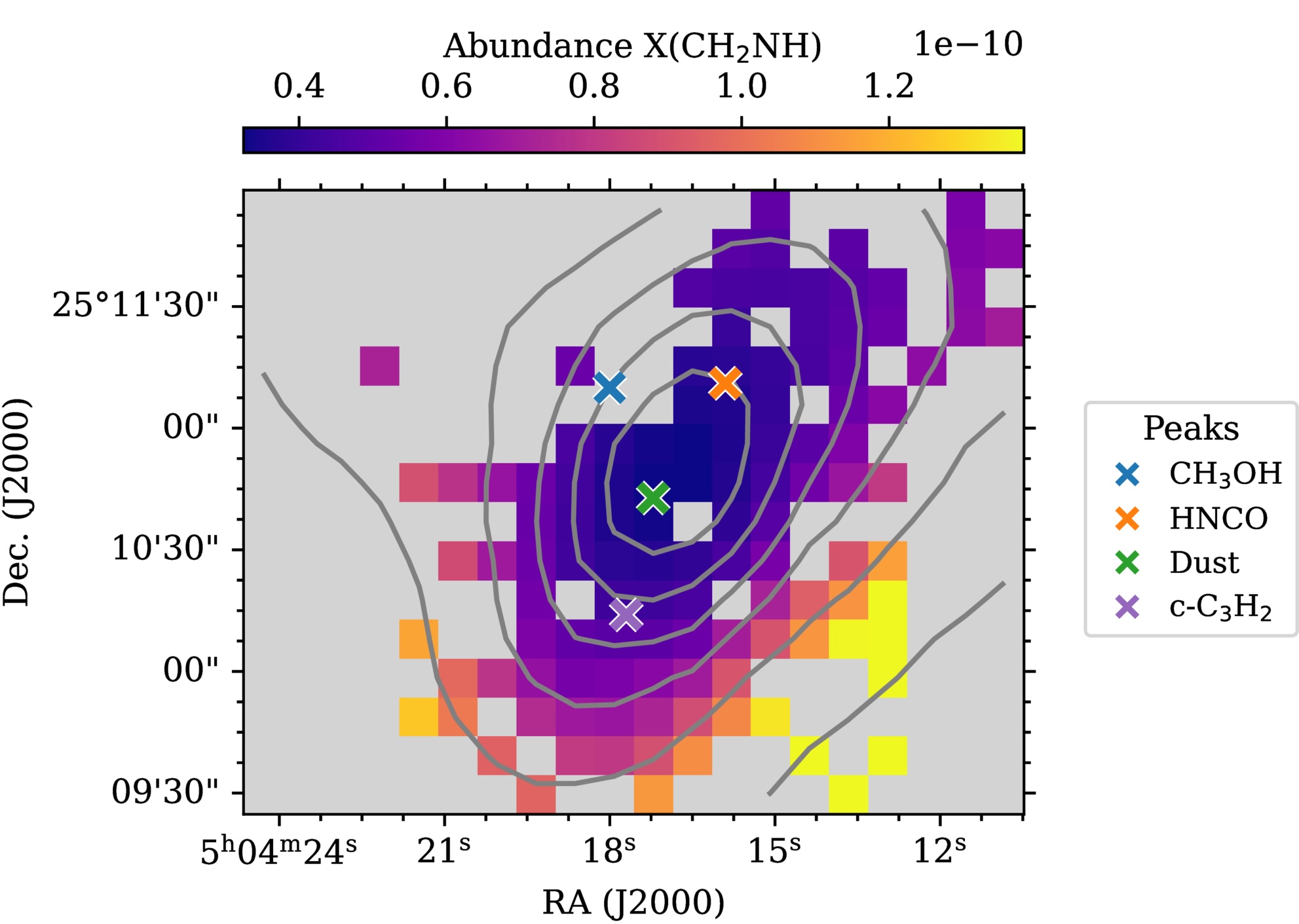
abundance of methanimine in L1544

Abundance of CH2NH in L1544. The contours indicate the column density of molecular hydrogen. The crosses show where the emission from other chemical species is at its peak. Click to enlarge. [Adapted from Lin et al. 2026]

The new observations show that CH2NH can be found throughout L1544, with clear spatial trends in the molecule’s abundance: higher near the outer layers of the core, lower near the center. Using chemical models to aid their analysis, Lin’s team showed that the observed distribution suggests formation pathways driven by moderate amounts of ultraviolet radiation.

In the outer layers of the core, where the gas is less dense, ultraviolet light creates reactive chemical species called radicals that can spur the formation of CH2NH. In the interior of the core, dense gas prevents the incursion of ultraviolet light. This means that few radicals are created that can help form CH2NH molecules, and the molecules that do form tend to freeze out onto dust grains, disappearing from the gas.

The discovery of CH2NH throughout L1544 suggests that the precursors to complex organic molecules can form during the cold, calm pre-stellar core phase of star formation, allowing these molecules to be inherited by nascent planetary systems.

Citation

β€œFirst Mapping of Prebiotic Molecule CH2NH in a Prestellar Core,” Yuxin Lin et al 2026 ApJL 996 L32. doi:10.3847/2041-8213/ae2c76

The post Mapping a Molecular Building Block in a Pre-Stellar Core appeared first on AAS Nova.

Chemists Capture a Bizarre Molecular Structure Never Seen Before

Crystalline Metallocene DerivativesScientists caught a famous β€œsandwich” molecule in a rare hidden state, uncovering a long-missing step in its formation. For more than 70 years, metallocenes have been among the most important molecules in organometallic chemistry. These compounds feature a metal atom positioned between two carbon-based rings, creating a structure often described as a molecular sandwich. They [...]

A Surprising Discovery Inside Fish Could Change What We Know About the Ocean

Gulf Toadfish (Opsanus beta)Scientists have uncovered evidence that tiny microbes living inside fish may be helping shape the chemistry of the world’s oceans. The new study, led by former graduate student Anthony Bonacolta at the University of Miami Rosenstiel School of Marine, Atmospheric, and Earth Science, suggests that bacteria in fish intestines may work together with their hosts [...]

Scientists Crack Major Ammonia Problem With a Platinum Catalyst Breakthrough

Platinum Catalyst Lights AmmoniaA newly engineered catalyst overcomes key obstacles that have long limited ammonia as a clean fuel for heavy industry. A newly developed single-atom platinum catalyst can ignite ammonia at about 200Β°C (392Β°F) and sustain stable combustion at 1,100Β°C (2,012Β°F) while producing very little NOx. The breakthrough could provide carbon-free, high-grade heat for industries such as [...]

Beans use an immune receptor to call in airstrikes on caterpillars

3 June 2026 at 12:15

For decades, scientists have understood that plants can release volatile organic compoundsβ€”essentially airborne chemical signalsβ€”to attract the natural enemies of the things that eat them, like caterpillars. What we didn’t know was exactly how a plant translates the physical act of being eaten into a specific, predator-summoning distress signal.

β€œ[One] thing we didn’t know is how the plant detects the caterpillar in the first place,” says Adam Steinbrenner, a biologist at the University of Washington. Now, after years of experimenting with common bean plants in the lab and in the agricultural fields of Oaxaca, Mexico, Steinbrenner’s team pinpointed a single immune receptor that orchestrates its anti-caterpillar defense system.

Drooling caterpillars

When an herbivorous insect like a caterpillar feeds on a plant, it introduces its saliva straight into the plant's damaged tissues. This saliva contains biological clues called HAMPs: herbivore-associated molecular patterns. One of the HAMPs molecules is a peptide called inceptin, and there’s an 11-amino acid fragment of inceptin named In11, as well. Both of them turn out to be a fragment of the ATP synthase found in chloroplastsβ€”basically a piece of one of the plant’s own proteins. As the caterpillar ingests the leaf, its gut enzymes chop up the plant's cellular engines and their pieces, including In11, are regurgitated back onto the leaf’s surface, albeit at extremely small concentrations.

Read full article

Comments

Β© mikroman6

The β€œProject Hail Mary” Plot Needs Much More Than a β€œHail Mary”

19 May 2026 at 01:59
I review the story "Project Hail Mary" by Andy Weir and the 2026 film. As science it is fundamentally flawed. Life is assumed to have evolved along a line different to the biochemistry we find on Earth. But that is the problem. Life on Earth could only come from an Intelligent Creator.

Origin of Life | Coded Information from Space?

31 October 2025 at 21:49
Satan's rebellion has led humanity to believe in false origins of life, such as abiogenesis and panspermia, instead of a divine Creator. I critique the scientific community's efforts to explain life without acknowledging supernatural creation, asserting the biblical viewpoint that true life and intelligence can only stem from God.

A Chilling Warning from Brussels | The Foundational Flaw in mRNA Technology That the Public was Never Told

23 October 2025 at 23:05
At the launch of "Make Europe Healthy Again," researcher Panagis Polykretis highlighted a critical issue with mRNA vaccines, asserting that they enable an immune attack on the body’s own cells, leading to severe adverse effects like myocarditis. He called for accountability and urgent safety studies amid rising health crises linked to the vaccines.

Signature of Alien Life β€˜Found’ on a Planet 124 Light-Years from Earth

An article claims scientists found evidence of biological activity on exoplanet K2-18b, citing detected molecules linked to microbial life. However, this overstates findings, because some other chemical processes may explain the results. The inordinate desire to find extraterrestrial life reflects a rejection of the Creator.

Can AI Ever Be Sentient?

John McCarthy, a significant figure in artificial intelligence, coined the term during the 1956 Dartmouth conference, aiming to develop machines that could simulate human intelligence. He proposed key aspects of AI, questioning its potential sentience. I argue that true sentience originates from a divine Creator, not from machines.

The Link Between Vaccines and Rising Autism Rates

2 April 2025 at 01:16
The increasing number of vaccinations correlates with rising autism rates in Western nations, raising concerns about vaccine safety. Despite scientific retractions, the link between vaccines and autism has been shown but few studies have evaluated the broader vaccine program's impact, leaving a significant knowledge gap.

The Physics of Creation | Day 3

13 January 2025 at 22:00
Day 3 of creation, God formed dry land and initiated life with green plants, establishing essential conditions for future sentient life forms. This day also included the formation of Earth's physical structures. All creations were designed perfectly, paving the way for environmental balance and the development of biodiversity.

Is Earth Unique? The Case Against Extra-Terrestrial Life

9 January 2025 at 22:05
The Search for Extra-Terrestrial Intelligence (SETI) program has yielded no evidence of intelligent life beyond Earth, raising questions about life’s uniqueness to our planet. Critics claim SETI lacks empirical support and resembles ufology. The author argues that life is a divine creation, asserting evolution cannot account for life's origin or complexity.

Have Aliens Already Terraformed Other Planets?

6 January 2025 at 22:13
A research paper proposes that advanced alien civilizations might be terraforming planets and spreading life through panspermia. It suggests that similarities among clustered planets could indicate extraterrestrial life, while acknowledging the challenges in detecting such life. This approach sidesteps the fundamental questions of life's origins.

Healing Skin Cancer with Milkweed | God’s Provision Against the Curse

24 December 2024 at 02:53
God cursed the creation which led to the emergence of diseases like cancer. But He also provided treatments for some of those diseases. Euphorbia peplus is such a plant, which is traditionally used to treat skin cancers. It is one natural remedy available from the weeds of the cursed creation.

Hydrocarbons in the Solar System | Implications for Extraterrestrial Life

19 December 2024 at 21:38
Hydrocarbons are primordial in the solar system, not merely fossilized remnants. Their presence on moons like Enceladus and Titan raises the possibility of extraterrestrial life. However, organic molecules alone do not confirm life, which relies on specific information encoding beyond mere chemical arrangements.

Cow Farts, Methane and Meat

6 December 2024 at 05:35
Public concern has surged over the food additive 3-nitrooxypropanol (3-NOP), used in cattle feed to reduce methane emissions. Critics claim this approach could lead to widespread cattle culling and a shift towards synthetic food production. Allegations link it to health risks, corporate interests, and a broader agenda against traditional agriculture.

❌