
❌

Normal view

NASA launches Nancy Grace Roman Space Telescope to shed light on the dark universe

1 September 2026 at 13:43

NASA has successfully launched the $4.3bn Nancy Grace Roman Space Telescope. The observatory took off atop a SpaceX Falcon Heavy rocket from Florida’s Kennedy Space Center at 7.26 a.m. local time on 30 August. The craft will now spend three months travelling to a point in space known as the second Sun–Earth Lagrange point (L2) where it will survey space with a field of view at least 100 times greater than the Hubble Space Telescope.

From L2, which lies about 1.6 million kilometres from Earth, the Nancy Grace Roman Space Telescope will yield insights into dark energy and dark matter, discover and characterize exoplanets, map billions of galaxies, and gain fresh understanding of black holes.

It will do so via a 2.4 m primary mirror that is accompanied by two instruments: a wide-field instrument will obtain images in visible and near-infrared light, while an experimental coronagraph will use masks, prisms and mirrors to cancel out the light from stars to help detect exoplanets.

“Roman will be a discovery machine that will bring us closer than ever before to answering humanity’s most profound questions about our cosmic history,” notes Nicola Fox, associate director for NASA’s Science Mission Directorate.

NASA intends the observatory to operate for at least a decade, with three specific surveys planned for its initial five years. The first will identify tens of thousands of distant supernovae, many more than the 2000 currently known, while a second survey will observe more than a billion galaxies.

Both these sets of measurements, combined with data from other survey telescopes, will be used to improve our understanding of dark energy and its potential role in the speed at which the universe expands. Their observations of gravitational lensing will also allow astronomers to map dark matter.

A third survey, meanwhile, will search the centre of the Milky Way for signs of gravitational microlensing that will reveal more than 2000 otherwise invisible exoplanets.
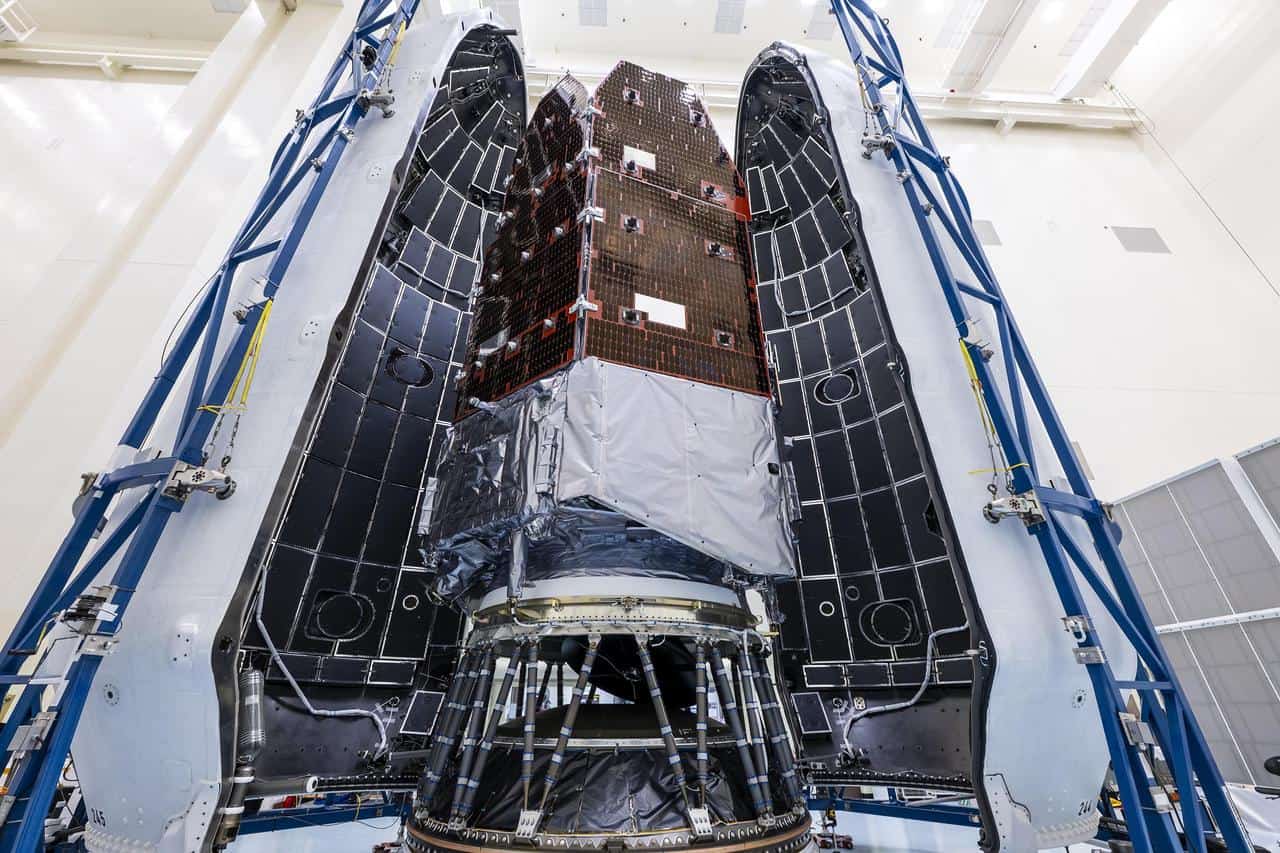
The Nancy Grace Roman Space Telescope
Space surveyor: the observatory will yield insights into dark energy and dark matter, study exoplanets, map billions of galaxies and to gain fresh understanding of black holes. (Courtesy: SpaceX)

Mother Hubble

The observatory was initially known as the Wide-Field Infrared Survey Telescope before it underwent several design changes due to cost pressures. In 2020 it was then renamed after Nancy Grace Roman (1925–2018), who in the early 1960s became NASA’s first chief astronomer and is known as “the mother of the Hubble Space Telescope”.

Yet the Roman observatory won’t replace Hubble or the James Webb Space Telescope, rather it will complement them, providing data from wide areas of the universe that those two instruments will then be able to observe in greater detail.

Indeed, Roman will survey the universe a thousand times faster than the Hubble, creating 1.4 billion terabytes (1.4 zettabytes) of information daily – the highest data rate of any NASA astrophysics mission.

NASA says that machine learning, artificial intelligence and “citizen science” will be used to help sift through the data and flag findings that astronomers will then study.

NASA administrator Jared Isaacman praised the mission as “exactly the kind of success story we want to see”. He noted that it was completed “ahead of schedule and on budget”, adding that it “will demonstrate what is possible when America’s space programme pairs bold ambition with disciplined execution”.

The post NASA launches Nancy Grace Roman Space Telescope to shed light on the dark universe appeared first on Physics World.

US orders universities to audit foreign research ties

26 August 2026 at 14:11

The US Department of Defense (DoD) has given 30 US research universities until the end of the month to audit, and potentially cease, their partnerships with universities and military training institutions in “foreign entities of concern”.

If the institutions do not comply with the order, they risk losing funding from the Defense Advanced Research Projects Agency, the Office of Naval Research, and the Air Force Research Laboratory – losses that could potentially close entire academic research groups or departments.

The order does not specify the foreign entities it targets. But a list that the DoD published last month identified 130 universities and research institutes in China, Russia and Iran that it claimed to be wrongly appropriating US-funded technologies.

The DoD, which the Trump administration calls the Department of War, also noted that its order applies to “organizations associated with rebranded Confucius Institutes” – cultural programmes associated with US universities that began in 2004.

The DoD asserts that the audit process is designed “to protect American taxpayer-funded research investments from unauthorized technology transfer, intellectual property theft and adversarial exploitation” adding that it will allow the department to “better anticipate emerging threats, adapt to evolving adversarial tactics and maintain America’s position as a global leader in innovation”.

“The Department of War has zero tolerance for academic partnerships that compromise our national security,” notes Emil Michael, the DoD’s undersecretary of war for research and engineering. “Institutions that receive funding from American taxpayers must uphold the highest standards of research security, and these mandated audits will ensure accountability across the board.”

China tension

Those affected by the order include Harvard University, Massachusetts Institute of Technology, Cornell University and Johns Hopkins University.

The DoD has not indicated why it has chosen the 30 targets for audit. However, since it took office last year the second Trump administration has criticized prominent universities over issues such as antisemitism and their use of diversity, equity and inclusion.

Harvard has received particular ire from the administration, which has cut or delayed government grants to its departments while fighting the university in court.

A Republican majority House of Representatives committee issued a report on 13 August claiming that Harvard received over $630m from Chinese sources. The report also noted that the university had created a nonprofit organization, Harvard Global, to accept overseas grants that the university itself is not legally permitted to receive.

The DoD’s audit comes as the Trump administration prepares to welcome President Xi Jinping to the US late next month.

Reacting to the order, a statement by China’s embassy in Washington notes that it opposes what it calls the politicization of normal scientific, educational, and academic exchanges. “The US side should abandon the Cold War mentality and foster an open, fair, and non-discriminatory environment for educational, scientific, and people-to-people exchanges between China and the United States,” it declared.

Physics World contacted some of the universities affected by the order but did not receive a response.

The post US orders universities to audit foreign research ties appeared first on Physics World.

Critics deride US administration’s ‘golden age of science’ report

5 August 2026 at 11:42

A new report by the Trump administration that outlines a model for the future government support for science and technology has drawn heavy criticism from the US scientific community. Entitled Science: A New Golden Age, it emphasizes developments by public–private partnerships at the expense of university-driven research with critics asserting it places politics above science.

The 104-page report aims to update a 1945 document – Science, the Endless Frontier – that was issued by Vannevar Bush, who served as director of the US government’s Office of Scientific Research and Development in the 1940s. The report eventually led to creation of the National Science Foundation (NSF) in 1950.

The 2026 report focuses on how government R&D spending reaches the scientific community and claims that the US research enterprise has become too centred on established research institutions rather than individual researchers.

The report wants the government to significantly reduce the amount and number of grants it gives universities and instead make large investments in industry and non-profits. It also calls for a significantly scale-up of the use of artificial intelligence in science.

“We must renew the R&D enterprise on which our scientific leadership depends,” US science adviser Michael Kratsios and Office of Management and Budget (OMB) director Russell Vought write in an accompanying memorandum.

Yet critics says that funding for exploratory science is not the administration’s only target. “It’s very clear that Kratsios/Trump want to destroy universities, or what he calls ‘legacy institutions’,” says public policy expert Shobita Parthasarathy from the University of Michigan. “There is no respect for basic research, which has historically driven innovation in the US [but that] industry won’t fund.”

Neal Lane, former US science adviser who served as NSF director between 1993 and 1998, takes issue with how individual agencies are asked to implement the points raised in the report. “Unlike previous rules, which were uniform guidance, allowing an agency like NSF to set their own rule, the new rule is a binding uniform regulation applying to all agencies as written,” he says.

Lane is also unhappy with the report’s dismissive approach to peer review, which it argues slows down innovation, proposing instead to diversify funding mechanisms with alternatives such as “golden tickets” rapid grants and prize challenges.

“For many decades, expert peer review has been regarded as the gold standard for funding research and publishing the results,” he says. “It is not credible for the administration to claim it supports ‘gold standard science’ without peer review.”

‘Misguided approach’

While some see merit in aspects of the report, or at least a need to rethink the underpinning of scientific research, the American Association of University Professors (AAUP) see the administration’s approach as a misguided way to address those challenges. “Reforms must strengthen scientific independence – not weaken it,” an AAUP statement asserts.

That view is echoed by the Federation of American Scientists (FAS), which note that while the report calls for a “lighter, faster, and more capable research enterprise”, it says that the to the “uniform guidance that governs how federal grant funding is administered runs counter to that goal”.

The report comes as the administration’s proposed budget for financial year 2027, which Congress must approve, would cut overall government spending on R&D by 22%, with support for the NSF slashed by more than 50%, NASA by 23% and the Department of Energy’s Office of Science by 15%. The OMB also proposes guidelines that would allow agencies to terminate grants that “no longer serve agency priorities or the national interest”.

Tess DeBlanc Knowles, a senior director at the US thinktank the Atlantic Council, says US science will be hit badly if those cuts go ahead. “No amount of experimentation can counteract the damaging effects that dramatically reduced funds will have on the foundation of the US’s scientific and technological leadership and ability to train the next generation of scientists,” she says.

  • A new report by the American Institute of Physics has found that physics and astronomy PhD graduates are quitting the US in record numbers. The proportion of non-US citizens leaving the US post-degree nearly doubled, from 16% in 2024 to 29% in 2025 – the largest one-year increase since 1997. The report also says about 12% of US citizens post-physics PhD left the US in 2025, compared to just 5% two years earlier.

The post Critics deride US administration’s ‘golden age of science’ report appeared first on Physics World.

Astronomers express outrage after regulators approve ‘space mirror’ permit

17 July 2026 at 15:30

Astronomers have raised concerns over a decision by the Federal Communications Commission (FCC) to permit the launch of a private satellite that can reflect sunlight onto the Earth’s surface after dark. Astronomers, however, fear that the mirror, and the several thousand that could follow it, will negatively impact both optical and radio astronomy.

The proposal by the Californian company Reflect Orbital involves putting a mirror-carrying-satellite – Eärendil-1 – into low-Earth orbit. Reflect Orbital aims to use the craft to test technology intended to deliver sunlight to solar farms after sunset, thus expanding the production of solar power at a time of peak demand for electricity.

In orbit, the satellite will unfold an 18 × 18 m aluminiumized Mylar reflector that can deliver a roughly 5 km circular spot of light to the ground with about the brightness of a full Moon.

In addition to providing solar power after dark, the company sees its technology as potentially effective for response to disasters, construction work and outdoor events at night.

Assuming Eärendil-1’s flight proves successful, the company plans to launch 1000 larger satellites in 2028, which would be able to reflect as much light as 100 full Moons with 5000 more satellites two years later.

The FCC has approved only the radio operations of “a single demonstration satellite [that is] an example of a potentially groundbreaking technology”. Other aspects of Eärendil-1, however, do not require official authorization.

Ben Nowak, chief executive and co-founder of Reflect Orbital, sees the licence as “the first step toward rigorously testing our technology’s efficacy and the safeguards we have developed”.

Flash points

Orbiting satellites’ impact on astronomy is hardly a new phenomenon. Their burgeoning number has already reduced observing times for optical astronomers, particularly after sunset.

Following the approval, the American Astronomical Society (AAS) has expressed “dismay” at the FCC’s decision. [Eärendil-1] carries the potential for significant harm to our members and the broader community of those who depend on a dark night sky,” the association says in a statement. “[This] could include damage to sensitive research equipment, potential flash-blinding of pilots and drivers, and potential permanent eye damage to anyone looking through a mid-sized telescope.”

While some satellite owners have been open to working with astronomers to reduce the impact on astronomy, astronomer Marcel Agüeros from Columbia University, who is also president of the AAS, told Physics World that Reflect Orbital “has been far less open” to discussing its plans. “We know nothing about the satellite’s orbit, for example,” adds Agüeros.

DarkSky International, a nonprofit organization that aims to preserve and protect the nighttime environment, has now called on the company to commission a “comprehensive, independent environmental impact assessment conducted by qualified experts”.

“The burden of proof rests with the operator to demonstrate that their system will not cause environmental or public harm, and a full, independent assessment is the necessary first step,” notes DarkSky International.

That move is backed by Agüeros, who adds that there doesn’t seem to have been much thought about the consequences of the FCC’s decision. “When you start to mess with the nighttime, there should be a very high bar you have to clear,” he adds. “We’re losing our ability to experience a dark sky – an experience that gives you a sense of your place in the universe that is pretty much unmatched.”

Reflect Orbital spokesperson Christopher Buscombe told Physics World that the company “care deeply” about the night sky and that they “want to preserve astronomical observation”.

“We’re also working with the National Science Foundation to develop a coordination agreement on these questions and look forward to their input,” adds Buscombe.

The post Astronomers express outrage after regulators approve ‘space mirror’ permit appeared first on Physics World.

❌