
❌

Normal view

NASA's newly launched Roman Space Telescope will 'directly' image exoplanets. But what does that mean?

9 September 2026 at 19:00

A brand new observatory began its tenure on Aug. 30 β€” it's called the Nancy Grace Roman Space Telescope, and it's equipped with a high-tech tool that can directly photograph planets beyond our solar system.

The tool is called a coronagraph; in simple terms, a coronagraph is a device that can be affixed to a telescope and block out the light of a star the telescope is looking at to study features around that star. Without such a device, starlight can be so overpowering that it outshines details nearby. You can think of a coronagraph as a way to recreate a total solar eclipse, except instead of the moon blocking out the sun it's a humanmade mask of sorts that does that trick.

But while coronagraphs have been used many times before, the one that just launched toward the stars is unprecedented. "The Roman Space Telescope is carrying the most advanced coronagraph that humanity has ever put into space," Dominic Benford, the telescope's program scientist, told Space.com.

If you can remember the striking "Pale Blue Dot" image of Earth that NASA's Voyager 1 spacecraft captured while floating about 3.7 billion miles (6 billion kilometers) from the sun, this is the kind of thing scientists expect to see with Roman's coronagraph. A menagerie of Pale Brown Dots should soon make us feel the weight of our existence.

"I love the feeling of smallness that comes from understanding you're not alone in the universe," Vanessa Bailey, Roman's coronagraph instrument scientist, told Space.com.

A hazy blueish image has one beam of light in the center-right. There's a tiny blue dot in the beam.

Earth as a "pale blue dot" seen by Voyager 1 in 1990. (Image credit: NASA/JPL-Caltech)

How does it work?

Coronagraphs aren't really a new thing. Often, they're even used to study our own sun.

For example, NASA's PUNCH mission β€” which stands for Polarimeter to Unify the Corona and Heliosphere β€” launched in 2025 and consists of four spacecraft, one of which holds a coronagraph. This coronagraph blocks out the light of our sun in order to reveal the wispy tendrils of the sun's outer atmosphere, or corona.

"In fact, more than 100 years ago, astronomers used coronagraphs to create an artificial eclipse to study the sun's corona," Bailey said during a press briefing on Aug. 29, a day before Roman launched to space. "That's the reason for the name."

But when it comes to other stars, coronagraphs hold another purpose. They can block out a star's light in such a way that planets actually orbiting that star come into view.

"We can block that starlight until we have only a few parts per billion of the light of the star remaining," Benford said of Roman's coronagraph. As a result, he explained, "we can directly see the light bouncing off something like a Jupiter around another star, which we've never been able to do before."

A red screen showing a circle in the center and a blast of light comes out the top left.

NASA's Solar and Heliospheric Observatory, or SOHO, constantly observes the outer regions of the sun's corona using a coronagraph, which blocks the bright solar disk. (Image credit: ESA/NASA/SOHO)

This process will surely give us our Pale Brown Dots β€” but to take things a step further, scientists will also be able to dissect the light bouncing off the theoretical Jupiter to reveal what the atmosphere of the world is like, too.

To be clear, Roman isn't the only astronomy tool we have that utilizes a coronagraph while looking beyond our solar system. Even the James Webb Space Telescope and Hubble Space Telescope have their own, for that matter. However, Roman's is far more complex.

For one, the Roman's coronagraph doesn't exactly "block" out starlight like a standard coronagraph does. For the "moon" in its artificial eclipses, it uses a combination of patterned disks and special filters to create destructive interference with the light of a target star. Destructive interference means competing waves of light cancel one another out, leading to a zeroed amplitude. In effect, this blocks out the starlight as necessary and only allows light reflected off the planets of interest to pull through and reflect off the coronagraph's mirrors.

A diagram showing a disk being put into a device. There is a boxout at the top right showing a circular pattern.

A diagram showing what the disk's pattern might look like. (Image credit: NASA's Goddard Space Flight Center)

The first active coronagraph

Which brings us to the next special part about Roman's coronagraph: It's the first "active" coronagraph to fly in space.

What this means is it can adjust those mirrors in real-time to make sure its exoplanet observations are as clear as possible. This is important because as light reflects off the coronagraph's mirrors, it can create small distortions that mess up the delicate destructive interference dance. You'd need to adjust to bring the balance back, and these adjustments are possible because Roman's coronagraph has hundreds of tiny pistons built into its mirrors. This makes them deformable so they can change shape to account for distortions.

If it all works out, this coronagraph should be capable of detecting exoplanets that are about 100 million times fainter than their stars.

"These deformable mirrors are a real engineering feat," Bailey said during the press briefing. "They can be commanded with the precision approaching the size of an atom, and this is what really allows us to make this transformative performance."

A bunch of golden components and wires in top of a large black box. A person in a white clean room suit stands behind the contraption.

The Roman Space Telescope's coronagraph as scientists were working on it. (Image credit: NASA/JPL-Caltech)

As for what the specific hope is for Roman's coronagraph, Bailey explained there are a few nearby star systems the team is particularly interested in peering into because we have hints of Jupiter-like planets orbiting in those systems that still haven't been imaged. "Or," she said, "there may be really interesting remnants of dust and debris from the process of planet formation." Perhaps that dust could exist in the habitable zones of the stars Roman looks toward, and perhaps this could tell us more about the birth of planet Earth.

"That is interesting in its own regard but also interesting as a precursor to the Habitable Worlds Observatory," Bailey said, in reference to NASA's next great project that will be equipped with a more advanced version of Roman's coronagraph. "We can study how dusty these nearby systems are and understand whether any of them might have too much dust for us to be able to observe an Earth-like planet in the future."

a space telescope unfurls a foiled cover on its top

An animation shows what Roman looks like deploying in space. (Image credit: NASA’s Goddard Space Flight Center Conceptual Image Lab)

While Roman will pretty much be focusing on Jupiter-like worlds because they're big enough to be detected with its current capabilities, HWO could certainly find another Earth someday.

From 6,000 exoplanets to 100,000

And before we wrap up, we must briefly mention this newly christened exoplanet hunter's partner tool, the majorly impressive Wide Field Instrument (WFI) that can survey huge swaths of sky in one go. It is because of the partnership between the WFI and its coronagraph that Roman will immensely expand our exoplanet gallery, says associate administrator for NASA's Science Mission Directorate Nicky Fox. The coronagraph won't be finding new exoplanets alone, but rather will be diving deeper into exoplanets the WFI finds first.

Blue reflective squares are attached to an instrument that hangs from above. A person in a white clean room suit is putting a metal door on top of the reflective squares.

The Roman Space Telescope's WFI. (Image credit: NASA/Chris Gunn)

WFI will use two different techniques to contribute to our gallery. The first one is called the transit technique, and it's the same method big names like Kepler and TESS tapped into. It involves noticing dips in starlight that happen when a possible planet transits the face of a star from the telescope's vantage point. "If you see that happen multiple times," Fox said, "you can infer that it's a planet, and you can get the radius and the size of the planet from that observation."

The second technique has to do with gravitational lensing, which refers to how objects with mass in space (and therefore gravitational influence) can warp the very fabric of spacetime and alter the path of light traveling through the affected region. What comes to mind might be a mighty galaxy cluster twisting spacetime like a sheet of satin, but little things like stars and planets can do it, too. The so-called "microlensing" effect of smaller objects warping spacetime leads to the brightening of background objects.

Fox sums up WFI's two techniques in a nutshell: "If you see a little dip, that can suggest there's a transiting planet. You see a little brightening, that can suggest there's a microlensing planet."

For WFI, the microlensing technique will be sensitive to Earth-size planets in the habitable zones of their stars, while the transiting technique will be more sensitive to planets closer to their stars. And as Bailey reminds us, there are absolute heaps of planets to test Roman out on: "When you look up at the night sky, most of those stars have planets."

Right now, we only know of about 6,000 of those worlds. Fox believes this new space telescope could unveil 100,000 more.

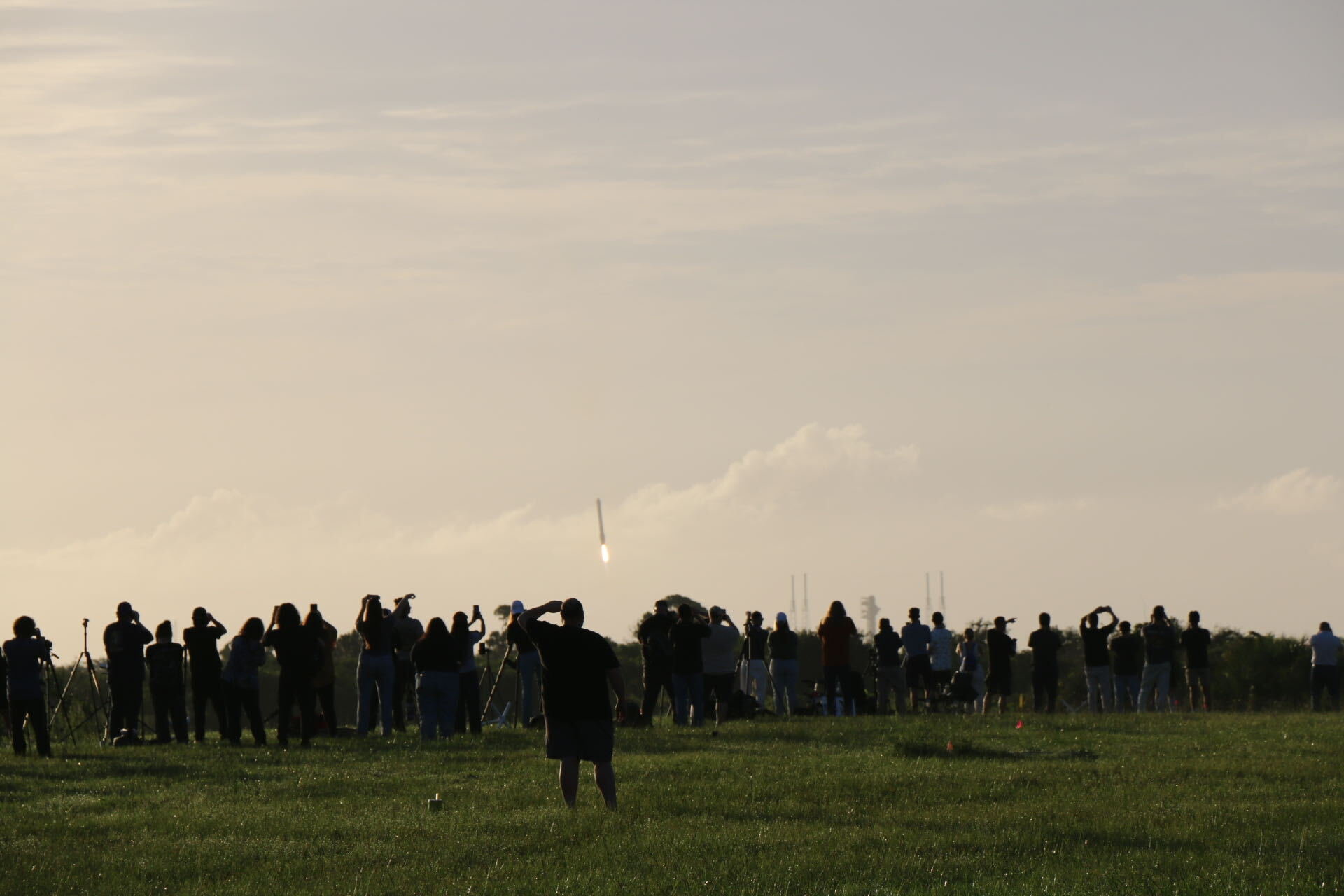
SpaceX rocket taxi returns after Roman Telescope launch | Space photo of the day for Sept. 8, 2026

8 September 2026 at 15:00

People stand on a lawn watching a long structure descend to Earth.

This might look like a rocket launching off Earth, but it's actually a rocket booster perfectly landing on our planet after fulfilling its duty. (Image credit: Chelsea Gohd)

On Aug. 30, the Nancy Grace Roman Space Telescope launched into space aboard a SpaceX Falcon Heavy rocket β€” then, after completing their job, the rocket's boosters safely landed back on Earth. Watching the events unfold, Space.com's Chelsea Gohd caught one of these beautiful landings on camera as onlookers at NASA's Kennedy Space Center watched in awe.

What is it?

The Roman Space Telescope is NASA's next great observatory, meant to revolutionize how we view the cosmos. Equipped with instruments like a coronagraph that can directly image exoplanets and a Wide-Field Instrument (WFI) that has a massively wide field of view, it's designed to work with big names like the Hubble Space Telescope and James Webb Space Telescope and reveal our universe's intricacies on a grand scale.

But to get to space, like any other space telescope, it needed a rocket to ferry it there. In this case, that was SpaceX's Falcon Heavy rocket. Falcon Heavy is about 230 feet (70 meters) tall and can lift nearly 141,000 pounds (64 metric tons) of payload to low Earth orbit. And importantly, Falcon Heavy's two boosters are reusable.

After launching a payload to space, the boosters split and each lands back on Earth in an upright position. In the image above, Gohd captured one of those boosters landing in the distance.

Why is it incredible?

Though we hear about it so often, there is something undeniably dreamlike about living in a time when a rocket can land its parts back on Earth so precisely. I was also there for the launch of the Roman Space Telescope in Florida, and it was breathtaking to watch such a huge piece of equipment navigate mid-air and straighten itself before landing. The crowd in the picture was equally astonished while the event unfolded.

My mother texted me just after she watched the Roman Space Telescope launch live online, exclaiming that the booster's landing looked just like a taxi returning to its station, getting ready for the next task. I hadn't thought about it that way before, but she was correct.

One of the boosters that participated in Roman's launch landed at Landing Zone 2 and the other hit the ground at Landing Zone 40. As NASA explained in a statement, one of these boosters carried out its very first mission while the other was on its third.

Now, the next spectacle to take our breath away will be Roman's very first images of the universe. Those are expected to drop next year.

Galaxies tangled in science and spirit | Space photo of the day for Sept. 7, 2026

7 September 2026 at 15:00

A dark scene with glowing dots on top of it. In the center, there are two wispy galaxies that look tangled in one another.

Nā 'Uhane Māhoe Huki PΕ« i ke Ola is the Hawaiian name given to this image of NGC 7253 β€” a pair of spiral galaxies caught in each other's gravity. This image was captured by the Gemini North telescope on Maunakea. (Image credit: International Gemini Observatory/NOIRLab/NSF/AURA)

It is nearly impossible to fathom the entirety of a single galaxy β€” these realms can span hundreds of thousands of light-years, and sometimes are even millions of light-years across. So imagine the grandeur of now one but two galaxies tangled together, in the process of merging into one. That's what you're seeing in today's featured image.

What is it?

The merging galaxies shown above were discovered by a group of students using the Gemini North Telescope, located on the Maunakea volcano in Hawaii β€” a very popular and often controversial location for ground-based telescopes. The students hailed from two local institutions, Waiākea High School and the Volcano School of Arts and Sciences, and had access to the telescope with the Project HōkΕ«lani internship.

They named their discovery Nā 'Uhane Māhoe Huki Pū i ke Ola, which translates to "The Twin Spirits Pulling Together Creating Life."

"'Uhane (spirit) was an important theme for our group. Our experiences throughout the week β€” 'oli (stargazing), visiting the summit and learning about the awesome scientific discoveries made possible by Maunakea β€” ignited our own spirits as we prepare for life after high school," Samantha Silva-Sampaio, one of the students, said in a statement.

The students also explain how the rest of the name fits in with their time at Gemini North. "Huki PΕ«," they say, has to do with the physical aspect of the two galaxies being pulled together, just like communities coming together to enable the discovery as a whole. And "i ke Ola" is meant to show that life can be created from interacting galaxies because this process gives rise to star birth, and hopefully we'll find a star besides the sun one day that hosts life on a world around it.

Why is it incredible?

The galaxy merger depicted in the image is formally known as NGC 7253 and is located around 200 million light-years from Earth in the constellation Pegasus. This region is also known as the Hawaiian constellation Ka Lupe o Kawelo.

What's especially spectacular about the image we see above is how sharply defined both galaxies appear during their gravitational interaction. It is also a treat to be able to live in a time when we can view an event happening so utterly far away with this much detail.

Galaxy mergers aren't a new thing, though. They occur all across the universe, and indeed even the Milky Way and our neighboring galaxy Andromeda are expected to collide (or maybe not?) at some point in the future. But not to fear β€” though it may not seem it from this image, within every galaxy is, well, a lot of space. So much so that it'd be surprising for anything in the colliding galaxies to actually smash together.

What does happen, however, is enchanting. All the interstellar gas and dust from both galaxies join together and lead to a spike in star formation. This means a ton of beautiful sparkles should decorate the final product of NGC 7253.

"'Uhane in this image reminds us that astronomy is not just science or spirit; it's both at the same time," Manu Silva-Sampaio, another one of the student discoverers, said in the statement.

Hubble Telescope sees spectacular 'superbubble' | Space photo of the day for Sept. 4, 2026

4 September 2026 at 15:00

Lots of sparkles and glowing dots among smoky tendrils of gas.

This nebula is named LHA 120-N44, or N44 for short, and it’s located in the constellation Dorado. (Image credit: ESA/Hubble & NASA, D. Gouliermis)

About 160,000 light-years away lies one of our Milky Way's little galactic neighbors: The Large Magellanic Cloud (LMC). And thanks to a new observing program, the Hubble Space Telescope has provided us with an intricate image of a nebula in the LMC. The surprising part? There's a giant void at the center. Scientists call it a "superbubble."

What is it?

What you're seeing in this image is a nebula within the LMC known as LHA 120-N44, or simply N44. It's located in the constellation of Dorado and, like a classic nebula, is the site of stars being born at a noticeably rapid rate.

But of course, what really can't be missed is the huge hole at the center of N44's dusty tendrils β€” this is the "superbubble," and its dimensions are staggering. NASA says it's about 210 by 140 light-years across β€” a truly unimaginable size, considering the distance between our sun and Pluto isn't even a single light-year.

One light-year, the distance light travels in a year, is about 6 trillion miles (9.7 trillion kilometers).

Why is it noteworthy?

The superbubble is a bit of a mystery, but one theory of why it exists is that stars at the center of the bubble could have undergone supernova explosions or have released stellar winds that swept away gas in the nebula. This could have resulted in a "void," as NASA calls it, surrounded by a gaseous shell. That would explain away the image we see pretty well, but there will likely be studies dedicated to refining that story.

Of note, in that shell around the superbubble, stars continue to form and show themselves as beautiful little specks across the watercolor-like landscape.

Something else interesting about this image is that N44 is what's known as an "emission nebula," meaning the gas you see has been energized by stars in the area. This enhances the luminescent quality of the portrait.

This is because the energization process, or ionization to be specific, generates ionized gas that ultimately must cool down. During that cooling, it goes from a higher energy state to a lower energy state and thus releases some energy. This energy loss causes N44 to glow brightly, creating the beautiful scene we see.

The reason scientists have used the Hubble Space Telescope to study N44 is this particular nebula offers good conditions to study star formation and evolution. As a matter of fact, Hubble managed to survey nearly half a million stars in and around the cluster, 30,000 of which are in the very early stages of their lives.

N44 has been a major topic of interest for quite some time. For instance, it made headlines in 2021 as well as in 2012 β€” both times due to Hubble's eye yet again β€” and observations with the Chandra X-ray Observatory led to a 2011 paper that discusses supernova shock waves and other phenomena shaping the nebula and its cavity.

❌