❌

Normal view

Seeking Technosignatures in Polluted White Dwarfs

15 July 2026 at 17:00

white dwarf with debris disk

White dwarfs often show signs of metals in their spectra, providing evidence that these evolved stars have accreted planetary material. Could white dwarf spectra also provide evidence for technological activity in these star systems?

A Record of Planets Past

When a Sun-like star reaches the end of its hydrogen-burning lifetime, it first puffs up into a red giant before exposing its white-hot core, which evolves into a white dwarf. This dramatic transition shakes up any planets that happened to be orbiting the star, and some close-in planets may end up crumbling apart, their rubbly remains peppering the surface of the white dwarf.

So far, astronomers have found hundreds of white dwarfs that appear to be polluted with heavy elements from their destroyed planets. These observations provide a valuable look into the bulk compositions of planetary materials outside our solar system. They may also provide a way to detect patterns of chemical abundances that are not natural, resulting from technological processes like industrial refining or the creation of alloys — in other words, a technosignature that is evidence of not just life, but technologically advanced life.

Seeking Signs of Technology
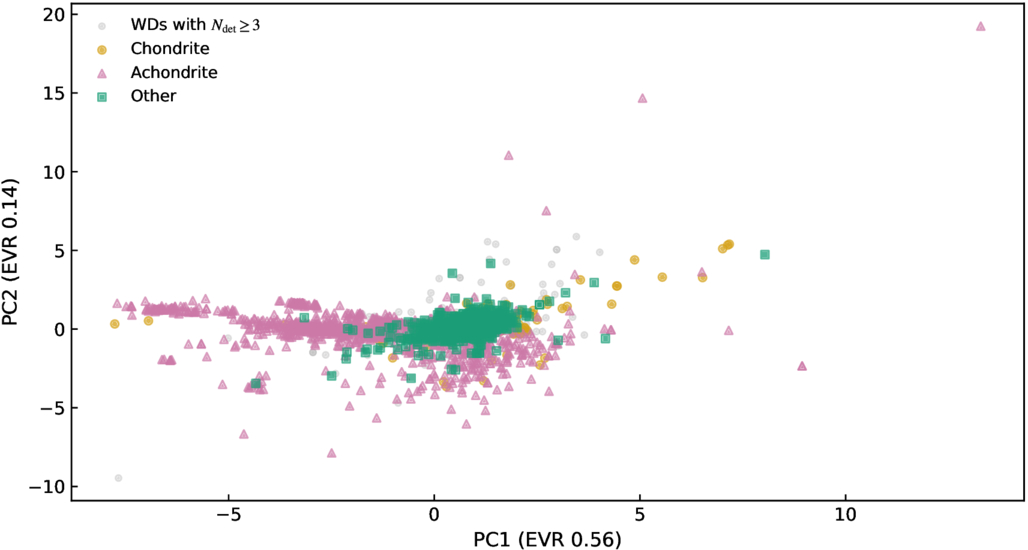
abundances of meteorites compared to white dwarfs

Representation of the chemical abundances of meteorites (pink, orange, and green) and white dwarfs (gray). Most white dwarf abundances overlap with the parameter space defined by the meteorite sample. Click to enlarge. [Huang et al. 2026]

A team led by Bo-Lun Huang (黄博伦) from Beijing Normal University recently investigated whether there is evidence for chemical technosignatures in the current sample of polluted white dwarfs. Huang and collaborators began their investigation with a catalog containing 697 measurements of white dwarfs with metals in their spectra. They applied Bayesian statistical methods to weigh the hypothesis that the chemical makeup of these white dwarfs is entirely natural against the possibility that they contain a blend of natural and technologically altered material.

The team used thousands of chemical abundance measurements from meteorites as a reference for the natural bulk composition of planetary material. For the mixture of natural and processed material, they combined the meteorite reference material with a template that is metal-rich and silicate-poor, with enhanced amounts of iron, nickel, chromium, and manganese.
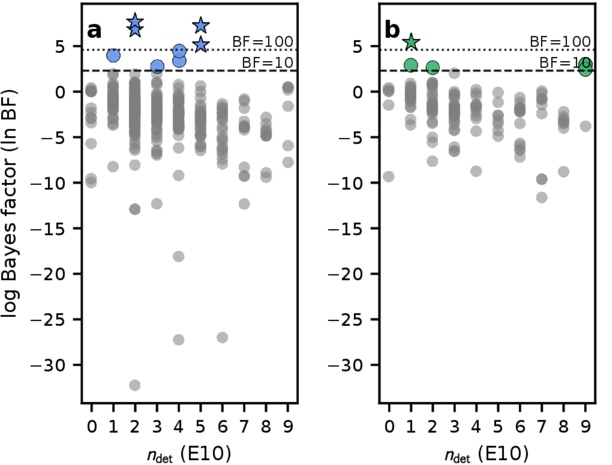
plot showing evidence for a natural + processed model relative to a natural model as a function of the number of elements detected

Evidence for a model including technologically processed material relative to a purely natural model, as a function of the number of elements detected in the white dwarf. ndet = 0 indicates that only upper limits were obtained on elemental abundances. Higher Bayes factors indicate stronger evidence. The left-hand plot is based on abundances measured from the white dwarfs’ photospheres, while the right-hand plot uses abundances adjusted for diffusion within the white dwarf. Click to enlarge. [Adapted from Huang et al. 2026]

No Strong Evidence, but a Path Forward

Ultimately, Huang’s team found that strong statistical support for the existence of technological processes was uncommon, though there were certain measurements in their sample of white dwarfs that were difficult to reconcile with a solely natural model.

Perhaps unsurprisingly, the team also found that the quality of the chemical abundance measurements affected the constraining power of the observation; some white dwarfs had upper limits for just a few elements, while others had definitive detections of many elements. They found that the most discerning observations recorded iron, magnesium, chromium, and titanium, plus either nickel, silicon, or sodium.

While this work didn’t dredge up firm evidence for technological activity, it provides a jumping-off point for future searches. The handful of white dwarfs in this sample that were fit poorly by a purely natural model could be compared against other technosignature models or targeted with high-resolution spectroscopy. Future measurements of iron and magnesium in polluted white dwarfs may be useful as a preliminary screening tool, helping to pick out intriguing targets for follow-up observations.

Citation

“A Calibrated Bayesian Search for Potential Chemical Technosignatures in Polluted White Dwarfs,” Bo-Lun Huang et al 2026 ApJ 1006 9. doi:10.3847/1538-4357/ae742c

The post Seeking Technosignatures in Polluted White Dwarfs appeared first on AAS Nova.
Now That’s Metal: How to Spot Stars That Have Swallowed Their Planets

3 June 2026 at 17:00

An illustration of an exoplanet about to be engulfed by its host star

Planets that get too close to their host stars are liable to be engulfed and consumed. New research explores how to identify stars that have had a planetary snack.

It’s Snack Time

Being a planet that closely orbits its star is dangerous, and various dynamical processes can draw a planet inward past the point of no return. When a planet vanishes beneath the surface of its host, it eventually disintegrates within the star, its atoms mixing into the blazing stellar soup.

This outcome is likely extremely common across the universe, and researchers have begun to see evidence for it: stars that appear to have absorbed angular momentum from their planets, white dwarfs with uncanny metals in their spectra, and stars with chemical abundances that don’t match those of their siblings. Now, in a recent publication led by Kaitlyn Lane (Vanderbilt University), researchers seek to find observational signatures of planetary engulfment of rocky exoplanets by main-sequence stars.

Modeling Engulfment

Lane’s team focused on main-sequence stars in the range of 0.5 to 1.4 solar masses, using one-dimensional analytical models to determine which of these stars will most readily display signs of having engulfed a planet. They simulated the stars as they consumed either an Earth-like planet or a super-Earth with the same composition as Earth but 15 times its mass.

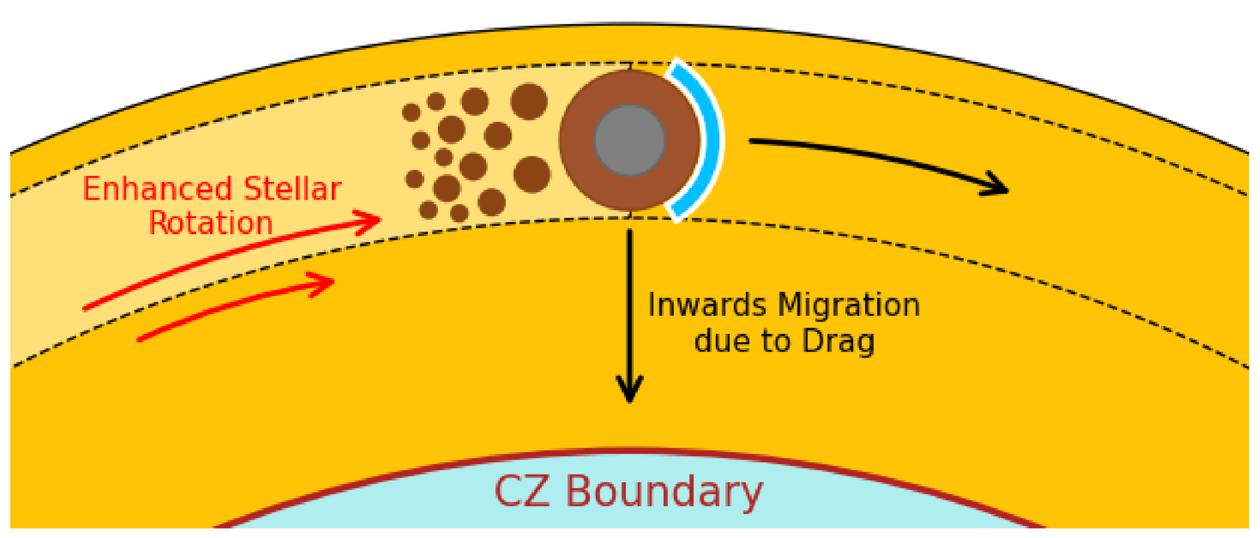
illustration of a planet being engulfed by its star

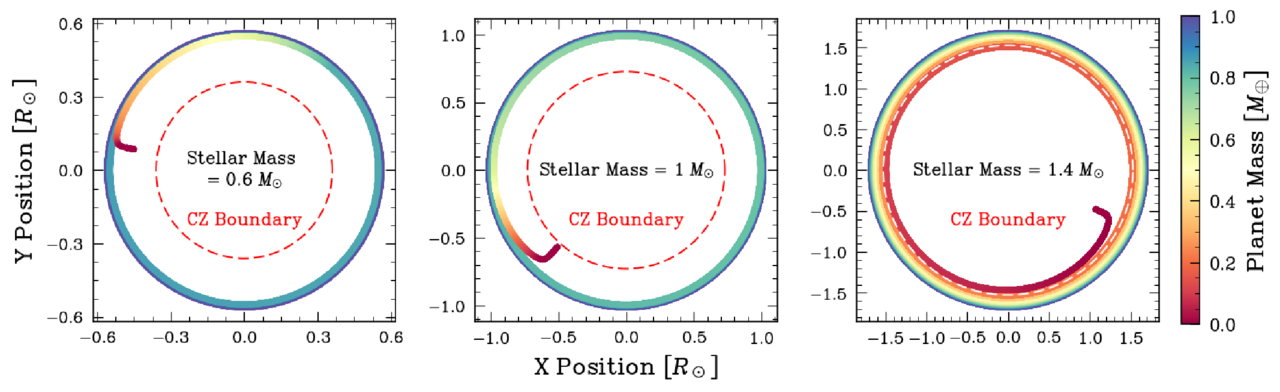
Diagram showing a planet being engulfed by its star and beginning to disintegrate before migrating inward. The boundary between the star’s outer convective zone (CZ) and inner radiative zone is shown. Click to enlarge. [Lane et al. 2026]

At the onset of the model, the engulfment is set to begin, the planet placed tangent to the star’s surface. The planets sink down and orbit just barely within their stars for 1–10 years, their solid surfaces slowly beginning to evaporate.

After that relatively lengthy phase, the process proceeds rapidly: as the planet inches deeper into its star, the drag forces grow stronger and the planet’s demise accelerates, with the planet disintegrating over the course of hours. In the last phase, the planet makes its final plunge and is destroyed in a half hour.

Signs of Planets Past

Lane’s team found that the planets tended to be destroyed fully within the outer convective layer of their stars, except in the case of the most massive stars studied here. For more massive stars, the outer convective zone is shallower than it is for the less massive stars, allowing a chunk of each planet to survive the passage through the convective zone to reach the radiative zone below.

simulation results showing planets disintegrating within their host stars

The trajectories of three example cases, showing how the planet loses mass as it spirals inward. In the 1.4-solar-mass case, part of the planet survives to reach the radiative zone, but the shallowness of the star’s convective zone means that the disintegrated planetary material is easier to observe. Click to enlarge. [Lane et al. 2026]

What this translates to, for the purposes of identifying planet-eating stars from afar, is that stars near the top of the mass range studied — from 1.0 to 1.4 solar masses — make the best targets. This is because the tell-tale planetary metals are not overly diluted within the stars’ relatively small convective zones, making these elements easier to detect. In terms of specific metals, the authors found that aluminum, calcium, and vanadium are the best signposts of planetary engulfment, with lithium also making the list.

While the authors acknowledge that there’s more work to be done — they plan to investigate the impacts of planetary engulfment on stellar structure more closely, for example — this work represents an important foray into identifying targets for future studies of stars that have eaten their planets.

Citation

“Observable Metal Pollution in Main-Sequence Stars: Simulations of Rocky Planets Engulfed by Stars in the 0.5 to 1.4 M⊙ Range,” Kaitlyn T. Lane et al 2026 ApJ 1003 67. doi:10.3847/1538-4357/ae5b9a

The post Now That’s Metal: How to Spot Stars That Have Swallowed Their Planets appeared first on AAS Nova.

Characterizing the Atmosphere of Exoplanet WD 0806b with JWST

3 April 2026 at 17:00

gas giant orbiting white dwarf

Orbiting a white dwarf, the exoplanet WD 0806b is the subject of a recent study using JWST to measure the atmospheric conditions governing the planet.

Directly Imaged Exoplanet WD 0806b

Most of the 6,000 and counting exoplanets discovered thus far have been detected due to their impacts on their host star — passing in front of the star and causing it to dim, or gravitationally tugging on the star and causing it to wobble. On rare occasions, though, astronomers have been able to catch the exoplanet itself through direct imaging. Directly imaged exoplanets offer key insights that cannot be obtained through indirect detection methods. Luminosity measurements and spectral emission features allow astronomers to more directly measure planet mass, radius, and composition otherwise inferred from the host star.

WD 0806b system

NIRCam image showing host star WD 0806 circled in orange and the location of exoplanet WD 0806b marked by the orange arrow. [Lew et al 2026]

Included in the about 90 distant planets that have posed for a picture is WD 0806b, a rare exoplanet companion trotting around a white dwarf at an orbital distance of 2,500 au (50 times the distance from the Sun to the Kuiper belt!). Originally discovered with the Spitzer Infrared Array Camera in 2011, WD 0806b is the second-coldest directly imaged exoplanet to date. With JWST’s high-precision photometric and spectroscopic capabilities, WD 0806b provides a unique opportunity to probe the atmospheric chemistry of cold giant planets and take steps toward understanding the co-evolution of white dwarfs and their surviving exoplanets.

WD 0806b’s Atmospheric Abundances from JWST

Aiming to characterize the physical properties and atmospheric composition of WD 0806b, Ben W.P. Lew (Bay Area Environmental Research Institute; NASA Ames Research Center) and collaborators used JWST’s Near-Infrared Camera (NIRCam) and Near-Infrared Spectrograph (NIRSpec) to obtain high-resolution imaging and spectroscopy of the exoplanet. Combining these observations, prior lower-resolution observations, and evolutionary planet models, the authors estimated the physical properties of WD 0806b including mass, radius, surface gravity, and effective temperature.

WD 0806b spectrum

NIRSpec spectrum of WD 0806b with best-fit model spectra overlaid. [Lew et al 2026]

From the derived physical properties, the authors modeled the NIRSpec spectrum to estimate molecular abundances and elemental abundance ratios in the atmosphere of WD 0806b. They obtained measurements of multiple molecules including carbon dioxide, carbon monoxide, and ammonia; these molecular abundances offer the opportunity to test chemical equilibrium and disequilibrium as well as eddy diffusion, or bulk mixing, in the planet’s atmosphere. The authors developed a novel chemical analysis framework to determine how bulk mixing varies with altitude in WD 0806b and reported the first observational evidence that mixing becomes weaker at higher altitudes in exoplanet atmospheres. This result points to the need for future studies exploring the impact of these chemical processes on spectra and photometry, which are essential to characterizing cold giant planets.

This study highlights how high-precision JWST data can reveal a rich collection of atmospheric conditions, chemical composition, and physical processes occurring in cold giant planets. With such a wide orbit from its host white dwarf, WD 0806b serves as an interesting case study for how giant planet composition may reflect the formation and evolutionary history of the overall system. Future observations of and comparisons to similarly cold giant planets will further uncover how atmospheric characterization may fit into our understanding of exoplanets and their histories.

Citation

“JWST Spectral Retrieval of Cold Directly Imaged Planet WD 0806b and the First Measurement of Altitude-dependent Kzz in Exoplanet Atmospheres,” Ben W.P. Lew et al 2026 AJ 171 227. doi:10.3847/1538-3881/ae4747

The post Characterizing the Atmosphere of Exoplanet WD 0806b with JWST appeared first on AAS Nova.

Looking for a Single Stellar Ancestor: Mono-Enriched Stars in Zoom-In Simulations

17 September 2025 at 17:00

supernova remnant N49

Editor’s Note: Astrobites is a graduate-student-run organization that digests astrophysical literature for undergraduate students. As part of the partnership between the AAS and astrobites, we occasionally repost astrobites content here at AAS Nova. We hope you enjoy this post from astrobites; the original can be viewed at astrobites.org.

Title: SIRIUS: Identifying Metal-Poor Stars Enriched by a Single Supernova in a Dwarf Galaxy Cosmological Zoom-In Simulation Resolving Individual Massive Stars
Authors: Yutaka Hirai et al.
First Author’s Institution: Tohoku University
Status: Published in ApJL

All of the elements in stars come from, well, other stars. Each star has its own unique makeup of elements, kind of like our own DNA. Just like genes passing down generation after generation, elements in stars can be passed down to newly forming stars after the previous generation has died. So, if you’re looking at the chemical makeup of a particular star, what you’re really seeing is all the elements that were created after another star in the region exploded (went supernova) and enriched the gas (that the new star formed from) around it with elements like oxygen, nitrogen, iron, and more.

Like genealogy for stars, astronomers can use stellar enrichment to work their way back from a star they observe to its potential predecessors. It’s a bit trickier for stars that have a lot of elements, dubbed “metal-rich” stars, because there’s no way to tell which star contributed what mixture of elements at what point in time. However, scientists have recently been observing “extremely metal-poor” stars, which are stars with only small amounts of elements like oxygen, nitrogen, or carbon. Because there are so few of these elements, it’s safe to assume that these stars formed out of gas that didn’t have many predecessor stars enriching it — in fact, astronomers are hoping to find stars that only ever had one ancestor, calling them “mono-enriched” stars. Finding a mono-enriched star would tell us exactly what elements were produced in the supernova — aka in supernova nucleosynthesis.

However, how many of these metal-poor stars are mono-enriched is unknown. Estimating this fraction could help researchers identify more of them. The authors of this study tackle this problem by examining how many might exist in dwarf galaxies and what kind of chemical signatures they could produce.

Simulating Mono-Enriched Stars

To do this, they simulate a dwarf galaxy with the hydrodynamic code ASURA and model the gas physics in the galaxy with CLOUDY. In this method, stars form once the density of hydrogen gas in a region exceeds a certain threshold at a temperature that is cool enough for the gas to clump together. Pockets of this simulated region are then randomly assigned a stellar mass from the initial mass function, and eventually explode, diffusing elements into the gas particles around it.

Finding Mono-Enriched Stars in the Simulated Stellar Haystack

plot showing stellar metallicity, carbon enhancement, and mass of simulated stars in a dwarf galaxy

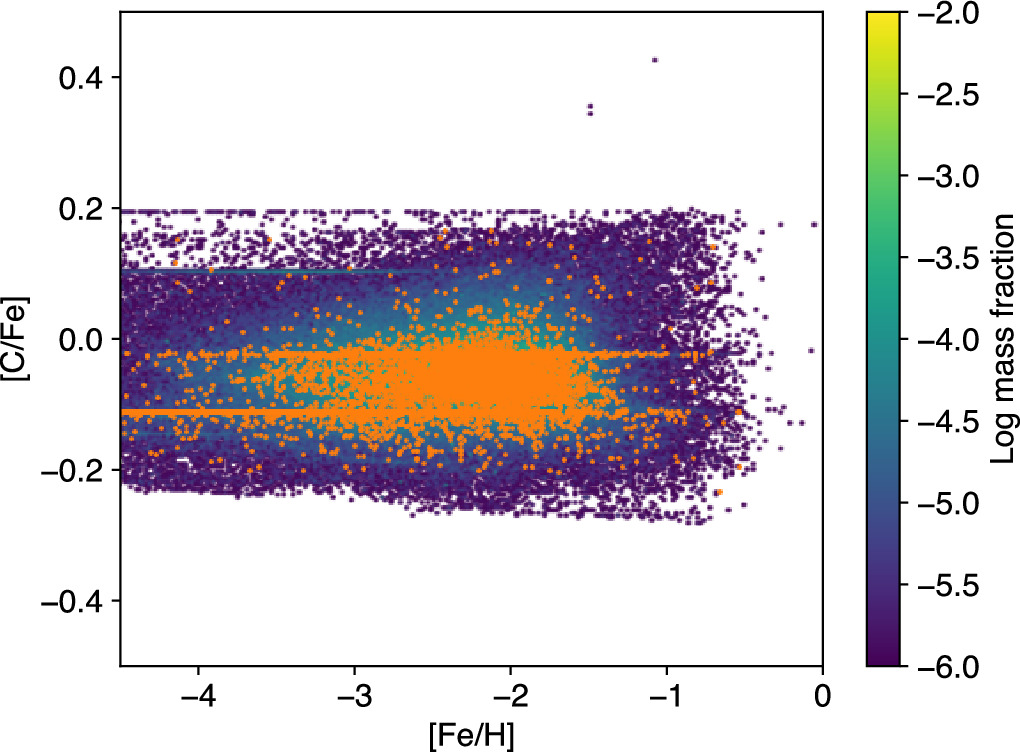
Figure 1: Every simulated star in the dwarf galaxy, shown as a function of their stellar metallicity, [Fe/H], carbon enhancement, [C/Fe], and their mass. Orange points are identified as mono-enriched stars. Click to enlarge. [Hirai et al. 2025]

The authors define a mono-enriched star as one with a carbon-to-iron ratio (denoted [C/Fe]) similar to that expected of a core-collapse supernova in their model. They identify a portion of the stars created as being mono-enriched, shown in orange in Figure 1. In total, this makes up about 1.5% of stars in this simulated dwarf galaxy.

Once these data points are collected, the authors investigate the fraction of mono-enriched stars at different metallicities. The authors essentially ask, are mono-enriched stars more likely to occur at lower metallicities? They find that, indeed, stars that are lower metallicity (and thus have lower [Fe/H]) are more likely to be mono-enriched (Figure 2). For stars with exceedingly low metallicities, [Fe/H] < −5, about 11% of them in this simulated dwarf galaxy have formed out of gas enriched by only one supernova.

Fraction of mono-enriched stars in the stellar population depending on the stellar metallicity

Figure 2: Fraction of mono-enriched stars in the stellar population depending on the stellar metallicity ([Fe/H]) of the population. Stars with much lower metallicities ([Fe/H] < 2.5) are more likely to be mono-enriched. [Hirai et al. 2025]

Finding Mono-Enriched Stars in the Observed Stellar Haystack

These theoretical predictions help observers prepare what to look for when they want to find a mono-enriched star. These predictions seem to suggest that astronomers should keep looking for these extremely metal-poor stars if we want to find these unique stars that tell us about what elements are made in core-collapse supernovae. There is currently a decently large database of extremely metal-poor stars found with photometry, and if observers could follow up with the most ideal candidates spectroscopically we could really test what kind of elements are in these stars. Further, the upcoming Subaru Prime Focus Spectrograph will take many spectroscopic observations of close-by dwarf galaxies, which may contain more extremely metal-poor stars.

The authors note there is more work to be done in simulations, as they are interested in testing how extremely metal-poor stars, specifically ones with enhanced carbon, form. All of this will hopefully lead to a better understanding of how elements are made when stars explode, perhaps leading us to how some of the earliest elements formed in the early universe.

Original astrobite edited by Diana Solano-Oropeza.

About the author, Caroline von Raesfeld:

I’m a third-year PhD student at Northwestern University. My research explores how we can better understand high-redshift galaxy spectra using observations and modeling. In my free time, I love to read, write, and learn about history.

The post Looking for a Single Stellar Ancestor: Mono-Enriched Stars in Zoom-In Simulations appeared first on AAS Nova.

❌