Les plus grosses pouponnières d'exoplanètes ne se trouvent pas où on le croyait !


![]()
Many galaxies, including our own, have a central supermassive black hole. In certain galaxies, gas becomes ensnared in the black hole’s gravitational pull and collects in a disk that feeds the black hole, forming an active galactic nucleus (AGN). An AGN can feast on this disk of gas and dust for millions to billions of years — glowing across the electromagnetic spectrum, brandishing relativistic jets, and creating a brilliant, variable light show visible from billions of light-years away.
Today’s Monthly Roundup investigates the connection between AGNs and neutrinos, considers the question of AGN variability, and explores modeling techniques for relativistic environments.
Where do neutrinos — neutral, nearly massless elementary particles — come from? AGNs have emerged as one likely source; in 2022, the IceCube collaboration reported evidence for neutrinos from the nearby galaxy Messier 77, which hosts an X-ray-bright AGN, and earlier observations potentially linked a neutrino to the blazar TXS 0506+056.
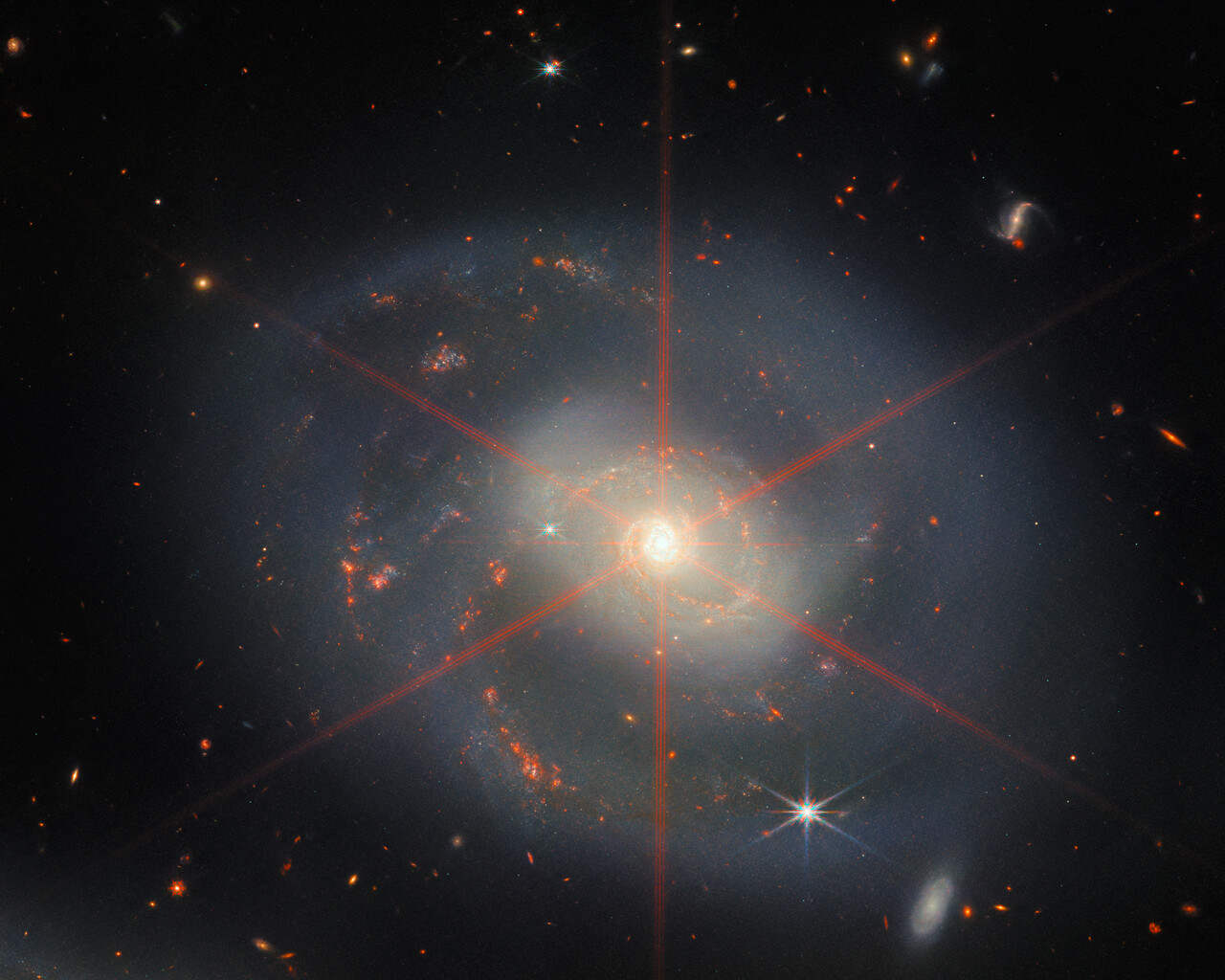
The spiral galaxy NGC 7469, shown here in this JWST image, contains an AGN that may be a source of neutrinos. [ESA/Webb, NASA & CSA, L. Armus, A. S. Evans; CC BY 4.0]
This result suggests that X-ray-bright AGNs are indeed a plausible source of neutrinos. As for the specific physical origin of these AGN-generated neutrinos, the data provide a few clues. The X-ray emission of an AGN is thought to arise from a billion-degree cloud of plasma called the corona. The interaction of coronal X-rays with high-energy protons is thought to produce neutrinos in the energy range of 1–10 teraelectronvolts — roughly the energies of the neutrinos associated with Messier 77 in this study. However, NGC 7469 was associated with neutrinos more energetic than this range, suggesting that not all AGN-produced neutrinos have a coronal origin. Thus, though the body of evidence suggesting that X-ray-bright AGN are a source of neutrinos, the precise mechanism through which these neutrinos are produced remains unknown.
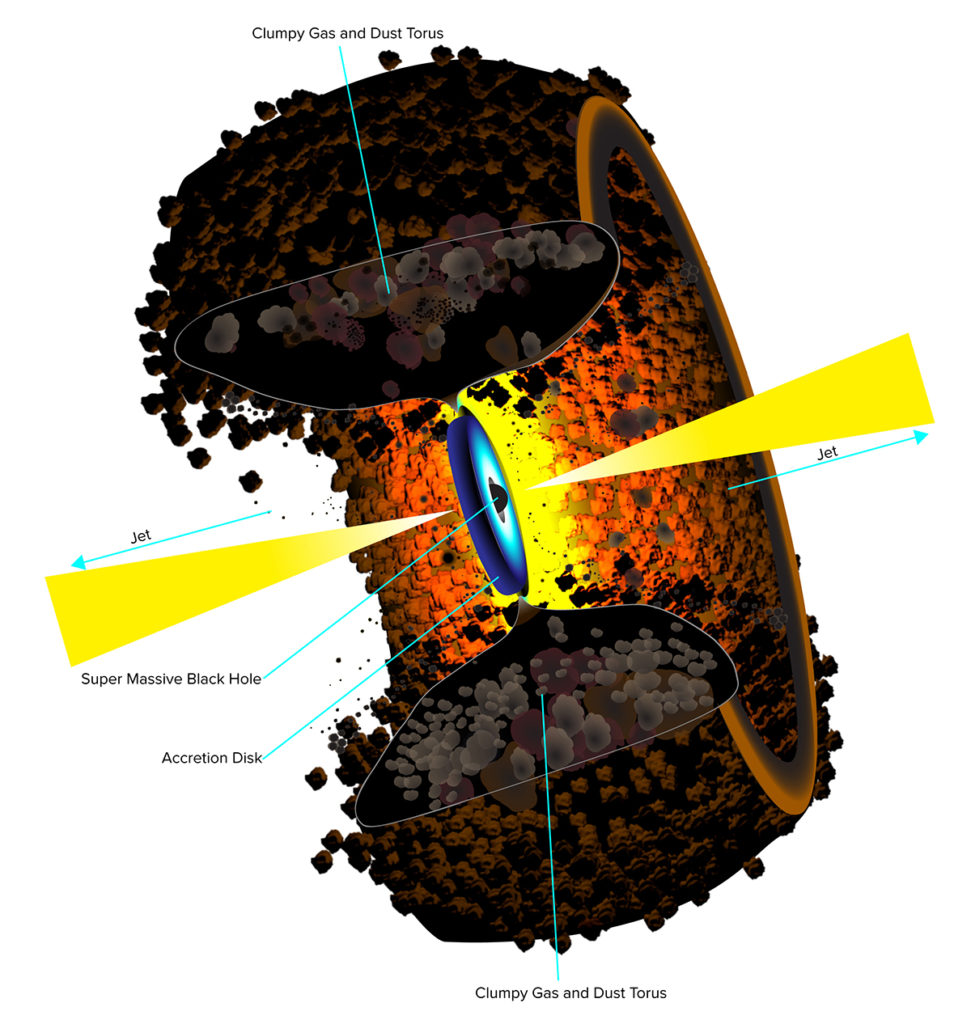
A diagram of the unified model of active galactic nuclei, showing an accretion disk, dusty torus, and jets. Click to enlarge. [B. Saxton NRAO/AUI/NSF; CC BY 4.0]
If there’s one constant when it comes to AGNs, it’s change; observations show that the emission from active galaxies varies on timescales from minutes to decades. Though both the accretion disk and the jet contribute to the overall multiwavelength behavior of an AGN, it’s not yet clear which of these structures is a greater contributor to an AGN’s variability.
Vineet Ojha (Peking University) and coauthors considered AGN variability at optical and mid-infrared wavelengths. Ojha’s team collected a sample of AGN that lie at similar redshifts and fall into one of three categories: narrow-line Seyfert 1 galaxies detected in gamma rays, narrow-line Seyfert 1 galaxies not detected in gamma rays, and broad-line Seyfert 1 galaxies detected in gamma rays. These three classes are distinguished by the presence or absence of relativistic jets as well as their accretion rate; gamma-ray-detected Seyfert 1s likely host jets, and narrow-line Seyfert 1s likely have higher accretion rates than broad-line Seyfert 1s.
Using optical data from the Zwicky Transient Facility and mid-infrared data from the Wide-field Infrared Survey Explorer, the team separated statistical wiggles from true variability and determined which sample of AGNs was most variable. They found that broad-line AGNs detected in gamma rays are the most variable, suggesting that jets are major contributors to AGN variability. Narrow-line AGNs detected in gamma rays are next in line, likely because these AGNs have jets but also have a strong thermal emission component from their accretion disks due to their high rate of accretion. Narrow-line AGNs not detected in gamma rays are the least variable, lacking a jet and dominated by thermal emission. Taken together, these results suggest that AGN variability is mostly jet driven, with some contribution from accretion disk instabilities.
The galaxy Messier 87 (M87) hosts one of the most studied AGN jets. M87’s jet is visibly structured, and it exhibits superluminal motion, in which the relativistic plasma appears to move faster than the speed of light. Because the plasma accelerated by an AGN moves so quickly, researchers attempting to model this plasma may opt to use the slow-light approach, in which the evolution of the ambient plasma is modeled simultaneously with the propagation of light through the medium. Though more computationally intensive than the fast-light approach, in which photons zip through a static medium, slow-light techniques are needed in regions of relativistic flows or strong acceleration.
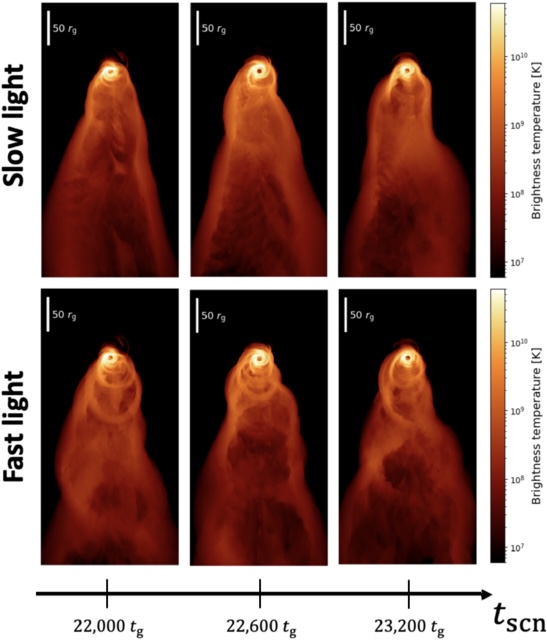
Comparison of the jet morphology from the slow-light (top row) and fast-light (bottom row) methods. [Adapted from Tsunetoe et al. 2026]
The team found that slow-light images tended to be smoother, lacking the looping, helical structures within the jet seen in fast-light images. Slow-light images show more evidence for the superluminal motion that is observed in relativistic jets like M87’s, as well as greater limb brightening and less wobbling motion. The team also investigated the effects of changing the black hole spin, finding greater wobbling in the jet for slow black hole spins and a straighter, wider jet for rapid black hole spins. Overall, Tsunetoe and coauthors found that the slow-light approach generated images that are more consistent with the properties of M87’s jet, demonstrating that the slow-light approach is necessary to capture the behavior of relativistic jets.
“Evidence for Neutrino Emission from X-Ray-Bright Active Galactic Nuclei with IceCube,” R. Abbasi et al 2026 ApJL 1000 L26. doi:10.3847/2041-8213/ae4aad
“The Relative Contributions of Accretion Disk Versus Jet to the Optical and Mid-Infrared Variability of Seyfert Galaxies,” Vineet Ojha et al 2025 ApJ 994 84. doi:10.3847/1538-4357/ae0a38
“Slow-Light Effect in the Jet-Launching Region of M87,” Yuh Tsunetoe et al 2026 ApJ 1000 29. doi:10.3847/1538-4357/ae43e7
The post Monthly Roundup: Investigating Active Galactic Nuclei appeared first on AAS Nova.
![]()
Editor’s Note: Astrobites is a graduate-student-run organization that digests astrophysical literature for undergraduate students. As part of the partnership between the AAS and astrobites, we occasionally repost astrobites content here at AAS Nova. We hope you enjoy this post from astrobites; the original can be viewed at astrobites.org.
Title: X-Ray Investigation of Possible Super-Eddington Accretion in a Radio-Loud Quasar at z = 6.13
Authors: Luca Ighina et al.
First Author’s Institution: Harvard–Smithsonian Center for Astrophysics and Italian National Institute for Astrophysics
Status: Published in ApJL
Quasars are some of the most extreme objects in the entire universe. Despite being as far as tens of billions of light-years away, they nonetheless can appear as bright as some stars in our own Milky Way. To put their brightness in perspective, one just has to consider the Sun. Compared to puny human scales, our star is a truly gargantuan object. It’s a fully functional fusion reactor, churning hydrogen into helium in its core and outputting an unfathomable amount of energy in the process. This glowing furnace is so bright that it can cook us with the heat of an oven during the day, even at a distance of more than 90 million miles (about 8 light-minutes). That distance dramatically dilutes the radiation of the Sun by the time it reaches us, as we only receive a small sliver of its total output, and yet we can still feel its heat pounding down on us when we stand beneath a clear summer sky.
However, if one were to move the Sun about 30 light-years away, it would appear completely unremarkable. You’d need to be under relatively dark skies to even spot it! The vastness of space would simply crush the output of our solar engine; however, if you place a luminous quasar at that same 30 light-year distance, its searing radiation would seem to effortlessly cross the cosmic gulf looming between the stars, scorching us relentlessly with the same heat as the Sun does today. The power of a quasar simply puts our star to shame.
Still, even quasars have limits. The source of power for these objects is a supermassive black hole. The supermassive black hole that lives at the center of our Milky Way is currently dormant. However, many supermassive black holes (especially in the early universe) actively gulp down matter, releasing tremendous energy that escapes in the form of radiation across the electromagnetic spectrum. The escaping photons bump into particles on their way out, exerting an outward pressure. If enough light is unleashed by the quasar, this pressure will actually balance against the pull of gravity, cutting off the food supply for the black hole. This negative feedback loop means that a given quasar has an upper limit to its brightness, called the Eddington luminosity, and to the speed at which it accretes matter, called the Eddington rate. The authors of today’s bite examine a particularly misbehaved quasar that seems to violate even these extreme limits.
The authors observed the quasar RACS J032021.44−352104.1 (RACS J0320−35 for short) with several radio observatories, including the Giant Metrewave Radio Telescope, the Australia Telescope Compact Array, and the Australian Large Baseline Array. Combining this data with publicly available observations, they find that the source is “radio-loud,” or bright at very long wavelengths. Typically, this kind of emission is expected to be generated by powerful jets that are ejected from the poles of a quasar. For example, the authors compare this radio-loud quasar to similar sources, which show significant variability in the X-ray part of the spectrum. This is a tell-tale sign that the X-ray emission is also generated by these jets (which might come out in fits and spurts and thus cause fluctuations in brightness over time).
However, when the authors examine X-ray data of RACS J0320−35 taken by the Chandra X-ray Observatory, they find surprising results. The quasar is extremely luminous in X-rays, making it one of the brightest in the early universe. But despite the fact that it pumps out a huge number of these energetic photons, it seems to preferentially emit only the lower-energy band of X-rays and completely lacks the highest-energy emission that characterizes similar sources. In technical terms, the X-ray spectrum of RACS J0320−35 is incredibly “soft.” Moreover, this X-ray emission seems to be constant on the timescale of months, though further observations will be required to test if it varies on longer timescales. Still, the softness of the spectrum and weak variability of this system mean that its X-ray emission is unlikely to be produced by a jet.
The authors carefully consider a particular variety of jet — one that is sharply angled towards us. Since quasar jets often travel at incredible speeds, the special theory of relativity kicks in and causes strange behaviors. In particular, an effect called relativistic beaming can cause a source to appear much brighter if traveling towards the observer at extremely high speeds. However, they find that although relativistic beaming can explain the mysterious X-ray properties of RACS J0320−35, such a scenario is incompatible with its observed radio emission. Moreover, a lack of gamma-ray emission and weak variability are further pieces of evidence against the jet origin of the X-ray emission.
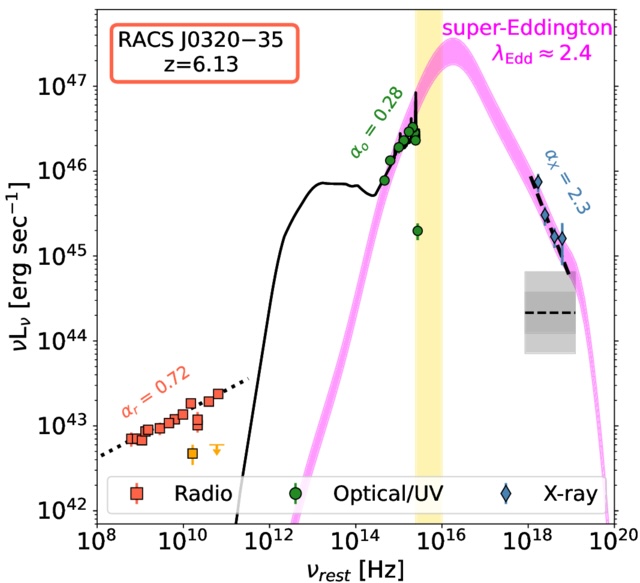
The article presents one more fascinating possibility for the origin of the X-rays in this source. Some theoretical work and simulations show that if a black hole breaks the Eddington limit and starts accreting matter at “super-Eddington rates,” the X-ray spectrum that results can be incredibly soft. The authors find excellent agreement between the observations and the predictions from a particular model that simulates a very slowly spinning black hole (see Figure 1). This scenario seems to be a promising explanation for the X-ray emission in RACS J0320−35, which is extremely exciting for several reasons.
Figure 1: A plot showing the observed energy spectrum of RACS J0320−35 and the theoretical spectra predicted by several models. In particular, the green circles (visible light and ultraviolet (UV) emission), blue diamonds (X-ray emission), and red squares (radio emission) represent the real observations. The shaded pink region represents the predictions of a model that simulates a black hole spinning very slowly and accreting at super-Eddington rates. The model seems to match the observed X-ray and visible/UV emission excellently. However, explaining the observed radio emission might require conditions that violate the assumptions behind this scenario. [Adapted from Ighina et al. 2025]
Despite the promising initial results of this model, there are a few caveats to the results presented in today’s article. For example, the radio jets observed from this source require a rapidly spinning black hole, which conflicts with the model assumptions. The authors note that a radio jet can be very far from a black hole, tracing its past activity. In fact, this jet may have actually spun down the central supermassive black hole by extracting energy from it, a fascinating possibility that will require both further observations and simulations to explore. Today’s bite shines a brilliant light on this possibility by analyzing RACS J0320−35, a fascinating quasar in the early universe and a stunning example that cosmic limits are meant to be broken.
Original astrobite edited by Veronika Dornan.
About the author, Ansh Gupta:
I’m an astronomy graduate student at the University of Texas at Austin working with Steven Finkelstein. I use data from JWST to study the formation and growth of the first galaxies and black holes in the universe. In my spare time, I enjoy playing piano, reading, and making YouTube videos.
The post The Winner of the Cosmic Speed-Eating Contest appeared first on AAS Nova.
![]()
The gravitational wave background — the constant, low-frequency hum of colliding supermassive black holes across the universe — seems to have a larger amplitude than expected. Can preferential accretion explain why?
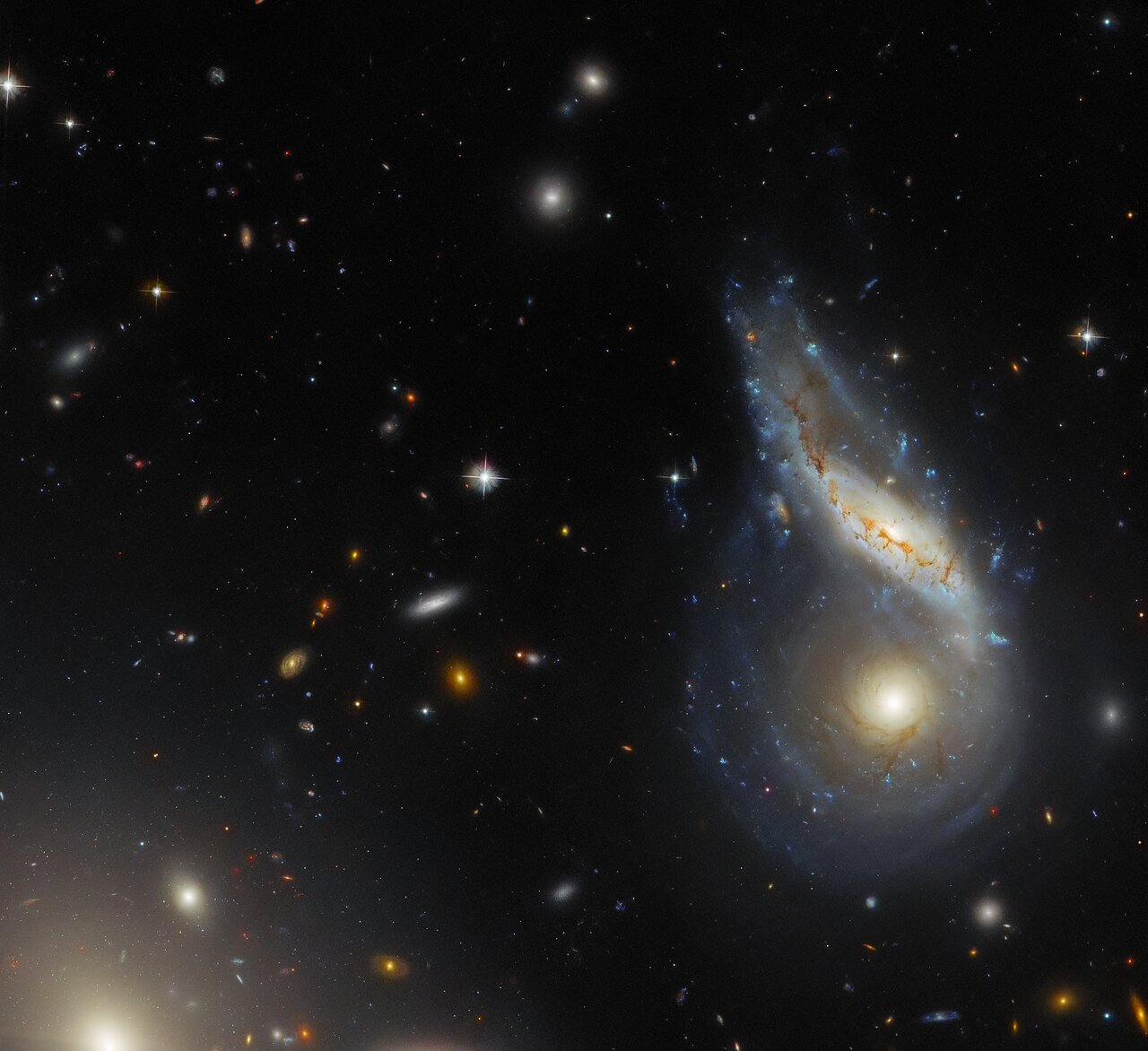
The peculiar galaxy Arp 122, shown here in a Hubble Space Telescope image, is in the process of merging. When two galaxies merge, the supermassive black holes at their centers eventually merge as well. [ESA/Hubble & NASA, J. Dalcanton, Dark Energy Survey/DOE/FNAL/DECam/CTIO/NOIRLab/NSF/AURA; Acknowledgement: L. Shatz; CC BY 4.0]
Though some researchers have invoked new physics to explain this discrepancy, all that may be required is an adjustment to our understanding of the supermassive black hole binary population in our universe. In a recent research article, Julia Comerford (University of Colorado Boulder) and Joseph Simon (University of Colorado Boulder; Oregon State University) tackled one of the underlying assumptions about the masses of merging supermassive black holes.
When supermassive black holes merge, the strength of the gravitational wave signal depends on how similar the black holes were in mass; merging equal-mass black holes produce stronger signals than mismatched black holes do. What if, Comerford and Simon proposed, the masses of merging supermassive black holes scattered across the universe are more similar than previously thought?
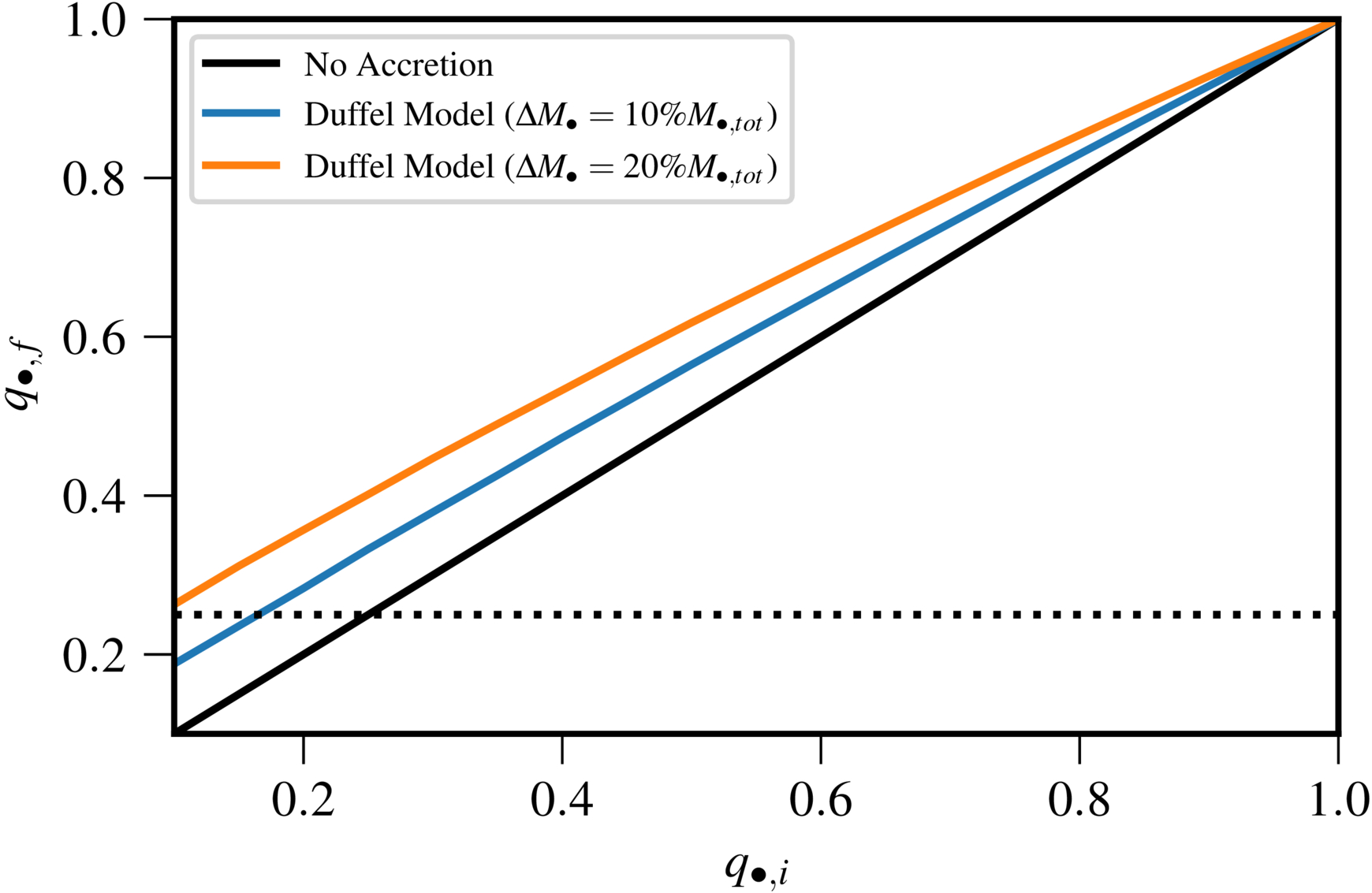
The initial and final black hole mass ratio, q. The blue and orange lines show a 10% and 20% increase in the total mass of the binary, respectively. The dotted line divides major mergers (q ≥ 0.25) and minor mergers. [Comerford & Simon 2025]
What’s more, it appears that the smaller of the two black holes tends to pack on more mass, meaning that the masses of the black holes grow more similar as they wind toward a merger. (This somewhat counterintuitive result arises because the smaller of the two black holes encounters more gas as it spirals inward.)
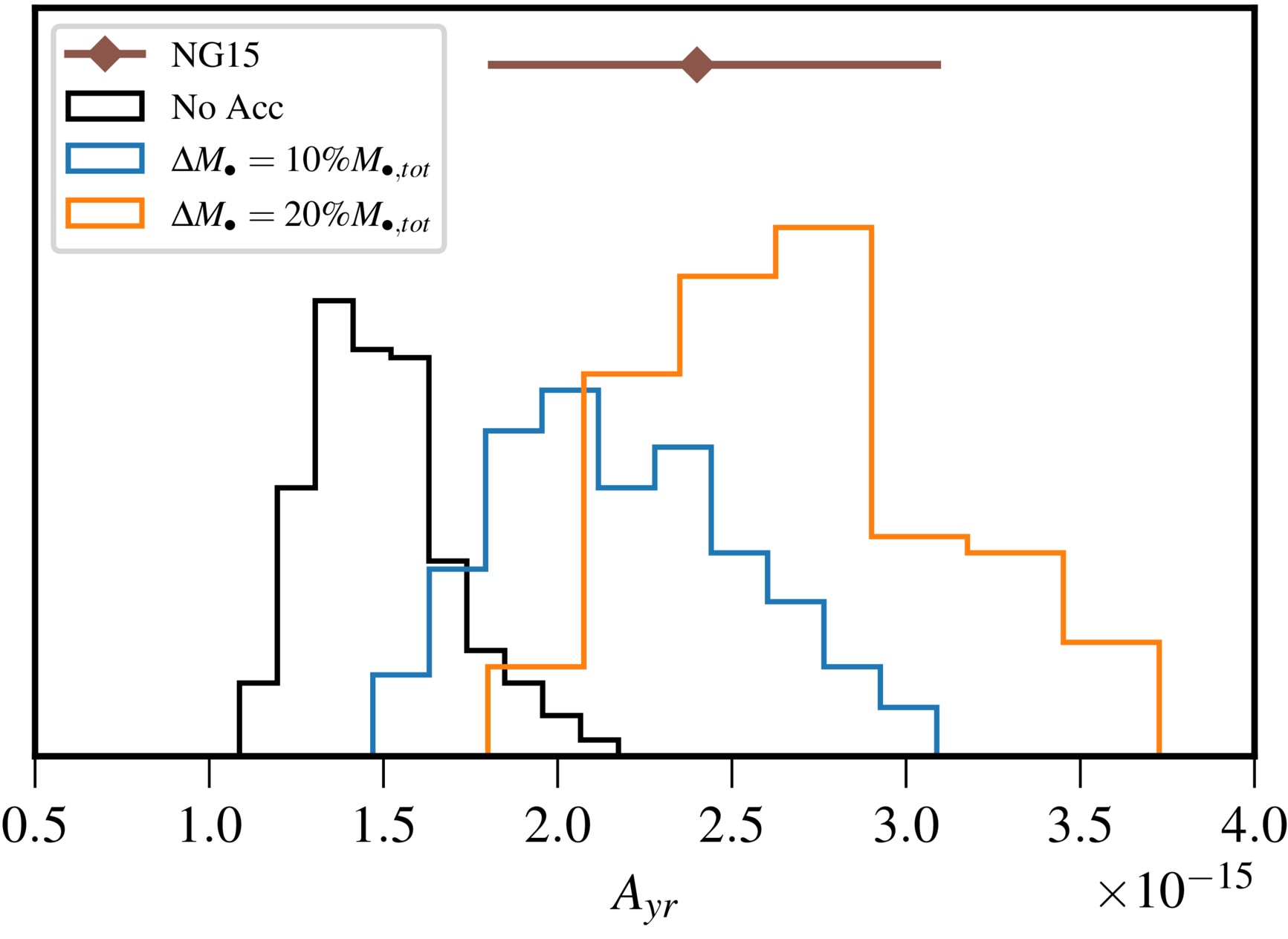
If accretion tends to even out the masses of the binary members, is the resulting increase in signal strength large enough to explain the observed amplitude of the gravitational wave background?
Probability distribution functions for the calculated gravitational wave background amplitude for different accretion conditions. The brown diamond shows the median amplitude from the NANOGrav data set. [Adapted from Comerford & Simon 2025]
The signal-boosting effect from preferential accretion may be especially important if the binary evolution timescale — the time it takes for black holes approaching a merger to reach a separation at which their gravitational waves become accessible to pulsar timing arrays — is longer than the estimated 1.8 billion years. At longer timescales, models without this accretion become entirely inconsistent with observations. Future research that examines the masses and accretion rates of supermassive black holes as they approach make their way toward a merger can provide further clues to the role of preferential accretion.
“Preferential Accretion onto the Secondary Black Hole Strengthens Gravitational-Wave Signals,” Julia M. Comerford and Joseph Simon 2025 ApJ 994 168. doi:10.3847/1538-4357/ae1133
The post Boosting the Gravitational Wave Background appeared first on AAS Nova.
![]()
Flashing on and fading quickly, recurrent novae are captivating astronomical phenomena. A recent study identifies one system that challenges our current understanding.
When a white dwarf — the white-hot remnant of a dead star — has a close binary companion, the white dwarf can pull material from the companion star onto its boiling surface. Ignited in a bright flash, the accreted material is blown out from the white dwarf in a nova explosion that gradually expands and fades over time. Some novae, known as recurrent novae, repeat on observable timescales, creating a “new” star in the sky on periods ranging from one to one hundred years.
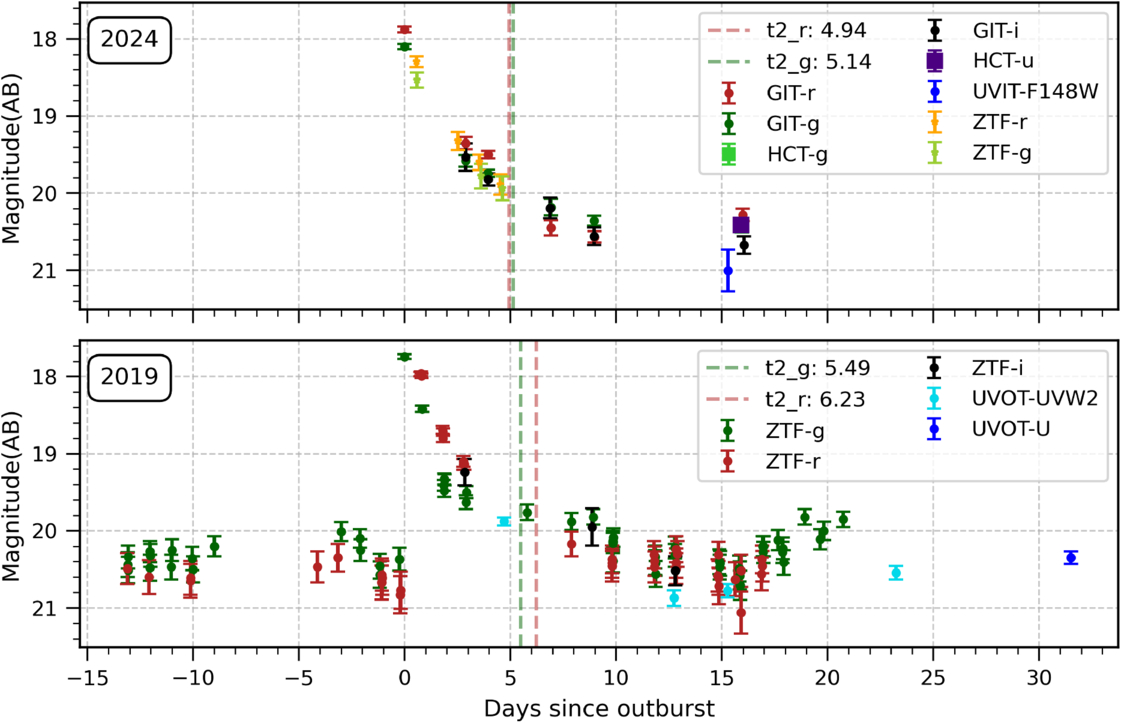
Two light curves of M31N 2017-01e outbursts from 2024 (top) and 2019 (bottom) showing how the light evolves over time. Click to enlarge. [Chamoli et al 2025]
Discovered in 2017, the second-shortest-period nova M31N 2017-01e has an outburst about every 2.5 years. This nova has sparked intrigue among researchers due to its low-amplitude outbursts and rapid evolution compared to other recurrent novae. While M31N 2017-01e exhibits some emission features typical for recurrent novae, recent studies have suggested that the system’s companion star may be a moderately young, blue B-type star. Most novae occur in systems where the white dwarf’s companion is a late-type main-sequence, subgiant, or giant star, making M31N 2017-01e an unusual case requiring further investigation.
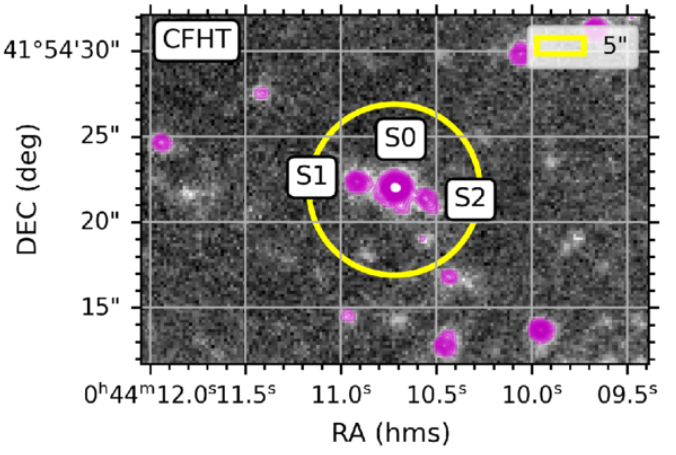
Optical image showing the location of sources near the location of M31N 2017-01e. The yellow circle corresponds to a radius of 5 arcseconds and is centered on the nova. Labeled S0, the source coincides with the location of the nova with sub-arcsecond resolution. Click to enlarge. [Modified from Chamoli et al 2025]
Aiming to constrain the nature and companion star of the nova, Shatakshi Chamoli (Indian Institute of Astrophysics and Pondicherry University) and collaborators performed a multiwavelength analysis using ultraviolet and optical observations of M31N 2017-01e.
In monitoring the nova during and in between outbursts, the authors identified a source at the reported location of M31N 2017-01e that exhibited variability and color consistent with previous observations of the system. Through a detailed photometric analysis, the authors found that the color and emission properties of the source are consistent with a hot, early-type star as was previously suggested. Though all the observational signs point toward a B-type companion, there’s one glaring obstacle to that scenario: such a massive star would typically be unable to transfer the amount of mass necessary to fuel the nova’s frequent eruptions without the accretion becoming unstable.
What else, then, could the companion be? The authors considered another stellar companion known as a Be star — a rapidly rotating, early-type star that occasionally hosts a disk of loose stellar material. With a blue color and spectral features similar to B-type stars, a Be star could match the observational properties of the nova’s companion while solving the problem of its accretion. Outbursts of M31N 2017-01e likely arise due to the white dwarf lying very near or within the Be star’s circumstellar disk, siphoning material and adequately fueling the system’s recurring eruptions. To confirm this hypothesis, researchers will need to perform follow-up infrared observations to search for the tell-tale signs of a dusty disk around the companion star.
This system is rare and challenges the assumed properties of recurrent novae. From this study, it is clear that nova progenitors are potentially quite diverse and require further multiwavelength observational programs to identify more systems like M31N 2017-01e.
“Challenging Classical Paradigms: Recurrent Nova M31N 2017-01e, a BeWD System in M31?” Shatakshi Chamoli et al 2025 ApJ 991 174. doi:10.3847/1538-4357/adf843
The post Rapid Recurrent Nova May Be Challenging Perceptions appeared first on AAS Nova.
![]()
Editor’s Note: Astrobites is a graduate-student-run organization that digests astrophysical literature for undergraduate students. As part of the partnership between the AAS and astrobites, we occasionally repost astrobites content here at AAS Nova. We hope you enjoy this post from astrobites; the original can be viewed at astrobites.org.
Title: Quasar Lifetime Measurements from Extended Lyα Nebulae at z∼6
Authors: Dominika Ďurovčíková et al.
First Author’s Institution: MIT Kavli Institute for Astrophysics and Space Research
Status: Published in ApJ
Observations have shown that galaxies, from our own Milky Way to far out into the distant universe, often host supermassive black holes at their centres. While the exact growth history of supermassive black holes is still uncertain, astronomers think that they likely begin as much less massive black holes, which grow primarily by eating up gas in a process known as accretion. As gas falls into the black hole, it releases a huge amount of energy, allowing astronomers to observe accreting black holes even when they’re billions of light-years away from us. The most luminous accreting supermassive black holes are known as quasars.
A supermassive black hole pulls gas in towards itself due to the force of gravity, but light emitted by the gas simultaneously exerts an outward pressure known as radiation pressure. The faster gas is being pulled into the black hole, the more light is emitted by the gas, and the stronger the pressure becomes. Eventually, the pressure will win out over gravity, preventing the black hole from accreting more gas. The theoretical maximum rate at which a black hole could accrete gas, without the gas being blown out by radiation pressure, is known as the Eddington rate.
If you took a black hole that initially weighed about 100 times the mass of our Sun and consistently fed it at the Eddington rate, it would take about 1 billion years to grow to the size of a supermassive black hole. However, measurements of quasar lifetimes suggest that black holes don’t continuously accrete at the Eddington rate, and instead, black holes go through phases of accretion. As a result, we should not expect to find supermassive black holes within the first billion years of the universe’s history.
But the universe loves to throw astronomers curveballs. Indeed, we have observed quasars less than 1 billion years after the Big Bang, suggesting that this simple picture of supermassive black hole growth is not quite right. Many mechanisms have been proposed as ways to speed up black hole growth, including accretion rates higher than the Eddington rate, mergers between two black holes, and phases of obscured growth during which the black hole accretes at the Eddington rate, but most of the light released in this process is hidden from view.
Today’s authors tackle the question of whether black holes have substantial phases of obscured growth by measuring the lifetimes of early universe quasars. Previous measurements have suggested that these quasars have only been active for less than 1 million years. However, the method that was previously used could be underestimating quasar lifetimes if there was a period of obscured growth. To determine whether this is the case, today’s authors use a different, independent method of measuring the quasar’s lifetime; if there’s a significant mismatch between the two age estimates, then it’s likely that the quasar has had significant periods of obscured growth.
The key to the methods used by today’s authors is that they probe different lines of sight to the quasar. Previous methods quantified the effect of a quasar’s light on the intergalactic medium (the diffuse gas in between galaxies) along the line of sight from the quasar to us. The method used in today’s article measures the size of a nebula of ionised gas, in the plane of the sky, at a right angle to the line of sight. While light from the quasar may have been obscured along our line of sight, it’s unlikely to have also been obscured at a different angle at the exact same time.
A quasar emits a lot of photons capable of ionising hydrogen, and as a result, a quasar can carve out bubbles of ionised gas in the otherwise neutral circumgalactic medium. The size of the ionised gas bubble, or nebula, grows at the speed of light, so if you know the size of the nebula, you can estimate the time since quasar activity began. Today’s authors looked for ionised gas in the circumgalactic medium of six early universe quasars, all of which are estimated to have very short lifetimes based on line-of-sight measurements.
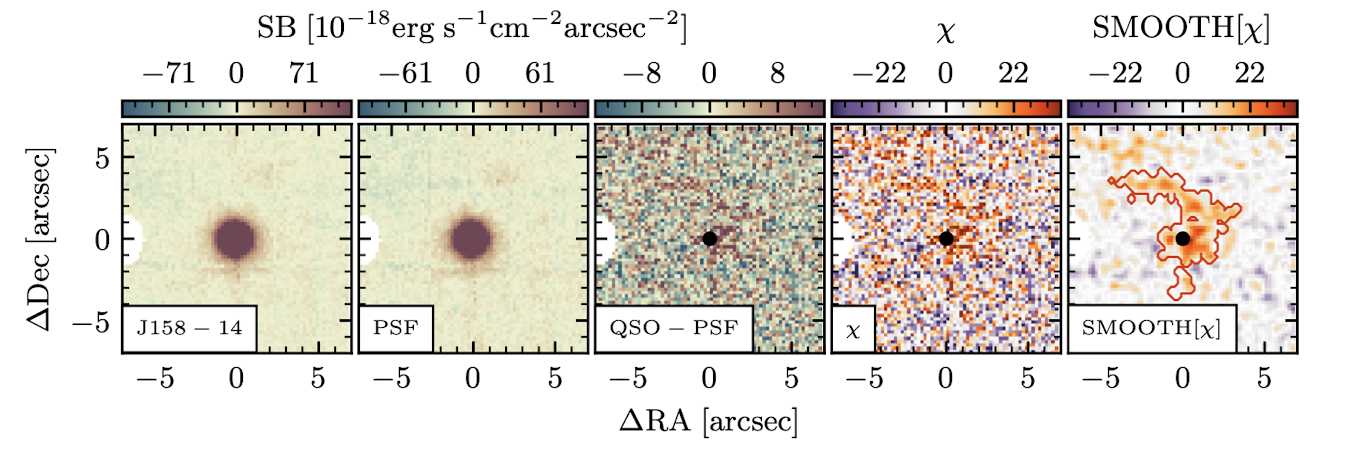
To observe ionised nebulae in the circumgalactic medium, today’s authors use observations from the Very Large Telescope’s Multi-Unit Spectroscopic Explorer (MUSE). The first three panels of Figure 1 show you (left to right) the quasar; the point-spread function (PSF), or a model of how the quasar’s light diffracts as it’s observed by MUSE; and the image of the region surrounding the quasar once you subtract the PSF from the image. Each pixel is colour-coded by brightness. The last two panels also show the PSF-subtracted image, but are instead colour-coded by the ratio of signal to noise in each pixel. In the last panel, the signal has been smoothed out, and you can see the structure of a nebula (outlined in red) emerge from the image.
Figure 1: To observe the nebula (red outlined region in the rightmost panel), you have to subtract out the light coming from the quasar (leftmost panel). [Adapted from Ďurovčíková et al. 2025]
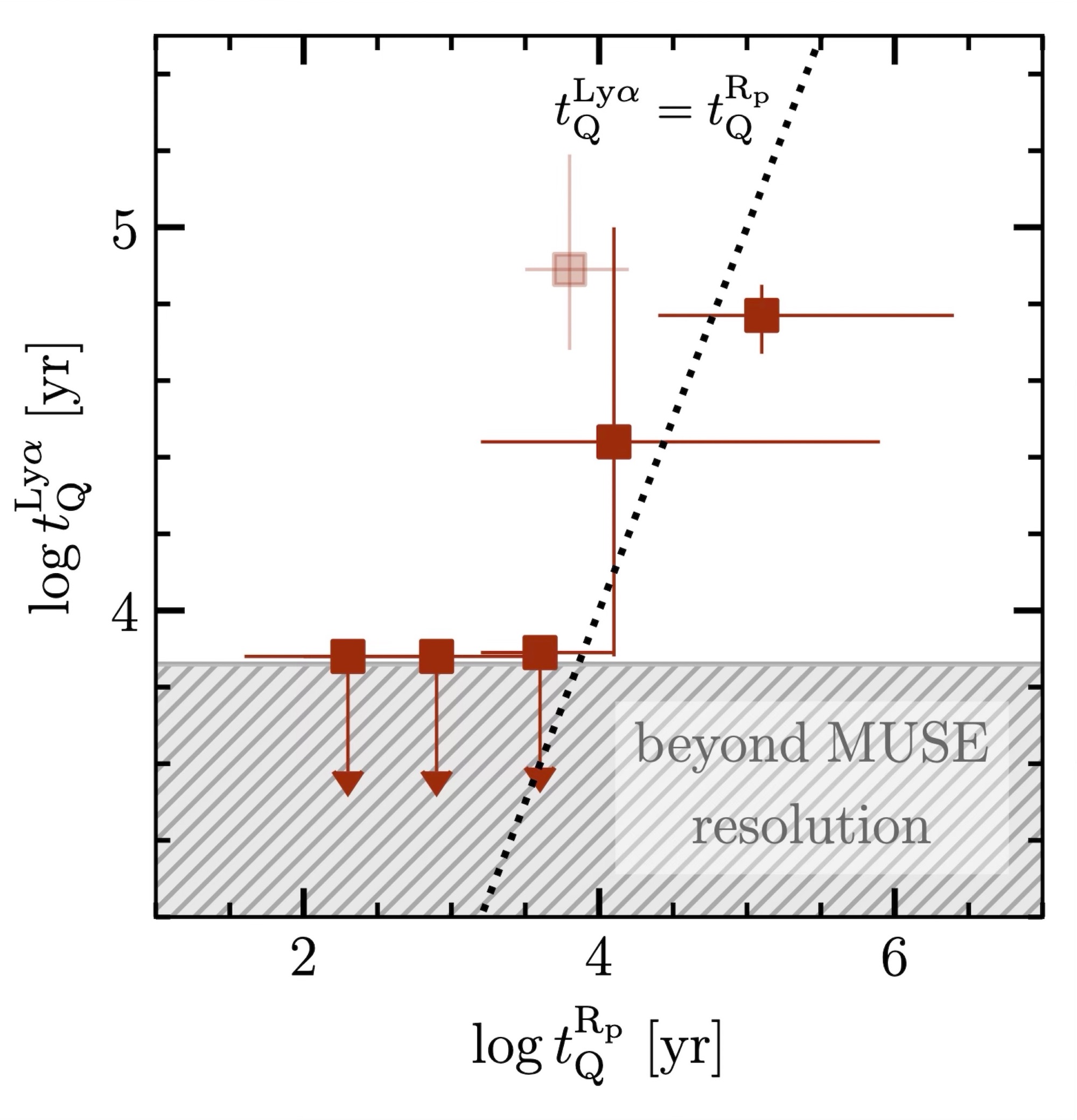
Figure 2: The age estimates derived by today’s authors (y-axis) are similar to the line-of-sight age estimates (x-axis), and generally follow a one-to-one relationship, suggesting that line-of-sight obscuration effects are not leading astronomers to underestimate the age of a quasar. [Adapted from Ďurovčíková et al. 2025]
Age estimates from the two methods are broadly pretty consistent, suggesting that obscuration effects are not causing one method to be severely underestimating the lifetime of a quasar. Therefore, for these six quasars, it seems unlikely that their growth can be primarily explained by phases of obscured growth. Instead, some other mechanism must have allowed these black holes to grow rapidly during the early universe and reach their supermassive sizes.
The mystery of how supermassive black holes can grow so quickly is still to be solved, but today’s article shows us that we haven’t been missing phases of obscured growth. The results of today’s article provide an independent measurement of quasar lifetimes, which models of supermassive black hole growth should be able to explain.
Original astrobite edited by Cesily King.
About the author, Nathalie Korhonen Cuestas:
Nathalie Korhonen Cuestas is a second-year PhD student at Northwestern University, where her research focuses on the chemical evolution of galaxies.
The post Are Quasars Growing in Secret? appeared first on AAS Nova.