❌

Normal view

Astronomers Detect Gamma-Ray Burst’s Magnetic Fingerprint

15 July 2026 at 23:42
This illustration depicts Faraday rotation in the afterglow of a gamma-ray burst. A powerful jet (upper left) sends polarized radio waves outward through the thin wall of a surrounding bubble of magnetized gas called an HII region. As the light passes through this material, its polarization angle is twisted by the magnetic field. Because the effect is stronger at longer wavelengths, the red and blue waves, which represent different radio wavelengths, exit the bubble oscillating in different directions. By measuring this difference, astronomers were able to map the magnetic environment surrounding GRB 260310A for the first time. Image credit: NSF / AUI / NRAO / M. Weiss

Using NSF’s Very Large Array (VLA), astronomers made the first radio detection of polarized light and Faraday rotation from a gamma-ray burst afterglow, offering an unprecedented glimpse of the magnetic fields surrounding one of the Universe’s most powerful explosions.

The post Astronomers Detect Gamma-Ray Burst’s Magnetic Fingerprint appeared first on Sci.News: Breaking Science News.

Pluto’s Moon Charon May Still Be Slowing Its Spin, Study Suggests

15 July 2026 at 19:16
This impressive view of Charon was captured on July 14, 2015. Charon’s color palette is not as diverse as Pluto’s; most striking is the reddish north (top) polar region, informally named Mordor Macula. Image credit: NASA / Johns Hopkins University Applied Physics Laboratory / Southwest Research Institute.

New research indicates that Pluto’s largest moon, Charon, may continue to lose rotational energy despite the pair’s long-standing tidal lock, offering scientists a rare glimpse into the hidden interiors of distant icy worlds.

The post Pluto’s Moon Charon May Still Be Slowing Its Spin, Study Suggests appeared first on Sci.News: Breaking Science News.

A New Catalog of Stellar Rotation Periods for Over a Million Stars

1 July 2026 at 18:22

TESS in space

Stellar rotation is a crucial aspect of not only stellar evolution but also exoplanet science, and a recent study has built the largest catalog of stellar rotation periods to date.

Stellar Opportunities with TESS

Since its launch in 2018, the Transiting Exoplanet Survey Satellite (TESS) has scoured the sky, searching for the signature recurring dip in starlight caused by planetary companions. While the primary goal of TESS is to discover exoplanets, the satellite’s mapping of the entire sky has created a rich database of high-quality photometry for millions of stars. These observations offer ample opportunity for scientists to study stellar properties and behavior across the Milky Way.

In particular, stellar rotation is a key property that traces a star’s age, magnetic activity, and internal structure. For exoplanet science, stellar rotation is both a help and a hindrance: it allows us to study how exoplanets may evolve over time with their host stars, but stellar activity can mimic or drown out planet signals, making them harder to detect. A few studies have investigated stellar rotation periods with TESS, looking at specific star clusters and known planet hosts. To date, however, no existing study has produced a larger catalog of TESS rotation periods — a product that would provide a wealth of information for both exoplanet and stellar evolution science.

Creating a Catalog

TESS All-Sky Rotation Survey

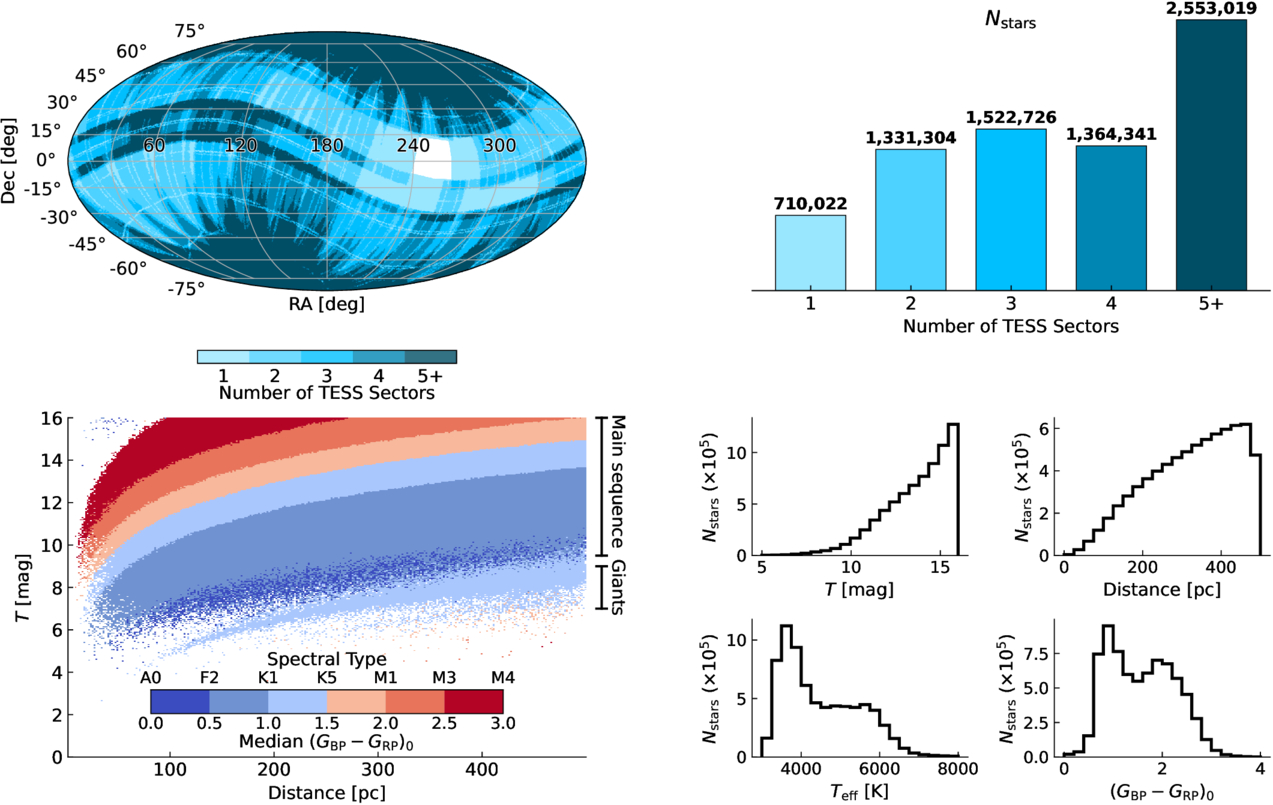
Target sample summary showing the TESS sky coverage (top left), histogram of number of TESS observations per star (top right), TESS magnitude as a function of distance to the star (bottom left), and histograms of magnitude, distance, temperature, and color across the sample (bottom right). Click to enlarge. [Boyle et al 2026]

Seeking to build a flux- and distance-limited catalog of TESS rotation periods, Andrew W. Boyle (The University of North Carolina at Chapel Hill) and collaborators used TESS full-frame images to survey the local neighborhood for stellar variability. To measure reliable stellar rotation periods for as large and diverse a sample as possible, the authors made selection cuts in brightness, distance, and data availability to build a target sample of 7,481,412 stars. They generated light curves for each observation of each star and searched them for periodicity, or repeated variation in brightness.

Not all brightness variations present in a star’s light curve are due to stellar variability — instrumental systematics and artifacts from the spacecraft’s orbital period can produce periodic variability. To combat this, the authors created a classification algorithm to select sources whose periodicity is most likely due to true stellar variability rather than instrumental or observational effects. Pairing this classification with some additional validation criteria, the authors built the TESS All-Sky Rotation Survey (TARS), a catalog of periods for 1,046,317 stars within about 1,600 light-years of our Sun.

Map of fast rotators in TARS sample

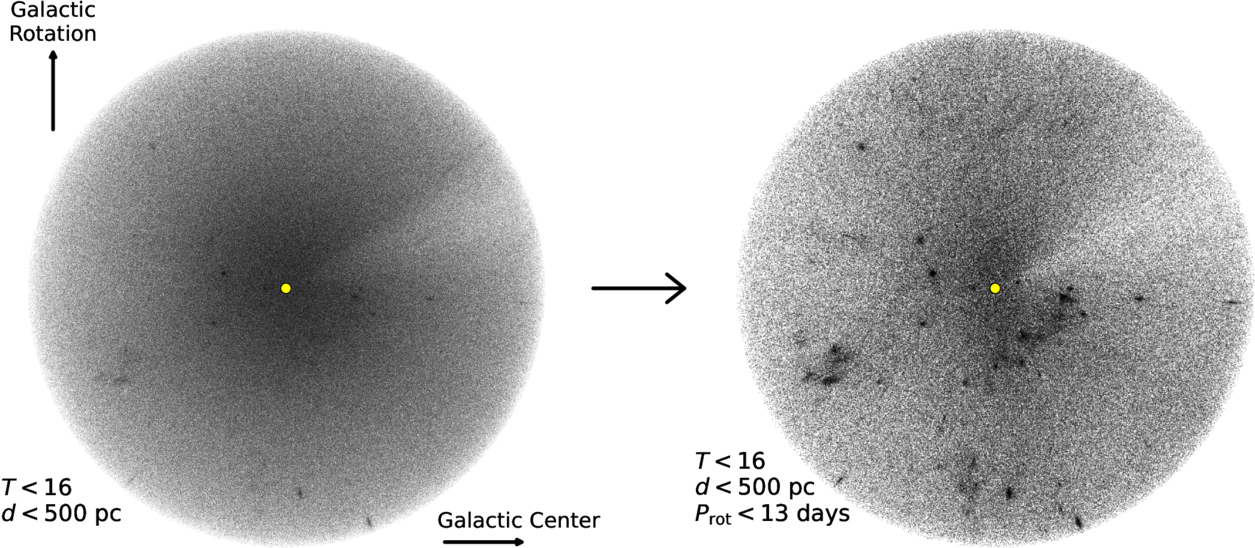
Map of all TARS stars within about 1,600 light-years of the Sun (left) and only the fast-rotating stars in the survey, highlighting clustered populations (right). Click to enlarge. [Boyle et al 2026]

Implications of TARS

Looking more finely at the TARS catalog, the authors provided additional quality cuts to remove other potential sources of stellar variability like binary companions or pulsations. The authors estimated that roughly 93% of their measured periods are due to stellar rotation, which expands the number of stars with known rotation periods by a factor of 2.3 within about 325 light-years and by a factor of 4.0 within about 1,600 light-years. As the largest homogeneous catalog of stellar rotation periods to date, TARS lays the groundwork for studies of stellar evolution, exoplanet discovery and evolution, and even Milky Way structure. For example, the authors found that when mapping the fast-rotating, typically younger stars in TARS, the location of young stellar associations in the local neighborhood became significantly clearer. This underscores the importance of this catalog for a range of science goals, and future work will only improve upon the data provided by TARS.

Citation

“The TESS All-Sky Rotation Survey: Periods for 1,046,317 Stars within 500 pc,” Andrew W. Boyle et al 2026 ApJS 284 75. doi:10.3847/1538-4365/ae6657

The post A New Catalog of Stellar Rotation Periods for Over a Million Stars appeared first on AAS Nova.

Asteroid Donaldjohanson is Wobbly, Peanut-Shaped Object with Watery Past, Scientists Say

22 June 2026 at 17:26
The asteroid Donaldjohanson is composed of two heavily cratered lobes, connected by a smoother neck, with overall dimensions 8.8 km by 4.4 km by 3.1 km. Image credit: NASA / Goddard / SwRI / Dan Gallagher.

The main-belt asteroid Donaldjohanson, a heavily cratered fragment born from a catastrophic breakup 155 million years ago, appears to wobble through space while preserving clues to the migration of water-rich worlds in the early Solar System, according to a new analysis of images and data from NASA’s Lucy spacecraft.

The post Asteroid Donaldjohanson is Wobbly, Peanut-Shaped Object with Watery Past, Scientists Say appeared first on Sci.News: Breaking Science News.

What makes ‘chemically peculiar stars’ peculiar?

27 April 2026 at 12:00

Stars are mostly made of 2 elements: hydrogen and helium. While this has always been the case, those 2 elements and lithium were the only elements in existence when the Big Bang occurred around 14 billion years ago. When the first stars exploded, they released those primordial elements, as well as heavier elements produced by nuclear fusion inside them. 

Astronomers call all elements heavier than hydrogen and helium metals, a term chemists use quite differently. Subsequent generations of stars, including the Sun, formed in clouds of gas and dust enriched with these metals, such as carbon, oxygen, magnesium, and silicon. Scientists estimate that modern stars are 1% to 5% metal by mass.

Astronomers claim there is no solid evidence that stars contain exceptionally high amounts of metals, but some, called chemically peculiar stars, appear to. Astronomers study stars by looking at the patterns of light they emit, called spectra. Each element produces a unique light pattern, so astronomers can compare the light patterns in a star’s spectra to determine how much of each element is present, especially in the outer layers of the star. Researchers theorize that chemically peculiar stars don’t actually have more metals than average stars. Instead, they think that metals from their interiors diffuse to their outer layers more than in most stars.

A team of researchers from the American Association of Variable Star Observers and Masaryk University in Czechia recently observed 85 chemically peculiar stars to understand their behavior and better classify them. For their study, they first used the General Catalog of CP Stars, published in 2009 in Astronomy & Astrophysics, to identify targets across the 4 classes of these stars, labeled CP1 through CP4. CP1 stars have strong spectral patterns for iron and other heavy elements, CP2 stars have strong patterns for silicon, chromium, strontium, and europium, CP3 stars have strong patterns for mercury and manganese, and CP4 stars have either unusually weak or usually strong helium patterns. 

The team compiled a list of 85 stars to observe, then used the BRIght Target Explorer (BRITE) Constellation to monitor changes in their brightness. The BRITE Constellation is a set of 5 satellites equipped with telescopes and cameras for either red or blue light. Using the BRITE Constellation, the team monitored each star for several days. 

They found that 74 of these 85 chemically peculiar stars varied in brightness during their survey. They attributed this to the varied abundance of metals on their surfaces, which would form dark patches that go in and out of view from Earth’s perspective as the stars rotate. The team observed that 6 of these 74 stars appeared to change in brightness over multiple periods. They were surprised by this result because a star’s brightness wouldn’t vary over multiple periods if the changes were due to rotation. They compared their findings to data other scientists had collected from these stars with the Transiting Exoplanet Survey Satellite, or TESS, and found that all 6 stars had been misclassified as chemically peculiar stars.

The other 11 chemically peculiar stars appeared to show no periodic changes in their brightness, suggesting that they’re stationary. The team claimed that some CP1 and CP3 stars don’t rotate, but they identified cases in which CP2 and CP4 stars that ought to rotate appeared to be stationary. They suggested 2 potential reasons for this. One is that these CP2 and CP4 stars are misclassified, requiring more thorough analysis of their spectra to confirm their classifications. The other is that the stars rotate slowly, with rotational periods of 50 days or longer, which would be difficult to distinguish from those of totally stationary stars.

The team concluded that more astronomers should revisit the historical classifications of stars, especially as technology advances and more space-based telescopes become available. This strategy would allow future researchers to draw better data from research archives and catalogs. Additionally, they claimed that their method of pairing long-term monitoring via small satellites with TESS data is well-suited for refining classifications, identifying misclassified objects, and further exploring the structure and mechanics of chemically peculiar stars.

The post What makes ‘chemically peculiar stars’ peculiar? appeared first on Sciworthy.

❌