❌

Normal view

Mercury Has Shrunk Even More than Planetary Scientists Thought

14 September 2026 at 19:41
This color image of Mercury was generated from three MESSENGER images taken through filters sensitive to light in different wavelengths. Image credit: NASA / Johns Hopkins University Applied Physics Laboratory / Carnegie Institution of Washington.

The Solar System’s smallest planet has contracted by nearly 19 km (12 miles) across, as crater debris masked telltale wrinkles on its surface, according to new research led by the German Aerospace Center’s Institute of Space Research.

The post Mercury Has Shrunk Even More than Planetary Scientists Thought appeared first on Sci.News: Breaking Science News.

Mercury May Have Shrunk Far More Than Scientists Realized—and Its Cratered Surface Was Hiding the Evidence

14 September 2026 at 13:35

Mercury has been slowly shrinking for billions of years. But scientists studying the smallest planet in the solar system may have overlooked just how dramatic that transformation has been because some of the evidence has literally been buried.

A new study suggests Mercury’s battered, crater-covered surface has concealed a significant fraction of the faults created as the planet cooled and contracted. After accounting for those hidden geological structures, researchers estimate Mercury may have shrunk by as much as 7.2 miles (11.6 kilometers) in radius—up to 30% more than previous estimates based on the same tectonic record.

The findings could alter models of how Mercury’s interior evolved and raise an interesting possibility beyond the planet itself. For instance, scientists may also be underestimating how much other rocky worlds, particularly the Moon, have contracted.

“Combined with the contractional strain map from Broquet and Andrews-Hanna (2026a), we show that radial contraction may have been underestimated by 10%–30%,” researchers write. “Our radial contraction correction should be considered as a lower bound.”

In the study published in Geophysical Research Letters, researchers led by Dr. Gaku Nishiyama of the German Aerospace Center (DLR) examined a longstanding mystery in Mercury’s geology.

As a rocky planet loses heat, its interior contracts. Much like the skin of a drying fruit, the planet’s rigid exterior must accommodate a shrinking interior, producing faults and enormous cliff-like features known as lobate scarps, along with wrinkle ridges and other shortening structures.

Scientists therefore use the crustal shortening recorded by these structures as a geological ruler to determine how much Mercury has contracted.

The problem is that those structures aren’t distributed across Mercury the way scientists might expect.

If cooling caused the entire planet to contract, the resulting deformation should be comparatively widespread. Instead, previous mapping has revealed regions filled with large scarps alongside enormous areas where surprisingly few contractional structures have been identified.

Dr. Nishiyama and his colleagues investigated whether at least part of that discrepancy could be an illusion created by Mercury’s extraordinarily battered surface.

Mercury’s Craters May Be Hiding Its Wrinkles

The researchers constructed a global map of Mercury’s surface roughness using topographic measurements acquired from NASA’s MESSENGER mission and a global digital terrain model produced from spacecraft imagery.

They then compared that roughness with previously cataloged tectonic structures.

Findings showed that fault scarps and other shortening structures were preferentially identified in smoother terrain, while rougher regions contained substantially fewer detectable structures. The relationship remained apparent across geographic scales extending to roughly 93 miles or about 150 kilometers.

That is counterintuitive because tectonic ridges themselves create topographic roughness. If roughness and plate movements were unrelated, areas with scarps might be expected to be slightly rougher than the surrounding terrain.

Instead, the researchers found the opposite.

One explanation is evident around relatively young impact craters such as Rachmaninoff. Large impacts blasted enormous quantities of debris across the surrounding landscape, producing thick blankets of material and secondary craters. In some locations, long tectonic structures appear to lose relief as they approach these deposits—consistent with the older structures being progressively hidden under impact material.

Other faults may still exist but become difficult to recognize against heavily cratered terrain. Once the surrounding topography becomes rough enough, a weathered ridge only a little higher than the background landscape can effectively disappear into the geological noise.

There is also a third possibility.

Heavily cratered regions may contain thick, porous layers of broken rock called regolith. During planetary contraction, some deformation could be absorbed as pores collapse rather than producing large faults visible from orbit. Alternatively, deformation could create faults too small for current observations to resolve. The researchers say available evidence cannot yet rule out that possibility.

Mercury Could Have Shrunk by More Than 7 Miles

Whatever mechanism is responsible, Dr. Nishiyama and his colleagues argue the relationship creates a systematic bias, where scientists see more evidence of contraction where Mercury’s surface makes that evidence easier to preserve and identify.

The team developed a correction using comparatively smooth regions, where tectonic structures appear less affected by this bias.

Applied to an earlier global estimate of 5.2 miles (8.3 kilometers) of radial contraction, the correction increased Mercury’s estimated shrinkage to roughly 7.2 miles or about 11.6 kilometers.

Depending on which tectonic structures are included, the researchers estimate surface roughness could have caused previous calculations to underestimate Mercury’s contraction by roughly 10% to 30%. They also caution that their corrected figure may itself represent a lower limit.

Ultimately, Mercury’s shrinking surface effectively records what has happened deep inside the planet.

The amount of contraction constrains how quickly Mercury lost heat, the thickness of its insulating regolith, the abundance of heat-producing elements, and even the composition and freezing history of its enormous metallic core. The revised estimate, for example, favors models involving a thinner regolith and lower sulfur content in Mercury’s core than some previous estimates.

Scientists may soon get a much sharper look.

The ESA-JAXA BepiColombo mission’s laser altimeter will eventually measure Mercury’s topography at scales as small as about 330 feet or 100 meters, possibly revealing geological relationships that MESSENGER could not resolve.

And Mercury may not be the only world whose geological record has been hiding in plain sight.

The Moon’s highlands are even rougher than Mercury’s cratered plains—by roughly 40% at the little-over 6-mile (10-kilometer) scale examined by the researchers. Yet evidence suggests the Moon contracted less than some thermal models estimate. If rough terrain similarly hides lunar faults, part of that difference might reflect structures scientists haven’t been able to see.

In other words, Mercury’s missing wrinkles may expose a wider problem in planetary geoscience. The more battered an ancient world becomes, the more effectively its later surface can erase the visible record of what happened before it.

“Investigating roughness alongside tectonic landforms may therefore refine our understanding of the lunar thermal evolution as well,” researchers conclude. “Mars could also be subject to this roughness effect, while topographic smoothing due to fluvial and aeolian processes may introduce more complex correlation between surface roughness and shortening structures.”

Study: Nishiyama, G., Broquet, A., Tosi, N., Preusker, F., Stark, A., Hussmann, H., & Hauber, E. “Underestimation of Planetary Contraction Due to Obscuration by Surface Roughness: The Case of Mercury.” Geophysical Research Letters 53, (2026). 

Tim McMillan is a retired law enforcement executive, investigative reporter and co-founder of The Debrief. His writing typically focuses on defense, national security, the Intelligence Community and topics related to psychology. You can follow Tim on Twitter: @LtTimMcMillan.  Tim can be reached by email: tim@thedebrief.org or through encrypted email: LtTimMcMillan@protonmail.com 

Mercury is shrinking faster than we thought. What's going on inside of it?

10 September 2026 at 16:00

Wrinkles on the surface of Mercury have revealed that the closest planet to the sun is shrinking faster than scientists thought.

New research suggests that Mercury is shrinking between 10% and 30% faster than had been previously estimated. The team behind this research calculated that the planet has lost nearly 12 miles (19 kilometers) of its total diameter since it formed.

The researchers think that the extremity of this shrinking has gone unnoticed previously because bombardment from space rocks over time has created craters that obscured the evidence of this process.

Scientists say determining the extent of the shrinking of Mercury is key to investigating the composition of the planet's interior.

"More shrinking means Mercury could have a larger metal core, less light elements like silicon mixed into the metal core, or a higher starting temperature," team leader Gaku Nishiyama, of the German Aerospace Center (DLR) Institute of Space Research said in a statement.

Mercury's rocky past

Like all rocky planets in the solar system, Mercury was formed 4.5 billion years ago during a violent and turbulent time in the solar system's history, as rocks and asteroids collided with each other and were bound together.

These impacts generated heat, which Mercury has been losing ever since. As the interior of Mercury cooled, it also shrank. This caused geological wrinkles in the form of scarps and ridges to develop in the rocky outer layers of Mercury.

This cooling should result in Mercury shrinking in a roughly uniform way, and that would make these shortening structures common across the planet. However, asteroid impacts throughout its history have not only created craters that obscure signs of its geological history, but have also spread debris across the surface of Mercury. This makes wrinkles tougher to spot among the accumulation of billions of years' worth of geological features.

A rough grey surface with circular indentations

NASA's Messenger spacecraft spots an apparently fresh crater on Mercury during its early orbits on March 29, 2011. (Image credit: NASA/JHUAPL/CIW)

The team combined previous maps of Mercury's geology with new observations of the entire planet's surface roughness. They found the roughest terrain of Mercury featured the fewest wrinkles.

"It made us think that there's a process obscuring shortening structures," said Nishiyama, who thinks that impact debris in the roughest regions of Mercury is covering shrinking wrinkles.

The team then used the ridges and scarps in regions less affected by the dispersal of debris to estimate the amount of contraction. This indicated that missing features in rough areas could amount to 10% to 30% extra shrinkage over the 4.5 billion-year lifetime of Mercury. That amounts to a total change in diameter of up to 14.5 miles (23 kilometers) rather than the currently estimated 2.5 to 10 miles (4 to 16 kilometers).

"30% is a little bit surprising, but the corrected amount of contraction actually makes sense to me," Nishiyama said.

A grey sphere with a silver and gold spacecraft over it

An illustration of NASA's MESSENGER probe over the surface of Mercury (Image credit: NASA/JHU-APL)

There may be more surprises in store. Nishiyama believes that the updated figures could still be an underestimate. This estimate is based on data collected by NASA's MESSENGER probe, which ended in 2015. MESSENGER could only distinguish features larger than around 3 miles (5 kilometers) across.

In November 2026, the BepiColombo mission will start conducting scans of Mercury's surface in much higher resolution than this, and that could reveal even more shrinkage features.

The team's research was published on Thursday (Sept. 10) in the journal Geophysical Research Letters.

Mercury may have shrunk much more than we thought, new study hints

10 September 2026 at 14:00

Mercury, which is about one-third the size of Earth, may have shrunk more in its evolution than scientists originally thought.

A new study suggests that the tiny planet may have contracted 10% to 30% more than previous models suggested — meaning the planet’s total diameter shrunk almost 12 miles (19 km) since Mercury was formed. (Mercury’s diameter today is roughly 3,032 miles (4,880 km).

Previous missions overlooked the extent of the shrinkage because impact-crater debris on Mercury's surface hid the evidence, according to a study published Thursday (Sept. 10) in the journal Geophysical Research Letters. That size difference is important when researchers consider the planet's history, said Gaku Nishiyama, a planetary scientist at the German Aerospace Center Institute of Space Research and an author of the study.

"Because Mercury's evolution is driven by its cooling, the amount of contraction — an indicator of the extent of cooling — is one of the most important observables that can be compared to models for estimating its evolution scenario," Nishiyama told Live Science in an email.

There could also be implications for the planet's composition. For example, more shrinkage at Mercury could mean the planet would have a larger metal core and fewer light elements, such as silicon, inside that core, according to an American Geophysical Union statement.

"The interior of Mercury would reflect its formation," Nishiyama said, and possibly hint at the innermost part of our solar system. "Therefore, to understand how our solar system has evolved up to now, information that can be extracted from this estimation — such as core composition and initial temperature condition — is critical."

A violent history

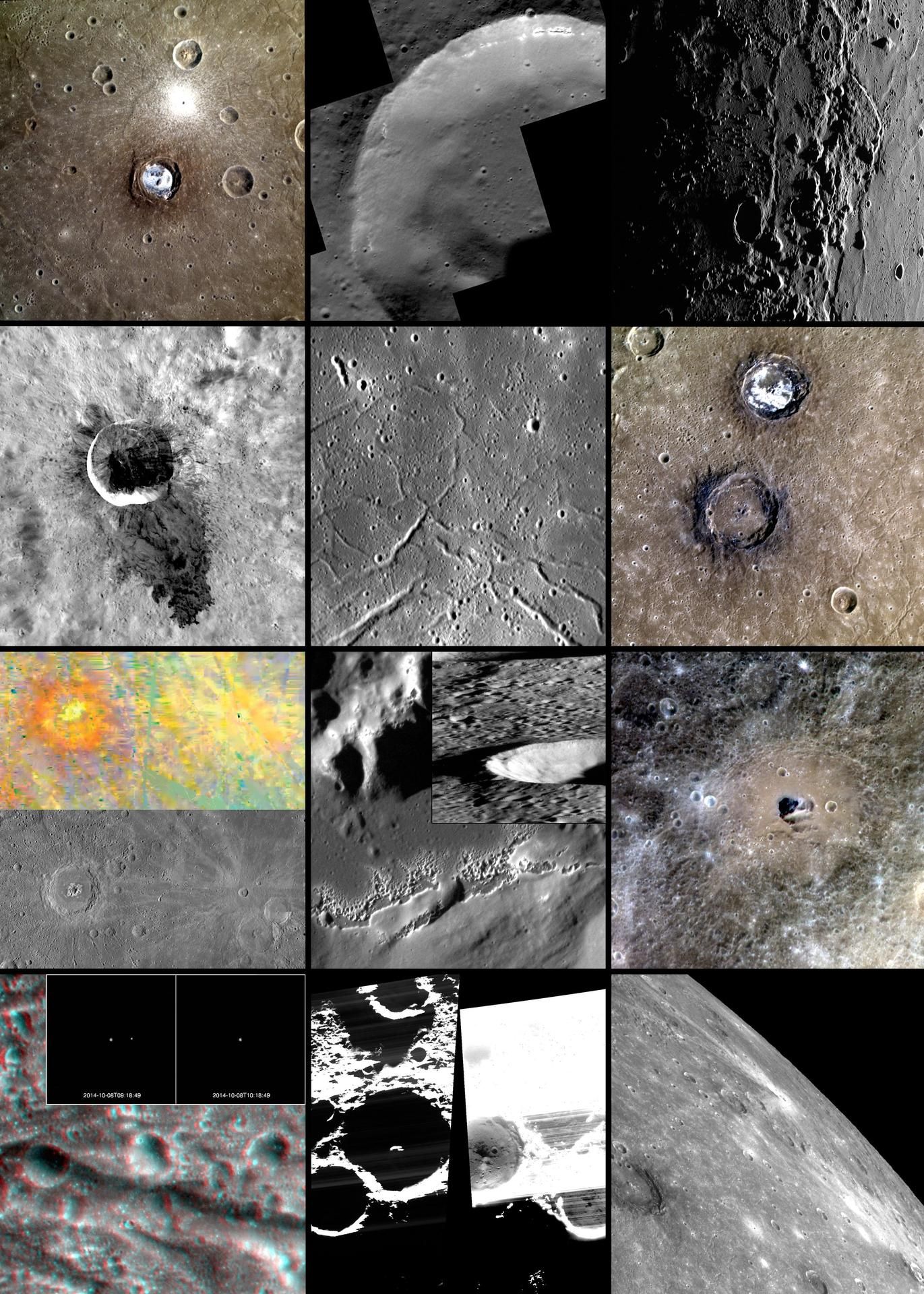
A series of images of the surface of Mercury from space.

Observations from NASA's MESSENGER spacecraft (examples shown here) helped the team build new maps of the planet's shrinkage. (Image credit: NASA/Johns Hopkins University Applied Physics Laboratory/Carnegie Institution of Washington)

Mercury and the rest of the solar system planets formed due to the gradual collisions and aggregations of rock and gas upon asteroids and comets. Some of those impacts that created the planets also released a lot of heat. Mercury has been slowly cooling from those ancient impacts, and its interior has been shrinking along the way.

While this kind of cooling affects the entire planet's landscape, impact craters can mask the effects because each crash into the surface generates its own surface changes, including debris and new divots. The craters build up over time, making it difficult to spot more ancient geology underneath.

Nishiyama's team compared two sets of maps from Mercury, using data from NASA's MESSENGER mission, which orbited Mercury between 2011 and 2015. One set of maps charted geological features showing contraction, and the other set estimated the roughness of the planet's surface. Their work covered the entire surface and demonstrated that the most rugged spots on the planet have fewer wrinkles from shrinking. In other words, according to Nishiyama, the debris from more recent impacts is covering up the evidence of shrinking.

Nishiyama said more information will help to confirm the estimate. Such data could come from the European Space Agency's BepiColombo spacecraft, which began its arrival sequence at Mercury earlier this month after nearly eight years of space travel. Once the mission settles in, the spacecraft will take higher-resolution imagery of the surface than MESSENGER did. Nishiyama's team expects BepiColombo to pick up smaller impact craters, as well as scarps and ridges, that could further refine the measurements.

"Stay tuned for future topography measurements by BepiColombo," Nishiyama said. "Future data from laser altimetry on BepiColombo will collect more information on planetary contraction by measuring topography more precisely."

BepiColombo Begins Final Approach to Mercury

6 September 2026 at 23:52
An artist’s impression of the ESA/JAXA BepiColombo spacecraft in cruise configuration, with Mercury in the background. On its 7.2 year journey to the innermost planet, BepiColombo will fly by Earth once, Venus twice and Mercury six times before entering into orbit. The MTM module is shown with ion thrusters firing, and with its solar wings extended, spanning about 100 feet (30 m) from tip-to-tip. The 24.6-foot (7.5 m) long solar array of the MPO orbiter in the middle is seen extending to the top. The Mio orbiter is hidden inside the sunshield in this orientation. Image credit: ESA / ATG Medialab / NASA / JPL.

After nearly eight years and billions of kilometers of travel, BepiColombo -- a science mission led by ESA in close collaboration with JAXA -- has begun its long-awaited arrival at the smallest and innermost planet in our Solar System.

The post BepiColombo Begins Final Approach to Mercury appeared first on Sci.News: Breaking Science News.

After 8 years, Europe's BepiColombo mission is on final approach to Mercury

4 September 2026 at 23:49

The BepiColombo mission cleared a major milestone this week in the final stretch of an eight-year interplanetary voyage to Mercury, the hard-to-reach, scorching hot iron world at the Solar System's innermost frontier.

The robotic science mission, with a price tag of nearly $2 billion, is led by the European Space Agency with contributions from Japan and the United States. Since its launch in 2018, BepiColombo has spiraled closer to the Sun using a combination of plasma propulsion and a series of flybys of Earth, Venus, and Mercury. The maneuvers changed the spacecraft's velocity and steered it toward a final encounter with Mercury later this year.

Next time it reaches Mercury, BepiColombo will be traveling at just the right speed for the planet's gravity to capture the spacecraft into orbit. Scientists working on interplanetary missions are accustomed to long waits for scientific payoffs. It took nearly 10 years for NASA's New Horizons spacecraft to travel from Earth to Pluto. It turns out traveling to fleet-footed Mercury and then entering orbit requires more energy, or delta-v, than sending a probe to fly by Pluto.

Read full article

Comments

© ESA/ATG medialab and NASA/JPL

2 spacecraft will soon reach Mercury after 8 years in space. Here's what BepiColombo can do

Mercury, the tiniest and least-explored planet in the inner solar system, is hiding mysteries far larger than itself — and finally, scientists will soon be getting not one but two spacecraft designed to decode the strange world.

That's thanks to the BepiColombo mission, a joint project of the European Space Agency (ESA) and Japan Aerospace Exploration Agency (JAXA) that launched in October 2018. After a harrowing journey through the inner solar system, the mission is tackling a crucial maneuver on Thursday (Sept. 3): separating its science equipment from the transport that carried it all that way. By April 2027, scientists hope the mission's two instrument-heavy probes will be gathering a slew of observations that could help solve puzzles about Mercury — and maybe even the solar system we call home.

"I think being able to see new data come out about Mercury is going to be so fantastic," Rachel Klima, a planetary geologist at the Johns Hopkins University Applied Physics Laboratory, told Space.com. The planet, she says, is "just so weird and beautiful and interesting."

An enigmatic planet

For now, Mercury holds the dubious honor of being the least-explored planet in the inner solar system, visited by only two missions to date. NASA's Mariner 10 spacecraft made a trio of zippy flybys in 1974 and 1975, giving scientists their first glimpses of the planet's cracked and cratered surface, as well as confirming the world has both a very tenuous atmosphere and a magnetic field.

"It really gave us our first close-up view of Mercury," Sean Solomon, a planetary scientist at Columbia University, told Space.com. "But it left a lot of pages blank."

And for decades, that was it. Scientists didn't return to Mercury until 2011, when NASA's MESSENGER spacecraft, with Solomon as its principal investigator, arrived at the tiny world. (Mercury has a radius of 1,516 miles, or 2,440 kilometers, meaning its width is just over a third of Earth's.) The spacecraft was packed with tools tailored to the job, such as spectrometers tuned to gamma-rays, X-rays and neutrons, and instruments to sniff out the atmosphere and measure the magnetic field, and it was there to stay. Four years of observations with MESSENGER showed scientists Mercury's complete surface for the first time, and by late in its mission, the spacecraft was passing just 15.5 miles (24.9 km) above the planet's surface.

But even MESSENGER wasn't sophisticated enough to crack Mercury's puzzles or unveil the strange planet's beginnings. "I think the jury's still out on exactly how Mercury got assembled," Solomon said.

Deep craters seen on a planet in this black and white image. A solar wing is visible on the right side.

Flying over Mercury's north pole gave BepiColombo's monitoring camera 1 (M-CAM 1) a unique opportunity to peer down into the shadowy polar craters on Jan. 8, 2025. (Image credit: ESA/BepiColombo/MTM)

MESSENGER opened up some smaller mysteries, too. It discovered bright, steep-sided pits that scientists dubbed "hollows." It found a suite of elements — that planetary scientists call "volatiles" for their tendency to slip free of rock — somehow more prevalent in Mercury's surface than Earth's. It calculated that the center of the planet's magnetic field is wildly offset from the planet's core. Plus, MESSENGER's tricky orbit also meant the spacecraft never saw the southern half of the planet as sharply as the northern half, leaving one side shadowed in doubt.

The arrival of BepiColombo

It's these mysteries that the ambitious BepiColombo mission hopes to tackle. By April, if all goes well, the mission will consist of two separate spacecraft gathering independent but coordinated data about Mercury.

Europe's Mercury Planetary Orbiter, or MPO, will focus on the planet proper. It's packed with 11 science instruments that will map the terrain, minerals in the crust, and the gravity field, investigate the hollows and volcanic deposits, and observe how the barrage of charged particles from the sun affects this innermost planet.

Japan's Mercury Magnetospheric Orbiter, or Mio, meanwhile, will focus on the planet's surroundings — its magnetosphere and wispy atmosphere, as well as the dust cluttering up its neighborhood.

Both spacecraft also carry instruments to measure the planet's magnetic field, offering simultaneous observations of different parts of the field to scientists who typically make do with data gathered from just one location at a time.

In fact, some of these instruments have been able to gather observations during BepiColombo's long trek to Mercury and its six quick flybys of the planet so far. But because of how the spacecraft were configured for the journey, most of the instruments have not — and will not — get to work until after MPO and Mio have separated. That is expected to happen in December.

The mission's science, then, has begun only in dribbles, while the bulk of its promise still lies ahead. "There is a growing literature of new results that have come from the BepiColombo flybys, but I expect that will explode once they go into orbit," Solomon said.

Diagram showing the key moments in the BepiColombo mission's arrival at Mercury.

A diagram showing BepiColombo's path to getting near Mercury. (Image credit: ESA)

He's especially excited to see the spacecraft's sharp views of the southern hemisphere, and particularly find hidden deposits of water ice across the area. These deposits would exist in deep craters that never feel the sun's heat. In examining this region of the planet, scientists will be able to reduce the northerly bias of MESSENGER's data and better see Mercury's complete picture.

Meanwhile, Klima is most eagerly awaiting MPO's work to map elements and minerals in the planet's surface. This work eluded MESSENGER, which used a technique that relied on these rocks being rich in iron and similar materials — but as it turned out, those elements were absent, leaving scientists stymied. MPO carries different technology that will be able to read rocks on the world even without iron, which Klima said could help reveal how Mercury — and our whole solar system, as a matter of fact — formed.

Klima says she hopes BepiColombo can get people excited about Mercury, the overlooked terrestrial planet of the solar system: "It certainly doesn't get the love and attention that Mars and Venus and everywhere else gets."

❌