Normal view
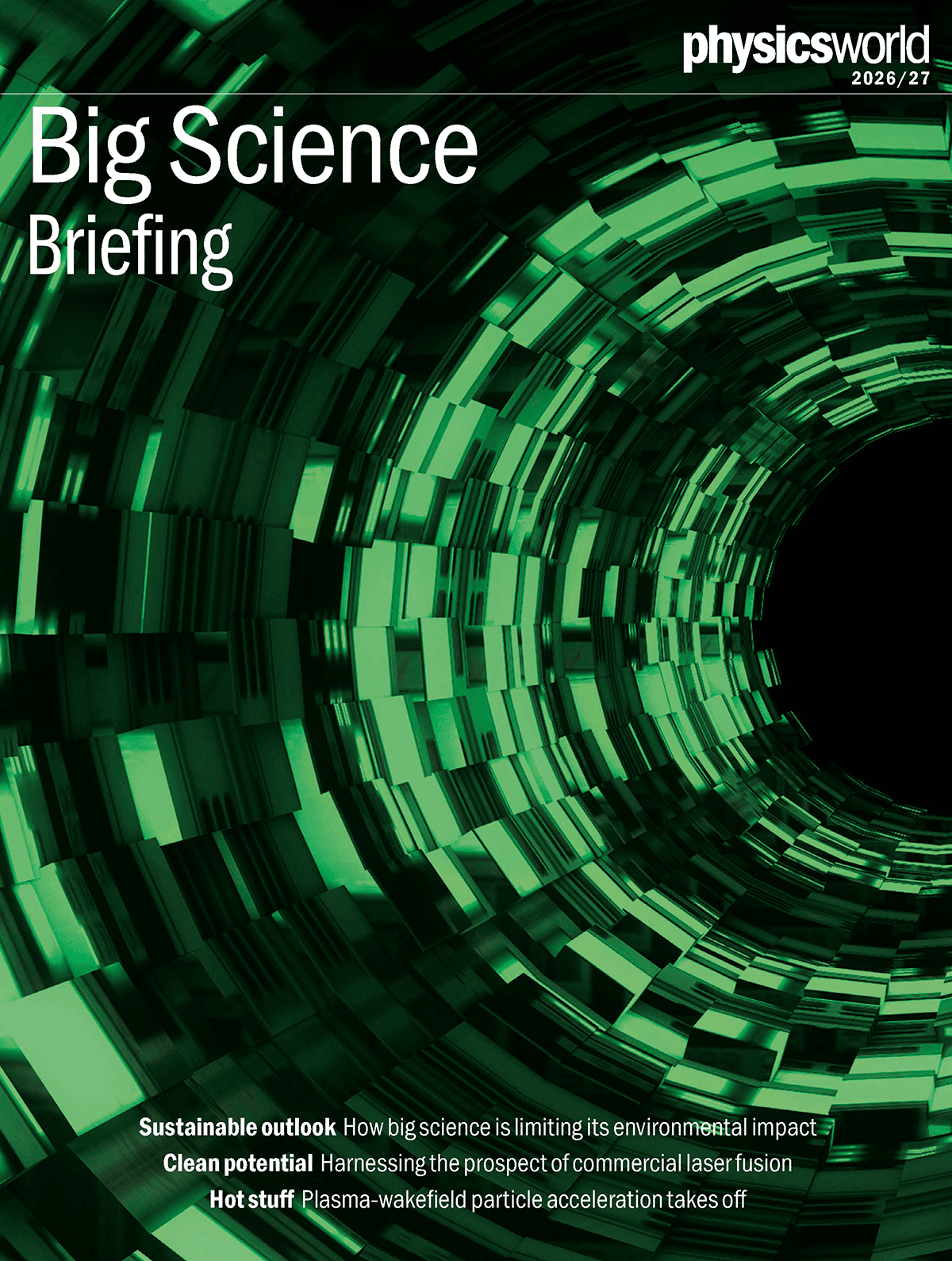
The free-to-read Physics World Big Science Briefing 2026 is out now
This summer in the Northern hemisphere has been a real scorcher with Western Europe experiencing prolonged hot and dry conditions that have fueled extreme wildfires across the region.
With that weather set to become the norm rather than a one-off event, everyone will need to do their bit to curtail the impact of climate change and “big science” is no different.
In this year’s Physics World Big Science Briefing, we report how accelerator science is making its technologies and facilities more sustainable. The aim is not only to cut the energy and resources that accelerators use, but also to understand – and, more importantly, minimize – their “whole-lifetime” environmental impact.
Longer term, researchers are also prioritizing disruptive accelerator concepts that could slash the size, cost and carbon footprint of next-generation facilities.
One example is plasma-wakefield acceleration, which uses laser- or particle-beam-driven intense “plasma waves” as the accelerating medium, yielding electric fields up to 1000 times greater than in classical accelerators. Those ultra-high accelerating gradients promise a significant reduction in the size, cost and carbon footprint of next-generation accelerator facilities.
Commercial considerations
With the world’s energy demands increasing, and our impact on the climate becoming ever clearer, the search is on for greener, cleaner energy production. That’s why fusion energy has undergone something of a renaissance in recent years.
According to a report by the Fusion Industry Association on the state of the fusion industry, 71% of the 56 private fusion companies surveyed for the report expect the first fusion plant to deliver commercial electricity by the 2030s.
One of the companies with such ambitious aims is Focused Energy, a laser-fusion firm based in Germany and California, which is attempting to generate energy from the laser-driven fusion of hydrogen isotopes.
In this briefing, Debbie Callahan, chief strategy officer at Focused Energy, describes how they plan to have a pilot plant, dubbed LightHouse, operational by the end of the 2030s.
While many milestones need to be hit before we see fusion generating electricity for the grid, when it comes to meeting the demands of a changing climate, big science is continuing to play a key role. Indeed, sustainability will be a keyword at this year’s Big Science Business Forum held in Maastricht from 27–30 October.
We hope you enjoy the briefing and let us know your feedback on the issue.
The post The free-to-read <em>Physics World Big Science Briefing</em> 2026 is out now appeared first on Physics World.
SK Hynix reportedly in talks with Intel to build memory chips in US
Adobe Joins the Race to Turn Enterprise Documents into AI Agent Workspaces
Jensen Huang explains why Nvidia will grow an astounding 70% next year
- TechCrunch
- Bending Spoons to buy collaboration tools maker Miro for $1.36B, 90% less than its 2022 valuation
Bending Spoons to buy collaboration tools maker Miro for $1.36B, 90% less than its 2022 valuation
- Computerworld
- Layoff remorse: Gartner says at least one in three positions eliminated by AI will be restored by 2029–at a higher cost
Layoff remorse: Gartner says at least one in three positions eliminated by AI will be restored by 2029–at a higher cost
Gartner on Wednesday said that it expects 30% of the positions eliminated by AI-related layoffs to be refilled by 2029, suggesting that the initial terminations were ill-advised and excessive.
“When business and IT executives look back on the early AI era, they will realize their greatest mistake was believing that work automation was the point, when workforce amplification was the opportunity,” said Tori Paulman, VP analyst at Gartner. “The competitive advantage will go to the CIOs and business executives who build an AI-shaped organization where AI value compounds by reshaping roles and allowing workflows to cross traditional boundaries, increasing velocity and reducing friction.”
The Gartner report noted that it is finding that the cuts “deplete talent pipelines and erode institutional knowledge.” Beyond the immediate workforce disruptions associated with any mass layoff, companies will also face steep increases in costs for recruitment, training, and onboarding.
It also predicted that, by 2027, “75% of organizations that prioritize capturing AI productivity gains as cost savings will be eclipsed by competitors that aggressively reinvest those gains into innovation, modernization and upskilling.”
In an interview with Computerworld, Paulman said that the 30% figure represents the average impact on organizations of all sizes; they estimate that the layoff boomerang for enterprises would be even higher, roughly 40%.
Paulman said that Gartner’s research found a lot of what they called “AI washing” by executives who want/need to do layoffs for purely budgetary reasons, and will falsely blame AI for the reductions because it makes them look better.
“More than 50% of our enterprise clients have been given a number [by their bosses],” Paulman said, and have been told by senior management to find that percentage of savings from AI.
But despite widespread evidence of problems due to AI-related layoffs, such job cuts are still increasing.
Layoffs were ‘excessive’
Other analysts and consultants agreed with the Gartner suggestion that many of these job losses attributed to AI are going to be walked back, but questioned the specific statistic. Some also noted that 70% of the AI-attributed layoffs may remain in force, which would suggest that the original terminations were mostly justified.
However, Frank Dickson, principal analyst at Dickson Research, argued that a lot of the layoff reversals will occur in a variety of ways that will obscure the fact that they are restoring a terminated role.
“A lot of that 70% never shows up as a clean rehire even when the original cut was wrong,” he said, pointing out that some of the losses caused service to quietly get worse, and stay poor, some of the work was contracted out or offshored, some of the roles were reconstituted with a different position or title, and some was covered by the remaining staff absorbing the load. This,” he noted, “shows up later as burnout and attrition, not as a line item on this report. None of that gets counted in the 30%, and none of it is evidence the original call was sound.”
Melody Brue, principal analyst for Moor Insights & Strategy, added that the 70% scenario “could show that a substantial share of the AI-related workforce reductions is durable,” but, she stressed, “it shouldn’t be mistaken for endorsement of how those layoffs were made. What it doesn’t show is whether the organization captured the full economic value it expected. A lower headcount is not by itself evidence of a successful AI transformation.”
Valence Howden, advisory fellow at Info-Tech Research Group, questioned the methodology behind the calculation of Gartner’s 30% figure, but he agreed with the overall sentiment that layoffs attributed to AI have been excessive.
“I’m not sure we can substantiate those numbers, since it’s much more of a guesswork statement than anything else,” he said. “I do believe the current trend is going to lead to rehiring, especially as AI governance requirements ramp up and given AI’s lack of contextual semantic understanding. We know AI has not provided the value proposition that it has been sold as providing, and unless costs are controlled, it will be cheaper to use humans to perform some of the advanced work.”
Supporting data
Dickson also raised questions about the Gartner report because it lacked comparative layoff statistics.
“Gartner doesn’t say what the reversal rate looks like for ordinary layoffs, the ones that have nothing to do with AI,” he said. “Suppose normal cuts get walked back at 10% to 15% in a typical five-year window, which is plausible given ordinary churn and business-cycle rehiring. A 30% rate specific to AI-driven layoffs would still run well above that, and that’s a damning number. Without that comparison, 30% is just a figure floating with no anchor.”
However, Dickson pointed to various datapoints supporting the position that AI layoffs have been excessive, noting that Forrester reported that 55% of businesses “already regret AI-driven cuts and are predicting half of those layoffs get quietly reversed.”
“Robert Half puts it at a third of hiring executives who eliminated roles for AI having already rehired. Ford, IBM, Booz Allen Hamilton, Alphabet and CSX have all walked back cuts or announced rehiring drives,” Dickson said. “Gartner’s 30% by 2029 sits comfortably inside that range.” Klarna has also walked back AI layoffs.
A ‘major indictment’
He added that many AI layoffs amounted to a corporate version of a crash diet. “You cut fast, you look great on the next earnings call, and eighteen months later, the weight is back, plus interest, because nobody fixed why the cut was made in the first place.”
Gartner’s Paulman agreed, noting, “business and IT executives who use AI primarily as a tool for cost cutting risk making reductions that are too deep and too soon, affecting their ability to innovate their business model and compete in new markets as AI continues to mature.”
Mike Wilkes, enterprise CISO at Aikido Security, said that even if the 30% figure turns out to be accurate, it is a major indictment of the layoffs.
“If 30% of AI-driven layoffs must be reversed, that is an enormous error rate for a strategic workforce decision,” Wilkes said. “Imagine any other major capital decision where nearly one-third had to be unwound at a premium three years later. No CFO would call that a strong outcome.”

Sequoia doubles down on Cymphony as AI agents create new enterprise security risks
The universal language of space is... Star Trek? Mais oui.
Sixty years after television audiences first tuned in to see the voyages of the Starship Enterprise, an astronaut on board the International Space Station has paid tribute to Star Trek by flying the badge of the franchise's latest fictional captain.
Expedition 75 flight engineer Sophie Adenot with European Space Agency (ESA) donned the Delta badge originally worn by actor Anson Mount for a video recorded from aboard the space station. Mount portrays Christoper Pike in the Paramount+ streaming series Star Trek: Strange New Worlds. Paramount and ESA both released the clip on their Instagram feeds.
"For 60 years, Star Trek has brought us stories of friendship and exploration. I'm wearing Captain Pike's badge aboard the ISS in celebration of continuing the real world work of science and exploration," said Adenot. "For me, exploration and science are about curiosity and cooperation daring to go a little farther together, learning from what we discover and build, and turning that knowledge into a better future for everyone."


© ESA
MacVoices #26237: Live! – Black Hat, AI Security, and the Risks of Moving Too Fast
MacVoices #26205: Live! – An AI Lifesaver For Creatives and Is The AI Reckoning Upon Us?
Now Rippling is counter-suing tiny startup Runlayer
Meta’s new Glimmer AI model offers a hint at Zuckerberg’s personal intelligence vision
After Rippling blew millions on AI in months, it built an employee ROI tool
Evidence in action: how science helps us make better decisions
How do we make good, well-informed decisions? This is the central question of author Helen Pearson’s new book Beyond Belief: How Evidence Shows What Really Works. It examines evidence-based decision-making and compares it with “conventional wisdom and questionable opinion”. Pearson is interested in how we can use scientific reasoning to empower decision-making using empirical evidence, rather than choices based on opinion or public sentiment.
Pearson uses human stories and historical narratives to outline “the evidence revolution”, in which academics, policy-makers and civilians have tried to embed evidence into decision-making. She tackles disciplines where evidence is seldom used, such as people management, or where its absence is surprising, like environmental conservation. Throughout Beyond Belief, Pearson asks us to understand what makes for good evidence, and how evidence can be better used in daily life.
An award-winning science journalist and editor at the journal Nature, Pearson is particularly good at establishing clear narratives based on a host of different scientific studies. She begins with the field of medicine, focusing on Iain Chalmers, one of the founders of the Cochrane Collaboration. Formed in 1993, it is considered to be a trailblazer in evaluating evidence-based healthcare. Indeed, the institution has influenced important changes to treatment, including the use of corticosteroids to save the lives of premature babies.
It seems obvious, Pearson suggests, that doctors would choose treatments based on rigorous evidence. Instead, she shows us that evidence-based medicine is a young field that only emerged in the 1970s. One particularly personal example she gives is the standard practice of shaving knee cartilage in meniscal tears – a procedure I nearly underwent in 2015 – which was shown to be no better than exercise therapy after a landmark trial in 2016. Beyond Belief offers a glimpse into how recent, and as-yet fragile, our reliance on evidence-based treatment is; as well as how much opposition it has faced from institutional inertia and scepticism.
The book is not just about medicine. It includes examples ranging from the roll-out of the pioneering Mexican social welfare scheme, PROGRESA, which helped to decrease poverty and improve health and education in the country; to the ineffective use of bat bridges over the UK’s A11 dual-carriageway. She also discusses using evidence to make management decisions, as opposed to relying on corporate wisdom or management consultancy. The examples are often surprising, underscoring Pearson’s central argument that evidence allows for better decisions, but getting people to use good evidence consistently is challenging.
Throughout the book, Pearson is engaging and often witty, while still discussing the complexities of implementing evidence-based best practice. Beyond Belief is highly readable too – even when navigating difficult concepts in meta-analyses. Pearson outlines the difficulties of teaching people how to use evidence, how to design studies well, and how studies can easily be misleading. She presents the enormous challenge of encouraging institutions to use evidence correctly, while remaining hopeful about our direction of travel.
There are places where tensions arise, one being in the chapter on policing. Pearson describes how evidence can be used in effective policing, for example, to support increasing patrols or stop-and-search in crime hot-spots. This reveals an interesting question about what the role of successful policing is – crime reduction, retributive justice or rehabilitation – and whose definition of justice that evidence is being used to support.
In these cases, the author’s arguments would have been strengthened if she had engaged more with the central premise of the book: that evidence always makes for better decisions. There are nuances that arise between evidence-based policy and harm reduction, and broader questions of trust that cause people to rebuke evidence entirely. A more serious conversation about these reservations might have deepened the argument in favour of empirical evidence, particularly in questions of social policy.
This discussion is not entirely absent. One particular strength of Beyond Belief is Pearson’s examination of COVID, drawn from her experience as a Nature editor during the pandemic. In this chapter, close to the book’s end, Pearson presents the difficulties of using evidence-based trials in acutely developing crises, in which scientists and public-health bodies have to adapt quickly to minimize harm. At a time when discussions about public health responses to COVID are so polarized, Beyond Belief provides a nuanced analysis of how we can arrive at a scientific conclusion under immense pressure.
At the heart of this book is Pearson’s passion and advocacy for a scientific approach to decision-making. She includes a call to action, empowering readers to be champions of evidence in their lives. Although only present in the short chapters towards the book’s end, her anecdotes about childcare, artificial intelligence and using your vote to support evidence through democracy, are useful reference tools. She also succeeds in her goal of starting a conversation about how we can best use evidence.
Ultimately, Beyond Belief sets out to demonstrate the ways in which evidence enters our lives and improves them. Pearson asks us to advocate for science in a world of increasing misinformation, and to challenge conventional wisdom while equipping us with the tools to do so. For that alone, her book is well worth reading.
- 2026 Princeton University Press 368pp £25 hb
The post Evidence in action: how science helps us make better decisions appeared first on Physics World.
Lodha Foundation unveils plans for India’s first privately funded physics institute
India’s first privately funded theoretical-physics research institute is set to open in the coming months in Mumbai. The Lodha Theoretical Physics Institute (LTPI), which was announced on 26 May, will be led by quantum physicist Jainendra Jain who is based at Pennsylvania State University in the US.
Jain, who will keep his position at Penn State, says that the new physics institute is expected to have at least 10 full-time faculty members, around 30 postdocs as well as long- and short-term visitors from around the world.
The first LTPI postdoc has already been recruited and Jain expects several visiting faculty members at LTPI by early 2027, who will be spending significant time in Mumbai. LTPI plans to hire 3–5 full time faculty members within the next three years.
LTPI is intentionally designed to be smaller and more focused than a typical research institute and will initially focus on three or four areas, one of which is strongly interacting quantum matter.
“We believe that this scale will allow the institute to respond nimbly to emerging scientific opportunities,” Jain told Physics World, adding that quantum matter “promises to continue to be a fertile ground for new transformative discoveries”.
LTPI is being set up by Mumbai-based Lodha Foundation – the philanthropic arm of India’s Lodha Group, which is one of the country’s largest real estate and construction companies.
In August the Lodha Foundation established the Lodha Mathematical Sciences Institute in Mumbai – India’s first privately funded mathematical sciences institute.
‘A destination of choice’
Privately funded research institutes are still a novelty in India, with most research, especially in basic science, carried out in publicly funded research institutes.
Compared to government-funded institutes, Jain says that LTPI’s goal “is to create an environment where researchers can devote the maximum possible fraction of their time and energy to science”.
To that end, Jains adds that administrative burdens and bureaucracy that often accompany publicly funded organizations will be kept to a minimum, with the institute having the flexibility to move into new areas.
LTPI will not grant academic degrees, and its members will not have mandatory teaching obligations.
Researchers at LTPI will also not be required to secure external funding to sustain their research programs, which will help them pursue long-term scientific questions.
“Our goal is to build an institute in India that stands alongside the finest theoretical physics centres and becomes a destination of choice for outstanding physicists from around the world,” adds Jain.
Sunil Mukhi from the publicly funded Indian Institute of Science Education and Research in Pune, says that the lack of government support for theoretical sciences as well as visitor programmes means that the LTPI will be a “huge benefit to the community”.
“Publicly funded institutes are subject to lots of rules and regulations that make it more complicated to function,” he says. “Government funding for [visitors] is very difficult to get because the value and necessity of visitor programmes is not understood by most of our agencies,” he says.
Mukhi adds it is “great to see industrialists stepping up” and that they are “now in a position to play a role”. “The talent is already there and only a well-funded, flexible, creative environment is needed,” adds Mukhi.
The post Lodha Foundation unveils plans for India’s first privately funded physics institute appeared first on Physics World.
Physicist John Hill takes the helm at Brookhaven National Laboratory
John Hill has become director of the Brookhaven National Laboratory in Long Island, New York, after serving as interim lab director since September. Hill will now oversee Brookhaven’s 3000-strong team of scientists, engineers and technicians as well as manage the lab’s annual $900m budget.
Brookhaven opened in 1947 as one of the first three US national labs, the others being Argonne and Oak Ridge. Brookhaven carries out a wide range of research in the physical, biomedical and environmental sciences and is home to seven Nobel-prize-winning discoveries.
Brookhaven operated the Relativistic Heavy Ion Collider (RHIC) until it shut down in February. RHIC collided heavy nuclei such as gold and copper to produce a quark-gluon plasma – a state of matter thought to have been present in the very early universe.
In 2020, Brookhaven was chosen to host the next-generation Electron-Ion Collider (EIC). Costing about $2bn, the EIC will smash together electrons and protons to probe the strong nuclear force and the role of gluons in nucleons and nuclei.
Building the EIC involves revamping the RHIC accelerator as well as adding an electron ring and other components with the first experiments starting the 2030s.
As well as RHIC and the EIC, Brookhaven is also home to other big-science projects including the National Synchrotron Light Source II, which opened in 2015 at a cost of $912m.
A Brookhaven career
With a PhD in physics from the Massachusetts Institute of Technology, Hill joined Brookhaven as a postdoc in 1992 before leading the lab’s X-ray scattering group from 2001 to 2013.
He then became deputy associate laboratory director for energy and photon sciences until becoming the lab’s deputy director for science and technology from 2023 to 2025.
In September 2025 he became interim director following the resignation of the theoretical physicist JoAnne Hewitt.
In the role, Hill will also become president of Brookhaven Science Associates – a partnership between Stony Brook University and the science and tech firm Battelle – that manage and operate Brookhaven on behalf of the US Department of Energy.
Hill notes that he is “very excited” to lead the lab in the coming years. “Brookhaven is entering a defining decade, and I’m honoured to take on this role at this time,” he says. “The vision we have for our future is a powerful one, including delivering the nation’s next particle collider and advancing science across a range of critical areas.”
The post Physicist John Hill takes the helm at Brookhaven National Laboratory appeared first on Physics World.
Why interdisciplinary science is needed more than ever
The lines between separate scientific disciplines are becoming more blurred. Solving today’s problems often requires teams of scientists from a range of specialisms. But multidisciplinary collaboration also has challenges, in particular the need to “speak the same language”, ask the “right” questions and be familiar with techniques and knowledge that exist in other fields.
To see the importance of finding a common language look no further than the rapid uptake of large language models (LLMs) such as ChatGPT. LLMs can be convenient research aids, but the information provided by them is not always accurate. We can ask LLMs questions about another field, but without existing domain knowledge we cannot always tell if the answers are reliable.
Getting up to speed with a new research field can be tricky – it’s difficult to understand everything fully, but tempting to think that you do. There’s a parallel with sport where it might sound reasonable, say, to assume that mixed martial arts (MMA) fighters can easily become boxers. However, the evidence suggests that MMA fighters often struggle against professional boxers even though fist fighting uses a subset of the skills needed to be successful in MMA.
Back in academia, it’s common to get pushback from “real experts” whenever grant proposals or papers drift too far outside one’s own comfort zone. Nevertheless, discipline mixing is needed more than ever. Today’s problems often straddle different scientific disciplines: how to treat large, complex datasets, for example, is a common challenge in many different fields.
Look up at the stars and not (just) down at your tea
We realized this recently in our work at Queen’s University Belfast, which has been pushing for researchers to share their data analysis strategies with colleagues in other fields. In our case, we had been collaborating with Yicong Li at the Institute for Global Food Security on infrared and ultraviolet-visible spectroscopy and machine-learning models for monitoring the freshness of fish, which required only a few samples for analysis.
However, many food studies need hundreds or thousands of samples to be analysed and class imbalances can quickly arise in which some types of foodstuff have more examples than others. This can then lead to training datasets that do not produce predictive models. One example is tea, which Li has been investigating recently, again via spectroscopy and machine learning, using many samples from all over the world.
Li was trying oversampling, which creates synthetic data to equalize class imbalances. Yet over in the Queen’s physics department, we discovered another strategy was being used to classify problems in astrophysics. Matt Nicholl and PhD student Xinyue Sheng had been working on predicting the classes of energetic cosmic explosions, based on an image of the galaxy where they occurred. They wanted to train their model to find particularly rare classes, so their training set had the same problem: there were only a handful of examples of some classes of interest.
In addition to oversampling, they were also using a “weighted loss function” in their training, in which weights were inversely proportional to the number of examples in a given class. Their approach led to a substantial improvement in their astrophysics application, but it turns out the basic idea is completely general in nature and can be just as easily applied to tea.
Sleeping beauties
Knowledge exchange does not only concern data, but sometimes a whole set of ideas. An interesting study of citation metrics in 2015 by researchers at Indiana University found that there is a class of papers that receive very little attention for years before suddenly shooting skywards with a deluge of citations. Notably, these “sleeping beauty” papers include Albert Einstein, Boris Podolsky and Nathan Rosen’s work in 1935 examining non-locality in quantum mechanics, which led to John Bell’s theorem in 1964 and ignited significant interest in the original “EPR” paper.
Such citation trends can arise because the papers’ findings are adopted by researchers in a different field. Other similar instances include work in the 1930s and 1940s on hydrophobic theory, which describes how certain substances minimise their contact with water. Yet perhaps the sleepiest of sleeping beauties is the principal component analysis (PCA) work by Karl Pearson, which slumbered for over 100 years before “awakening” in the early 2000s.
PCA – a technique that simplifies complex datasets by reducing the number of variables while minimizing information loss – had already been gaining traction during the 1980s and 1990s when matrix calculations became easy for computers alongside the development of statistical software packages and open scripting environments. In research papers published today it would be unusual not to see PCA used as an exploratory tool for multivariate dataset analysis.
As these examples show, it’s crucial that communication channels are open between varying fields. However, too many academic researchers can get siloed. Interdisciplinary science hubs are one way to break down barriers, acting as spaces to exchange ideas between scientists.
One example that we have been involved with is Smart Nano NI, which is a consortium of universities and photonics-based companies in Northern Ireland. It recently released TITAN, a bio-process analysis system based on gold nanostructured chips, for real-time bio-analysis. Smart Nano NI is now moving from benchtop to backpocket, looking to develop fully miniaturized sensing devices by integrating different kinds of photonic components like lasers, filters and detectors, all on the same chip.
Elsewhere, centres for doctoral training – such as the Photonic Integration and Advanced Data Storage programme with the University of Glasgow – bring together groups of PhD students to work on various projects under a common theme. These schemes not only foster new ideas with the student cohort but bring together academics to bridge different parts of research. Either way, we are getting people talking and interested in emerging scientific questions.
So if you are sitting on a problem, there might be a chance that someone in a different field has solved it or at least offered the tools to do so. As our sky-gazing friends might say, “There is nothing new under the Sun.”
The post Why interdisciplinary science is needed more than ever appeared first on Physics World.