Global warming will soon cross a critical threshold, surpassing a dangerous limit set years ago, the United Nations Environment Programme (UNEP) has found. But experts say it's still possible to cool things back down, emphasizing that the stakes are too high to stop trying.
In 2015, 196 nations and territories signed the Paris Agreement, pledging to restrict the average rise of global temperatures to below 2 degrees Celsius (3.6 degrees Fahrenheit) above pre-industrial levels. Ideally, the rise was meant to be kept to 1.5 degrees C (2.7 degrees F) above those levels. However, according to a new report detailed by the UNEP, we are on track to cross that 1.5 C line — and soon.
"This summer's scorching heat, raging wildfires and deadly floods are a warning of what lies ahead. We must make the overshoot above 1.5 degrees as small and short as possible. That demands an overshoot of ambition," U.N. Secretary-General Antőnio Guterres said in a statement.
According to the new report, experts have found that if we as a planet continue with business as usual, not only will we pass 1.5 C, but it will happen within just a few years. The report, however, maintained a positive tone. Rather than simply predicting a doomsday plot, the main purpose of this release is to outline a pathway with the necessary steps to set things on the right track.
"As global temperature rise gets set to cross 1.5°C, pushing climate risks and impacts to dangerous new heights, the world must strive to return to below 1.5°C as soon as possible and simultaneously reduce the vulnerability of societies, communities and economies to climate impacts," the report, titled "Limiting Overshoot: Navigating exceedance of 1.5°C and pathways towards return," states in its abstract.
Climate change is primarily caused and driven by human activities like transportation, industrial manufacturing, agriculture and more. According to the report, the two main aspects of this work need to be: reducing emissions and enabling adaptations to protect people impacted by the effects of climate change.
The U.N. states in the report the necessity of both an immediate and sustained reduction in the emissions of greenhouse gases like methane and carbon dioxide. Not only do we need to find a way to cut emissions fairly immediately, but we also need to find a way to sustain that effort over time. The U.N. further states it is important to not only work toward removing carbon from the atmosphere, eventually reaching net-negative emissions where more emissions are removed by humans from the atmosphere than added to the atmosphere.
This sort of carbon capture technology is still fairly early in its development, but according to the U.N., it is essential we find ways to rapidly move toward a future where we can capture and store carbon from the air and therefore reduce the quantity of greenhouse gases around our planet.
In addition to these long-term emission reduction actions, in this report the U.N. has also asserted that this process will need to include "adaptation actions," or ways to support the many people and communities already affected by climate change.
Even if all of the world's nations start working immediately to drastically reduce emissions, we are already seeing the sometimes fatal and irreversible effects of climate change. From increasing the intensity of wildfire seasons to worsening natural disasters, climate change is far from a distant future. It's our reality, especially for those living in high-risk areas like coastlines. So, while the nations of the world need to work together to reduce emissions, it is also important that adaptations are found to reduce the existing and future impacts of climate change on our communities.
"There are no good outcomes if we remain above 1.5°C. Across the globe, extreme heatwaves are already proving that climate impacts will strike faster, hit harder, and last longer — costing more lives and causing deeper disruption," Inger Andersen, the Executive Director of UNEP, said in the same statement. "Now is the time we must double down on climate action. We can — and must — get on the right path. By cutting greenhouse gas emissions, strengthening resilience and adaptation, and ensuring exceedance of 1.5°C is as small and short as possible."
United States Space Command just held its first-ever "Apollo Maneuvers" exercise, which saw spacecraft maneuvering through simulated contested environments.
U.S. Space Command combines assets and personnel from each U.S. military branch (including the U.S. Space Force) to project American military power into and from orbit. It's unclear which or how many satellites or spacecraft took place in Space Command's recent Apollo Maneuvers 2026, but the exercise involved international partners, according to a command statement. What is known is that the exercise aimed to demonstrate "dynamic on-orbit operations, validate contested logistics and advance collective space maneuver doctrine."
To put it in plain English, this means that Space Command practiced maneuvering satellites and other spacecraft in proximity to one another in a simulated conflict environment, in order to continue refining the "orbital dogfighting" that the U.S. military has been hinting at for some years.
In military terms, dogfighting refers to the close aerial combat that fighter jets engage in, pitting two or more pilots against one another in contests of flying ability and firepower.
In terms of space, this involves "objects in space maneuvering in and out and around each other in synchronicity, and in control," according to Space Force's Vice Chief of Space Operations Gen. Michael A. Guetlein.
“That's what we call dogfighting in space," Guetlein told attendees at a conference in 2025, according to Air & Space Forces, while speaking about Chinese satellite operations observed in 2024.
From statements that U.S. Space Command leadership gave about its recent exercise, it sounds like Apollo Maneuvers practiced just that, but in space.
"We will take some of our existing satellites and work with partners to demonstrate what are some of the requirements and capabilities to be able to maneuver for advantage, not just maneuver when you have to change your orbital position," Space Force Gen. Stephen N. Whiting, commander of U.S. Space Command, told reporters last month during a briefing at Redstone Arsenal in Alabama, according to Air & Space Forces.
"The side that can maneuver persistently and at scale will set the operational rhythm in orbit."
Space Force Gen. Stephen N. Whiting, commander of U.S. Space Command, delivers a keynote address at the Space Foundation's 40th annual Space Symposium in Colorado Springs, Colorado on April 8, 2025. (Image credit: Space Foundation)
When it comes to space and what appears to be the inevitability of a conflict extending to Earth orbit, we're still not quite sure what that will look like. But several nations have been developing capabilities and concepts for maneuvering satellites in close proximity to other satellites with the intent to destroy or disable them, or to deny or degrade their communications or intelligence-gathering capabilities.
But Space Force and U.S. Space Command still appear to lack many of the technologies they say they need to wage such warfare. Speaking at the Space Foundation's Space Symposium in 2025, Whiting stated that that the United States needs "orbital interceptors" to fight in space.
"And what do we call these?" Whiting rhetorically asked attendees. "We call these weapons, and we need them to deter a space conflict and to be successful if we end up in such a fight."
But U.S. Space Force has ordered and executed recent missions that have demonstrated capabilities and technologies along the lines of what Whiting described.
In June 2026, for example, a Rocket Lab Electron rocket sent one of the company's Puma satellites to orbit, where it rendezvoused with a True Anomaly Jackal spacecraft that launched a month earlier. Once both spacecraft were in orbit, they maneuvered close to one another to simulate "dynamic engagements."
The mission showed Space Force's "readiness to lean on our commercial partners to deny, disrupt and counter any adversarial advantage — no matter where they try to operate in space," according to a Space Force statement.
On Sept. 9, 1982, the first private rocket launched from a Texas cattle ranch.
The Conestoga 1 rocket was designed by Space Services Inc. of America (SSIA) and built from spare parts of other rockets. It was named after a type of covered wagon that used to transport American settlers westward to the new frontier during the 19th century.
The 36-foot rocket lifted off from a private launch facility on Matagorda Island, Texas and flew for 10-and-a-half minutes. It reached an altitude of 195 miles and became the first privately funded rocket to reach space.
The only payload on board was 40 gallons of water, which didn't serve much scientific purpose, but it was ejected from the spacecraft at peak altitude to serve as a visual marker so ground crews could watch.
The private Conestoga 1 rocket sits atop its launchpad at Matagorda Island, Texas ahead of its historic Sept. 9, 1982 launch. It was the first privately developed rocket to fly. (Image credit: Space Services Inc.)
Why it mattered
Private rocket launches may seem routine today (SpaceX alone launches hundreds each year), spaceflight in 1982 was primarily the purview of government agencies like NASA, the U.S. military and other national agencies.
That changed with the launch of Conestoga 1 by SSIA. The company, led at the time by legendary Mercury 7 and Apollo-Soyuz astronaut Deke Slayton, and entreneurs Charles Chafer and David Hannah, Jr., was based in Houston and raised $6 million from 57 supporters to develop their rocket, according to Wired. The company initially tried to launch a different type of rocket, called Percheron, in 1981, but it exploded on the pad, according to an account by Inc. magazine.
SSIA found success three years later with Conestoga 1, a solid-fueled rocket based on an old Minuteman missile second stage (which Wired said SSIA bought from NASA for $365,000). It launched on its suborbital mission from Matagordo Island, Texas, which is about 170 miles (274 km) north of what is now Starbase, Texas, home to SpaceX's Starship megarocket launches.
SSIA would go on to launch another suborbital sounding rocket carrying science experiments in 1989. The company attempted to launch a larger Conestoga rocket (Conestoga 1620), which included additional strap-on boosters, in October 1995 from NASA's Wallops Flight Facility on Wallops Island, Virginia, but it failed 46 seconds after liftoff, according to NASA.
Today, SSIA's subsidiary Celestis, a space funeral company, now offers memorial flights by arranging to fly human cremains into space on commercial spaceflights. (SpaceX's Falcon 9 rockets have carried some such payloads. Another branch offers informal star naming services.
But the legacy of Conestega 1 lives on today in a robust commercial space launch industry that has seen a number of private companies enter the space marketplace. SpaceX, Blue Origin, Virgin Galactic and Scaled Composites have even built and flown private astronauts on suborbital (and orbital in SpaceX's case) missions. SpaceX, meanwhile, has built and launched the largest private rocket on Earth, the Starship and Super Heavy booster. It stands over 400 feet tall, is more powerful than NASA's mighty Saturn V moon rocket, and is designed to be fully reusable to allow missions to Earth orbit, the moon and Mars.
The Anak Krakatau volcano began erupting on Sept. 4, 2026, as seen here on Sept. 5 by the Landsat 8 satellite jointly operated between NASA and the U.S. Geological Survey (USGS) (Image credit: NASA Earth Observatory/Michala Garrison)
A volcano on an Indonesian archipelago began erupting on Sept. 4, and satellites in orbit have been watching closely.
What is it?
The volcano Anak Krakatau started spitting out ash and lava on Sept. 4. On an archipelago between Sumatra and Java, the island volcano's sudden eruption grounded flights, closed schools and even stopped fishing in the area.
The volcano launched ash into the air and into the city of Jakarta and the Lampung province during a 25-hour-long eruption. But even following this eruption, Anak Krakatau remained active throughout the weekend. In fact, the volcano is still so active that it could erupt again soon.
But it wasn't just people on Earth watching the volcano erupt this past weekend. The Landsat 8 satellite, operated by NASA and the U.S. Geological Survey (USGS), spotted a white plume of volcanic gas billowing into the atmosphere all the way from space. The white plumes of gas are thought to mainly contain water vapor, carbon dioxide and sulfur dioxide, while ash and debris make up the brown clouds surrounding the plumes.
Why is it incredible?
While Anak Krakatau simmers after this most recent eruption, this event isn't a major shock, as the volcano sits in what is known as the "Ring of Fire." This "ring" (a loose term, as it's not exactly a ring) snakes about 25,000 miles (40,000 kilometers) around the Pacific Ocean and includes over 750 volcanoes, some dormant and some active.
In fact, in Indonesia alone there are 500 volcanoes, and 127 of them are active, including Anak Krakatau. And this volcano has a particularly interesting story: It emerged from the sea in 1927, rising from the caldera formed by the 1883 eruption of Krakatau (also known as Krakotoa), which was one of the most famous and destructive volcanic events in history. (Anak Krakatau means "child of Krakatau" in the Indonesian language.)
While not all geologists agree on the exact margins of the Ring of Fire, it rests on a string of tectonic plates and has existed for over 35 million years. And not only is this ring home to hundreds of volcanoes, it's also a hot spot for earthquakes.
A photon, or particle of light, from the biggest cosmic explosion since the Big Bang, nicknamed "the BOAT" (for the brightest of all time), should not have reached Earth. That is, unless it defied rules defined by Einstein. Now scientists may know how it did this, with new research suggesting how the high-energy photon may have survived a journey of more than two billion light-years without being absorbed.
The BOAT, a gamma-ray burst officially designated GRB 221009A, was first detected on Oct. 9, 2022. Among the ocean of photons from the event that rained down on our planet was the highest-energy photon ever detected originating from a gamma-ray burst. It was detected by Carpet, an ultra-high-energy cosmic-ray detector located at the Baksan Observatory in the Russian Caucasus.
The problem is, according to all current rules of physics, a particle with such high energy shouldn't reach Earth from an explosion occurring such a vast distance away. That's because space isn't empty; it is filled with a "fossil" radiation field of photons left over from just after the Big Bang called the cosmic microwave background (CMB). It should be virtually impossible for a high-energy photon to travel 2 billion light-years without interacting with a CMB photon and being transformed. And still it came.
"We started from a very simple question: how did this photon survive a journey that, according to known physics, should have destroyed it?" team leader Giorgio Galanti from the Italian National Institute for Astrophysics (INAF) said in a statement. "The new data from the Carpet experiment showed us that the explanations proposed so far were no longer sufficient.
"We therefore looked for a theoretical scenario capable of consistently describing what we observe, without resorting to arbitrary corrections to the equations."
A hypothetical transformation
To investigate the mystery of how this high-energy photon reached our planet, Galanti and colleagues turned to incredibly light hypothetical particles called axion-like particles (ALPs).
ALPS could serve as a solution to this puzzle via a mechanism that would allow photons to transform into ALPs as they travel and then convert back into photons as they reach the Milky Way. The problem is that this still can't account for such a high-energy photon.
This team combined the idea of ALPs with a proposed violation of one of the fundamentals of Einstein's 1905 theory of special relativity called "Lorentz invariance."
In short, Lorentz invariance says that observers moving at different speeds should experience the same physical laws. The team tested the idea that Lorentz invariance could be violated at high energies, thus changing how photons propagate through space.
An illustration of the supernova that launched teh BOAT, the gamma-ray burst that is the most powerful cosmic explosion since the Big Bang (Image credit: Aaron M. Geller / Northwestern / CIERA / IT Research Computing and Data Services.)
In the scenario devised by the team the photon would have avoided being wiped out by interactions with the CMB as it would avoid interactionc with these fossil photons.
The new research therefore implies that at high enough energies, photons can take a "fast lane" through a transparent universe, dodging the physics that would normally force their destructive transformation.
Interestingly, there is some evidence relating to the BOAT that seemingly backs this theory. According to the picture developed by the team, this high-energy photon should have arrived at Earth around one hour after lower-energy particles of light originating from the BOAT. Indeed, that is exactly what happened.
"The most interesting aspect of our work is that, for the first time, it brings together two ideas that until now had been developed separately," team member Marco Roncadelli of the National Institute for Nuclear Physics (INFN) said. "If future observations confirmed this scenario, the universe would become a natural laboratory for studying quantum gravity at energies enormously higher than those achievable by any accelerator built on Earth."
The team's research is available on the repository site arXiv and has been accepted for publication in the journal Physical Review Letters.
Starting today (Sept. 9), skywatchers in the Northern Hemisphere have a chance to spot one of the night sky's more elusive sights: the zodiacal light.
Zodiacal light is a faint, pyramid-shaped glow rising in the east before morning twilight. It is caused by sunlight reflecting off interplanetary dust.
The phenomenon is sometimes nicknamed the "false dawn" because its soft glow can be mistaken for the signs of morning twilight. Unlike dawn, however, the zodiacal light appears as a distinct cone or wedge of light extending upwards from the horizon along the ecliptic — the apparent path the sun, moon and planets follow across the sky.
Early fall provides a good opportunity for northern hemisphere observers to look for zodiacal light before dawn, when the angle of the ecliptic helps the glow stand more prominently above the eastern horizon.
Timing and location are everything in order to observe the Zodiacal Light. You must be far from city lights, looking east, around 4:00 a.m. EDT. Give your eyes plenty of time to adjust to the darkness and avoid looking at your phone or other bright lights while searching for the faint glow.
How to find it
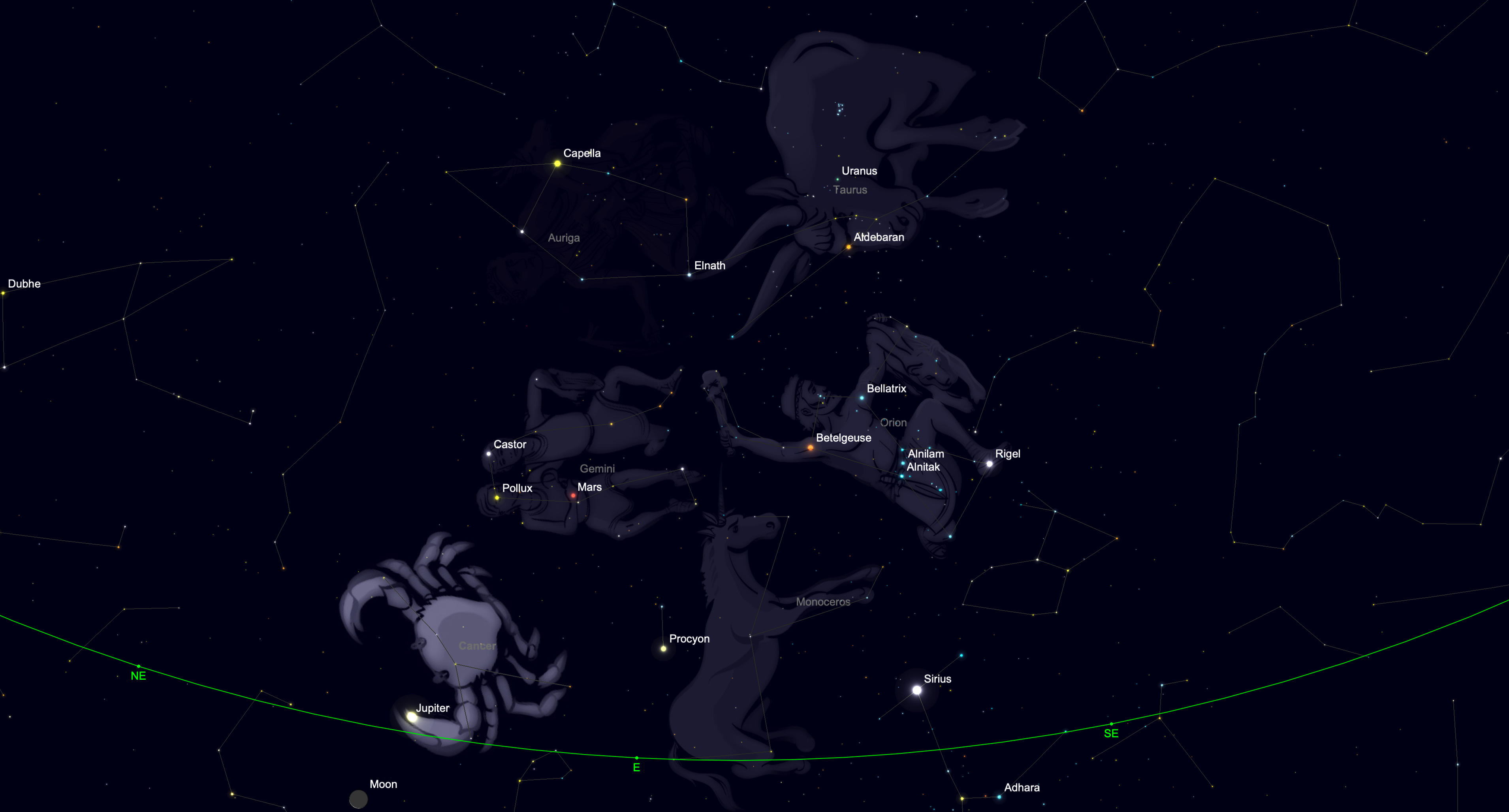
Trace the cone of light as high as possible. Under pristine, dark skies, you can follow this glow deep into the zodiacal constellations that lie along the ecliptic. The base of the light cone will start near Cancer, resting just above the horizon, stretching upward through Gemini, and reaching high into the predawn sky toward Taurus.
The zodiacal light may be visible before dawn in early September as a faint cone of light rising from the eastern horizon through the zodiac constellations. (Image credit: Jules-Pierre Malartre/Starry Night)
How to photograph it
Capturing the Zodiacal Light is very similar to photographing the Milky Way. You will want a fast, wide-angle lens (such as a 14 mm lens at f/2.8) to properly frame the sweeping diagonal of these constellations. Use a high ISO (1600 to 3200) and take a 15-to-20-second exposure on a fixed tripod.
Disney's Marvel movies have had their ups and downs, but James Gunn's Guardians of the Galaxy trilogy has never missed. Now, thanks to this deal, you can get 40% off this Lego version of Baby Rocket Raccoon's Ship, as seen in Guardians of the Galaxy Vol. 3. However, you'll have to hurry as this set has been retired by Lego and is selling fast.
Put together this 330-piece set and you have a blocky replica of the vessel that Rocket Raccoon used to make his escape from—well, that would be getting into spoiler territory. But if you're a fan of this fuzzy little guy, you will want this Lego Marvel Baby Rocket Raccoon's Ship on your shelf. Just remember, this is a retired Lego set so when it's gone it's gone.
Save $14 on this play-friendly Lego Marvel Baby Rocket Raccoon's Ship set. With 330 pieces it's an easy afternoon's build, and the included Baby Rocket figure is so cute it should be illegal under intergalactic law. You will have to hurry, though, this set is retired and likely to sell out. View Deal
This Lego Marvel Baby Rocket Raccoon's ship isn't just a fun build, it's great to play with too. (Image credit: Lego)
Alongside the usual interstellar shenanigans, Marvel's Guardians of the Galaxy Vol. 3 revealed the origin story of Rocket Raccoon. This Lego model, which comes with an utterly adorable model of Baby Rocket, captures one of the most dramatic moments of the film, Rocket's escape from his captor. And if you're fast, you can grab this Lego Marvel Baby Rocket's Ship at a bargain price.
Made up of 330 pieces and for builders aged 8 years and up, this should only take you a couple of hours to build, maybe longer for little fingers. It's a seriously striking ship, and is sure to entertain Guardians of the Galaxy fans of all ages. Aside from Baby Rocket, it also comes with a minifigure of grown-up Rocket Raccoon, both of which can be perched in the opening cockpit.
Pilot's seat aside, there are several other play-friendly features. You can also lower the landing gear and given how light it is, you or younger builders can swoosh this striking ship around the house. Why not make up your own Guardians of the Galaxy Vol. 4? Maybe you can catch up with Doctor Doom and prevent Avengers: Doomsday from happening.
You will need to hurry, though, because this set has been retired by Lego and this could be your last chance to get your hands on it, outside of paying double or triple the price on eBay. And for more MCU builds, we have rounded up the best Lego Marvel sets.
Key features: 330 pieces, for builders age 8+, Baby Rocket and Rocket Raccoon minifigures, 9 × 4.5 × 2.6 in. / 23 × 11 × 7 cm size.
Launched: April 2023
Price history: This set has dropped to $25 in the past when other retailers were selling their stock off, but this is the cheapest we've seen it at.
Reviews consensus: Over at Walmart, this set's reviews are almost universally positive, praising it as a fun, straightforward build, with some of the praise coming from non-Marvel fans. At this price, you really can't go wrong.
✅ Buy it if: You want an easy-to-build, entertaining set that not only looks great on a shelf, it's fun to play with too.
China is making progress on its Tianwen 3 Mars sample return mission, which aims to bring back to Earth roughly 500 grams (17.6 ounces) of Red Planet collectibles in 2031.
According to the China National Space Administration, the Tianwen 3 mission will have a lander, an ascender, a service capsule, an orbiter and an Earth reentry module.
If all goes to plan, Tianwen 3 will launch in 2028 on two Long March 5 heavy-lift rockets from the Wenchang Space Launch Site on the island of Hainan, China's southernmost province.
Sputnik moment
"The Tianwen 3 mission is progressing smoothly, with intensified efforts being made to overcome technical challenges," Hou Zengqian, the mission's chief scientist, recently told CCTV, a state-run Chinese broadcaster.
"The probe equipment has entered the prototype development phase, and scientifically, many scientist teams from across the country are working together to tackle the challenges in accordance with the mission's scientific objectives," Hou added.
Meanwhile, NASA's plans for hauling Mars samples to Earth are murky at the moment. So China appears to be in the lead to notch a major space milestone.
"If accurate, this represents a Sputnik moment," said former NASA "Mars Czar" Scott Hubbard, referring to the reported Tianwen 3 progress.
"China will not only grab the headlines but may be the first to find evidence of life on another planet," Hubbard, who also previously directed NASA's Ames Research Center in Silicon Valley, told Space.com.
Diagram of China's Tianwen 3 Mars sample return mission. (Image credit: The University of Hong Kong/Zengqian Hou, et al.)
Top scientific priority
"The Tianwen 3 mission will look for microbial traces potentially similar to early forms of life on Earth, while also taking into consideration the possibility of unknown forms of life that may have emerged through Mars' unique evolutionary history, providing crucial evidence to answer this major scientific question," Hou told the state-run Xinhua news agency in a recent interview.
Searching for potential signs of life on Mars is the top scientific goal of the Tianwen 3 mission, Hou said on Sept. 3 during the 2026 International Deep Space Exploration Conference on, which was held in Hefei, the capital of eastern China's Anhui Province.
Landing site
China's Mars sample-return trek will be launched "around 2028" on two Long March 5 rockets departing from the Wenchang Space Launch Site in China's southernmost island province of Hainan. (Launch windows for Mars missions come around just once every 26 months. The next one opens in November-December of this year, and the one after that, which Tianwen 3 apparently is targeting, runs from December 2028 to January 2029.)
Hou also said China expects to finalize the landing site for the mission by the end of 2026, with Chinese specialists advancing work on a next-generation geological map of Mars in its entirety.
If everything goes according to plan, the mission will collect samples from the Martian surface and then send them back to Earth around 2031.
"Regardless of whether signs of life are found, the returned Martian samples will have irreplaceable scientific value," Hou said.
Tackle the challenges
Hou added that analyses of the returned samples at microscopic, molecular and isotopic scales could deepen our understanding of Mars' geology and environment, as well as the evolution of habitability and the conditions under which life may originate.
According to Hou, Mars sample return is an extremely complex project, with landing-site selection, planetary protection and contamination control, and the identification of potential signs of life among its key challenges.
Chinese Mars researchers are selecting candidate landing sites for the mission based on factors that include geological age, history of water activity, habitability and the potential for preserving biosignatures.
Planetary protection lab
Xinhuareported last month that a "planetary protection laboratory" is to be built in the first phase of Hefei's Deep-Space Science City in east China's Anhui Province, citing the Deep Space Exploration Laboratory (DSEL).
"The planetary protection laboratory will implement a two-way protection system that guards both the returning Martian samples and Earth's biosphere," Xinhua reports.
The lab's tasks encompass sample sterilization, unsealing, processing and biological risk assessment. "The facility is designed to support the implementation of major deep-space missions and to enable scientific research on Martian samples," added Xinhua.
China "will follow the planetary protection policies of the Committee on Space Research, to prevent biological contamination of Mars by terrestrial organisms and to protect Earth from any potential extraterrestrial life forms that may be carried back in the samples," said Li Hang, director of the development planning department at DSEL, according to Xinhua.
You can view a video about China's Mars sample return plans here.
Scientists may finally know why Venus, Earth's twin, lacks a moon, finding that the hottest planet in the solar system may have consumed its own natural satellite.
Venus is often referred to as Earth's twin due to its size, mass, rocky composition, and distance from the sun, but there are some glaring differences between the two planets. Aside from Venus' blisteringly hot temperature, which could melt lead, incredible surface pressure, violent high-speed winds, and clouds of sulfuric acid, one of the key differences between Earth and Venus can be seen from afar. While our planet has a constant companion in the form of the moon, Venus lacks a moon of its own. In fact, the only solar system planets lacking moons are Venus, the second planet from the sun, and Mercury, the closest planet to the sun.
One question that scientists have puzzled over for years is whether Venus always lacked a moon, or if the hottest planet in the solar system once had a natural satellite and somehow lost it. Now, a team of researchers may have arrived at an answer, determining the fate that would have befallen a hypothetical moon orbiting Venus.
"I have always had a fascination with moon formation and evolution in the solar system, and particularly with Venus since my research is centered around its evolution and potential for past habitability," team leader Stephen R. Kane of the University of California, Riverside told Space.com. "Venus is Earth's twin, and both are nearly identical in size, mass, and composition. However, Earth has a large moon, and Venus has no moon at all, not even a small captured satellite.
"Venus undoubtedly experienced large impacts, just as Earth has, and so has had as much, if not more, opportunity to form a moon similar to what we see in our own skies."
Kane and colleagues constructed a simulation to test their ideas of what could have become of the Venusian moon.
"The work involved going back to fundamental physics and creating the simulation from the ground up, which I validated by ensuring I could reproduce the evolution of the Earth-moon system," Kane said. "The moment I realized that our model provided a complete explanation for Venus not having a moon was an exciting one!"
Did Venus consume its own moon?
The team modelled a gravitational tug-of-war between Venus, a hypothetical moon, and the sun, following this forward over billions of years.
"This is the same physics that governs our own moon, which is slowly drifting away from Earth. We ran the calculations across a wide range of possibilities for how fast Venus was spinning and how massive its moon might have been, using two independent mathematical descriptions of how tides work," Kane explained.
The researcher said that this was done so the conclusions reached wouldn't hinge on one set of assumptions. They found in most cases a Venusian moon would not drift safely outward the way ours does. Instead, the modelling showed that a moon orbiting Venus would eventually reverse its course and spiral inward, causing it to be torn apart by the planet's gravity.
Kane and colleagues found that possessing an intimidating size wouldn't guarantee a Venusian moon's survival, either.
"An interesting aspect is that a heavier moon is destroyed faster, since a massive moon would drain Venus's spin so efficiently that it hastens its destruction," Kane added.
Venus as seen from Earth may look peaceful, but up close, it is a hellish world that may have destroyed its own moon. (Image credit: Starry Night)
But are there any circumstances under which a Venusian moon could have survived?
"Survival came down to two main things: Venus had to be spinning fast when the moon formed, with a day shorter than about 12 hours, and the moon couldn't be too massive, up to roughly the mass of our own moon," team leader Stephen R. Kane of the University of California, Riverside told Space.com. "In that narrow window, the moon migrates outward and stabilizes, much as Earth's did. Outside that range, the moon is unfortunately doomed to be consumed by Venus.
"So a surviving moon would have had to be modest in size, orbiting a rapidly spinning early Venus, which are conditions that don't match what we think early Venus was actually like."
We may never conclusively know if Venus has indeed destroyed its own moon, as Kane thinks that collecting direct evidence from astronomical observations will be very difficult.
"Finding direct observational evidence is pretty tough. A moon lost billions of years ago would leave little to no direct trace we can point a telescope at today, so we can't observe the event itself," Kane said. "However, there are indirect avenues. For example, if a moon was destroyed and its debris rained down on Venus, it could have left a chemical fingerprint in the planet's surface or atmosphere, and upcoming missions to Venus, including NASA's DAVINCI (Deep Atmosphere Venus Investigation of Noble gases, Chemistry, and Imaging) probe, will measure atmospheric composition in detail."
If missions such as DAVINCI could help us develop a better understanding of the Venusian interior, then this would also improve the models such as the one used in this research. That is because the outcomes of such models depend on properties of Venus's interior, which aren't currently well understood.
"There's a broader test beyond our solar system because our results predict that slowly rotating, Venus-like planets around other stars should generically lack large moons, so as astronomers begin searching for moons around exoplanets, that's a prediction that can eventually be checked against real data," Kane said.
An artist's depiction of the DAVINCI probe nearing the surface of Venus. (Image credit: NASA's Goddard Space Flight Center)
Kane and colleagues don't intend to rest on their laurels while further data from Venus or even Venus-like exoplanets are delivered. They have plenty to work on in the meantime.
"There are numerous implications of our work that I would like to explore further. These include the compositional and atmospheric effects of a Venusian moon consumption event that may be testable now," Kane concluded. I would also like to explore similar effects for Mercury and Mars, and conduct further studies on exoplanet cases where such moon collision scenarios may have occurred."
The team's research is available as a pre-peer-reviewed paper on the repository site arXiv.
Stoke Space has amassed a substantial sum during its latest round of financing and is revealing exactly where it plans to invest its new stack of cash.
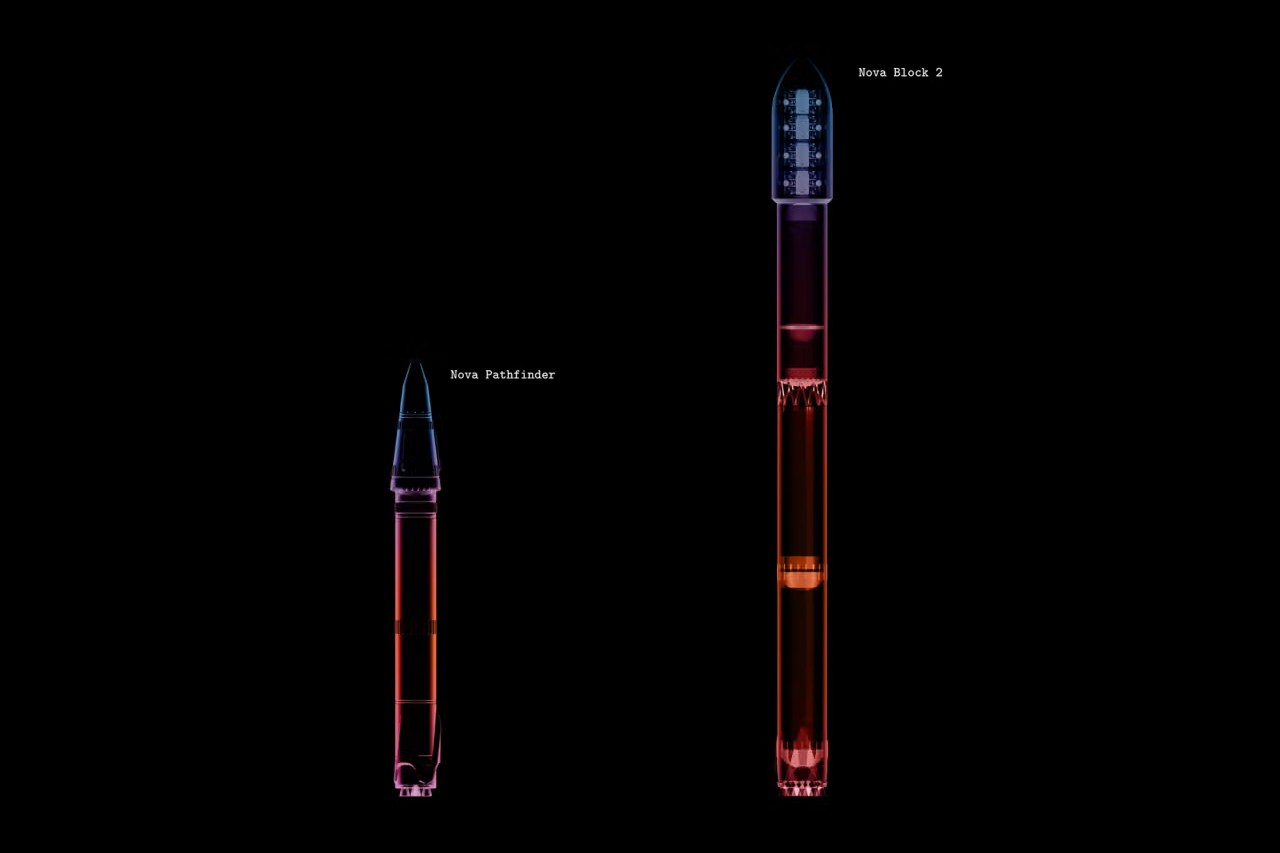
The Kent, Washington-based company just raised $1 billion via its"Series E" capital campaign, bringing Stoke’s total investor haul to $2.3 billion. The Sept. 8 announcement provided a development update for Stoke’s fully reusable Nova Pathfinder launch vehicle and included plans for its never-before-seen Nova Block 2 rocket, a more powerful system designed to be able to deliver up to 15 tons to low Earth orbit (LEO).
“We are humbled by the trust our investors and customers have placed in us in pursuit of this critical generational challenge,” said Andy Lapsa, Stoke CEO and co-founder. “This investment enables us to scale toward delivering the capability and cadence our customers require.”
Nova Pathfinder is Stoke’s first orbital launch vehicle (the largest first rocket ever undertaken by a U.S. launch company, according to Stoke), and is based on the same technologies the company is building into its Block 2 design. Both two-stage vehicles are being manufactured with full and rapid reusability in mind, with Pathfinder serving as the proving ground for that architecture.
Pathfinder's first stage is powered by seven Stoke-designed full-flow, staged-combustion (FFSC) Zenith rocket engines, fueled by liquid oxygen and liquefied natural gas (LNG). The first stage on Nova Block 2 will be equipped with 14 Zeniths. Stoke calls FFSC “perhaps the most difficult rocket engine cycle to develop,” but highlights its advantages; the tech leaves fewer residuals like soot around the engines and reduces the amount of maintenance needed between flights, according to the company.
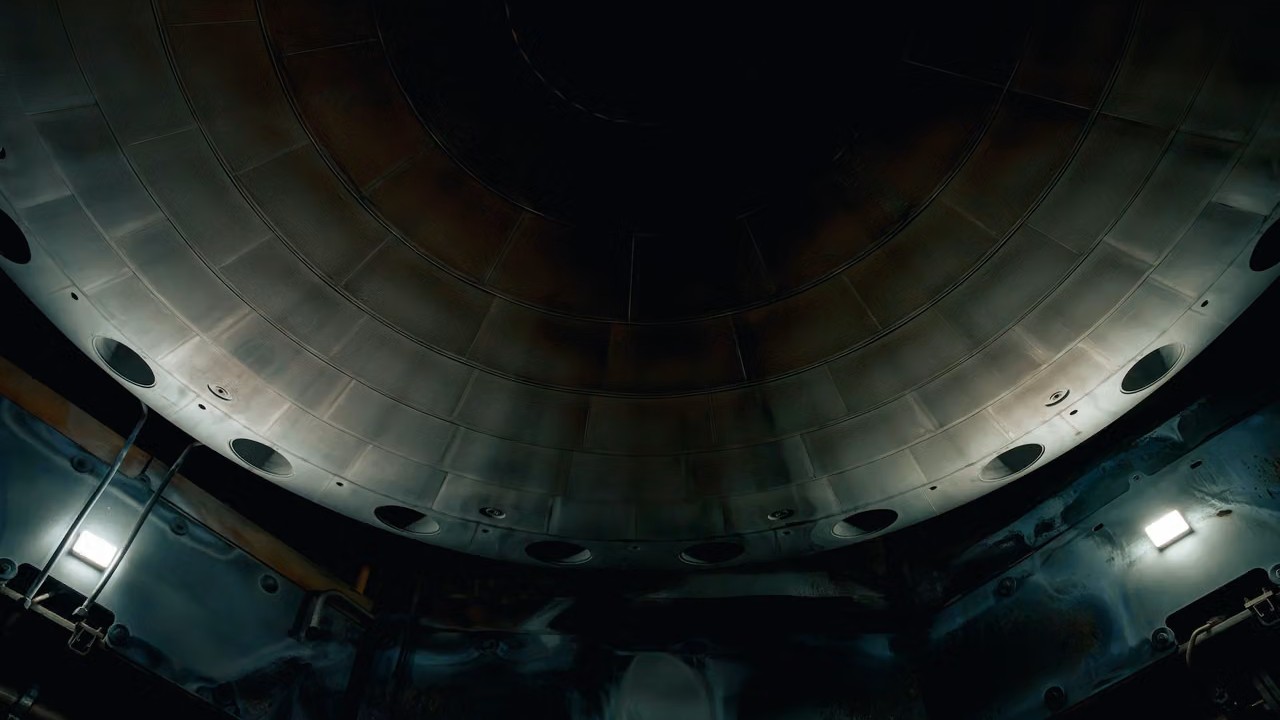
The upper stage of both rockets is the more atypical approach to spacecraft design, compared to other vehicles of the same launch class. The aft end of Nova’s second stage is designed with a heat shield to protect the vehicle during reentry through Earth’s atmosphere. Instead of the ceramic tiles historically used on the heat shields of previous spacecraft, the dome-like structure at the base of Nova’s upper stage is made of metal, which is actively cooled by the liquid hydrogen that fuels the stage’s Andromeda propulsion system.
Rather than a single large, vacuum-optimized engine bell at its center, Nova’s upper stage features 12 small dual-thrust chambers integrated into a circle around the outer edges of the vehicle’s heat shield. Stoke successfully completed a “hopper” test flight of Pathfinder’s upper stage engine system in 2023, flying the vehicle about 30 feet (10 meters) into the air before it safely touched down.
Andromeda upper stage engine and integral re-entry heat shield. (Image credit: Stoke Space)
Scaling up to Block 2, Stoke plans to equip the upper-stage system with independent systems for each of the 12 engines, potentially increasing thrust by over a factor of five, according to the company. Block 2’s upper stage also drops Pathfinder’s tapered design in favor of cylindrical tanks, increasing propellant and payload volume to accommodate a 5-meter-wide (16.4 feet) fairing.
Stoke says the larger Block 2 configuration has been in the works alongside Pathfinder for several years. The company is developing the more powerful rocket to support large commercial and national security satellite constellations, of which there soon may be a high demand.
Nova Block 2’s closest competitors are SpaceX’s Falcon 9 rocket and Rocket Lab’s upcoming Neutron launch vehicle, which is still under development. And Falcon 9 is already being sundowned by SpaceX as the company gets closer to operational flights with its next-generation Starship rocket. While certain Falcon 9 flights for NASA, like crew launches to the International Space Station, are expected to continue until at least 2030, SpaceX CEO Elon Musk has said that Starship’s ultimate success “means winding down Falcon.” The timing should line up with when Stoke hopes to step in with Nova Block 2. Block 2’s first launch is targeted for 2029, with production and flight cadence expected to increase from there.
Nova Pathfinder next to Nova Block 2. (Image credit: Stoke Space)
As Stoke ramps up development for its upgraded launch vehicle, the company’s fresh round of funding will also go toward construction of the physical infrastructure Stoke needs to build, test and eventually operate both vehicles. The company is planning a 475-acre (192 hectares) expansion to its 75-acre (30 hectares) Moses Lake Test Site in Washington to support propulsion and vehicle testing as Pathfinder nears its first launch and Block 2 hardware begins coming online.
Stoke is also expanding its operations at Cape Canaveral Space Force Station (CCSFS) in Florida. The company was selected by the U.S. Space Force in 2023 to manage CCSFS’s Space Launch Complex-14, where it’s now building a new payload processing facility sized to accommodate both vehicles. And to complete its full reusability system, the company is also developing an offshore recovery platform.
Pathfinder has a much shorter timeline to the launch pad. Stoke is targeting early 2027 for Pathfinder’s debut launch, which the company plans to send to orbit with a customer payload. If that’s successful, Stoke hopes to fly multiple Pathfinder missions throughout 2027 and 2028 while Block 2 development and testing continue in parallel.
Once Block 2 does reach the launch pad, Stoke plans to keep Pathfinder in service. “We see value in having more than one way to serve the market, since some missions are particularly well suited to the Pathfinder configuration,” the company said.
September 8th, 1966 was a Thursday. Not a fresh-start-Monday or an exciting Saturday. A regular old Thursday; except that this one catalysed a cultural phenomenon. This was the Thursday that "Star Trek" was first broadcast, drawing viewers across the United States into a space-age world that revolutionised television.
The thing is, in 1966 no exoplanets (planets beyond our Solar System) had actually been discovered. Yet the franchise gave audiences a galaxy brimming with desert planets, ocean worlds, binary sunsets, and countless versions of Earth. Sixty years later, astronomers have confirmed more than 6,000 planets beyond the Solar System, known as exoplanets.
But how well do "Star Trek"’s fictional worlds compare with those astronomers have actually discovered?
When many of us think "Star Trek", the first planet that comes to mind is the dry, hot, and rocky Vulcan. Canonically, it orbits 40 Eridani A, a real star around 16 light-years from Earth. Real stars invite real observations, which led to astronomers announcing a possible planet in orbit in 2018. Of course, this was nicknamed Vulcan. However, later work has shown that this apparent signal was likely caused by stellar activity, rather than a planet in orbit.
This is, unfortunately, a common issue. Stellar activity, such as starspots, convection, and other magnetic activity, is very good at producing signals that look incredibly planetary.
(Image credit: Don Davis)
Although the candidate planet was ultimately discredited, genuine hot, rocky planets do exist around other stars. Many of them orbit extremely close, completing an orbit in less than an Earth day. Some may have molten surfaces, atmospheres poisoned with vapourised rock, or even permanent day and night sides. While Vulcan itself may not be real, nature has produced rocky worlds considerably more hostile than Spock’s birthplace.
In contrast to Vulcan, "Star Trek" also gave us planets almost entirely covered with water. One particularly intriguing case is The Waters, from Voyager’s Thirty Days episode. The Waters is a sphere of water, with no solid core, kept together by a containment field. This is a little different to what an astronomer would refer to as a water world, but a planet-sized mass of water could theoretically be held together by its own gravity, without the need for a containment field.
However, the immense pressure deep inside this would transform much of the water into high-pressure ice rather than leaving it as one enormous liquid ocean. While no exoplanet has been definitively proven to have a global ocean, there are candidates like TOI-1452 b — a super-Earth orbiting a red dwarf star — that could contain a much larger proportion of water than Earth. It’s important to keep in mind, however, that a water-rich planet doesn’t necessarily make a good home. Water could exist beneath a chokingly thick atmosphere, as high-pressure ice, or sitting above an inhospitable interior.
(Image credit: Benoit Gougeon, Université de Montréal, CC BY-ND)
Something "Star Trek" got very right is planets with two or more suns, such as Risa under its twin stars. The first confirmed planet orbiting two stars — known as a circumbinary planet — was Kepler-16 b. As it orbits a binary star system, it would experience a double sunset from the surface…if a surface existed.
Unlike many of the fictional planets in "Star Trek", Kepler-16b is a cold, gas giant; not somewhere we could sit and admire the view. In 1966, not only had exoplanets not yet been discovered, but astronomers had no observational evidence that planets could form and remain stable in dynamically complicated multiple star systems.
There are, however, many circumstances where reality goes far beyond what was imagined in "Star Trek".
(Image credit: ESO/M. Kornmesser)
Take WASP-76 b, an ultra-hot gas giant around 640 light-years away. The planet has a dayside so hot that iron vaporises, and it could be re-condensing into iron-rain on the cooler nightside. KELT-9 b is similarly hot, with molecules torn apart by the heat and metals existing in the atmosphere. 55 Cancri e is a super-Earth that orbits its host star every 18 hours, and could be covered by a magma ocean. There are also rogue planets, wandering through space with no host star.
"Star Trek" frequently invented strange planets by changing one familiar feature, but nature stared at the rulebook and ripped it to shreds. We’ve observed planets that have combinations of temperature, gravity, chemistry, and orbital architecture that writers in 1966 never could have anticipated.
The greatest scientific accuracy in "Star Trek" wasn’t the description of any given planet. Instead, it beautifully predicted that we live in a galaxy in which planets are abundant, gorgeously varied, found around a huge range of stars, and worth investigating even when they are nothing like Earth.
(Image credit: Paramount)
The necessity of a large population of conveniently habitable, human-safe worlds for "Star Trek"’s storytelling definitely set a limitation on the types of planets explored throughout the franchise. Our discoveries so far show that finding planets with Earth-like conditions is incredibly difficult, but not that they aren’t out there, somewhere.
"Star Trek" gave us a galaxy teeming with strange new worlds. Sixty years later, the surprise isn’t that these worlds exist, but that the real ones are even stranger than writers dared to imagine.
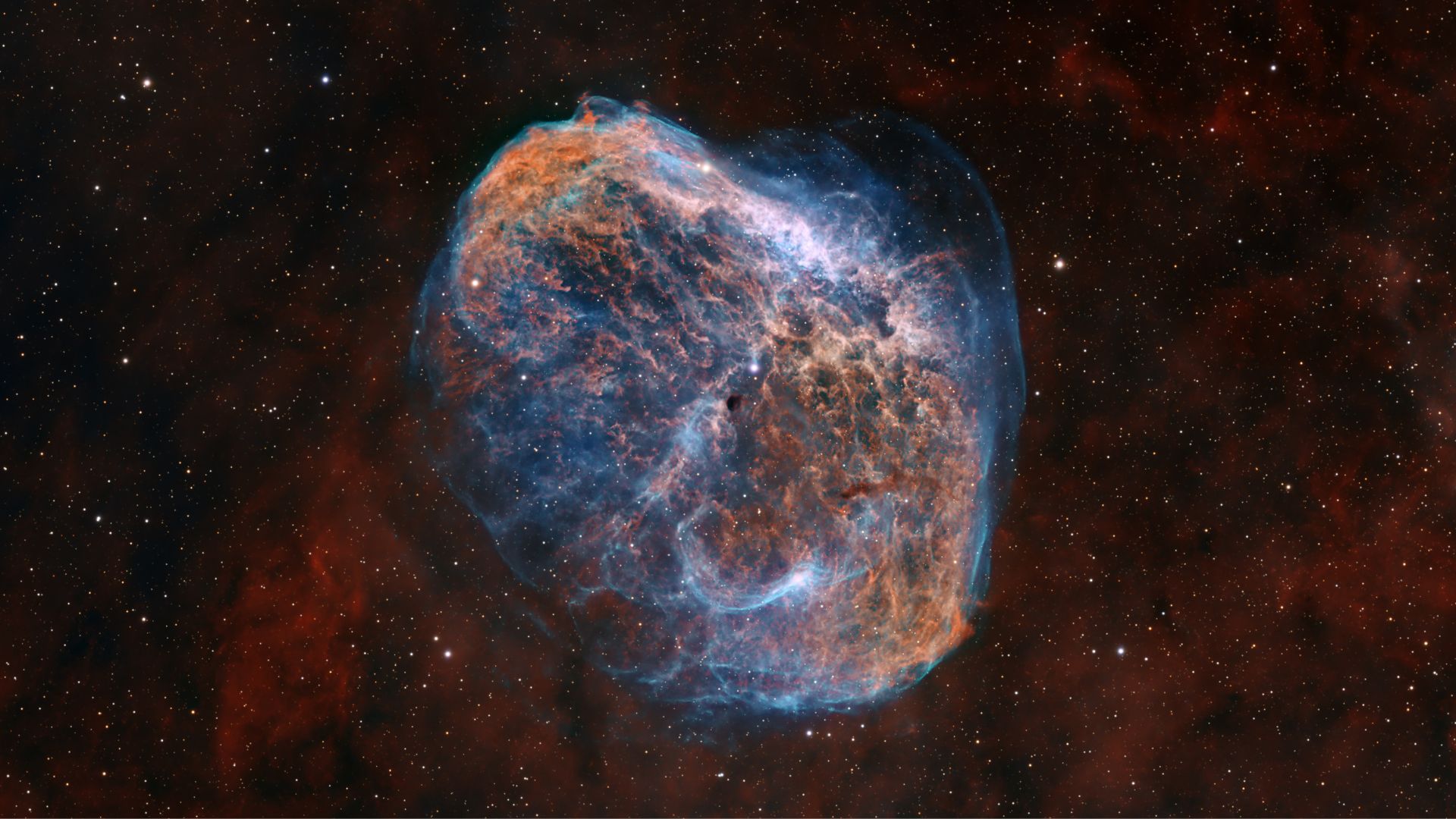
The Crescent Nebula shines in the constellation Cygnus. (Image credit: Kevin Boardman)
Astrophotographer Kevin Boardman captured this spectacular view of the Crescent Nebula, revealing intricate filaments of gas surrounding a massive star nearing the end of its life some 4,700 light-years from Earth in the constellation Cygnus.
Boardman's image represents a turbulent chapter in the life of the colossal Wolf-Rayet star WR 136 (HD 192163), which, visible as a blue point of light at the center of the image, is expected to end its life in a dramatic supernova explosion in about 100,000 years.
The 25-light-year-wide bubble is formed from stellar material cast off by WR 136 during its transformation into a red giant star, according to NASA. Repeated impacts by fast-moving stellar winds later send shockwaves through the outer shell, creating the complex filaments we see today.
ZWO ASI533MC Pro
(Image credit: Amazon)
The ZWO ASI533MC Pro camera is the best dedicated astro camera out there, in our opinion. It features zero amp glow, 80% quantum efficiency and a 20FPS frame rate. It also features a 9MP sensor and you can check out our ZWO ASI533MC Pro review for a more in-depth look.
Catalogued as NGC 6888, or Caldwell 27, the Crescent Nebula, gets its nickname from its crescent-moon like appearance when observed in certain wavelengths of light. Boardman revealed spectacular detail in the nebula by imaging it with a set of narrowband filters over 16 hours and 18 minutes spread across five nights in late July.
"In the image, orange-red H-alpha reveals the tangled filaments while blue-cyan [O III] outlines emission from doubly ionized oxygen around the shell," Boardman told Space.com in an email. Each filter isolates specific wavelengths of light emitted by ionized gases, allowing different structures within the nebula to stand out.
Boardman collected roughly 12 hours of narrowband data from the nebula itself, along with four hours and 20 minutes of data capturing the surrounding stars, before combining exposures using the astronomy software PixInsight during post-processing.
The Crescent Nebula is too faint to be spotted with the naked eye, but can be seen with a moderate-to-large telescope equipped with a light pollution filter throughout September.
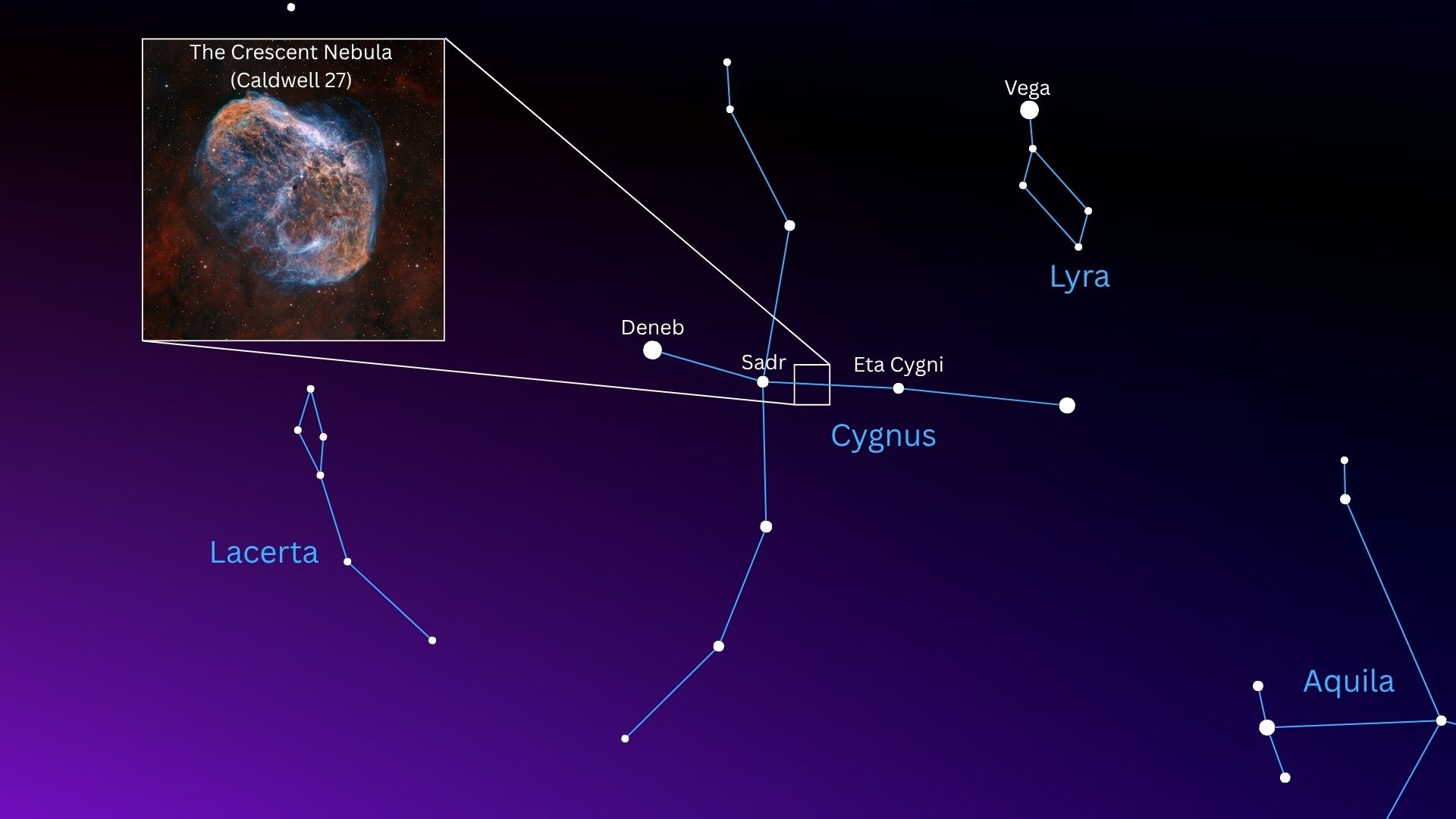
How to find the Crescent Nebula among the stars of the constellation Cygnus. (Image credit: Inset image: Kevin Boardman, created by Anthony Wood in Canva.)
First, locate the magnitude +2.34 star Sadr at the center of the cross-shaped constellation Cygnus, which appears high overhead for Northern Hemisphere observers in late summer.
Next, locate the dimmer magnitude +4.03 star Eta Cygni using the simplified star chart above, or with the aid of a smartphone astronomy app. The Crescent Nebula lies directly between these two bright stars and is best seen on the dark nights surrounding this month's new moon phase on Sept. 10-11.
Editor's Note: If you would like to share your astrophotography with Space.com's readers, then please send your photo(s), comments, and your name and location to spacephotos@space.com.
On Sept. 8, 2004, NASA's Genesis spacecraft crash-landed in Utah after its parachutes failed to deploy.
Genesis was NASA's first sample-return mission since the Apollo program, and the first attempt ever to bring back samples from someplace farther than the moon. The spacecraft picked up solar wind particles while orbiting the L1 Lagrange point, which is about 1 million miles from Earth. L1 is a "sweet spot" between the Earth and the sun, where the gravitational pull from both objects balances out.
Genesis collected samples of the solar wind using arrays made of ultrathin semiconductors called "wafers." Atoms and ions floating around in space stuck to these wafers, and Genesis was supposed to bring them back safely. But that didn't happen, because its parachute didn't work.
Instead, Genesis tumbled from the sky and slammed into the Utah desert. Scientists literally had to pick up the pieces after the wafers containing the solar wind samples shattered into thousands of tiny shards. Luckily, scientists were still able to salvage some of the samples.
NASA's Genesis solar wind sample return capsule, seen here half-buried in the Utah desert floor, crashed due to a design flaw on Sept. 8, 2004. (Image credit: USAF 388th Range Squadron)
Why it mattered
NASA's Genesis probe launched in August 2001 on a $264 million mission to collect samples of the solar wind. It was the first time NASA tried a sample-return mission since Apollo 17 in 1972 (which was a crewed flight), and this trip would be fully robotic.
A scientist in protective gear trying to secure solar wind samples from crashed Genesis spacecraft.NASAFragments of NASA's shattered Genesis sample cansiter with solar wind samples.NASAThis artist's concept shows what the Genesis spacecraft looked like in space with its fragile sample return wafers exposed to collect solar wind samples.NASA
But a design flaw in the parachute system, and a fairly basic one at that, doomed the Genesis spacecraft. Four gravity switches in the sample-return canister were installed backwards due to an error in the design schematics. It affected both the primary and backup parachute systems.
The switches were supposed to detect when Genesis began braking in Earth's atmosphere and trigger parachute deployment. That never happened, so the probe crashed into Earth instead.
Speaking of things flying through space. There was another event that occurred on this day in 1966 that - while not actually being in space - has influenced our concept of spaceflight for a decade.
On Sept. 8, 1966, the first episode of "Star Trek" debuted on television. The iconic science fiction series, which has spawned a myriad of spin-offs and feature films (not to mention all the merch), has inspired countless engineers, scientists and space fans over six decades.
Looking for a quality camera that marries style and performance? Look no further than the Nikon Zf. Despite its vintage looks, it's one of the best Nikon cameras you can buy and with its excellent low-light performance, we also rank it as one of the best astrophotography cameras. Now, thanks to this deal, it's the cheapest it's been since last year's Black Friday.
In our Nikon Zf review, our expert called it "A great buy that offers excellent value for money when compared with some of the much more expensive Nikon models." Now less than $1,800, this is a steal for astrophotographers and photographers in general.
Save $453 on this impressively capable Nikon Zf camera. It isn't just a great low-light performer, it's an excellent all-rounder. Its retro-aesthetic is a bonus for those who miss the look and feel of film cameras. View Deal
Couple the Nikon Zf with a suitable lens and you've got a camera that excels at astrophotography. FutureFutureFutureFutureFuture
What's not to love about this Nikon Zf camera? We ranked it as the best camera under $2,000, before inflation pushed it past that price point, and this deal makes it the cheapest it's been since last Black Friday.
Not only does this full-frame mirrorless camera offer excellent low-light performance, so much so that we think it's one of the best cameras for astrophotography, it's a brilliant all-rounder too.
In their Nikon Zf review, expert Jase Parnell-Brookes awarded it four-and-a-half stars, discovering that its strengths go far beyond its vintage stylings, remarking that "It delivered an impressive dynamic range and performed well in various lighting scenarios."
And, while you can point and shoot, the Nikon Zf is packed with controls designed to enhance your experience. From changing the ISO and ISO sensitivity, through to switch to black-and-white mode, you have complete control over your images. That much choice may seem daunting but the buttons and dials are intuitive enough that using them becomes second nature.
There are Nikon cameras out there that can beat its 24.5 MP images, but you'd have to spend significantly more. The Nikon Z8, for example, is over half as much again. If you want to make your money count, the Nikon Zf is the camera to buy. However, you'll have to hurry if you want to make the most of this deal. As we write this, there are just a handful of units left in stock.
Key features: 24.5 MP FX CMOS Sensor, Z mount, 100-64000 (expandable to 204,800) ISO, 4K UHD 30p video, 1 lb 9.1 oz / 710 g weight, 1SD UHS-II + MicroSD UHS-I card slots.
Product launched: September 2023
Price history: This is the cheapest this camera has been all year. It last dropped to around this price last Black Friday.
Reviews consensus: Reviewing theNikon Zf, we awarded it four-and-a-half stars praising, in particular, its low light performance and how it stacks up to Nikon's more expensive cameras. We were also impressed by its vintage appearance, replicating the look of a film camera. Its Amazon reviews are just as positive, with just a few purchaser complaining about its weight.
A team of researchers just chased a pair of reentering satellites in a private jet to learn about the pollution caused by space debris burning up in Earth's atmosphere.
The satellites in question were the European Space Agency's (ESA) Tango and Samba spacecraft, which once formed the Cluster constellation, together with the already de-orbited Rumba and Salsa. The quartet used to study the interaction of Earth's magnetic field with the solar wind. After 25 years of service, ESA took advantage of the Tango and Samba's controlled demise to help scientists learn what happens when satellites break apart and burn up during their spiral back to Earth.
The international team of researchers chased the two reentries, which occurred one day apart — on Aug. 31 and Sept. 1 — above the southern Pacific Ocean a few hundred miles from the Polynesian archipelago of Tonga.
Their goal was to understand what happens when satellites disintegrate and what chemical compounds arise in the process. Although companies such as SpaceX, Amazon and Blue Origin want to launch huge numbers of satellites to space in the next decade — SpaceX alone plans to loft 100,000 of its Starlink V3 spacecraft — very little is known about the effects of satellite reentries on Earth's atmosphere. Researchers are also still unsure which spacecraft burn up completely and how many fragments may reach the ground, putting lives and property at risk.
"We want to understand what happens to these bodies as they fly through the atmosphere, which causes friction and very high temperatures," Jiří Šilha, CEO of the Slovak company Astros Solutions, and one of the researchers aboard the plane, told Space.com. "We know that those satellites break up into fragments, which subsequently melt in the atmosphere."
The researchers chased the reentering spacecraft following exact calculations provided by ESA controllers, who were able to maintain connection with the spacecraft until the very last moment before they plunged into the atmosphere.
Researchers inside a private jet during a campaign observing the reentry of ESA's Cluster Tango satellite on Sept. 1, 2026. (Image credit: Jiří Šilha)
The satellite reentries, although they occurred during daylight, were visible from aboard the plane even to the naked eye, said Šilha, and created spectacular fireballs that lasted tens of seconds.
"Bolides and meteors only last a few seconds or less," said Šilha. "But satellites are slower. They enter the atmosphere at a shallower angle, and the atmosphere slows them down further."
But the researchers were there for science, not for a sky show. And it was a rare opportunity: The Cluster trajectories were so precisely known that the scientists could prepare for them and be at the exact spot at the exact time to witness those explosions from only a couple of hundred miles away.
The aircraft, a small commercial business jet, was packed with 30 cameras and spectrometers fitted with special filters to capture not only how the satellites disintegrated but also detect the spectral signatures of the chemical elements released as their bodies burned up.
Eight scientists were squashed on board the darkened jet operating the instruments through the aircraft's six windows as the pilots navigated to the vicinity of the spot where ESA analysts had predicted the breakup would occur.
"We were flying toward the object, and first it looked like a compact source of light as the material ablated," said Šilha. "At some point, there was a sudden explosion as the satellite disintegrated."
The plane allowed the researchers to overcome any clouds that could obscure the view from the ground, and also to bypass the thickest layer of the atmosphere, which would distort the measurements. As the satellites hurtled through the air, slowing down from the mind-boggling speed of 22,370 mph (36,000 kph) at which they hit the upper atmosphere, the jet approached them to within a distance of around 75 miles (120 kilometers).
"We begin observing it when it's at about 90 kilometers [56 miles] and it stops being visible at about 65 to 70 kilometers [40 to 44 miles]," Šilha said. "For about thirty to forty seconds after the explosion, you can observe an interesting structure as all those various fragments ablate in the atmosphere. Then they all either burn up or slow down."
Šilha said the cameras captured tens of fragments, in detail that had never been observed before.
The researchers also attempted to trace seven chemical compounds, including titanium, sodium and potassium, which get released as satellites burn up. The team was especially interested in aluminum, which makes up the majority of a satellite body. Aluminum is not naturally present in Earth's atmosphere and most likely forms aluminum oxide during the incineration. The potential presence of aluminum oxide in the atmosphere in higher concentrations worries scientists, as it could potentially trigger ozone depletion in the stratosphere.
"We tried to measure the aluminum at different altitudes, using specialized filters, which could tell us when this aluminum interacts with the atmosphere," said Šilha. "That's when the aluminum oxide likely forms, and that's something that has never been observed before. We don't know exactly how and in what quantities the aluminum oxide might be forming."
The researchers will now analyze the data to learn exactly what chemical reactions may be occurring during every second of the breakup and burn-up process. The data will help atmospheric physics and chemistry researchers improve their models to further our understanding of the potential damage the growing satellite industry might do to the planet and its climate in the future.
"The data will help us validate whether the models agree with reality," said Šilha.
The team previously chased the reentry of the first of the four Cluster satellites — Salsa — in September 2024. The lessons from that campaign helped the team get closer to the Tango and Samba spacecraft and obtain more and more accurate data.
The date of 'Star Wars Day' is based on a "May the fourth be with you" pun. The date of 'Alien Day' (April 26), meanwhile, is inspired by an extremely tenuous link to LV-426, a moon pivotal to the first two movies.
'Star Trek Day', however, is based on an actual date; September 8 is the anniversary of the Original Series' very first broadcast in 1966. This year's birthday is more important than most, as the "Star Trek" franchise reaches the ripe old age of 60 — Kirk and Spock's diamond jubilee.
Birthdays are traditionally a time to take stock of past, present and future, so we've taken this opportunity to deliver a status report on the legendary franchise, via TV, movies and 60th anniversary celebrations — including commemorative coins and record-breaking Vulcan salutes.
Will "Star Trek" continue to live long and prosper, or would Dr McCoy deliver one of his more pessimistic assessments, Jim?
It's time to give the veteran franchise a health check…
TV shows
(Image credit: Paramount)
Television is where the voyages of the starship Enterprise began, and still feels like the franchise's natural home. There have now been 12 separate TV shows set in the "Star Trek" continuity — 14 if you throw in "Short Treks" and pre-school YouTube series "Star Trek: Scouts" — and the final frontier has flourished on the small screen over the last decade.
Indeed, since "Discovery" first spooled up the spore drive in 2017, we've enjoyed the most bountiful period of "Trek" since the glory days of the '90s, when "The Next Generation", "Deep Space Nine" and "Voyager" became appointment viewing. In many ways it's been a masterclass of universe-building, as executive producer Alex Kurtzman (with his Secret Hideout production company) has overseen an impressively large and varied fleet of shows.
Although Disney+'s "Star Wars" TV adventures have all — with the notable exception of "Andor" — tended to be relatively uniform in tone, "Trek" has generally taken much bigger swings. "Discovery" warped off to the undiscovered country of the 32nd century, while "Lower Decks" proved that "Star Trek" and out-and-out comedy can be natural bedfellows.
"Star Trek: Picard"'s peerless final run of episodes (arguably the best season of "Trek" ever made) skilfully mixed masterful storytelling with unashamed "TNG"-era nostalgia. "Strange New Worlds" managed to recruit the franchise's best ensemble since the '90s. "Prodigy" was a kids' show grown-up fans could enjoy, too.
(Image credit: Paramount Plus)
And for a brief period between May 2022 and April 2023, there were five active "Star Trek" shows at various stages of the production/release cycle. Little did we realize that would be a peak for the franchise and that — a little over three years later — we'd be facing the prospect of a future without any "Star Trek" TV at all.
At present, there are no "Trek" shows in production. "Strange New Worlds"' fifth season and "Starfleet Academy"'s second are already in the can, but both will be their respective show's final voyages; the sets have been dismantled, the casts have moved on to new projects.
Meanwhile, rumored spin-offs like "Picard" follow-up "Legacy" and "Strange New Worlds" sequel "Year One" seem destined to remain in the realms of Trekkie fantasy.
As "SNW" co-showrunner Henry Alonso Myers told TrekMovie in August 2026, "We haven't been told anything [about 'Year One']. It's not up to us. It's up to Paramount. We stand by and are ready to work at their discretion. We love 'Star Trek'. We'd be happy to do it again. It is out of our hands."
(Image credit: Paramount+)
Rights holder Paramount (and its CBS subsidiary) is the unknown factor here. Skydance Media bought the studio last year, and — perhaps unsurprisingly — execs have been hesitant to invest in major new projects as they wait to learn the new regime's direction of travel.
Skydance's impending acquisition of Warner Bros may also be a factor — if, say, Paramount and Warner were to merge their respective streaming platforms, would "Trek" get as much prominence on HBO Max as it currently does on Paramount+?
Reports in early 2026 suggested that Kurtzman was in early negotiations to renew his production deal (the previous one expired with "Starfleet Academy"), but it's looking increasingly unlikely he'll return. Paramount, however, has reiterated the ongoing importance of the franchise to its bottom line.
"It's one of the reasons why Chris [Parnell, executive vice president of Paramount+ Originals] is here as the resident number one fan of the 'Star Trek' franchise," said head of Paramount+ Originals Jane Wiseman in an August 2026 interview with Deadline.
"And there’s so many people in this building, by the way, that are. It is our goal and it is our job to figure out what the next bounce of 'Star Trek' is. We're talking to a lot of writers, we are leaning on [production company] CBS Studios, and it is imperative that we figure out what the next iteration is in this franchise because it's just too important. We also are in touch with Paramount Pictures; they have a 'Star Trek' movie that’s in development." (More on that below…)
(Image credit: Paramount)
That still leaves an awful lot of questions. Would a new iteration of "Trek" stick with the current 10-episode format, or go back to the longer 20+ runs of the '90s? Has the disappointing "Section 31" killed the prospect of another "Trek" TV movie stone dead? Will Paramount see more value in its massive library of legacy "Trek" content? And how will "Trek"'s famously progressive and liberal outlook mesh with a new-look company whose CEO, David Ellison, is close to President Trump?
Nearly seven years elapsed between "The Rise of Skywalker" and "The Mandalorian and Grogu", but that's small fry next to the extended wait for a new "Star Trek" movie. It's now 10 years (and counting) since "Star Trek Beyond" brought the Kelvin-verse adventures of alt-Kirk and alt-Spock to a close, as movies from the final frontier took a backseat to their TV counterparts.
Having made a critically acclaimed start in 2009 — director JJ Abrams ramped up the fun, effectively using "Trek" as a calling card for "The Force Awakens" — this self-contained "Trek" offshoot gradually ran out of momentum. Released four years later, "Star Trek Into Darkness" made more money than its predecessor, but felt like a tired retread of past glories. "Star Trek Beyond" (2016) made less money than either, offering an enjoyable (though hardly memorable) planet-based romp that set up the crew for more voyages… voyages that would ultimately never happen.
JD Payne and Patrick McKay (now showrunners on "The Lord of the Rings: The Rings of Power") were hired to write a script, while SJ Clarkson ("Madame Web") and Matt Shakman ("The Fantastic Four: First Steps") were both attached as directors at one stage or another. One iteration would have seen timey-wimey stuff uniting two of the Hollywood Chrises, Pine and Hemsworth, bringing James T Kirk face-to-face with late dad George.
(Image credit: Paramount Pictures)
"The conceit was that through a cosmic quirk in the 'Star Trek' world, they were the same age," McKay told Esquire. "It was going to be a grandfather-son space adventure — think 'Indiana Jones and the Last Crusade' in space. We were really thrilled about it."
"Alien: Earth" boss Noah Hawley also worked on a new story entirely separate from the Kelvin-verse, and even Quentin Tarantino pitched his take on "Trek" to the Paramount suits. The "Pulp Fiction" writer/director's Earth-bound story would reportedly have taken its cues from "A Piece of the Action", a 1920s-inspired episode from the Original Series.
"I think [Tarantino's] vision was just to go hard. It was a hard R. It was going to be some 'Pulp Fiction' violence," recalled "The Revenant" screenwriter Mark L Smith, who worked with Tarantino on the script (h/t Collider). "Not a lot of the language; we saved a couple things for just special characters to kind of drop that into the 'Star Trek' world, but it was just really the edginess and the kind of that Tarantino flair, man, that he was bringing to it. It would have been cool."
(Image credit: Paramount+)
But after all those false starts, Paramount is seemingly moving ahead with another film, currently — as far as we know — the only "Trek" screen project in active development.
The as-yet-untitled movie is scripted by "Dungeons & Dragons: Honor Among Thieves" writer/director duo Jonathan Goldstein and John Francis Daley, will feature an entirely new group of characters, and will apparently be inspired by a pair of hit movies from the '90s and '00s.
"Two movies we cite as [comparisons] for what we're hoping to do are 'Training Day' and 'Crimson Tide'," Goldstein toldInverse on the recent press tour for Apple TV+'s "Mayday".
(Image credit: Paramount Pictures)
"I think the portrayal of Starfleet and the people that work within it have always been generally idealized versions of what the future could be," added Daley. "And while this [script] isn’t a cynical or nihilistic take on it, I think it does acknowledge that there are some bad apples in every institution that can have a strong voice and can really make an impact on that institution and everything it stands for."
It's hoped that the new film will launch a new franchise of its own, though it seems to be a riskier franchise relaunch option than a TV show. Although "Trek" has spawned a long-running and successful movie franchise, its films have rarely ranked among the biggest earners in Hollywood — not since 1986's "The Voyage Home" has a "Trek" outing made it into an end-of-year top 10 in the US.
Maybe Paramount is eyeing up this "Training Day"/"Crimson Tide" format as an excuse to cast a pair of high-profile A-listers in the lead roles, following Disney/Lucasfilm's lead in recruiting Ryan Gosling for the upcoming "Star Wars: Starfighter". But with IP-based, space-set adventures "The Mandalorian and Grogu", "Masters of the Universe" and "Supergirl" all having floundered in multiplexes this summer, this film could be a gamble — especially as it'll need to appeal far beyond the traditional "Star Trek" heartlands to become a hit.
Beyond movies and TV
(Image credit: Bloober Team)
As "Doctor Who" proved when it was off air between 1989 and 2005, a lack of new screen "product" can be good news for other platforms.
In other words, there's little chance of a shortage of new stories across media, old (novelisations and comics) and new (Webtoons, audiobooks and videogames) — way too much to list here, in fact.
You can also get stuck into some"Star Trek" Lego, which is a pretty good way to fill that Starfleet-shaped hole.
The 60th anniversary
(Image credit: Paramount)
A media franchise reaching its 60th anniversary is a massive deal, but is Paramount doing enough to celebrate one of its crown jewels becoming a sexagenarian?
The 30th birthday was marked by a couple of special episodes: "Voyager"'s literally titled "Flashback" saw Tuvok remembering his days on the USS Excelsior alongside a certain Captain Sulu, while "Deep Space Nine"'s "Trials and Tribble-ations" spliced Sisko and the gang with footage from Original Series episode "The Trouble with Tribbles".
But now, even though we're seven episodes into a run of "Strange New Worlds", there's no special birthday episode on the cards — it's no spoiler to say that this week's tense instalment, "Orders of Magnitude", is not very party-ish at all. It feels like a missed opportunity, seeing as "Doctor Who"'s 50th and 60th anniversary outings — most notably 2013's multi-Doctor "The Day of the Doctor" — have been memorable in their own right.
(Image credit: Paramount)
"The days of being able to know when your show was going to be on television are maybe behind us," "SNW" co-showrunner Akiva Goldsman lamented to SFX magazine. "God knows nothing would have been more fun than a 'Strange New Worlds' Christmas episode, and yet there'll not be one."
And if you want to mark the occasion yourself, there are nearly 1,000 episodes of "Star Trek" — plus 13 movies — to enjoy, most of them on Paramount+. That's one hell of a legacy.
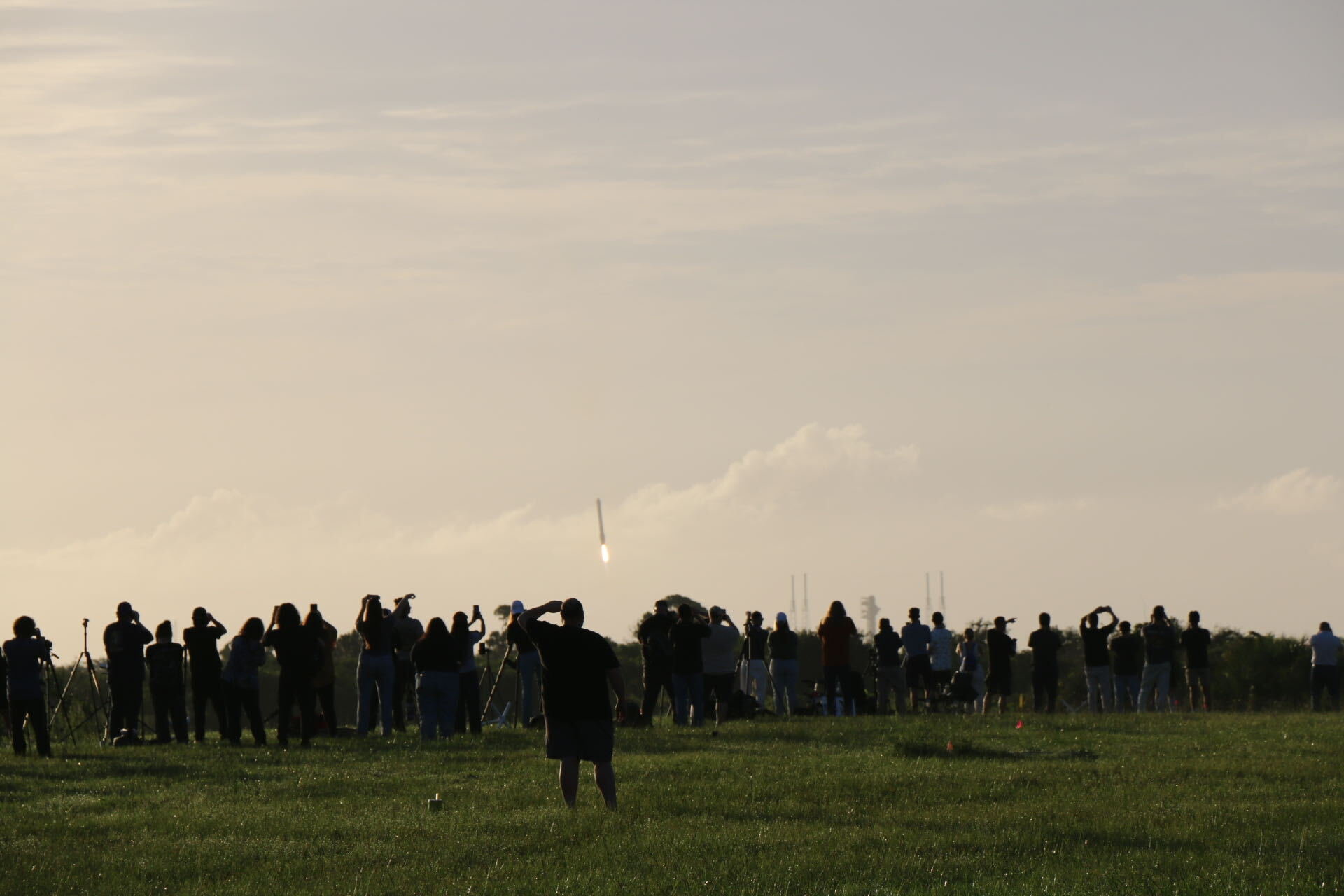
This might look like a rocket launching off Earth, but it's actually a rocket booster perfectly landing on our planet after fulfilling its duty. (Image credit: Chelsea Gohd)
On Aug. 30, the Nancy Grace Roman Space Telescope launched into space aboard a SpaceX Falcon Heavy rocket — then, after completing their job, the rocket's boosters safely landed back on Earth. Watching the events unfold, Space.com's Chelsea Gohd caught one of these beautiful landings on camera as onlookers at NASA's Kennedy Space Center watched in awe.
What is it?
The Roman Space Telescope is NASA's next great observatory, meant to revolutionize how we view the cosmos. Equipped with instruments like a coronagraph that can directly image exoplanets and a Wide-Field Instrument (WFI) that has a massively wide field of view, it's designed to work with big names like the Hubble Space Telescope and James Webb Space Telescope and reveal our universe's intricacies on a grand scale.
But to get to space, like any other space telescope, it needed a rocket to ferry it there. In this case, that was SpaceX's Falcon Heavy rocket. Falcon Heavy is about 230 feet (70 meters) tall and can lift nearly 141,000 pounds (64 metric tons) of payload to low Earth orbit. And importantly, Falcon Heavy's two boosters are reusable.
After launching a payload to space, the boosters split and each lands back on Earth in an upright position. In the image above, Gohd captured one of those boosters landing in the distance.
Why is it incredible?
Though we hear about it so often, there is something undeniably dreamlike about living in a time when a rocket can land its parts back on Earth so precisely. I was also there for the launch of the Roman Space Telescope in Florida, and it was breathtaking to watch such a huge piece of equipment navigate mid-air and straighten itself before landing. The crowd in the picture was equally astonished while the event unfolded.
My mother texted me just after she watched the Roman Space Telescope launch live online, exclaiming that the booster's landing looked just like a taxi returning to its station, getting ready for the next task. I hadn't thought about it that way before, but she was correct.
One of the boosters that participated in Roman's launch landed at Landing Zone 2 and the other hit the ground at Landing Zone 40. As NASA explained in a statement, one of these boosters carried out its very first mission while the other was on its third.
Now, the next spectacle to take our breath away will be Roman's very first images of the universe. Those are expected to drop next year.
Scientists have spotted the first hints that Albert Einstein's formulation of gravity operates in the quantum realm.
The hints have to do with observations of a falling quantum object, and though this may not seem like a huge deal (literally, we are talking about atoms here), it could be an important step on the road to a theory of ... everything.
To start, we have to go back to the early years of the 20th century. Consider Einstein's iconic theory of gravity, general relativity, and the elusive realm of quantum mechanics. While the former describes the universe on scales of planets, stars and black holes, even demonstrating how galaxies and galaxy clusters formed, the latter describes the counterintuitive physics found on scales smaller than atoms. But there is a problem: these two important theories don't play well together.
A team of researchers has performed an experiment to find the point where quantum mechanics and general relativity meet. Namely, how the quantum properties of atoms change as those atoms fall under the influence of gravity.
"This is a unique paper, in the sense that it combines a hard experiment with a far-reaching theoretical interpretation, about one of the most fundamental questions in physics: How can gravity, described by Einstein's theory of relativity, and quantum theory, be unified into one understanding of the universe?" team leader Ron Folman of the Ben-Gurion University of the Negev said in a statement. "These two pillars of modern physics have so far eluded all attempts at a unified theoretical framework, but this complex experiment gives more hints as to how such a unification may be achieved."
Elevators and equivalence
At the cornerstone of the team's experiment is an important element of general relativity called the equivalence principle.
The equivalence principle states that, for an observer in free fall, gravity should disappear. If that sounds confusing, consider this popular analogy: You are inside a closed elevator with no view of your surroundings. You feel heavy. You might drop a ball, and it would fall to the floor of the elevator. Why would these things happen? Well, there are two options.
You might be sitting stationary on the ground floor, or the elevator could be moving upwards at an acceleration equal to the gravitational field strength of Earth, 9.8 meters per second squared. You can't tell the difference between gravity and acceleration. That's the equivalence principle.
Now, let's shake that up. Suddenly, you can't feel weight anymore. You drop the ball, and it floats. Gravity has disappeared, or the upward acceleration has ended. Inside the elevator, two things may have happened, and you can't distinguish between these two either. The elevator cable may have snapped, and you may now be in free fall, or the upward acceleration may have carried you to space and then ceased.
A demonstration of the equivalence principle. (Image credit: Robert Lea (created with Canva))
The big question now is: How do you test this on a quantum scale, especially for particles that behave as waves as they travel?
Wave hello to quantum gravity?
To measure the equivalence principle at a quantum scale, the researchers turned to a piece of equipment called the Quantum Galileo Interferometer. This allowed them to split the quantum wave associated with a traveling atom into two paths. One was held in place while the other was allowed to fall freely.
The team then reunited the wave to observe the changes gravity had introduced to the falling wave.
For the experimental subjects, the team chose a cloud of rubidium atoms, which they cooled to just above absolute zero. These were placed close to the surface of a specially designed atom chip. Using microwave pulses, the scientists placed the atoms in what is known as a quantum superposition.
A superposition is one of those really weird things unique to quantum physics, effectively allowing a quantum system to simultaneously exist in two or more contradictory states. In this case, the superposition allowed each atom to travel along two different paths at the same time.
Magnetic fields generated by the atomic chip applied an upward push along one path, counteracting the downward pull of gravity and holding it stationary. The other path was subjected to magnetic pulses pushing the atoms upwards. The pulses were then shut off, allowing the atoms to fall freely under gravity like a ball thrown into the air.
The 2D MOT apparatus which feeds the science chamber with cold atoms. At the center is a glass cell held under vacuum between coils producing magnetic fields. The atoms go into the science chamber through the tiny hole that may be seen in the center of the yellow (reflecting) surface. (Image credit: Or Dobkowski.)
When the waves were reunited, the team used an effect called interference, which occurs when the peaks and troughs of two misaligned waves meet, to measure changes in the free-falling wave.
This represented the first time that the effects of gravity and free fall on the phase of a quantum wave had been measured.
However, while this is an effective demonstration of Einstein's equivalence principle in the quantum realm, it isn't a demonstration of quantum gravity. Yet it remains a step along a frustratingly long road physicists have been traveling down for over a century with no end in sight.
"We have no consistent theory telling us why quantum physics should fail," team member Vlatko Vedral said in the statement. "This experiment pushes quantum mechanics into one of its most intriguing frontiers, gravity, and shows that, once again, its predictions hold."
The team's research was published on Wednesday (Sept. 2) in the journalScience Advances.
It began with an unusual flash detected off the coast of South Africa by an aging American satellite — and to this day, debate continues over whether this odd Cold War event involved an illicit atmospheric nuclear test.
The strange story of the "South Atlantic Flash," better known as the Vela Incident, began on Sept. 22, 1979. At that time, Vela 6911, a satellite in a constellation developed by the United States for the specific purpose of detecting nuclear detonations, observed something that immediately alarmed officials: a peculiar flash of light emanating from somewhere over the South Atlantic Ocean.
A significant part of what concerned U.S. officials at the time had been the double flash of light detected during the event — a distinctive feature that strongly resembled the flashes produced by a nuclear explosion in Earth's atmosphere. The characteristic double flash results from the rapidly changing brightness of the fireball and shock wave produced by an atmospheric nuclear detonation, creating a distinctive optical signature that Vela's sensors were specifically designed to recognize. The South Atlantic event, therefore, seemed like a prime candidate for a secretive nuclear test being carried out by an unknown party — but if that were the case, who was responsible?
What do we know?
U.S. officials responded to a possible nuclear test
Then-President Jimmy Carter was promptly alerted to the situation, as evidenced in diaries the former U.S. leader would publish years later. "There was indication of a nuclear explosion in the region of South Africa," Carter wrote in an entry on the same date of the event. A later entry penned the following February would go on to add that "We have a growing belief among our scientists that the Israelis did indeed conduct a nuclear test explosion in the ocean near the southern end of Africa."
President Jimmy Carter, seated at a desk in the Oval Office of the White House in 1980. (Image credit: Bettmann/Getty Images)
Despite that belief regarding the possibility of a clandestine nuclear test,a scientific panel assembled in 1980, chaired by MIT professor Jack Ruina, eventually put forward an alternative explanation: that the flash had more likely been an anomaly caused by a small meteoroid striking the satellite.
Notably, the panel did not rule out the possibility of a nuclear explosion at the time, although the alternative they put forward remained controversial among scientists and intelligence officials.
A memorandum to Director of Central Intelligence Stansfield Turner from Frank Press, White House science adviser, in which Press explains the reasoning behind the Ruina panel's conclusion that the Vela flash was "probably not from a nuclear explosion" and was therefore more likely "caused by a natural event." (Image credit: Public Domain/National Security Archive)
Documents and government insiders surface
By the turn of the 21st century,formerly classified documents began to surface that revealed the extent of the inner tensions between U.S. government agencies over what caused the Vela incident.
Among the critics of the debris-induced "anomaly" hypothesis had been Defense Intelligence Agency Vice Director Jack Varona. According to documents released in 2006, Varona said the investigations by the 1980 scientific panel had been a politically motivated "whitewash," and that evidence collected by the U.S. intelligence community included detections "unique to nuclear shots in a maritime environment," based on an analysis by the Naval Research Laboratory.
Varona wasn't alone. Other former intelligence officials who came forward over the years included Stansfield Turner, the former Director of Central Intelligence during the Carter administration, who in 2003 described the Vela detection as a "man-made phenomenon."
Similar views were advanced by retired CIA officer Tyler Drumheller, who in 2006 wrote that he had sources at the time who "collectively provided incontrovertible evidence that the [South African] apartheid government had in fact tested a nuclear bomb in the South Atlantic in 1979, and that they had developed a delivery system with assistance from the Israelis."
The Vela-5A & B satellites in a cleanroom at Los Alamos National Laboratory (left); and an illustration of one of the satellites in orbit above Earth (right). (Image credit: Los Alamos National Laboratory)
What remains unknown?
Scientists revisit the mystery
While we still don't know if the South Atlantic Flash was a nuclear test, several scientists have reexamined the available evidence within the last decade, and what they found has lent further weight to the idea that the Vela incident had involved a detonation of some kind.
Among the most significant assessments,a 2017 study by Christopher Wright and Lars-Erik De Geer combined modern research into interplanetary dust and hypervelocity impacts with revelations from recently declassified documents, as well as publicly available information that had been previously overlooked.
Their conclusion: while no model was presented for the tenuous "meteoroid" theory advanced by the May 1980 scientific panel, the double flash observed by the Vela satellite in 1979 was indeed "consistent with a nuclear explosion, albeit detected by an aged satellite for which background modulation was abnormal and/or commenced earlier," adding that additional radionuclide and hydroacoustic evidence existed which supported the conclusion "that the Vela Incident was a nuclear weapon test explosion."
Wright and De Geer weren't alone either.A 2022 study examined data collected by NASA's Nimbus-7 satellite just 16 minutes and 44 seconds after the double flash over the South Atlantic, which suggested a disturbance in the ozone layer that appeared to be consistent with a blast-generated shock wave.
Artist's concept of a Nimbus spacecraft in orbit over Earth. (Image credit: NASA)
Still, some of the original members of the 1980 scientific panel have defended its work amid the more recent scientific studies. Richard Mueller, who served as the panel's youngest member at the time, defended the group's conclusions ina November 2019 oral history conference, maintaining that the chances the Vela incident had involved a nuclear event were "as close to zero as it gets."
This determination, Mueller argued, was made despite early interpretations by many panelists that a nuclear event had seemed most likely. Wright and De Geer, both of whom attended the 2019 oral history conference, were among the participants that pushed back on Mueller's views.
Who was responsible?
Amid the mounting evidence over the last several decades suggesting the Vela incident was indeed a nuclear test, debate continues over who was most likely to have been responsible.
Although suspicions have long centered on a cooperative — and secret — strategic effort between apartheid-era South Africa and Israel, publicly available evidence remains lacking, and a fair amount of information in declassified documents that could point to this possibility remains redacted.
An illustration of two Vela satellites separating in orbit. (Image credit: Los Alamos National Laboratory)
The mystery remains
Thus, after more than four decades, questions continue to linger over the famous Vela incident, including what nations might have been involved in such a test if it occurred. Despite that uncertainty, one thing does seem evident: information conveyed in unredacted portions of declassified records, combined with modern scientific analyses, increasingly point to the likelihood that the strange "South Atlantic Flash" in 1979 was anything but natural.
I'm a pretty thrifty guy; no one will ever accuse me of being a hoarder or a bulk shopper. You won’t ever see me at a Costco lugging around 48-count packs of toilet paper, hernia-inducing apple bags, or ginormous 5-pound boxes of Goldfish Crackers.
But after tinkering around with "The Last Starship" for a while, I think I could be converted into a doomsday prepper; someone who loads up on necessary supplies and has a keen sense of the proper protocol for acquiring stockpiles of food, water, ammo, and —if I were stuck out in deep space — oxygen.
After being available in early access for nearly three years, "The Last Starship" 1.0 was finally released on Feb. 6, 2026, for PC from Introversion Software, the same inventive creators of "Prison Architect". It's hardly a new release at this point, but I've been absorbed by it for the last few months, and it's definitely one that space game fans should check out.
This engaging indie sci-fi video game teaches single-player gamers how to strategically operate an interstellar shipping and trading conglomerate. It does this by repeatedly driving home the importance of planning ahead while operating in the cold vacuum of outer space and fortifying your sturdy spaceship.
Oh, and watch out for space pirates!
Introversion's "The Last Starship" is officially classified as a 2D space construction and simulation game, where you design, build, and upgrade your very own working starship. Once it’s in operational order, you strike out into the starfields to investigate colorful solar systems, discover rare resources, and even stumble upon arcane secrets.
There's a dreamy, meditative element to "The Last Starship" that can’t be denied, even in this middle-aged gamer’s attitude of flying by the seat of my pants and holding an advanced degree in procrastination from Cambridge University.
You get a sense of genuine pride in accomplishing goals, fine-tuning your interstellar trading operations, and seeing them flourish before you.
Just as in real life, your specific choices will dictate your personal odyssey, whether you’re a brave soul itching to become a pirate hunter, a working joe looking to get into salvaging, mining, or transport delivery, or a visionary scientist like the Stargate engineer.
First, choose an appropriate spaceship hull, then boost its propulsion system with engines, add critical life support systems, external sensors, thrusters. Then, supply your crew with tasty chow, and some bristling lasers and autocannons to test your might on the battlefield against space buccaneers. Rescue crews and civilians in peril, or go into business for yourself organizing an asteroid mining camp for profit. The choice is yours.
It's all hands to battle stations in this scene from "The Last Starship" (Image credit: Introversion Software)
And for my fellow right-brained individuals who can barely fathom how a basic kitchen toaster works, this indie gem is a real eye-opener to the planning and engineering know-how that goes into such fantastic machines.
Once you’re up and running and your dutiful crew is bustling about carrying out various operational tasks, you're free to explore the galaxy in your new cosmic ride as its proud captain, picking up missions.
Gliding around the cosmos as the master of your own epic domain with your starship humming happily beneath you provides a supreme sense of satisfaction. Mostly you’ll be hopping around the open-world environment, building and customizing your vessel, and grabbing contracts for a variety of legitimate and illegitimate enterprises to fatten your alien-skin wallet.
(Image credit: Introversion Software)
Feeling ambitious? Become a hustler as a commercial spacebus driver or strike out excavating and smelting minerals for profit to sell and bolster your bank account to purchase even larger starships or equipment upgrades. Feeling lazy? Just play around and create cool ships while traversing the universe!
For intrepid commanders, the game’s procedurally generated map delivers missions and meteor storms featuring a multitude of characters inhabiting their own storylines waiting to be uncovered.
Managing your resources will be of the utmost importance, but organizational aptitude and drone deployment will exponentially increase your survivability in the final frontier. Intense space combat sessions do remind me of some of the cooler "close quarters battle" scenes in "The Expanse."
Cruising a massive spaceship build from Introversion's "The Last Starship" (Image credit: Introversion Software)
On the slight downside, "The Last Starship" might be a bit rudimentary for gamers seeking more challenging logistical endeavors, as I've found it's pretty easy to build up your spaceship. Obstacles are usually solved easily by slapping on another module or installing more reactors and managing your oxygen and CO2.
Despite that, it’s a thoroughly enjoyable initial iteration that’s constantly receiving attentive updates and patches, so hang with it, ye gallant captains.
"The Last Starship" is an excellent 2D open-world, spaceship-building game that offers tons of strategy fun in a nostalgic visual package. If you’re an "F.T.L." fanatic, you’ll absolutely dig it!
"The Last Starship" is available for purchase on Steam, Humble Store, and GOG for Windows and macOS. Oh, and there's a free demo you can check out if you're on the fence.

 Login