A new way to move around Earth's outer atmosphere could soon get a field test.
The Spanish company Kreios Space plans to launch into orbit the world's first satellite that uses scooped-up air to push it forward, the company announced on Tuesday (Aug. 4).
The technology Kreios Space has been developing is called air-breathing electric propulsion (ABEP). It relies on air sourced from Earth's atmosphere, which is then heated up, ionized and expelled to generate thrust.
Diagram showing the different types of orbit around Earth. (Image credit: ESA)
This method will allow satellites in very low Earth orbit (VLEO) — the region from roughly 60 miles to 250 miles (100 to 400 kilometers) above our planet — to counteract atmospheric drag without the aid of liquid fuel.
"Kreios is building the satellites that make sustained operations in very low Earth orbit possible," Kreios Space CEO Adrián Senar said in the Aug. 4 announcement.
"By enabling satellites to fly lower, longer and more efficiently, we are enabling higher-resolution Earth observation, much better satellite communications, more responsive and accurate missions and a more sustainable orbital infrastructure," he continued.
Kreios Space chose Lithuanian-based Kongsberg NanoAvionics to provide the satellite bus that will carry the ABEP system into orbit for the test run.
"Kreios is tackling one of the most demanding operating environments in space, and this mission joins a very short list of European VLEO initiatives," Kongsberg NanoAvionics CEO Atle Wøllo said in the same statement.
"Our engineering team has worked closely with Kreios to configure the MP42 satellite bus to the mission's specific requirements and support the integration of Kreios' technology," he added.
Kreios Space did not give a target launch date for the mission in Tuesday's statement, saying that the company will launch it "at a time when interest in and development of VLEO technologies has accelerated." But the company's website identifies 2027 as a notional target for its first space mission.
A new, very low frontier
Satellites in low Earth orbit (LEO) — altitudes of roughly 100 miles to 1,200 miles (160 to 2,000 km) — generally don't need constant propulsion. Usually, a small boost from traditional thrusters here and there is enough to keep a LEO satellite on the right track. To power the thrusters, these satellites usually have some form of fuel built in.
VLEO works differently. It's low enough that there's still some atmosphere present, which generates drag on spacecraft. If you want a satellite to move around VLEO, it'll need to employ propulsion most or all of the time to counteract that drag. Any fuel that the satellite brings with it therefore won't last long.
So, if satellites are going to operate in VLEO, it would be very helpful to have a method of propulsion that doesn't require traditional fuel — a method like ABEP.
Satellites in VLEO have a few advantages over those operating in LEO, like sharper imagery thanks to the closer vantage point. One of the biggest advantages is that VLEO is much less crowded. There are thousands of satellites in LEO — most of them SpaceX's Starlink broadband spacecraft — and the number is growing all the time. But VLEO has plenty of room.
If ABEP technology works and companies start outfitting satellites with this new propulsion method, then we might start seeing satellites operate quite close to Earth, zooming through the atmosphere and using the air around it to stay on course.
On Aug. 9, 1976, the Soviet space program launched its last moon mission.
Luna 24 was a robotic sample return mission and the third of its kind. It lifted off on a Proton-K rocket from the Baikonur Cosmodrome in Kazakhstan and safely landed on the lunar surface nine days later.
The probe landed in a dark plain of the moon known as Mare Crisium, or the "Sea of Crises" and collected 6 ounces (170.1 grams) of soil samples, which it brought back to Earth on Aug. 22, 1976. Scientists then found that the samples from Luna 24 contained tiny traces of water — about 0.1% by mass.
This photo, taken by NASA's Lunar Reconnaissance Orbiter, shows the location of the Soviet Luna 24 moon lander on Mare Crisium near a crater. (Image credit: NASA/GSFC/Arizona State University)
Why it mattered
The Soviet Union lost the Space Race to land the first humans on the moon, but its Luna program of robotic probes was prolific. The country's Luna 2 was the first spacecraft ever to land on the moon (it slammed into the lunar surface in 1959), with the more advanced Luna 9 making the first-ever soft-landing on the moon in February 1966, beating NASA's Surveyor 1 by about 4 months.
By 1976, 12 NASA astronauts had walked on the moon, the last two on Apollo 17 in 1973 and the Space Race was over. But the Soviet moon program was not, with Luna probes and Lunakhod rovers.
A Roscosmos illustration of the Luna 24 lunar sample return capsule launching from its lander to return pieces of the moon to Earth in August 1976. (Image credit: Roscosmos)
The Luna sample return missions consisted of a lander equipped with a descent stage, ascent stage and Earth return capsule. The probes could collect samples of the moon, place them in the return capsule on the ascent stage, then rocket it from the moon for the trip back to Earth. NASA's Lunar Reconnaissance Orbiter has captured photos of the descent stages of Luna 16, Luna 20 and Luna 24 still on the moon.
The Luna 23 spacecraft remained on the moon entirely, as it was damaged during landing and wasn't able to return a sample. NASA's LRO images later revealed Luna 23 likely fell on its side. But Luna 24, the last of the series, worked as planned, landing on Mare Crisium on Aug. 16, 1976, collecting a sample of the lunar regolith and launching back into space less than 24 hours later.
While Luna 24 was the last Soviet moon sample return mission, it was not the last for Russia.
In August 2023, Russia's Roscosmos space agency launched the Luna 25 mission, its first in 47 years, toward the lunar south pole.
Luna 25 was planned to be the first in a new fleet of moon probes, but ultimately crashed into the moon after an orbital maneuver went wrong.
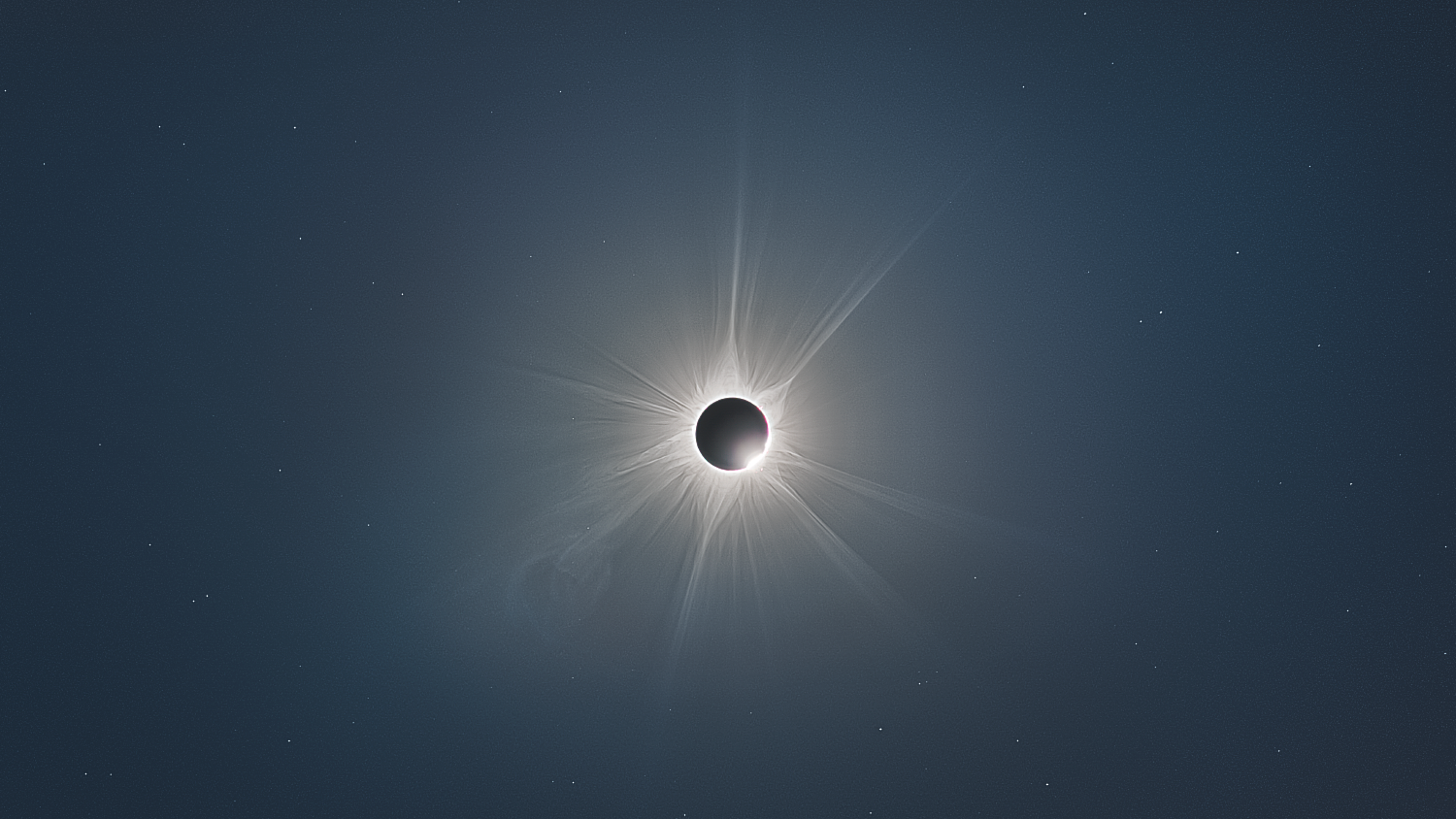
Every total solar eclipse is different. While the silhouette of the moon passing across the sun barely changes, the moment our natural satellite covers the entire solar disk, something spectacular happens — the emergence of the corona. The Latin word for "crown", the solar corona is one of the wonders of nature. To gaze upon its delicate, spiky white tendrils during brief moments of totality is to glimpse the infinite, but it's only a glimpse because the corona is always changing. Shaped by the sun's constantly changing magnetic field, the corona evolves from year to year, month to month and even day to day. No two total eclipses ever reveal exactly the same structure.
It's one reason why eclipse chasers keep traveling. The corona visible during the total solar eclipse of Aug. 12, 2026 — if skies are clear — will be a unique snapshot of the sun at a specific moment in Solar Cycle 25. It will reflect years of changing magnetic activity, thousands of sunspots and countless eruptions of solar material.
Once totality ends, that exact configuration of the corona will never be seen again. Can we know in advance what it might look like?
The sun's hidden atmosphere
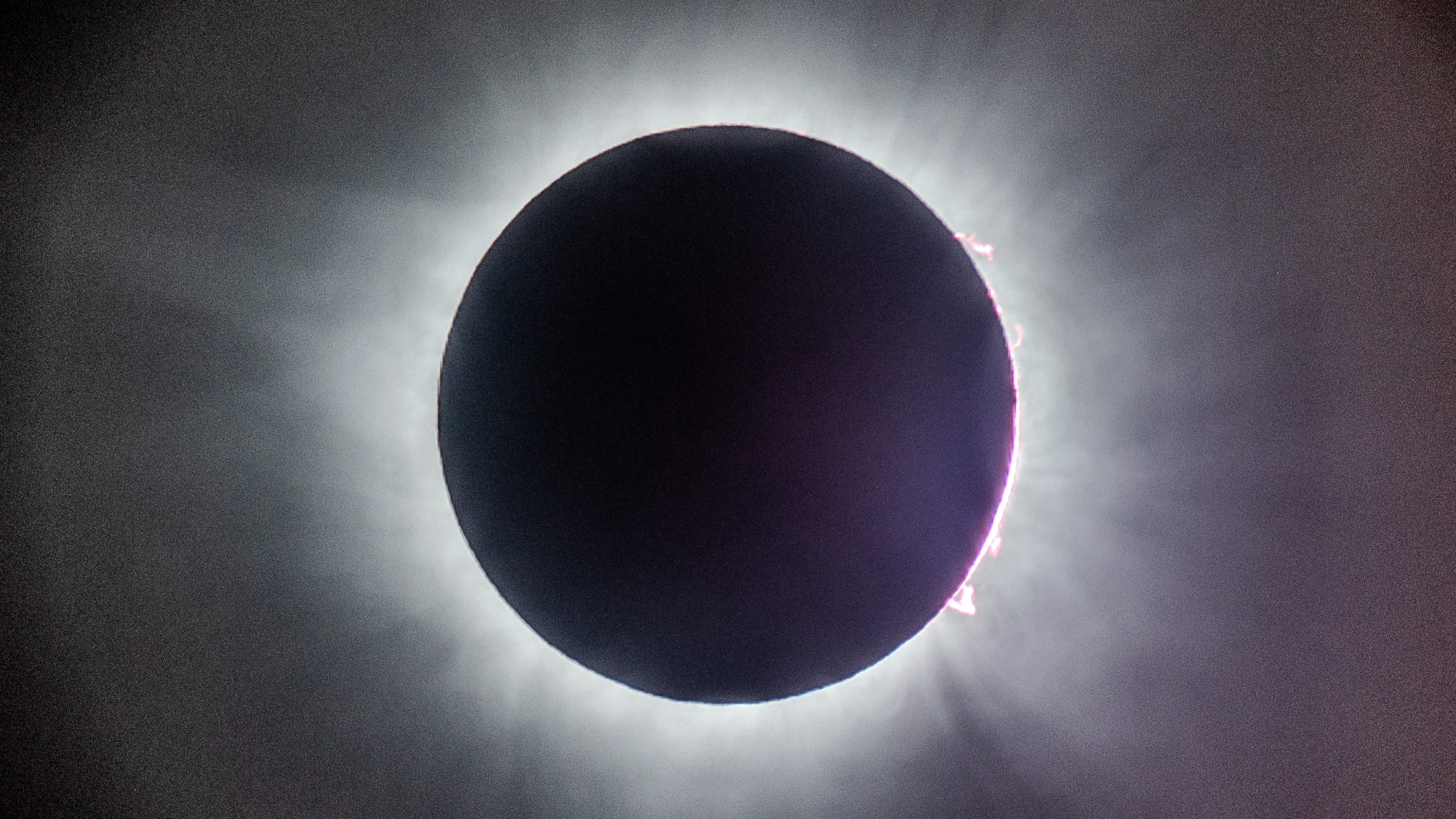
Under normal circumstances, the sun's corona — our star's outer atmosphere — is invisible. It extends millions of miles into the solar system, but it's overwhelmed by the brilliant light of the sun's photosphere, its visible surface. Totality changes that. When the moon completely covers the photosphere, the corona suddenly emerges. White streamers extend away from the black silhouette of the moon. Pink loops and prominences can appear around the edge of the moon.
For many first-time observers, the greatest surprise during totality is not only the detail but the scale. The corona often appears much larger than expected, extending several solar diameters away from the eclipsed sun. Photographs can capture some of that complexity, but they rarely reproduce the impression of depth and structure visible to the human eye, whose dynamic range is vastly superior to any camera.
The corona on Aug. 12, 2026, may resemble the total solar eclipse on April 20, 2023. (Image credit: NASA/ESA (SOHO), P. Horálek/Institute of Physics in Opava; Josef Kujal (of the Astronomy Society of Hradec Kŕlové) and Milan Hlaváč.)
Why every corona looks different
The corona is not a fixed object. It is created by extremely hot plasma — highly energized, ionized gas — that's trapped and sculpted by the sun's magnetic field. Since the sun's magnetic field is constantly changing, the corona changes with it.
"The sun follows a natural 11-year cycle of increasing and decreasing activity," Ryan French, solar physicist, author and science communicator at the Laboratory for Atmospheric and Space Physics (LASP) in Boulder, Colorado, and author of Little Book of Eclipses: An Essential Companion to Solar and Lunar Events told Space.com in an email. "At the peak of this cycle, called solar maximum, there are loads of sunspots on the sun, which are giant magnets nestled in the base of the sun's atmosphere. These sunspots produce a lot of solar flares and coronal mass ejections, which are kind of bursts and eruptions of energy from the sun's atmosphere, and at solar minimum, the sun has none of these things."
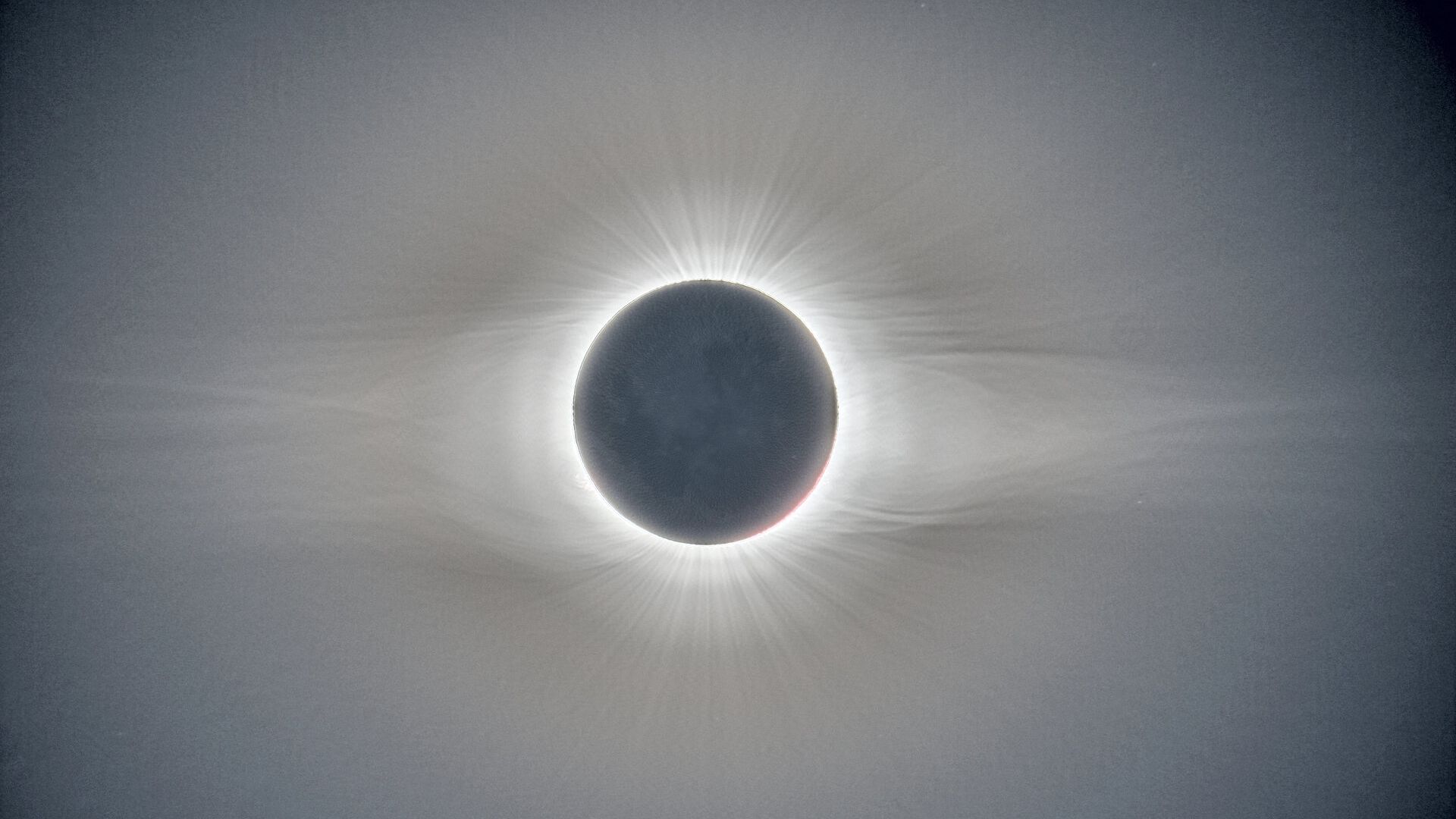
That magnetic activity determines the overall shape of the corona. During solar minimum, when the sun has few or no sunspots, the corona tends to look more uniform and more symmetrical. Long streamers often stretch from either side of the sun, giving the corona a wing-like appearance. During solar maximum, it can look much more complex. Sunspot regions act like magnetic anchors, creating structures that can appear as spikes or streamers extending in different directions.
"If you were to see a total eclipse during solar maximum, the solar corona looks almost like a five-pointed cartoon star," said French. "That's because every one of these sunspot regions creates a spire or spike that you can see with the eye."
Not solar maximum — but not quiet
The 2026 eclipse will not occur at solar maximum. Solar Cycle 25 peaked in October 2024, according to NASA and NOAA, with the Aug. 12, 2026 eclipse occurring almost two years later, during the cycle's declining phase. However, solar activity does not collapse immediately after solar maximum. It declines gradually, and the sun is expected to remain more active than it was in the lead-up to solar maximum.
"We're no longer in solar maximum — we're a third of the way past the peak in terms of amplitude and years passed," said French. "The corona will still be far more active than during the 2017, 2019 and 2020 total solar eclipses, but much less so than 2024's."
That makes the 2026 eclipse especially interesting. It likely won't show the full, highly structured corona seen close to the peak of activity in 2024, when the April 8 total solar eclipse occurred with a monthly sunspot number of about 144. Current predictions for August 2026 are closer to 102; far fewer, but still considered active by recent-cycle standards.
That means eclipse-watchers should expect something between extremes: not the clean, flattened corona of solar minimum, but not quite the wildest solar-maximum display either.
The sun's corona is only visible during the totality phase of a total solar eclipse. (Image credit: Getty Images)
A comparison with past eclipses
A useful comparison may be the total solar eclipses near the previous solar maximum. Solar Cycle 24, which peaked in April 2014, was relatively weak. The closest total solar eclipses to that peak were the rare hybrid eclipse of Nov. 3, 2013, when the monthly sunspot number was around 113. By contrast, Solar Cycle 23, which had a double peak — in March 2000 and November 2001 — was relatively strong. The closest total solar eclipse occurred on June 21, 2001, with a monthly sunspot number of around 203. Its corona was likely more complex than expected in 2026.
The 2026 eclipse therefore sits in a middle category. It's not a repeat of 2024, but it's not a quiet-sun eclipse either. An active declining-phase corona, it will likely feature strong streamers extending far into space, but with greater asymmetry, with one side of the corona more active. "It's sunspots specifically near the edge of the sun that dictate what the corona will look like," said French. The sun rotates every 27 days, so any large active region of sunspots rotating onto the sun's edge shortly before Aug. 12 could alter the corona's appearance dramatically. It's why any forecasts of what the corona looks like — which often come from Predictive Science a week before the eclipse — are generally refined on the day of the eclipse.
Red prominences may steal the show
One of the most memorable sights during totality is the appearance of vivid pink or crimson features around the moon's edge. These are usually prominences — immense structures of hydrogen plasma suspended above the sun's surface by magnetic fields. They're often mistaken for solar flares by beginners, such as after the 2024 total solar eclipse.
"Prominences are large magnetic structures that suspend plasma in the atmosphere of the sun, and they glow very bright in a very specific wavelength of light called hydrogen alpha," said French. Prominences are more likely when the sun is active, and because they can last for days or weeks, they are easier to anticipate than a flare. In hydrogen-alpha images taken before eclipse day, observers may be able to see which prominences are present around the solar edge.
The 2026 eclipse may have favorable geometry for sighting prominences. Because the moon will appear only slightly larger than the sun — which contributed to the relatively short duration of totality, at a maximum of just 2 minutes 18 seconds — smaller prominences on different sides of the sun could be visible at the same time. That is different from longer eclipses, where the larger apparent moon can cover prominences on one side before revealing others on the opposite side.
Could a CME be visible?
A coronal mass ejection (CME) is an eruption of plasma and magnetic field from the sun's atmosphere. Seeing one during totality is possible — it happened during the total solar eclipse on Dec. 14, 2020 — but requires luck. "CMEs travel very slowly, so they take several hours to traverse and escape from the sun's atmosphere, so you wouldn't see any motion during an eclipse," said French. "But what you could see, if you're lucky, is a snapshot of an eruption — though maybe a long exposure camera will be more likely to see this than your eye would." Such a view would be rare, but the chances are higher in an active solar environment than near solar minimum.
The 2019 total solar eclipse on July 2, 2019, just before the last solar minimum in December 2019. (Image credit: ESA/CESAR/Observatorio Astrofisico di Torino)
Predicting the corona yourself
There will be a forecast from Predictive Science, which can be so accurate that some eclipse chasers avoid it, so as not to ruin the surprise of totality. One way to get a general idea is to look at real-time images from telescopes that use coronagraphs to block the sun, such as the COSMO K-Coronagraph, NASA SOHO's LASCO C3 and the GOES CCOR-1. For sunspots, check the latest H-Alpha image from the Global Oscillation Network Group (GONG).
No scientist can say exactly what the corona will look like on Aug. 12, 2026. That will depend on the sun's magnetic activity in the days immediately before totality, the location of sunspot groups, the presence of prominences and the possibility of eruptions. "What exactly we see during the August eclipse will depend on what the activity is that week," said French. "And even if you saw an eclipse a month before or a month after, it could be very different." For a few fleeting minutes over Greenland, Iceland, Spain and the Balearic Islands, the sun's hidden atmosphere will become momentarily visible before vanishing back into the glare, never being seen again in quite the same way.
We're just a few short days away from the Aug. 12 total solar eclipse, when millions will watch as the moon glides across the face of the sun, hiding its light in a wondrous display of orbital mechanics.
The eclipse will unfold during August's new moon phase, as the lunar disk slips silently between the sun and Earth in the daytime sky. Ordinarily, the subtle tilt in the moon's orbit causes its shadow to pass just below, or above our planet, missing it entirely.
However, on Aug. 12, the moon's orbit will carry it into a near-perfect alignment with the sun and Earth, casting its colossal shadow across a 182-mile-wide corridor known as the path of totality, where viewers will get to see the lunar disk fully hide the sun's disk.
The path of totality for the Aug. 12 eclipse cuts through Spain, Iceland and Greenland. Hundreds of millions more watching from outside of this narrow corridor will also bear witness to a spectacular partial solar eclipse, as the moon passes in front of our parent star, without fully obscuring its surface. Those unable to watch the eclipse in person by dint of geography can also follow along online, with details of the livestream to be released closer to the event.
Read on to discover what will happen during each stage of the Aug. 12 total solar eclipse.
Stage 1: The partial eclipse begins
The partial phase of the eclipse officially begins at the moment of "first contact", when the lunar disk takes its first nibble out of the sun — a subtle transformation that will first become visible in the skies over the U.S. state of Alaska at 11:34 a.m. EDT (1534 GMT) on Aug. 12.
The moon takes its first "bite" out of the sun during the partial phase of a solar eclipse. (Image credit: Photo by Noam Galai/Getty Images)
You can check out exactly when the partial eclipse will begin from your location and find out exactly how much of the sun will be hidden by the moon using Time and Date's interactive eclipse tracker.
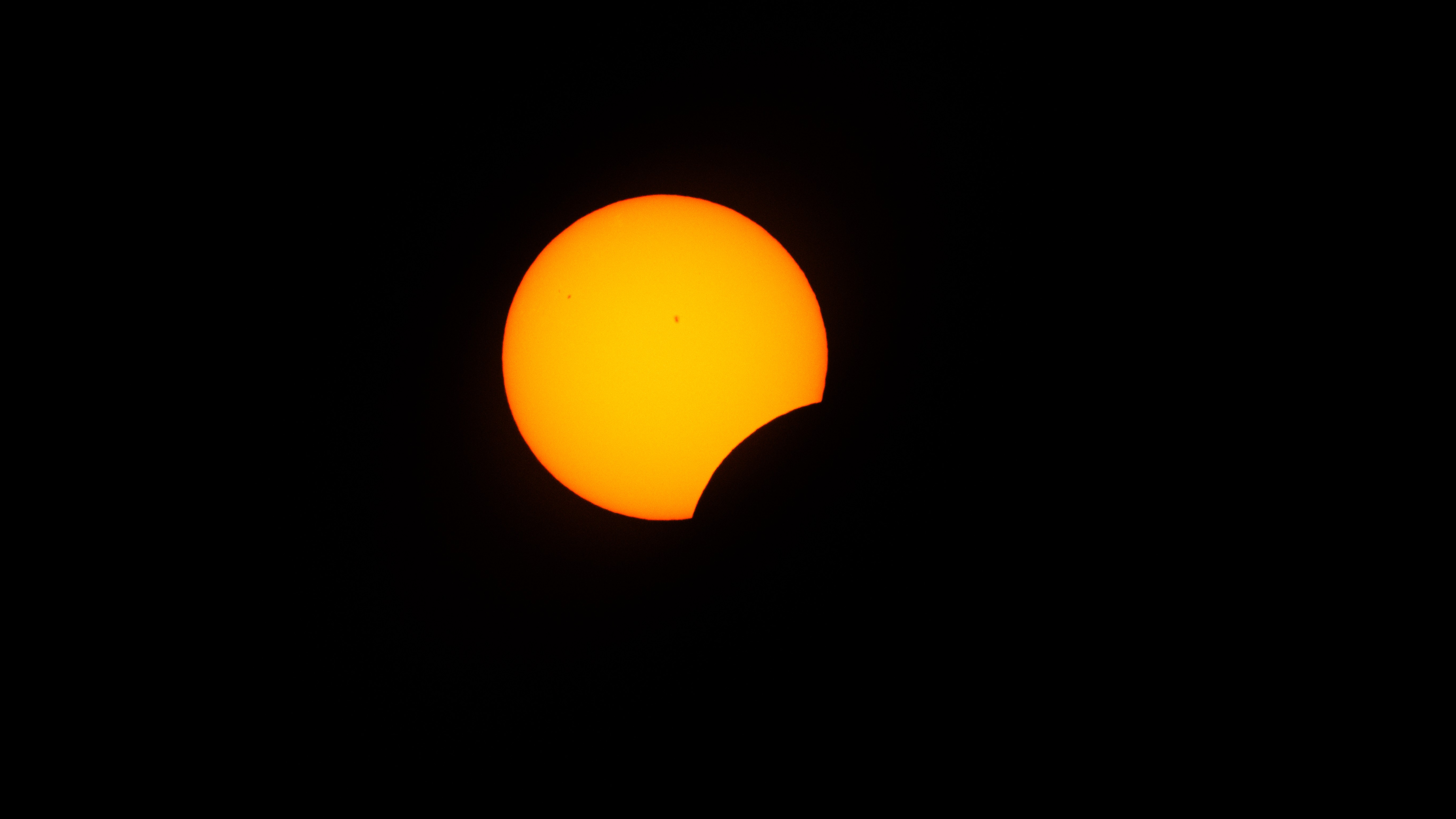
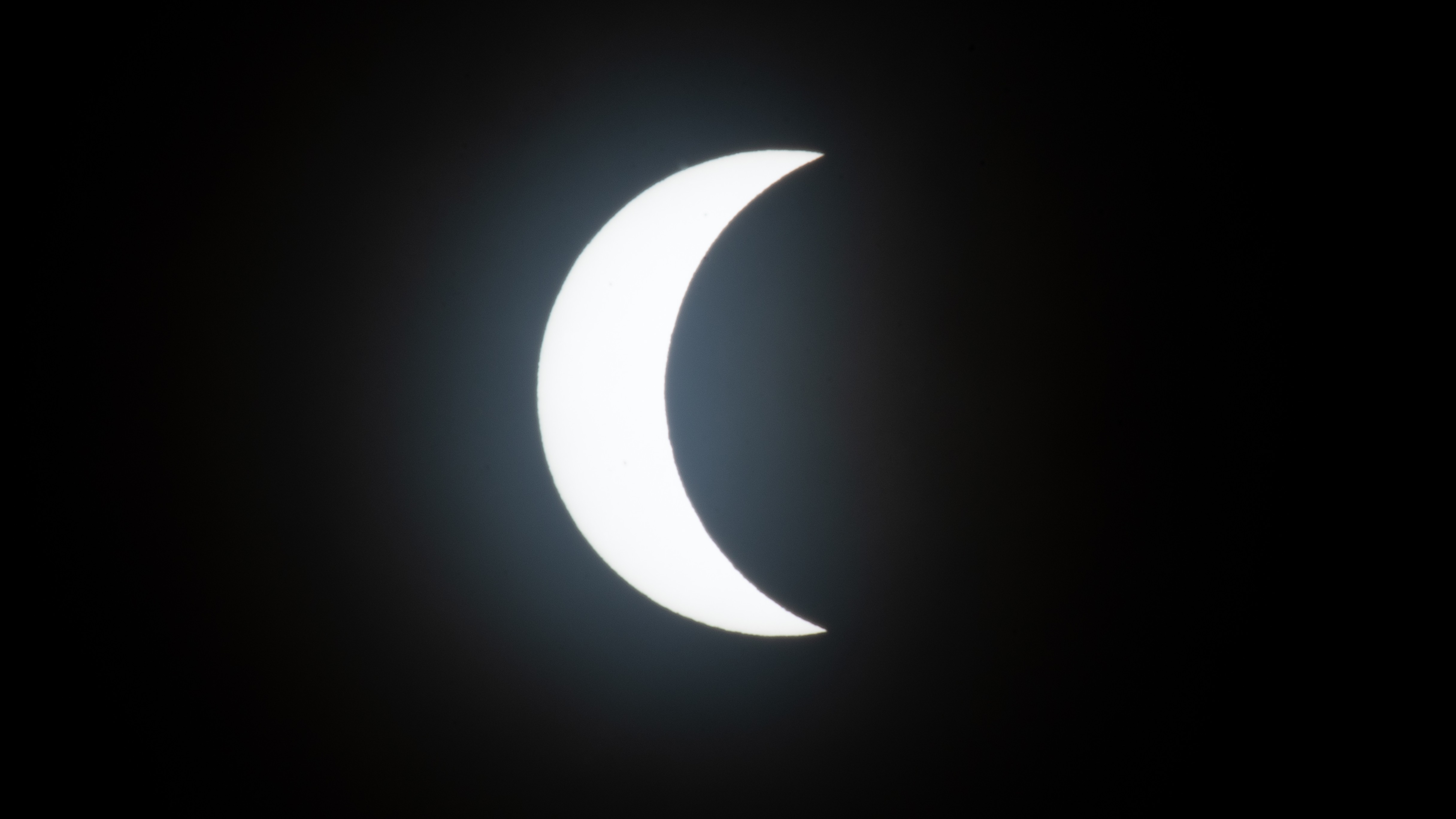
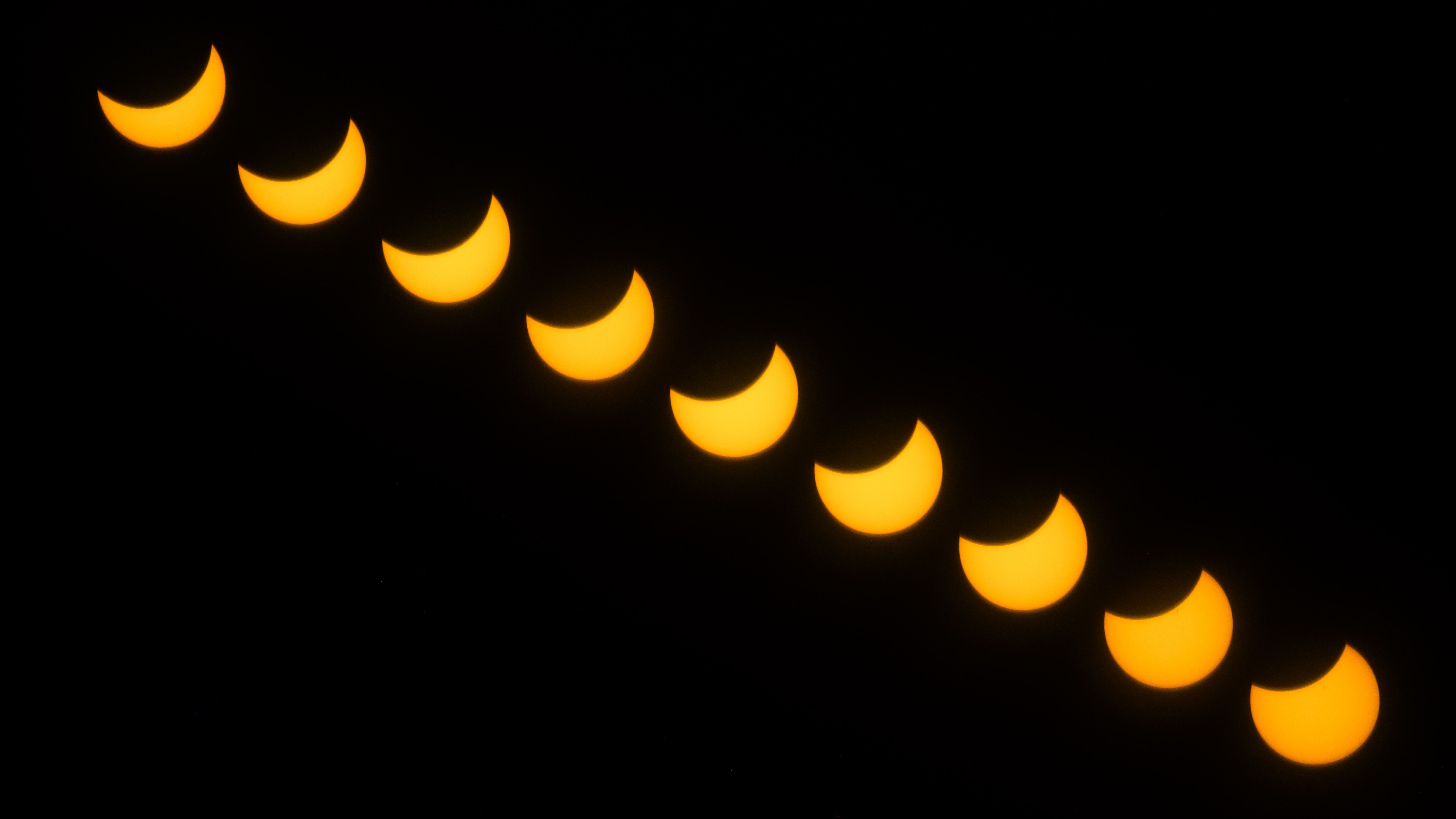
The hour and a half following first contact will see the moon sink ever farther into the sun's disk for those in the path of totality, transforming it from a burning orb into a magnificent shining crescent.
The and moon meet in the skies over Mexico during the 2024 total solar eclipse. (Image credit: Photo by: Edwin Remsberg/VWPics/Universal Images Group via Getty Images)
You may notice the temperature drop noticeably, accompanied by a subtle darkening of the sky in the half hour preceding the climactic phase of totality, as the moon reduces the sun to a thin sickle in the evening sky. Pinpricks of light — such as those that shine through a colander, or the gaps in a leaf — will also appear to mirror the scene above, creating a kaleidoscope of tiny bright crescents.
Pinpricks of light create tiny crescents during a solar eclipse. (Image credit: Photo by: Edwin Remsberg/VWPics/Universal Images Group via Getty Images)
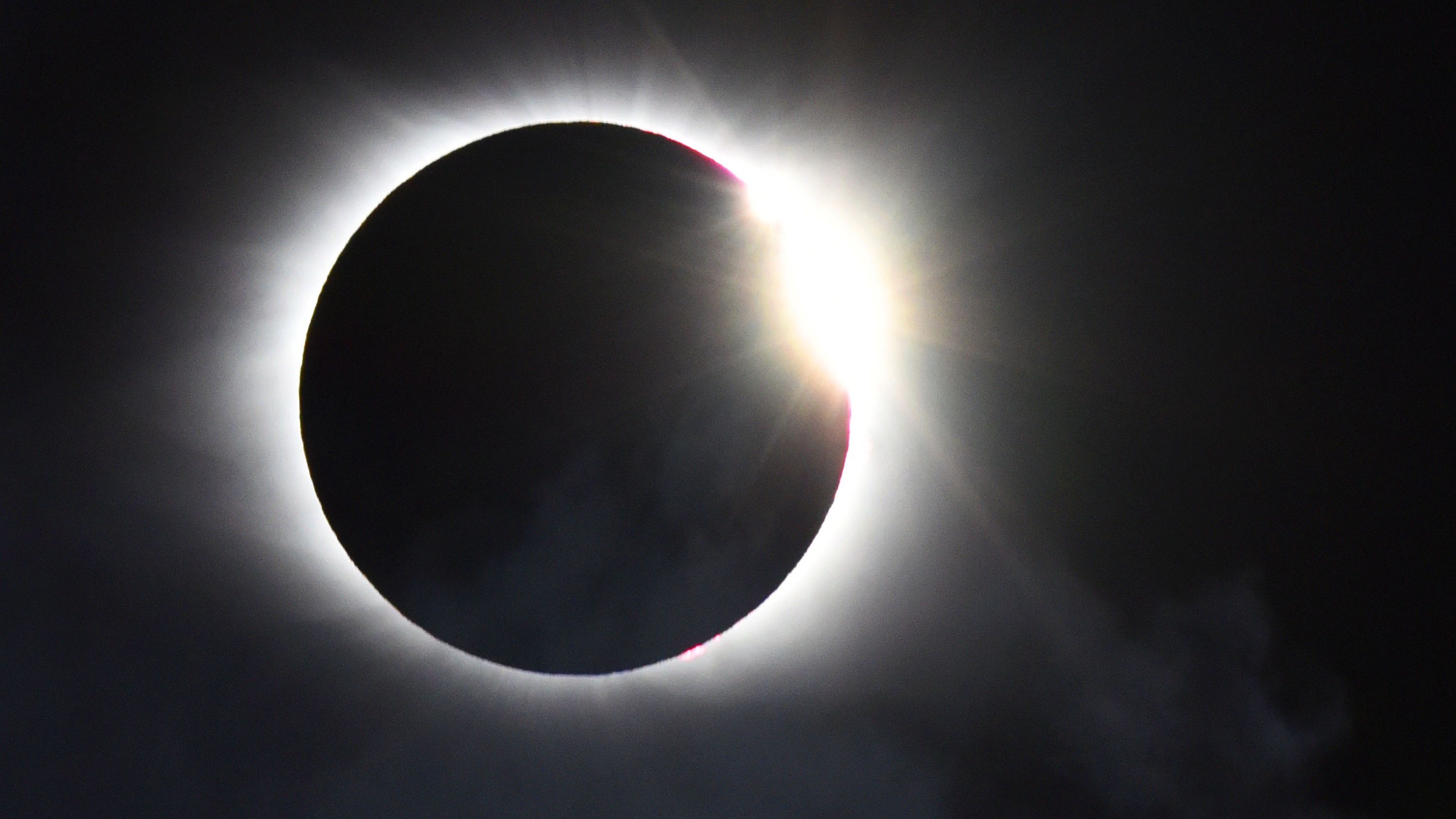
Some of the most spectacular moments of an eclipse occur just before and after totality. First, look out for the "diamond ring" effect, as the last sliver of the sun peeks out from behind the lunar disk to appear as a gorgeous celestial jewel, while the outermost layer of our star's atmosphere, the corona, creates a glowing halo around the moon.
The diamond ring effect shines from behind (Image credit: Photo by Chris McKay/WireImage)
Tear your eyes away from the sun for just a second and you may just catch sight of the moon's shadow advancing on you from the west, before it engulfs your surroundings in a false night.
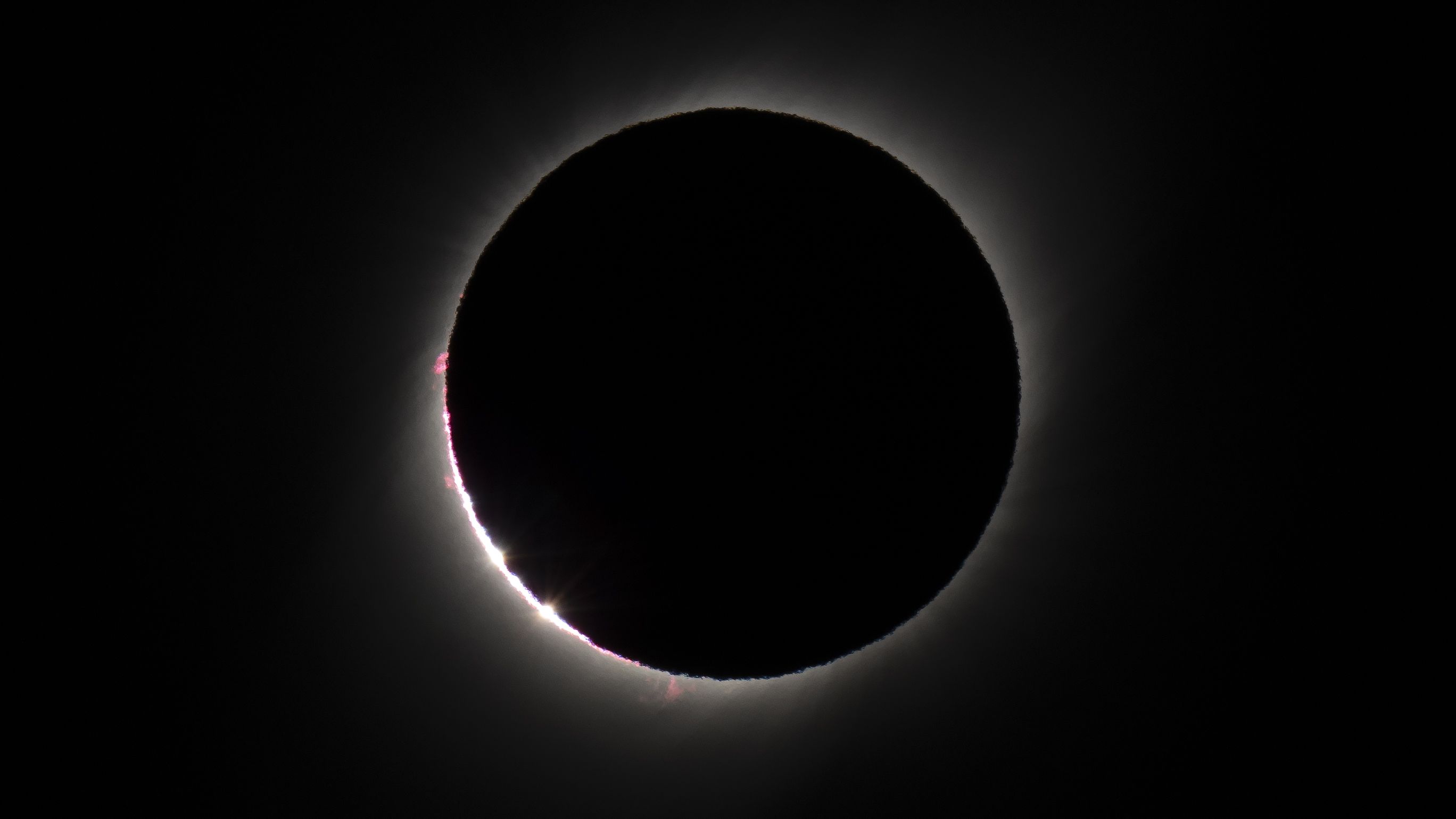
Baily's beads appear in the moments before totality. (Image credit: STAN HONDA/AFP via Getty Images)
The final seconds before totality will see bright "Baily's Beads" form dazzling points of light on the moon's edge, where the last shreds of the sun's disk shine through the ravines and valleys that scar the ancient lunar surface.
Stage 3: Totality & maximum eclipse
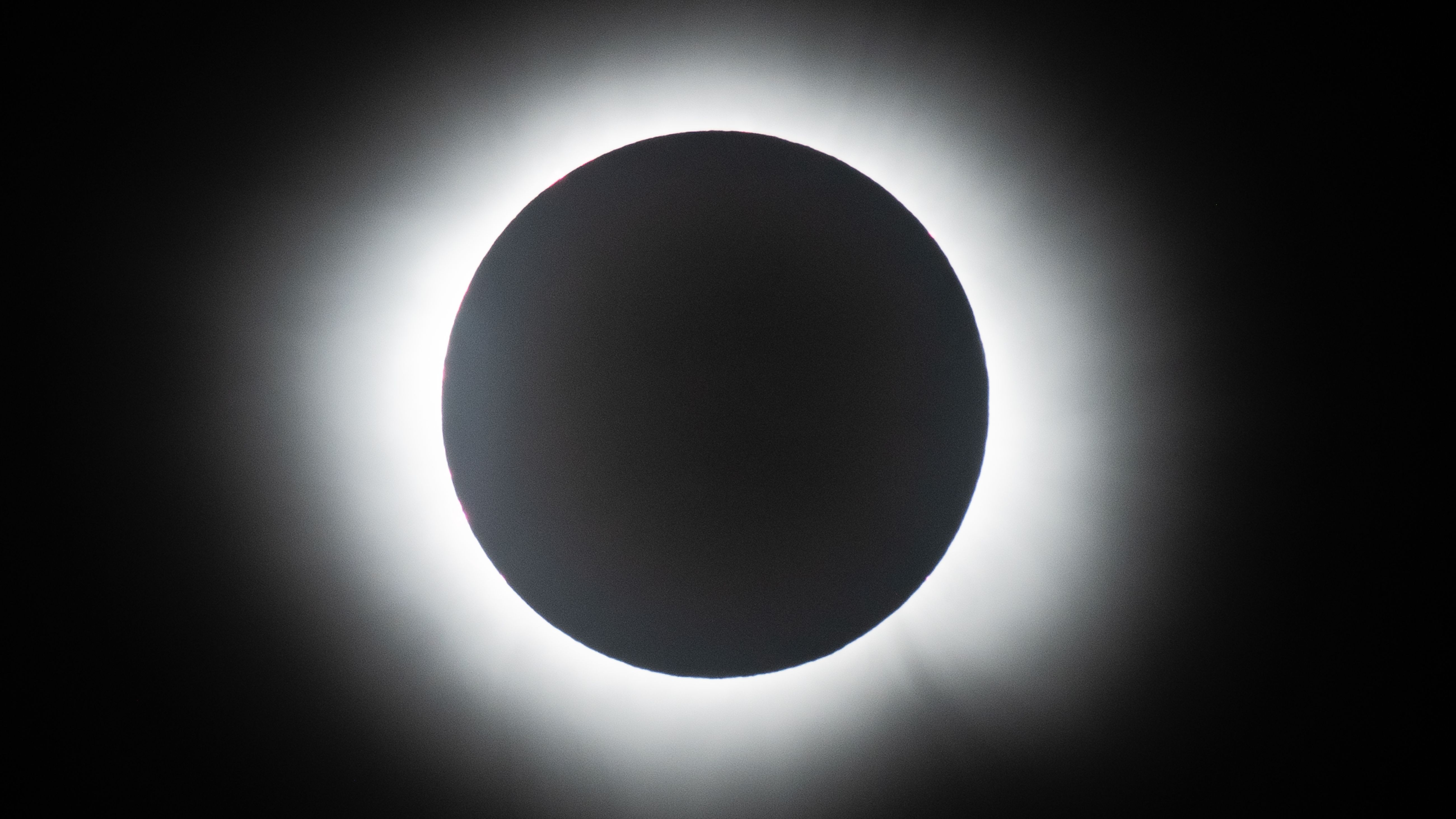
As the last of the sun's surface slips behind the moon, totality begins. This is the climactic phase of the eclipse, when the moon acts like a natural coronagraph to block the brilliance of the sun's disk, ushering in a false night in which our star's outer atmosphere can be seen leaping out from the lunar silhouette.
Totality will last a maximum of 2 minutes, 18 seconds, during which time it's safe to remove your glasses and look at the sun. Just be sure to put them on again before its fiery disk reemerges from the other side of the lunar disk.
The sun's corona haloes the moon at the climax of a total solar eclipse. (Image credit: Photo by: Edwin Remsberg/VWPics/Universal Images Group via Getty Images)
That white halo surrounding Earth's natural satellite is the sun's corona — a jacket of superheated gas that surrounds our parent star. Look out for glowing solar prominences leaping outward through the sun's atmosphere, along with the red line of the chromosphere — the layer of the sun's atmosphere beneath the corona — which appears fleetingly at the beginning and end of totality, according to NASA.
The point of maximum eclipse occurs roughly halfway through totality, when the sun's disk is most hidden by the moon.
Eagle-eyed skywatchers may catch Jupiter and Mercury shining to the lower right of the eclipsed sun in the faux twilight experienced during totality, while Venus will appear as a bright star-like object to its upper left. If you're incredibly lucky, you could even spot one of the brightest shooting stars or fireballs of the Perseid meteor shower, which comes to a peak around the same time as the Aug. 12 total eclipse.
Stage 4:Totality ends
The fourth stage of the eclipse comes as the very edge of the sun's disk emerges from behind the moon, marking the end of totality as Bail's Beads and the diamond ring effect play out in reverse, before giving way to an ever-thickening solar crescent.
Stage 5: The partial eclipse ends.
The waning partial eclipse will come to a global end at 3:57 p.m. EDT (1957 GMT), as the moon's silhouette exits the sun's disk in the skies off the west coast of Africa — a moment known to astronomers as fourth contact.
The moon exits the solar disk at the end of a total solar eclipse. (Image credit: Getty Images)
Space.com is on hand to provide expert coverage and on the ground reporting as the eclipse unfolds. Skywatching Editor Daisy Dobrijevic is undertaking an expedition with HX to observe the total solar eclipse from the waters around Greenland, while Skywatching Writer Anthony Wood heads to Spain in a cowboy hat, to catch the orbital showdown with citizen scientists from NASA's Dynamic Eclipse Broadcast Initiative.
Be sure to check out our total eclipse live blog to stay up to date with all the latest news, along with our handy explainer article detailing everything you need to know about the Aug. 12 total solar eclipse.
Editor's Note: If you capture footage of the Aug. 12 total solar eclipse and want to share it with Space.com's readers, then please send your photo(s), comments, name and location to spacephotos@space.com.
The rocket's first stage returned to Earth as planned about 8.5 minutes later, landing in the Pacific Ocean atop the SpaceX droneship "Of Course I Still Love You." It was the 16th flight for this particular booster, which is designated B1093.
A SpaceX Falcon 9 rocket launches 24 Starlink internet satellites from California's Vandenberg Space Force Base on Aug. 8, 2026. (Image credit: SpaceX)
B1093's most recent flight before today was on July 14, when it launched 27 Starlink satellites to LEO from Vandenberg.
Meanwhile, the Falcon 9's upper stage continued carrying the 24 Starlink satellites toward LEO today, deploying them about 61 minutes after liftoff as planned.
Today's launch was the 92nd Falcon 9 liftoff of 2026, and the 71st of the year devoted to building out the Starlink megaconstellation.
Starlink, by far the largest orbiting network ever assembled, currently consists of more than 10,900 active satellites — and it's growing all the time.
Fans who'd grown up on the original "Star Wars" trilogy were adults when they went through the ordeal of Han, Luke and Leia dying on screen. If tears were shed then, however, spare a thought for the kids who'd queued to watch "Transformers: The Movie" back in 1986, only to see many of their heroes expiring in the cartoon spin-off's opening act.
If you can have a bloodbath of sentient machines, this was it, as robots in disguise met their maker at an alarming rate. Ironhide? Dead. Ratchet? No more. Starscream? Pushing up mechanical daisies. Not even the iconic Optimus Prime was spared, as the noble leader of the Autobots met a brutal end at the hands of his nemesis, Decepticon leader Megatron.
This may seem like a recipe for traumatizing the film's target audience — and for many of "Transformers: The Movie"'s young viewers, it was a genuinely disturbing experience. But toy manufacturer Hasbro had ulterior motives for killing their darlings.
(Image credit: Paramount Pictures/Hasbro)
Like "Masters of the Universe" (and many other '80s cartoons before and after), the popular "Transformers" TV show was a thinly veiled commercial for one of the hottest toylines on the planet. But, the theory went, the kids who'd been watching since the series debuted in 1984 would now be familiar/bored with the original line-up, and already have the relevant robots in disguise in their toyboxes. By instigating an on-screen cull, Hasbro believed they'd be able to make way for new characters, and keep their young fans coming back for more.
"They created the story using characters that could best be merchandised for the movie," director Nelson Shin (who, in a previous life, had helped to animate the lightsabers in the original "Star Wars") told SFX magazine in 2011. "Only with that consideration could I have freedom to change the storyline. What I tried to focus on was animation-izing the story. For example, when Optimus Prime died, I changed his color from red and blue into gray in order to show that the spirit was gone from his body."
(Image credit: Paramount / Hasbro)
Although screenwriter Ron Friedman was sceptical — "I told Hasbro and their lieutenants they would have to bring him back, but they said no and had 'great things planned'," he recalled to Todd Matthy.com — many of the production team had little idea of the emotional carnage they were about to unleash.
"We didn't know that [Optimus Prime] was an icon," story consultant Flint Dille admitted in an interview on the "Transformers: The Movie" DVD. "It was a toy show. We just thought we were killing off the old product line to replace it with new products.
"Kids were crying in the theaters," he continued. "We heard about people leaving the movie. We were getting a lot of nasty notes about it. There was some kid who locked himself in his bedroom for two weeks."
(Image credit: Paramount / Hasbro)
Forty years on from its original release, a movie with such a high death count looks like a misguided brand extension for a popular Saturday morning cartoon — especially as the TV incarnation hadn't killed anyone across its two seasons to date. But for all its flaws, "Transformers: The Movie"'s storytelling was arguably bolder than any other Hollywood animation of the era.
It was also an impressive technical feat. Although the visuals are a visible step-up from the TV version, Shin (who'd been supervising producer on the cartoon from day one) and his team had to work to extremely tight deadlines to meet the film's release date:
"Time constraints and the sheer amount of work needed were the two biggest challenges, since everything had to be hand-drawn by people!"
(Image credit: Paramount / Hasbro)
The film is set in 2005, some 20 years on from the original series. The Decepticons have taken control of the Transformer homeworld of Cybertron, while human Autobot chum Spike Witwicky (a kid in the TV show) is now grown up with a son of his own. When the villains attack the Autobots' base on Earth, Optimus Prime is fatally wounded, with Megatron also at death's door.
A moment where he pleads, "Don't leave me, Soundwave!" to his loyal cassette player lieutenant is unintentionally hilarious, though still can't compete with a later sequence in which the surviving Autobots dance for joy with some new allies — tonally this movie is all over the place.
Having been cast adrift by the duplicitous Starscream, Megatron runs into a planet-sized robot in disguise named Unicron, who has a similar world-chomping MO as Marvel's Galactus. He wants to get his hands on the Autobots' Matrix of Leadership (the only thing in the universe that can kill him), so he transforms a reluctant Megatron into the souped-up Galvatron, and sends him out to hunt for the McGuffin.
(Image credit: Paramount / Hasbro)
It makes for a madcap 85 minutes as two factions of mostly unfamiliar faces vie to come out on top. The story is mostly told via the medium of fast-paced laser battles, alongside encounters with the surprising number of robotic lifeforms who populate the galaxy. Among them are a five-faced being with a penchant for feeding its fellow machines to mechanical sharks, and some scrapyard dwellers whose conversation is based on snippets from TV ads.
The "Junkions"' leader, Wreck-Gar, is voiced by Monty Python's Eric Idle, just one of the numerous star names whose presence would have meant little, if anything, to the film's young audience back in 1986. Megatron's Galvatron upgrade brought with it the dulcet tones of "Star Trek"'s Leonard Nimoy, reckless Autobot up-and-comer Hot Rod was voiced by "The Breakfast Club"'s Judd Nelson, and Robert Stack (whom readers of a certain vintage will recognize from "Airplane!") was Optimus Prime's ultra-serious number two, Ultra Magnus.
The biggest name of all was a bona fide Hollywood legend, as Orson Welles delivered his final performance as Unicron. Of the "Citizen Kane" auteur, Shin said, "He was co-operative and professional, and I liked working with him," though Welles was apparently a little less convinced.
(Image credit: Paramount / Hasbro)
"You know what I did this morning?" he reportedly complained to a friend. "I played the voice of a toy… I menace somebody called something-or-other. Then I'm destroyed. My plan to destroy whoever-it-is is thwarted, and I tear myself apart on the screen."
The filmmakers also spent more of their reported $6 million budget than they probably should have on a soundtrack powered by '80s hair metal and power ballads — Stan Bush's "The Touch", originally written for Sylvester Stallone vehicle "Cobra", went on to have a second life when the fictional Dirk Diggler "covered" the song in Paul Thomas Anderson's "Boogie Nights".
In hindsight, few of the creative decisions above were conducive to winning over a fanbase who'd have been happy with an extended episode of the TV show. "Transformers: The Movie" subsequently struggled to make back its budget at the box office, an also-ran in a packed summer that also included "Aliens", "Flight of the Navigator" and "Short Circuit".
(Image credit: Paramount / Hasbro)
It's since gone on to pick up a cult following, but still feels like one for completists — ask a casual fan to name a Transformer, and they're going to say Optimus Prime, Bumblebee or Megatron ahead of movie debutants Kup, Arcee (belatedly the first female Autobot) or Rodimus Prime.
Perhaps inevitably, Optimus Prime didn't stay dead for long, and made his inevitable comeback in the next season of the TV show. The good/bad thing about living in a modern pop culture universe is that death doesn't have to be the end.
"Transformers: The Movie" returns to theaters with a 40th anniversary re-release on September 17. It's also available to buy or rent on Amazon Prime Video.
On Episode 222 of This Week In Space, Rod Pyle and Tariq Malik are joined by space writer Rich Edwards to discuss the best ways to repel space invaders.
We've all seen the movies... the aliens come to Earth, the aliens overcome the inferior humans, and the aliens fall prey to something dumb they overlooked, like microbes, Windows 95, or most absurdly, water. From the 1950s through yesterday, some of the best movies we've seen were about the invasion of our planet. They can be clever, scary, or even downright dumb, but they are all fun.
This Week in Space covers the new space age. Every Friday we take a deep dive into a fascinating topic. What's happening with the new race to the moon and other planets? When will SpaceX really send people to Mars?
Join Rod Pyle and Tariq Malik from Space.com as they tackle those questions and more each week on Friday afternoons. You can subscribe today on your favorite podcatcher.
Early risers will catch a spectacular sight in the predawn hours of Aug. 9, as the slender crescent moon shines close to the red light of Mars among the stars of the constellation Taurus.
The 17%-lit crescent moon will rise around four hours before sunrise, or shortly after 2 a.m. for viewers in New York. The Red Planet will be visible as a steady crimson light less than 5 degrees to the lower right of the moon — close enough to share the field of view of a pair of 10x50 binoculars.
Both Mars and the moon will appear to race one another over the eastern horizon in the hours that follow, with the Red Planet gaining a slight lead over its competitor as dawn breaks.
The stars of the constellation Orion will glitter to the right of the pair throughout the race, while the Bull of Taurus watches on from above and Gemini watches from below, giving us a sneak peak at the starscape that will shine high overhead in the long winter nights a few months from now.
Celestron UpClose G2 10x50
(Image credit: Celestron)
Want to get a closer look at the moon? For around $50 you can grab these beginner binoculars for better views of craters and seas on the lunar surface. 10x is enough for a closer look without worrying about excessive shakes during handheld observation.
Look out for the subtle glow of earthshine illuminating the night side of the moon on Aug. 9, as sunlight scattered off our planet's surface and atmosphere reflects onto the nearby lunar disk, revealing the ghostly outlines of its dark lunar seas.
It's one of the last chances we'll get to gaze at Earth's satellite ahead of its new moon phase on Aug. 12, when it will cross the face of the sun in the daytime sky to trigger a spectacular total solar eclipse, which will be visible across parts of Greenland, Iceland and Spain.
Editor's Note: If you would like to share your astrophotography with Space.com's readers, then please send your photo(s), comments, and your name and location to spacephotos@space.com.
On Aug. 8, 1977, the Salyut 5 space station fell out of space and burned up in Earth's atmosphere.
Salyut 5 was a Soviet space station and part of the highly-secretive Almaz military space station program. It launched in 1976 and housed two crew of cosmonauts as they conducted military experiments and other scientific research in orbit. Originally, four crewed missions were supposed to go to Salyut 5. However, the third crew was unable to dock their spacecraft and had to return home.
The fourth mission had to be canceled because Salyut 5 was starting to run low on propellant for its main engines and attitude control system. Salyut 5 couldn't be refuelled, so it was deorbited and left to burn up in Earth's atmosphere.
A diagram of a Soviet Almaz military space station, such as Salyut 3 and Salyut 5. Salyut 5 was the last of the secretive space station series. (Image credit: NASA)
Why it mattered
When it comes to space stations, Salyut 5 was the last of its kind. While it was the Soviet Union's fifth Salyut station, Salyut 5 was actually the third and final space station dedicated primarily to Earth reconnaissance from space, and was part of the Almaz military space station program, the Soviet Union's counterpart to the U.S. Manned Orbiting Laboratory spy station.
Salyut 5 launched in June 1976 and was expected to host at least four cosmonaut crews during its time in orbit, but only three missions were ultimately launched.
The first mission, Soyuz 21, arrived at Salyut 5 a month after its launch, but returned to Earth early due to a noxious smell (possibly due to a fuel leak) on the station. A second mission, Soyuz 23, failed to dock at the station in October 1976 when their rendezvous system experienced a malfunction. After using too much propellant, they abandoned the docking attempt and returned to Earth, only to splash down in a frozen lake, making it the only Soyuz ever to land in water, according to RussianSpaceWeb.com.
The third and final Salyut 5 crew , Salyut 24, visited the station in February 1977, venting its air to avoid any lingering contamination before spending about 18 days in space. After the cosmonauts' departure, a small reentry capsule carrying the film from their reconnaissance photography separated from Salyut 5 and returned to Earth, RussianSpaceWeb reported.
By mid-1977, Salyut 5 was running low on propellant and couldn't be refueled. A fourth crewed mission was canceled and it was ultimately deorbited. Two more Salyut stations, Salyut 6 and 7, would eventually fly as science stations.
It's hardly a "Great American Eclipse," but on Aug. 12, 2026, some parts of the North American continent will see a partial solar eclipse.
Will it be as impressive as on April 8, 2024, when totality visited Mexico, 15 U.S. states and six provinces in Canada? No, yet in some parts of the U.S. and Canada, astronomers will be out in force to capture a significant chunk of the sun as it is obscured by the new moon.
The spotlight may be on the total solar eclipse in Greenland, Iceland, and Spain, but millions across North America can still see the moon take a bite out of the sun on Aug. 12. The farther northeast you are, the deeper the eclipse. Here's everything you need to know about the partial solar eclipse in North America.
Where to see the partial solar eclipse in the U.S.
Between 7:34 a.m. AKDT and 2:52 p.m. EDT, 20 U.S. states will see something of the partial solar eclipse, though only northeastern states will get a good view. Here's a sample of locations and the time of maximum eclipse. Note that the partial eclipse begins (first contact) and ends (last contact) around 55 minutes before and after the time of maximum eclipse given here.
Location
Maximum eclipse
Time (local)
Fairbanks, Alaska
37%
8:27 a.m. AKDT
Presque Isle, Maine
28%
1:50 p.m. EDT
Bangor, Maine
23%
1:53 p.m. EDT
Portland, Maine
19%
1:53 p.m. EDT
Montpelier, Vermont
17%
1:49 p.m. EDT
Manchester, New Hampshire
16%
1:53 p.m. EDT
Boston, Massachusetts
16%
1:55 p.m. EDT
Providence, Rhode Island
15%
1:55 p.m. EDT
Springfield, Massachusetts
14%
1:53 p.m. EDT
New Haven, Connecticut
12%
1:54 p.m. EDT
Bridgeport, Connecticut
11%
1:54 p.m. EDT
New York City, New York
10%
1:54 p.m. EDT
Newark, New Jersey
9%
1:53 p.m. EDT
Rochester, New York
9%
1:43 p.m. EDT
Allentown, Pennsylvania
8%
1:52 p.m. EDT
Buffalo, New York
7%
1:42 p.m. EDT
Philadelphia, Pennsylvania
7%
1:53 p.m. EDT
From most of the northeast U.S., only a small eclipse will be visible on Aug. 12, 2026. (Image credit: imageBROKER/Lucas Seebacher via Getty Images)
Where to see the partial solar eclipse in Canada
Between 8:38 a.m. MST and 4:38 p.m. NDT on Aug. 12, every province in Canada will be able to see some kind of partial solar eclipse, but those in the east of the country will see something much more significant. Here's a sample of locations and the time of maximum eclipse. Note that the partial eclipse begins (first contact) and ends (last contact) around 55 minutes before and after the time of maximum eclipse given here.
Location
Maximum eclipse
Time (local)
Iqaluit, Nunavut
61%
1:24 p.m. EDT
St. John's, Newfoundland and Labrador
53%
3:34 p.m. NDT
Moncton, New Brunswick
32%
2:55 p.m. ADT
Halifax, Nova Scotia
31%
3:00 p.m. ADT
Churchill, Manitoba
27%
12:02 p.m. CDT
Quebec City, Quebec
24%
1:46 p.m. EDT
Whitehorse, Yukon
23%
9:26 a.m. MST
Trois-Rivières, Quebec
21%
1:45 p.m. EDT
Sherbrooke, Quebec
20%
1:48 p.m. EDT
Montreal, Quebec
18%
1:45 p.m. EDT
Ottawa, Ontario
15%
1:42 p.m. EDT
Kingston, Ontario
12%
1:43 p.m. EDT
Toronto, Ontario
8%
1:40 p.m. EDT
St. Catharines—Niagara, Ontario
8%
1:41 p.m. EDT
Kitchener, Ontario
7%
1:38 p.m. EDT
Hamilton, Ontario
7%
1:40 p.m. EDT
London, Ontario
5%
1:38 p.m. EDT
Windsor, Ontario
3%
1:36 p.m. EDT
What to expect
This is a small partial solar eclipse in North America, which occurs at lunchtime. In the east of the continent, it will occur high in the sky — about two-thirds of the way between the horizon and the zenith — in the south-southwest. At maximum eclipse, the partially eclipsed sun with resemble a thick crescent or a smile. It won't get dark — that only happens within the path of totality — nor will daylight be affected.
Those using a telescope to observe or image the partial eclipse (using a solar filter) should also consider that Venus — which will be visible just after sunset — reaches dichotomy on Aug. 12. This is the point in its current apparition as the "Evening Star" that it starts becoming interesting in a telescope. Dichotomy sees it reduce to 50%-lit and gradually become an ever-shrinking crescent.
Perhaps more importantly, the early hours of Aug. 13 see the peak of the annual Perseid meteor shower.
When is the next solar eclipse visible from the US after August 2026?
The next solar eclipse on Aug. 2, 2027, will be seen in Newfoundland, Canada, where a 23% partial eclipse will occur at the province's southwestern tip.
On Jan. 26, 2028, during an annular solar eclipse across northern South America, eastern U.S. states and eastern Canada will see a very small partial solar eclipse shortly after sunrise. Florida will have the best view, with around 15% of the sun blocked.
On Jan. 14, 2029, a large partial solar eclipse will be seen in the morning sky across all of North America — up to 81% in northern Canada and 74% in northwestern U.S. states. On June 12, 2029, a smaller partial solar eclipse will peak at 34% just after sunrise from Nunavut, the Northwest Territories and the northern tips of Alberta and British Columbia.
Power: 8x AA batteries (not supplied)/external 12V DC via adaptor panel
Mount head weight: 2.9 lbs/1.3kg
Total weight with optional tripod: 8.8 lbs/4.05kg
Tripod: 31.7-59.8 inches/80.5-152cm adjustable aluminum tripod with accessory tray, bubble level and 3/8-inch screw fitting
Finding the sun sounds easy, right? Many people think of the sun as big and bright, but it’s actually rather small in the sky — it’s got an angular diameter of just half a degree, in fact, the same as the moon. Put an all-important solar filter on a telescope, and you’re left with the challenge of finding a tiny orange or white circle in a sea of black. Even if you manage to find the sun, nudging a solar telescope back into position every few minutes to keep it in the field of view quickly gets irritating.
Dual-axis alt-az tracking keeps the sun in view during observing sessions. (Image credit: Jamie Carter)
Cue the Sky-Watcher SolarQuest mount, a simple grab-and-go product that exists to solve exactly that problem. Costing around $585/£259-£359 (the latter with a tripod), it is not a general Go-To astronomy mount and it is not trying to be one. It is best understood as a dedicated solar tracking platform for small solar telescopes. That could range from regular telescopes wearing solar filters, most likely during a solar eclipse, to dedicated solar telescopes such as white-light-filtered refractors and H-alpha (Hydrogen-alpha) telescopes designed specifically for viewing the sun.
Sky-Watcher SolarQuest mount head: Design
Its 8.8-lb payload suits compact white-light and H-alpha solar scopes. (Image credit: Jamie Carter)
Lightweight and compact mount head
Simple controls make it beginner-friendly
Vixen-style saddle suits small solar scopes
The SolarQuest mount head weighs just 2.9 lbs/1.3 kg, accepts standard 45mm Sky-Watcher/Vixen-style dovetails and can be fitted to a tripod using a 3/8-inch screw. Meanwhile, the optional tripod is lightweight and easily adjustable, with a bubble level and accessory tray. Whatever tripod you use, it’s imperative to get it stable before using the SolarQuest because its ability to track the sun successfully depends on it.
The Sky-Watcher SolarQuest comes with an optional sturdy tripod.Jamie CarterThe tripod comes with a handy accessory tray.Jamie CarterThe optional tripod includes grippers to keep the rig steady.Jamie Carter
With the optional aluminum tripod — which we used in our review — the total setup is still only around 9.9 lbs/4.05 kg, making it easy to set up inside and carry into the garden. Eclipse chasers travelling abroad will easily be able to store it in a carry-on camera bag.
HelioFind technology makes solar alignment fast and beginner-friendly. Jamie CarterA Vixen-style saddle accepts many small solar telescopes and spotting scopes. Jamie Carter
The mount itself has very few controls: A power button and an 8-way sliding switch. A long press of the power button finds the sun, with the second used to make manual adjustments. There are no menus and no alignment tasks.
Sky-Watcher SolarQuest mount head: Performance
Its job is simple: Find the sun and keep it centered. (Image credit: Jamie Carter)
Finds the sun automatically in clear conditions
Fine-tuning controls keep the sun centered
Works well with solar telescopes
At first glance, the promise of the Sky-Watcher SolarQuest mount head is so simple: you level the tripod using its built-in bubble or spirit level and point the attached telescope somewhere to the left of the sun. You then long-press the power button and step back. The built-in GPS calculates the date, time, and location, as well as the sun’s altitude and azimuth. The mount levels the telescope, pauses, then slews to the right altitude. Then its photodiode solar sensor (a small camera) hunts for the solar disc and locks on. In practice, the system gets impressively close to that ideal — but with some small caveats.
A colorized image of the sun taken with a ZWO planetary camera on an H-Alpha telescope mounted on the SolarQuest. (Image credit: Jamie Carter)
The sun needs to be in a clear sky, but it doesn’t have to be high. We reviewed the SolarQuest during a summer heatwave, when getting up very early was the only sensible way to observe the sun. Having got up early to take advantage of the cool morning air before the sun rose too high, we feared the SolarQuest would fail to find such a low sun. Luckily, there were no such issues, with SolarQuest taking just under 60 seconds to be perfectly aligned with the sun.
The solar sensor uses four photodiodes to lock onto the sun. (Image credit: Jamie Carter)
For visual observing, that’s transformative. Instead of spending the first part of a session aligning, shadow-aiming and nudging a scope into position, you can be looking at the sun within minutes. However, we did have to use the joypad on the SolarQuest to center the sun. Happily, the controls are very sensitive and move slowly, so we were able to have a perfect view of the sun in under two minutes from pressing the power-on button. That’s impressive.
Sky-Watcher SolarQuest mount head: Functionality
Built-in GPS calculates the sun’s position automatically. (Image credit: Jamie Carter)
Accurately tracks the sun
8x AA batteries are old-fashioned
Payload is a limiting factor
Tracking accuracy is very good, with a tiny adjustment on the joypad required perhaps every few hours. Since it largely follows the sun’s path through the sky, it should be suitable for a total or deep partial solar eclipse, when a crescent sun could confuse the sensor (to be sure, you could cover the sensor during totality so it doesn’t hunt for the sun and try to realign during an eclipsed crescent sun).
However accurate it is, this is an alt-az mount. It can track the sun well but it cannot remove field rotation during much longer imaging sessions. For visual use and almost all solar use — including casual video capture — that is not a major issue. However, for long-duration solar imaging and creating time-lapses, it’s a limitation to keep in mind.
The battery compartment takes eight AA batteries, though external power is available. (Image credit: Jamie Carter)
One practical complaint is the battery compartment. Pop open the door (which detaches and becomes easily lost) and inside is a small plastic cradle that takes eight AA batteries. As if needing to take a trip to a store before being able to use the SolarQuest wasn’t annoying enough, it occurred to me that if I was going to an eclipse, I would need to travel with at least eight more AA batteries as spares — and possibly another 16x for true peace of mind. Not a pleasant prospect. Should any gadget like this be AA battery-powered in the age of Lithium-ion and USB-C? A resounding no. The box includes a 12V DC connection but there’s no cable. It all seems poorly thought through and old-fashioned.
The mount head weighs just 2.9 lbs, making it easy to carry outside. (Image credit: Jamie Carter)
However, the main practical limitation of the SolarQuest is its 8.8 lbs (4 kg) payload, which sets it apart as an accessory for small solar telescopes. At its best when speed and simplicity matter, SolarQuest is a travel-friendly mount ideal for beginners and eclipse chasers seeking to remove a common frustration from solar observing — finding and tracking the sun — without adding complexity. It almost totally succeeds.
How we tested the Sky-Watcher SolarQuest mount head
We tested the Sky-Watcher SolarQuest mount with the Sky-Watcher Heliostar 76mm H-alpha solar telescope. (Image credit: Jamier Carter)
We tried the SolarQuest for about two weeks with both a Celestron Regal M2 spotting scope (with a solar filter attached) for white-light observations of the solar disk and a Skywatcher HelioStar 76mm solar telescope. The latter was used to get some images of the sun in H-Alpha (Hα), in conjunction with a ZWO ASI174MM planetary camera.
Should I buy the Sky-Watcher SolarQuest mount head?
Buy it if:
✅ You want to get into casual backyard solar observing: The SolarQuest mount is great for those who have a small solar telescope or a regular telescope with a solar filter and want to start observing the sun more.
✅ You want fast, automatic solar finding and tracking: The SolarQuest mount makes solar observation super easy and super quick so finding the sun isn't a chore and allows you to focus on observation.
Don't buy it if:
❌You want a mount for nighttime astronomy as well: It has one job, to find the sun, and doesn't work for finding any targets in the dark night sky.
❌You don’t want to travel with lots of spare AA batteries: The mount is powered by eight AA batteries and if you are carrying spares, this means a lot of extra weight to carry around when travelling to observation locations.
If you need something to support a solar or solar-filtered telescope under 8.8 lbs/4kg, the SolarQuest should be on your radar. It quickly finds the sun and tracks accurately, removing the need for manual alignment. It’s also really compact, operates quietly and has very simple controls.
The included instructions are poor, the way it’s battery-powered is far from ideal, and it’s limited by its payload capacity, but it’s so easy to use and quick to work that it’s hard to criticize the SolarQuest too harshly — it’s a slick and simple accessory.
If the Sky-Watcher SolarQuest mount head isn’t for you
There are very few dedicated solar trackers like the Sky-Watcher SolarQuest. However, some star trackers do have a mode where you can choose the sun as the star to track, including the Benro Polaris. Once you’ve entered the sun in the frame using the virtual joystick, the Polaris can automatically track it. Another alternative is an equatorial mount, which, when well aligned, can handle solar observing for longer periods and/or for making time-lapse sequences.
The company plans to build factories on the moon, using robots to do much of the heavy lifting, Elon Musk said on Tuesday (Aug. 4) during SpaceX's first-ever quarterly earnings call.
"We are going to land a lot of tonnage on the moon," he said. "We're going to build the factories on the moon. The robots will be helpful with that."
This is not a newly revealed vision; Musk first laid it out in February, in a blog post that announced SpaceX's purchase of xAI, a company that the billionaire entrepreneur founded in 2023. But Musk doubled down on it this week, showing investors that off-Earth manufacturing is very much front-of-mind for SpaceX.
The factories in question will build SpaceX's Starmind AI satellites, if all goes according to plan. The company aims to operate a million-strong Starmind constellation in Earth orbit in the coming years, and then go farther afield with the craft after that.
Eventually, SpaceX wants to launch locally made Starmind satellites off the lunar surface using electromagnetic mass drivers — basically, extremely powerful rail guns.
"Using robots on the moon to scale up manufacturing on the moon — which, I know it sounds, like, super sci-fi right now, but it's going to happen — will enable us to build the mass accelerator on the moon," Musk said.
"And if you have a mass accelerator on the moon, and you have solar and radiator production on the moon, you can — I know this sounds totally nuts — but you can you can probably scale to 1,000 times the economy of Earth in terms of intelligence launched to space, but probably, you know, maybe even a million times," he added.
"Solar and radiator production" refers to the manufacture of key Starmind satellite components: solar panels to power them and radiators to dump the large amounts of heat they'll produce into the vacuum of space.
A rendering of one of SpaceX's planned "Starmind" AI satellites in orbit. (Image credit: SpaceX)
Musk didn't provide details about the robotic lunar labor force. But he's presumably counting on Optimus, a humanoid robot built by another one of his companies, the carmaker Tesla. Musk has previously said that SpaceX will launch some Optimus units to Mars in the near future, to help pave the way for human settlement of the Red Planet.
Those robots will fly on Starship, SpaceX's fully reusable next-gen megarocket, which is currently gearing up for its 14th test flight. Indeed, Starship is key to most of the company's plan's both in Earth orbit and beyond.
"Starship aims to quadruple payload capacity and reduce launch costs by 10 times compared to our Falcon 9 rocket, unlocking significant capabilities across all of our business segments," SpaceX Chief Financial Officer Bret Johnsen said during Tuesday's earnings call.
"We continue to make progress building the infrastructure required to support thousands of Starship launches per year, including accelerating Raptor and launch vehicle production, the buildout of our gigabays, and making significant progress towards activating multiple launch pads at Starbase and in Cape Canaveral at Pad 39A and Pad 37," he added. (Raptor is the engine that powers Starship, and Starbase is SpaceX's South Texas site, which serves as the current hub of Starship manufacturing, testing and launch activities.)
Tuesday's call was a landmark for SpaceX — its first as a publicly traded company. Musk founded SpaceX as a private concern in March 2022 and took it public this past June, via the richest IPO in history.
The IPO raised $86 billion and valued SpaceX at $1.77 trillion. Only six American companies had higher market capitalizations at the time — NVIDIA, Apple, Alphabet (Google), Microsoft, Amazon and the semiconductor manufacturer Broadcom. (Market caps fluctuate all the time, going up and down with companies' stock prices.)
The main point of Tuesday's call was to discuss SpaceX's first-ever earnings report, which covered the second quarter of this year. The company's revenue over that stretch was $7.8 billion, a 92% increase over the same period in 2025, according to the report. SpaceX lost more money than it made during Q2 2026, but the shortfall was considerably smaller than in Q2 2025 — $541 million versus $1.0 billion.
It looks like Starship's two-week-long ocean adventure won't have a happy ending.
The SpaceX megarocket conducted its 13th test flight on July 24, lifting off from the company's Starbase site in South Texas. Things went pretty well on Flight 13, especially for Starship's 171-foot-tall (52 meters) upper stage, known as Ship, which splashed down as planned in the Indian Ocean off the coast of Western Australia.
In an unexpected first, Ship survived that homecoming, staying in one piece even after toppling over and hitting the waves. It remains intact still, and SpaceX is towing it toward shore in Western Australia to get a better look. But the ambitious effort is unlikely to succeed, SpaceX founder and CEO Elon Musk told us today (Aug. 7).
SpaceX works to get the upper stage from Starship's 13th test flight to shore from its Indian Ocean splashdown site. This is a screenshot from a video the company posted on X on Aug. 7. (Image credit: SpaceX)
"Unfortunately, ship recovery is not looking good right now. Nonetheless, we were able to obtain close-up photos of critical regions of the heat shield and engines for future upgrades," Musk wrote this afternoon via X, the social media site he owns.
He was responding to a SpaceX post from an hour or so earlier, which provided an update about the recovery effort and shared two photos and a video of the activities.
The recovery team has "been overcoming challenging conditions and increasingly rough seas as they attempt to guide the 52m long spacecraft to port," SpaceX wrote in the post.
The SpaceX Recovery team is still working to recover Flight 13’s Starship from the Indian Ocean. They’ve been overcoming challenging conditions and increasingly rough seas as they attempt to guide the 52m long spacecraft to port pic.twitter.com/ECT5FyCvr7August 7, 2026
Starship is the biggest and most powerful rocket ever built, standing about 408 feet (124 meters) tall when stacked. Both of its stages — Ship and the Super Heavy booster — are designed to be fully and rapidly reusable, a breakthrough that SpaceX thinks will revolutionize spaceflight.
A key enabler of rapid reuse is Ship's heat shield, which protects the vehicle during its downward trips through Earth's atmosphere. Musk has described heat shield development as perhaps the biggest challenge on Starship's road to operational flight — but that challenge may now be in the rearview mirror.
"I don't want to jinx it or anything, but I think I'd consider the heat shield problem solved at this point," Musk said on Tuesday (Aug. 4), during SpaceX's first-ever quarterly earnings call.
It's no surprise that Starship and Flight 13 came up in that call. The megarocket is key to SpaceX's ambitious future plans, which include assembling and operating a million-satellite AI constellation in Earth orbit.
Flight 13 was similar to previous Starship test missions; it was a suborbital jaunt that ended with Super Heavy coming down in the Gulf of Mexico and Ship landing in the Indian Ocean.
There was a big milestone, however, in addition to Ship's unexpected transition to seagoing vessel: During its time in space, the upper stage deployed 20 functional Starlink V3 satellites, the bigger, next-gen variant of SpaceX's broadband spacecraft.
These satellites quickly came back down to Earth on July 24, but Flight 13 was a vision of the future nonetheless. SpaceX wants to operate a constellation of 100,000 or so Starlink V3s, and this network will be lofted by Starship.
NASA just made an interstellar tweak to the Voyager 2 spacecraft, known as the "Big Bang", to keep its remaining 50-year-old science instruments running a little longer.
Voyager 2 and its twin launched in 1977, called Voyager 1, rely on a form of nuclear battery known as a radioisotope thermoelectric generator that uses the heat produced by the decay of plutonium. But the supply of plutonium on each probe drops at about four watts a year on each spacecraft.
To keep the probe running on this dwindling power supply, engineers recently reduced Voyager 2's power requirements by turning off a few non-science devices and using "lower-power alternatives" that are still effective enough to keep the spacecraft warm while it's so far from the sun, NASA officials said in a statement. "The spacecraft power margins have grown razor thin, requiring the team to conserve energy by shutting off non-essential devices and systems," NASA officials wrote of the mission, which is managed by the agency's Jet Propulsion Laboratory.
The drop in power is having a measurable science impact on both spacecraft — each has turned off two of their science instruments since 2024 alone. While some of these instruments were shut off after the spacecraft finished their historic planetary flybys decades ago, others were turned off due to power requirements.
Each spacecraft initially launched with 10 instruments, and Voyager 2 is now down to only three instruments. At first it looked as though Voyager 2 would have to shut down another of these instruments later this year, but luckily, the new power shifts will allow all three to operate "for at least another year," NASA said.
Voyager 1 will be tasked to do the same "Big Bang" power change "in the coming months." A signal to each spacecraft takes nearly 24 hours (or one light-day) to make a one-way journey, and officials noted Voyager 1 is further from Earth than its twin. (Voyager 2 is at about 142 astronomical units or sun-Earth distances, while Voyager 1 is nearing 171 AU.)
The two spacecraft initially launched to take advantage of a rare alignment between the outer solar system gas giant planets, which in order of distance from the sun are Jupiter, Saturn, Uranus and Neptune. Each Voyager spacecraft first flew past Jupiter and Saturn, taking unprecedented imagery of the planets and their moons.
NASA's Voyager 2 probe captured this image of Europa, the smallest of Jupiter's four Galilean moons, on July 9, 1979. (Image credit: NASA/JPL)
Next, Voyager 1 was directed to fly above the plane of the solar system (also known as the ecliptic) while Voyager 2 continued flying past Uranus and Neptune, becoming the first spacecraft to see these worlds and their moons. Voyager 2's last planetary flyby was in 1989.
The two spacecraft continue to send scientific data from interstellar space; Voyager 1 passed into that region in 2012, while Voyager 2 did so in 2018. Voyager 1 is Earth's most distant spacecraft, currently around 15.9 billion miles (25.5 billion kilometers) away from us, according to NASA.
New evidence has come to light showing that the mysterious 'little red dots' discovered in the early universe by the James Webb Space Telescope could evolve into the active centers of fully formed galaxies.
"Everything created in the early universe must evolve into something around us," said George Rieke of the University of Arizona in a statement. "We have had little idea of what little red dots become, but these results finally show us how to find their progeny."
Discovered by the James Webb Space Telescope (JWST) almost as soon as it became operational in 2022, little red dots have been a perplexing cosmological mystery. As their name suggests, they appear small, red and surprisingly bright. They are mostly found at redshift values suggesting they existed between 13.2 and 12.2 billion years ago. To shine so brightly at such great distances would usually imply these objects are quasars — which are luminous nuclei of galaxies powered by active supermassive black holes — but the light coming from little red dots is more like that of bloated stars. It looks to be mostly in infrared with some ultraviolet, and none of the X-rays that one would expect from an active black hole chomping down on material.
As such, researchers have come up with the hypothesis that little red dots are "black hole stars," or vast clouds of gas heated from within by a concealed but growing supermassive black hole.
However, the population of little red dots drops off a cliff at redshifts equating to less than 12 billion years ago. Where did they all go? There are two options. Either they all died off, or they developed into objects more familiar to us.
A team led by Pierluigi Rinaldi, who was at the University of Arizona's Steward Observatory when conducting this research but is now at the Space Telescope Science Institute (STScI) in Baltimore, think it has identified a descendent of a little red dot. It appears to be in the form of a distant galaxy, catalogued as WISEA J123635.56+621424.2, which is found at a redshift of 2, meaning that we see it as it was 10.5 billion years ago.
The galaxy displays neat spiral arms around a red core. Rinaldi's team have nicknamed it the Saguaro, after a species of cactus native to the Sonoran desert in the United States' south-west, thanks to the galaxy's arms and how its core resembles the red fruit produced by the cactus.
A field of galaxies in Ursa Major, with the Saguaro galaxy inset. (Image credit: NASA/ESA/CSA/STScI/Pierluigi Rinaldi (Steward Observatory); Image Processing: Alyssa Pagan (STScI))
Saguaro's core has all the hallmarks of a little red dot. It shines bright in infrared as seen by JWST, and also emits in ultraviolet as detected by the Hubble Space Telescope. Yet, NASA's Chandra X-ray Observatory has also detected faint X-rays originating from Saguaro.
"What the X-ray observations show is that this galaxy has an active galactic nucleus, and a very obscured one at that," Carys Gilbert of the University of Cape Town in South Africa, who participated in the study alongside Rinaldi, said in the statement. "It's not only obscured but also X-ray weak. That kind of combination could explain the lack of X-ray emission that we see from all other little red dots. It fits the puzzle of little red dots nicely."
This is not the first time X-rays have been seen coming from a little red dot. Earlier this year it was reported that scattered X-rays were seen breaking through from a little red dot called 3DHST-AEGIS-12014, given credence to the hypothesis that little red dots are black hole stars, where the black hole gradually consumes the "star" from the inside out, eventually carving holes through which X-rays can escape. We see 3DHST-AEGIS-12014 as it was 11.8 billion years ago, meaning that Saguaro, which existed 1.3 billion years later, is a little bit further on in its development.
A comparison to how the Saguaro galaxy appears to us now, and how it would appear as a little red dot if it existed at a higher redshift. (Image credit: Alyssa Pagan (STScI); Illustration: Leah Hustak (STScI))
"Because the Saguaro is at lower redshift, we can see the very beautiful and bright host galaxy in high resolution and detail with Webb and Hubble," said Harvard's Zihao Wu, who was also part of Rinaldi's team.
Intrigued, Rinaldi's team simulated how Saguaro would appear to us if it existed a billion years after the big bang. Much of its galactic structure would either be less developed or simply just too faint to be seen at such distance. All that would be visible would be the nucleus, looking very much like all the other little red dots.
This implies that little red dots are not a unique population of their own, but are simply a phase in the development of galaxies with supermassive black holes. Our own Milky Way could have been a little red dot once upon a time.
Saguaro is a crucial link in the story of little red dots and how they connect with modern galaxies. While there is still much to learn, such as the beginning of their story and how they form, the middle and end of their story is now beginning to take shape.
Solar observation can be tricky or underwhelming when trying to observe with handheld methods such as using solar eclipse glasses and solar binoculars. Hunting for the sun with binoculars can be tricky due to the essential ISO 12312-2 rated solar filters on the glass blocking all vision except for the solar disk itself. This is where a smart telescope like the entire Unistellar range can help; it automatically finds and tracks the solar disk from a few presses on your smartphone.
With some light adjustments in Adobe Lightroom, the details on the solar surface really pop out on the photograph from the eQuinox 2. Harry Bennett / FutureAll it takes is a few seconds to stack frames on a smart telescope and get more detail on the solar surface.Harry Bennett / Future
All you need is to attach the correct Unistellar solar filter for your model, click Go-to on the Sun and the telescope will slew to the solar disk. If connected to a tablet or larger screen, you can get a much bigger image of the sun to share with groups and family. This also allows you to watch the observation from a shaded spot and get comfortable without needing to stay out under the beating sun.
(Image credit: Harry Bennett / Future)
Smart telescopes not only find and track the solar disk but they can image it too. Using built-in image focusing, stacking and processing, the telescope delivers a sharper image within seconds and reveals solar details like sunpots on the surface. If you don't want to miss getting a shot of the next solar eclipse, you can use the solar observation mode to capture the sun at all stages of the eclipse from your smart telescope. At the time of writing, the next total solar eclipse is coming on Aug. 12, 2026 and will be mainly visible in Greenland, western Iceland and northern Spain. Partial eclipses will be visible in some other European countries, parts of Canada and New York City.
The entire path of totality for the 2026 total solar eclipse. (Image credit: Created using MapHub.net. Source: Esri, Maxar, GeoEye, Earthstar Geographics, CNES/Airbus DS, USDA, USGS, AeroGRID, IGN, and the GIS User Community)
What to do: A generalist step-by-step for most smart telescopes
1. Turn your smart telescope on
2. Link the smart telescope to a smartphone or tablet
3. Install the solar filter if the model requires a separate attachment
4. Select the sun on the app and wait for the location
5. Focus the image if needed and then use enhanced vision for more detail
What do you need?
The eVscope 2 can easily find the solar disk once selected. (Image credit: Harry Bennett / Future)
For solar observation with a smart telescope, the first thing you will need is a smart telescope. While I'm going over how to use a Unistellar eVscope 2 for solar imaging and observation, most of the other smart telescope brands have models that are capable of this too, like the Dwarflab Dwarf Mini 3 and Vaonis Vespera II. If you are used to using a traditional telescope, bear in mind that you will need a smart device to operate the smart telescope and observe your targets. Most smart telescopes come with a tripod, so you shouldn't have to worry about getting one extra but it is an essential piece of equipment.
Make sure the bubble level on the tripod is centered so your setup is flat. (Image credit: Harry Bennett / Future)
Next, you need a solar filter for your telescope. This is to protect the image sensors in the body of the telescope and drastically reduce the amount of light entering the aperture, so that you don't get a highly overexposed image. Many brands sell these solar filters separately and in the case of Unistellar, you have to make sure you get the right one for your model. There is a solar filter for their Odyssey range and then another filter for their pro range, which features the eQuinox 2 and eVscope 2 models.
Some smart telescope companies sell their solar filters separately, like Unistellar, Vaonis and Celestron. (Image credit: Harry Bennett / Future)
Finally, you will also need access to somewhere with a good view of the sun, so a park, garden or open space is ideal. Solar imaging is best done in mid-to-late morning before the sun has heated up our atmosphere, which causes disturbance in the image. This is especially important if you are looking to get crisp shots of sunspots.
Observing and imaging the sun
The solar filter prevents the sun from damaging the image sensor in the smart telescope. (Image credit: Harry Bennett / Future)
Make sure your tripod is level, with your smart telescope properly attached, then turn it on and remove the dust cap. Open your preferred app and add your device by following the on-screen instructions.
The Unistellar eQuinox 2 is easy to set up in a yard or open space.Harry Bennett / FutureUsed with a solar filter, smart telescopes allow you to track night sky objects and grab sharp images. Harry Bennett / FutureThe solar filters are easy to attach to the aperture on the eQuinox 2. Harry Bennett / FutureWith the solar filter attached, the eQuinox 2 is ready for solar observation and photography. Harry Bennett / Future
Next, you should inspect your solar filter for any tears or holes, as any exposure to the sun without the filter can permanently damage the sensor. Installation is easy as you just clip the filter onto the end of your smart telescope.
On the Unistellar app, on-screen instructions guide you through connecting to the device. (Image credit: Unistellar)
After the device is connected, go to the list of sky targets in your app and it will allow you to browse or search for the sun. Click on it to bring up the go-to functions and if you are interested, more astronomical information about your chosen target.
In the Unistellar planetarium, you simply just select the sun and click GoTo to start target location. (Image credit: Unistellar)
Clicking on go-to for the sun brings up a series of slides to guide you through how to safely observe the sun with your device. The app also recommends positioning your telescope mount in the direction of the sun with the motor on your right to avoid any issues or delays in slewing.
While not rapid, the eQuinox 2 finds the sun within a minute or two, with extra time spent centering the solar disk. (Image credit: Unistellar)
After pressing go, the smart telescope should move and slew towards the sun. It can take a little while but it is rather exciting as you see the edges of the solar disk flash on the screen as the telescope gets closer and centers the image.
Once I found the solar disk, I saw that the sunspots were out of focus.Harry Bennett / FutureUsing the focus wheel on the bottom of the Unistellar eQuinox 2, I incrementally adjusted the focus.Harry Bennett / FutureWhen focusing the sunspots on the eQuinox 2, they only get darker and slightly sharper, but sharp focus is not achieved until stacking. Harry Bennett / Future
For smart telescopes with manual focusing, you will need to make sure that your image is in focus. Now on a bright sunny day, this can be tricky to see on a smart device screen but it is essential to getting a sharp image of sunspots. Using the wheel at the bottom of the eQuinox 2, I gradually adjusted the focus in small increments to allow for live image delay on my tablet. I used the sunspots as a guide for my focus, but it was still difficult because they don't become crystal clear during focusing, they just get slightly more defined and darker.
Selecting enhanced vision on the Unistellar app starts stacking exposures and develops enhanced sharpness on the sunspots. UnistellarBy stacking frames sunspots and surface details become sharper.Harry Bennett / Future
The real detail on the surface comes after you click enhanced vision mode or equivalent on the app, which starts live stacking of exposures of a few milliseconds and reveals a much more textured view of the solar surface. The sunspots get much sharper edges and you are able to see both the umbra and penumbra on some of them. In my imaging session, I got an image displaying the larger active regions of 4498, 4496 and 4492 as well as some smaller regions.
Observing an eclipse with your smart telescope
Using a smart telescope can make capturing a great shot of the solar eclipse easy and painless. (Image credit: Hector Knudsen / Getty Images)
You should prepare well in advance if you are planning to observe a solar eclipse and test out the kit there before the big day. You don't want to be learning how to use your device on the day of the eclipse. Practice setting it up for solar observation a good few times before the day of the eclipse.
Using one of the best stargazing apps or the official Unistellar eclipse page, you can find out where the eclipse will be visible from and the time of maximum coverage in that location, so you can plan accordingly. The Aug. 12, 2026 total solar eclipse is just before sunset will be very low on the horizon, so you would need to find somewhere with a good view of the sunset and, ideally, do a practice run a week before. Setting up a few hours before the actual eclipse is necessary to avoid any last-minute disruptions and to get your telescope trained on the sun before the lunar disk starts to eclipse it. This is assuming that the skies are completely clear and free of clouds, but this is definitely something you should check before hauling your kit to a remote location. I use the Met Office Cloud cover map for the UK but other sites offer US and international coverage such as and Ventusky, SAT24 and Astrospheric.
Our top smart telescope recommendations to suit all budgets
Picture it: A swarm of tiny robot helicopters descends through a reddish-brown sky, landing gracefully on the Martian surface. What are they wearing? Tiny capes.
NASA's SkyFall mission will send a trio of mini rotorcraft to Mars equipped with ground penetrating radar technology which happens to look like little capes. These uniquely designed swaths of fabric look decidedly strange or even accidental in new videos from NASA's Jet Propulsion Laboratory (JPL) that show the little drones practice landing. But these capes are actually flexible antennae that will allow the craft to peer beneath the Red Planet's surface in search of water ice.
"The only way to detect shallow subsurface ice remotely is to fly close to the ground," Adrian Tang, SkyFall’s ground-penetrating radar lead instrument scientist at JPL, said in a statement on Thursday (Aug. 6). "By flying low and slow, a SkyFall helicopter could capture radar images that resolve the fine layering where dry soil gives way to ice, detecting its presence and mapping its extent."
Orbiting spacecraft have studied Mars for decades, imaging the planet and mapping it with radar. But from orbit, their radar is unable to see the first few feet of material just below the planet's surface — a zone where scientists expect to find shallow ice deposits mixed in with the rocks and dust. This work could be important for future astronauts who need to better understand the ground below their feet for safety reasons, and for future travelers searching for accessible ice to process for drinking water, oxygen and fuel.
Skyfall will follow in the footsteps of Ingenuity, the first rotorcraft on another world, which hitched a ride to Mars aboard NASA's Perseverance rover. The new choppers are based heavily on Ingenuity, which weighed just 4 pounds (1.8 kilograms) here on Earth. But Skyfall will be more capable than Ingenuity, whose main job was to show that choppers can explore the thin skies of Mars.
SkyFall's tiny cape ground-penetrating radar, which uses a type of flexible antenna called Vivaldi that was invented back in 1978, is designed to survey up to 16 feet (5 meters) below the Martian surface. The radar will be able to reach anywhere from several yards below the planet's surface to the uppermost layers of surface material.
And the antenna's unique design ensures that the SkyFall drones will be able to make these subsurface observations without damaging the equipment during landing.. The antenna is extremely lightweight, and the team miniaturized it to be both the right size and shape to fit the tiny helicopters, which sit just 6 inches (15 centimeters) above the ground at rest. The tricky thing was, the designers had to miniaturize the radar antennae while maintaining functionality. But they did just that, and these tiny radar capes will be able to bend and move out of the way as the rotorcraft do their thing, flying above and landing on the Red Planet.
"Although we managed to shrink the antenna quite a bit, it is about 1.5 times longer than the helicopter’s legs," Christine Gebara, SkyFall ground-penetrating radar mechanical lead at JPL, added in the statement.
"That means during landing, the Vivaldi has to bend out of the way — and if it lands on a rock, it bends even further," she added. "But when the helicopter takes off again, the antenna must spring back into place for data collection. Because SkyFall is expected to make dozens of flights exploring Mars, we needed an antenna that could repeatedly handle those pressures without losing its shape in flight."
A radar engineer at NASA JPL works to test the antenna on the SkyFall helicopter. (Image credit: NASA/JPL-Caltech)
To make these little capes capable of withstanding incredible feats on another world, the engineers behind the helicopters covered the antenna in layers of polyester and Vectran, a flexible (but incredibly strong) material that was previously used for the airbag that cushioned NASA's Spirit and Opportunity Mars rovers during their touchdowns in 2004. The antenna's shape is also reinforced with flexible fiberglass tape springs and a lightweight structure. In total, each antenna weighs a miniscule 5 ounces (142 grams).
But a crafty design isn't enough. Getting to Mars is no small feat, and NASA needs to be sure that these little helicopters and their gear are up to the challenge. So, in JPL's Environmental Test Laboratory, which recreates different elements of environments beyond Earth, the SkyFall team put the rotorcraft and its little radar antenna to the test. They bent and flexed the antenna over and over, recreating multiple landings on the surface, exposed the craft to extreme temperatures, and continually checked to make sure that, throughout this testing, the helicopter could still transmit and receive radar signals. At the end of this testing, the antenna had endured 200 simulated Mars landings and was still working just fine. That is more than twice the number of landings expected from the mission.
"This test checked every box it was supposed to and answered our biggest technical questions," Tang added. "While we still have work ahead of us before the antenna is fully flight-qualified, this was a major milestone, and the hardware performed exactly as expected."
The trio of SkyFall helicopters will put their radar capes to the ultimate test when they fly to Mars. NASA plans to launch this mission to the Red Planet in 2028 aboard NASA's Space Reactor-1 Freedom, the first nuclear fission-powered interplanetary spacecraft.
A private rescue spacecraft is having troubles of its own in Earth orbit.
LINK, a satellite built and operated by the Arizona company Katalyst Space Technologies, launched July 3 on a daring and unprecedented mission: Rendezvous with NASA's Swift space telescope and boost the observatory to a higher orbit before it falls out of the sky.
About three weeks after launch, however, LINK started spinning at an unexpected rate, a problem that caused a temporary communications dropout and a reset of its satellite platform. And two of LINK's three orientation-controlling reaction wheels stopped working.
Spacecraft operators always work hard to fix such problems when they crop up, but there's a special urgency where LINK is concerned. It needs to reach Swift soon, or atmospheric drag will pull the observatory — which possesses no thrusters of its own — down past a point of no return. NASA thinks this boundary lies at around 186 miles (300 kilometers) above Earth, an altitude that Swift is expected to reach by October.
So the original plan called for LINK to meet up with Swift in early August, just a month after launch — pretty much as soon as commissioning work on the rescue craft wrapped up. That's not going to happen at this point, but mission teams haven't given up on the rescue attempt. Indeed, they're making progress on getting LINK back up to speed, as a new update relates.
"LINK originally was in a multi-axis spin rotating at about 9 degrees per second, which resulted in sporadic communications and impeded LINK’s progress toward Swift," NASA officials wrote in the update, which the agency posted on Thursday (Aug. 6).
"Using a series of burns from one of LINK’s electric propulsion thrusters, the Katalyst team now has slowed that spin to about 1.47 degrees per second," they added. "Katalyst plans to keep LINK at that spin rate as it proceeds with next steps for the mission."
Those next steps include uploading flight software updates "with new attitude controllers designed to maintain LINK’s stability in its current configuration," NASA officials wrote. "These updates would allow LINK to begin maneuvering to align with Swift’s orbit."
The updates are expected to be beamed up to LINK "in the coming days," according to the update.
Artist's illustration of Katalyst Space Technologies' Link servicing spacecraft approaching and capturing NASA's Swift space observatory on an orbit-boosting mission. (Image credit: Katalyst Space Technologies)
Swift — officially known as the Neil Gehrels Swift Observatory, launched in 2004 to study gamma-ray bursts, the most energetic events in the universe.
The $250 million telescope's initial altitude was about 375 miles (600 km). But it has fallen considerably since then, and the descent is accelerating: The lower Swift goes, the more atmosphere it encounters and the greater the force of frictional drag becomes.
Swift is still working just fine, which explains why NASA wants to save it. Last September, the agency awarded Katalyst $30 million to build LINK — a refrigerator-sized spacecraft with three robotic arms — and fly its rescue mission.
That's a very tight timeline, but Katalyst hit it, getting LINK ready by its launch date and checking off a number of commissioning milestones before running into trouble. The company has experience delivering under pressure, so maybe it can pull off the rescue craft's rescue before it's too late.
The Chinese commercial launch company Landspace is set for a second attempt at catching an orbital booster.
The startup launched its first Zhuque-3 rocket in December 2025, in what was a milestone for Chinese rocket reusability efforts. While the Zhuque-3 second stage successfully reached orbit, the first stage exploded in a dramatic fireball during its final powered descent toward the landing pad.
Now, Landspace is poised for a second attempt at liftoff and landing, with airspace closure notices indicating that launch is scheduled from the Dongfeng commercial space innovation pilot zone at Jiuquan spaceport, in northwest China, at around 7:45 p.m. EDT on Aug. 10 (23:45 GMT, or 7:45 a.m. Beijing time, Aug. 11).
UPDATE | ZhuQue-3 Y2 Reusable Launch Vehicle Completed Static Fire TestOn June 29, 2026, LandSpace's ZhuQue-3 Y2 reusable launch vehicle successfully completed a static fire test at the Dongfeng Commercial Space Innovation Pilot Zone.The test comprehensively verified the… pic.twitter.com/G9EzZbnyqBJune 29, 2026
The company conducted a successful static fire test on June 29 in preparation for the launch.
"All systems operated normally, and test data and results met expectations, validating the correctness and coordination of system operations and laying a solid foundation for upcoming flight missions," Landspace stated in a post that day on the social media platform X.
Zhuque-3 is a 216-foot (66-meter) stainless steel rocket powered by methane-liquid oxygen engines. It's similar in capabilities to SpaceX's Falcon 9, and is capable of sending 40,350 pounds (18,300 kilograms) of payload to low Earth orbit (LEO).
The Aug. 10 launch will be China's fourth orbital booster recovery attempt. The first was the Zhuque-3 launch in December 2025; the second was the debut, just days later, of the Long March 12A, which also reached orbit but with a first-stage recovery attempt ending in flames. The third try, using the Long March 10B, took place on July 10. That one was successful: China made history, becoming just the second country to land an orbital booster, in this case using a vessel equipped with a net-capture system.
Landspace, when it makes its expected second attempt next week, will use a powered descent and landing legs, similar to the Falcon 9.
On Aug. 7, 1980, NASA's Viking 1 spacecraft ended its epic and historic mission on the Red Planet.
Viking 1 was the first spacecraft to successfully land on Mars. It was one of two Viking missions NASA launched in 1975 to go look for evidence oflife on Mars. Each of the Viking missions were composed of an orbiter and a lander. Viking 1's orbiter took photos of the Martian surface that helped NASA decide where to drop the lander.
After four years of orbiting Mars, the orbiter ran out of attitude-control propellant, so NASA had to shut it down. The lander continued its scientific observations for another three years before it lost contact with NASA in 1983.
A photo of NASA's Viking 1 Mars orbiter with its Mars lander attached in a landing capsule.NASAThis NASA graphic shows the different parts of the Viking 1 Mars Orbiter.NASA
Why it mattered
NASA's Viking 1 mission is most well-known for making the first truly successful landing on Mars, but the mission was more than just a huge lander. Viking 1 actually consisted of two spacecraft, the Viking 1 Lander and the Viking 1 Orbiter. The two spacecraft rode to Mars together, with the lander separating from the orbiter ahead of its landing on the Red Planet.
In fact, NASA sent FOUR Viking spacecraft to Mars in total. The Viking 2 mission also carried both a Lander and Orbiter. But the Viking 1 probes were the first of that wave. The two orbiters were based on NASA's general Mariner 9 spacecraft bus, but more sophisticated. They carried three primary instrument suites: A two-camera imaging system; infrared spectrometer for water vapor mapping; and an infrared radiometer for thermal mapping.
The Viking missions were only planned to last 90 days, but both the lander and orbiter lasted years beyond their design lifetime. The Viking 1 Orbiter studied Mars for four years, orbiting the planet 1,488 times before shutting down on orbit 1,489 on Aug. 7, 1980.
The Viking 1 and Viking 2 Orbiters captured a combined 52,663 high-resolution photos of Mars, mapping about 97% of its surface with a resolution of about 984 feet (300 meters). They also snapped photos of Mars' two moons, Phobos and Deimos, in great detail, far surpassing what NASA achieved with the Mariner 9 Mars orbiter in 1971.

 Login