Starship isn't the only SpaceX rocket flying today.
A Falcon 9 rocket launched from California's Vandenberg Space Force Base today (July 16), carrying 21 satellites for the U.S. military's advanced new "Tranche 1 Transport Layer" (T1TL) constellation to orbit.
Liftoff took place at 4:32 p.m. EDT (2032 GMT; 1:32 p.m. local California time).
A SpaceX Falcon 9 rocket launches the Third Tranche 1 Mission for the U.S. Space Development Agency from Vandenberg Space Force Base in California on July 16, 2026. (Image credit: SpaceX)
SpaceX's Starship megarocket — the biggest and most powerful launch vehicle ever built — is slated to make its 13th test flight a few hours later. It will lift off from the company's Starbase site in South Texas during a 90-minute window that opens at 6:45 p.m. EDT (2245 GMT; 5:45 p.m. local Texas time).
SpaceX will stream that mission live, and Space.com will carry the feed. Coverage will begin about half an hour before launch.
Today's Falcon 9 flight helps assemble the T1TL, a network in low Earth orbit (LEO) that will be operated by the U.S. Space Force's Space Development Agency (SDA).
The T1TL "will provide global communications access and deliver persistent regional encrypted connectivity in support of warfighter missions around the globe," SDA officials wrote in a explainer.
The T1TL will eventually consist of 126 satellites, which will be built by York Space Systems, Lockheed Martin and Northrop Grumman. Sixty-three of the spacecraft have now launched to date, on three Falcon 9 launches from Vandenberg — one last September, another last October and today.
These 126 spacecraft will be part of a larger LEO network that the SDA calls the Proliferated Warfighter Space Architecture.
The PWSA is "a proliferated constellation of hundreds of optically linked small satellites, in low-Earth orbit (LEO), delivering capability at speed to the warfighter," SDA officials wrote in a Tranche 1 fact sheet.
"SDA leverages spiral development to deploy and proliferate new capability into a new generation of the PWSA every two years, called a 'tranche,' to continually increase capability used by the warfighter," they added.
The first stage of a SpaceX Falcon 9 rocket rests on a drone ship after launching the Third Tranche 1 Mission for the U.S. Space Development Agency on July 16, 2026. (Image credit: SpaceX)
Everything went according to plan today, at least during the mission's early stages. The Falcon 9's first stage came back to Earth about 8.5 minutes after liftoff for a landing in the Pacific Ocean, on the drone ship "Of Course I Still Love You." According to a SpaceX mission description, it was the fourth flight for this particular booster, which is designated 1103.
The Falcon 9's upper stage continued hauling the 21 satellites to LEO. We don't know when or exactly where they'll be deployed; the SpaceX mission description doesn't provide that information, and the company cut off its launch webcast shortly after booster landing at the request of the SDA.
Editor's note: This story was updated at 4:44 p.m. ET on July 16 with news of successful launch and booster landing.
Two major mysteries in science, the nature of dark matter and the possible existence of higher dimensions, could be linked, new research suggests. The team behind a new study proposes that dark matter may be so strange and ghost-like because it is in tune with a fifth dimension.
When scientists discuss "extra dimensions," they aren't talking about other universes in which another evil version of you exists (and with a beard). Instead, they refer to dimensions that could be "curled up" with reality alongside the standard four-dimensional spacetime, consisting of the three dimensions of space and one dimension of time.
While these extra dimensions remain highly speculative, they have become a hot topic, especially as string theory, the most popular extension to standard physics, relies upon the existence of at least 11 dimensions. Scientists are more sure that dark matterexists, but proving its existence still remains troubling because, despite its gravity literally holding galaxies together and outweighing ordinary matter by around five to one, it remains effectively invisible because it doesn't interact with light and it simply ghosts through ordinary matter.
"Understanding dark matter would represent a profound advance in humanity's knowledge of the cosmos and what it is made of," team member Yu-Dai Tsai of the University of Sheffield said in a statement.
"Our research gives physicists clear new targets in the search for dark matter, while connecting two of the biggest ideas in fundamental physics: the mystery of dark matter and the existence of hidden dimensions."
Dark photons play dark matter like a violin
Though the main idea is that dark matter may operate in the fifth dimension, this new research expands upon that concept with another theory. It suggests that dark matter exists with another inhabitant of the fifth dimension, a force-carrying particle called a "dark photon."
Standard photons are the constituent particles of electromagnetic radiation, or light; dark photons would be similar but for a hypothetical "dark force."
The team's new proposal would see the unique geometry of the fifth dimension causing the masses of dark matter particles to form an arrangement that gives rise to a "dark matter resonance." This is akin to the intense vibration of a musical instrument at certain notes.
"Dark matter resonance is already known to be a powerful idea, with the potential to change our understanding of how dark matter was produced in the early universe and how we search for it today," team member Yu-Dai Tsai of the University of Sheffield said in a statement. "But many previous resonant dark matter models have treated the resonance as an assumption. This work gives a possible deeper origin for it: the resonance may come directly from the geometry of hidden dimensions."
An illustration shows a cloud of dark matter slipping past a distant star (Image credit: Robert Lea (created with Canva))
Tsai explained that while dark matter resonance is a phenomenon that has been explored before, the research conducted by this team differs because it suggests dark matter resonance is not a coincidence. Instead, the possible deeper origin for the resonance sees it emerge directly from the geometry of hidden dimensions. This would allow dark matter to interact strongly shortly afterthe Big Bang while allowing it to settle into its ghost-like inert existence today.
"This resonance can make dark matter interactions much stronger at crucial epochs in cosmic history, such as in the early universe," Tsai added. "Crucially, the model allows for these strong interactions in the past while still explaining why dark matter appears so inert and hard to detect today."
Of course, it is very early days for the team's theory, but it excitingly offers a way toward solving two of the universe's greatest mysteries.
SpaceX's Starship megarocket will take to the skies again on Monday (July 20), and you can watch the thundering action live.
Starship, the biggest and most powerful rocket ever built, is scheduled to lift off from SpaceX's Starbase site in South Texas on Monday — the 57th anniversary of NASA's Apollo 11 moon landing, by the way — during a 90-minute widow that opens at 6:45 p.m. EDT (2245 GMT; 5:45 p.m. local Texas time). It will be Starship's 13th flight overall and its second mission of 2026. (SpaceX originally tried to launch Flight 13 on Thursday, July 16, but that attempt was aborted at the last second.)
You can watch Starship Flight 13 live here at Space.com, courtesy of SpaceX; coverage will begin about 30 minutes before liftoff. Follow our Starship live blog for updates and other news about the test flight.
A potentially revolutionary rocket
SpaceX's first Starship V3 vehicle launches on a test flight on May 22, 2026. (Image credit: SpaceX)
Starship consists of a first-stage booster called Super Heavy and an upper-stage vehicle known (somewhat confusingly) as Starship, or simply Ship. Both elements are made of stainless steel and are designed to be fully and rapidly reusable.
The stacked vehicle stands more than 400 feet (122 meters) tall and can carry more than 110 tons (100 metric tons) to Earth orbit. SpaceX thinks Starship's combination of power and reusability will revolutionize spaceflight, allowing humanity to settle the moon and Mars, among other bold exploration feats.
Starship debuted in April 2023 and has flown 11 more suborbital flights since, most recently on May 22. That Flight 12 test was the first mission for Starship Version 3 (V3), an advanced iteration of the megarocket that was many months in the making. (Flight 11, the last launch of Starship V2, lifted off in October 2025.)
Starship V3 will be the first operational variant of the vehicle. It will fly on NASA's Artemis III mission to Earth orbit in 2027, for example, and land the agency's Artemis IV astronauts on the moon a year later, if all goes to plan.
Starship V3 performed quite well during its launch debut in May. During Flight 12, Ship successfully deployed 22 payloads via its "PEZ dispenser" slit — 20 dummy versions of SpaceX's Starlink broadband satellites and two actual Starlinks equipped with imaging sensors — and came back to Earth in one piece, splashing down as planned off the coast of Western Australia.
There were a few hiccups, however. Super Heavy suffered engine issues during its return to Earth, for instance, and ended up crashing in the Gulf of Mexico rather than making a controlled splashdown there.
SpaceX will run it back on Flight 13, shooting mostly for the same objectives that Flight 12 targeted — with a few notable exceptions.
The plan for Starship Flight 13
Eventually, SpaceX plans to return both Super Heavy and Ship directly to the launch pad after liftoff, catching each with the "chopstick" arms attached to Starbase's two launch towers. (Starship will also fly from Florida and perhaps other places as well in the coming years; these future pads will have chopstick arms, too.) This strategy will allow each vehicle to fly multiple times per day, according to the company.
SpaceX has caught Super Heavy three times to date, but it's been a while; the last such snag came on Flight 8 in March 2025. And the company has never tried a chopsticks catch with Ship.
Those trends will continue on Flight 13. If all goes to plan, Super Heavy will steer its way to a controlled splashdown in the Gulf of Mexico (which the Trump administration has renamed the Gulf of America) about seven minutes after launch.
"The booster’s primary test objective will be executing a successful launch, ascent, stage separation, boostback burn and landing burn at an offshore landing point in the Gulf of America," SpaceX wrote in a Flight 13 mission description. "There have been several modifications to hardware and software to address issues seen on the previous flight."
Ship will again target a splashdown in the Indian Ocean off the coast of Western Australia, which will occur about 65 minutes after launch. And the vehicle will again deploy some objects into suborbital space — but here's where Flight 13 will break new ground.
Those objects will be 20 V3 Starlink satellites — next-gen versions of the broadband spacecraft, which will "greatly expand the network's capacity and user speeds," SpaceX wrote in the mission description.
The Starlink V3 plan will require thousands of launches — a load that's beyond even the capabilities of SpaceX's workhorse Falcon 9 rocket, which flew 165 times in 2025. (Adding to the difficulty: Starship V3 satellites are considerably heavier than their predecessors. Each one will apparently weigh around 4,400 pounds, or 2,000 kilograms.)
Even if you can't see SpaceX's Starship in person, you can score a model of your own. Standing at 13.77 inches (35 cm), this is a 1:375 ratio of SpaceX's Starship as a desktop model. The materials here are alloy steel and it weighs just 225g.View Deal
The 20 Starlink V3 satellites "will extend solar arrays and antennas and will attempt to connect with the larger Starlink constellation via high-capacity lasers," SpaceX wrote in the Flight 13 description. "The Starlink satellites will be on the same suborbital trajectory as Starship and are expected to demise upon reentry approximately 20 minutes after deployment."
Six of the 20 spacecraft are equipped with cameras, which they will use to scan and study Ship's heat-shield tiles. SpaceX wants to gather more data about the heat-shield system before it attempts to bring Ship back to the launch pad for a chopsticks catch.
And SpaceX won't just passively observe the heat shield during Flight 13; it will conduct some experiments as well.
For example, the shield "will have load-sensing tiles to take measurements as the vehicle experiences higher dynamic pressure on ascent than previous flights, putting added stress on the tile attachments in exchange for increased payload-to-orbit capability," the mission description reads.
So there will indeed be some new things to look out for during Flight 13. And watching the world's biggest and brawniest rocket lift off is a treat no matter what sort of mission it's flying, so be sure to tune in!
Editor's note: This story was updated at 1:25 p.m. ET on July 17 with the new target launch date of July 20.
NASA is picking up the pace on its Artemis III mission preparations, pressing forward on multiple fronts to assemble launch vehicle hardware and beginning routine simulations inside Artemis mission control.
The agency is "full steam ahead," according to a July 13 NASA update. Across Kennedy Space Center (KSC) in Florida, components of Artemis III's Space Launch System (SLS) rocket are coming together, undergoing tests and awaiting transportation for final integration ahead of next year's launch. NASA is targeting mid-to-late 2027 for Artemis III, which will launch four astronauts into low Earth orbit (LEO) aboard the Orion spacecraft. It will be the second crewed mission of NASA's Artemis program, which aims to establish a permanent human presence on the moon.
Artemis III will be a critical stepping stone in NASA's lunar landing architecture, despite the mission not actually flying to the moon. Instead, SLS will launch Orion and its four-person crew into LEO for rendezvous and docking operations with the program's two commercial lunar lander vehicles: SpaceX's Starship and Blue Origin's Blue Moon spacecraft.
With the completion of the massively successful Artemis II mission that flew astronauts around the moon in April and the second half of 2026 beginning to count down, NASA has shifted into full gear to complete assembly and testing of the hardware that will launch Artemis III.
Several components for the mission's SLS rocket have arrived in the Vehicle Assembly Building (VAB) at KSC. The SLS core stage was delivered at the end of April, and it was connected with the rocket's engine block section in May. The first two of the core stage's four RS-25 engines arrived in June and will be installed on the SLS engine block once the remaining two are delivered, after which NASA plans to begin integration with the mobile launch platform (MLP) and launch operations tests. A temporary weather cap was also delivered in June, which will protect the stage when NASA transports it to the launch pad for tests before the full vehicle is stacked.
The bottom segments of both SLS solid rocket boosters (SRBs) were delivered over the last week, and they have been mounted on the MLP, according to NASA's update. The upper SRB segments arrived at KSC via train in June and will undergo inspection and testing before the twin boosters are fully stacked.
Per NASA: Artemis launch director Charlie Blackwell-Thompson participates in the launch countdown simulation on July 2, 2026, in Firing Room 1 of the Launch Control Center.NASA/Chad SiwikPer NASA: Employees pose for a photograph following work inside the VAB to secure the left-hand aft assembly solid rocket booster segment to the mobile launcher at the VAB on July 9, 2026.NASA/Ben SmegelskyPer NASA: The left-hand and right-hand aft assembly solid rocket booster segments for NASA’s Artemis III SLS (Space Launch System) rocket are secured to the mobile launcher at the agency’s Vehicle Assembly Building at NASA’s Kennedy Space Center in Florida on July 11, 2026. NASA/Frank MichauxPer NASA: Artemis III astronauts Randy Bresnik and Andre Douglas visit the Multi-Payload Processing Facility at NASA's Kennedy Space Center on July 10, 2026.NASA/Cory Huston
Inside KSC's Neil Armstrong Operations and Checkout Building, the Artemis III Orion is making significant progress — engineers have now finished installation of the spacecraft's heat shield.
Artemis III will be the first Orion mission to use an upgraded heat shield, featuring design improvements gleaned from analysis of unexpected wear on the heat shield flown on Artemis I. Orion's service module is also currently inside the Operations and Checkout Building and recently completed acoustic testing. Both the service module and Orion capsule are now being prepared for joining and eventual transportation to the VAB for stacking.
The pieces for Artemis III are coming together at @NASAKennedy.The twin solid rocket boosters? They’re getting stacked.The launch team? They’re simulating the countdown.The heat shield? It’s now attached to the Orion spacecraft.Full steam ahead for Artemis III. pic.twitter.com/2f92kv6HEiJuly 13, 2026
On the personnel side of things, Artemis III team members at KSC have begun monthly launch simulation tests to hone procedures for SLS propellant loading, terminal count operations (the final 10 minutes prior to liftoff) and launch day operations. Those tests will continue regularly leading up to Artemis III's launch next year, according to NASA.
As teams across NASA are busy readying all the pieces for Artemis III, others are looking ahead to the program's first lunar landing, planned for Artemis IV. That mission, scheduled for late 2028, will deliver a crew of astronauts to the surface of the moon for the first time since 1972. The SLS that will get them there is also coming together piece by piece.
The liquid oxygen (LOX) tank for the Artemis IV SLS core stage was recently relocated within NASA's Michoud Assembly Facility in New Orleans, positioning the tank for testing as it enters its next phase of production.
Rocket Lab has completed a major qualification test for its formidable Archimedes engine, which will power the company's next-gen Neutron launch vehicle.
As Rocket Lab continues with regular launches of its workhorse small-lift Electron rocket, development of Neutron has carried on in the background, progressing toward a possible debut later this year. The company recently completed a full-duration burn of a second-stage Archimedes, paving the way for integration with Neutron in the coming months.
The burn took place at Rocket Lab's Archimedes Test Complex, housed at NASA’s Stennis Space Center in Mississippi. The full-duration test aimed to simulate flight-like requirements and lasted just under 5.5 minutes. "What a thing of beauty," the company said in a July 13 social media post announcing the success, calling it a "critical preparation for Neutron's first flight."
Rocket Lab performs a test burn of its Archimedes engine at NASA's Stennis Space Center in Mississippi. (Image credit: Rocket Lab)
Neutron is equipped with eight Archimedes engines on its first stage, which together provide nearly 1.5 million pounds of thrust at liftoff. The output of each is comparable to that of each Merlin 1D engine, which powers the first stage of SpaceX's Falcon 9 rocket. Like the Falcon 9, Neutron is also designed for partial reusability: Its first stage will be capable of returning for landing back at its launch site or on droneship vehicles stationed at sea.
The vehicle's second stage, however, is unique compared to other rockets. Conventional launch vehicles secure their payloads inside protective fairings that fall away from the rocket completely once damaging aerodynamic forces disappear in the vacuum of space. But Neutron's fairing halves separate like a clam shell. Rocket Lab has dubbed the system the "Hungry Hippo," after the popular children's game.
Neutron's fairings are also unique in the way they house the rocket's second stage, which emerges from the open fairing jaws to provide its payload a final push into orbit. A single vacuum-optimized Archimedes (AVac) powers Neutron's second stage. It features an engine bell that stretches about eight feet (2.5 meters) taller than the rocket's first-stage engines and produces 1.2 times the thrust of its first-stage counterparts in a vacuum.
Archimedes second stage engine full duration burn - complete ✅ (and what a thing of beauty). The AVac (Archimedes Vacuum) engine produces 1.2x lbf of its Stage 1 variant and stands ~2.5m taller thanks to its extended nozzle optimized for the vacuum conditions of space.Recent… pic.twitter.com/zFb6cKNy1gJuly 14, 2026
For the recent engine test, Rocket Lab installed a shorter sea-level variant skirt on the AVac to compensate for its grounded altitude, which can expose the full-length nozzle to "flow separation and instability," the company's post said. "Stub skirts are used to anchor our engineers' analysis for how the engine will perform with the full nozzle in vacuum conditions."
Rocket Lab had targeted late 2025 for Neutron's debut but pushed that date to the first half of 2026 as last calendar year was approaching its end with the rocket far from being ready for launch. Neutron's timeline suffered another blow in January, when the main stage tank ruptured during a pressure test taking place at the company's Wallops, Virginia, launch facility.
Setbacks aside, Rocket Lab founder and CEO Peter Beck has repeatedly voiced his stance that the Neutron team is focused on reaching orbit when the vehicle is ready, not meeting an arbitrary target date.
America and Hollywood might feel like the natural home of sci-fi, but Britain has quite the science fiction pedigree of its own.
Doctor Who is obviously our great nation's most famous sci-fi export, standing tall amongst the other giants of the genre, but it's far from our only contribution. From television to literature, there is a history of some truly great and groundbreaking science fiction coming from this loose collection of islands.
So, make yourself a nice cup of tea and have a seat while we break down the UK’s 10 best science fiction shows of all time (in no particular order).
1. Doctor Who
(Image credit: BBC)
Release date: November 23, 1963 | Seasons: 41 | Cast: William Hartnell, Patrick Troughton, Jon Pertwee, Tom Baker, Peter Davison, Colin Baker, Sylvester McCoy, Paul McGann, Christopher Eccleston, David Tennant, Matt Smith, Peter Capaldi, Jodie Whittaker, Ncuti Gatwa (& many more)
Doctor Who might not be the juggernaut that it once was, but it is one of the longest-running science fiction shows in the world. It's been going (on and off) since 1963, and it has always had something important to teach its audience.
From the off, it was a show championing scientific curiosity, kindness, and openness, though the stern tones and prickly demeanour of William Hartnell have since given way to a minimum of 14 different actors playing the same role.
While there’s certainly a difference between the original run of television serials and the typically self-contained format of the modern incarnation, the sheer wealth of different stories available means you can find something for everyone.
2. The Quatermass Experiment
(Image credit: BBC)
Release date: July 18, 1953 | Seasons: 4 | Cast: Reginald Tate, Wilfrid Brambell, Katie Johnson
From Doctor Who to one of its contemporaries, or rather, the show that inspired it. The Quatermass Experiment was a set of four different sci-fi serials, each containing 6 episodes, that debuted in 1953, a full decade before Who hit our screens.
The Quatermass Experiment is a striking piece of television, partially because it was really the first of its kind, because it was squarely aimed at adults. Before this, most sci-fi TV was aimed at kids, while silver screen efforts focused on schlocky B-movie-style effects, such as those seen in “The Day the Earth Stood Still”.
Humanity's first rocket launch to space goes awry when it returns to Earth with two crew members missing, and the one remaining astronaut is gravely ill. Professor Quatermass and his team are left struggling to unravel the mystery of what happened to the crew.
While only the first two episodes managed to survive the original live broadcast, the serial still went on to have a huge impact on science fiction. It was one of the first sci-fi shows with mass appeal, and the trio of follow-up serials kept Bernard Quatermass as an icon of pop culture all the way into the 70s, with a variety of Hammer Horror adaptations to bring the character to new audiences.
3. Blake’s 7
(Image credit: BBC)
Release date: January 2, 1978 | Seasons: 4 | Cast: Gareth Thomas, Michael Keating, Sally Knyvette, Paul Darrow
And now for something completely different: Blake 7, aka one of the grittiest and most depressing space shows that Britain ever produced.
Blake’s 7 tells the story of Roj Blake, a political dissident working against the totalitarian Federation controlling Earth and its colonies. On his way to a lifetime of false imprisonment, Blake manages to escape and capture a powerful alien vessel, which he then crews with another 5 people and 1 computer, to work together to overthrow the federation.
While most sci-fi of the time was chipper and optimistic about our future, Blake’s 7 was a sci-fi show that explored themes of political dissidence, cynicism, and freedom fighting. It’s a show about a small group fighting a much more powerful enemy, and frankly, it goes to some very, very dark places. When the phrase “mass-murder” has to be bandied around more than once, you know you've left happy-go-lucky behind.
It has an incredibly dour feeling most of the way through, and the ending does nothing to change that vibe. Dark tone aside, Blake’s 7 is the sort of sci-fi show that we just don’t see anymore.
4. The Prisoner
(Image credit: ITV Studios)
Release date: September 29, 1967 | Seasons: 1 | Cast: Patrick McGoohan, Angelo Muscat, Peter Swanwick, Denis Shaw, Fenella Fielding
If you’re a British sci-fi fan of a certain vintage, then you should already be familiar with The Prisoner.
Filmed (mostly) in Portmeirion, the show has some of the most iconic visuals in sci-fi history, despite only being a single self-contained series. From the giant evil balloon, known as Rover, to the beautiful houses of Portmeirion itself, The Prisoner is an incredibly visually striking show.
It follows the plot of a British secret agent who becomes frustrated with his position and resigns. While preparing for a trip, he is rendered unconscious using knockout gas and awakes to find himself inside a perfect recreation of his own home, but this one is located in a mysterious settlement known as The Village.
The plot goes to some wild places from there, but the story is deeply rooted in the societal fear that was surrounding the ongoing counter-cultural movements of the day. Individualism is pitted against collectivism throughout the show, and it’s a testament to the writing that neither ideal is shown to be the obvious right choice by the end.
5. Red Dwarf
(Image credit: BBC)
Release date: February 15, 1988 | Seasons: 12 | Cast: Chris Barrie, Craig Charles, Danny John-Jules, Robert Llewellyn, Norman Lovett
If you’re into Space and British Comedy but you’ve not watched Red Dwarf yet, then what the smeg have you been doing?
This space sitcom follows the adventures of mega-slob Dave Lister, his neurotic, hologramatic bunk-mate Rimmer, their evolved Cat (of the same name), and square-headed mechanoid Kryten. Each episode sees the crew dealing with various sci-fi calamities, from emotion-sucking monsters and time travel shenanigans to being stuck on a frozen asteroid, as they make their way through a harsh galaxy.
The show packs some of the funniest moments in British TV history, especially during the first 5 series or so. They parody every sci-fi concept known to humanity, balancing straight comedy, horror, and drama. You'll get introspective looks at what it means to be human alongside ridiculous situations where Lister gets turned into a 6-inch-tall RoboCop rip-off.
It's also deeply rooted in the British working-class culture of the time, which means plenty of time for curry, beer, banter, and slobbing around the place.
6. Hyperdrive
(Image credit: BBC)
Release date: January 11, 2006 | Seasons: 2 | Cast: Nick Frost, Kevin Eldon, Miranda Hart, Stephen Evans
In a similar vein to Red Dwarf, but nowhere near as popular, Hyperdrive is a Nick Frost-led sci-fi sitcom from 2006. It tells the tale of a British spaceship, the HMS Camden Lock, in its attempts to serve the national interest in an ever-evolving galaxy.
Starring British comedy favourites such as Kevin Eldon and Miranda Hart, Hyperdrive is a very silly show that ended up more like a workplace sitcom in space rather than the next Red Dwarf.
What saves Hyperdrive is the dry humour and the slightly insane set and character design. The series is replete with a baffling array of alien races, almost all of which are basically humans with varying levels of prosthetic facial makeup or zany outfits. Some of these guys are obvious parodies of alien races from classic shows, but they’re all thoroughly weird and worth the price of admission on their own.
7. The Hitchhiker’s Guide to the Galaxy
(Image credit: BBC)
Release date: January 5, 1981 | Seasons: 1 | Cast: Peter Jones, Simon Jones, David Dixon, Mark Wing-Davey, Sandra Dickinson
If you’re more familiar with the movie adaptation or the original radio show, then you might have missed out on the slightly more obscure The Hitchhiker’s Guide to the Galaxy TV series. A decent amount of the radio cast reprise their roles in this single season of British TV, and much like the radio show, the production was ground-breaking for its time.
The show is a ramshackle blend of production techniques, using everything from model shots, classical animation, and even a fair few instances of matte painting to show the truly impossible on a grand scale.
As a result, the TV show has its own surreal vibe that isn’t always found in other versions, and it can get surprisingly grimy and dark when it needs to. Plus, if you get the DVD version, there’s an added joke where every so often it’ll pretend to have an ‘infinite improbability drive’ issue and stop working.
Any talk about British sci-fi cannot fail to mention Charlie Brooker’s seminal science fiction Netflix series that was so popular it damn-near became a phenomenon.
If you’ve somehow missed out on the show so far, it’s a sci-fi anthology series where each episode tells a self-contained story, usually about an element of modern-day society. This ‘reflecting society’ element is why it’s called ‘Black Mirror’, as it could be said the show is holding up a ‘black mirror’ to society.
Black Mirror mostly works in the realm of speculative fiction, but several episodes have a more contemporary, real-world setting. The bulk of the show, though, deals with the pitfalls of technology, modern consumer culture, and the modern media landscape, certainly realms more than familiar to science fiction.
9. Life on Mars
(Image credit: BBC)
Release date: January 9, 2006 | Seasons: 2 | Cast: John Simm, Philip Glenister, Liz White, Dean Andrews, Marshall Lancaster
While it might not be what you immediately think of when it comes to sci-fi, Life on Mars is a fantastic show that straddles the space between speculative science fiction and crime drama, though it’s closer to ‘A Stir of Echoes’ rather than ‘Childhood’s End’.
The show tells the story of Sam Tyler, a modern-day police officer who hits his head and wakes up in the 1970s. While trying to figure out what’s going on, Sam has to deal with the realities of life and policing in the UK in the early 70s, something that’s shockingly entertaining to watch him attempt to juggle.
The real draw of the show is the mystery. Throughout the runtime, you’re never really sure if he has travelled back in time or if he’s either dead or in a coma. Even when you start to think that the show is giving you answers, you’ll soon find the rug pulled out from under you, and the want to finally learn what is happening will keep you coming back.
10. Utopia
(Image credit: Channel 4)
Release date: January 15, 2013 | Seasons: 2 | Cast: Alexandra Roach, Nathan Stewart-Jarrett, Paul Higgins, Fiona O'Shaughnessy, Adeel Akhtar
The final entry on the list is a bit more of an obscure one. Back in 2014, Channel 4 put out Utopia, a sci-fi conspiracy thriller with a comedic bent to it.
Utopia follows a group of nerds who discover a comic has been predicting historic events and accidentally unmask a shadowy conspiracy. While the show was unceremoniously ended after only two series, and on something of a cliffhanger, it offers something that is dark, gritty, humorous, and horrific in equal measure.
Utopia doesn’t shy away from the violence inherent in telling a dystopian story. In fact, the level of violence can be a bit much at times, which is part of the reason some audiences shied away from it. But, if you can stomach it, Utopia is some of the most thrilling British sci-fi ever produced.
More sci-fi TV
That’s it for our list of excellent British Sci-Fi Shows, but if you enjoyed the list, you might want to check out our list of upcoming sci-fi shows. If the big screen is more your speed, we also have a list of upcoming sci-fi movies.
A space rock exploded through a bedroom ceiling in New Jersey, and scientists have now traced its origins to a strange, briny asteroid once visited by a NASA mission.
Two years ago on July 16, 2024 in the middle of the afternoon, a sonic boom shook New York City as a fireball streaked through the sky. The culprit? A rock the size of a heavy airline bag weighing roughly 110 pounds (50 kilograms). The meteorite hurtled over the east coast before crash-landing in a house in Hillsborough, New Jersey where the homeowner found it, reeking of sulfur. In studying this meteorite, scientists think that it could have come from the surface of an asteroid where liquid saltwater could have rested, possibly providing clues to life's origins on Earth.
"In a way, you can think of it as smelling the origins of life's atmosphere," lead author and meteor astronomer Peter Jenniskens of the SETI Institute and NASA’s Ames Research Center, told Space.com.
Despite its sulfuric stench, in a stroke of absolute luck, this meteorite crashed into the right house. After traveling through our atmosphere and heating up, searing through the sky and then crashing through a roof and then a bedroom ceiling, the meteorite broke apart into pieces. The homeowner not only sprung into action to collect these pieces of space rock into jars, they did so with gloves, protecting the rocks and keeping them remarkably well-preserved.
"He had the wherewithal to put on gloves and take out jars," Jenniskens said. "And for this type of meteorite, carbonaceous chondroits, it's very important because they just suck in every moisture you can think [of]." So if he would've handled the rocks with his bare hands, oils or moisture from his hands could have completely contaminated the rock, which is common in found meteorites. The homeowner also thought to call the American Meteor Society very quickly after recovering the rocks, making these samples unusually pristine.
A fragment of the Hillsborough meteorite. (Image credit: SETI Institute)
Of course, some of the rocks were found to have some fiberglass and even carpet remnants on them after crashing through the roof of a house, Jenniskens said. But the integrity of the meteorites was still incredibly well-preserved for scientific investigation.
What did they find in these space rocks?
Once the rock fragments were collected, they were brought in for analysis led by co-author Mike Zolensky, a meteoriticist at NASA's Johnson Space Center. And they found the now-dubbed "Hillsborough meteorite" to be full of organic compounds created through chemical reactions with minerals also present in the rock as well as amino acids. They also found that some parts of the rocks were more altered by water than others.
They classified the meteorite as a CM1/2 carbonaceous chondrite, which are primitive meteorites that formed in the early solar system. CM2 meteorites typically come from parent asteroids that haven't been significantly altered by water while CM1 typically comes from asteroids with water. The Hillsborough meteorite doesn't fit neatly into either category, with some pieces of the rock altered by salty water.
This provided evidence that its parent asteroid must have had water, leading them to further classify this rock as a CM1/2, a category between 1 and 2. This is only the second meteorite of this type observed on Earth.
"Thanks to the homeowner’s quick reaction, these are the most pristine CM1/2 meteorites we know of," Jenniskens said in a statement.
They also found small, salty fragments inside the meteorite, leading the researchers to conclude that this rock may have come from a near-surface area of its parent asteroid, where liquid water evaporated and salt accumulated. A salty, briny asteroid.
This salty brine on the rock's parent asteroid could be an important piece to study, as researchers think that such a brine could ignite the chemical reactions between organic molecules and minerals that could create life. Some theories suggest that life on Earth began thanks to minerals and molecules deposited by crashing meteorites, and further study of such a well-preserved piece of a briny asteroid could help to put those pieces together.
And while the team doesn't know the full story behind the organic compounds and amino acids found in this rock, early analysis suggests that the amino acids present formed on the rock's parent asteroid with the help of chemical reactions in this briny environment.
Another major finding came from information from even before the crash. Thanks to reports from members of the public and footage from cameras (even doorbell cameras) across the eastern U.S., experts led by Jenniskens were able to piece together the trajectory of the object. Doppler weather radar at Newark Airport even helped to put the pieces together, detecting a long trail of pebbles stretching from Staten Island to New Jersey falling from the rock as it fell apart and out of the sky. This combined intel provided experts with the object's speed, and the direction from which it came.
In piecing together the rocks' trajectory, "we can say where they came from in the asteroid belt," Jenniskens said. "This one seemed to have come out of the inner asteroid belt."
In fact, he added that this meteorite's parent asteroid likely came from an area of the asteroid belt already observed in a flyby by NASA's Lucy mission, which is exploring the asteroids of the solar system. Could it be possible that Lucy observed the same bit of rock that ended up in a bedroom in New Jersey?
Jenniskens added that "If you hear about a meteorite fall in your area, please check your dash cams and video cameras and security ring [cameras], and even your cell phones." Who knows, you might have even accidentally captured footage that helps researchers to better understand a mysterious rock from space.
And if you live in the greater New York City area and want to get a closer look at this space rock, some of the meteorite fragments will be on display, curated at the American Museum of Natural History.
This work was described in a study published in the journal Science Advances.
Is space … sweet? As it turns out, interstellar space has sugar — and it's the same type of sugar that's found in raspberries (and self-tanners, surprisingly).
A sugar compound called erythrulose has been found near the center of our galaxy, swirling amongst the gas and dust like grains of sugar in a cotton candy machine. More specifically, this sugar was detected in a molecular cloud in the interstellar medium, or the space between star systems in a galaxy. And while we may not be able to use this sugar to make some kind of cosmic candy, scientists think that it could hold the clues to life's origins.
"The detection of erythrulose is very exciting because it opens up the possibility of discovering in space other sugars such as ribose, which is part of RNA, and other important molecules for the origin of life," Carlos Briones, co-author of the study, said in a statement.
Now, this isn't the first time sugar has been found in space. NASA's OSIRIS-REx mission visited the asteroid Bennu and returned samples of the space rock to Earth in 2023. An analysis of those samples revealed strange black grains of material that contained sugars, sugars have been detected in meteorite samples and a study from over 25 years ago even found sugar at the center of the Milky Way.
However, this is the first time sugar has been found in the interstellar medium, and it's also the first "true sugar" found in interstellar space. The difference is that while there have been some sugar-like compounds found in space, "true" sugars have a spine of at least three carbon atoms. Erythrulose has four.
"Our work shows that sugars can form naturally in space," lead author Izaskun Jiménez-Serra, an astronomer at the Center for Astrobiology in Madrid and the Spanish National Research Council, added in the statement.
This newly-spotted sugar is an exceptionally interesting find because erythrulose can change into the ingredients that create nucleic acids, and therefore life. Nucleic acids are essential to life as we know it, carrying information in cells — in fact, both DNA and RNA are types of nucleic acids.
Erythrulose could have "provided the feedstock for the first nucleic acids," Jiménez-Serra added. "That’s why the detection of erythrulose is so relevant for the origins of life."
In interstellar space, stars and planets are born in massive molecular clouds of dust and gas. If there is indeed sugar like erythrulose in these clouds, it could find its way onto asteroids and comets, or other small bodies that might crash into planets. If those objects were to crash into a young planet, that sugar could be left behind and go on to spark life.
In fact, some scientists think that life on Earth could've been sparked by asteroids delivering the materials for life via such collisions during an era where our planet was heavily bombarded by such objects around four billion years ago. Could those space rocks have held sugar from interstellar space and delivered it to Earth, supporting the earliest iterations of life as we know it?
This work was described in a study published July 13 in the journal Nature Astronomy.
On Aug. 12, 2026, skywatchers across the U.K. will experience a rare astronomical double-header: a deep partial solar eclipse before sunset followed, hours later, by the peak of the annual Perseid meteor shower. Although the path of totality will sweep from Greenland and Iceland to Spain, it will miss Britain entirely. However, the solar eclipse will still be dramatic, with up to 96% of the sun obscured for viewers in the far southwest.
This will be the U.K.'s deepest partial solar eclipse since 2015, and timing will be everything. The eclipse reaches its peak around 7:00-7:16 p.m. BST, with the sun hanging low above the west-northwest horizon as a narrowing crescent shortly before sunset. Because the sun will be relatively low, choosing the right location will matter far more than traveling huge distances. Coastal viewpoints, hilltops and open landscapes with unobstructed western horizons will offer guaranteed views — if the sky is clear.
The locations below prioritize another crucial factor: dark skies. While the eclipse will be visible almost everywhere in the U.K. and most will be happy to see it from close to where they live, the real reward comes after darkness falls, when the Perseids begin flashing across the sky. Find somewhere remote, stay overnight — ideally camp — and this could become one of the most memorable observing sessions of the year.
During a partial solar eclipse, it is NEVER safe to look directly at the sun without solar eclipse glasses designed for solar viewing. Read our guide on how to observe the sun safely.
1. Hugh Town
The Isles of Scilly will see the largest eclipse in the U.K. (Image credit: Westend61 via Getty Images)
Location: St. Mary's Island, Isles of Scilly, U.K.
Max eclipse: 96.4% at 7:16 p.m. BST
Sun position: 13° above west-northwest horizon
Eclipse window: 6:19-8:10 p.m. BST
Sunset: 8:49 p.m. BST
Light pollution: 3.2 Bortle/SQM 21.86
Cloud risk: 74%
The Isles of Scilly combine Britain's deepest partial eclipse with some of southern England's darkest skies. From Hugh Town and nearby west-facing beaches on St Mary's, the eclipsed sun will hang low above the Atlantic Ocean late in the day. Later that night, with minimal light pollution and broad sea horizons, the islands are an exceptional place to watch the Perseid meteor shower beneath pristine late-summer skies.
2. Land's End
Land's End will see one of the biggest eclipses on the U.K. mainland. (Image credit: PKM1 via Getty Images)
Location: Sennen, Penzance, England
Max eclipse: 95.9% at 7:16 p.m. BST
Sun position: 13° above west-northwest horizon
Eclipse window: 6:19-8:10 p.m. BST
Sunset: 8:47 p.m. BST
Light pollution: 3.1 Bortle/SQM 21.85
Cloud risk: 71%
Land's End is one of the best places on mainland Britain to watch the eclipse because of its vast Atlantic horizon and minimal obstruction toward the west-northwest. The sun will appear heavily eclipsed as it descends toward the ocean before sunset. After dark, the remote far-western location and low levels of artificial light make this region an outstanding destination for viewing the Perseid meteor shower.
3. Boscastle
Boscastle's River Valency valley will frame the eclipsed sun. (Image credit: Graham Custance Photography via Getty Images)
Location: Cornwall, England
Max eclipse: 94.7% at 7:15 p.m. BST
Sun position: 13° above west-northwest horizon
Eclipse window: 6:18-8:09 p.m. BST
Sunset: 8:45 p.m. BST
Light pollution: 4.0 Bortle/SQM 21.71
Cloud risk: 76%
Boscastle's narrow harbor and dramatic valley may create a natural frame for the eclipsed sun as it sinks toward the Atlantic. The village's northwest-facing coastline offers clear views toward the low evening eclipse, while the surrounding Cornish countryside remains relatively dark after sunset. Once twilight fades, the cliffs and headlands nearby become excellent places to watch for bright Perseid meteors.
4. Exmoor Dark Sky Reserve
Exmoor Dark Sky Reserve is a great choice for an eclipse and the Perseids. (Image credit: Devon and Cornwall Photography via Getty Images)
Location: Exmoor National Park, Somerset and north Devon, England
Max eclipse: 93.7% at 7:14 p.m. BST
Sun position: 12° above west-northwest horizon
Eclipse window: 6:17-8:08 p.m. BST
Sunset: 8:42 p.m. BST
Light pollution: 3.9 Bortle/SQM 21.67
Cloud risk: 69%
Exmoor combines elevated moorland, dramatic coastline and protected dark skies, making it ideal for both the eclipse and the Perseids. Coastal viewpoints such as Valley of Rocks and Heddon's Mouth offer clear west-facing horizons for the low-eclipsed sun before sunset. Later that night, Exmoor's status as a Dark Sky Reserve makes it perfect for seeing bright Perseid meteors — and the Milky Way.
5. Rhossili Bay
Rhossili Bay in the Gower has a west-facing beach and dark skies at night. (Image credit: Chris Griffiths via Getty Images)
Location: Gower Peninsula, Swansea, Wales
Max eclipse: 93.8% at 7:13 p.m. BST
Sun position: 13° above west-northwest horizon
Eclipse window: 6:16-8:07 p.m. BST
Sunset: 8:46 p.m. BST
Light pollution: 4.0 Bortle/SQM 21.63
Cloud risk: 73%
Rhossili Bay's enormous west-facing beach and elevated clifftops make it ideal for watching a low eclipse unfold above the sea. Located on the Gower Peninsula, the area is a Dark Sky Community that retains relatively dark skies despite its popularity during the day. As darkness falls later that evening, the open coastal landscape provides excellent visibility for Perseid meteors.
6. Strumble Head
Strumble Head in west Wales has a clear western horizon and dark skies. (Image credit: Andrea Ricordi, Italy via Getty Images)
Location: Pencaer, Pembrokeshire, west Wales
Max eclipse: 94.0% at 7:13 p.m. BST
Sun position: 14° above west-northwest horizon
Eclipse window: 6:15-8:07 p.m. BST
Sunset: 8:51 p.m. BST
Light pollution: 3.3 Bortle/SQM 21.84
Cloud risk: 70%
Strumble Head offers one of the clearest west-facing horizons in Wales, with the eclipsed sun appearing above the Irish Sea beside its iconic lighthouse. The remote Pembrokeshire coastline experiences very little artificial light, helping preserve dark skies after sunset. Once the eclipse ends, this rugged headland becomes an excellent place to watch the Perseids, with broad ocean views and little interference from nearby towns.
7. Llŷn Peninsula
The remote Lleyn Peninsula is close to a Dark Sky Sanctuary. (Image credit: WLDavies via Getty Images)
Location: Llŷn Peninsula, Gwynedd, north Wales
Max eclipse: 93.3% at 7:11 p.m. BST
Sun position: 14° above west-northwest horizon
Eclipse window: 6:14-8:05 p.m. BST
Sunset: 8:52 p.m. BST
Light pollution: 2.9 Bortle/SQM 21.91
Cloud risk: 70%
The remote Llŷn Peninsula projects deep into the Irish Sea, offering expansive views toward the west-northwest horizon, where the eclipsed sun will appear before sunset. It is also one of the darkest regions in Wales, lying close to the protected skies of Ynys Enlli (Bardsey Island) Dark Sky Sanctuary. With minimal light pollution and wide rural vistas, the peninsula becomes a superb location for watching Perseid meteors later that same night.
8. Galloway Forest Dark Sky Park
The shore of Clatteringshaws Loch in Galloway Forest Park. (Image credit: Flavio Vallenari via Getty Images)
Location: Galloway Forest Park, Dumfries and Galloway, Scotland
Max eclipse: 91.8% at 7:07 p.m. BST
Sun position: 14° above west-northwest horizon
Eclipse window: 6:10—8:01 p.m. BST
Sunset: 8:47 p.m. BST
Cloud risk: 85%
Galloway Forest Park was Britain's first Dark Sky Park and remains one of the country's premier stargazing destinations. Open western views around Clatteringshaws Loch, along with other viewpoints away from the forests, make it well-suited to the low evening eclipse. After twilight fades, exceptionally dark skies reveal the Milky Way in striking detail, creating near-perfect conditions for viewing the Perseid meteor shower in the early hours — if the sky is clear.
9. Northumberland Dark Sky Park
Sunset at Kielder Water in Northumberland. (Image credit: Paul Hayes via Getty Images)
Location: Northumberland National Park and Kielder Water & Forest Park, Northumberland, England
Max eclipse: 90.4% at 7:07 p.m. BST
Sun position: 13° above west-northwest horizon
Eclipse window: 6:10-8:00 p.m. BST
Sunset: 8:49 p.m. BST
Light pollution: 3.3 Bortle/SQM 21.82
Cloud risk: 90%
Northumberland's Dark Sky Park combines remote landscapes with some of England's darkest skies. Locations around Kielder Water and Northumberland National Park provide broad views toward the low west-northwest eclipse shortly before sunset. Later that night, the region becomes one of the finest places in Europe to watch the Perseids, with frequent views of the Milky Way and bright meteors overhead. Check for any events at Kielder Observatory.
10. Giant's Causeway
Giant's Causeway will have a great view of the eclipse. (Image credit: Francesco Vaninetti Photo via Getty Images)
Location: Bushmills, Northern Ireland
Max eclipse: 93.1% at 7:07 p.m. BST
Sun position: 16° above the west horizon
Eclipse window: 6:09-8:02 p.m. BST
Sunset: 9:31 p.m. BST
Light pollution: 4.2 Bortle/SQM 21.52
Cloud risk: 81%
The Giant's Causeway in Northern Ireland offers a spectacular foreground for the eclipse, with the sun appearing low above the Atlantic beyond the famous basalt columns. Although the skies here are not as dark as in some rural parks, the north Antrim coastline still experiences relatively modest light pollution. Nearby coastal viewpoints and beaches provide good conditions for watching Perseid meteors later that night beneath expansive northern skies.
Glaciers flow across the Himalaya, as seen from the International Space Station. (Image credit: NASA/Jessica Meir)
Towering glaciers flow down the Himalayas' northern slopes like icy giants cascading onto China's Tibetan Plateau.
What is it?
Back in May, from aboard the International Space Station 259 miles (417 kilometers) above Earth, NASA astronaut Jessica Meir peered out the station's windows with her camera and captured a breathtaking sight.
In that fleeting moment from space, she captured the northern slopes of the Himalaya mountains stretching into China. And atop the mountains, slow-moving rivers of glacial ice carve their way downhill.
This view shows the enormity of this mountain range, which separates Nepal from China's Tibetan Plateau. The Himalayas have the highest mountains in the world, including Mount Everest, with over 110 mountain peaks surpassing 24,000 feet (7,300 meters) of elevation above sea level. Ranging across five countries (Nepal, India, China, Bhutan and Pakistan) the mountain range is about 1,500 miles (2,400 kilometers) wide.
Why is it incredible?
With the range being so incredibly expansive, this view from space offers a unique vantage point from which we can see a large swath of the mountains in motion. Even in a helicopter, you would get a fairly localized view of individual mountains in the Himalayas. This view provides a striking scene that you cannot see from the surface of our planet.
This view is also a reminder of how important space is in our evolving understanding of climate change. As our planet continues to change and sea levels rise with warming temperatures, we can see glacial movement from space. This is an important resource to researchers fighting to better understand climate change so we can better fight it. With access to information about glaciers and how they melt, move and flow across the world, we can be better prepared to protect our planet and its inhabitants.
It has taken over ten years, but astronomers have finally won a prolonged game of cosmic hide-and-seek with a planet hiding around the star Beta Pictoris. The extrasolar planet, or exoplanet, is known as Beta Pictoris d. It is found 63 light-years away and has two planetary siblings, which were caught some time ago.
This new exoplanet is 100 times fainter than its sibling Beta Pictoris b, which was the first planet discovered in the system. That makes Beta Pictoris d the faintest exoplanet ever seen from Earth.
Like its previously discovered sibling, Beta Pictoris d is a gas giant. However, unlike Beta Pictoris b and Beta Pictoris c, it is much further away from its parent star and is thus much cooler than its siblings. The newly discovered world is also smaller than the previously seen world around Beta Pictoris. While both Beta Pictoris b and Beta Pictoris c have around 10 times the mass of Jupiter each, Beta Pictoris d has only around 2.4 times the mass of the solar system's most massive world. That makes it one of the lightest exoplanets ever directly imaged by a ground-based telescope.
"Planet d, it seems, has been playing a game of hide-and-seek with us for over a decade, and only now can we say ‘found you!’" team member Jayne Birkby an astronomer at the University of Oxford in the UK, said in a statement.
The discovery of Beta Pictoris d helps clear up a puzzle regarding a disk of dust and debris in this planetary system, which is theorized to be made of the leftovers of planet formation. That is because this newly found world has exactly the right mass and location needed to explain both the odd shape of this debris disk and its location.
11 years of hide-and-seek
The team behind this discovery wasn't initially looking for a third planet around Beta Pictoris. Instead, they were simply attempting to learn more about the system's first planet.
"This was a serendipitous discovery," team co-leader Ben Sutlieff, an astronomer at the University of Edinburgh said. "We initially wanted to look more at a known planet in the system, Beta Pictoris b, to see how it changed over time."
That was until they spotted telltale signs of another planet around the same star. Delving back into 11 years of archival data, the team found the third planet lurking in various images.
Marked with an arrow is Beta Pictoris d, the third planet discovered around the star Beta Pictoris. (Image credit: ESO/B. Sutlieff, M. Bonse et al.)
To consider how impressive it is to directly image a planet outside the solar system, consider that of the over 6,000 worlds in NASA's exoplanet catalog, less than 100 were discovered using direct imaging. Such detections are so tricky because they require picking out the thermal glow of a planet from the glare of its parent star.
Catching a direct image of an exoplanet as faint as Beta Pictoris d is a major step forward for this technique.
"The new planet is 100 times fainter than Beta Pictoris b, the famous planet in the same system, making it the faintest exoplanet ever imaged directly from Earth," team co-leader and European Southern Observatory researcher Markus Bonse said.
An illustration of the three planets of Beta Pictoris. (Image credit: Robert Lea (created with Canva))
The discovery of Beta Pictoris d makes the Beta Pictoris system just the second in which more than two worlds have been directly imaged. The first was HR 8799, which is located around 133 light-years away.
"Systems with multiple directly imaged exoplanets are the 'holy grails' of discoveries, because they can teach us a lot about what different exoplanets are like in the same formation environment," Sutlieff said
Thus, the discovery of Beta Pictoris d via direct imaging should encourage further direct imaging of planetary systems which may also harbor faint planets. This is an investigation that could be picked up by the Extremely Large Telescope (ELT), currently under construction in the Atacama Desert of northern Chile.
"Planets seem to have friends," team member Beth Biller, of the University of Edinburgh in the UK, said. "Many of the famous directly imaged exoplanet systems seem to have multiple giant planets in the same system, and likely there are even more lower-mass planets hiding in these systems that might be revealed with instruments on the ELT."
SpaceX's Starlink satellites made over 355,000 collision avoidance maneuvers throughout the past year, with each satellite now dodging debris and other spacecraft on an almost weekly basis.
The numbers are based on disclosures made by SpaceX in its latest semiannual report to the Federal Communications Commission (FCC). According to the latest report, Starlink satellites performed an overall 207,152 avoidance maneuvers between December 2025 and May 2026, up nearly 60,000 from the 148,696 reported in the previous half year. That brings the yearly total to over 355,000, more than three times as many as the constellation performed in 2024. On average, each Starlink satellite performed more than 40 space dodging maneuvers per year between June 1, 2025 and May 31, 2026.
Experts fear the situation might soon get out of hand. "I think we're heading towards a situation where there will be a collision involving an operational satellite in the constellation," Hugh Lewis, a space sustainability expert and professor of astronautics at the University of Birmingham in the U.K., told Space.com. "And it will not be for the lack of trying to avoid those things. It will be in spite of all those maneuvers."
The increase coincides with the growth of the internet-beaming constellation and the overall number of satellites in space in the past five years. Starlink grew from about 6,000 satellites in 2024 to more than 10,000 as of June 2026. Over the same time period, the overall number of operational spacecraft in orbit rose from around 10,000 to about 16,000.
The SpaceX constellation orbits at altitudes between 298 miles (480 km) and 342 miles (550 kilometers) and uses an autonomous collision avoidance system that initiates a maneuver when the probability of a collision appears higher than 3 in 10 million. Lewis says that although SpaceX is "doing an excellent job" managing orbital traffic, the steep growth cannot continue without risks.
"The avoidance maneuvers reduce the probability of a collision to about one in a million, which is so small that it's negligible," Lewis said. "The problem is that if you make a million maneuvers and you have a residual probability of one in a million, you end up with an aggregate risk across your entire constellation that you can't get rid of."
Lewis points out that with the expected continued rise in avoidance maneuvers (SpaceX has applied to the FCC to increase the size of its constellation to 100,000 satellites), SpaceX will have made a million avoidance maneuvers over the lifetime of the Starlink constellation as early as June 2027. By 2030, the constellation may be making more than a million maneuvers every year. At that point, the one in a million risk of a collision may no longer be negligible at all.
NASA astronaut Don Pettit captured SpaceX Starlink satellites below the International Space Station on November 2024. (Image credit: NASA/Don Pettit)
Tommaso Sgobba, the Director of the International Association for the Advancement of Space Safety, told Space.com that the increase in collision avoidance maneuvers is a predictable certainty.
"The more satellites you pack into [an orbital] shell, the more pairs of satellites exist that could potentially cross paths," Sgobba wrote in an email. "Adding satellites does not just add risk one unit at a time, it multiplies the number of possible pairings. Double the satellites in a shell and you roughly quadruple the number of pairs that need to be watched."
Sgobba also said that the collision probabilities predicted are highly inaccurate as the effects of air drag, which change frequently with space weather, are currently impossible to predict.
He said that due to the vast uncertainties in satellite trajectory predictions "operators lack tools to tell a real threat from statistical confusion," adding that "satellites are frequently dodging ghosts, burning fuel and shortening their operational lives in the process."
SpaceX, being the largest constellation currently in orbit, takes the bulk of responsibilities for orbital maneuvering. Instead of communicating with the other operator to decide who will make the dodge, Starlink satellites automatically avoid other objects — both space debris fragments or operational satellites — whenever there is a conjunction alert.
Other ambitious constellations, such as Amazon LEO or China's Thousand Sails, or Qianfan, are currently being deployed, actively adding to the high number of satellites operating in low Earth orbit.
A 30-minute exposure of the night sky showing the high number of satellites in orbit as of June 2024. (Image credit: Alan Dyer/VWPics/Universal Images Group via Getty Images)
Lewis said that the only way to safely manage multiple constellations is to make sure their orbits do not intersect. That, however, is not the case based on available information. The Thousand Sails constellation, in particular, is expected to occupy similar regions as Starlink. Many of the recently announced orbital data center projects want to launch into particular orbital regions that are convenient for their operations and are therefore likely to overlap.
"The safe thing to do is to separate the constellations," Lewis said. "But then you are talking about orbital carrying capacity and the first mover benefit, because if I go into a particular altitude with my constellation, then nobody else can use it."
Sgobba calls for predicted numbers of collision avoidance maneuvers based on satellite numbers to be mandatorily disclosed to regulators before applications are granted.
"Right now, there is no clear requirement for a company to say, before launch, how many collision avoidance maneuvers a constellation of this size and density will need every year and whether the satellites carry enough fuel and automation to actually perform them all," Sgobba wrote.
"In short, the crowding of orbit is not an accident waiting to happen. It is a manageable, predictable engineering workload and the argument worth making publicly is that regulators should be treating it that way, by asking for these numbers up front rather than reacting to headlines about near misses after the fact."
SpaceX is just a few days away from its first Starship test flight of the summer, and if you're hoping to watch the world's largest rocket lift off, you'll need to know where and when to tune in. But don't worry — we've got you covered.
The next Starship test flight, called Flight 13 (SpaceX doesn't appear to be superstitious), is scheduled to launch from the company's test site in Starbase, Texas near Boca Chica Beach on Monday, July 20. Liftoff is set for 6:45 p.m. EDT (2245 GMT).
As its name suggests, the upcoming flight will be the 13th test launch overall of SpaceX's Starship megarocket. It will be the second such flight this year, after the May 22 launch of Starship Flight 12. SpaceX is designing Starship, which stands more than 400 feet (121 meters) tall, to be a fully reusable rocket capable of launching missions to the moon, Mars or beyond.
NASA picked Starship to land its Artemis IV astronauts on the moon by 2028, and SpaceX has sold at least one Starship passenger flight to Mars as well. But before SpaceX can carry astronauts to other worlds with Starship, it has to complete a series of suborbital flights and, eventually, reach Earth orbit for in-flight fueling tests, docking demonstrations and more.
SpaceX's Starship Flight 13 is a suborbital test that will be the second flight of SpaceX's new V3 Starship. Below you'll find details on what time Flight 13 will launch, what the mission will do and a full timeline for the mission.
What time is SpaceX's Starship Flight 13 launch?
(Image credit: SpaceX)
SpaceX is currently targeting the launch of Starship Flight 13 for no earlier than 6:45 p.m. EDT (2245 GMT) on Monday, July 20. (The company originally tried to lift off on Thursday, July 16, but that attempt was aborted at the last second.) However, the exact timing of the launch could change.
That's because SpaceX has a 90-minute window in which to launch Flight 13 from Starbase Pad 2. Liftoff could occur anytime between 6:45 p.m. and 8:15 p.m. EDT (2245 to 0015 GMT). SpaceX's launch webcast will begin 30 minutes before liftoff.
And remember, SpaceX likely has backup days, so the launch could slip a bit if needed. In that case, it would likely lift off at the same time — 6:45 p.m. EDT — and have a 90-minute window, as on the coming attempt.
Even if you can't see SpaceX's Starship in person, you can score a model of your own. Standing at 13.77 inches (35 cm), this is a 1:375 ratio of SpaceX's Starship as a desktop model. The materials here are alloy steel and it weighs just 225g.View Deal
Can I watch SpaceX's Starship Flight 13 launch?
Yes, you'll be able to watch SpaceX's Starship Flight 13 launch online, but you'll have your pick on where to watch.
SpaceX will provide its own livestream of the launch via its X account and the official Flight 13 mission page. If everything is on time, that livestream will begin at 6:15 p.m. EDT (2215 GMT) — 30 minutes before the planned Flight 13 liftoff.
Space.com will simulcast the SpaceX Flight 13 launch webcast on this page, as well as an our homepage and YouTube channel.
A prelaunch show
Now, if you need to get your Starship Flight 13 fix earlier than SpaceX's stream, a good place to look is the NASASpaceflight show: Its livestream will start several hours before liftoff.
The NASASpaceflight launch webcast will begin on July 20 at 3:45 p.m. EDT (1945 GMT). NASASpaceflight has a wealth of cameras installed around SpaceX's Starbase test facility, and the company will share up-close views and live commentary for many preflight activities.
In-person launch options
While SpaceX does not have an official Starship launch viewing site, there are several places where you can see the launch in person around the Starbase area.
For first-time spectators, I recommend watching Starship launch from near the Cameron County Amphitheater at Isla Blanca Park on South Padre Island, which is just across the bay from Starbase. The rocky beaches around the amphitheater offer a clear line of sight of the Starship launch pad, and there are often spectators on boats out of nearby Port Isabel offering a picturesque view. It's about 5 miles (8 kilometers) from the launch site, and the park has bathrooms.
The traffic getting to South Padre Island (if you're not staying at a hotel on the island) can be heavy on launch days, so another option is watching from the shore in Port Isabel, which is home to Hopper Haus, a SpaceX-themed bar and grill that I can confirm makes awesome burgers.
There is also a shoreline stretch of Highway 48 between Brownsville and Port Isabel, from 6 to 8 miles (10 to 13 km) from the launch site, where you can pull up for the day to watch the launch. It's just the side of the highway, so you won't find amenities like bathrooms there. You can learn more about that at the site SpaceLaunchSchedule.com.
If you're looking for a more rustic experience (and have cash for a $200 ticket, though kids under 17 are $40), you can camp at the Rocket Ranch, which is 3.8 miles (6.1 km) from the Starbase launch site, and camp there for one day and night. It has two viewing locations available, one at an "Outpost" and the other on the campground itself. The Outpost location is the closest and has "unmatched media service," so you can stay connected. Larger four-day camping packages are also available. The ticket includes bus transportation from the ranch campground to a viewing site and back for one launch attempt. I've actually never visited this ranch, but I wanted to include it so you know it's an option. Be sure to read the full Rocket Ranch FAQ so you know what to expect.
How long is SpaceX's Starship Flight 13?
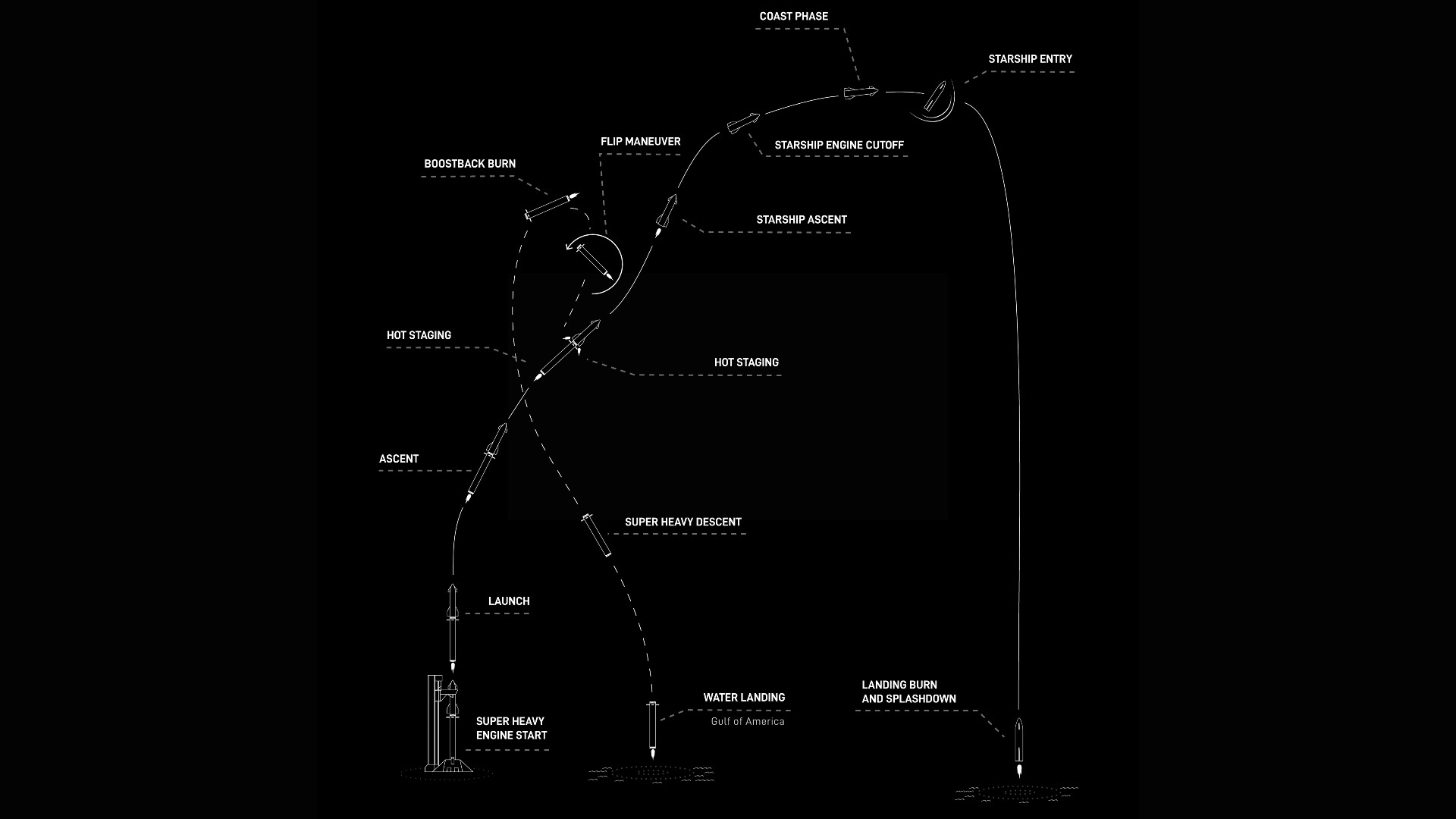
A diagram showing SpaceX's Flight 13 Starship mission profile. The flight should last just over 1 hour. (Image credit: SpaceX)
SpaceX's Starship Flight 13 test flight will last just over 1 hour and 5 minutes and should follow the same mission profile as the company's last test, Flight 12, in May. This will be the second flight of SpaceX's new Starship Version 3, or V3.
During Flight 12, the giant Super Heavy booster stage failed to return to Earth properly for a controlled landing and splashdown in the Gulf of Mexico (which the Trump Administration has renamed the Gulf of America). Instead, the booster crashed into the ocean.
"The booster’s primary test objective will be executing a successful launch, ascent, stage separation, boostback burn, and landing burn at an offshore landing point in the Gulf of America," SpaceX wrote in a mission overview. "There have been several modifications to hardware and software to address issues seen on the previous flight."
Starship Flight 13 will launch from SpaceX's new Pad 2 at Starbase, which the company upgraded with shorter, faster "chopsticks" — capture arms that can catch returning Starship Super Heavy boosters and Ship upper stages during landing, as well as lift vehicles into place on the pad for launch. Check out our full overview on how SpaceX changed Starship for V3 here.
SpaceX Starship Flight 13 Launch Timeline
TIME (Hr:Min:Sec)
EVENT
T-0:50:00
Flight director polls for fueling
T-0:37:30
Ship liquid oxygen loading begins
T-0:37:00
Super Heavy liquid oxygen loading begins
T-0:35:25
Super Heavy liquid methane loading begins
T-0:34:48
Ship liquid methane loading begins
T-00:21:30
Raptor engine chilldown begins on Ship and Super Heavy
Super Heavy landing burn shutdown (followed by splashdown)
T+08:05
Starship engine cutoff
T+16:40
Payload deploy demo starts
T+27:29
Payload deploy demo complete
T+38:58
Ship engine relight demonstration
T+47:30
Ship reentry
T+01:02:23
Ship transonic
T+01:03:01
Ship is subsonic
T+01:05:01
Landing burn start
T+01:05:03
Landing flip
T+01:05:12
Landing burn three to two engines
T+01:05:19
Landing burn two to one engines
T+01:05:26
"An exciting landing!" SpaceX says.
SpaceX will not try to reach orbit with Starship Flight 13 or return its Ship back to Earth for a capture at the launch pad. Instead, both vehicles aim to make controlled descent and water landings, before falling over and sliding into the sea.
While the Super Heavy booster will splash down in the Gulf of Mexico off the coast of Boca Chica, the Ship upper stage will follow a suborbital trajectory for a target splashdown in the Indian Ocean off the coast of Western Australia.
During the flight, the Ship vehicle will attempt to deploy 20 Starlink V3 satellites, the company's newer and larger satellite-internet units, but they won't reach orbit. They will follow Starship's suborbital trajectory back down to Earth and burn up in the atmosphere.
Six of the Starlink V3 satellites are equipped with cameras to record live views of Starship and its heat shield and beam them back to Earth for analysis.
"For the first time, Starship will carry V3 Starlink satellites to space, which aim to greatly expand the network's capacity and user speeds. As part of this initial test, Starship is planned to deploy 20 satellites which will extend solar arrays and antennas and will attempt to connect with the larger Starlink constellation via high-capacity lasers," SpaceX wrote in the mission overview. "The Starlink satellites will be on the same suborbital trajectory as Starship and are expected to demise upon reentry approximately 20 minutes after deployment."
What if Starship Flight 13 can't launch?
If SpaceX can't launch Starship Flight 13 on July 20, the company likely has multiple backup opportunities. So, if bad weather or another technical issue delays launch, SpaceX could try again in the coming days.
Whichever date SpaceX launches Starship Flight 13, you will be able to follow the mission on Space.com. Be sure to return to Space.com on launch day for complete Starship Flight 13 coverage.
Editor's note: This story was updated at 1:15 p.m. ET on July 17 with the new target launch date of July 20.
SpaceX reached a milestone with its latest Starlink launch, sending the satellites into orbit on its 600th flight of a flight-proven booster.
The sexacentennial launch came on the second of two Falcon 9 missions that lifted off less than eight hours apart overnight from Monday to Tuesday (July 13 to July 14). The first flight, with Starlink batch 15-14, launched at 9:28 p.m. EDT (0128 GMT or 6:28 p.m. PDT local time) from Space Launch Complex 4 East at Vandenberg Space Force Base in California.
Both flights also successfully recovered their Falcon 9 first stage boosters. B1093, launched from Florida, completed its 15th flight. B1080, launched from California, achieved its 28th mission. The record for a single Falcon 9 first stage's re-flight stands at 36 launches.
The addition of 56 more Starlink satellites to SpaceX's megaconstellation brought the total active number of broadband internet relay units to 10,839, according to tracker Jonathan McDowell.
In addition to Tuesday's launch being the 600th launch of a flight-proven Falcon 9 stage, SpaceX now stands at 83 Falcon 9 missions this year to date.
Astronomers have spotted four dead star white dwarf stars playing a game of cosmic hide-and-seek, all four of which were hiding in the glares of red dwarf companion stars.
This marks the first detection of white dwarfs existing in double star systems in our cosmic backyard. The white dwarfsare all located within around 65 light-years of Earth, and one of them is number nine in the top 10 closest white dwarfs to the solar system.
White dwarfs are the type of stellar remnants left behind when stars around the size of the sun run out of fuel needed for nuclear fusion. This leads to their cores collapsing. The lack of fusion also means these stellar remnants cool and become dim. Thus, the light of much larger and brighter red dwarf stars is incredibly effective at hiding white dwarfs.
"Nearby isolated white dwarfs are usually easy to find, but we couldn't see these four stars directly in visible wavelengths because their red dwarf companions were drowning out their light," team leader Mairi O'Brien of the University of Warwick in the UK said in a statement."It's a reminder that even in our own cosmic neighborhood, we can still find surprises if we look in the right way, at the right wavelengths."
Wobbles gave them away
Though astronomers have been diligently surveying our cosmic backyard for decades, white dwarfs are extremely good at remaining unseen. In fact, the only thing that gave these four hidden dead stars away? Curious "wobbles" caused in the motion of the stars they were hiding behind, like a hiding child causing a curtain to ripple.
The team followed up on these telltale clues by taking a closer look at these systems with NASA's long-serving Hubble Space Telescope. This investigation was conducted in ultraviolet light and using custom calibration to prevent flaring from the red dwarf companions from mimicking white dwarf signals.
This investigation not only revealed the four lurking white dwarfs, but also demonstrated that one of these systems, G 203-47, located just 25 light-years away, has some curious characteristics. Twenty-seven years elapsed between the initial radial wobble and the detection of this hidden dead star.
That isn't the weird thing, though. What is strange is that the red dwarf companion of this white dwarf only rotates once every 100 Earth days or so, yet it only takes about 15 days to orbit its dead star companion. This means that gravitational forces have failed to lock the red dwarf and white dwarf together, which is what happens in similar systems.
"What's fascinating is that G 203-47 shouldn't be rotating this slowly if it formed the same way as similar systems. This suggests that these binaries have had very different evolutionary histories," team member David Wilson, of the University of Colorado Boulder, said. "Some underwent violent, prolonged interactions early on that locked them tidally. Others, like G 203-47, experienced gentler, briefer encounters that left them in this unusual state."
An illustration of a red dwarf star orbiting a white dwarf dead star companion. (Image credit: Robert Lea (created with Canva))
The discovery of these white dwarfs helps researchers better understand the population numbers of the dead stars throughout the Milky Way. In fact, predictions would have suggested finding roughly four to five closely orbiting white dwarf-red dwarf pairs within around 65 light-years of our solar system, so finding four should instill a lot of confidence in our current theoretical models.
"Only about 30% of red dwarfs within 20 parsecs[65 light-years] have been systematically surveyed for hidden white dwarf companions," team member and University of Warwick researcher Pier-Emmanuel Tremblay said in the statement. "We think there could be as many as nine or 10 additional binary systemsin our local stellar environment that we haven’t found yet.
"If we put more targeted effort into observing red dwarfs, perhaps we will find more surprises like this."
The first of 10,000 missing black holes in the Omega Centauri globular cluster has been found thanks to teamwork by the Hubble and James Webb space telescopes.
The two observatories discovered the black hole after watching a star orbiting around something massive but dark, and which therefore could not be seen. The Hubble data ran from 2003 to 2023, and the James Webb Space Telescope picked up after that to help refine the measurements.
Astronomers used the space telescopes to focus on a particular star in a binary system that appeared to be home to another, dark object called oMEGACat BH-2. Previous studies had suggested that the dark object was a neutron star. However, the new results are conclusive: the object has a mass 4.46 times that of the sun. This is too massive to be a neutron star, so it must therefore be a black hole.
Omega Centauri is the most massive of our Milky Way galaxy's globular clusters. It is so massive that astronomers suspect that it is actually the core of a dwarf galaxy that has lost most of its stars to the Milky Way's gravitational cannibalism, which over the aeons has torn strips from Omega Centauri. Even so, Omega Centauri still contains about 10 million stars, collectively located 18,000 light-years from Earth.
In 2024, astronomers using the Hubble Space Telescope found clinching evidence that an intermediate-mass black hole – one that has a mass about 8,200 times that of our sun – lurks at the center of Omega Centauri, strengthening its claim of being the remnant of a dwarf galaxy, since galaxies harbor black holes at their center but star clusters typically do not.
However, alongside this intermediate-mass black hole should be about 10,000 other stellar-mass black holes born from the supernova explosions of massive stars. Searches have focused on binary systems where a star orbits a compact object, but until now astronomers had drawn a blank.
Now, a team led by Matthew Whitaker of the University of Utah in Salt Lake City have come along to save the day by diligently sifting through 20 years of Hubble observations, plus additional supporting views from the JWST, to uncover a stellar-mass black hole in Omega Centauri for the first time.
Whitaker's team used a technique called astrometry, which is the measurement of the changing positions of stars as they move through space. Although the black hole itself is dark, it is orbited by a normal star with a mass 78% that of our sun. Thanks to the unprecedented vision of Hubble and the JWST, Whitaker and his colleagues were able to track the motion of this star around the black hole.
It turns out that the star is on a 94-year-long orbit around the black hole, which is the widest separation of a binary composed of a stellar-mass black hole and star ever found. Over that 20-year-period, Hubble saw less than a quarter of the star's total orbit, but it coincided with the star's closest approach to the black hole, during which the star moved faster.
Based on this motion, Whitaker's team were able to measure the strength of the black hole's gravitational field acting on the star, and from that calculate the mass of the black hole.
An image of the globular cluster Omega Centauri. (Image credit: ESA, NASA, Maximilian Häberle (MPIA), Joseph DePasquale (STScI))
"The precision of these measurements is incredible, down to a fraction of a pixel on Hubble and Webb's detectors," said Whitaker in a statement. "It would not have been possible to find this black hole without these two space telescopes."
Given how wide the orbit of the star is around the black hole, the likelihood is that the black hole's gravity captured the star when it passed close. This is a state of affairs that will not last forever; within another billion years, encounters with other stars in the crowded environs of the cluster will probably pluck the black hole's companion away.
The mass of oMEGACat BH-2 does seem unusual, however, in the sense that it is lower than expected. The mass of oMEGACat BH-2 exists in a void that has only become apparent during the past eleven years of gravitational wave detections. These gravitational waves are produced by the mergers of stellar-mass black holes, but black holes with masses between 2.5 times the mass of our sun (the theoretical limit for neutron stars) and five solar masses are conspicuous by their absence in the gravitational-wave events. Yet here is oMEGACat BH-2, sitting within that mass gap.
"It's important to understand black hole populations in globular clusters because there's uncertainty about their physics and formation," said Anil Seth of the University of Utah.
"More specifically, understanding the process of forming black holes and then dynamically forming binaries is vital, because it affects our ability to interpret and understand gravitational-wave events. Environments like Omega Centauri are the primary places where we think binaries are merging and creating these waves."
A colorful collection of 100,000 stars are displayed in this small region inside the Omega Centauri globular cluster, a dense group of nearly 10 million stars. (Image credit: NASA, ESA, and the Hubble SM4 ERO Team)
In particular, the stars of Omega Centauri are more primitive than our sun, chemically speaking, with fewer elements heavier than hydrogen and helium. Which types of massive stars produce black holes when they explode as supernovas is still an area of active research, but oMEGACat BH-2 adds another complication to the mix in that its progenitor star contained few heavy elements.
"We need to figure out how that happens," said Seth.
So that's one down, and 9,999 or thereabouts to go. Whitaker's team continue to use Hubble and JWST data to find more stellar-mass black holes in Omega Centauri, but he also highlights the potential of NASA's Nancy Grace Roman Space Telescope to find black-hole binary systems in our Milky Way galaxy at least when the telescope launches later this year.
"Roman … will image the crowded galactic bulge, including the galactic center, very regularly with Hubble-like resolution and with a much wider field of view," said Whitaker. "We're hoping we'll be able to find black hole binary systems like this one because of the regular cadence of Roman's observations."
As our planet revels in the recent achievements of this spring’s Artemis 2mission and its four astronaut crew members, a new four-part PBS documentary series takes a scrutinizing look at space exploration and its inherent perils and promises. "Once Upon a Time in Space" will be available to watch on PBS (and the PBS app) starting on July 14, 2026 (9pm ET).
Directed by James Bluemel and his filmmaking team — the crew behind the award-winning "Once Upon a Time in Northern Ireland" and "Once Upon a Time in Iraq" — "Once Upon a Time in Space" explores the connections between those venturing beyond Earth's gravity and the support staff remaining behind while pioneering souls venture into hostile outer space territory.
"'Once Upon a Time in Space' tells the human stories behind one of our most extraordinary endeavors: the exploration of space," states the official synopsis. "Moving beyond scientific achievement, the series examines the personal experiences of astronauts, cosmonauts, ground-based participants, and the loved ones left on Earth. Across four episodes, it traces significant landmarks in spacefaring history, from the birth of the Shuttle and the pioneering Space Station Mir to the rise of commercial spaceflight."
"Once Upon a Time in Space" launches on PBS on July 14 (Image credit: PBS/BBC)
"Through powerful firsthand testimony and intimate, unseen archival footage, a complex portrait of humanity emerges: one that lays bare both our fragility and boundless curiosity. Accounts of bravery, friendship, and tragedy are told against the backdrop of a rapidly changing world, connecting technical and geopolitical developments to those who experienced them."
Here’s a schedule of the docuseries’ chapters and their slated air dates:
Episode 1 "America First" – Tuesday, July 14 – 9:00 p.m. ET
Episode 2 "The Russian Thing" – Tuesday, July 21
Episode 3 "Politics Always Wins" – Tuesday, July 28
Episode 4 "Friends Forever" – Tuesday, August 4
This remarkable show features NASA astronauts Charlie Bolden, Anna Lee Fisher, Bill Fisher, Michael Foale, Jerry Linenger, Mike Mullane, Dan Tani, and Terry Virts. They’re joined by cosmonauts Sergei Zalyotin and Alexander ‘Sasha’ Lazutkin, NASA officials, aerospace engineers, and numerous family members.
Produced in collaboration with the BBC, "Once Upon a Time in Space" was first broadcast last fall in the UK, but now makes its U.S. premiere at 9:00 p.m. ET on PBS, PBS.org and the PBS app.
A miniature X-ray machine is set to transform astronauts' health prospects following a successful test in orbit. As a bonus, as well as checking for broken bones on the moon, the technology could also be distributed to small towns and villages in rural areas to provide enhanced medical care far from major hospitals.
For much of the Space Age, astronauts have only had access to ultrasound machines as tools to diagnose injuries. Unlike ultrasound, which requires a medium through which sound waves can pass, X-rays can be used in a vacuum. The problem with X-ray machines is that traditionally they have been big and bulky, they use a lot of power, they have difficulty imaging something that isn't perfectly stationary (resulting in blurred images), and they tend to get damaged when jostled about during launch and atmospheric re-entry. Yet, as human spaceflight and voyages beyond Earth-orbit come to prominence once more, with proposals for an outpost on the moon, there is a greater chance of an astronaut being injured and therefore a greater need for medical X-rays in space.
Technology has now reached the stage where small-scale, portable X-ray devices are commonplace on Earth.
"Portable X-ray machines are in use everywhere — at the Kentucky Derby, on the sidelines of the Super Bowl and around the globe in low-resource areas — because they can run on solar power and can be operated by individuals with no medical expertise," Sheyna Gifford, who is a medical doctor and assistant professor of aerospace medicine at Mayo Clinic in Rochester, Minnesota, said in a statement.
Gifford wanted to put one of these portable X-ray devices to the test in space. The first chance her team got to simulate taking an X-ray in space conditions was during a parabolic flight in 2022 (when an aircraft simulates microgravity by climbing high on a parabolic trajectory, as in the famous "Vomit Comet") when members of the flight crew used a portable X-ray machine to produce an X-ray image of someone's hand.
The real test, though, came on March 31, 2025, with the launch of the private Fram2 mission, which took four first-time astronauts on a 3.5-day mission around Earth on board a SpaceX Crew Dragon. The astronauts, none of whom were medical experts, received four hours training on the portable X-ray device before launch, and then while in orbit they were tasked with taking X-rays of a smartwatch, a hand, an abdomen, a pelvis and a chest. These X-ray images were recorded digitally, enabling the astronauts to review them straight away without having to develop film.
Back on Earth, three independent medical experts compared the Fram2 X-rays with similar X-rays taken prior to launch. They found that while the ground-based X-rays were better quality, the space-based ones were good enough to be used to diagnose injuries such as broken bones.
Furthermore, the X-ray device made it back to Earth on board the Crew Dragon with only minimal damage to its exterior after being buffeted around. The Fram2 crew members all reported that the X-ray machine was easy to use, and they recommended that in future it be designed to be easier to clamp securely into place inside the crew cabin.
Representative preflight, in-flight, and postflight chest radiographs. Radiographs of the chest were acquired (A) preflight by a crewmember, (B, C) in-flight on day 3 after launch (L+3) by a crewmember, and (D) postflight by a non-crew operator using the same imaging protocol. (Image credit: Radiological Society of North America (RSNA))
"We believed an off-the-shelf portable system would stand a very good chance of surviving pre-launch testing and be operational in space by crew members with minimal training," said Gifford. "By acquiring the first human and equipment X-rays in space, our study demonstrates the feasibility of in-orbit radiography and expanded diagnostic capabilities for crew health and hardware evaluation."
The usefulness of X-ray machines in space extends beyond just applying them to human health. X-rays can be used to inspect potential damage to electronics and spacesuits, to diagnose problems with malfunctioning satellites, and even be strapped to lunar rovers for analyzing the surface of the moon.
The next step, says Gifford, is to make the portable systems even smaller.
"It is my hope that we can further reduce the size of portable imaging systems and improve their ruggedness and usability so they can be included in future missions," she said.
The technology can also prove its value here on Earth. Easy to use and highly portable X-ray devices that can produce digital images that can be scrutinized on a tablet or even a smartphone would be invaluable to rescue teams in remote areas or tight spaces. It would also transform medical care in rural towns and villages that are far from large hospitals — reducing the burden on those large hospitals in the process.
"Disseminating autonomous miniature X-ray systems around the globe could also change the game in public health," said Gifford. "The sky is not the limit when it comes to X-rays in space and here on Earth."
The findings from the X-ray tests were reported on July 14 in the journal Radiology.
Astronomers have, for the first time, directly mapped the magnetic field surrounding an unusual "lighthouse" pulsar, revealing an invisible cosmic highway that channels particles blasted from the rapidly spinning stellar remnant.
Using NASA's Imaging X-ray Polarimetry Explorer (IXPE) mission, researchers measured the magnetic field around the pulsar PSR J1101−6101 — nicknamed the "Lighthouse" — and confirmed a long-standing prediction that its high-energy particles stream along magnetic field lines extending through the Milky Way. This discovery offers a rare look at how some of the universe's most extreme objects accelerate particles to nearly the speed of light, according to a statement from the space agency.
Pulsars are rapidly rotating neutron stars — the ultra-dense remnants left behind when massive stars explode as supernovas. Their powerful magnetic fields channel beams of radiation from their magnetic poles that sweep across space as the stars spin, much like the beam of a lighthouse.
PSR J1101−6101, which is located at the center of the Lighthouse Nebula, spins about 16 times every second and is traveling at supersonic speeds after receiving a powerful kick from the supernova that created it. As it tears through interstellar gas, it leaves behind a bright X-ray tail while producing a narrow filament that juts out almost perpendicular to its direction of travel. Astronomers had long suspected this unusual structure traced energetic electrons escaping along the Milky Way's magnetic field.
"We wanted to test that theory,"Jack Dinsmore, lead author of the study and undergraduate student at Stanford University, said in the statement. "The 'smoking gun' would come by measuring the polarization of the light, which indicates the magnetic field direction. If the magnetic field points along the filament, that confirms that the filament's particles are flowing along the field."
Unlike conventional X-ray telescopes, IXPE measures the polarization of X-rays — the preferred orientation of their electric fields — allowing scientists to reconstruct the geometry of otherwise invisible magnetic fields. Because the Lighthouse Nebula is relatively faint in X-rays, the researchers developed new analysis techniques to extract as much information as possible from the observations.
Using IXPE, astronomers measured the nebula's magnetic field for the first time, confirming that high-energy particles escape the pulsar by traveling along the Milky Way's magnetic field lines. (Image credit: X-ray: Chandra: NASA/CXC/Stanford Univ./J.T. Dinsmore et al.; IXPE: NASA/MSFC/J.T. Dinsmore et al., Radio: CSIRO/ATNF/ATCA; Optical: 2MASS/UMass/IPAC-Caltech/NASA/NSF; Image processing: NASA/CXC/SAO/L. Frattare)
The team found that the magnetic field runs parallel to a remarkably long filament extending away from the pulsar, confirming that high-energy particles are streaming along magnetic field lines. But the observations also uncovered an unexpected twist: the field is far more orderly than scientists anticipated. The unusually strong polarization signal suggests the filament contains much less magnetic turbulence than current models predict, offering new insight into how fast-moving pulsars inject energetic particles into the surrounding galaxy.
"The striking divergence in magnetic field orientations observed between radio and X-ray wavelengths provides compelling evidence for the highly structured nature of these objects," Niccolò Bucciantini, co-author of the study from the Italian National Institute for Astrophysics, said in the statement. "This marks the first clear indication that particles of different energies occupy distinct regions within the system, hinting at the presence of multiple, and potentially very different, acceleration mechanisms at work."
Their findings were published July 9 in The Astrophysical Journal.
NASA's Mars rover Curiosity spotted these "honeycomb" structures on Mars. (Image credit: NASA/JPL-Caltech/MSSS)
NASA's Curiosity rover has spotted a strange honeycomb texture on the surface of Mars. But what is it?
What is it?
Almost 14 years since landing on the Red Planet, Curiosity is still hard at work exploring. And in new observations, Curiosity has revealed an image that is certainly ... peculiar.
Curiosity went to get a closer look at an area first observed from Mars orbit, and found what appears to be a honeycomb structure in on the planet's surface. Polygonal shapes, nearly identical to one another, make up a pattern almost like a Martian wallpaper or carpet.
But what is it? Why does it look like that? What is a honeycomb doing on Mars?
Why is it incredible?
This is one of many mysteries we have yet to solve on Mars. While the team saw this area first from orbit around the planet, when the rover arrived and saw this structure they were surprised, they shared in a blog post.
In addition to the honeycomb texture, the area was littered with dark rocks and strewn around. But even these pebbles lack explanation. Did they "float" down from higher rock levels, did they launch out of Gale crater during some ancient collision or could they possibly even be meteorites from outside of Mars that ended up strewn across the surface? Researchers think any one of these explanations could be possible.
Previous, similar dark stones have been found on Mars with minerals like nickel that are common in meteorites and uncommon in Mars rocks. But are these similar? Perhaps part of a similar collision event? We don't yet know.
As researchers find new mysteries on Mars, they also continue to find new ways to investigate the unknown. With further study, they will explore both these strange honeycombs and the dark rocks scattered amongst them.

 Login