❌

Normal view

Rocket Lab launches US Space Force mission with less than 17 hours' notice β€” a new record

23 June 2026 at 19:00

Rocket Lab has successfully launched the second spacecraft for the U.S. Space Force's Victus Haze Tactically Responsive Space (TacRS) mission, setting a new readiness record in the process.

Only 16 hours and 42 minutes passed between Rocket Lab receiving the Notice To Launch from the Space Force's Space Safari Program Office and liftoff of the company's Electron launch vehicle, beating the previous TacRS record set by Firefly Aerospace on the September 2023 Victus Nox mission by more than 10 hours.

Liftoff occurred on Friday (June 19) at 6:19 a.m. EDT (1019 GMT, 10:19 p.m., local time), from Rocket Lab's Launch Complex-1, in New Zealand, beginning a rapid-response demonstration designed to simulate a real-world orbital threat scenario.

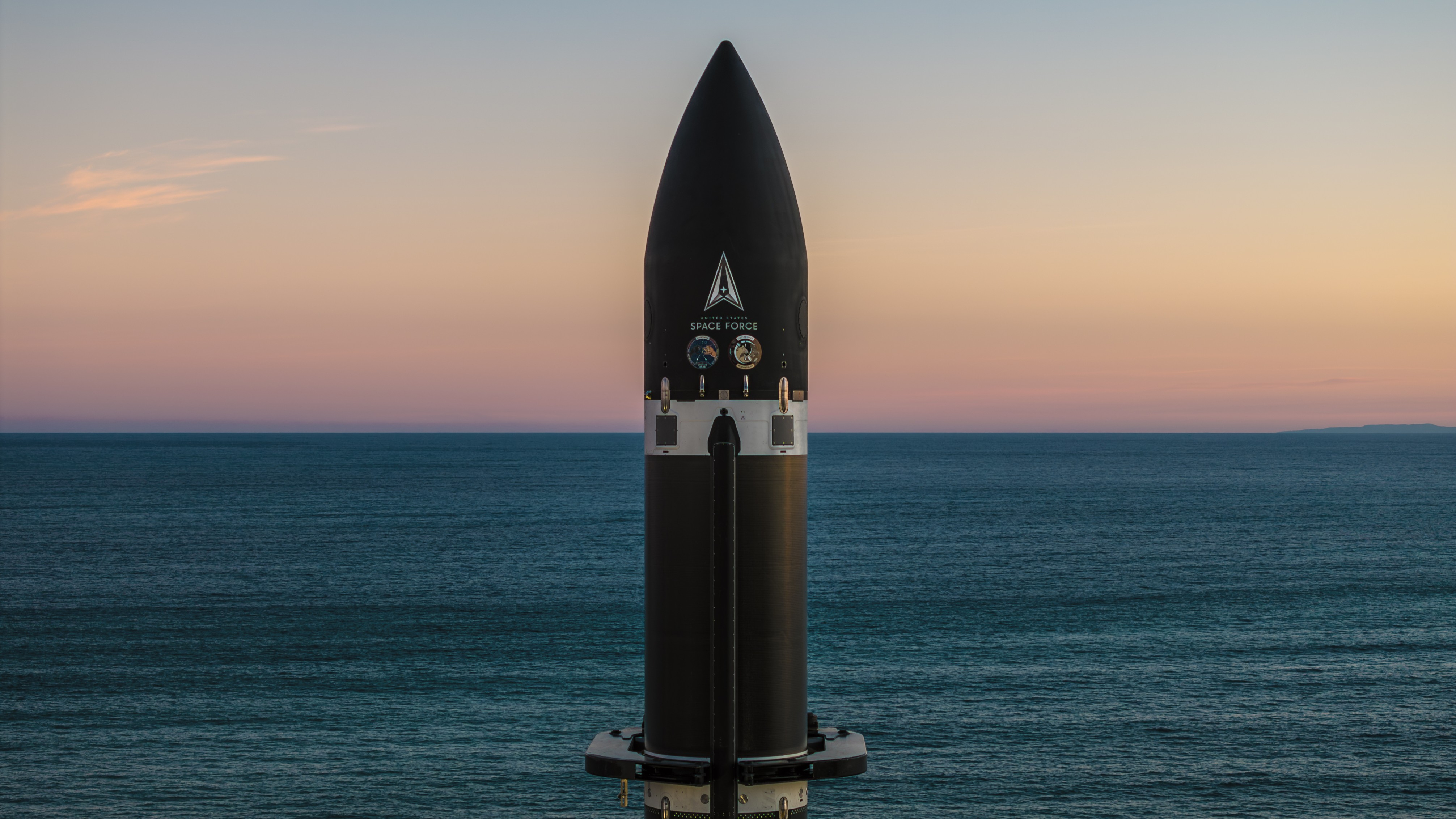
The top of a black rocket stands against a background of rich sea parted in the center by the horizon, and a cool, orange-hued sky.

Rocket Lab's Electron rocket launched on Friday (June 19) at 6:19 a.m. EDT (1019 GMT, 10:19 p.m., local time), from Rocket Lab's Launch Complex-1, in New Zealand. (Image credit: Rocket Lab)

Electron delivered a Rocket Lab-built Pioneer spacecraft to low Earth orbit (LEO), where it has begun pursuit of another Victus Haze spacecraft that was launched by SpaceX in May and serves as the target vehicle for the demonstration β€” True Anomaly's Jackal satellite. According to a June 22 Rocket Lab statement, "[Pioneer] is now fully commissioned and conducting complex orbital maneuvers to chase down another spacecraft on orbit and conduct Rendezvous and Proximity Operations (RPO)."

Victus Haze is a TacRS mission managed by Space Systems Command's Space Safari Program Office, with the objective of demonstrating the rapid acquisition, launch and operation of spacecraft in response to orbital threats and "non-compliant satellites," the Rocket Lab release said.

"Rendezvous and Proximity Operations on such short timelines are certainly not trivial, especially in a crisis or conflict scenario, but this demonstration of our ability to commission a complex and capable space vehicle within less than 72 hours, and immediately begin an RPO scenario thereafter, shows that we can field capability to deny adversaries first-mover advantage into novel orbits,” said Lt. Col. Lincoln Miller, Space Safari system program manager, in the statement.

Rocket Lab and True Anomaly teams are now managing their respective spacecraft in orbit. They will soon enter the RPO phase of Victus Haze, conducting space domain awareness (SDA) threat-response scenarios and "dynamic engagements with the other," according to a separate statement from the U.S. Space Force (USSF).

The VICTUS HAZE mission explained. Phase 1: Launch on demand πŸš€ The @USSpaceForce's @USSF_SSC called, told us to launch, and just 16 hours 42 minutes hours later, Electron successfully left the pad from LC-1.Phase 2: πŸ›°οΈ With Pioneer spacecraft checkouts complete 34 hours… pic.twitter.com/lJK226LhzTJune 23, 2026

Space Force officials have increasingly looked to commercial providers to develop new capabilities and technologies to address potential conflicts in space. β€œVictus Haze is primed to further demonstrate our readiness to lean on our commercial partners to deny, disrupt, and counter any adversarial advantage β€” no matter where they try to operate in space,” acting Space Force portfolio acquisition executive Col. Bryon McClain said in the USSF statement.

With its Electron rocket and Pioneer spacecraft both vertically integrated into Rocket Lab's manufacturing processes, this Victus Haze launch marks the first TacRS mission to be carried out by a single prime contractor, providing the spacecraft, launch vehicle and on-orbit operations.

"This is what modern space power looks like: the ability to reinforce and reimagine national security space architecture at will," said Rocket Lab CEO Peter Beck. "We’re proud to be providing the nation with those next-generation space capabilities, today.”

SpaceX launches its 1st 'Starfall' reentry capsule in early morning Falcon 9 liftoff

22 June 2026 at 23:00

SpaceX's newest spaceflight tech has to launched to the final frontier for the first time.

The company's Starfall capsule took to the skies on its debut mission today (June 23), following SpaceX's application with the U.S. Federal Aviation Administration (FAA) for two reentry vehicle landings. The mission lifted off from Space Launch Complex-40 at Cape Canaveral Space Force Station in Florida at 6:52 a.m. EDT (1052 GMT).

Starfall is a cargo transportation vehicle designed to carry payloads to low Earth orbit (LEO) and beyond, aboard SpaceX's Falcon 9 and Falcon Heavy rockets, and also return materials safely back to Earth. The platform isn't designed to fly human passengers; it's geared toward the support of research or other payloads that require retrieval after a stint in space, such as pharmaceuticals and other products of orbital manufacturing.

a flat space capsule reenters Earth's atmosphere

Render of Starfall capsule reentering Earth's atmosphere. (Image credit: SpaceX)

The concept has already been put into practice by Varda Space, which has landed five of its 3-foot-wide (0.9 meters), roughly 650-pound (300 kilograms) conical "W-series" capsules to date, one of which returned a payload for the U.S. Air Force after more than eight weeks on orbit. Starfall is more than three times as large, measuring 10 feet (3.1 m) across and 2.5 feet (0.75 m) tall. The SpaceX vehicle can carry up to 2,200 pounds (1,000 kg) of payload.

Starfall has two primary sections, which separate after reentry: a top plate for payload storage and attitude control components, and a carbon fiber heat shield that stores compressed gas to power attitude control maneuvers needed for precise reentries and landings, heat shield jettison and parachute deployment, according to SpaceX's FAA filing.

two perspectives of a black, hokey-puck-looking shape on a white background.

(Image credit: Federal Aviation Administration (FAA).)

SpaceX plans to launch Starfall on suborbital missions, in addition to the longer-term stretches it will be able to spend in LEO. The capsule lacks a propulsion system and is incapable of deorbiting itself. The FAA document is unclear about how this will be accomplished, but it's likely that this launch will use Falcon 9's second stage to bring the demo capsule back to Earth.

In the event that Starfall experiences some sort of issue in space or during reentry, SpaceX has designed the spacecraft for safe expendability. "Capsules use nonhazardous inert cold gas (nitrogen) for attitude control and contain no liquid propellants or hazardous substances. All pressurized systems would be vented prior to splashdown, therefore, no propellants would be released into the ocean," the company says in the FAA document.

a red square covers an area of ocean on a map off the California coast.

SpaceX is targeting an area 700 nautical miles (1,300 km) off the United States West Coast for Starfall splashdowns. (Image credit: Federal Aviation Administration (FAA))

SpaceX has not yet specified how long it plans to keep the test Starfall vehicle in orbit on this debut mission, and did not broadcast views of the Falcon 9 second stage after separation from the rocket's booster. When the Starfall payload returns, SpaceX is targeting an area in the Pacific Ocean for splashdown, about 700 nautical miles (1,300 km) off the United States West Coast.

On the opposite side of the U.S., the Falcon 9 rocket that launched the Starfall demo mission headed for a return in the Atlantic Ocean. It was the 29th flight for this particular booster, tail number 1078, whose previous experience includes NASA's Crew-6 launch to the International Space Station, a Space Force mission and 23 Starlink launches, among others. Following stage separation, about 2.5 minutes after liftoff, Booster 1078 fine-tune its trajectory for a landing burn and touchdown on the SpaceX autonomous droneship "A Shortfall of Gravitas" downrange in the Atlantic, touching down about T+9 minutes.

Editor's note: This story was updated at 7:10 a.m. EDT to reflect the successful launch of SpaceX's Falcon 9 rocket and Starfall demonstration mission.

NASA's Roman Space Telescope arrives in Florida ahead of SpaceX Falcon Heavy launch this summer

22 June 2026 at 21:00

The heavy hitters in space telescopes are about to be joined by a new contender.

NASA's Nancy Roman Grace Space Telescope arrived at the Kennedy Space Center (KSC), in Florida, on Sunday (June 21), for final tests ahead of launching later this summer. Roman was shipped to KSC from NASA's Goddard Space Flight Center in Greenbelt, Maryland, riding the agency's Pegasus barge from Baltimore to the Space Coast.

KSC is Roman's final stop before launching to space aboard a SpaceX Falcon Heavy rocket where it will join other flagship observatories like Hubble, Webb, Chandra and Spitzer. NASA is currently targeting an Aug. 30 liftoff β€” eight weeks ahead of its original schedule. Before that date arrives, Roman will undergo tests inside KSC's Payload Hazardous Servicing Facility (PHSF), where upgrades were recently completed to prepare for the telescope's arrival.

Roman, inside a specialized, environmentally-controlled protective container used to encapsulate the telescope at the start of its journey from Goddard, was transported to the exterior of the PHSF building following its KSC arrival, where teams began a decontamination and cleaning process to ready the container for opening today (June 22) inside the PHSF airlock, followed by the unboxing and transportation of the roughly 18,000-pound (8,200-kilogram) spacecraft to the high bay clean room for prelaunch preparations.

Roman's work platform inside the PHSF, which NASA refers to as "the Pantheon" will allow engineers to perform final checkouts on the spacecraft, including tests of the telescope's six solar panels, insulation, and heat management components. Technicians will also load Roman with about 290 gallons (1,100 liters) of hypergolic hydrazine fuel, which will power the satellite's thrusters for delivery to its final orbit and small positional adjustments during the ten or more years the propellant is expected to last.

Roman is headed to Sun-Earth Lagrange point two (L2), a station-keeping point about 1 million miles (1.6 million kilometers) beyond Earth on the side opposite the sun. Lagrange points are regions of space similar to where the gravitational influence of two or more bodies is equal, allowing spacecraft to be "parked" and remain in place without needing to fire their thrusters and expend fuel. Once it settles in at L2, Roman's mission is set to last for at least five years, with the option for NASA to extend the telescope's use as long as its fuel lasts and instruments perform as needed.

Using its 7.9-foot-wide (2.4 meters) primary mirror, combined with a 300-megapixel camera and coronograph, Roman's primary mission will be hunting down the elusive mysteries of dark energy and the accelerating expansion of the universe through the discovery of "billions of galaxies, hundreds of thousands of new exoplanets, hundreds of blackholes, and … vast volumes of daily data for astronomers to study," according to NASA.

A private company will build and launch NASA's next Mars orbiter in 2028 β€” and it's not SpaceX

19 June 2026 at 22:00

NASA has announced a new commercial partnership for the next satellite headed to the Red Planet.

California-based Relativity Space will design, build and launch the spacecraft that carries NASA's Aeolus instrument suite to orbit around Mars, where the probe will be the first to provide daily measurements of the planet's global environment. Aeolus will collect data on Martian dust and cloud cover, winds and temperatures, according to a NASA release.

"Public-private partnerships like this are a force multiplier for science," NASA Administrator Jared Isaacman said in a statement on Wednesday (June 17).

The newly announced relationship, and others between NASA and private industry, is designed to allow the agency to concentrate its resources on important science discovery. "By pairing NASA’s world‑class instruments with commercial innovation and investment, we can deliver more science, more often, and reduce the time it takes to get essential data into the hands of researchers preparing for future human missions to Mars," Isaacman said.

Aeolus consists of four instruments, designed to work in tandem to create a complete picture of the Martian atmosphere and its behavior. In addition to refining scientific models for the Martian environment, NASA plans to use the data to reduce risks to future robotic and crewed missions landing on Mars' surface.

The science suite includes the Doppler Wind and Temperature Sounder (DWTS‑Ozone), in collaboration with GATS, designed to measure wind speeds and temperatures present up to 37 miles (60 kilometers) above the ground. The Thermal Limb Sounder (TLS), designed with Xiomas Technologies, will create vertical temperature profiles and provide data on atmospheric dust and cloud cover, while the Surface Radiometric Sensor Package (SuRSeP) collects compositional data on those clouds and dust, and tracks how the Martian surface absorbs, stores and releases energy, like heat. Finally, Aeolus' Wide‑Field Context Camera (WFCC) will take daily images to assess atmospheric activity across the whole of Mars.

Relativity Space's Terran 1 rocket successfully blasted off for its test flight but malfunctioned three minutes after liftoff.

Relativity Space's Terran 1 rocket successfully blasted off for its test flight but malfunctioned three minutes after liftoff. (Image credit: Relativity Space)

NASA is targeting 2028 for the launch of the Aeolus mission, which will be designed and built at NASA's Ames Research Center in California, where it will also be integrated on Relativity's spacecraft for testing ahead of launch. NASA has committed to support Aeolus' scientific operations for at least one Martian year (approximately 687 Earth days). However, the agency has historically extended its missions to Mars, when able.

NASA was recently forced to end operations of its MAVEN (Mars Atmosphere and Volatile Evolution) probe around Mars, after an anomaly led to a loss of communications with the satellite, but the spacecraft ran for more than a decade beyond its original one-year mission. The agency's only two active satellites orbiting the Red Planet are the Mars Reconnaissance Orbiter (MRO) and Mars Odyssey, which are both operating nearly two decades or more, respectively, beyond their initial mission timelines.

For its part, Relativity will be in charge of designing the Mars-bound spacecraft and will also be responsible for launch and for satellite operations in space. The company's pathfinder launch vehicle, the Terran 1 rocket, lifted off for the first and only time in March 2023, but it failed to reach orbit. The company then pivoted to development of the bigger, partially reusable Terran R rocket, which is expected to debut sometime later this year. Eric Schmidt, who served as Google CEO from 2001 to 2011, was appointed to lead Relativity in March 2025.

NASA's ambitious Artemis 3 mission includes 3 giant rocket launches, 2 private moon landers and 1 big question: Can it all work together?

10 June 2026 at 17:41
NASA's Artemis 3 mission in 2027 looks to be one of agency's most complicated missions ever, with three giant rocket launches and two private moon lander prototypes that haven't been built yet.

❌