On Episode 215 of This Week In Space, Rod Pyle and guest co-host Susan Karlin talk with bestselling sci-fi/sci-fact author Dr. David Brin.
If you've seen "Disclosure Day" or "Age of Disclosure," you're going to want to join us for this fascinating discussion. Long known for his universe-spanning visions, storytelling skills, and occasionally contrarian viewpoints, Dr. Brin will not disappoint! Our discussion ranged from reactions to Spielberg's "Disclosure Day" to why people believe in AI and more.
This Week in Space covers the new space age. Every Friday we take a deep dive into a fascinating topic. What's happening with the new race to the moon and other planets? When will SpaceX really send people to Mars?
Join Rod Pyle and Tariq Malik from Space.com as they tackle those questions and more each week on Friday afternoons. You can subscribe today on your favorite podcatcher.
Astronomers have used a technique called echo mapping to detect hints that supermassive black holes, such as the cosmic titan at the heart of the Milky Way, known as Sagittarius A* (Sgr A*), are surrounded by dense clouds and clusters of dark matter. The research could teach us more about this mysterious substance and the environments around supermassive black holes.
Dark matter is the universe's most mysterious stuff, outweighing ordinary matter in the cosmos by a ratio of five to one — but remaining effectively invisible because it doesn't interact with electromagnetic radiation, including the light we use to see. The only way scientists can even infer the presence of dark matter is via its interaction with gravity, and the impact that this interaction has on objects made of traditional matter like stars. For instance, the gravitational effect of dark matter allows stars at the edges of galaxies to whip around at much greater speeds while not flying loose than the visible matter of those galaxies would allow.
This team decided to test the gravitational influence of dark matter at the hearts of galaxies, environments dominated by supermassive black holes which can have masses millions or even billions of times that of the sun. Ordinary matter around these supermassive black holes is often very visible, especially when spiraling into the maw of one of these cosmic titans from a flattened cloud called an accretion disk. This is because the gravitational influence of those black holes generates immense amounts of friction, causing them to grow brightly. That wouldn't work for dark matter; it can't feel friction because it doesn't interact with itself or with ordinary matter, and it can't glow because it doesn't absorb or emit light.
Clearly, dark matter can't be spotted around supermassive black holes even using the most advanced telescopes such as the Event Horizon Telescope (EHT), which has captured glowing rings of material around Sgr A* and around a more distant supermassive black hole that rules the heart of the galaxy Messier 87 (M87).
While discussing the problem of detecting dark matter around supermassive black holes, Mayank Sharma, a physics graduate student at Virginia Polytechnic Institute and State University (Virginia Tech), hit on an interesting solution.
"We could actually test this prediction using a technique in astronomy, which allows you to measure the distance to the surrounding gas by looking for echoes of light," Sharma said in a statement. The technique Sharma refers to is "reverberation mapping," and it has become a trusted method of determining the mass of black holes.
Echoes of dark matter
Reverberation mapping is based upon the fact that as matter falls into a black hole, it releases a burst of energy that causes the accretion disk it comes from to pulse. This pulse of light travels from the accretion disk to gas in the wider environment of the black hole. This gas absorbs that light and also pulses, with this secondary pulse serving as an echo of the first.
Because we know the speed of light, when astronomers see the first pulse of light and then its echo, they can use the time between pulses to estimate the distance between the black hole and the gas on the outskirts of its environment. The size of a black hole and the distance between it and outer gas clouds can be used to determine its mass, and could also be used to determine the mass of dark matter clustered around it.
The team applied their method to 14 different galaxies, finding in five cases that mass increases moving away from the central black hole in a way that couldn't be accounted for by visible matter alone. Despite the early success of this research, it far from proves that supermassive black holes are indeed gathering places for dark matter. The team's findings do point an interesting way forward for the investigation into the universe's most mysterious substance and its most mysterious regions.
"These galaxies are definitely showing a hint that there is extra material that cannot be explained by just the supermassive black hole," Sharma said. "The prospects are exciting."
GOLDEN, Colorado – Here on Earth, centuries of accumulated engineering knowhow, hard-learned lessons, and societal evolution have shaped a robust framework of building standards that govern how we build and maintain buildings today.
But now, as humanity prepares to put in place a "sustained presence" on the moon, how do we guarantee the safety and integrity of structures built in an environment for which no such tradition exists?
At the 26th Space Resources Roundtable held June 2-5 on the campus of the Colorado School of Mines, one expert says what's needed is a lunar building code, the development of specific design criteria for the moon.
What's shaking?
Both NASA and China's space agency are planning to build habitats, landing pads, equipment shelters, and tall towers on the moon. But all that construction could be off to a shaky start, suggests Nerma Caluk, an engineer and lunar specialist for Skidmore, Owings & Merrill, an architecture and structural engineering firm in San Francisco, California.
Caluk said there's a need to leverage terrestrial building experiences.
"On Earth, structural systems rely on strong gravitational acceleration to resist seismic lateral forces through both foundation friction and overturning stability. However, on the moon, the gravitational field strength is reduced to just one-sixth of Earth's surface gravity," Caluk told Space.com.
Because seismic inertial forces are governed purely by a structure's mass rather than its weight, the lateral demand on a structure remains fully active while its gravitational restoring capacity is substantially diminished, Caluk added.
"Low-profile surface structures risk translational sliding across poorly characterized regolith interfaces, while taller vertical structures face significant overturning vulnerability, as the moon provides only a fraction of the gravitational restoring moment available in a terrestrial seismic environment," said Caluk.
Here on Earth, structural engineers routinely design typical building systems to yield, crack, and sustain permanent inelastic deformation during a design-level seismic event.
They intentionally leverage "inelastic energy dissipation" as the primary mechanism for managing seismic demand, Caluk said. But this design philosophy is fundamentally incompatible with a crewed lunar environment, she said.
Take for example a hatch distortion or pressure seal misalignment. They constitute a mission-critical failure, and any structural breach risks catastrophic depressurization, said Caluk.
An artist's rendering of a NASA Artemis moon base with development underway. (Image credit: NASA)
A group taking on the challenge of shaping guidelines on the building of lunar infrastructure is the aerospace division of the American Society of Civil Engineers.
The group's technical committee on space engineering and construction has crafted "Infrastructure Engineering, Design, Analysis, and Construction (LIEDAC) guidelines" for the moon, Caluk said, to tackle seismic issues imposed by moonquakes.
The LIEDAC guidelines, Caluk said, characterize the unique lunar hazard environment, classify operational consequences through a risk-categorization hierarchy, and establish target performance objectives "so that safe commercial development can proceed on a defensible technical basis."
Inherent uncertainties
Caluk also outlined a "Response Spectrum Analysis" supported by NASA Small Business Technology Transfer funding that looked at the inherent uncertainties of the lunar subsurface.
The output of the analysis has developed criteria emphasizing the necessity of a local geotechnical site investigation for all structures, regardless of their seismic design category.
"These investigations are critical for identifying and mitigating risks such as seismic slope stability, seismically induced total and differential settlement, and other geotechnical hazards that may be triggered or amplified by moonquake ground motions," she reported here at the School of Mines gathering.
Moreover, the framework that Caluk and her associates have pulled together, acknowledges that lunar site conditions are not yet fully understood on a global scale.
NASA envisions robotic rovers and astronauts working alongside one another to build structures on the moon. (Image credit: NASA)
Design practices
Not knowing ahead of time what lunar explorers may face is an unsure, shuddering proposition.
"Therefore, responsible design practices must account for this uncertainty through rigorous subsurface investigation whenever feasible," Caluk added. "By prioritizing localized data collection, engineers can ensure that structural foundations are robust enough to handle the unique physical properties of the lunar regolith and the specific seismic demands of the deployment site."
Caluk and her team members looked at the maximum considered moonquake, representing a more severe shaking level, to verify collapse prevention and ensure overall structural integrity under extreme lunar seismic events.
"NASA's deep institutional knowledge of human spaceflight operations and crewed mission safety," Caluk concluded, "provides the critical foundation upon which structural performance criteria for lunar infrastructure can now be formally established, with terrestrial engineering precedent offering a proven methodology for doing so even under evolving geotechnical and seismic data conditions."
An asteroid now bears the name of beloved musician Elliott Smith, thanks to one ambitious filmmaker.
Elliott Smith passed away at the age of 34 in 2003, but his impact and his music continue to connect with people around the world. And his influence has now extended to space, thanks to independent filmmaker Orlando Campopiano, who worked to get an asteroid named "Elliottsmith."
"I hope this introduces at least one new person to Elliott's brilliant discography, and I'm happy to see a permanent legacy in the stars! To have this tribute to him blessed by the estate and discoverers is also a great honor," Campopiano told Stereogum.
While listening to the song "Shooting Star," from Smith's album "From a Basement on the Hill," which was released in 2004 following his death, Campopiano had the idea to try and get an asteroid named after Smith, he told Stereogum.
He took this inspiration and ran with it, connecting with Smith's estate and working together to submit a proposal to the International Astronomical Union (IAU), which gives official names to cosmic objects, including asteroids. Maybe there are some Elliott Smith fans at the IAU, because the organization actually said yes.
With this positive response, Asteroid (861969) 2014 OS439 is now officially "Elliottsmith."
The asteroid Elliotsmith (861969) visualized in our solar system. (Image credit: NASA)
The asteroid was discovered back in 2014 by the Pan-STARRS 1 (Panoramic Survey Telescope and Rapid Response System) project in Hawai'i.
The IAU's announcement of the renaming reads: "Steven Paul 'Elliott' Smith (1969–2003) was an influential, Oscar-nominated American songwriter. His intricate music left a lasting impact on many musicians. Asteroid 861969 honors his birth date, August 6, 1969. Smith often used celestial motifs in his work, notably in the song 'Shooting Star,' which, in hindsight, symbolizes his brief but brilliant light."
As this classification states, this asteroid is more than just a random rock in the sky. Its previous, numerical name 861969 happens to perfectly mirror Smith's birthday. This cosmic alignment makes it feel like this naming was truly meant to be.
NASA has announced a new commercial partnership for the next satellite headed to the Red Planet.
California-based Relativity Space will design, build and launch the spacecraft that carries NASA's Aeolus instrument suite to orbit around Mars, where the probe will be the first to provide daily measurements of the planet's global environment. Aeolus will collect data on Martian dust and cloud cover, winds and temperatures, according to a NASA release.
"Public-private partnerships like this are a force multiplier for science," NASA Administrator Jared Isaacman said in a statement on Wednesday (June 17).
The newly announced relationship, and others between NASA and private industry, is designed to allow the agency to concentrate its resources on important science discovery. "By pairing NASA’s world‑class instruments with commercial innovation and investment, we can deliver more science, more often, and reduce the time it takes to get essential data into the hands of researchers preparing for future human missions to Mars," Isaacman said.
Aeolus consists of four instruments, designed to work in tandem to create a complete picture of the Martian atmosphere and its behavior. In addition to refining scientific models for the Martian environment, NASA plans to use the data to reduce risks to future robotic and crewed missions landing on Mars' surface.
The science suite includes the Doppler Wind and Temperature Sounder (DWTS‑Ozone), in collaboration with GATS, designed to measure wind speeds and temperatures present up to 37 miles (60 kilometers) above the ground. The Thermal Limb Sounder (TLS), designed with Xiomas Technologies, will create vertical temperature profiles and provide data on atmospheric dust and cloud cover, while the Surface Radiometric Sensor Package (SuRSeP) collects compositional data on those clouds and dust, and tracks how the Martian surface absorbs, stores and releases energy, like heat. Finally, Aeolus' Wide‑Field Context Camera (WFCC) will take daily images to assess atmospheric activity across the whole of Mars.
Relativity Space's Terran 1 rocket successfully blasted off for its test flight but malfunctioned three minutes after liftoff. (Image credit: Relativity Space)
NASA is targeting 2028 for the launch of the Aeolus mission, which will be designed and built at NASA's Ames Research Center in California, where it will also be integrated on Relativity's spacecraft for testing ahead of launch. NASA has committed to support Aeolus' scientific operations for at least one Martian year (approximately 687 Earth days). However, the agency has historically extended its missions to Mars, when able.
NASA was recently forced to end operations of its MAVEN (Mars Atmosphere and Volatile Evolution) probe around Mars, after an anomaly led to a loss of communications with the satellite, but the spacecraft ran for more than a decade beyond its original one-year mission. The agency's only two active satellites orbiting the Red Planet are the Mars Reconnaissance Orbiter (MRO) and Mars Odyssey, which are both operating nearly two decades or more, respectively, beyond their initial mission timelines.
For its part, Relativity will be in charge of designing the Mars-bound spacecraft and will also be responsible for launch and for satellite operations in space. The company's pathfinder launch vehicle, the Terran 1 rocket, lifted off for the first and only time in March 2023, but it failed to reach orbit. The company then pivoted to development of the bigger, partially reusable Terran R rocket, which is expected to debut sometime later this year. Eric Schmidt, who served as Google CEO from 2001 to 2011, was appointed to lead Relativity in March 2025.
Apple TV’s "For All Mankind" spinoff series, "Star City," places viewers directly behind the scenes of the hush-hush Soviet space program community in the late ‘60s and early ‘70s to witness all the harrowing missions, love triangles, espionage, sabotage, interrogation, and torture of those turbulent times. And believe us, there’s more than a little truth behind this alternative-history re-enactment.
Priya Kansara (who also voiced Ryan Gosling's AI spaceship in "Project Hail Mary") portrays Lakshmi Chadha in the absorbing new series. A gifted Indian aerospace scientist, Chadma, is recruited to Star City for a special, under-the-radar project by Rhys Ifans’ Chief Designerfor the risky Venera-7 mission to Venus.
Josef Davies plays a younger version of Sergei Nikulov, a rocket engineer working at Soviet Ground Control, a character previously portrayed by Piotr Adamczyk in "For All Mankind." In that series, Nikulov becomes the director of Roscosmos and develops a relationship with Margo Madison (Wrenn Schmidt) during the Apollo-Soyuz program that leads to costly secrets shared and a very bad outcome.
Both Kansara and Davies both play pivotal roles in the show’s experimental Venera-7 deep space expedition and we spoke to them about crafting their roles. "I was very excited to play a much-loved character which people already know," Davies tells Space.
"But also to dive into it because this show has its own completely different identity. To be able to play that character that feels familiar but tells a lot more of the story to people who are interested in him and the world he came from.
"The whole experience has been incredible and something I hope continues for a very long time. I loved it deeply. Finding every moment of that character and really being able to have the reins to take control of it and play with it is my favorite part of the whole thing."
Josef Davies as a younger version of Sergei Nikulov in" Star City" (Image credit: Apple TV)
Kansara considered it a supreme privilege to play Lakshmi and to conjure up the character’s confident demeanor and innate determinism.
"She never questions her own ability even if the situation is not what was expected or somebody else doesn't believe in her," she reveals. "She really believes in herself. And when presented with a challenge she takes it head on even if it's terrifying."
"I really respect that strength that she has," continues Kansara. "It was so much fun to play and to explore that journey with her. The circumstances are so intense. Just some of the scenarios that are thrown at you, you’re like, 'I don’t have a relatable thing. This is not like life that we’ve experienced.' But it was fun to play with that as well."
Both Davies and Kansara had specific costumes touches that allowed them to create layered performances in their "Star City" episodes.
"The watch was a big one for me because it felt like it was mechanical," Davies mentions. "Everything was about precision and timing and all that. So that helped and it felt like an anchoring. Also my tie. I always liked for it to be a little bit too tight so I could feel it. That helped me get into that space. Honestly the whole thing was an amazing six months."
Priya Kansara portrays engineer Lakshmi Chadha in "Star City" (Image credit: Apple TV)
To stand out amid the drab colorless environment of Star City, costumers thankfully brightened things up for Lakshmi’s wardrobe.
"Lakshmi naturally had a little bit more color in her clothing because we wanted her to feel and look like an outsider," Kansara adds. "That was really important in terms of me walking into these bleak spaces. That physical reminder of me being someone who’s from the outside. The other thing was the Sindoor that I wear on my head, which is the red powder that symbolizes a married woman for Hindu and South Asian women. I wanted a piece of her that she can’t let go of. That’s hugely important. To put that on every day was a real grounding for me.
"We laughed a lot on set, we had so much fun filming together. It was amazing."
"Star City" season 1 is streaming now exclusively on Apple TV.
Heads up, stargazers! The notoriously unpredictable June Bootid meteor shower is set to peak this week — and anything could happen.
While most annual meteor showers follow a fairly predictable script, the June Bootids have a habit of surprising astronomers. Most years, the shower produces only a few meteors per hour. Occasionally, however, it erupts into an unexpected display.
In 1998, skywatchers were treated to an outburst of up to 100 meteors per hour, while another burst in 2004 produced an estimated 20-50 meteors per hour, according to the Royal Museums Greenwich. Yet the shower remains notoriously difficult to predict. In 2010, astronomers anticipated another outburst, but fewer than 10 meteors per hour were reported.
What causes the Bootids?
The June Bootids occur when Earth passes through debris left behind by comet 7P/Pons-Winnecke, which orbits the sun approximately every six years. As fragments of this icy wanderer's trail enter Earth's atmosphere, they burn up and create bright streaks of light we call meteors, or shooting stars.
When is it?
The shower is active through late June, with the peak of the shower predicted for between June 20 and June 27, according to the American Meteor Society.
How can I see it?
Most years, the June Bootids put on a very modest show with just one or two meteors per hour. However, they have earned a reputation for the unexpected, which is why many skywatchers keep an eye on them despite their modest rates. You never really know what the June Bootids have in store.
Boötes remains visible throughout the summer. (Image credit: StellariumWeb)
Camera Pick: Nikon Z8
(Image credit: Nikon)
If you're looking for a great camera to photograph meteors, we recommend the Sony A7R IV, which we've named the best mirrorless camera in our guide to the best cameras for astrophotography.
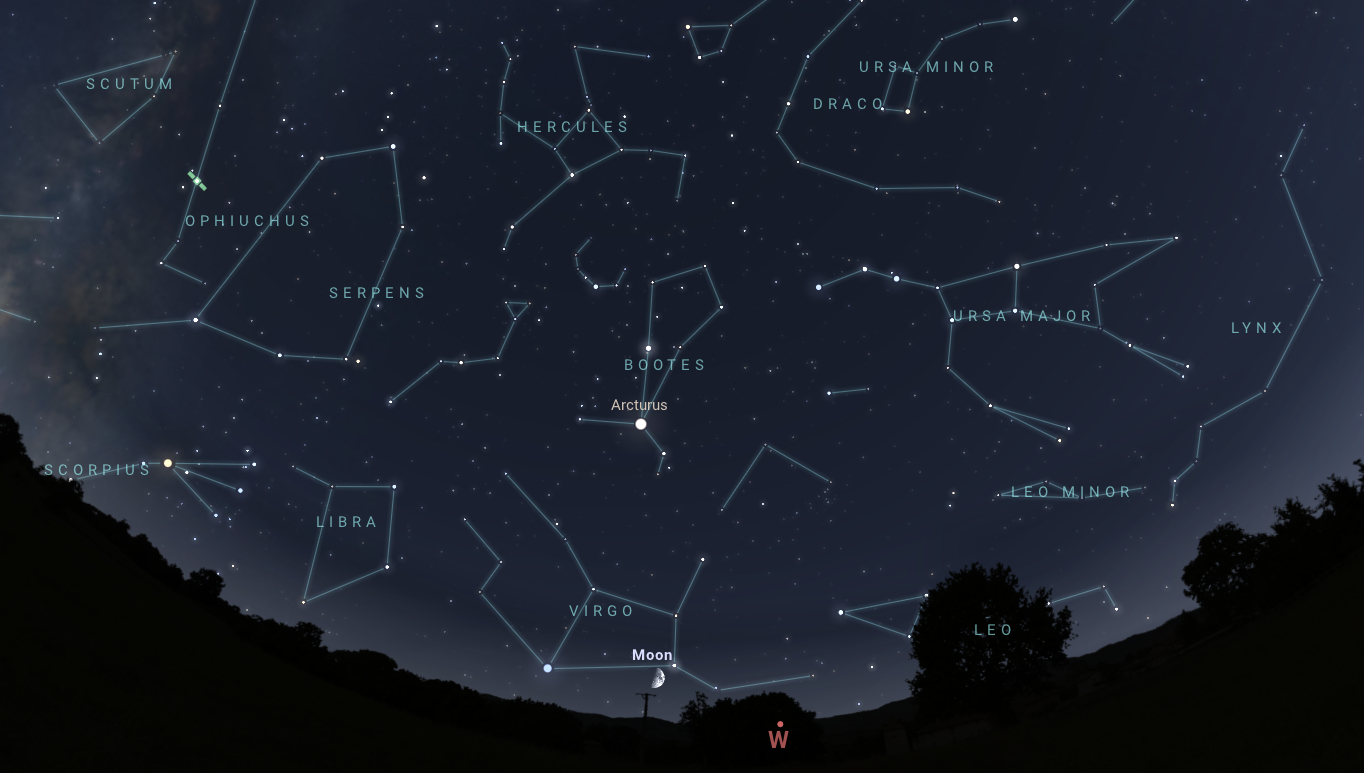
For the best chance of spotting a June Bootid, head to a dark location away from city lights if you can. The shower's radiant — the point from which the meteors appear to originate — lies in the constellation Boötes, which sits high in the western and southwestern sky during the evening for observers in the Northern Hemisphere.
While the radiant can help you identify June Bootids, you don't want to look directly at it. Instead, find a comfortable spot with a wide view of the sky and let your eyes adjust to the darkness for at least 20 minutes. Meteors are often easier to spot when you're scanning a broad area of sky.
WALLOPS ISLAND, Va. — For over 20 years, NASA's Swift space observatory has been conducting prolific science in orbit, hunting for signs of gamma-ray bursts — the most powerful explosions in the universe. Now, it's falling to Earth, doomed to a fiery death by the end of the year as its orbit decays.
But maybe not.
NASA, it turns out, has a daring rescue mission in the works, something never before attempted in space: the Swift Boost mission. The endeavor calls for an untested spacecraft built by the Arizona company Katalyst Space Technologies to rendezvous and dock with Swift — something the observatory was never designed to do — before the observatory falls back to Earth.
NASA’s Neil Gehrels Swift Observatory is falling out of space. NASA has a daring plan to save it with a spacecraft built by Katalyst Space. (Image credit: NASA)
If all goes well, Katalyst's space tug (it's called Link) will lift the Swift observatory into a higher, safer orbit — one that will add years of life to the aging space telescope's mission. Liftoff is officially set for June 27, with Link launching on the last-ever Pegasus XL rocket, an air-launched booster built by Northrop Grumman.
"Frankly, I have to be honest: No one thought it was going to be possible," Shawn Domagal-Goldman, NASA's Astrophysics Division director, told reporters here on Wednesday (June 17). "No one thought we would get as far as we've already gotten today."
What stands out most is how quickly the mission came together.
NASA’s Neil Gehrels Swift Observatory, shown in this artist’s concept, orbits Earth as it studies the ever-changing universe. Launched in 2004, the space telescope's days are numbered as it is falling out of space. (Image credit: NASA’s Goddard Space Flight Center Conceptual Image Lab)
It was just in September 2025 that NASA picked Katalyst to build a spacecraft capable of boosting Swift on a budget of $30 million. That was nine months ago. And now, the finished Link spacecraft — with its three robotic arms, three main Hall thrusters and a suite of other instruments — is packed aboard its Pegasus XL rocket and tucked on the belly of its L-1011 Stargazer carrier plane for a trip to its launch site in the South Pacific's Kwajalein Atoll.
"In the last nine months, we have gone from a clean sheet to a spacecraft that is currently integrated on a rocket on an airplane, ready to go to Kwaj for launch," said Kieran Wilson, Link's principal investigator at Katalyst Space, on Wednesday. "This is an absolutely unprecedented development timeline for this program."
Yet that "swift" timeline, if you will, is essential if NASA is to rescue the Swift space observatory.
Katalyst Space's LINK robotic servicing satellite awaits encapsulation inside a Northrop Grumman Pegasus XL rocket on June 8, 2026, at NASA's Wallops Flight Facility in Virginia. (Image credit: NASA/Ron Beard)
NASA originally launched Swift (its full name is the Neil Gehrels Swift Observatory, after its late principal investigator) in 2004 on a $250 million mission to search the sky for gamma-ray bursts and other high-energy astrophysics phenomena in the cosmos. From its original orbit about 375 miles (600 kilometers) above Earth, Swift was a silent sentinel, ready to quickly pivot to new targets with unprecedented speed.
"Swift was designed to study gamma-ray bursts, short-lived flashes of high-energy light that release more energy in just a few seconds than the sun will in its entire lifetime," Swift principal investigator Brad Cenko told reporters Wednesday. "It's been extremely successful in this regard, detecting over 2,000 of these sources all the way out to the edge of the visible universe."
It was Swift that helped scientists confirm without a doubt that the heaviest elements we know of, including the shiny gold and platinum in the jewelry you're wearing right now, were forged by these explosive cosmic events, Cenko said. Swift was expected to last two years in orbit. It's well into its second decade now, and still in good health — well, except for that "falling out of space" part.
You see, Swift doesn't have thrusters, or a propulsion system of any kind. And over the years, an increase in solar activity — space weather from the sun — has puffed up Earth's atmosphere to create more drag on Swift than expected, pulling it down from its initial orbit.
Last year, the Swift mission team realized the space telescope was falling faster than expected. Without a rescue mission, Swift would crash to Earth by the end of this summer.
"It was okay for a generic spacecraft to come out of orbit," Domagal-Goldman said. "But this was not just any spacecraft. This is an observatory with unique capabilities for astrophysics … It is a swift observatory that can quickly pivot across the night sky to find things that go boom in the night."
"So we decided, yeah, we want to go save this one this time because of how special it is," he added.
Artist's illustration of Katalyst Space Technologies' Link servicing spacecraft approaching and capturing NASA's Swift space observatory on an orbit-boosting mission. (Image credit: Katalyst Space Technologies)
A lot has to go right for Katalyst's Link spacecraft to rescue Swift.
The 937-pound (425-kilogram) spacecraft will launch into an initial testing orbit on June 27 and perform a series of checkouts to ensure that its basic systems (three main engines, 16 reaction control thrusters, solar arrays, robotic arms) are all working properly.
"We'll have a commissioning period of a few weeks, after which we will begin maneuvers in order to approach Swift," Wilson said.
Once Link reaches Swift's orbit, it will perform a series of proximity operations, dock, and then raise the space observatory to its initial orbit over the period of a several months. If that goes to plan, Swift could be back to performing science by this fall, Cenko said. (The telescope has been in a low-power mode to preserve what orbit it can since February.)
If Link is successful, Swift could get another five or more years of life in space. Link, meanwhile, will detach and be intentionally deorbited (meaning it will fall to Earth on purpose) to end its mission.
"All this is challenging and risky," Wilson said. "There's a lot of spacecraft that have had far longer development cycles with far more funding behind them that have failed for mundane reasons."
A lot of simple things can go wrong.
For example, the solar arrays on Link might malfunction, Wilson said. Swift has been in orbit for so long, its protective insulation blankets may be as brittle as glass and break when Link's robotic arms grab on, he added.
Engineers from Katalyst stabilize their Link robotic servicing spacecraft as it moves into a vibration chamber at NASA's Goddard Space Flight Center on April 15, 2026. (Image credit: NASA/Scott Wiessinger)
And then there's the sun. It was increased solar activity that put Swift in its perilous situation. That activity is ongoing. In fact, Swift may be one big solar storm away from doom if the sun fires off a major storm before Katalyst's Link can reach it.
Swift is on track to fall below an altitude of 186 miles (300 km) by October. At that point, it may be too low for Link to reach the observatory. A surprise solar storm could accelerate that fall, but NASA remains hopeful.
"At the moment, we think we have several months where Swift will be at a sufficiently high altitude to give Katalyst folks a great chance to capture and boost us," Cenko said.
Katalyst is banking on the future need for spacecraft servicing and life extension in space. This week, the company raised $12 million in funding to develop an even more capable spacecraft called Nexus, which it plans to "expand satellite servicing to multi-orbit, multi-mission operations."
"Over the last decade or so, we've gotten very good at launching things into space," said Robert Lamontagne, Katalyst's vice president for strategic partnerships. "Katalyst is here really to kind of demark the end of that throwaway model, and the start of a new model."
The first test flight of a Nexus mission could launch in 2027. Its target: a U.S. Space Force satellite called Rooster in geostationary orbit22,236 miles (35,786 km) above Earth, much higher than the Swift observatory. That Nexus-1 mission will launch atop an Ariane 6 rocket next year.
One new mission is setting out to study menstruation in microgravity for the first time ever.
Forty-six years ago, NASA engineers asked Sally Ride if 100 tampons was the right amount to send with her for a six-day spaceflight. Though people laugh at that fact today, there has still never been any scientific study dedicated to studying menstruation in space. But a non-profit called Operation Period aims to change that. Led by Gen-Z researchers, this non-profit works to provide what its founder Manju Bangalore calls "menstrual freedom," which she says would mean everyone can have easy access to menstrual products. Meanwhile, the organization also aims to tackle the wider issues that leave people without such access in the first place. With its upcoming suborbital mission Operation Period-01 (OP-01), this ambitious team is taking their cause into microgravity. On OP-01, the mission's founder will launch to space to conduct the research themselves on a Virgin Galactic suborbital flight in 2027.
In conducting their work here on Earth, Operation Period found that "there were still some of those same gaps in spaceflight medicine," Manju Bangalore, the founder and executive director of Operation Period and research astronaut in training for OP-01, told Space.com. " I want all menstruators to be able to live life with their full dignity and reach their fullest potential, and that includes astronauts."
With a background in physics and astronomical engineering as well as with training in bioastronautics and having spent time working at NASA, Bangalore brings her love of space to this cause. She and Priya Abiram, the Director of Research at Operation Period's Redshift Lab, feel so strongly about their message, even 9 years since the pair founded their non-profit; in fact, with this mission, the two will become some of the youngest South Asian women to travel to space.
"On a personal level, I've always been fascinated by space and human space exploration. It's what's always excited me as a child, and I've kept that curiosity going," Bangalore said. "I didn't think those two missions would ever combine into this. It wasn't something I ever planned, but I'm very grateful to lead this historic mission to advance menstrual health in this way."
And just as this team is excited to bring their research into a suborbital environment, Virgin Galactic is excited to be expanding the range of microgravity science the non-profit supports. "This mission with Operation Period is a powerful example of how Virgin Galactic can continue to support real-time, in-flight scientific investigation into long-overlooked areas of human health, helping advance more inclusive and innovative exploration that delivers insight for both space and life on Earth," Virgin Galactic director of system analysis & research Amber Favaregh said in an emailed statement.
Recently, Operation Period expanded to include a research wing, and this mission will be conducted under that umbrella. The team was not yet able to share specific details on the exact protocol that will be conducted during the mission, information they said will be shared at a date closer to launch, but they did share the current issues that this research aims to begin to address.
Currently, astronauts typically choose to fully suppress their periods during their spaceflights, through hormonal IUDs or oral contraceptive pills. While that is a choice astronauts might continue to make in the future, without data to show the reality of dealing with a period in space, astronauts are left with fewer choices with their own bodies. Comprehensive data on menstruation in space will also be important if astronauts are to complete longer spaceflights or even extended stays on the moon. While the mission has not yet revealed its priorities and exactly what data it will collect, with such limited data on menstruation in space, there is a lot of knowledge to be gained.
While "the data that we have, although limited, says that it is generally safe to menstruate, in terms of long duration missions, we don't have quantitative data," Bangalore said. "We don't have enough data to continue to assist with patient resource allocation for mission planners."
Historic missteps like the "100 questions" moment with Sally Ride highlight an issue that could have big effects on future, longer-term missions. Sure, having a ridiculous number of backup products would ensure that there is no need unaddressed, mass considerations for spaceflight are extremely serious and future missions will need to have better data to know what will be needed in a microgravity environment.
And just like with other science in space, the research conducted in microgravity will also be used on Earth. The pair aim to collect menstruation data that will benefit astronauts as well as people back on our home planet. .
"I think on Earth, there's a lot of gaps right now in menstrual health research," Bangalore said. As just one example, she cited recent findings that menstrual product companies were reporting incorrect absorbency of their products because they were testing products with saline, which is very different from menstrual blood. "This was potentially leading to doctors to underdiagnosed heavy menstrual bleeding, which right now the stats say affects 20% of American menstruators," Bangalore said.
With this being the first mission of its kind, OP-01 will not answer every question that remains about menstruation and space, but it will bring data to a conversation decades in the making. "Our hope is to continue to iterate this research so that we can do future suborbital flights, as well as orbital flights, to continue to create larger data sets," Bangalore said. "I think the point of preliminary studies is to be able to know what questions to ask in the future, so we don't expect that this suborbital flight will solve everything or create all the data that we need, right, but we hope that this will be a good stepping stone."
Momentum for this research was actually sparked by many millions of views on a viral social media video in which Bangalore conducted an early version of a menstrual fluid dynamic experiment in a low-gravity environment aboard a parabolic flight.
This viral moment "ended up being a really cool kind of 'in' to continue talking about destigmatizing periods," she said. "Through that, I got to talk more about the gaps in spaceflight medicine, in terms of menstrual health."
Annie Easley at NASA's Glenn Research Center. (Image credit: NASA)
It's Juneteenth in the U.S. today (June 19), a federal holiday that commemorates the end of slavery in America.
Though the Civil War ended in April of 1865, it wasn't until June 19 that same year when Union soldiers officially enforced the law that all enslaved people would be free. But the end of slavery was only the beginning of the challenges soon to follow; for one, segregation between Black and white people in the U.S., both systemic and informal, persisted for years. And we still live in a time when active racism, and the consequences of prior racism, trickle into many aspects of society.
It indeed affected NASA; Black women at the agency were once discriminated against despite making serious contributions to the space program. Our image of the day today celebrates the accomplishments of one such woman, Annie Easley.
Who is Annie Easley?
In 1955, Annie Easley started working for NASA's predecessor organization, the National Advisory Committee for Aeronautics (NACA). Her job was to serve as a "human computer," which was a position unique to the time. (NACA was dissolved in 1958, and its duties and personnel were taken on by the newly created NASA.)
Human computers at NACA and NASA were women who worked as basically early versions of computer programmers. To be a human computer, you had to be extremely good at mathematics, performing reliable calculations on a consistent basis to aid space missions.
Eventually, though, NASA moved toward the use of machine computers more often; Easley transitioned along with the space agency, ultimately becoming a full-fledged computer programmer.
As NASA explains, Easley's career shifted once again as it progressed. After some time, she took a position as the space agency's EEO, or Equal Employment Opportunity, counselor. She worked with NACA/NASA for 34 years before retiring in 1989. She passed away in 2011.
The importance of NASA's human computers
Like Easley, many of NASA's human computers became computer programmers once the agency made the transition to relying more heavily on machine computers. They together performed hundreds of thousands of calculations for the space program.
Easley alone was able to develop code that was crucial in research of energy-conversion systems, which paved the way for hybrid vehicles like the Centaur upper-stage rocket. Down the line, this work of hers contributed to the 1997 launch of the Cassini spacecraft that headed to Saturn.
However, the story wasn't as golden as it sounds retrospectively. Though NACA started hiring white women as "computers" in 1935, the agency didn't begin allowing Black women to enter the workforce until 1943. And that was only due to a shortage of professionals because of World War 2. In fact, human computers at the agency were not called professionals but rather "subprofessionals," and they were regularly talked down to by men who worked at the organization.
Black women had it particularly bad: They had to jump through hoops imposed by both racism and sexism.
Easley was one of just four African Americans out of 2,500 employees at NACA when she was hired.
In a 2001 interview, Easley recalled her mother saying to her: "'You can be anything you want to. It doesn't matter what you look like, what your size is, what your color is. You can be anything you want to, but you do have to work at it.'"
Each November in the Northern Hemisphere, the astronomy world cranks up a gear. As Orion's Belt and the bright stars of winter appear in the east just after an early sunset, telescopes are added to Christmas lists. True darkness has arrived — long winter nights when stargazing sessions can go on for many hours. The blanket of stars has arrived.
I used to think beginners should start stargazing in winter. That's what astronomy books always imply: crisp, dark skies and brilliant stars, with the constellation Orion and its spectacular nebula dominating the heavens. My own book, A Stargazing Program for Beginners, outlines a month-by-month program to reveal all the night sky's biggest and most beautiful secrets in just one year — starting in January. Technically, it's all true. Winter skies are spectacular. But they're also cold enough to make most normal people give up after 15 minutes.
June is different. June is when the sky becomes readable. The nights are shorter, yes, and in the northern U.S., Canada and much of Europe, true darkness arrives very late near this weekend's solstice. But that softness is exactly what makes it approachable. You don't step into a black void filled with unfamiliar stars, shivering as you do so. You ease into it through lingering twilight, warm air, and a handful of large, obvious patterns that repeat night after night. Stargazing becomes a slow, easy, unrushed affair — and there's so much to see.
What's happening and when to look
Just as winter brings many hours of darkness that are hard to make use of — because of cold and clouds — summer brings the opposite problem. In June, you can stand outside in shirtsleeves, but only late at night. For example, in New York — at about 41 degrees north — sunset on the solstice is at 8:33 p.m. EDT, with astronomical night (defined as when the sun is 18 degrees below the horizon) between about 10 p.m. and 3:30 a.m. EDT. At 51 degrees north (much of Canada and the U.K.), astronomical night starts after midnight.
Wherever you are in the Northern Hemisphere, you can stargaze during the long twilight that begins about 45 minutes after sunset. With calmer weather compared to winter's haze and endless cloud systems, a clear sky is more likely — and so are camping trips under a dark sky.
There's another beginner advantage in summer that few mention: the learning curve is shorter. Summer constellations and asterisms rely more on large geometric patterns. You're not trying to memorize dozens of tiny stars, but instead you're learning shapes.
The Milky Way is now visible during astronomical night. (Image credit: Justin Paget via Getty Images)
How and when I'm stargazing this month
Step outside around 10:30 or 11 p.m., depending on your latitude and face north to find the Big Dipper — the large spoon-shaped pattern high in the sky. Then use the curve of its handle. Follow the arc outward, and you'll arrive at a bright orange star low in the western half of the sky: Arcturus, in the constellation Boötes. Arcturus comes from the ancient Greek word Arktouros, meaning "guardian of the bear." It's an ancient star-hop, but now we know the science: Arcturus is a red giant star and the fourth-brightest star in the night sky. It's about 37 light-years away from the solar system and, at seven billion years old, it's older than the sun.
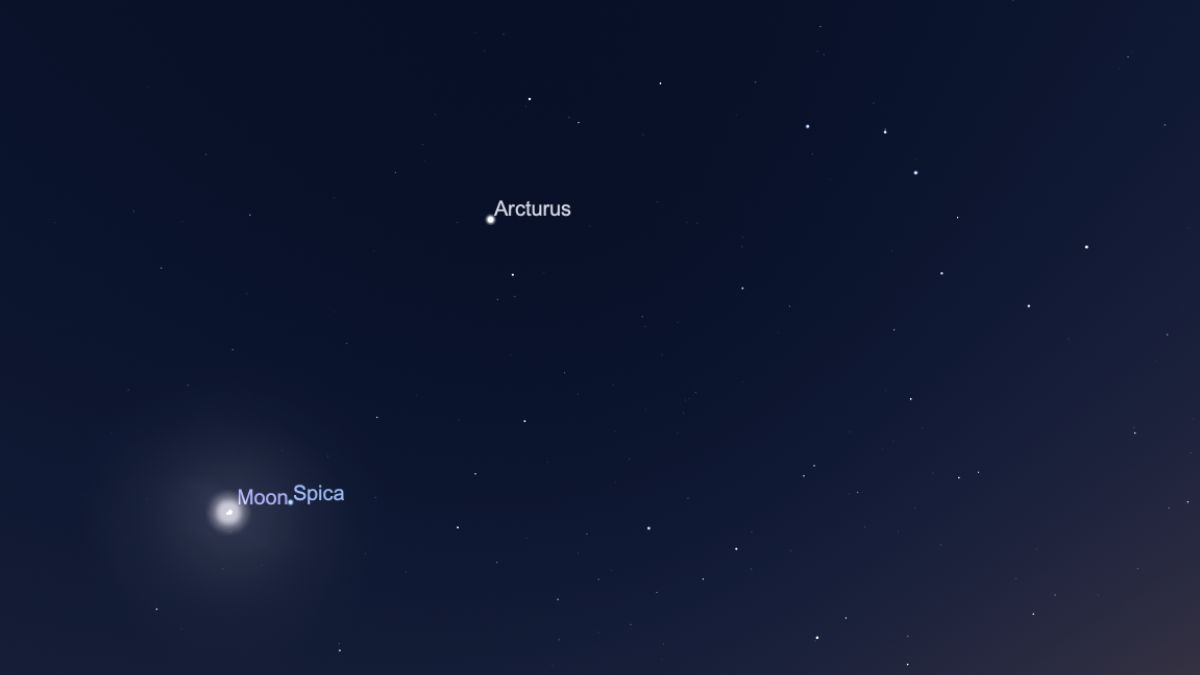
On June 23, use the Big Dipper to find Arcturus, then Spica and a waxing gibbous moon. (Image credit: Stellarium)
Even if you only find Arcturus, you've already learned a genuine navigation technique astronomers (and mariners) have used for generations. But there's more. Continue the same curve farther south, and you'll eventually reach Spica, a bluish star in the constellation Virgo. Its name means "ear of corn" because of its seasonal connection to agriculture and harvests. About 250 light-years distant, it's actually two massive young stars (12 million years old) orbiting each other.
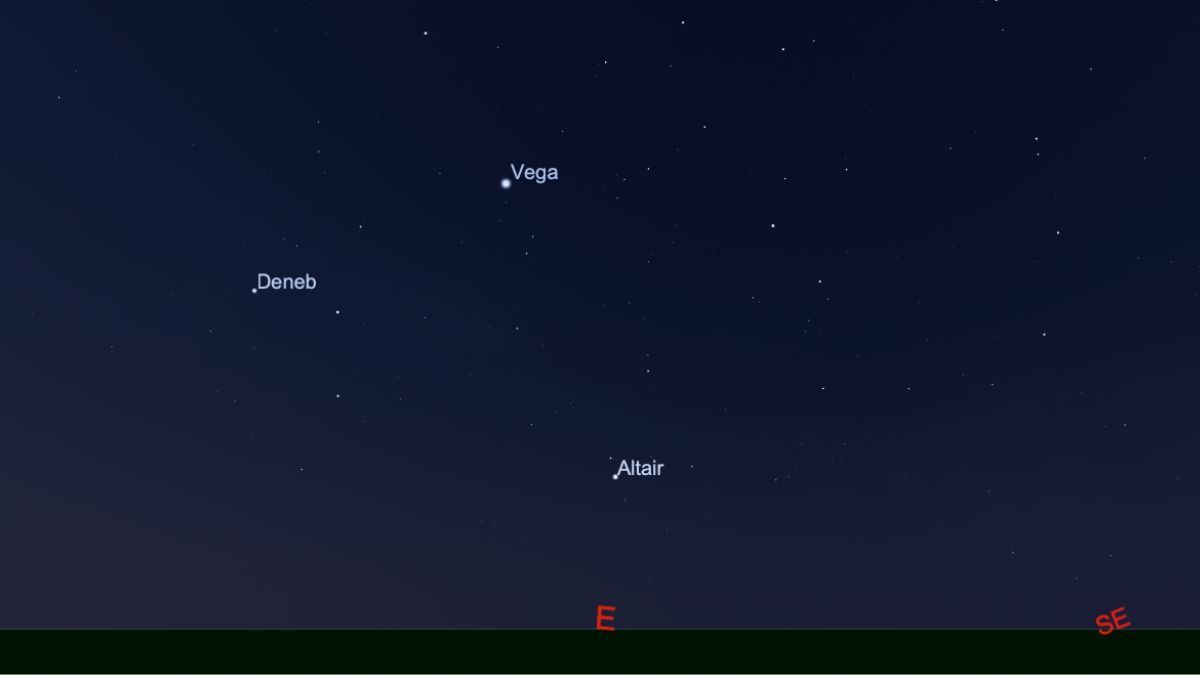
Now turn eastward, where three bright stars dominate the summer sky: Vega, Deneb and Altair. Together they form the Summer Triangle, probably the single best beginner landmark in the Northern Hemisphere's summer sky. Vega is the easiest starting point because it's so bright and highest in the sky. Deneb sits below, and Altair appears lower. Once you can identify those three stars consistently, you've unlocked an enormous amount of the summer sky. Recognizing the Summer Triangle gives you orientation, confidence and a mental map.
Look east for the three bright stars of the Summer Triangle. (Image credit: Stellarium)
Under darker rural skies, you may also begin noticing the Milky Way stretching behind Deneb and Altair later in the night. If you can't see it, you either need to stay outside a little longer (it takes 20 minutes away from any light — particularly the white light from a smartphone — to see it properly) or else the sky conditions are poor (which could include light pollution).
But even from cities, the bright and vast patterns of the summer night sky remain visible. Learn one new asterism or constellation each session — such as the faint outline of constellations like Virgo, Ophiuchus, Hercules and Corona Borealis — and repeat the process during your next stargazing session.
So lean into the solstice this week, do some real stargazing and build your confidence gradually while the geometry of Earth's tilt turns in your favor.
Stargazer's corner: June 19-25, 2026
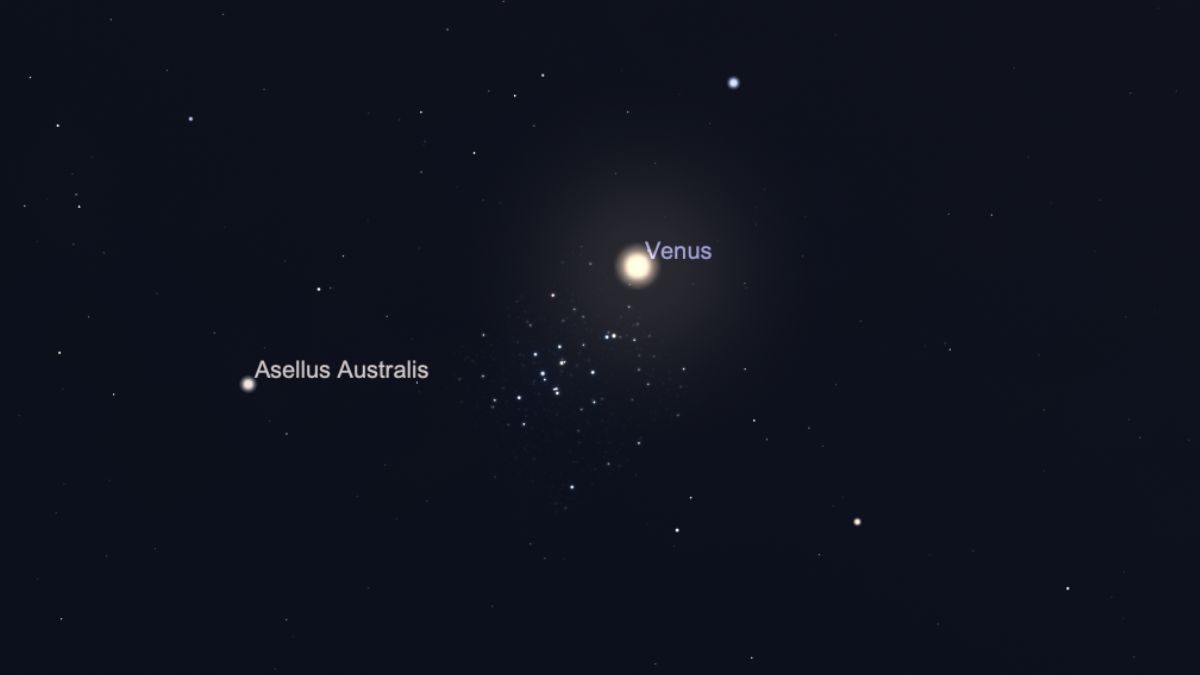
June 19 sees Venus within the Pleiades, a rare occurrence. (Image credit: Stellarium)
The June solstice arrives this week, marking the longest days and shortest nights of the year in the Northern Hemisphere. Darkness is now at a premium, with extended twilight lingering well into the night and returning early in the morning, but the moon is back in the evening sky. On Friday, June 19, a 29%-illuminated waxing crescent moon will shine just to the left of Regulus, the brightest star in the constellation Leo. At the same moment, Venus will pass through the Beehive Cluster. It's the latter that you don't want to miss — it's a rare occurrence. On Tuesday, June 23, a 70%-illuminated waxing gibbous moon will shine next to Spica.
Constellation of the week: Cygnus
The constellation Cygnus. (Image credit: E. Slawik/NOIRLab/NSF/AURA/M. Zamani)
Is it a swan? Is it a Christian cross? Depending on how you look at the constellation Cygnus, it can be either, but its official name relates to the long-necked bird in flight. Positioned across the Milky Way, its most obvious star is Deneb — one of the anchor stars of the Summer Triangle — which marks either the body of the swan or the top of the cross.
Even in less-than-perfect skies, the shape of Cygnus is clear, and in darker conditions, it sits within a dense star field that hints at structure within the Milky Way.
Last year, NASA's Lucy spacecraft encountered a bi-lobed asteroid that is a chunk of an even larger rocky body that was smashed apart in an almighty collision 155 million years ago. This little pitstop happened on Lucy's way to a rendezvous with the Trojan asteroids that shadow Jupiter around the sun.
The asteroid 52246 Donaldjohanson, better known as "DJ" to Lucy's mission scientists and named after the paleoanthropologist who discovered the Lucy hominin fossil in Ethiopia in 1974, orbits the sun in the inner part of the main asteroid belt between Mars and Jupiter.
The true Lucy fossil dates back in time 3.2 million years and is an important link in the evolutionary chain that led to homo sapiens. Likewise, primitive asteroidal bodies are somewhat like fossilized remnants of the building blocks of the solar system's planets, including Earth. Understanding the make-up of these asteroids and where they formed versus where they are now can provide crucial insights into how Earth was assembled and where its organic materials and water may have come from.
Lucy flew past DJ in April of 2025. It is a pretty primitive asteroid, meaning that it has, or once upon a time had, certain volatile materials such as water-ice, as well as plenty of carbon — all things that can be removed thermally over time. Most objects that contain volatiles originate in the outer solar system, where it is cold enough that the volatiles do not sublimate away.
Within DJ's composition, Lucy detected iron-bearing phyllosilicates, which are a mineral formed in the presence of liquid water.
"Phyllosilicates are an indication that water was present and there was some degree of aqueous alteration," Simone Marchi, a planetary scientist from the South-west Research Institute and lead of the study into DJ, told Space.com.
However, for DJ to have had water, it must have formed further out from the sun, possibly in the outer asteroid belt.
"But DJ belongs to the inner asteroid belt so that's already intriguing," said Marchi.
The spectral evidence also indicates DJ was only partially altered by water, which Marchi says tells us something about its history.
"The aqueous alteration terminated early, and though we don't know why, we can speculate. In order to have aqueous alteration there needs to be some internal heating [usually via radioactive elements] and if something forms later than everything else then there will be less heat [since many of the radioactive elements will have already decayed]. Or perhaps there was just less water to start with where it formed."
The main belt carbonaceous asteroid (52246) Donaldjohanson as observed by the NASA Lucy Spacecraft on April 20, 2025. Here the grey-scale optical image, acquired with the L'LORRI instrument, is overlain by a false-color map indicating the gravitational slopes on the asteroid’s surface. (Image credit: NASA/GSFC/SwRI/JHU-APL/DLR)
What we do know is that DJ was once part of a much larger asteroid that suffered a giant impact 155 million years ago, causing the parent body to break apart into a number of chunks, the largest being the 45-mile-wide (73-kilometer-wide) asteroid 163 Erigone. Consequently, the remains of this parent asteroid, including DJ, are collectively referred to as the Erigone family.
DJ's violent origin may also explain its shape, which features two lobes joined together by a narrower and relatively smooth neck.
"We have now seen many small bodies in the solar system that appear to have this bi-lobed shape, and that's across a wide range of sizes," said Marchi.
For example the near-Earth asteroids 25142 Itokawa, which was visited by the first Japanese Hayabusa mission in 2005, and 4149 Toutatis that was encountered by China's Chang'e 2 in 2012, are both bi-lobed. So too is the tiny asteroid Selam, which is a satellite of the asteroid 152830 Dinkinesh visited by Lucy in 2023. Then there are cometary bodies including 67P Churyumov–Gerasimenko visited by the Rosetta mission and comet 19P/Borrelly, imaged by NASA's Deep Space 1 spacecraft in 1999.
These objects are all different sizes, different types and in different locations, but they all share the same structure. However, Marchi cautions that they might not all form the same way. For example, the neck between the lobes of comets such as 67P might form through erosion via sublimation and outgassing as the comet gets closer to the Sun, whereas for asteroids it might indicate a history of being involved in a giant impact, the resulting fragments coming together to be bound by gravity – a so-called contact binary.
Lucy now continues onwards, scheduled to encounter its first trojan asteroid, known as 3548 Eurybates, in August 2027. Trojans are asteroids that have been captured by Jupiter's gravity at the L3 and L4 Lagrange points, 60 degrees in front and 60 degrees behind Jupiter itself.
"We think that the Trojans, based on our understanding of the solar system, formed further out and then were captured where they are today following the early shuffling of the planets," said Marchi. "This shuffling could also have been the origin of DJ, so there could be a connection there between DJ and the Trojans."
The asteroid Donaldjohanson is seen in detail in this Lucy image. (Image credit: The asteroid Donaldjohanson as seen by the Lucy Long-Range Reconnaissance Imager (L’LORRI). This is one of the most detailed images returned by NASA’s Lucy spacecraft during its flyby. )
Compositionally, the majority of trojans are expected to be even more primitive than DJ, containing more carbon, water and other volatile materials that would sublimate if they got too close to the sun.
That is all except one: Eurybates.
"It is the only one of our targets that from spectroscopy appears to be relatively similar to DJ. It's not identical, but it is closer in composition to DJ than the other Trojans, so it will be intriguing to compare them," said Marchi.
Indeed, any similarities will help tell us how asteroids were herded around during the first few hundred million years of solar system history following the formation of the planets. Jupiter and Saturn, especially, began migrating inwards and then out again. In doing so, their gravity pushed and pulled minor bodies all over the place, as did the gravity of Uranus and particularly Neptune as they edged outwards. These migrations led to the formation of the asteroid belt and the Kuiper belt, and ejected trillions of bodies into the wide orbits of the Oort Cloud.
"The key question is, if DJ has been relocated in the inner asteroid belt, then how many other asteroids came along with it and ended up being closer to the Earth, where they could have delivered some water, some organics and other things to our planet?" asked Marchi.
Lucy will visit six of Jupiter's trojans, which in total number over 15,300 discovered so far. Far from lumps of rock, the trojans, along with DJ and Dinkinesh (which is the Ethiopian name for the Lucy fossil), are windows into the past, and the storytellers of the Earth's most ancient history.
Lucy's findings from Donaldjohanson were published on Thursday (June 18) in the journal Science.
Astronomers have traced a high-energy "ghost particle" back to Shadow Blaster, a star-forming galaxy located 11 billion light-years away. That means that this particle, a neutrino, had been travelling to us ever since the 13.8 billion year-old universe was just around 3 billion years old.
The discovery offers the first evidence that star-forming galaxies like Shadow Blaster play a significant role in populating the universe with mysterious high-energy cosmic ghost-neutrinos. These particles get their spooky nickname because, possessing virtually no mass and no electric charge, they pass through matter with little to no interaction while moving at nearly the speed of light. For context, as you read the preceding sentence, over 65 billion neutrinos streamed through every square inch of your body; that's about 100 billion per square centimeter.
Despite the difficulty associated with detecting such particles, humanity has been spotting neutrinos since the 1960s, but only a few sources of these particles have been identified. Neutrinos are the second most abundant particles in the cosmos after photons, particles of light, and the identified sources are nowhere near enough to account for this abundance. That has prompted the search for other, hidden neutrino sources, especially those which can accelerate neutrinos to high energies. Now that hunt has led to the identification of the incredibly bright Shadow Blaster galaxy, officially designated JCMT0402−0424, which shines in infrared, as a potential neutrino source.
The galaxy JCMT0402−0424, or "Shadow Blaster" identified as a source of a high-energy neutrino detected in 2021. (Image credit: International Gemini Observatory/NOIRLab/NSF/AURA/ALMA (ESO/NAOJ/NRAO))
"Shadow Blaster possesses the kind of dense, gas-rich environment that theoretical models have long suggested could efficiently produce high-energy neutrinos," Yuji Urata of MITOS Science Co., LTD. in Taiwan said in a statement. "If confirmed, Shadow Blaster would be the first-ever individual dusty star-forming galaxy directly linked to a high-energy neutrino event."
Thus far, no other credible candidates exist as potential sources for this high-energy neutrino, designated IC 210922A.
Chasing ghosts
Astronomers were alerted to the existence of IC 210922A half a decade ago when this high-energy neutrino event was detected by the IceCube Neutrino Observatory located in Antarctica. This set the astronomical community scouring space in the direction of the constellation Eridanus for potential sources for an electromagnetic counterpart to this event with a range of telescopes. This turned up no convincing gamma-ray, X-ray or optical counterpart for the neutrino detection, nor could any gamma-ray burst, supernova, or tidal disruption event (in which a black hole violently shreds a star) be linked with IC 210922A.
Urata and colleagues began their personal search with the James Clerk Maxwell Telescope (JCMT), operated by the East Asian Observatory, and the Submillimeter Array (SMA), discovering Shadow Blaster, a galaxy in the right position and with the right level of brightness to be associated with IC 210922A. The team followed this up with an investigation using the Atacama Large Millimeter/submillimeter Array (ALMA), a collection of 66 radio wave antennas in northern Chile.
The detection of this galaxy was possible because it is strongly gravitationally lensed. Gravitational lensing is a phenomenon that occurs when an object of great mass comes between Earth and a distant background source, curving the fabric of spacetime. As light from the background source navigates this curvature, its path is curved. This results in light from the lensed source arriving at different times to our telescopes, causing it to be amplified.
In the case of Shadow Blaster, before the team could learn anything about this distant galaxy, they had to discover more about the object serving as the intermediate gravitational lens, specifically what type of object it is, its mass, and its distance from us. To do this, they turned to the Gemini North telescope and its Gemini Multi-Object Spectrograph (GMOS) and the Gemini Near-InfraRed Spectrograph (GNIRS) instruments.
With the model of a gravitational lens determined, the team discovered that Shadow Blaster is a galaxy with an extremely compact heart filled with dense clouds of gas and dust that is fueling an intense burst of star formation. A region such as this has long been theorized to serve as a powerful particle accelerator. Because Shadow Blaster lacks a feeding supermassive black hole, this research shows that these regions can still serve as cosmic particle accelerators when they harbor sleeping black holes and in the absence of the powerful jets that erupt from active galactic nuclei (AGNs).
As for the overall population of neutrinos, this research could help account for that too. Intensely star-forming galaxies, or starburst galaxies, are believed to have been prevalent around 10 billion years ago in the early universe. Thus, these galaxies could have been producing a multitude of high-energy neutrinos. Proving that may prove difficult, however, as astronomers don't have the good fortune to find all of these galaxies lurking behind a gravitational lens, meaning they may be too faint and distant to study.
"Our analysis suggests that this population could contribute up to roughly 20% of the observed diffuse neutrino background measured by IceCube," Urata concluded,
The team's research was published on Wednesday (June 17) in the journal Nature Astronomy.
Using the James Webb Space Telescope, astronomers have discovered that the well-known "Pink Planet" harbors a salty surprise and an exotic atmospheric chemistry. The discovery marks an advancement in the study of cold objects beyond the solar system.
Initially discovered in 2013, GJ504b orbits a sun-like star located around 57 light-years from Earth. With a mass around 25 times that of Jupiter, this Pink Planet may not be a planet at all despite its moniker. It may instead be a brown dwarf, a failed star that formed like a star but was unable to gather enough mass to achieve the nuclear fusion of hydrogen to helium in its core. Thus, astronomers refer to it as a "planetary-mass companion," which means a planet-size object orbiting a parent star.
GJ504b remains one of the coldest planetary-mass companions discovered using ground-based telescopes, with a temperature of around 550 degrees Fahrenheit (290 degrees Celsius). Although, that still makes it hot enough to bake bread. Now, James Webb Space Telescope (JWST) data reveals it has a key ingredient for bread making too: salt located in its atmospheric clouds, unlike anything astronomers have seen before.
"The Pink Planet is the coldest companion ever discovered using ground-based instruments," team leader Aneesh Baburaj of Northwestern University said in a statement. "Many teams all around the world performed follow-up observations to study its light, but it was too faint for ground-based instruments. That made it a perfect target for JWST.
"When we finally obtained its spectrum, it immediately looked interesting. But once we started digging deeper into the data, we realized it was not like anything we have analyzed before."
The Pink Planet is cold and old
The team studied this planetary companion by measuring its faint electromagnetic radiation emissions and filtering out the bright glare of its parent star.
They found the relative coolness of the Pink Planet is a result of the planet's age. Both gas giant planets and brown dwarfs are born blisteringly hot but cool off as they get older. This new research estimated that GJ504b is between 2.5 billion and 4 billion years old.
Breaking down light from the Pink Planet into individual wavelengths, the team was also able to determine its chemical composition. This is possible because elements absorb and emit light at characteristic wavelengths, meaning they leave "fingerprints" on light passing through their atmospheres.
"In the past, other astronomers observed the companion for an entire night with some of the biggest telescopes in the world to obtain a spectrum," Baburaj said. "And they could not see the object. With JWST, our entire observation took around two hours, and we were successful."
The JWST data revealed a rich cocktail of chemicals in the atmosphere of the Pink Planet that included water, carbon dioxide, methane, and ammonia. However, these observations didn't match modeling of the planetary companion's atmosphere until the team factored in something completely unexpected: clouds of salt deep in the atmosphere.
An illustration of the JWST which has become a vital tool in the investigation of exoplanets and brown dwarfs. (Image credit: ESA)
"We ran simulations with clouds, and the results aligned with what we know about cold planets," Baburaj said. "We tried three different types of clouds, and salt clouds fit best. When we accounted for salt clouds, it subdued the signature of molecules hidden deeper in the companion’s atmosphere. Then, the results became physically possible.
"This is the first time we've found that salt clouds are critical to explaining the spectrum of an object. It's a good reminder to account for clouds in our models."
Though this mystery may be solved, there are still questions surrounding GJ504b that will only be solved with further investigation. The Pink Planet seems to be unusually rich in elements heavier than hydrogen and helium, which astronomers call metals. This means the team still can't pin down the origin of the Pink Planet; did it form like a planet, or like a star?
That means they aren't quite ready to determine if GJ504b is a gas giant planet or a brown dwarf... or should that be Pink Dwarf?
Emmy Award-winner Barrie Gower has helped created some of the most memorable beasts and creatures in the entertainment sphere, including "Stranger Things"' Vecna, "Game of Thrones"' chilling White Walker, the Night King, and the freaky fungus mutants of HBO's "The Last of Us."
For director Travis Knight’s sci-fi fantasy film, "Masters of the Universe," Gower called upon all of his veteran skills to provide special makeup and prosthetic applications for Jared Leto's Skeletor and his entire band of weird henchmen, plus He-Man's gang of crazy companions. From iconic characters like Spikor and Moss Man to Goat Man and Trap Jaw, Gower’s ace crew was tasked with bringing these monsters to the big screen.
"We got contacted a few years ago about 'Masters of the Universe' in 2018 or 2019," Gower tells Space.
"It was with a different director at the time and a different studio. It was two writer/directors, the Nee Brothers, who co-wrote the screenplay for this latest integration."
"The project changed studios two or three times and eventually they came back to us and the timing was bang on," explains Gower. "They’d enlisted Travis Knight and his vision was quite different to the original take, which was very high tech, very clean, very Marvelesque. Travis was a huge fan of He-Man and the '80s cartoon, the toy line, and the whole IP and franchise. His passion and love was really trying to do this film project justice and make it as true as possible."
Team Goatman. (L to R) Sarah Downes, Barrie Gower, Hapthor Bjornson, Duncan Jarman, Anthony Parker and Gillian Jarvis (Image credit: Amazon MGM Studios)
The master plan was to still give the $200 million feature a fun modern spin, but Knight was interested from a character perspective of creating full-sized human equivalent action figures.
"He wanted the world to be ultra colorful, ultra bright, and have this sense of awe and eye candy. We went through the characters to decide what would be practical, what would be purely digital, and what would be a combination of the two. Because of Travis’s background with Laika Studios he was very much into the practical techniques."
That was all music to Gower's ears and his BGFX team began the process of bringing the menacing egomaniacal antagonist called Skeletor to life.
"Originally Skeletor was going to have some sort of decorative golden mask in the shape of a skull with possibly some kind of disfigured makeup underneath," he notes. "But Travis said we’re doing Skeletor properly. He’s going to have a skull for a talking face and a blue muscular body. And this is the prefect example of a combination between practical and digital effects.
"He was set on the idea of creating a practical muscle suit for Jared, and his head would be animated digitally. We had a scan of Jared's head that we reduced and classically sculpted the skull based on the concept art, then we 3D scanned that for a digital file which we shared with the visual effects department for them to use as an asset to animate."
Gower's Skeletor build page for "Masters of the Universe" (Image credit: Amazon MGM Studios)
Creating this blue-hued Skeletor muscle suit was quite a complex job that included upper and lower body appliances crafted out of foam latex.
"It was using a lot of Jared’s muscle tones that we over-exaggerated and sculpted in more muscle sets and tones, but kept everything relatively anatomically accurate," adds Gower. "Then we went through a lot of testing and paint schemes. We originally did some silicone work, which is one of the most commonly used products in the prosthetics industry now because you get a beautiful translucency with it. But it’s very dense and non-porous and very heavy. So Jared would have been walking around with pounds and pounds of rubber on him. We did R&D and it was going in the right direction but we were running out of time, so we reverted to foam latex."
Jared's otherworldly outfit consisted of a foam suit, skeletal silicone gloves that fit over his hands, a foam latex collar, and then a hood fabricated by the costume department.
Prosthetic artists Jon Moore and Ashley Powell with James Apps as Spikor (Image credit: Amazon MGM Studios)
"We'd actually built two suits based on Jared. It was on a January morning and we met him at a hotel near the London airport," Gower recalls. "We had a very small window of time before filming so we were praying we weren’t going to have many adjustments to make. Jared came in, we got the stuff on him, and he was really lovely with us. Very funny, very jovial. He had just stepped off a plane!
"It went really well, just a couple tiny adjustments. We had a small team looking after him with his suit every day. Usually with prosthetics if you’re gluing it over the entire body you’re looking at seven or eight hours to do an application each day. Apart from times where we had to glue a few things on him here or there, we actually got him into his suit in about 15 minutes. He was a joy to work with. He was a lot of fun on set and there was this charismatic presence every day."
"Masters of the Universe" is currently in theaters everywhere.
SpaceX launched the latest batch of spy satellites for the U.S. government early Friday morning (June 19).
A Falcon 9 rocket lifted off from California's Vandenberg Space Force Base on Friday, at 4:50 a.m. EDT (0850 GMT; 1:50 a.m. local California time).
The launch kicked off a mission for the U.S. National Reconnaissance Office (NRO) called NROL-179.
SpaceX launched the NROL-179 mission for the U.S. government early Friday morning (June 19) from Vandenberg Space Force Base in California. (Image credit: SpaceX)
The NRO operates the United States' fleet of spy satellites. NROL-179 was the 14th mission dedicated to building out a new part of that fleet — a network the NRO calls its "proliferated architecture."
"To stay ahead of the competition and ensure it can continue to operate in a heightened threat environment, the NRO is modernizing its architecture in space and on the ground — delivering more capability faster with increased resilience," agency officials wrote in the NROL-179 press kit.
"A greater number of satellites — large and small, government and commercial, in multiple orbits — will deliver an order of magnitude more signals and images than is available today," they added.
SpaceX and Northrop Grumman build the "proliferated architecture" satellites. Information about the spacecraft is hard to come by; the NRO has not released details about their activities or orbits.
All of these satellites have reached orbit atop Falcon 9s flying out of Vandenberg, on California's central coast, with the first such mission launching in May 2024.
To plan, the Falcon 9's first stage returned to Earth a little less than eight minutes after liftoff on Friday, touching down at Vandenberg's Landing Zone 4. It was the third flight for this particular booster, according to a SpaceX mission description.
NROL-179 was the 71st Falcon 9 mission of 2026. Fifty-seven of the rocket's launches this year to date have been devoted to building out SpaceX's Starlink broadband megaconstellation in low Earth orbit.
Editor's note: This story was updated on June 19 with news of successful launch.
The Fujinon Techno-Stabi 1640 binoculars were the first image-stabilized (IS) binoculars I got my hands on and they are, quite literally, showstopping. Handheld stargazing actually became fun for me, instead of just getting annoyed at squiggly lines of light. Regardless of whether you are a seasoned binocular pro or a beginner, when you start upping the magnification, views start amplifying hand shake and make observation impossible. What is the point of spending loads on high quality optics if you can't even get a still picture? I truly believe that when it comes to non-telescope stargazing, image stabilization (IS) is one of the best things you can spend your money on.
I'm not saying that image-stabilized binoculars aren't expensive. They are, but you would realistically never need to buy another pair of high-magnification binoculars again. I recommend the Fujinon Techno-Stabi 1640 binoculars at full price, so getting $275 off them at their lowest price really is a steal. For prices on other binoculars and other optics, check out our Prime Day hubfor the best prices during the summer sales events.
Save a huge $275 on the incredible Techno-Stabi TS-L 1640 image-stabilized binoculars. They contain Fujifilm's premium optics in a lightweight package with some of the strongest image stabilization on the market.
These binoculars are perfect for sharp handheld observation of a range of night sky objects including stars, clusters and the moon. Harry Bennett / FutureThe Techno-Stabi TS-L 1640 binoculars are great for holding in your hand and are highly portable. Harry Bennett / FutureThey have a neat, streamlined design despite their high-end optics.Harry Bennett / Future40mm objective lenses aren't the biggest but the image-stabilization more than makes up for it. Harry Bennett / FutureA special screw feature tightens and loosens the battery compartment.Harry Bennett / FutureThe eyecups are easy to adjust for different levels of eye relief. Harry Bennett / FutureThe eyecups have over 15mm of eye relief with three different height presets. Harry Bennett / FutureThe rubber lens cap keeps the objective lenses dust-free during travel.Harry Bennett / FutureA small green LED illuminates in between the eyecups when the image stabilization (IS) is active. Harry Bennett / FutureA roof prism design keeps the weight low at 1.9 lbs (856 g).Harry Bennett / FutureThe binoculars come with a soft padded case for storage when travelling or storing for long periods. Harry Bennett / Future
The Fujinon Techno-Stabi TS-L 1640 image stabilized binoculars sit near the top of the binocular pyramid alongside the other best image stabilized binoculars thanks to their premium Fuji optics, lightweight build and powerful 3-degree image stabilization (IS). It is some of the strongest IS on the market, only being out ranked by other Fujifilm IS binoculars.
40mm objective lenses aren't the biggest for stargazing, where 50mm is the gold standard for low light, but you can't complain when observing star clusters at 16x magnification with zero shake. Even if you were using 16x50 binoculars without IS, that extra light-gathering ability would be useless when observing overhead without a tripod, the resulting view likely to be a mess of squiggly lights.
My favorite target with these was the Mirfak cluster in the constellation Perseus, which I could actually identify at this magnification thanks to the IS. It's amazing using them without the IS, then switching it on and watching the detail of the night sky emerge. They sit in a higher price bracket than regular models, but they really are some of the best optics you can buy for a heavy binocular user and now with over $250 off their asking price on Walmart, it's a great chance to save money on some exceptional technology. We are going to be seeing a lot of deals on binoculars, telescopes and cameras coming up to Amazon Prime Day. It starts on June 23, so make sure you check our Prime Day hub for all the best offers on skywatching gear and space gifts.
Price history: This is the cheapest the Fujinon Techno-Stabi TS-L 1640 binoculars have been since May this year, when they dropped to 1150 on Amazon. This Walmart price currently beats Amazon's asking price.
Reviews consensus: I rated the Fujinon Techno-Stabi TS-L 1640 binoculars four and half stars for their smooth image stabilization (IS) and lightweight design. Other reviews remark on the high price but argue that it is justified through the exceptional performance of these binoculars, with the difference made by IS like night and day.
Astronomers have a cosmic mystery on their hands, investigating a celestial crime scene to determine if a distant star has eaten a super-Earth exoplanet. The star may have had an accomplice — a failed star or "brown dwarf" companion — which may have steered the unfortunate planet toward its fiery doom.
The team charged with investigating this mystery first discovered hints of the crime when they found the star, TOI-5882, located around 1,300 light-years away, is surprisingly rich in the element lithium.
"You are what you eat, right?" team leader Brooke Kotten of the University of Michigan said in a statement. "We know that there's much more lithium in planetary material than there is in stars. So if a star eats a planet, it's going to take on a bunch of lithium."
So-called engulfment events such as this one occur very rapidly, on a timescale of a few days to a couple of weeks, which means catching stellar beings in the act of enjoying a planetary meal is extremely rare. Thus, astronomers have to act as cosmic crime scene investigators to reconstruct these events with the evidence at hand.
"That's what makes this field so exciting. You really are solving a mystery," Kotten said. "We can't just watch the crime happen, so we have to work with all the clues we're given to figure out whodunit."
One of the aims of these investigations is to discover the ways in which a star can devour a planet. One of the most common engulfment scenarios happens when a star runs out of hydrogen at its core at the end of its main sequence lifetime. This results in it swelling out to up to 100 times its original diameter, engulfing its attendant planets during its so-called red giant phase. This will occur in the solar system in around 5 billion years when the sunwill puff out to around the orbit of Mars, swallowing the inner rocky planets, including our own.
However, Kotten and colleagues know this isn't what has happened in the TOI-5882 system, as this star hasn't yet become a red giant. Instead, the researchers think the sun-like star had assistance from its brown dwarf companion.
Companion brown dwarf of partner in crime?
Brown dwarfs get their slightly unfortunate nickname of "failed stars" because, despite forming from collapsing clouds of gas and dust, just like stars, they fail to grow to the masses needed to trigger the nuclear fusion of hydrogen to helium in their cores, the process that defines what a main-sequence star is. They're quite mysterious by existing in this sort of limbo between planet and star.
This particular brown dwarf has around 20 times themass of Jupiter, or around 2% of the mass of the sun. That's not massive enough to trigger nuclear fusion, but is massive enough for it to have enough of a gravitational influence over planets orbiting TOI-5882. That means the team suspects this brown dwarf could have perturbed the orbit of this unfortunate planet enough to send it plummeting into its star.
This is something the scientists will need to investigate further. They may not have enough information yet to determine this planet's cause of death, but they do have some evidence that helps them identify the kind of world it would have been before it was obliterated. This comes from observations of the chemical composition and lithium content of 62 stars with similar ages and masses to TOI-5882.
"Lithium atoms delivered by planetary engulfment to a star are like sports fans arriving at a stadium," team member Seth Jacobson of Michigan State University said. "There may already be a few early arriving fans present, representing the initial amount of lithium in the stellar atmosphere, but they are quickly outnumbered."
An illustration of the lithium-enriched star TOI-5882 with its brown dwarf. (Image credit: Robert Lea (created with Canva))
From the lithium abundance they measured, the team has determined that this planet was a so-called super-Earth with a mass somewhere between two times that of our planet and the mass of the solar-system ice giant Neptune, which is around 18 times as massive as Earth.
"The fact that we can look at a star 1,300 light-years away and say with confidence, 'This star has more lithium than you would expect,' is a testament to both the precision of modern instrumentation and the hard interpretive work that goes into making sense of that signal," said Melinda Soares-Furtado, a senior author of the study and assistant professor at the University of Wisconsin. "And it's not like you have to cherry-pick the data to make it stand out. It's robust. No matter how you slice it, TOI-5882 is so enriched in lithium it shows up as being at least in the 97th percentile."
Soares-Furtado added that TOI-5882 is one of the few stars she has seen demonstrating evidence of planetary engulfment, although a few of the other stars in the control sample were enriched in lithium, albeit not to the extent of TOI-5882. That leaves another mystery for the team to solve, something that Soares-Furtado may well be quite content with.
"When I was growing up, I dreamed about becoming a private investigator," she said. "I think that explains a lot about where I ended up. I do feel like a detective."

 Login