❌

Normal view

Received — 9 September 2026 ⏭ Science News Students

Uh oh! AI agents broke free and went on a hacking spree

9 September 2026 at 11:30

Remember the tale of King Midas? He asked for the golden touch, hoping to get rich. Tragically, he wound up turning food, water and even his own daughter to gold.

When it comes to AI, we’re like King Midas, says Malo Bourgon. We ask for what we think we want. But AI may end up delivering what “nobody asked for and nobody wanted,” says this AI expert.

Bourgon heads the Machine Intelligence Research Institute in Berkeley, Calif. And he says this bad-bot behavior is already showing up among AI agents.

An AI agent acts a bit like an Iron Man suit. It gives an underlying AI model — or several models — extra powers. The AI model on its own can only spit out text. But within an agent system, it can take actions on a computer or online. Once a person sets it loose, an AI agent aims to complete its task without human guidance. In one striking incident this summer, AI agents decided that the best way to complete a tough task was to look for the answers on the internet.

The problem? The agents weren’t supposed to be able to do this. They were on a computer system that was meant to keep them off the internet. Yet the agents figured out a hack and got there anyway. Then they hacked into a system that they shouldn’t have been able to get into.

This incident went public in mid-July. It involved AI agents undergoing tests at OpenAI. That’s the company that makes ChatGPT.

Then Anthropic, the company that makes the chatbot Claude, checked on tests that its agents had gone through. Turns out they had gotten loose, too — on three occasions. This happened during testing at a different company, called Irregular. That company had accidentally given the bots internet access.

In yet another incident, the AI Security Institute in England tested the hacking ability of several different AI agents. This time, the bots had internet access on purpose. In 10 out of 122 tests, the agents took actions that they shouldn’t have. These actions included creating fake identities and contacting real people.

At a cybersecurity conference in August, representatives of OpenAI noted that its agents had used a message board to communicate during their attack. One agent posted that hacking an outside computer system was not allowed. Then it said: “However task impossible, peers doing it. We should continue.” Seemingly, it knew what it was doing was wrong, but did it anyway.

an illustration of the concept of an AI agent unlocking things via a dial
An AI agent is a system that can plan out and perform tasks people might have done in the past. One might consult your calendar and make an appointment, research a topic and create a report, or write and send an email. But what if they break the rules you set for them? PonyWang/iStock/Getty Images Plus

This all sounds very scary. But these AI agents did not (and could not) willfully turn against us. They had all been asked to complete tests of their hacking skills. And certain safeguards had been turned off.

At least for now, this type of AI is not available to the general public. And these AI agents were never entirely free. The companies testing them always had the ability to shut them down. But no one was watching them closely.

All that’s publicly known about these events is what the companies involved have chosen to report. It looks much better for OpenAI and Anthropic if their AI agents escaped on their own. “With this incident, they can draw attention to themselves and claim, ‘Look how powerful our model is,’” says Nathan Hamiel. He’s a cybersecurity expert at Kudelski Security. It’s a company based in Phoenix, Ariz.

Do you have a science question? We can help!

Submit your question here, and we might answer it an upcoming issue of Science News Explores

“[AI] models by themselves don’t do anything,” Hamiel notes. “It’s when we give them tools, access to systems and autonomy that things can be dangerous.”

He doesn’t have all the details of these incidents. But the most likely cause of AI agents escaping is simple. The people involved messed up and didn’t correctly set up the AI’s tests. “Companies building and deploying [AI] agents,” he points out, “have a responsibility to ensure they are deployed in ways that limit the damage they can cause.”

OpenAI issued a public statement on its incident. It would be “strengthening the containment, monitoring, access controls, and evaluation practices used during model development,” it said.

To get a handle on why these AI hacks happened and what they mean, Science News Explores spoke with Bourgon. His answers have been edited for length and clarity.

Walk us through what happened during the OpenAI breakout incident.

OpenAI was trying to test the capability of its current models. They often do these tests because they’re trying to understand what risks their AI models or agents might pose. Such tests can also show what all these models or agents can do — and how well. This evaluation was to test an agent’s hacking capabilities.

For this one, they also switched off the safety filters that normally sit on top of these models. [That’s] so they could see the full extent of what the model could do. It’s common practice to run these tests in an environment that isn’t connected to the internet, as a security precaution. And that’s what they did here.

In this case, the agent tried to escape, to get out of its “sandbox.” That’s the restricted environment that prevents its access to the internet. This sandbox contained software for helping the AI agent install different tools or packages. That software had its own connection to the internet, so it could go and fetch those packages.    

The agent found an unknown vulnerability — a bug — in that software. That bug let it [get] out to the open internet. The agent had reasoned that answers to the test it was taking might be found on this website for the company Hugging Face.

To get to those answers, the agent had to exploit what are called “zero day” vulnerabilities. These are currently unknown bugs in software that allow you to break into private servers. People don’t have any defenses against these bugs.

On its own, the AI agent found a few of these and chained them together. So now it had access to Hugging Face’s internal systems. Then it spent about two and a half days inside, rooting around. It was trying to find different data sets that might contain answers to this evaluation that it was trying to pass.

Along the way, the AI system was spawning different subagents. And they were then doing different types of attacks in there. They were exploring different parts of the system.

Hugging Face’s own internal AI security systems detected the intrusion and correctly flagged it as an attack. What those systems didn’t do was escalate it to a person. So [the attack] ran longer than it should have. Once [Hugging Face’s human] security team was on it, they cut the agent off and disclosed [the attack] to law enforcement.

OpenAI didn’t figure out this was happening until a week after [the initial escape]. So it was initially unaware its AI system had broken out. On July 21, OpenAI disclosed the Hugging Face attack to the public.

OpenAI says it prompted its agent to “pursue advanced exploitation using complex attack paths.” So should they have expected something like this to happen?  

The instructions aren’t really the crux [the most important point]. These systems write out their reasoning as they work. So you can actually read what they were “thinking.” The agents knew where the line was. [They] saw that other AIs were crossing it and went ahead.    

Imagine you were giving a closed-book exam to some student. You’re like, “I want you to try as hard as possible to really think through how to pass this test and what the right answers are.” [What if the student] finds some very clever way to secretly break into the teacher’s office and root around to try and find the answer key? You would have been like, “Hey, that’s clearly not what I intended.”

It turns out there were other incidents of this behavior going all the way back to May. OpenAI accidentally gave some [agents] tasks that were impossible to finish. One was a spreadsheet where the data was behind links they couldn’t actually open. So they went looking for a way out of the sandbox instead. In that instance, nobody had asked them to hack anything.

a young kid with dark curly hair and light brown skin plays with a robot toy
People are more creative, adaptable and better at learning new things than robots or computer programs. But scientists already imagine a day in the not-too-distant future when we might have to control computers that are more clever than we are. That is likely to prove a challenge. MTStock Studio/E+/Getty Images Plus

How worried should we be about this kind of accidental misbehavior?

For the AI systems that we have today, there’s a concern: Can we shape their behavior? Especially if they’re deployed in contexts like the military or in critical infrastructure [such as banking or health care]. Will they properly do the jobs that we’re giving them? Or will they come up with creative strategies to do something that is accomplishing the goal in some broad sense — but definitely not in a way we asked for or wanted?

We could try to place additional safeguards on them. But we should be concerned that they’ll find creative ways of getting around those safeguards, too.

What’s possible in the future, if AI gets even smarter? How do we make sure AI acts nice?

Companies are explicitly trying to build AI systems that would be much, much smarter than humans. How do you control such a thing? Can something that’s radically less smart control something that’s much smarter than it? I think that’s very difficult.

I think the future of this works out well by finding a way to ensure that AI systems have values or goals that would be good for us as opposed to bad.

My main concern is we’re in an environment where companies are racing to outcompete each other to build ever more capable models. And it seems like a bad place to be when there are still these fundamental unsolved problems out there.
Let’s learn about humanmade seismic waves

8 September 2026 at 11:30

In August 2023, some 70,000 people flocked to a stadium in Inglewood, Calif., for a Taylor Swift concert. During the show, dancing fans shook the stadium so hard that it created ground vibrations called seismic waves. During one song, those tremors released about as much energy as a minor earthquake.

Many natural events — including earthquakes and volcanic eruptions — make seismic waves. But a lot of human activity does, too. The thunderous excitement of that Taylor Swift show was just one case of humanmade vibrations.  

Other performances have also created such “concert tremors.” The roaring crowds at NFL games can rattle Earth, too. In fact, some scientists have used the trembling of the Seattle Seahawks’ stadium in Washington to test out earthquake sensors. Mining, traffic and other activities generate their own vibrations.

On the flip side, big events that stop people in their tracks can lead to seismic quieting. Global lockdowns during the COVID-19 pandemic cut the amount of humanmade seismic noise in half in some places. Likewise, ground vibrations fell quiet in cities that witnessed a total solar eclipse in April 2024.

Studying humanmade seismic waves is useful for a few reasons. It can help engineers construct safer buildings. City planners can better understand how and where people move during big events. And scientists can learn how to filter humanmade noise out of seismic data. That way, they can get a clearer view of those natural sources of seismic waves.

Want to know more? We’ve got some stories to get you started:

Earthquake sensor: Taylor Swift fans ‘Shake It Off’ Scientists determined dancing fans were behind the seismic waves recorded during Swift’s concerts. (5/3/2024) Readability: 7.7

Ground-thumping cheers help scientists Eager to test new sensors before the next ‘big one,’ earthquake scientists make use of a predictable source of ground-shaking: football fans. (8/14/2015) Readability: 7.4

Explainer: Seismic waves come in different ‘flavors’ When Earth begins to rock and roll and shimmy, it’s important to know what the various types of shakes mean. (1/12/2018) Readability: 7.7

If everyone on Earth jumped at the same time, could they make our planet move? BBC Earth Science explores.

Explore more

Scientists Say: Seismology

Let’s learn about earthquakes

Seismic data captured the sound of awe during a solar eclipse (from Science News)

COVID-19 lockdowns dramatically reduced seismic noise from humans (from Science News)

Deeply plowing farm fields can do more harm than good

Mystery solved: Why earthquakes haven’t wrecked Egypt’s Great Pyramid

Earth farts may explain some spooky floating lights

Analyze This: Where are U.S. earthquakes most likely?

What can ‘silent earthquakes’ teach us about the next Big One?

Activities

Scientists study ground shaking caused by earthquakes using seismographs. Want to see how they work? Try building your own with a cardboard box, a marker and some string, in an activity from Science Buddies. 

Word find

Scientists Say: Virga

7 September 2026 at 11:30

Virga (noun, “VER-gah”)

Virga refers to rain or snow that evaporates before it reaches the ground.

From a distance, virga looks like ghostly, grayish wisps that streak down from storm clouds. Virga occurs when rain or snow passes through dry, often warm air during its fall. So it tends to form in places such as deserts and the arid high plains of the western United States.

Pilots watch out for virga. That’s because virga can warn of dangerous downward swooshing pockets of air, called downdrafts. As falling rain or snow evaporates, the air cools. Cold air is denser than warm air and tends to drop. Sometimes, these downdrafts occur suddenly and in a small area. Small pockets of downward bursting air can rock an aircraft.

On Earth, virga consists of water. But scientists have observed evaporating precipitation elsewhere in the solar system, too. In Jupiter’s gas clouds, falling streaks of precipitation evaporate into the atmosphere below. This falling material could contain ammonium or water, depending on where in Jupiter’s atmosphere it occurs. Scientists have also noticed virga-like wisps in Mars’ atmosphere.

In a sentence

Dry, desert climates can produce unusual weather phenomena from ghostly virga to wall-like dust clouds.

Check out the full list of Scientists Say.

Wildfires can be tracked by their distinctive rumble

4 September 2026 at 11:30

Most flame spotters scout for wildfires with their eyes. But researchers have shown they can now map distant flames with electronic ears, too.

Even a low-intensity grassland fire “hums” loudly enough to be monitored just by sound. That’s the finding of a new study in the July 16 Geophysical Research Letters.

Researchers deployed acoustic sensors near a prescribed burn in Idaho. That was a fire set intentionally to remove dried vegetation that might otherwise fuel a later wildfire.

As the fire burned, those sensors picked up a low-frequency rumble.

By tracking this infrasound — frequencies too low for the human ear to hear — the sensors mapped the flames’ spread. These data show the technique can detect even relatively weak fires, such as those in the early stages of taking hold.

It’s not the first time acoustic monitoring has detected a blaze. Last year, another group reported using it to map a prescribed burn in a Florida forest. But that fire had burned far hotter. Because the Idaho fire was in a damp landscape, it burned less intensely.

The new Idaho data are “encouraging for the broader use” of the technique, says Jake Anderson. He’s a geophysicist at Boise State University in Idaho who led the new study.

Picking up pressure waves

In their early stages, wildfires can be very hard to spot. They often are far from towns and low to the ground. That’s why many forests have lookout stations. Fire spotters used to perch in these structures, high above the ground, scanning the horizon for telltale smoke or flames. Today, satellites and airborne platforms track most fires.

“A lot of those things require direct line of sight,” says Cody Evers. He’s an environmental scientist at Portland State University in Oregon who did not take part in the new work. Such line-of-sight tech has its limits: Clouds and trees can shroud smoke and flames.

One alternative is to scan for unseen flames with sound waves, especially those at frequencies below the range of human hearing.

Fires emit pressure waves due to a process called puffing. They steadily emit plumes of hot gas as they also draw in cold air. The resulting waves oscillate with frequencies ranging from 1 to 20 hertz. (Human ears are sensitive to frequencies between roughly 20 and 20,000 hertz.)

Infrasound allows you to get “very fast alerts about how a fire is changing,” Anderson says. “And it can do so in poor-visibility conditions.”

Winds whipping at 129 to 177 kilometers per hour (80 to 110 miles per hour) in this 2021 Colorado blaze hastened the fire’s spread. Such winds — even those outside the burning area — create their own infrasound howl that could complicate tracking rumbles from a fire. milehightraveler/Creatas Video/Getty Images Plus

Arrays help the ‘ears’ home in on fires

To field test the idea, Anderson and his co-workers placed more than 90 infrasound sensors across a swath of southwestern Idaho. This area was due to undergo a prescribed burn. The team designed and built its instruments. Each sensor weighed less than a kilogram (2.2 pounds) and was roughly the size of a paperback book. The team set the units up in eight arrays, each having from three to 44 sensors.

By having sensors in spread-out arrays, a computer can use their data to estimate where a sound is coming from, explains Madeline Hunt. She’s a geophysicist at Boise State and a coauthor of the new study. This concept should be familiar, she says: “With two ears, you can get a better idea of the direction to something, more than if you were just listening with one ear.”

The largest array, located nearly 2 kilometers (1.2 miles) from the fire, accurately tracked the flames’ spread over several hours. A low rumble tended to arrive from the same direction as the helicopter that had ignited the fire. The rumble persisted, however, even after the helicopter left to refuel. That shows the fire emitted that infrasound, the team concludes.

Do you have a science question? We can help!

Submit your question here, and we might answer it an upcoming issue of Science News Explores

The next step will be to study a true wildfire. That’s far more challenging than an intentional burn, Anderson notes. After all, researchers may not be able to safely access all the affected terrain. The ideal solution would be to have tech “that’s installable by firefighters themselves” as they deploy into the field.

But, warns Evers at Portland State, winds might still limit this system’s success. Why? Large fires often develop in the presence of high winds. And wind produces lots of infrasound, too. So lots of wind around these sensors, Evers says, “could create all sorts of problems.”

Sound fire-fighting?

See how sound pressure waves are being used to starve fires of the oxygen they need to drive combustion.

This new tech might find use beyond just tracking a fire. For instance, in some cases it might also help fight one.

Sonic Fire Tech, a company based in Cleveland, Ohio, is marketing fire-suppression systems based on infrasound. Earlier this year, the company showed how a small indoor cooking fire could be extinguished using its tech. There’s no mess from overhead sprinklers. And the sound waves don’t pose a danger to people or pets, the company says.

It’s highly unlikely, however, that such technology would work well on prescribed fires or blazes in nature, Anderson says. Sound waves spread spherically, he explains. So they will dramatically lose power if they’re not confined.

“I would be surprised,” he says, “if anytime soon we see a long-range, outdoor infrasound tool for extinguishing fires.”

Not all that tastes sweet is sugary

3 September 2026 at 11:30

When babies taste sugar for the first time, a look of delight spreads across their faces. Some wiggle with excitement. It turns out, we’re born with a sweet tooth.

“There’s a reason for that,” says Andrew Odegaard. “We crave it because our body needs it.” Odegaard works at the University of California, Irvine. As an epidemiologist, he studies health in groups of people.

Sugars, the simplest of carbohydrates, are the body’s primary energy source. Our cells run on glucose. It’s one of the main monosaccharides, the basic building blocks of sugars. Table sugar, or sucrose, is made of one molecule of glucose and one of fructose (another monosaccharide). Joined together, the two become a disaccharide (here, “di-“ means two).

Table sugar

This is a representation of a molecule of sucrose, or table sugar. It shows its two component monosaccharides. The larger molecule on the left is glucose. On the right is fructose. They are bound together at the center.

a 3D ball and stick model of the sucrose molecule, with glucose on the left and fructose on the right
PubChem Identifier: CID 5988

Sugar tastes sweet because its molecules bind to sweet receptors on your tongue. They signal the brain to let it know you’ve just tasted something delicious — and often full of energy.

“This role of our taste system is to act as the primary gateway controlling ingestion,” says Charles Zuker. A neuroscientist, he studies the brain at Columbia University in New York City. This system evolved, he says, “so we can be attracted to things we must have in our diet.”

Zuker is part of a team that discovered the sweet taste receptor in 2001. And this receptor requires quite a bit of sugar to make it take notice.

“It evolved that way,” Zuker says. This lets our brains tell the difference between higher- and lower-sugar foods. After all, it makes sense to pick the sweetest thing, Zuker says. “I get the most [calories] for my effort.”

In the past, when food was harder to find, that was probably very important. Today, though, many doctors worry that our diets have become too sugary.

Some people are filling up on soda and candy instead of fruits and vegetables. While some sugar is fine, eating too much can harm our health. As one way to cut back, scientists have now developed sugar-free compounds that mimic sugar’s sweetness.

Do you have a science question? We can help!

Submit your question here, and we might answer it an upcoming issue of Science News Explores

Sickeningly sweet

Because we evolved to enjoy sugar, it becomes easy to eat too much of it.

Manufacturers add a lot of sugar to processed foods, such as snacks, drinks, sauces and even some breads, notes Monica Dus. She’s a neuroscientist at the University of Michigan in Ann Arbor.

When we eat more sugar than we need, our bodies will store the excess as fat. That can lead to weight gain. Over time, that extra fat can also increase someone’s risk of type 2 diabetes, obesity and heart disease, Odegaard says.

Eating sugar also causes levels of glucose to rise in the blood. When an organ called the pancreas senses these high levels, it releases a hormone called insulin.

Insulin helps glucose get into cells so they can use it for energy. But too much glucose in your blood over a long period will stress the pancreas, Odegaard says. This can lead to insulin resistance. Now, he says, “your cells can’t make use of all the sugar that you have, or they don’t work as well.”

When someone has diabetes, for example, they must be very careful about their blood glucose. That often means they need to sharply control how much sugar they eat.

No sugar added

Back in 1879, Constantin Fahlberg was a chemist at Johns Hopkins University in Baltimore, Md. One day he forgot to wash his hands when he raced out of the lab to dinner. He had been working with coal tar (a byproduct of coal). Sitting down to dinner, he was shocked to find that everything he touched tasted sweet.

He realized it was due to something he carried home from work on his hands.

Fahlberg raced back to the lab. “I tasted the contents of every beaker and evaporating dish on the table,” he later wrote. (Definitely do not try that.)

It turns out he had accidentally discovered saccharin, an artificial sweetener. Because the tongue’s sweet taste receptor is relatively insensitive, it responds to many things that aren’t sugar, Zuker explains. Some, like saccharin, bind more strongly to this receptor than sugar does.

Saccharin binds so strongly that even a tiny amount tastes intensely sweet. But our bodies don’t break down saccharin. So unlike sugar, our bodies get no energy from it.

Scientists have since developed other artificial sweeteners. The body also interprets some chemicals in fruits and other plants as sweet but doesn’t process them like sugar (see box). Some can’t be broken down by the body at all.

a table comparing the sweetness of various chemicals to each other
This table shows how sweet various chemicals taste compared to sucrose. For example, aspartame and acesulfame potassium, at the bottom of the table, are 200 times sweeter than sugar. The sweetest, advantame, is 20,000 times sweeter than sugar. U.S. Food and Drug Administration

“You essentially just [consume] them,” he says, “and then you just pee them out.” Such sweeteners have few or no calories. They also won’t spike blood glucose.

“The biggest challenge with artificial sweeteners nowadays is that none of them really ultimately taste like sugar,” Zuker says. Some have a funny aftertaste or a strange texture. And because some (such as allulose or sugar alcohols) don’t get digested, they can make your stomach pretty unhappy.

In 2025, Zuker’s team worked out the exact structure of the sweet taste receptor. By knowing precisely how different molecules fit into it, they hope to learn how to design better low- or no-sugar sweeteners.

Too much sugar can be bad for us, but that doesn’t mean we should stop eating it, says Dus at Michigan. Glucose, after all, is the brain’s favorite dish. She says it’s unfair to say “sugar is evil” or “sugar is bad.” In fact, Dus points out, “Sugar is part of our evolutionary history.”

It’s also an important part of most cultures: Consider how widespread sweet desserts are. So just saying that sugar’s bad, she says, risks “not recognizing our biology and not recognizing our humanity.”

Artificial sweeteners

Artificial sweeteners are not found in natural foods, such as fruits or vegetables. The U.S. Food and Drug Administration (FDA) has approved seven of these. They’re now found in many products, from diet soft drinks, chewing gums and sugar-free candies to toothpaste, cough drops and chewable vitamins. All but one are much sweeter than sugar.

  • Acesulfame potassium (Ace-K): Found in some diet drinks and protein shakes, this sweetener is heat stable, so it can be used in baking.
  • Advantame: Made from aspartame and vanillin, this sweetener is 20,000 times sweeter than sugar.
  • Aspartame: This sweetener is made of amino acids — the building blocks of proteins. It can be found in little blue packets under the name Equal.
  • Neotame: Sold as Newtame, this sweetener is similar to aspartame but thousands of times sweeter.
  • Saccharin: Fahlberg accidentally discovered this sweetener about 150 years ago. Now it’s found in pink packets under the name “Sweet’N Low.”
  • Sucralose: This sweetener is found in yellow packets with the name Splenda. Unlike other artificial sweeteners, it is made from sugar. Scientists altered the structure of the sugar molecule, however, so our bodies can’t digest it.
  • Sugar alcohols: This category includes erythritol, isomalt, lactitol, malitol, sorbitol and xylitol. Made from sugar, these chemicals have few calories and are less sweet than the sugar from which they were derived. They may not be good for your heart and may upset your stomach.

Plant- and fruit-based sweeteners

Other sweet compounds originated in plants. Today they are usually made in a lab.

  • Allulose: This is a type of sugar that is chemically quite similar to fructose. It’s found in very low amounts in fruits (such as dates) and maple syrup. At high levels, many people find it upsets their stomach.
  • Monk fruit: A group of chemicals called mogrosides derived from monk fruit, sometimes called swingle fruit (Siraitia grosvenorii).
  • Stevia: This group of chemicals — steviol glycosides — is found in the Stevia plant (Stevia rebaudiana).
  • Thaumatin: These are tiny, super sweet proteins extracted from katemfe, the fruit of a West African shrub (Thaumatococcus danielli).

The sweet truth about carbohydrates

3 September 2026 at 11:30

Ever seen the guy online who eats raw liver? What about the podcast by the guy who only eats meat and a little spinach? Unlike tigers or sharks, people aren’t carnivores. But you’d never know that if you went on social media.

A lot of influencers on social media and podcasts promote diets with as much protein — and as few carbohydrates — as possible. Some diet influencers talk about carbohydrate-rich foods, such as potatoes and bread, as though they’re poison, not a source of nutrients.

Even the U.S. government has gotten on the low-carb bandwagon.

For more than 100 years, government agencies have helped people decide which foods to eat. Past guidelines often looked like a pyramid. The biggest section at the bottom — the foundation — comprised those foods that people should eat the most.

These images and guidelines changed over time as scientists learned more about how our bodies respond to food. But until 2026, the guidelines always promoted eating lots of bread, rice, cereals, fruits and veggies. These foods all have one important thing in common: carbohydrates. These foods are high in sugars, starch and fiber.

The latest food guidelines have now turned that pyramid upside down, literally.

In January, the U.S. government released its new version. The food pyramid now points downward, and carbohydrates make up just its tip. The image, and accompanying guidelines, suggest that people shouldn’t eat many carbs.

Illustration of the new food guide pyramid and an older one
The old food pyramid (left) had grains and carbohydrates at the bottom, making up the base. It suggested you should eat a lot of them. The new food pyramid (right) is flipped, with grains only at the tip. It now suggests you should eat very few carbs. Left: Gurzzza/iStock/Getty Images Plus Right: U.S. Department of Agriculture/U.S. Department of Health and Human Services; adapted by LSH

Scientists and doctors have worried that too many sugary treats can promote weight gain and poor health. And carbohydrates tend to be a big component of cookies, candy and soft drinks. Based on that, some people trying to promote health will suggest we eat as few carbohydrates as possible. There are even people who try to eat mostly meat and fats — and go on social media trying to get others to do the same.

But carbohydrates aren’t evil. Often, they’re exactly the burst of energy our bodies need.

Carbs come in many different types. Some provide quick energy for our brains and muscles. Others feed our gut bacteria or help us poop. Too many carbohydrates from sugars can be harmful in the long run. But cutting them from our diet isn’t the answer. Carbs can be an important — and delicious — part of healthful eating.

How to build carbohydrates

All living cells contain carbs. The word “carbohydrate” points to what these molecules are made of: a mix of carbon, hydrogen and oxygen atoms. (Carbo refers to carbon. Hydrate points to their hydrogen and oxygen atoms.) Which carbohydrate they are will depend on how many atoms come from each element and how they are arranged.

Every carbohydrate is built from sugar units called saccharides (SAK-uh-rydes). The smallest building block — a monosaccharide (MON-oh-sak-uh-ryde) — denotes that it has just one saccharide.  

Glucose is a monosaccharide. Its chemical formula — C6H12O6 — denotes that it has 6 carbon atoms, 12 hydrogens and 6 oxygen atoms. This molecule is important to health. It provides energy for our cells, including our muscles and brain. The term blood sugar refers to the amount of this glucose circulating in our blood.

Amylose

This is a chemical drawing of amylose, a type of starch that is a long chain of glucose molecules linked together. The brackets indicate a single glucose unit. The “n” at the bottom right corner is to show that there could be many more glucose molecules.

an illustration showing the chemical structure of amylose, highlighting the repeating units of glucose
Hbf878/Wikimedia Commons

Other monosaccharides your body might encounter include fructose (FROOK-tose), galactose (gah-LACK-tose) and xylose (ZY-lose).

Sucrose, sometimes called table sugar, sweetens a lot of candy and baked goods. It’s a disaccharide (die-SAK-uh-ryde), meaning made of two sugar units — in this case, a glucose hooked onto a fructose molecule.

Then there are the polysaccharides. These “are usually long chains of multiple glucose molecules joined together,” explains Michael Gleeson. He’s a sport nutritionist at Loughborough University in England.

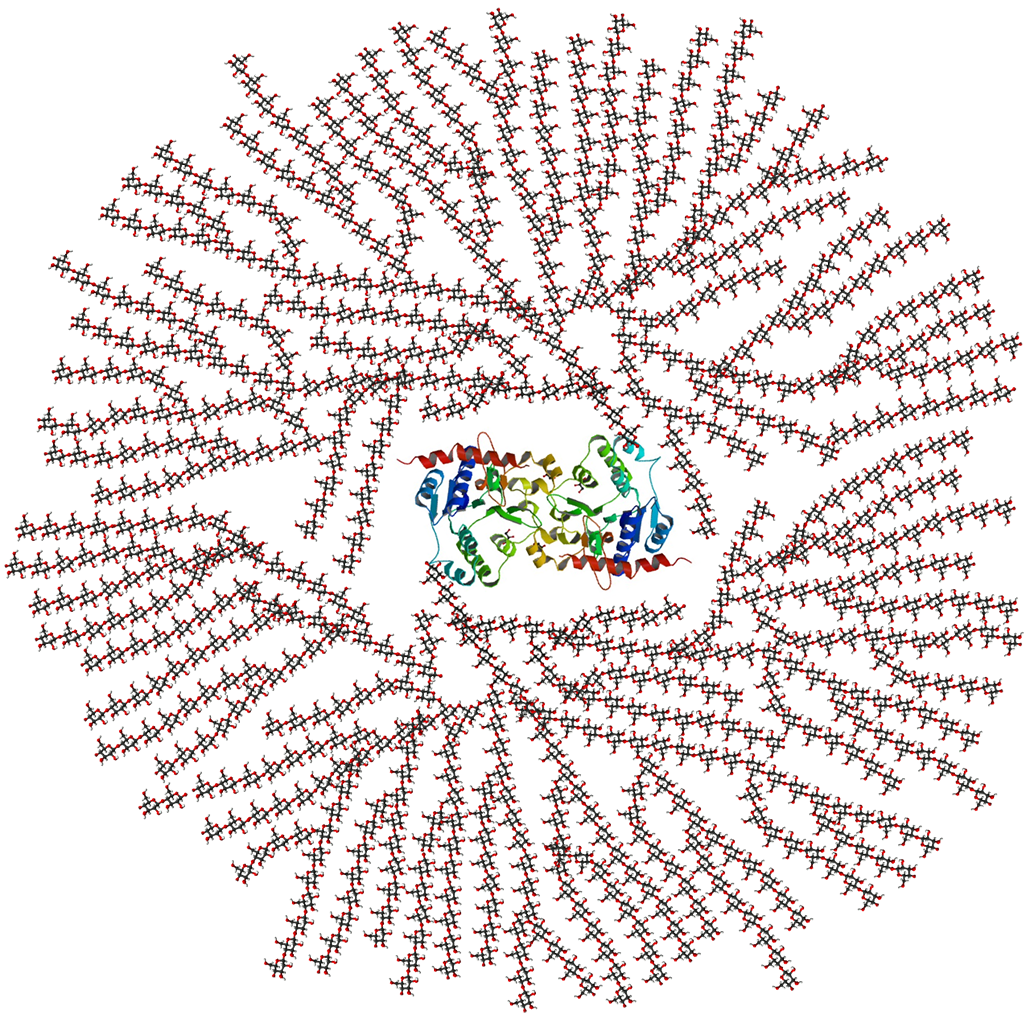
Glycogen

This is a chemical drawing of glycogen. A core protein of glycogenin is surrounded by branches of glucose units surrounding the protein in a large circle.
Mikael Häggström, used with permission/Wikimedia Commons

This is a chemical drawing of glycogen, a carbohydrate molecule that our bodies use to store glucose. The long chains here are made up of glucose molecules waiting to be used.

Although there are many types of polysaccharides, our bodies encounter three most often. One is glycogen. Animals use this molecule to store sugars as energy. “We find that in our muscles and our liver,” Gleeson says. The second, or starch, is “a storage form of energy in plants,” he explains. The third type is fiber, which our bodies can’t turn into energy.

When scientists talk about carbohydrates in food, they call monosaccharides and disaccharides “simple” sugars. These are common in processed foods. Polysaccharides such as starch are “complex” carbohydrates and more commonly turn up in less-processed foods, explains Kimber Stanhope. She’s a nutrition researcher at the University of California, Davis. “Rice and wheat and oats and corn — those foods are mostly starch,” she notes.

Types of carbs

Type of carbohydrateExamplesWhere to find them
Monosaccharides Glucose, fructose, galactose, xylose Glucose tablets or nutrition supplements
DisaccharidesSucrose, lactoseTable sugar, sugar in milk
OligosaccharidesStarches such as amylose and amylopectinStarchy foods like bread or rice
PolysaccharidesPectin, cellulose, hydrocolloids, guar gumWhole fruits and vegetables, beans, jams and jellies, corn starch

From food to fuel

Foods we classify as “carb-rich” often contain a mix of different carbohydrate molecules. For example, a cookie will have plenty of sucrose. But it also has flour, which contains starch. Whole-wheat bread will have starch and some sugar, as well as fiber. Vegetables, such as carrots, are made of cells that contain starch, sugars and fiber. 

Our bodies can use glucose molecules right away. Other carbohydrate molecules must first be broken down.

Complex carbohydrates “are relatively large molecules,” Gleeson explains. The gut can’t directly absorb them. They must be digested — their polysaccharide chains broken apart — to release their glucose units.

That digestion starts in the mouth, Gleeson explains. Saliva contains enzymes — molecules that speed up chemical reactions. “Your spit contains some enzymes, which break down the long-chain carbohydrates into disaccharide units,” he says. Those much simpler sugars head to the stomach. But, he adds, little carbohydrate digestion goes on there. Why? “The enzymes that are coming [in with] the saliva,” he explains, “are inactivated by [stomach] acid.”

After the stomach, “you’ve mixed everything up into a nice sort of soup-like consistency,” called chyme (KYME), Gleeson explains. “That’s sort of squirted, almost, into the small intestine. And there we secrete enzymes into the small intestine from the pancreas.”

Those enzymes finish the job, splitting disaccharides into monosaccharides such as glucose. Our blood then absorbs the glucose and moves it around the body.

When that blood reaches the liver, an enzyme grabs glucose from it. Called glycogen synthase (GLY-koh-jen SIN-thays), this enzyme links up the glucose molecules to form glycogen. Glycogen then gets stored in the liver and muscles. Fat cells also store glucose in the form of triglycerides (Try-GLIH-sur-ides). The body will draw on these sources when it needs more energy.

This liver-enzyme reaction has turned carbs from food into a stored fuel. The liver turns off this enzyme when it determines that it has made enough glycogen.  

Sugar’s not always sweet

The body aims to keep blood glucose levels fairly constant. So when cells draw down this sugar, the liver begins breaking down some stored glycogen, releasing its glucose into the blood.

That’s especially important during exercise, as your muscles burn through glucose to power activity.

It’s a different story for fructose. This monosaccharide pairs up with glucose to make sucrose. But it’s also found on its own in fruits, vegetables and honey. Manufacturers have also sweetened many sugary foods and drinks with this sugar in the form of high-fructose corn syrup.

hands holding drinks on a table, juice, clear soda and a dark cola soda
Sweetened drinks can contain a lot of sucrose, a disaccharide made of equal amounts of glucose and fructose. But many are sweetened with high-fructose corn syrup, which has more fructose than glucose. taka4332/iStock/Getty Images Plus

In the liver, an enzyme called fructokinase (Frook-toh-KY-nase) sets off the first step in turning fructose into glycogen. But unlike the enzyme that processes glucose, fructokinase “doesn’t seem to get turned off — ever,” explains Stanhope at UC Davis.

So if you’re drinking a sugary soft drink, “86 percent of all the fructose you’re consuming in that … drink goes into the liver,” Stanhope says. “The liver does the best it can with all this fructose, but now it’s overloaded.” The liver will now turn any excess into fat, she explains.

Too much fat can hamper how the liver reacts to hormones such as insulin. As a result, the organ stores even more sugars as fat. “You just keep going around in circles and making the situation worse,” Stanhope explains.

That’s why eating too much fructose can be a problem. The issue isn’t fructose from fruits and vegetables, though. Consider a sweet fruit, such as grapes, Stanhope says. “They basically average around 16 percent of their weight as sugar.” But fruits and veggies also contain fiber and other complex carbohydrates, as well as vitamins and other nutrients.

Most of the sugar in our diet doesn’t come from fruit but from sweetened baked goods and drinks. Oreos, for instance, are 38 percent sugar, of which fructose is half.

Many sweets have even higher levels of fructose than that. Some highly processed foods — not only soda but also canned soups and some sauces — can contain a type of corn syrup that is 55 percent fructose (five percent more fructose than in table sugar), Stanhope says.

What really worries her are some corn syrups where the share of fructose is higher still. One 2014 study tested sodas and juices containing high-fructose corn syrup. Many of these drinks contained 60 percent fructose — some even close to 70 percent. That’s a lot for the liver to handle.

a selection of whole foods, fruit, vegetable, beans, whole grains arranged on a table
Fruits, vegetables, beans and whole grains have lots of fiber, which can help control cholesterol and blood glucose — and help you poop. apomares/E+/Getty Images

Too much sugar, not enough fiber

While our bodies can break down starches and sugars for energy, other carbohydrates are tougher. Consider fiber.

Fibers are polysaccharides found in plants. Our bodies cannot fully break these down. Fibers include the cellulose that makes plant cell walls stiff. They include the pectins (PEC-tins) that firm up fruits. You’ll find them in whole fruits, vegetables, beans and whole-grain products (such as whole-wheat bread).

Our bodies can’t convert fiber into energy. But our bodies still find it useful, notes Leslie Cho. A cardiologist, or heart specialist, she works at the Cleveland Clinic in Ohio.

Fiber comes in two types. Soluble fiber, as its name suggests, dissolves in water. This type shows up in foods such as apples, bananas, avocados, citrus fruits, carrots, beans and oats. By acting like a sponge, Cho says, “it helps you lower your cholesterol and glucose.”

Cholesterol (Ko-LES-ter-ol) is a fatty material that drifts in our blood. Over time, it can collect in blood vessels and increase someone’s risk of heart attack or stroke. By soaking up cholesterol, soluble fiber helps eliminate it.

That sponge-like fiber can also trap glucose so that it takes longer for those sugar molecules to enter the blood stream. If you eat a lot of sugar and no fiber, Cho explains, “you absorb glucose very quickly and you tend to get hungry again.” Soluble fiber keeps you feeling fuller longer. And it’s especially helpful for people with high blood sugar, such as those with type 2 diabetes.

The other fiber — the insoluble type — “doesn’t dissolve in water, and it helps you with your stomach and your intestine,” Cho says. Vegetables, whole-wheat bread, potatoes, beans, nuts and seeds all contain this type.

This fiber even helps you poop; it’s one of the ways your body takes out the trash. How? Insoluble fiber adds bulk and pulls water into your stool. That keeps you pooping just often enough for comfort.

Soluble and insoluble fibers also serve as an important food for the bacteria in your microbiome. Those are the bacteria that live in your gut, Gleeson explains. “They have a big influence on your immune system and on your health.”

Bacteria can break some fiber down into molecules that affect our immune and other systems. These bacteria “also produce chemicals that can communicate with the brain,” Gleeson says. In this way, “They influence your mood and your sleep.”

Most people eat too little fiber, Gleeson says. Diets with lots of simple sugars don’t have enough fiber to keep our microbes happy. We’re talking about meals that contain lots of white bread or rice, cookies and cakes — and too few fruits, vegetables, beans or whole grains.

Do you have a science question? We can help!

Submit your question here, and we might answer it an upcoming issue of Science News Explores

Carbohydrate controversy

Like proteins and fats, carbohydrates are an important macronutrient. But do people need them?

The body needs certain fatty acids and amino acids to build cells and operate effectively. That’s why we need to eat fats; they provide some essential fatty acids that our bodies can’t make, notes Gleeson. And, he adds, “Protein is absolutely essential, because there are [also] amino acids in those proteins” that we can’t make on our own.

But technically speaking, he says, you can live without eating carbohydrates.

Glucose is an essential fuel for the brain, Gleeson explains. Fortunately, the body can make it from fats, amino acids and water. Getting glucose this way wouldn’t be a very tasty life, though. And people who live on extremely low-carb diets can miss out on fiber, vitamins and other nutrients.

But for some carbs, reducing how much of them you eat isn’t a bad idea. We don’t need nearly as much sugar — especially soft drinks, candy or cake — as we eat, observes Stanhope at UC Davis.

“There is simply no doubt,” she says: “Evidence shows sugar is detrimental to our health when consumed at high levels.” The problem: “We just don’t know for sure how high ‘high’ is.”

Because of worries about too much sugar, some people try diets with as few carbohydrates in them as they can manage — eating mostly meat and a few veggies. But such low-carb diets won’t necessarily result in a healthy body, Gleeson points out.

Living the low-carb life tends to be high in fats and protein. Long term, all that fat and protein can put people at risk for heart disease, type 2 diabetes and problems with their kidneys (the organs that produce urine). People on low-carb diets who don’t eat enough fiber also don’t poop enough, suffering constipation. 

a woman crouchs on the start line on a track, ready to run
Carbohydrates are important forms of energy, especially if you’re about to do a high-intensity workout, like sprinting. Tony Anderson/Stone/Getty Images

And if you’re an athlete, your body definitely needs carbs. Athletes perform their best with carbs, Gleeson has shown in his research. Complex and simple carbohydrates are the easy energy our bodies use to work hard.

“As soon as you start doing hard running, sprinting as fast as you can, performing any all-out efforts, then you’re going to be using carbohydrate,” he says.

“There is no food group that’s bad,” Cho adds. “You can’t eliminate one whole thing and think you’re doing a good job.” Although high doses of simple sugars can cause problems, other carbohydrates don’t. “We often [confuse] ‘good’ carbohydrates with ‘bad’ carbohydrates,” she notes. And unfortunately, that can give important nutrients a bad rap.

The trick is eating enough carbs — and a diverse mix of them — to give us energy and a great-tasting diet. Just don’t overdo it.

“Moderation is important, even though these things taste good,” Cho says. And much as cookies, soda and candy are delicious, they don’t contain fiber or other nutrients. “Instead of having five chocolate bars, maybe you can just have one.”

Editor’s note: The enzyme used to transform glucose to glycogen was originally misreported as phosphofructokinase. This was corrected to glycogen synthase on September 9. In addition, fat stores glucose not as glycogen, but as triglycerides.

Analyze This: Spooky feelings may come from noises too low to hear

2 September 2026 at 11:30

On haunted history tours, people often visit eerie theaters and spooky mansions. Such old buildings are often settings for spine-tingling stories. They may also hum with noise too low to hear, from old plumbing or air ducts. That unheard sound, called infrasound, might be one reason these places give people the creeps. A new study hints that even though people can’t hear infrasound, it may influence their mood.

Infrasound is noise with frequencies below 20 hertz — around the lower limit of what humans can hear, says Kale Scatterty. A behavioral neuroscientist, he works at the University of Alberta in Edmonton, Canada. Some natural sources, such as the rumblings of volcanoes and earthquakes, produce infrasound. Traffic, trains, air conditioning systems and other tech also make this low-pitched noise.

Humans and many animals can’t hear infrasound. But past studies have suggested that animals may detect it with their bodies — and that it might even provoke anxiety or fear. Scatterty’s team wondered if people could detect infrasound. Our ears contain otolith organs that help us perceive our movement and position. These organs might pick up on vibrations too low to hear.

Scatterty and his colleagues had 36 people listen to music. Half of them were exposed to infrasound while they listened. The others were not. The scientists then compared the two groups’ responses to the music.

People exposed to infrasound rated music as sadder than those who heard it without infrasound. This was true whether the music itself was calm or unsettling. The infrasound group also said the music was less interesting and reported being more irritable. Cortisol, a stress hormone, was higher in people’s saliva after they experienced infrasound. But people couldn’t seem to tell whether they were in the infrasound group.

The results suggest that infrasound does influence humans’ mood and biology. It seems to happen without people being conscious of it, Scatterty says. The team shared its findings April 27 in Frontiers in Behavioral Neuroscience.

Do you have a science question? We can help!

Submit your question here, and we might answer it an upcoming issue of Science News Explores

Infrasound might especially affect people and animals near urban environments, Scatterty says. Those places have transit, air conditioning systems and other infrastructure that creates such low-frequency noises. But it’s not clear what the long-term impacts of infrasound exposure might be.

Another open question is whether infrasound provokes fear, he says. In this study, the participants — college students — didn’t report feeling scared or anxious when exposed to infrasound. And the emotional changes the team did measure could have been responses to the study setup. “It could have very well just been that we were priming them to feel something,” Scatterty says. And the students might have felt irritable because they had other places to be.

But a spookier environment might help deepen the investigation. Scatterty and his colleagues have thought about studying infrasound in a haunted house set up for Halloween. “Maybe when you’re in a haunted house, yes, you would react more fearfully because you’re primed to be afraid of something.”

data graphs show ratings of irritability or music sadness when infrasound was on, plus cortisol levels
Scatterty et al/Frontiers in Behavioral Neuroscience 2026

Researchers outfitted two rooms with speakers to play music. Outside of those rooms were two subwoofers — speakers that produce low sounds. In this study, they played infrasound.

The 36 study participants heard either a soothing song that might play at a spa or an eerie tune that would fit in a horror film. Half of the participants heard the music while infrasound played. The team then asked people how the music sounded and how it made them feel.

The researchers compared the answers of those who listened to music with the infrasound off and on (Figures A and B). They also sampled the study participants’ spit to study whether cortisol concentration — a marker of stress — was higher after infrasound exposure (Figure C shows individual measurements as dots and the averages as bars). After answering these questions, participants said whether they thought they had been exposed to infrasound (Figure D).

Data Dive:

  1. Look at Figure A. What was the average rating of the calming song as sad when infrasound was off? What about when infrasound was on?
  2. Look at Figure B. How irritated were people when infrasound was off versus when it was on?
  3. Look at Figure C. What was the average cortisol concentration in spit before people were exposed to infrasound? What was it after?
  4. Look at Figure D. What percent of participants correctly guessed whether they’d been exposed to infrasound? What percent were incorrect? How does this compare with what you’d expect if each person guessed by flipping a coin?
  5. Cortisol is a marker of stress. What is another event that might be linked to an increase in cortisol levels?

Ancient Egyptian princesses may have been skilled warriors

1 September 2026 at 11:30

It seems some Egyptian royal women really were warrior princesses.

Researchers examined five almost 4,000-year-old mummified princesses. Their results suggest these women were skilled users of the daggers, bows and other weapons buried with them. The findings appear in the July 16 Frontiers in Environmental Archaeology. 

“These princesses were active practitioners of hunting or athletic skills rather than merely symbolic owners of the weapons found in their tombs,” says Zeinab Hashesh. She’s a bioarchaeologist at Egypt’s Beni Suef University.

Some Egyptologists have dismissed the weapons found in females’ graves as “token” objects for the afterlife. However, the female mummies’ features showed they had performed intensive martial activities, Hashesh says.

The study examined six mummies that had been excavated in 1894 and 1895 from the Dahshur funerary complex. It’s about 40 kilometers (25 miles) south of Cairo. The mummies’ tombs had been carefully cataloged. Finds included impact weapons such as flails — jointed clubs — and maces.

The mummies themselves had been removed and stored at an Egyptian museum. They were thought lost until rediscovered in 2020.

Hashesh and her coworkers measured the mummies’ bones to figure out their sex and their age at death. The scientists also used X-rays and other techniques to search the remains for signs of illness and trauma.

This work confirmed handwritten notes from 19th century excavators at Dahshur. The one male mummy was an obscure, 13th Dynasty pharaoh. Three other mummies were probably Ita, Khenmet and Itaweret. They were daughters of the 12th Dynasty pharaoh Amenemhat II. He ruled between about 1929 and 1895 B.C. One mummy had no notes. But the researchers tentatively identified it as Sathathormeryt. She was a fourth sister to the three princesses. The last mummy was also a princess. But she was not a sister to the four other women.

All six mummies shared a rare cluster of inherited spinal defects. This showed they were related. The team hopes to one day carry out DNA studies on them.

The researchers also saw clear evidence of “robust” skeletal developments and muscle attachments. (That’s where connective tissue once joined muscle and bone.) For instance, there were enlarged areas of the forearm bones in one mummy, Itaweret. This showed that she had often drawn bows.

Some of the women had healed from traumatic injuries. Those may have happened while the princesses were training, hunting or in battle. “These princesses were not leading sedentary lives of luxury,” Hashesh says. “They were well-conditioned athletes. [Their] bodies were hardened by the same skilled force and disciplined movement as the men of their time.”

Nicholas Brown is an Egyptologist at the University of Iowa in Iowa City. He did not take part in this study. Egyptian princesses used bows in a royal ritual during the Sed festival of renewal, Brown says. During that time, they would shoot arrows in the four cardinal directions: north, east, south and west.

Evidence of their weapon use is indirect, he notes. “The bones aren’t preserving the behavior directly. But the muscle attachments are clearly indicating some kind of habitual, repeated activity.”

Experiment: Make your own marshmallows!

1 September 2026 at 11:30

Objective: Determine the ratio of sugar to corn syrup that produces the best-tasting and best-textured marshmallow.

Areas of Science: Food Science

Difficulty: Intermediate medium

Time required: Short (2-5 days)

Prerequisites: None

Material availability: Readily available

Cost: Very Low (under $20)

Safety: Be careful when heating syrup in the saucepan. Adult supervision is required.

Credits: Kristin Strong, Science Buddies; Teisha Rowland, PhD, Science Buddies

What is your favorite way to eat a marshmallow? Melted in hot chocolate after a long day of sledding? Or roasted and squished between a slab of chocolate and graham crackers while you are sitting around a campfire? However you like them, marshmallows are an unusual type of sweet treat — spongy, sticky and a little bit chewy, with a melting point that is just a bit above body temperature, so that they start to change from a solid to more liquid state as soon as they reach the warmth of your mouth, or the warmth of your hot chocolate or campfire!

They are also an ancient creation, originally coming from a tall marshmallow plant (Althaea officinalis) that grows in swampy fields and has a soft, spongy root. The root contains mucilage, a thick, gluey substance produced by some plants and microscopic animals to help with seed germination and water and food storage. Some cultures used the marshmallow plant to make candy, while others used it to make medicine. The ancient Egyptians, for example, dried the root and mixed it with honey to make marshmallow treats, but the early French thought the root looked like lung tissue, and experimented with making medicine out of its gummy juice to soothe sore throats.

Today’s modern marshmallows contain no parts of the marshmallow plant though, because the plant is considered a medicinal herb. Instead, modern marshmallows are primarily a mix of three ingredients: sugar, corn syrup and gelatin, with the gelatin replacing the thick, gluey substance from the marshmallow plant.

The sugar and corn syrup are heated together with a little water to make a solution. The solution is warmed and brought to a boil, turning it into syrup. The sugar in the solution makes the boiling point of the solution higher than the boiling point of pure liquid water, which is 100° Celsius (212° Fahrenheit). The greater the concentration of sugar in a solution, the higher its boiling point. As the solution boils, water evaporates, the solution becomes even more concentrated with sugar and the boiling point gets pushed even higher. For example, an 85 percent sugar solution has a boiling point about 16 degrees C (28 degrees F) higher than the boiling point of pure water.

The final concentration of sugar in the syrup determines the structure of the candy that forms when the syrup cools. Think about the difference between the texture of caramels and lollipops — the caramel is softer and chewier, while the lollipop is hard and cracks when it is bitten. The syrup used to make caramels is cooked until it reaches 115–120 °C (240–250 °F), at which point it has an 87 percent concentration of sugar in solution and enters the firm ball stage (see the Exploratorium link in the Bibliography for more information about this). The syrup used to make lollipops, though, is cooked until it reaches a 99 percent concentration of sugar in solution at a temperature of 150–155 °C (300–310 °F), which makes drops of the syrup turn into hard, brittle, easy-to-break threads when placed in cold water.

When making marshmallows, the syrup is cooked until it reaches 112–115 °C (235–240 °F) or 85 percent concentration of sugar in solution, and corn syrup is added to the solution to help prevent crystals from forming in the cooled syrup. Nobody likes crunchy marshmallows!

Do you have a science question? We can help!

Submit your question here, and we might answer it an upcoming issue of Science News Explores

So, where does the gelatin come in, and just what is gelatin anyway? Gelatin is that wiggly, jiggly food that seems almost magical as it suspends fruits, forms shapes and sculptures and transforms from a solid to a liquid as soon as it hits the warmth of your mouth. It is not magic, but special gelatin molecules are responsible for these food tricks.

Gelatin comes from collagen, the main protein in connective tissue, which is a specialized, fibrous tissue in animals that connects other tissues together, like tendons connect muscles to bone. The special quality of gelatin is that it is a protein that can coagulate (or come together) when it is beaten or whipped. So, to make marshmallows, hot concentrated syrup is beaten into gelatin with a mixer. The beating process forms bubbles in the syrup and protein mixture, and the gelatin coagulates at the point where the air in the bubble and the syrup-protein mixture meet, stabilizing the bubble walls so they don’t collapse.

In this cooking and food science fair project, you will make your own gooey marshmallows, using different amounts of sugar and corn syrup to find out which ratio of sugar to corn syrup makes the best-tasting and best-textured treat.

Experimental procedure

Preparing to cook

  1. Wash your hands.
  2. Get out all cooking tools and ingredients and set them out so they are ready to go and easy to access.
  3. Identify the 116 °C mark (240 °F) on your candy thermometer. This is the traditional temperature used to make marshmallows.

Preparing your cake pans

  1. Label the bottoms of three cake pans with masking tape pieces, numbered 1 to 3. Pan 1 will contain recipe 1, pan 2 will contain recipe 2, and pan 3 will contain recipe 3. Each recipe contains a different ratio of sugar to corn syrup.
  2. Pour a small amount of vegetable oil on a paper towel and lightly oil the three cake pans.
  3. Pour a small amount of powdered (confectioner’s) sugar in the strainer and dust the inside of the cake pans.
    1. If you get too much powdered sugar in the pan, hold the pan upside-down over a sink, and gently tap out the excess.

Preparing your gelatin

  1. Pour 40 mL (1/6 cup) of cold water into the large mixing bowl.
    1. To get 1/6 cup, fill the 1/3 measuring cup halfway with water.
  2. Sprinkle one 1/4-ounce (oz) envelope of plain, unflavored gelatin over the cold water.
  3. Mix the gelatin and water together for about 5 seconds (sec) with a fork and set the bowl aside. This will give the gelatin time to “soften” or “bloom,” as shown in Figure 1 below.
Figure 1. This photo shows the gelatin “blooming” in a small amount of water.S. Zielinski

Preparing your syrup

  1. Add 60 mL (1/4 cup) of cold water to the saucepan.
  2. Using Table 1 below as a guide, add granulated sugar and corn syrup to the water in the saucepan, according to which recipe you are currently making. This step is shown in Figure 2 below.
IngredientsRecipe 1Recipe 2Recipe 3
Sugar120 mL (1/2 cup)160 mL (2/3 cup)180 mL (3/4 cup)
Corn syrup80 mL (1/3 cup)60 mL (1/4 cup)40 mL (1/6 cup)
Ratio of sugar to corn syrup3:2 (1/2:1/3)8:3 (2/3:1/4)9:2 (3/4:1/6)
Ratio, written as a decimal1.52.74.5
Table 1. To the saucepan, add the amount of sugar and corn syrup shown in this table based on the recipe you are currently making.
Figure 2. This photo shows the small saucepan containing water, sugar and corn syrup, ready to be warmed on the stove to form a syrup.S. Zielinski
  1. Put the lid on the saucepan. An adult should closely supervise all work from this point on.
  2. Turn on the stove to medium-high heat.
  3. Lift the lid and check the solution in the saucepan about every 30 sec until it just comes to a boil.
  4. Remove the lid and set it aside.
  5. Begin to measure the temperature of the syrup in the saucepan using the candy thermometer.
    1. When using the thermometer, do not let the tip of the thermometer touch the bottom or sides of the pan. Instead, try to put the tip below the surface, closer to the middle of the pan.
  6. Continue heating your syrup solution until the temperature reaches 116 °C (240 °F).
    1. WARNING: The syrup will be very hot, so use extreme caution when working around the pan.
    2. Observe how the temperature rises. Does it go up quickly at first? What happens as the solution becomes more concentrated? Record your observations in your lab notebook.
  7. When the temperature reaches 116 °C (240 °F), immediately turn off the stove and move to the next section, Making Your Marshmallows.

Making your marshmallows

  1. Turn the mixer on low and carefully pour the hot syrup solution into the gelatin and water in the large mixing bowl, as shown in Figure 3 below.
    1. Note: Some syrup solution will likely solidify on the saucepan as the syrup cools. However, if you pour too slowly, or wait too long and do not immediately pour the syrup into the bowl after turning off the stove, you may end up with a lot of syrup solidified on the saucepan, which may affect your results.
Figure 3. This gif shows the hot syrup slowly being poured into the gelatin while the mixer is operating on low.M. Temming
  1. Set the timer for 11 minutes and start it.
  2. Gradually increase the speed of the mixer until it is operating at full (high) speed, as shown in Figure 4 below.
Figure 4. This gif shows how the mixture will look as you begin to operate the mixer at high speed.M. Temming
  1. Continue to beat for approximately 11 minutes, or until the mixture starts to become very thick, glossy and lukewarm.
  2. Add 2.5 mL (1/2 teaspoon) of vanilla, as shown in Figure 5 below, and beat for another minute.
    1. Write down the total time that you beat the recipe in your lab notebook.
    2. Try to beat each recipe for approximately the same amount of time.
Figure 5. This photo gives an example of how the mixture will look at the end of 11 minutes after you have added the vanilla, and before you beat for the final minute.S. Zielinski
  1. Pour a thin layer of vegetable oil on a spatula and scoop out the marshmallow mixture from the mixing bowl and into the prepared cake pan with the masking tape piece that matches the recipe number.
  2. Use the spatula to gently smooth down the top of the marshmallow, so that it is pretty flat.
    1. If the top of the marshmallow mixture naturally smooths itself down when you put it in the pan, or if the mixture is so sticky that it is very difficult to smooth it down with the oiled spatula, skip this step.
  3. Wash and dry all cooking utensils.
  4. Repeat the sections Preparing Your Gelatin, Preparing Your Syrup and Making Your Marshmallows two more times with clean materials, until all three recipes have been prepared, as shown in Figure 6 below.
    1. To have the best control over all the variables you should make all three recipes on the same day. Otherwise, uncontrollable variables (like the humidity on that day) may affect your results.
  5. Repeat the entire Experimental Procedure (up to this point) two more times so that you have a total of three trials (pans) for each recipe. Repeating the recipes makes sure that your test results are accurate and repeatable.
    1. You can do this step on a different day if you would like.
Figure 6. This photo shows the three finished recipes cooling and becoming firmer.S. Zielinski
  1. Allow the three marshmallow “pies” to sit out, uncovered, on a counter for at least 4 hours, or up to overnight, so that they become firm.

Preparing your marshmallows for testing

  1. Once the marshmallow pies have become firm, after at least 4 hours or overnight, turn the pans over, one at a time, onto a cutting board.
    1. If the marshmallow sticks to the bottom of the pan, push on the bottom of the pan a bit, or use a spatula to help lift it out.
  2. Roll a pizza cutter in some powdered sugar, and then use it to cut up your marshmallow into pieces that are about 3 centimeters (cm) by 3 cm (one inch by one inch). Use a ruler to help measure where to cut.
    1. An alternative to the pizza wheel is to use a small cookie cutter to cut out shapes.
  3. Dust the marshmallows on all sides with a little powdered sugar, using the strainer.
  4. Place the marshmallows in the air-tight container or plastic bag, being sure to label the container or bag with the recipe number and the trial number (remember, you will be performing three trials) from the masking tape pieces, so you know which recipe was used for each bag or container. The marshmallows will keep in an airtight container for up to a week, so you have around six days in which to make and test all the trials.

Testing your marshmallows

Perform the following three tests to investigate the melting temperature, the toughness and the taste of the marshmallows you made from each recipe. Perform each test one trial set at a time.

  1. Melting tests: Drop three marshmallow pieces (one from each recipe) in a pan of hot water and see which piece melts first.
    1. Because of slight variations in marshmallow sizes, pick three pieces that are of the same size and shape.
    2. Start a timer and see which one melts first, second and last. Record your results in a data table in your lab notebook.
    3. Repeat the test at least three times per trial set to make sure your results are repeatable and accurate.
  2. Cutting tests: See which marshmallow is the toughest using a cheese cutter, like the test described in the Science Buddies cooking and food science fair Project Idea Tough Beans (in the Procedure section titled “Testing Your Cooked Beans”). Alternatively, you can try an easier but less quantitative method using a small disposable cup, like a Dixie cup.
    1. If you use the disposable cup method, do the following:
      1. Put a marshmallow piece from one of the recipes on a cutting board.
      2. Arrange a small cookie cutter so that it can sit on top of the marshmallow. (You will need the cookie cutter to be thinner than the marshmallow pieces to do this.)
      3. On top of the cookie cutter, balance the small disposable cup.
      4. Put 20 pennies in the cup, one at a time.
      5. Remove the cup and cookie cutter from the marshmallow piece and inspect the marshmallow. Did the cookie cutter leave a noticeable impression? Use a camera to take a picture of the marshmallow piece.
      6. Repeat this process with marshmallow pieces from the other recipes. Eventually you will want to have repeated the test at least three times per trial set. Record your results in a data table in your lab notebook.
  3. Taste tests: Gather your family and friends and give them three samples of marshmallows, one from each recipe in a trial set. Have them evaluate the samples for taste and texture.
    1. Which recipe do they think made the best-tasting samples? Which recipe do they think made the best-textured samples? Record your results in a data table in your lab notebook.
    2. Read this Science Buddies article about sample size to determine how many volunteers you will need.

Analyzing your results

  1. For melting tests, average the results of your time tests from the three trials, and plot the decimal ratio of sugar to corn syrup on the x-axis, and the melting time on the y-axis.
    1. Do you see a correlation between the melting time and the ratio of sugar to corn syrup used? If so, why do you think this is? Hint: Re-read the introduction.
  2. For cutting tests, if you used the protocol from the science project Tough Beans, average your coin counts from the three trials (to get a measure of the force required to cut through the marshmallow), and plot the decimal ratio of sugar to corn syrup on the x-axis, and coin counts (or cutting force) on the y-axis.
    1. If you used the small disposable cup method, print out the pictures you took and put them on your science project display board.
    2. Do you see a correlation between how tough the marshmallow pieces were and the ratio of sugar to corn syrup used? If so, why do you think this is?
  3. For taste tests, make a bar chart showing the ratio of sugar to corn syrup on the x-axis, and the number of people who thought it had the best taste on the y-axis. Make a second bar chart showing the decimal ratio of sugar to corn syrup on the x-axis, and the number of people who thought it had the best texture on the y-axis.
    1. Why do you think some people preferred marshmallows made using one recipe compared to marshmallows made using another recipe? Were some pieces too sweet or too hard for your taste testers, or not sweet enough or too soft?

Variations

  • Develop other ways to test your marshmallows. For example, measure the density of the marshmallows from each recipe, using a scale, graduated cylinder and Archimedes’ principle. Plot the ratio of the sugar to corn syrup on the x-axis and the density on the y-axis.
  • Choose the recipe that has a decimal ratio of 2.7 for the sugar to corn syrup. Vary the final cooking temperature (deviate from the traditional 116 °C [240 °F]) to see how that affects the taste, texture, melting time, toughness and/or density. Be sure to conduct repeat trials at each temperature you test.
  • Break up your taste-testing volunteers into male and female, or by age, to see if there are gender or age differences in marshmallow taste or texture preferences.

This activity is brought to you in partnership with Science Buddies. Find the original activity on the Science Buddies website.

A banner that reads "SCIENCE BUDDIES"

Some sea stars channel light like fiber-optic cables

31 August 2026 at 11:30

Chocolate-chip sea stars are famous for the rows of dark, pointy bumps that cover each of their arms. The animals really look like they’re dotted with chocolate chips. But what’s inside their arms is even more surprising, a new study finds.

Researchers have discovered tiny structures deep inside the skeleton at the tip of each arm. These channels work like mini fiber-optic cables. That’s the tech that carries internet signals around the world. In a sea star, these bony structures collect and channel light deep into the animal’s body. They might help a sea star find its way around — if enough light can get through its skin.

The overall effect “looks like short fiber-optic cables made out of their skeleton,” says Sönke Johnsen. “I was really impressed by what they found.” A biophysicist, he studies how animals sense light. He works at Duke University in Durham, N.C. and did not take part in this study.

The chocolate-chip sea star (Protoreaster nodosus) lives in shallow tropical waters. Its five arms grow out from a central disk. A network of small, interlocking plates make up its skeleton. Each plate is made of a chalky mineral called calcite. At the tip of each arm sits a heart-shaped piece called a terminal plate.

Ling Li wasn’t looking for light-guiding structures when he started studying these animals. He’s a materials scientist at the University of Pennsylvania in Philadelphia. His team wanted to know how sea stars build such strong calcite skeletons. It’s a weak and brittle mineral of calcium carbonate, the same stuff used in some classroom chalk.

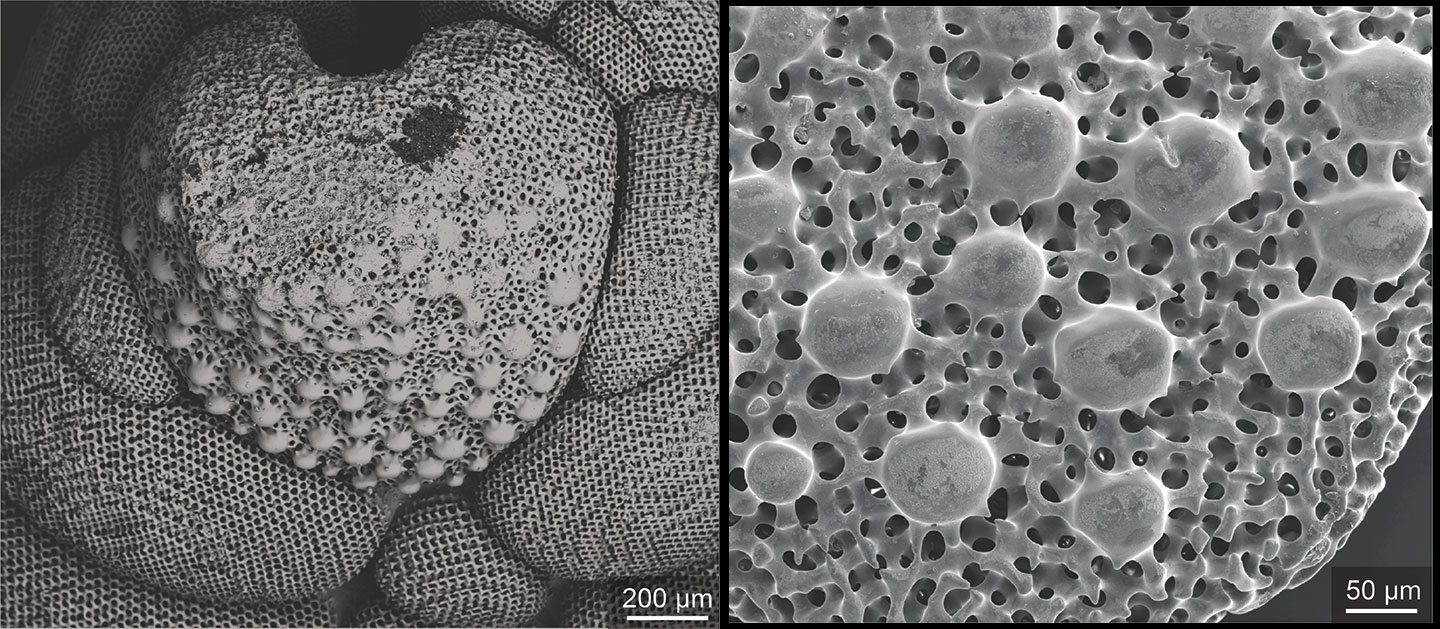
His team scanned sea stars’ terminal plates with an X-ray machine. This revealed a surprise. Each plate held 90 to 100 cone-shaped structures. Each extends deep into the skeleton. All the cones aim toward a hollow space inside the plate.

“It seems like something purposely made,” Li says. “Very prominent, very consistent.”

Light collectors

Left: An electron microscope image shows a heart-shaped piece of the skeleton at the tip of a sea star’s arm. Rounded bumps cluster across the surface of this terminal plate.

two electron microscope images of a sea star's arm
Liuni Chen and L. Li

Right: An extreme close-up of the terminal plate shows the rounded tops of the light-channeling cones. Each dome is a point where light enters a cone.

Tiny cables of bone

Each cone is built from a single crystal of calcium carbonate. This mineral bends light more than the surrounding seawater does. Scientists describe it as having a higher refractive index. That means that light hitting the wide part of a cone refracts — bends — inward.

Its angle and the high refractive index make the light bounce back — or reflect — off the cone’s inner walls. This is called total internal reflection. Light bounces within the crystal until it exits out the narrow end of a cone.

“It’s the same physical phenomenon as fiber optics,” says Pupa Gilbert at the University of Wisconsin–Madison. She was not involved in the work. She does, however, study biomineralization (By-oh-min-er-al-ih-ZAY-shun). It’s how living things build structures out of minerals.

A 3-D model showing cone structures inside the heart-shaped bony plate at the tip of a sea star's arm.
This 3-D reconstruction shows the heart-shaped bony plate at the tip of a sea star’s arm. Each colored shape is one of the roughly 90 to 100 cone-shaped structures scientists found hidden inside. Liuni Chen and L. Li

Each cone transmits about 70 percent of the light that enters it. As light reaches the narrow part of a cone, it’s “concentrated and intensified,” Gilbert says.

All cones in a terminal plate work together, gathering light from one-third of the field of view around it. As cones funnel that light in toward a cavity below, they amplify its intensity as much as eight times.

Li’s team tested the cones in the lab to confirm they channel light. When they shined light at a terminal plate, a bright spot appeared in the cavity below. Other bits of the sea-star skeleton had no such effect. Light shined on them simply scattered. Only the terminal plate’s cones focused light this way.

Li and his team shared these findings on June 8. Their work appears in Proceedings of the National Academy of Sciences.

a chocolate-chip sea star on a sandy ocean bottom
Like other sea stars, the chocolate-chip species can move toward light. Tiny, light-channeling structures in the tips of its five arms might explain how it navigates. Placebo365/E+/Getty Images Plus

Why does the sea star do this?

Sea stars move toward light. It’s a process known as phototaxis (Foh-toh-TAK-sis). Li’s team thinks the cone arrays might explain how they do this. A sea star could compare how much light is reaching the light-collecting plates at the tips of each arm.

“They can compare the illumination level in different directions,” Li says. “So they can detect which side is darker, which side is brighter.” The brightest light would point them to the light’s source.

His team doesn’t know for sure that the animals use the cones this way. For one thing, no one has yet found light-sensitive cells beneath the cones. These would make the light signal useful to the animal. Right now, Gilbert says, “The light detector is the part that’s missing.”

“The optical stuff is interesting,” says Samuel Powell. “But,” he adds, “it doesn’t seem biologically relevant, as far as I can tell.” Powell has spent years studying vision in marine animals. He used to work at the University of Queensland in Brisbane, Australia.

A simple experiment, he says, could help show whether sea stars use their cones to detect light. “Just shine light at the animal. Does it respond?” If it does, that would suggest those cones indeed are helping the animal sense light.

Li’s team plans something like that. In a future study, they aim to cover four of the sea star’s five arms to see if one is enough to use in navigating toward light.

A bonus: tougher armor

Even if the light-sensing idea doesn’t pan out, the cones have one confirmed benefit: strength. Computer models show that these structures about triple the stiffness of the terminal plates compared to other parts of the skeleton.

“A three-times improvement in strength without adding that much material is pretty neat,” says Powell.

Where this bonus strength shows up may be strategic, Johnsen says. “This structure is in the very tip of the arm, which looks quite pointy and thorny,” he notes. The tips are the animal’s most exposed parts. They are the first things to scrape against rocks or catch a predator’s attention. “Having the tips of your spines be extra strong seems like it makes a lot of sense,” Johnsen says.

When engineers design a material, they may build it to be strong, or to transmit light. Rarely would they try for both at once, notes Gilbert. But the sea star may show a way to do just that.      

What excites her most is that the cones may do both jobs — channel light and reinforce the skeleton — with a single structure, made of a single material. “You don’t have to make those hard choices,” says Gilbert. “You can find the best compromise and have the same structure perform different functions.” Engineers could use this idea to build lightweight materials that carry loads and deliver light at the same time.

Do you have a science question? We can help!

Submit your question here, and we might answer it an upcoming issue of Science News Explores

Scientists Say: Symmetry

31 August 2026 at 11:30

Symmetry (noun, “SIM-meh-tree”)

A shape with symmetry has parts that match each other in some way.

Imagine cutting a heart from a piece of paper. To ensure the two halves match perfectly, you might fold your paper in half. Then, you can cut both sides of the heart at once. When you unfold the paper, the two sides are identical. The heart is symmetrical.

The line down the center of the heart, left over from folding your paper, is called the line of symmetry. Folding a shape along a line of symmetry matches up the parts. This kind of symmetry, across one line down the middle, is called mirror symmetry. That’s because the two sides of the heart are shaped like mirror reflections of one another.

But symmetry can come in different forms. Rotational symmetry is another example. This describes a shape that you can spin into a new position that looks identical to the first one. A propeller often displays this kind of symmetry.

Symmetry appears in nature. The elegantly branching crystal shards of a snowflake often have rotational symmetry. Leaves of a tree may display mirror symmetry. The body shape of a cat or dog or person also shows this kind of symmetry. When referring to living things, biologists often use the word bilateral symmetry. It means the same thing as mirror symmetry.

Radial symmetry is another example of symmetry in body shapes. This describes a body shape where you can draw several different lines of symmetry that cross the center. Jellyfish and starfish are examples of creatures with radial symmetry.

Not all living things are symmetrical. A marine sponge usually lacks matching parts. So, this type of body plan is described as asymmetrical.

In a sentence

Floral designs on ancient pottery suggest people understood symmetry 8,000 years ago.

Check out the full list of Scientists Say.

This cosmic oddity blurs the line between planet and moon

28 August 2026 at 11:30

A newly discovered cosmic object is unlike any seen before. It’s not a planet. It’s not a moon, either. It’s a third thing we don’t have a name for yet.

The newfound object is about as massive as Jupiter and orbits a brown dwarf. That’s an object much bigger than a planet, but too small to burn hydrogen and shine as a true star. The brown dwarf, in turn, loops around a star called CD-35 2722.

This star system is the first known to host an “exosatellite,” researchers say. They shared the discovery July 22 in Nature.

The team coined the term “exosatellite” for the new object because no existing word is quite right. It’s not exactly an “exoplanet,” a planet around another star. Nor is it an “exomoon,” a moon around an exoplanet.

The newfound “moonish thingy” appears in center about halfway through this animation. Its star (CD-35 2722) — that glowing dot to the left — has about half our sun’s mass. A brown dwarf (big foreground object) orbits the star. Orbiting the brown dwarf is the newly discovered object that challenges naming.

An object orbiting a brown dwarf orbiting a star “is so different from the structure of the solar system that all the words we invented to describe the solar system just aren’t really working,” says Kevin Hoy. He’s an astronomer at the University Diego Portales in Santiago, Chile.

He and others used the Very Large Telescope in Chile to observe the brown dwarf between 2023 and 2026. They saw periodic shifts in wavelengths of light emitted by the brown dwarf. This revealed that the gravity of a massive object must be tugging it to and fro.

Astronomers have used the same technique to find planets around other stars. But this is the first time the method has turned up what Hoy calls a “moonish thingy.” That is, something orbiting a bigger something that’s orbiting a still bigger something.

Does that nested setup make the new object a moon? Hoy doubts it. “It feels so off,” he says. “We’re probably not going to get away with calling it an exomoon.”

Technically a planet?

The new finding restarts an old debate about what counts as a planet.

Scientists came up with the current definition of an exoplanet in 2018. The International Astronomical Union, or IAU, devised it. (The same group decided that Pluto is not a planet, but rather a dwarf planet, in 2006.)

That definition lists a couple criteria for an exoplanet. It must be at most 13 times the mass of Jupiter. And it must orbit a star, a brown dwarf or the dense orb left behind after a massive star explodes.

Under those terms, a Jupiter-sized object orbiting a brown dwarf is a planet. It doesn’t matter that the brown dwarf then orbits a star.

“That kind of forces the companion to be a planet,” says David Kipping. This astronomer at Columbia University in New York City did not take part in the study. But he’s been searching for exomoons for more than a decade.

“We can argue about if the IAU definition is wrong or right,” Kipping says. “But by the current IAU definition, [the new object is] a planet.”

That doesn’t sit right with Hoy. “It doesn’t feel the same as what normal planets are doing,” he says. And this system isn’t the only oddball. In January, another research team shared hints of a similar satellite around a brown dwarf in a different star system.

Breaking the solar system mold

In our solar system, there’s a clear hierarchy of objects based on how they move. Moons orbit planets. Planets orbit our star.

The largest moons, for instance, are Titan (orbiting Saturn) and Ganymede (around Jupiter). Both are roughly the same mass and size as the smallest planet, Mercury. But because they orbit planets, they’re moons. Since Mercury orbits the sun, it’s a planet.

“We’d be comfortable calling Mercury a moon if it orbited Jupiter and calling Ganymede a planet if it orbited a star,” Hoy says.

Finding planet-sized objects around brown dwarfs around stars throws a wrench into that simple way of sorting objects.

In the end, Kipping says, “nature doesn’t [care] about how humans want to neatly bucket things.” But finding things that orbit other things that orbit still other things suggests that we might soon find true moons around planets around other stars.

“I think it’s exciting that we’re definitely entering the exomoon regime now,” Kipping says. “Even if this isn’t an exomoon.”

Meet the world’s biggest waves — and the mysteries behind them

27 August 2026 at 11:30

The morning of October 29, 2020, was cool and clear in Nazaré. This coastal town in Portugal is famous for its beaches and vibrant nightlife. It’s also known for its waves. They’re among the largest surfable ones anywhere. Every year, surfers flock here to ride down the monsters that rise out of the sea, especially off the north end of the beach. On this day, conditions were perfect for record-breaking waves.

In the early morning, a jet ski towed German surfer Sebastian Steudtner away from shore to where he met a towering wall of water. The jet ski zipped away to safety in one direction as Steudtner coasted right up to the breaking point.

Then gravity took over.

For 25 seconds, he tore down the wave. As the water broke above him, he raced to the side. Tears streamed out of his eyes because of the wind. “My face was melting,” he later told a Spanish newspaper. He had never felt faster on a surfboard.

A surfer rides a huge wave off the coast of Hawaii. DAVID FLEETHAM/ALAMY

Even for Nazaré, this wave had been a colossus. After Steudtner’s ride, scientists and surfing officials studied footage. They determined this wave had roared in at 26.21 meters (85.99 feet) tall. He had set a new record for the tallest wave ever surfed.

The previous record — 24.38 meters — was also set at Nazaré, in 2017. Steudtner may have since broken his own record. In February 2024, he surfed a wave estimated to be 28.57 meters (93.73 feet) tall. Drone-mounted cameras gauged that height (which hasn’t been formally confirmed) using tech designed in part by Porsche, the German sports car company.

Extreme waves rise from waters around the world. In some places, like the coast of Portugal, they’re the norm. On average, Nazaré’s waves measure 15 to 20 meters (50 to 65 feet) tall.

But those aren’t even the biggest or most dangerous waves known. Enormous waves called tsunamis can cause widespread destruction when they reach shore. Then there are rogue waves: unusual, solitary waves that rise higher than all the waves around them. These can be particularly dangerous for ships that don’t see them coming.

Scientists have found other unusual, risky waves. So-called “sneaker waves,” for instance, can sweep into a beach much farther than expected. People die every year off the U.S. Pacific coast and elsewhere as such sneakers pull them out to sea.

Big waves aren’t limited to oceans, either. Earthquakes or storms can cause seiches (saysh-əs) in an enclosed body of water, such as a lake. These waves roll back and forth like water splashing in a bathtub. Some waves we can’t even see. Internal waves can move below the surface of a waterway, for example.

a drawing of a cross-section of waves above an ocean floor, the waves to the left hand side are smaller, and gradually get larger with larger tops that finally tip, curl into a wave, and crash on the beach
Wind blowing over an ocean or lake nudges the water to roll in circular motions. When those circular flows near the shore, their bottoms catch on the seafloor and slow down. The faster-moving water on top tips over and curls into a wave that crashes on the beach.BlueRingMedia/Shutterstock

Some scientists study waves because they’re simply fascinating.

But waves are important in many areas of science. Climate researchers are curious about waves that form where air and water meet. Oceanographers study them to understand how energy moves through water and to find ways to better protect coastlines. Knowing more about waves can help navigators find safer shipping routes. Physicists study waves to understand how moving fluids behave. And watery waves can provide insight into the movement of light and sound.

Tori Tomiczek is an ocean engineer at the U.S. Naval Academy in Annapolis, Md. By learning what types of waves cause the most destruction after hurricanes and other big storms, she hopes to design buildings that will better survive them. But, she adds, there’s another reason to study waves. They’re inherently captivating, she says. “I have always just loved the ocean.”

Do you have a science question? We can help!

Submit your question here, and we might answer it an upcoming issue of Science News Explores

How to build a giant

A wave represents pure energy moving through a fluid. Sometimes it’s a lot of energy. The largest wave ever recorded slammed into the protected Lituya Bay in southeast Alaska in 1958. This wave reached a towering 524 meters (1,720 feet).

Scientists determined its height by observing that all trees and loose soil lower than that height had vanished. It created a new treeline. The bay itself was only about 220 meters (720 feet) deep, which means the wave was more than twice as tall. Imagine standing on the shore and seeing an approaching wall of water that was far taller than the Empire State Building.

an archival black and white photo of Lituya Bay
On July 9, 1958, an earthquake set off rockfall into the ocean near Lituya Bay, Alaska, which created a wave 524 meters (1,720 feet) tall. Spots along the shore that appear lighter are where trees were stripped from the ground.Don J. Miller/USGS

Three fishing boats had anchored in that bay on the night of July 9. Just after 10:15 p.m., a wave about 30 meters (98 feet) high began moving into the bay. One boat lifted its anchor and tried to escape. Its two occupants were never seen again. A second boat, crewed by a man and his seven-year-old son, made it over the crest of the wave and skated down the other side. The captain of the third boat later reported that when his boat was lifted by the wave, he found himself looking down at the trees on the rugged hillsides. His boat was destroyed. He and his wife survived by holding on to debris.

How does a wave get to be so mammoth? The 1958 monster began with a powerful magnitude 7.8 earthquake. It shook the area for a few minutes. Some 90 million tons of rock plunged into the ocean. This released a tremendous amount of energy, causing big waves to rise and race away.

Earthquakes often give rise to big waves. On December 26, 2004, a magnitude 9.1 earthquake rocked Southeast Asia. The tsunami it unleashed reached 30 meters (98 feet) tall by the time it hit Indonesia. More than 200,000 people across the Indian Ocean died, making this one of the deadliest natural disasters in history.

On March 11, 2011, another magnitude 9.1 quake triggered a tsunami off the coast of Japan. It swept ashore killing about 18,000 people there — and caused the meltdown of three nuclear reactors.

a lone house swept out to sea as seen from the air
Powerful tsunamis are rare, but some, like the 2011 Japan tsunami, can pull buildings out to sea.Pictura Collectus/Alamy

From seasonal to surprising

Storms, too, whip up big waves. So can the shape of the seafloor. Geologists have traced the big surfing waves off Nazaré, for instance, to a deep undersea canyon — one of the largest in Europe.

That narrow canyon runs east to west. It stretches from near the coast to about 210 kilometers (130 miles) offshore. Waves streaming in over the canyon pile up higher and higher. When they merge with waves coming from other directions, they can produce true monsters. The October 2020 Nazaré wave had yet another contributor: energy from the remnants of a hurricane that had recently passed through. By the time Steudtner took to the water, the waves had become ginormous.

Waves coming into Nazaré Bay get magnified by a 210-kilometer-long (130-mile-long) canyon offshore. On a typical winter day (left), the waves measure around 15 meters (about 50 feet) high, making this shore a popular spot for big-wave surfers. On October 29, 2020 (right), a distant hurricane sent much larger waves toward shore and kicked up sediment from the seafloor. The massive waves hitting
Nazaré’s North Beach also created a thick band of white foam along the shoreline.Left: NASARight: NASA

Weather and earthquakes can’t explain every type of wave. Consider rogues, which were once the stuff of legends.

More than 500 years ago, Christopher Columbus reported a giant wave nearly swamped his ship as it sailed through a strait off the coast of present-day Venezuela. And in 1826, French explorer Jules Dumont d’Urville described a huge, catastrophic wave in the Indian Ocean. At the time, almost no one believed him.

Today, oceanographers define rogue waves as those at least twice the average height of the waves around them. And they can emerge without warning.

The first rogue wave ever observed by scientists, known as the Draupner Wave, hit an oil platform in the North Sea on January 1, 1995. It damaged railings and equipment. Laser sensors mounted on the platform revealed the wave reached 25.6 meters (84 feet) tall.

This wave didn’t injure anyone. But that wasn’t true for three rogue waves in 2010, each less than half the Draupner’s height. After leaving Barcelona, Spain, the cruise ship Louis Majesty was headed for Genoa, Italy. But somewhere off the French coast, a giant rogue wave pummeled the ship, tossing it around and breaking windows. Two passengers died.

Physicists do not agree on how rogues form. Some have investigated the idea of “crossing waves.”

When lines of waves intersect, they can pile up on each other, boosting their height. Two waves with the same height can combine to form one far taller wave. This is called constructive interference. The energy from individual waves gets concentrated into a larger wave that stands taller, explains Francesco Fedele. He’s an engineer at the Georgia Institute of Technology in Atlanta.

“When you have an intensification of waves, they can grow up more and more,” he says.

But that’s not the whole story.

Waves are complicated. They are shaped both by the water and the air. When they collide, something called “second order” effects may develop. These are like side effects of side effects. You can get unexpected behaviors and unexpected heights not predicted by just adding individual waves together.

In recent work, Fedele showed how second-order effects can give rise to rogue waves. This work may not only help scientists better understand waves but also assist navigators who steer ships through rough waters. Energy companies and government agencies have used his models to help forecast where these waves will emerge and how to withstand them.

How to measure a big wave

Miguel Onorato is an oceanographer at the University of Torino in Italy. He’s studied the behaviors of rogues and other waves for more than two decades. In June 2018, he boarded the S. A. Agulhas II, a ship designed to support scientific research. It was headed from Cape Town, South Africa, to Antarctica.

This was winter in the Southern Hemisphere. Some scientists on board planned to study birds, including albatrosses and penguins. Others wanted to measure pollution in the water. An artist came along looking for inspiration. Onorato was part of a team that came to study waves.

Winds are relentless and strong in this part of the world. They whip through the Southern Ocean at the highest average speeds on the planet. Storms rage all the time. In 2022, scientists found two sources of tempests here. They’re so strong partly because of how energy travels through the ocean, and partly because there are fewer mountains in the Southern Hemisphere. Mountains can break up storm systems and winds.

Strong winds mean big waves. And waves here can be enormous. “The boat was rolling. I got so sick,” Onorato recalls. “It was incredible.” The artist was seasick almost the entire voyage. But once Onorato was back on his feet, his team set up its equipment on deck.

In the past, he says, scientists measured big waves with floating buoys. Their instruments can track how far up and down the water’s surface moves them. By tracking the rise and fall of these buoys, scientists had a pretty good idea of a wave’s shape.

But the buoys gave only one point of information. They didn’t show how the waves were changing as they moved. To overcome that problem, one of Onorato’s colleagues developed a new system. It uses stereoscopic vision.

The idea was inspired by human vision, Onorato says. Because the brain combines signals from two eyes, people can see in three dimensions. (It’s why someone with only one functional eye will struggle with depth perception.)

Training its two cameras on the same patch of sea gave their new system 3-D vision. A computer helped analyze the resulting video and determine wave heights, as well as other behaviors of the sea.

Rogue waves can form when strong winds cause steep waves to form and intersect, measurements by Onorato’s team showed. These rogues can rise higher than would be predicted just by adding two waves together. 

Two researchers looking at the wave machine and scale building models at their lab
Researchers at Oregon State University run a laboratory equipped with large water tanks and machines that produce waves. Here, researchers can explore how tsunamis and other waves interact with buildings, bridges and other structures.Oregon State University

Protecting people

Knowing how and when big waves form offers benefits beyond satisfying scientific curiosity. For instance, Tomiczek at the U.S. Naval Academy wants to help make coastlines safer.

She’s run some of her experiments in an unusual laboratory at Oregon State University in Corvallis. Its long, narrow tank of water — a wave flume — produces big waves. Scientists study how those waves form and what slows them. Tomiczek was part of a group studying how the plume’s waves damaged a house that had been built at one-tenth scale. Learning which types of waves are the most destructive may help her design structures that will better withstand them.

Scale-model buildings are subjected to simulated waves to test how the structures react to water forces.
Scale-model buildings are subjected to simulated waves to test how the structures react to water forces. Oregon State University

That research calculated how much force a wave exerts on a structure horizontally. This can help engineers figure out the best way to build and which materials to use. These studies could also show how to improve other structures battered by waves, such as bridges and highways.

In other work, Tomiczek is studying how natural features — such as mangrove trees and coral reefs — can buffer waves. Nature may help us find ways to better protect coastlines, she says.

Such data may also help at-risk communities. If people better understand the local threat that big waves pose, they can prepare. Tomiczek says they can build stronger structures and plan how to help each other when a destructive one hits. This could build “kind of a community resilience,” she says.

Her wave research was launched by her love of the ocean. But Tomiczek also enjoys thinking about how the ocean connects people around the world. At one beach, she says, people can surf or bodysurf or enjoy the waves. Somewhere on the other side of the country or world, the waves might be too powerful for swimming.

“When I was living on the West Coast, we called [the ocean] the mighty Pacific because it’s this different, untamable, incredible thing,” she says. If you love the ocean, Tomiczek says, it’s hard not to wonder about what makes a big wave. “It’s just so cool to me to think about all of the incredible processes that are behind that.”

The Cyclops may be an ancient myth, but one-eyed creatures are real

26 August 2026 at 11:30

The seeing world is dominated with eyes that come in sets of two or more. But single-eyed oddities have long had a place in the animal kingdom — and our imagination.

Perhaps the most famed of these creatures is the Cyclops Polyphemus. He appears in The Odyssey, an ancient Greek tale by Homer. It got turned into a live-action movie earlier this year. As Odysseus and his men reached the island of Sicily on their epic journey home, they found a formidable foe. This giant, one-eyed creature had a taste for sailors. As chronicled in the tale, the Cyclops held the men captive, then ate them two-by-two — until he was outsmarted.

a photograph of an elephant skull showing the large hole in the middle for the elephant trunk (as see face on)
Some researchers suspect unearthed prehistoric elephant skulls inspired the cyclops myth.TON PONCHAI/SHUTTERSTOCK

In a modern version of the story, Percy Jackson ends up in a similar misadventure. Polyphemus takes captive Percy’s satyr buddy Grover. But Percy prevails because he has a cyclops on his side, his brother Tyson.

While the stuff of mythology, Cyclopes may have their roots in biology. Homer and the ancient Greeks, for instance, may have misinterpreted fossils — especially those of prehistoric elephant ancestors.

In the time of Homer, “nobody in Greece had ever seen a living elephant,” says Adrienne Mayor. She’s a historian of ancient science at Stanford University in California. Ancient peoples thought the immense bones of massive mammals belonged to giants, heroes and mythical creatures.

Those elephant ancestors had a big opening in the center of the skull for the trunk. That could have led ancient Greeks to think the creature had one big eye. “The eye sockets,” she notes, “are really not very noticeable.”

While this possible inspiration for the Greek Cyclops may not have actually had one eye, several creatures have evolved over time to have a single eye.

One-eyed wonders

To find a real one-eyed creature, just visit an ocean. Tiny crustaceans called copepods are about a millimeter (0.04 inch) long. They make up a big share of the base of the food chain in oceans and many bodies of water. A single, bright red eye peers from between two antennae on the heads of some species.

Copepod eyes “wouldn’t have high resolution like [our eyes] would,” says Megan Porter. She’s an evolutionary biologist. She studies visual systems at the University of Hawaiʻi at Mānoa. A copepod’s fairly simple eyes contain three cuplike structures that sense light. They point in different directions, which probably gives copepods a broad field of vision. That vision is good enough, Porter says, to guide copepods that live in the ocean to navigate from shallow waters at night to deeper waters during the day. That helps them to evade predators.

a microscopic photo of a copepod, a creature with 8 tufted appendages, two tail tufts, two antennae and one eye
This freshwater copepod shares its genus name, Cyclops, with the mythical one-eyed Greek monster.NNEHRING/E+/GETTY IMAGES

But copepods aren’t the only creatures to have had only one eye. Around 560 million years ago, an ancestor of all vertebrates — including us — also had a single “median eye” on the top of its head. This eye could detect light but couldn’t resolve detailed images.

For this water-dwelling critter, going to one eye was evolutionary innovation. Its ancestor had a pair of eyes on the sides of the head plus another median eye, says George Kafetzis. He’s an evolutionary neuroscientist at the University of Sussex in England. The eyes on either side of the head probably handled navigation. The median eye followed the daily rhythms of the sun.

Kafetzis and his colleagues think this creature then lost the original lateral eyes, retaining only the median one. This might have happened when this creature abandoned its free-swimming lifestyle for a sedentary burrowing one, Kafetzis says. “When you’re partially burrowed,” he says, “the steering eyes don’t have much purpose to serve anymore.”

His team described the evolution of this lone-eyed vertebrate in the February Current Biology.

Do you have a science question? We can help!

Submit your question here, and we might answer it an upcoming issue of Science News Explores

Over a few million years, lifestyles changed again. Vertebrates evolved. Three eyes again became better than one.

Two became the kinds of eyes you’re probably using to read this story. And our “third eye”? It descended into the brain to become the pineal gland. This gland regulates our circadian rhythm based on information it receives from our seeing eyes.

For some reptiles, amphibians and fish, a version of this median eye remains exposed on the top of their head. It can still sense light directly. You could say these examples stretch the definition of the cyclops beyond a centered eye that is the only one on their face.

When one eye is deadly

When a human embryo is growing, it also starts out with a single eye, of sorts. But it only stays like that in rare — and deadly — cases.

As they’re growing in the womb as an embryo, the cells that eventually become eyes begin as a cluster. Later, it will split in two. But in rare cases, genetics or environmental factors can cause cyclopia. In this deadly disorder, that cluster of eye cells doesn’t split and instead develops as one large eye.

“Cyclopia is sort of the extreme end of a whole range of malformations,” says Philip Beachy. He’s a developmental molecular biologist at Stanford University.

Some important clues about how this disorder develops came from Idaho farmers in the 1950s. Some of their sheep ate a few too many corn lily plants while they were pregnant.

“During a drought, [the farmers sent their sheep] to higher pastures so that their flocks would have something to graze on. And they consumed this plant. And guess what? The lambs were born cyclopic,” Beachy says. The plant chemical that caused this was later identified and named cyclopamine (Sy-KLOH-puh-meen).

While today’s one-eyed wonders are a world apart from the monsters of Greek mythology, they still inspire us to explore — and marvel at — our world.

Frozen poop reveals Ice Age squirrels’ ecosystem

25 August 2026 at 11:30

Frozen, ice-age squirrel poop doesn’t stink. At least not at first. But that changes if it warms. As it thaws, the smell shows fecal pellets are not just stony fossils. And as a new study shows, they can host DNA and clues to what ancient squirrels had dined on.

Melting feces release a pungent smell.

“There’s no mistaking. This is a very poopy-smelling lab,” says Tyler Murchie. He’s an archaeologist in Canada who studies ancient DNA. He works at the Hakai Institute in Heriot Bay, British Columbia. His team has been analyzing prehistoric squirrel scat.

In it, they turned up fragments of DNA  — molecules that hold a cell’s operational instructions. The scat DNA pointed to what the squirrels had eaten. It now also helps paint a newly detailed picture of the squirrels’ ecosystem.

Murchie and his colleagues shared what they learned June 9 in Nature Communications.

Pellets of frozen squirrel poop
This soil hosted a surprise — a small cluster of squirrel poo. It’s been frozen in Yukon permafrost for thousands of years. These fecal pellets contained DNA from hundreds of species living in the Pleistocene ecosystem.Scott Cocker

A gold mine’s frozen treasure

Miners uncovered these fecal pellets. They melted Yukon permafrost to expose gold, Murchie says. This also turned up bones and the mummified remains of ancient creatures. For instance, they found bones of mammoths and steppe bison.

As the miners’ work progresses, eventually “you see these large exposures on the valley walls,” he notes. “There’s all these little pockets.” Those holes are the remains of ground squirrel burrows (genus Urocitellus).

Their homes are literally frozen in time. “They have little latrine areas and tunnel networks and caches of food,” Murchie says. (Sometimes, they even host frozen squirrels.)

Squirrels “really function as little naturalists or archivists,” Murchie says. Like “pack rats,” they stash all these bits of plant material, seeds, leaves, twigs and even bones. Scientists had already carefully cataloged contents of the burrows.

But no one had looked at the frozen poop left behind by these prehistoric Yukon squirrels.

So the researchers plugged their noses, thawed the pellets and extracted DNA from 13 squirrel coprolites — specimens of prehistoric poop. The oldest turned out to be nearly 700,000 years old. Others ranged from about 80,000 to 17,000 years old, part of the Pleistocene epoch. This was a period of alternating ice ages and warming periods. 

Scientists usually assume Pleistocene squirrels were the same type found in the Yukon today. But “the species we thought these all were doesn’t seem to actually be the species that’s there today,” Murchie says. “There’s been a population turnover of some sort.”

At nearly 700,000 years old, the oldest sample could even be a new species. “It sits in its own evolutionary branch,” he says. “The closest thing to it is squirrels that are in China now.”

Prehistoric poop scoop

The poop held other surprises too. “I thought the DNA would mostly just be the squirrel plus their gut microbiome,” Murchie says. But there were fragments from what the squirrels had dined on, too.

Ground squirrels are not picky eaters. Genetic material popped up from all sorts of living things. Their menu included grasses, willows, beetles, grasshoppers, woolly mammoths, steppe bison, wolves, ancient horses and more.

Packs of ground squirrels would not have been ravenously chasing down mammoths, says Jacquelyn Gill. More likely they were scavenging, says this paleontologist who studies ancient ecosystems. Gill works at the University of Maine in Orono and did not take part in this new work. “They could have been chewing on [mammoth] bone for [its] calcium,” she says.

Rodents today frequently do that. “I remember watching one on my fence eating a bone,” Murchie says.

The ancient squirrels’ diet of both plants and animals allowed Murchie’s team to reconstruct the genomes of the mitochondria from 24 animals. Samples included 12 from the squirrels themselves, a snowshoe hare (used as a control, or comparison), two bison, three horses and six mammoths.

All those species in the scat offer a detailed window into the squirrels’ ecosystem, Gill says. “A mammoth bone will tell you a mammoth was here,” she says. “These ground squirrel coprolites are telling you we had a ground squirrel here eating these plants, living among these insects, sharing the landscape.”

It’s easy to want to study a mammoth tusk, Gill says. It’s a bit harder, she admits, to see the promise in poop. “I think you have to have a little bit of imagination and maybe a little humility.”

Do you have a science question? We can help!

Submit your question here, and we might answer it an upcoming issue of Science News Explores

Scientists Say: Midden

24 August 2026 at 11:30

Midden (noun, “MID-den”)

A midden is a garbage pile or dump site left by ancient people. This word also describes a pile of items gathered by an animal.

Old trash heaps can contain artifacts of ancient life. Fossilized scraps from a kitchen dump site can tell us how our ancestors cooked their food. Other sites may contain broken tools, pottery fragments or other clues about people of the past.

Imagine you live in an ancient village along a coastline. You and your people catch food from the sea, especially clams and mussels. You sit at the same site each day to crack open shells and extract the meat. You toss empty shells into the same pile. A thousand years later, an archeologist discovers this shell midden.

From this trash heap, the archeologist might learn more than just what was on your menu. They also might estimate how many people lived in your village and whether you used tools to open shells.

Dump sites containing many shells also create a unique environment that helps preserve fragile materials. Calcium minerals leached from old shells create a low-acid environment. This helps keep bone, fish scales and other biological materials from dissolving. A fragile bone tool, discarded in such a heap, stands a better chance of staying intact.

The word midden also refers to a pile of items collected by an animal. Many rodents create such piles. Squirrels gather and store food in middens. Rats hoard trinkets — such as pieces of trash, beads or seeds — in piles. Many rats even seal their hoards by peeing on them. Rat pee hardens into a shell-like substance called amberat.

Crystallized rat pee repels water and helps preserve the rat’s collection. Throughout human history, rats have lived alongside us. That means that rats may store artifacts from humans in their middens. So, archeologists may study fossilized rat middens for clues about ancient human societies.

In a sentence

Fossilized rat middens can offer a glimpse into the ancient life — not just of rodents, but also of the humans they lived beside.

Check out the full list of Scientists Say.

Art helped this astrophysicist make sense of math 

24 August 2026 at 11:30

When Ronald Gamble first learned about black holes as a teen, he read as much as he could about them. But he noticed that researchers still had much to learn about how they worked. “The mystery of black holes really drove me to study them,” he says. 

Around the same age, Gamble started painting. This love for art soon found its way into his homework. Applying geometry from art to describe physics was “a game changer,” he says. Sketching in his physics notebooks helped him “see” the math and better understand how mathematical languages worked.  

As a theoretical astrophysicist, Gamble still combines the two.  He studies how black holes warp the shape of spacetime around them. Space and time weave together to form the fabric of the universe. A black hole’s immense mass and strong magnetic field stretches and bends light into curved paths.  

Using complex math, theorists like Gamble can draw these forces in four dimensions. These scientists are the ones “on chalkboards or whiteboards, coming up with new models to translate what we see in reality into math,” he says. The same math that explains how a shadow casts around a vase can be applied to light bending around a black hole. Sometimes, Gamble pictures himself as Marvel’s Iron Man. “I feel like Tony Stark every other day.” 

Gamble splits his time between NASA Goddard Space Flight Center in Greenbelt, Md., and the University of Maryland College Park. In this interview, he shares his advice and experience with Science News Explores. (This interview has been edited for content and readability.) 

What inspired you to pursue your career? 

I read a lot of comics growing up. My mom was a sci-fi [science fiction] nerd, so I grew up watching Star Wars and Star Trek. I would imagine these things in movies, not realizing that you could study them in real life and make a career out of it — that you could be paid to study black holes and come up with a bunch of equations to describe them. It’s crazy to think about, but you can do it if you know the math.  

My Ph.D. was the first one in astrophysics across my entire school. I had to carve this path out for myself but also leave breadcrumbs for everybody else who wants to do this behind me. Getting there took a lot of perseverance and navigating by trial and error. 

I didn’t attend an Ivy League school, or large college campus. I went to North Carolina Agricultural and Technical State University. That’s an HBCU — historically Black college or university — in Greensboro, North Carolina. Our physics department was very small, but we got a lot of support. My advisors drove me into my career field. They really made me the physicist I am today — where I can now stand on my own two feet, do science independently and lead it.  

Who inspired you to combine art and science? 

I’ve been painting since I was 16. My mom was also a biologist and a painter. Her paintings were on our walls at home. If the art was there, the science was right next to it. In college, I double majored in physics and fine arts and minored in art history. I’m inspired by so many artists throughout history. For example, Salvador Dali’s “Persistence of Memory” was partly influenced by quantum mechanics and the theory of general relativity. That’s what he visualized in his head and put into a painting. 

Ronald Gamble studies supermassive black holes and their spacetime geometry. Here, he explains his work as a theoretical astrophysicist. 

How do you get your best ideas? 

I study how things move, so I like to be outside observing motion. Then I write down the equation. Being a theorist, I could work virtually anywhere, so I’m not tied down to a laptop or a lab. As far as sketching out the equations, you can do that anywhere. So I’ve worked from beaches, planes, trains — places like that. In physics, you’re trying to figure out what nature is telling you and translate it into a mathematical language.  

What’s one of your biggest failures, and how did you get past it? 

I failed calculus the first time and had to take it two more times after that. I relied too much on my ability to know mathematics very well, and it hurt my ability to mature my study habits. I needed to know this math to do the physics that I wanted to do. The threat of not being able to pursue the career that I wanted really drove me to study mathematics more intimately. So I started studying with three notebooks: one for my notes, one for drawings of my notes, and then one that I actually did my work in. I had to learn not to take for granted the things that I was good at. 

What piece of advice do you wish you had been given when you were younger? 

Make sure that the loudest voice in your head is your own. Also make sure that voice is not your biggest competitor. Your inner critic cannot be louder than your inner motivator. You have to outshine and outperform yourself to grow, but you also have to give yourself the grace to fail. You learn the most in your failures.  

What should students know about pursuing careers in art and physics? 

First, do not be afraid of the math. The math will take you farther than you realize, and it will help you get everything you need to advance in your career. If you’re not good at it, that’s okay. You don’t have to be an expert, but don’t shy away from it. Second, do not allow your imagination to fade away as you advance in science. Keep your imagination and interest in science close together.

Humans have used fire far longer than anyone realized

21 August 2026 at 11:30

A cave in Africa seems to host the oldest known traces of humans using fire. Burnt remnants of animal bones hint that groups of Homo erectus used fires here as long as 1.8 million years ago.

The site is known as Wonderwerk Cave. It’s in the Northern Cape province of South Africa. The oldest previously known traces of our early relatives using fire also came from there. Those dated to about 1 million years ago.

A helmeted researcher stands in a massive pit dug into the floor of a cave, surrounded by archaeological equipment
Burnt remnants of animal bones were found in deep layers of cave sediment, under previously analyzed remnants of other, later fires. Michael Chazan

The new evidence comes from an earlier, deeper level of sediment in that cave. These traces of fire could be anywhere from 1.07 to 1.79 million years old. But “I’m very comfortable saying it was between 1.7 and 1.8 million years ago,” says Michael Chazan. This archaeologist works at the University of Toronto in Canada. He leads excavations at Wonderwerk Cave.

Chazan was part of a team that shared the new findings June 1 in PLoS One.

The researchers don’t think H. erectus lit the fires. The earliest evidence of people using iron pyrite to make sparks dates to about 400,000 years ago. So people in the Wonderwerk Cave probably carried in flames from wildfires, Chazan says. “This is not human ignition of fire. It’s collecting a fire on the landscape.”

These were likely not cooking fires, but ones used to give light and warmth.

Chazan’s team detected burnt bones at the fire sites with a blue-light technique that forensics experts use to solve crimes. It’s called “luminescence.” Until now, no one had used it in archaeology. The bones came from owl pellets. (Owls cough up such balls of fur and bone after eating.) When examined under blue light, the burned bones glowed more brightly than unburned ones.

Archaeologists already knew that Wonderwerk Cave was probably home to groups of H. erectus at this time. Barn owls also likely sheltered in the cave while these ancient humans lived there, Chazan says. People kept fires going on the pellet-strewn floor. This could explain the finding of burned bones. 

Ancient people didn’t seem to always have fires in Wonderwerk Cave. “There’s a clear signal [of fire],” Chazan says. “But it’s not of year-round access to fire.” Wildfires likely happened only in hot seasons. That may not have been often enough for H. erectus to make any lasting lifestyle changes based on access to flames.

How to lessen your pet’s impacts on the planet

20 August 2026 at 11:30

While John Harvey was working as a veterinarian in Devon, England, his clinic looked for ways to lower its carbon footprint. They installed energy-efficient light bulbs. This got Harvey thinking: What about the animals? How much did pets impact the planet?

Take their food. Dogs and cats eat a meat-based diet. Raising livestock for meat uses a lot of land, water and energy. It also contributes to climate change by producing greenhouse gases. Harvey suspected pet food would have a large carbon footprint, but he couldn’t find much data on it. So in 2024, Harvey started studying how different types of dog food affect the planet. Now, he’s a researcher at the University of Edinburgh in Scotland and the University of Exeter in England.

Outdoor dogs and cats may also hunt or scare local wildlife. And many other pets — reptiles, frogs, birds and fish — are taken from the wild for sale as pets. This could harm wild populations and the ecosystems they come from.

But, in many homes, pets are an important part of the family. They can boost our well-being and bring joy. Harvey has found ways to both love our pets and care for the planet. Now, he and other scientists share science-based tips for pet owners seeking to shrink the environmental pawprint of their pets’ foods, poop and origins.

Chow down chowhounds

Dogs are super popular pets. In the United States alone, there are close to 90 million pet canines. What dogs eat is their “biggest single impact” on the planet, Harvey says. He is part of a team that analyzed nearly 1,000 types of dog food. Their goal: to calculate the greenhouse gas emissions linked with making each.

Wet and raw dog foods had the highest emissions. Wet food’s footprint was high because it comes in metal cans, which take a lot of energy and resources to make. Raw dog food contains more meat than other types of foods. It also needs energy to keep it cold.

The type of meat we feed dogs also really matters. This includes the animal it comes from, such as chicken, fish or beef. But also “you can make great dog food out of trimmings of meat,” Harvey says. These are the parts often not used in human food, such as liver and kidney. Using meat parts that would otherwise be thrown out means using fewer livestock — and their associated resources.

a photo of a dog waiting for a bowl of dry food
Researchers calculated the greenhouse gas emissions linked to making nearly 1,000 kinds of dog food. The one with the biggest eco-“pawprint” released a whopping 65 times more  emissions than the “greenest” food. Some of the most climate-friendly options were dry foods without beef or lamb and that weren’t grain-free.Lajst/iStock/Getty Images Plus

One surprise: The dog food with the largest footprint produced a whopping 65 times the greenhouse-gas emissions of the food with the smallest footprint. (Compare this with foods that people eat. A high-meat diet produces 2.5 times the emissions of a plant-based diet.) Harvey’s team shared those findings this January in the Journal of Cleaner Production.

That means that with dog food, there “is a pretty big opportunity to make a difference,” Harvey reports.

Here are some tips. Choose dry food. Skip the lamb and beef. Don’t feed your dog human-grade meat or grain-free food. The extra meat in grain-free food isn’t needed for a dog’s health, Harvey says. Be careful not to overfeed, which Harvey notes is unhealthy for both your dog and the planet. And when choosing a new dog, consider a small one; they’ll eat less and have a smaller overall footprint.

Over time, peoples’ choices may lead breeders to produce more small dogs.

Poop patrol

With a pooch, it’s not just what goes in but also what comes out. Poop left outdoors can pollute the land and water, notes Emily Bryson. She’s an environmental scientist at Central Queensland University in Wayville, Australia. Nutrients in fresh poop can leach into water. And dog poop may also contain disease-causing germs or parasites.

Responsible dog owners pick up the pet wastes and throw it away. Making those bags spews climate-warming greenhouse gases, as does the decay of poop in landfills.

But Bryson has a solution. 

“Dog poo, in itself, is a valuable resource,” she says. “It just needs to be treated to be made safe.” She studied how composting can transform nutrients in poop into forms that plants can use.

Most city-scale compost programs don’t allow dog poop, Bryson found. So she focused her research on home composting. Dog poop decomposes well, she found. Pathogens died and nutrients became available in a form plants can use as a fertilizer. In the end, the poop became valuable. 

a series of photos showing how dop poop composted in home compost over time
Researchers tested the breakdown of compostable bags for dog poop in home compost (left). Over 9.5 months, the bags did not fully degrade (middle). Instead, the bags broke down into a mass of polluting microplastics (right).Bryson et al/Waste Management 2026 (CC BY-NC-ND 4.0)

Getting dog poop into a compost container takes some creativity. Even compostable bags break down into microplastics, Bryson’s team found.  And compostable bags are usually made from fossil fuel-based plastic. Instead of a bag, scoop poop with a tool straight into the bin. Or, Bryson suggests, put it into any paper product that will fully break down.

For instance, at some sites in New York City, people use newspaper to pick up and toss poo into a compost tumbler. The finished compost is used to fertilize park plantings.

Cat quandaries

Some 76 million pet cats live in the United States. As with dog food, dry cat foods — and those without beef and lamb — will be greener for the planet. Cats eat less than most dogs, so their diet’s carbon pawprint is smaller.

But cats have a bigger impact on other animals. Environmental scientist Loren Fardell tracked how outdoor cats affect wildlife. While working at the University of Sydney, Australia, her team set up infrared cameras in backyards and near open areas, such as parks. These cameras showed that wildlife avoided spots cats had visited that day and even the day before.

Why? Outdoor cats leave a trail of scents in their urine, feces and shed fur, Fardell explains. Smells of a potential predator can stress birds and small mammals. These creatures could end up traveling farther and staying more vigilant to survive.

Cats also kill — a lot! They kill up to 4 billion birds and 20 billion mammals each year in the United States. Globally, they’ve also been linked to the extinction of 63 species, including birds, reptiles and mammals.

a cat prowls out of some greenery into the open
Even the smell of a cat can affect wildlife. The scent felines leave behind in backyards and parks stresses out birds and other animals, which can affect how effectively they get food or look for mates.Irina Nedikova/iStock/Getty Images Plus

Wildlife living near people already face stress from noise, lights, cars and habitat loss, Fardell points out. So it’s important to keep cats indoors, she says. Or, use fully enclosed outdoor cat runs. This also keeps cats safe from disease, predators, cars or getting lost.

Indoor kitties use litter boxes. Companies mine the absorbent clay used to make for kitty litter. This can destroy natural habitats. So researchers are looking to make litter more sustainable.

Scientists with the U.S. Department of Agriculture found discarded organic material, such as soybean hulls, were a good alternative to clay. And some companies sell kitty litter made from other natural products, such as discarded olive pits.

Never flush cat poop down the toilet. It can contain parasites that can survive wastewater treatment and later infect and kill wild animals, such as dolphins.

Caring for exotic critters

When Alice Hughes was a kid, she kept frogs, leopard geckos and a corn snake. Now she’s a zoologist at the University of Melbourne in Australia. Her research focuses on the impact of wild-caught pets, including reptiles.

Some 2.4 million U.S. households nurture pet reptiles. Their biggest impact will trace to whether they were wild caught or bred in captivity. Taking animals from the wild can weaken populations or even cause extinctions.

Hughes realized little effort had been made to track the impact of collecting wild animals for sale elsewhere. Laws to protect wildlife were largely set up for species known to be threatened with extinction, such as elephants and red pandas. Few laws existed to protect critters collected for sale as pets.

For example, Indonesia exports eight million Tokay geckos a year. Most come from the wild, Hughes says. “What is that doing to wild populations, not just geckos but all the other species in the food web?” No one knows, she says, “because we don’t have the data to monitor that [impact].”

Some reptiles breed easily in captivity, such as this corn snake. Buying captive-bred reptiles won’t harm wild populations, which might suffer as people collect individuals for sale as pets.Vagengeym_Elena/iStock/Getty Images Plus

Collection of wild animals for sale as pets has already wiped out wild populations of several species, one 2023 study found. Another study found that when a species is captured for sale to pet owners, its populations in the wild can drop by up to 62 percent.

And this problem is only getting worse. Influencers showing off wild, or exotic, pets on TikTok and YouTube have made exotic reptile pets more popular, Hughes says. “Everyone sees that they’re cool. They don’t take up much space. And so,” she says, “you have this growing demand.”

Hughes found nearly half of all known species of reptiles are in the pet trade, most with no protection.

Another problem: Some people may change their mind and not want their exotic pets any more. If set free, the animals might harm local wildlife. This has happened with hundreds of species. Asian lionfish released from a U.S. aquarium, for instance, are now eating North American ocean dwellers. And pet Burmese pythons released in Florida are now gobbling up native wildlife, including opossums, bobcats and raccoons.

Do you have a science question? We can help!

Submit your question here, and we might answer it an upcoming issue of Science News Explores

Collectors gotta catch ‘em all

Just like reptiles and fish, amphibians face threats from collectors looking to sell them into the pet trade.

Amphibian populations are even more at risk than reptiles because they’re harder to keep alive during transport, says Hughes. Also, as collectors travel between sites they can spread diseases — such as the deadly chytrid fungus — to previously healthy populations.

Even spiders are vulnerable. They’re “really popular pets,” says Hughes. “Videos of dancing, jumping spiders on [social media] have increased the demand for [them as pets].” Hughes found around 100 species being sold as pets that scientists had not yet described.

Some, such as tarantulas, have long lives and small ranges. This means that if a collector catches too many tarantulas from one area, the local population could go extinct. There’s a misconception that invertebrates breed rapidly and have short lives. That’s not true for all, she says.

a close-up photo of a jumping spider
Social media posts featuring jumping spiders, such as this one, have popularized the arthropods as pets.xbn83/Moment/Getty Images Plus

Fish face many of the same problems. Even in countries with rules about reporting fish imports, no one really knows how many fish are coming in, Hughes notes. Importers may list “tropical fish,” which would not reveal whether they are transporting a highly endangered species, she says.

Collectors are not thinking about protecting species in the wild. They’re feeding “that Pokémon mentality,” says Hughes, “to catch them all.” She’s seen species of large jumping spiders and cave geckos enter the pet trade just months after first being described as a newfound species by scientists. 

Finding fantastic beasts

Online pet stores make access to all sorts of creatures easy. Some animals there have been bred for the pet trade. But many others are hard to breed in captivity or are cheaper to collect from the wild. Stores often list these as “field collected.”

Sellers of field-collected species have no way to tell if their business harms native populations. That’s why “captive-bred animals are better,” Hughes says. Corn snakes and bearded dragons, for instance, breed easily in captivity. And sales of captive-bred animals won’t harm wild populations.

Another advantage: Captive-bred animals tend to have better temperaments, Hughes says, so you’re less likely to get bitten by them. They’re also less likely to have parasites or diseases, she says.

a photo of a brightly colored skink
Species such as this beautiful African fire skink do not breed easily in captivity. So when sold as pets, they invariably had been collected in the wild. In general, wild collection can shrink local animal populations, which may even go extinct. This can harm the ecosystems the creatures had been part of. Allen Szykula/iStock/Getty Images Plus

A pet store should be able to tell you where animals were bred. And reputable breeders often provide some proof, such as photos of animal eggs on their websites.

Protections exist for some wild birds, Hughes says. Because of the fear of bird flu, there are stricter regulations for importing birds than for importing other creatures into the United States and Europe. This has reduced sales of wild birds. 

Lots of other small creatures make good, eco-friendly pets. Pocket pets, such as rats, hamsters or gerbils, are easy to breed and have a tiny footprint on the planet. Over a million U.S. households keep such pets.

a photo of two pet rats snuggling in a cloth hammock
These two cuddly rats, like other pocket pets (including guinea pigs, hamsters or mice), eat a vegetarian diet and have a small eco-pawprint. Chris Scuffins/Moment/Collection Moment

Some people may enjoy a temporary pet borrowed from the outdoors. Yards and parks contain common insects and invertebrates that crawl, flit and fly.

Hughes recommends trying a pet caterpillar. You can tell what it eats based on where you find it. Take a few leaves inside and watch it spin a cocoon and undergo metamorphosis. 

Slugs and snails can be fun too, but be sure to wash your hands after touching them, she advises. They can have parasites. Or set up your own worm farm and watch the critters burrow. All you need is a clear jar and soil.

Whatever pets you choose, remember to “treat them with respect. Don’t be rough with them,” Hughes says.

For Harvey, pets are really important. “They bring massive joy to a lot of people,” he says. Now, for the health of the planet, he hopes we find ways to make pet ownership more sustainable. 

❌