The term “snow line” is used in both earth science and astronomy. It has similar, but slightly different, meanings in each field.
On Earth, a snow line is the boundary between snow-covered and bare ground.
Imagine you are hiking up a craggy, white-capped mountain. When you reach the edge of the snowpack, you’ve reached the snow line. This is an elevation-based snow line. Likewise, if you were to march toward one of Earth’s poles, you would eventually pass a point beyond which the ground remains snow-covered. This is a snow line based on latitude.
It is important to note that a snow line does not mark a place where snowmelt never occurs. It just marks a point at which the snow falls at least as fast as it melts and evaporates.
Some snow lines are permanent. Others are seasonal. They move as snow melts faster during warmer months and builds up faster during colder months.
Many factors determine the elevation or latitude where a snow line occurs. For example, it’s easier for snow to build up on mountains closer to Earth’s poles. So here, snow lines often occur at lower elevations — sometimes as low as sea level. But near the equator, it’s warmer and harder for snow to build up. There, a mountain’s snow line may occur over 6,000 meters (19,700 feet) above sea level.
Snow lines can even vary on two different sides of the same mountain. Intense sunlight on one side can raise a snow line. Harsh wind also makes it harder for a mountain to hold onto snow. So a wind-swept mountainside usually has a higher snow line.
In astronomy, a snow line refers to the distance from a star where it’s cold enough for a certain type of molecule to freeze. For example, water freezes the closest to a star. Carbon dioxide freezes farther out than that. Methane, carbon monoxide and other chemicals become solid farther and farther out.
Topology is a field of math that focuses on how molding or stretching a shape alters the space it takes up.
In a way, topology is similar to geometry. Both fields study shapes. However, geometry focuses on rigid measurements, such as the length of lines in a triangle. It answers questions like: If I change the length of this line, how will the other lines change? In geometry, the new triangle is considered a different triangle altogether.
The shape of a mug can stretch and morph into the shape of a donut without cutting or adding any pieces. For that reason, a mug and a donut can be members of the same topological family. Lucas Vieira/Wikimedia Commons (Public Domain)
But topology does not focus on such rigid measurements. Instead, topology treats the study of shapes like a game. As in a game, a topologist sets out certain rules. Then, they explore what shapes are possible within those rules.
For instance, a rule might be that all the shapes in a certain family can morph into one another without tearing or gluing parts together. You could explore this yourself by squeezing a water balloon. As you watch the balloon warp, you see continuous changes to its shape. Squeezing the middle causes the outsides to bulge. But the balloon doesn’t break or form new connections. So, all the shapes the balloon takes still obey the rule.
A mathematician might say that all the shapes of this balloon belong to the same topological group.
Another rule might be that all the shapes in a group must have one hole. A donut is an obvious member of this group. But so is a mug. If you made both of these shapes out of clay, you could remold one into the other without tearing the clay or attaching any new pieces. Under the one-hole rule, they are in the same topological family.
A particularly mind-twisty rule might be that all shapes in a family have “non-orientable surfaces.” That means the shape doesn’t have a clear outside and inside. A loop with a twist in it, called a Möbius strip, is a famous example.
A Möbius strip is a curious shape with no set inside or outside. A ball would be able to roll over the entire surface of the strip without having to jump from one side to the other. This is one example of a famous shape in topology.PeterHermesFurian/iStock/Getty Images Plus
Topology can be represented in many ways. Computer models can render and play with shapes. The math of algebra can describe concepts in topology, too.
Setting up rules for shapes and playing around with them is more useful than you might think. It helps scientists understand what is physically possible and impossible. Engineers can use these insights to imagine new technologies. Cosmologists use topology to describe the shape of our universe. And physicists who study string theory use it to probe the nature of matter.
PHOENIX, Ariz. — When someone says they’re “addicted to caffeine,” it might not seem that alarming. After all, many people rely on a morning coffee or an afternoon energy drink to get through the day. But Sophia Zeng, 16, says we might need to reconsider our attitudes about one of the most common drugs in the world.
Her research hints that caffeine might impact genes involved in brain development. And it may affect kids and adults in different ways.
After noticing that she and her mother responded differently to caffeine, Sophia Zeng did a series of experiments to explore the effects of this common drug on developing brains.K.G. Carpenter
The American Academy of Pediatrics advises that kids avoid caffeine. Yet many kids and teens consume caffeine in some form every day. Sophia is one of those caffeine drinkers. She first got curious about the effects of this drug when she noticed differences in how she and her mom reacted to caffeinated tea.
Sophia’s mom is “really a tea lover,” she says. “After drinking tea, she would feel more focused.” But drinking tea didn’t always leave Sophia feeling good. “If I stopped drinking it, I’d receive headaches,” she says. To get rid of those headaches, she needed more caffeine. That got Sophia wondering: Why does caffeine make some people feel happy and helpful, while leaving others with increased stress and headaches?
Sophia’s work earned this sophomore from Tsinghua International School in Beijing, China, a spot at the 2026 Regeneron International Science & Engineering Fair, or ISEF. This is a program run by the Society for Science (which also publishes this magazine). Sophia was among 1,725 students from 65 nations or territories who competed in 2026. Participants shared nearly $7 million in prizes.
A three-stage approach
Dye-ing for caffeine
These images show a decrease in rat neuron complexity with increasing caffeine exposure. The “control” group was exposed to no caffeine. “NGF” neurons were exposed to nerve growth factor, which is expected to promote neuron growth. Other neurons were exposed to low, medium and high levels of caffeine. MAP2 is a protein on the surfaces of cells. Red fluorescent dye binds to those proteins to reveal neurons’ shapes and growth. DAPI is a fluorescent dye that highlights the nuclei of cells. Together, these colorful tags reveal that with increasing levels of caffeine, fewer neurons grow and fewer connections form between neurons. S. Zeng
The first thing Sophia did was look at past data on caffeine. She analyzed published studies with the goal of identifying new patterns. This approach is called bioinformatics.
Sophia focused on studies that had looked at how caffeine affected the brains of adult mice. Her analysis suggested that caffeine could alter which genes in a mouse’s DNA were active, or expressed.
Next, Sophia took her work to a lab. She grew rat brain cells in petri dishes for six days, then exposed the cells to different levels of caffeine. Two days later, she compared the neurons under a microscope.
To make the neurons show up clearly, Sophia used fluorescent dyes that bind to the cells. Dyes can highlight important features, such as how the cells are forming connections with one another. Those neuron-to-neuron connections are called synapses.
Dishes exposed to more caffeine contained fewer neurons, Sophia found. What’s more, those neurons showed fewer connections. Caffeine seemed to make neuronal networks simpler and scarcer.
In another set of experiments, Sophia studied young zebrafish that had been exposed to different levels of caffeine. She looked at how far the fish swam and where. More caffeinated fish swam more, she says. They also made erratic choices, spending time in regions of their tank that calm fish typically avoided. Both of these findings hinted that the fish that got more caffeine were more anxious.
But Sophia didn’t stop there. She looked at what changes in the fishes’ brains might have led to this behavior. Sophia measured the activity of four genes involved in brain development. All four were less active in the caffeine-exposed fish, she found.
Takeaways for caffeine drinkers
Interestingly, some genes in the young zebrafish were turned down, or less active, in a way not seen in the neurons from adult rats. So, caffeine may affect the brain differently at different ages, Sophia says. But together, the mouse brain data, the rat neuron experiment and the fish studies all point to the same pattern. Caffeine seems to affect gene activity in neurons. And that in turn may impair brain development and behavior.
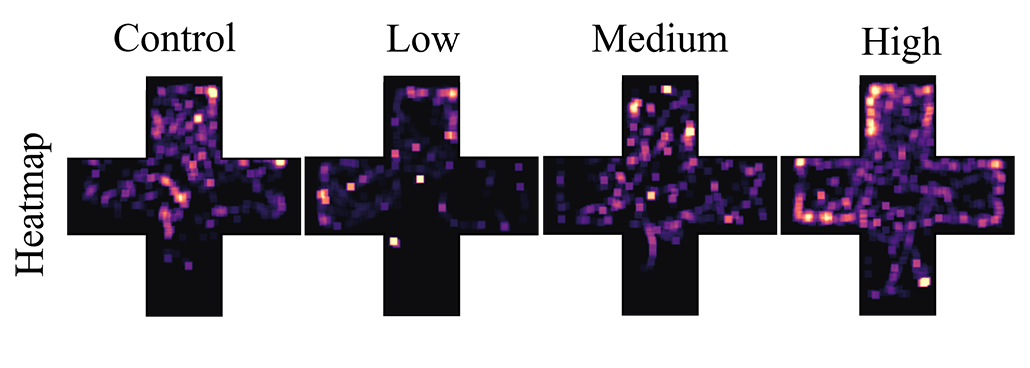
Past caffeine exposure changed the movement patterns of zebrafish. As caffeine exposure increased, fish moved more erratically throughout the four zones of their aquarium. (The bright dots on the heatmaps show where the fish swam.) This evidence points to behavior changes and increased anxiety linked to caffeine.S. Zeng
“I feel that we really don’t talk about caffeine, even though we drink it,” Sophia says. It’s in so many everyday drinks, she adds. Between soda, tea and other beverages, young people may be consuming a lot more of it than they realize.
Sophia suggests greater skepticism about using this drug. People tend to think about caffeine as a helpful tool for focus, she notes, and dismiss potential downsides. But her findings highlight that caffeine comes with trade-offs — and those trade-offs may harm young brains more than we know.
Synesthesia is a trait that some people have in which one kind of sensory input triggers other senses. To someone with synesthesia, different colors may have different tastes. Or hearing certain sounds may cause them to see certain shapes.
This phenomenon is not a mental illness. Rather, it is considered a form of neurodiversity. Up to 4 percent of people may have some form of synesthesia.
This trait takes many forms. Grapheme-color is one type. This means that a person sees letters or numbers in different colors. For instance, when a person sees the number 7, it may always appear yellow. About 1 percent of people share this trait.
Another type is called chromesthesia. That’s when hearing a sound causes a person to see colors or shapes around them. Historians think that Vincent van Gogh, a 19th-century painter, may have had this trait. He described seeing colors around him when he played the keys of a piano.
Other famous artists, such as singer and songwriter Billie Eilish, have described this experience, too. “Everything that I make I’m already thinking of what color it is, and what texture it is, and what day of the week it is, and what number it is, and what shape,” the musician told iHeart Radio.
Scientists are not sure exactly what causes synesthesia. But they believe it is at least partly linked to a person’s genes.
When it comes to rockets, bell-shaped engines are the norm. But they’re not the most efficient shape. Engineers have relied on this design only because it avoids a known overheating risk faced by a more efficient engine. Now, though, three 17-year-olds have redesigned the nozzle of the more efficient aerospike engine to better manage heat.
They’re hoping that one day their new tech might literally shoot for the stars.
Devin Wanchoo, Michael Obeng and Mazon Ben Chouikha attend Governor’s School at Innovation Park in Manassas, Va. Their new work began as a way to satisfy a class assignment. “We wanted to do something in aerospace. We wanted to do something involving biomimicry. And then we wanted to do something that no one has done before,” says Michael.
Those motivations led them to refine a better rocket system.
Michael Obeng (left), Mazon Ben Chouikha (middle) and Devin Wanchoo (right) hold a model of their new aerospike nozzle. They’ve improved the heat tolerance of the aerospike design using a novel machine-learning algorithm and some inspiration from Mother Nature. K.G. Carpenter
During their research, the young engineers learned that bell-shaped rocket engines become less powerful the higher they ascend. For decades, engineers have experimented with an alternative that would avoid this limitation: the aerospike engine.
Unfortunately, this design has its own big limitation: It shoots super-hot exhaust gases from the engine right up against its spike structure. Eventually, that heat can “cause the spike body to melt and crack under thermal stress,” Devin says.
Their work won these teens a spot here at the 2026 Regeneron International Science and Engineering Fair, or ISEF. The event is a program of the Society for Science (which also publishes this magazine). The young aerospike researchers were among 1,725 students — from 65 nations or territories — who competed at the 76th annual ISEF. These participants shared nearly $7 million in prizes.
A guiding spike
Imagine a rocket launch. Flames burst downward from the engines and propel the rocket upward. Initially, the flames form a column.
If you were to fly alongside the rocket as it ascends, you’d eventually see the shape of that exhaust change. The column of gases would start to balloon outward.
This 60-second video illustrates why aerospike engines would be so much more efficient than today’s bell-shaped alternatives — if you could get aerospikes to manage the heat of the exhaust gases moving through them.
During liftoff, high atmospheric pressure initially forces the gases into that column shape. But as the rocket climbs, the air pressure weakens — and so does control of the exhaust gases. Now they spread out, reducing lift.
The thrust must go down for the rocket to go up. But higher up, as the gases balloon out, bell-shaped engines “can lose up to 30 percent of their efficiency,” says Devin.
Engineers have been looking to overcome that. And the aerospike engine is one possible solution.
“Unlike a bell nozzle — which needs that giant encasing structure — the aerospike just has its central spike,” Devin explains. It will deliver a strong, reliable upward thrust as long as you have some way “to force gases [down] along the spike wall.”
Those gases flow along the spike’s surface. The spike acts as a guide to direct the gases down so they can’t spread out. But that guiding spike introduces its own problem.
Coming from the engine, exhaust gases “are extremely hot,” notes Michael. The spike’s tip takes a pummeling from those gases. Their heat is “essentially attacking it, attacking it, attacking it,” he says.
What’s more, those gases tend to recirculate along the spike. This helps counter the air pressure’s attempt to weaken the downward flow of the gases, Michael says. Unfortunately, he adds, it also increases the heat.
So what makes this engine so good at maintaining a strong downward flow of exhaust gases, Devin points out, “is the same thing that causes that very aggressive heating of the spike body.”
Typical cooling methods just haven’t been good enough to spare the spike.
To counter that, the trio looked for inspiration in nature. Living things have evolved different ways to cool themselves. The team considered plant veins, insect exoskeletons, shark tissues and more. Then the trio created ICARUS, a machine-learning algorithm, and used it to test bio-based cooling strategies.
ICARUS, says Devin, is “probably the most novel part” of their project. It’s a simpler, heat-driven version of tools used by the aerospace industry. And it does more than just test ideas. “We built it on a machine-learning layer that was able to suggest [spike shapes] to try,” Devin says.
The young engineers started with shapes suggested by nature. Then they used ICARUS to optimize those designs. For instance, says Mazon, his team might suggest a certain surface pattern or feature. Then ICARUS “might change the width of it [or] the depth of it” to optimize the spike’s heat resistance.
The approach worked. Heat flux refers to how fast heat moves through a material. “We were able to reduce temperatures and heat flux by up to 40 percent,” Devin says.
Human skin inspired their most successful design, Devin says. Pores in our skin release sweat. As it evaporates, it wicks away heat. Mimicking this trick helped “bleed propellant to fight back against that heat creep,” says Devin.
Validating ICARUS
Using what they learned from ICARUS, the team members 3-D printed models of the six most promising designs. Then they put the models under a heat gun and measured how long each took to reach 90° and 110° Celsius (194° and 230° Fahrenheit), says Devin. They also tracked at what temps the models began to warp.
Then they built a copper prototype of their best-performing model. In the final stage of testing, Michael says, they became the first high school students to ever do a cold-flow test on such an engine. A cold-flow test, explains Devin, is “just testing that your engine can pressurize properly and that propellants are flowing.”
This test was “pretty cool,” he says. “We got to verify our ICARUS predictions.”
Devin Wanchoo and Michael Obeng prepare to conduct a cold-flow test of their new engine nozzle. They believe they are the first high schoolers to do so with a linear nitrogen oxide/ethanol aerospike system.M. Obeng, M.B. Chouikha and D. Wanchoo
ICARUS can also offer design tips beyond rocketry, Mazon says. For instance, the surface patterns designed to manage heat could even be applied to homes. “If you were to put [these patterns] on wood and you built the house, then it’s very likely to be safer” in terms of withstanding wildfires, he says.
For their work, Devin, Michael and Mazon took home fourth place — and $600 — in ISEF’s Engineering Technology: Statics and Dynamics division.
Metal-organic frameworks — or MOFs — are a type of material made of metal– and carbon-based molecules. These molecules are linked together into complex, 3-D shapes.
Imagine a house that’s being built. After laying the foundation, builders construct a skeleton-like wooden frame. This framework consists mostly of empty space. MOFs are structured much the same way. Their molecules assemble into a scaffold-like material. And like that wooden frame, an MOF’s interior is also mostly empty space.
Unlike the holes of a sponge, the empty spaces inside an MOF are not random. Scientists can choose the sizes, shapes and chemistry of these gaps. That’s important. It allows scientists to custom-make MOFs for specific tasks. A very porous MOF may be especially good at sopping up substances. Another MOF with certain chemistry may work like a filter, letting some substances through it but blocking others.
Metal-organic frameworks (MOFs) consist of many Lego-like pieces. Those pieces form organized structures with lots of empty pockets. The gaps allow MOFs to sponge up greenhouse gases and, perhaps one day, deliver drugs inside the body.CSIRO Australia/Wikimedia Commons
Scientists custom-build MOFs for many different uses. In medicine, MOFs may tote drugs to specific places inside the body for release. Or they might release medicines only under certain conditions.
MOFs may also help manage climate change by absorbing carbon dioxide (CO2) from the air. These MOFs often contain exposed metal ions. (An ion is an atom that carries an electric charge.) Those metal ions can bind to the oxygen atoms in CO2 molecules, snatching them out of the atmosphere.
Still other MOFs can pull water from desert air and release it for drinking. Others can filter out harmful wavelengths of sunlight to protect crops. Or they can shield against toxic chemicals. In fact, MOFs have so many uses that they won the 2025 Nobel Prize in chemistry.
In a sentence
Scientists developed metal-organic frameworks (MOFs) that yank pollution from our water sources.
PHOENIX, Ariz. — Nervous? One day soon, relief might be just a chew away.
For years, research has been showing that chemicals found in passionflower plants can help fight anxiety. Two teens have now created a chewing gum that can release those chemicals.
Zackary Nizker (left) and Sara Hoti (right), both 16, developed a medicinal chewing gum. It aims to help people struggling with anxiety. K.G. Carpenter
“Gum is very popular among high schoolers,” says Zackary Nizker, 16. This junior at McIntosh High School in Peachtree City, Ga., hopes this habit will make gum an easy way for teens to deal with anxiety. And there are many who face this. “In the U.S.,” Zackary says, “a third of all adolescents and young adults suffer from a form of anxiety.”
But teens aren’t the only ones who could use some relief. Zackary’s grandmother struggles with nervousness, which he says “got really severe last year.” The drugs she got prescribed help, he says, though their side effects can be “very severe.” In his grandma’s case, “she could hardly walk or stand. It was a very scary situation.”
Flavonoids are antioxidant chemicals made by many plants. The plants use them to fight tissue damage from oxidation. Many herbal remedies contain these compounds, too, notes Sara Hoti, Zackary’s classmate. Chamomile, used in some teas, is one flavonoid-loaded herb. But for their study, she and Zackary used an extract of a plant that grows wild in their hometown: passionflower (Passiflora incarnata).
Their work earned these teens a spot as finalists here at the 2026 Regeneron International Science & Engineering Fair, or ISEF. It’s a program created and run by Society for Science (which also publishes this magazine). As fourth place winners in the Translational Medical Science division, Sara and Zackary took home $600. They were among 1,725 students — from 65 nations or territories — competing at the 76th annual ISEF. Participants this year shared nearly $7 million in prizes.
Flower-powered relief
“Chewing gum, by itself, is already known to reduce anxiety,” says Zackary. But a host of studies going back decades shows that passionflower flavonoids reduce anxiety. They do this, he explains, by increasing brain levels of a signaling compound known as GABA. (That’s short for gamma-aminobutyric acid.) “It slows down neuron firing in your brain,” Zackary says. That slowdown, he says, seems to calm an anxious brain.
By combining herbal remedies with rhythmic chewing, he says, their new gum could become “a more effective treatment.” But to test whether chewing gum would release any flavonoids in it, they needed to run some tests.
To start, they cooked up some bubble gum. It included a gum base, powdered sugar, various other sweeteners — and, of course, passionflower extract.
Chew on this
The finished chewing gum was molded into a strip, then cut and wrapped in parchment paper and foil. The gum contains all ingredients — including melted gum base, softeners, sweeteners and flavonoids. After drying, sugar was coated on the outside of the gum.
S. Hoti and Z. Nizker
The teens had hoped to make that extract. After all, Sara says, in her hometown, passionflowers are everywhere. But the pair did their experiment during the winter, when the flowers were “all gone — out of season.” So they ended up having to buy the extract.
Afterward, they tested their prototype gum — and struggled, Zackary recalls. Why? “We’re not allowed to just give people some random gum we made and say, ‘Here, chew this, let’s see if it works.’” Instead, they had to do tests “outside of the body.”
Watch the teens, fourth-place winners in their division, describe the mechanism by which their new chewing gum formulation should help people who are feeling nervous or anxious.
Double bubble testing
The pair conducted two tests. The first examined whether each quantity of gum contained the same dose of passionflower extract. So they analyzed slices of the gum under a microscope. Using computer software, they could calculate the share of the flavonoid particles in view. Here, Sara says, “you want your value to be below 15. We actually got a value of 8.4, which was perfect.” (In these tests, Zackary adds, the “values” do not come with a unit.)
A second test, called the Shinoda test, measured how well flavonoids in their gum resist breakdown. If they broke down, the likelihood they’d prove helpful against anxiety could fall apart, too. So the young scientists exposed their gum to various conditions and then used this color-changing test to check whether the flavonoids had held up.
This test is usually done with liquids. Their gum was a solid. So learning how to Shinoda test their gum proved a “really long process,” Sara says.
To mimic the work of saliva, they cut their gum into pieces and soaked them in alcohol for three hours. And nothing happened. The flavonoids never left the gum.
To use the gum you’d chew it, they realized, an action which could release the flavonoids. But “since we couldn’t chew it ourselves,” Zackary says, “we broke the gum into pieces with our hands. That simulates chewing.” They also extended their soak time to three days.
This time, “we got this bright orange coloration change,” says Sara. That showed that the gum’s flavonoids had been released but not broken down — even after exposure to hydrochloric acid and other harsh conditions.
In the future, the teens want to find ways to market their gum and test in people its ability to relieve anxiety.
“Medicated chewing gum is not a new thing,” says Sara. Energy-boosting gums, which release a stimulant, already exist. Smoking-cessation gum contains nicotine. And you can buy passionflower teas. But “nowhere on the market is there a gum for anxiety,” says Sara.
She hopes their recipe could help anyone who feels a bout of nervousness coming on. Maybe you’re “going into an interview or a presentation,” she says. “You can just [chew] this and you know, chill out.”

 Login