❌

Normal view

Received — 24 June 2026 ⏭ Science News Students

Analyze This: A rocket reentry spiked metal levels in the atmosphere

24 June 2026 at 11:30

For the first time, scientists have measured metal pollutants leaching from a piece of space junk in the atmosphere. They caught a burst of lithium as a SpaceX rocket burned up high above Earth’s surface. Such pollutants can damage the ozone layer and may impact global climate.

Humans have been launching metal things into orbit around Earth for nearly 70 years. But the pace of launches has skyrocketed in the past decade. And private companies plan to boost the number of launches in the near future. Consider SpaceX’s Starlink system. This system provides internet to far-flung places. It will eventually consist of more than 40,000 satellites. Already, nearly 10,000 Starlink satellites orbit Earth.

Each piece of Starlink equipment has a planned life of about five years. After that, the satellite burns up in the upper atmosphere. This releases metals. They include lithium, aluminum and copper. Those metals may speed up chemical reactions that destroy ozone. That’s a problem, because the ozone layer of Earth’s atmosphere protects life on Earth from getting too much ultraviolet (UV) light from the sun.

Metal pollution from space junk may also affect Earth’s climate. Such metals could change the balance of light that reaches the ground or gets bounced back to space.

The stratosphere is the layer of the atmosphere that extends from 14 to 64 kilometers (9 to 31 miles) above Earth. A 2023 study found that about 10 percent of particles there contain pollutants from burnt-up satellites and rocket parts.

a diagram of Earth's atmosphere showing layers where pollution from meteors and burnt-up space debris can collect
This diagram shows different layers of the atmosphere. The breakup of meteors forms natural metal layers. But space junk can also cause pollution in the upper atmosphere that may mess with the ozone layer. R. Wing et al/Communications Earth & Environment 2026

Scientists wanted to see if they could directly trace such particles to a piece of space debris. They got their chance on February 19, 2025. That day, the researchers observed a cloud of lithium about 100 kilometers (60 miles) above Germany. It was blowing away from the upper stage of a Falcon 9 rocket. This rocket part contains fuel and an engine. The rocket part made a fireball as it broke apart over Ireland and the United Kingdom.

“A few hours after the reentry of this rocket, we could see 10 times more lithium than we would have observed otherwise,” says Claudia Stolle. She’s a meteorologist at the Leibniz Institute of Atmospheric Physics. That’s in Germany.

The measurements relied on lidar. Lidar sends out laser pulses and detects the light that bounces back. The laser light is tuned to specific wavelengths that reflect off particular materials, such as lithium.

The team also ran computer models of the atmosphere. These showed that the wind had carried the lithium from the spot where the rocket came down to the area over Kühlungsborn, Germany. That’s where the lidar was located.

The researchers shared their findings February 19. The work appeared in Communications Earth and Environment.

The technique could help monitor potential harms from space debris. Meteorites — space rocks that fall to Earth — bring metals into the atmosphere. But falling space junk may one day boost metal pollution by around 40 percent, Stolle’s team estimated. Tracking such contaminants and their effects will become increasingly important.

More companies and countries are planning to launch satellites into orbit, Stolle notes. “All of them will burn up sooner or later.”

Leaching lithium

R. Wing et al/Communications Earth & Environment 2026

Using a technique called lidar, researchers in northern Germany caught a burst of lithium in the upper atmosphere. The lithium came from a piece of a Falcon 9 rocket. Carried by the wind, the lithium spread from one point to a wider area. This type of spread is called a plume. The figure on the left is a heat map. It shows the density of lithium (per cubic centimeter) at different altitudes over time (shown in local German time). The plot on the right shows the lithium density at different altitudes at 1:30 a.m. on February 20. The amount of lithium is higher in the center of the plume and lower at the plume’s edges.

Data Dive:

  1. Look at Figure A. When did the density of lithium increase?
  2. What was the altitude of the lithium plume?
  3. What was the lithium density at the center of the plume?
  4. Look at Figure B. How tall was the plume, top to bottom, at 1:30 a.m. on February 20?
  5. If the data continued recording after 2:00 a.m. on Feb 20, what would it likely look like?

The dawn of animal evolution saw a bizarre array of sea creatures

23 June 2026 at 11:30

Animals may have had a rich variety of complex body types far earlier than scientists had recently thought.

A crucial moment in the history of life on Earth was the Cambrian explosion. Starting some 539 million years ago, it marks when animals very quickly became much more diverse. How this “explosion” in diversity happened has been a mystery. But a trove of newfound fossils points to an answer.

Animals seem to have begun evolving an array of strange body types even before the famed explosion. Researchers described them April 2 in Science.

“This paper is absolutely fascinating,” says Emily Mitchell. “It provides vital insights into [pre-Cambrian] life.” Mitchell is a paleontologist who did not take part in the research. She works at the University of Cambridge in England.  

The time just before the Cambrian explosion is known as the late Ediacaran (Ee-dee-OCK-ur-ən) Period. It lasted from about 575 million to 539 million years ago. The earliest fossils that were clearly animals date to this time. But until now, they haven’t offered many details about the bodies of critters who lived back then.

What’s more, many animals seen in the Cambrian Period haven’t been found in the Ediacaran Period. This led researchers to suspect the Cambrian explosion started with very few species.

Newfound fossils unearthed in southwestern China now challenge that idea. They show that more than 539 million years ago, Earth’s oceans teemed with a zoo of weird creatures.

Soft, clarinet-shaped animals anchored themselves to the seafloor. They swayed alongside creatures that looked like worms or baskets. Those were just a few of the complex species thriving in pre-Cambrian seas.

Strange sea creatures

Paleontologist Gaorong Li led the new research. It all started in 2022. He and others were collecting fossils near Yuxi, China. Their team was on the hunt for remnants of Ediacaran algae. But that hunt turned up something odd: fossil fragments of species they couldn’t identify.

In 2023, the team discovered another surprise. They turned up fossils of bizarre, cylindrical animals several centimeters (inches) long. At one end, the critters had flat pads that could have gripped the ocean floor. At the other end were flag-shaped tentacles that appeared to extend from their mouths.

A fossil image on the left and illustration on the right of the fossilized creature on the right.
This early deuterostome (fossil at left, artist’s reconstruction at right) is related to animals like vertebrates and sea stars. It appears to have appendages on one end that may have been used in feeding. It’s also new, very early fossil evidence of animals with bilateral symmetry in the Ediacaran Period.Gaorong Li & Xiaodong Wang

Finding these “bugle worms” was a turning point, Li says. Back then, he worked at Yunnan University in Kunming, China. In 2024, his group joined forces with researchers at the University of Oxford in England. Together, they gathered roughly 700 late Ediacaran fossils.

They compared this haul to other Ediacaran fossils. They also compared the new fossils to those from the Cambrian Period.

Some of the new fossils looked like Haootia — an animal that lived some 560 million years ago. Haootia and these other fossils resembled martini glasses with tentacles on the rims. Like modern jellyfish, they had body parts that spread out from a central point. This is known as having radial symmetry.

A fossil image on the left and illustration on the right of the fossilized creature on the right.
The Haootia-like animal (fossil at left, artist’s illustration at right) may have been a relative of animals such as corals, anemones and jellies.Gaorong Li & Xiaodong Wang

Bilateral bodies

The freshly collected fossils included more eyebrow-raising finds. Some had bilateral symmetry. That is, they had similar features on the right and left sides of their bodies — as humans do.

It’s rare to find such early fossils with left-right symmetry. Until now, only four species from the Ediacaran Period had shown this feature. Li and his team found more than 180 bugle worms and other fossils with this type of symmetry. Some looked like sausages on skewers with feathery bits around their mouth ends.

The sheer number of fossils with bilateral symmetry that Li’s group found is striking, says Emmy Smith. She’s a paleontologist at Johns Hopkins University in Baltimore, Md. The diversity among these fossils amazed her.

Many had special structures for feeding, Smith notes. Clearly, the animals were quite physically complex. “That strengthens the view that [animals] were already diversifying before the Cambrian,” she says.

The Cambrian explosion, it seems, didn’t come out of nowhere, Li says. Instead, animal life had been getting more complex for millions of years before that.

Do you have a science question? We can help!

Submit your question here, and we might answer it an upcoming issue of Science News Explores

Could a storm last forever? 

22 June 2026 at 11:30

The weather forecast can get extreme in the land of Hyrule, found in the Nintendo series The Legend of Zelda. A downpour in the coastal province of Faron, for instance, prevents Link, the game’s hero, from reaching Calora Lake. And constant lightning and rain threaten the skybound Thunderhead Isles. These storms only end once Link completes a series of quests, all while dodging lightning.

Never-ending storms make for moody gameplay. But real storms “can’t last forever,” says Stephanie Spera. Storms result from imbalances between moisture and temperature. “A storm kind of fixes a temporary imbalance,” she says. This physical geographer at the University of Richmond in Virginia uses satellite data to study changes to the landscape.

“The whole purpose of anything in weather is to get the atmosphere back in balance,” explains Chris Vagasky. He directs the Wisconsin Environmental Mesonet. It’s a network of weather stations. Physical features such as mountains and oceans, even buildings, often keep that from happening, he says. Though violent at times, thunderstorms help balance and redistribute heat, moisture and electrical charges.

For constant thunderstorms like those seen in Faron, those imbalances would have to remain out of whack. But on Earth, atmospheric physics ensures that even the strongest storms eventually fade away.

No storm lasts forever 

Thunderstorms form when warm, moist air rapidly rises and meets cooler air in the atmosphere. This creates the instability needed for a storm. Such moisture often comes from the evaporation of ocean water. As this moisture-filled, warm air rises, it creates updrafts — upward air movements. Water vapor in this air condenses into droplets, forming a cumulus cloud. This cloud formation, in turn, releases energy as heat. That heat fuels stronger updrafts, which power the storm.

Within the clouds, water droplets collide with ice crystals. This creates static charges and, in turn, lightning. As a cloud grows, water droplets become heavy enough to fall through it. The resulting rain and ice create cooler downward winds, or downdrafts. They cool the cloud and eventually overpower the warmer updrafts. As the atmosphere now regains its balance, the storm ends. 

Most thunderstorms only last an hour at most. For constant thunderstorms, such as those seen in Faron, you’d need to maximize a storm’s ingredients, says Vagasky. For moisture, there would need to be a “persistent conveyor belt of warm, moist air.” This air would most likely be heated by 24-hour sunlight. And the Thunderhead Isles would likely need to hug mountains that could help condense that moist air into clouds.

A gif shows Hurricane Harvey swirling over a satellite image of coastal Texas.
In 2017, Hurricane Harvey stalled over Houston, Texas, for about four days. During that time, some areas received more than 127 centimeters (50 inches) of rain.Jesse Allen/NASA

Keeping things moving 

Even if a storm could sustain its own internal energy, it couldn’t stay in the same place forever. That’s because Earth’s atmosphere is in constant motion. Large belts of wind blow in particular directions (based on their latitude). Some storms get an extra boost from fast, narrow bands of wind called jet streams. Like conveyor belts, these streams move weather across continents. Clocking in at up to 320 kilometers (200 miles) per hour, jet streams “really help to push all of that activity from one place to another,” Vagasky says.

Sometimes these wind patterns can increase how long storms last. High-pressure systems or the jet stream can make Earth’s longest-lasting storms — tropical cyclones — sort of stall out in one place for a bit. In August 2017, for instance, weak prevailing winds let two high-pressure systems hover over the United States. In turn, Hurricane Harvey stalled over Houston, Texas, for about four days. Fueled by warm coastal waters, some areas received more than 127 centimeters (50 inches) of rain before the storm moved inland and broke up.

Like Houston, Faron lies along a coast. Depending on where Hyrule is located on the planet, it may be at risk for cyclones. But a cyclone couldn’t last year-round unless the oceans stayed consistently warm. On Earth, cyclones die when they make landfall, face windshear or reach colder water in higher latitudes. “They need to be refueled, which is why they die over land,” says Spera. “There’s no energy source.”

Learn about the basic ingredients of every thunderstorm and how weather satellites watch for developing storms.

Earth’s flashiest storms 

Thanks to physics, perpetual storms like those in Faron are impossible on Earth. But certain scenarios come close.

The storm plaguing the Thunderhead Isles looks similar to a region called the Intertropical Convergence Zone (ITCZ), says Spera. This solid band of clouds encircles the globe near the equator. Here, prevailing winds from the northern and southern hemispheres meet. This lifts warm, humid air heated by the intense sunlight found in the tropics.

But the ITCZ isn’t a single, massive thunderstorm, Spera adds. Instead, a series of intense but short-lived events develop here. This zone also moves back and forth across the equator, leading to seasonal monsoon rains like those found on the Indian subcontinent. If the Thunderhead Isles were under the ITCZ, they wouldn’t have the relentless lightning storms seen in The Legend of Zelda games. Instead, it would just “be really rainy for a really long time.”

For flashier storms, the Catatumbo lightning phenomenon is truly unrivaled. This mass of thunderstorms occurs over Lake Maracaibo in coastal Venezuela. Here, lightning flashes up to 300 days per year and can last for nine hours at a stretch! Catatumbo holds the world’s record for the most concentrated lightning.

The key to Catatumbo lightning is geography. The nearby Caribbean Sea offers huge amounts of warm, humid air. Lake Maracaibo sends in added moisture. Winds whisk this moist air up the northern end of the Andes Mountains. There it meets colder air. The bowl-shaped mountains hugging the lake prevent the resulting cumulonimbus clouds from moving. This can lead to stagnant thunderstorms, ones similar to those of the Thunderhead Isles. Says Vagasky, “Catatumbo is one of the closest things that we might see to that.”

Scientists Say: Snow line

Snow line (noun, “SNOH line”)

The term “snow line” is used in both earth science and astronomy. It has similar, but slightly different, meanings in each field.

On Earth, a snow line is the boundary between snow-covered and bare ground.

Imagine you are hiking up a craggy, white-capped mountain. When you reach the edge of the snowpack, you’ve reached the snow line. This is an elevation-based snow line. Likewise, if you were to march toward one of Earth’s poles, you would eventually pass a point beyond which the ground remains snow-covered. This is a snow line based on latitude.

It is important to note that a snow line does not mark a place where snowmelt never occurs. It just marks a point at which the snow falls at least as fast as it melts and evaporates.

Some snow lines are permanent. Others are seasonal. They move as snow melts faster during warmer months and builds up faster during colder months.

Many factors determine the elevation or latitude where a snow line occurs. For example, it’s easier for snow to build up on mountains closer to Earth’s poles. So here, snow lines often occur at lower elevations — sometimes as low as sea level. But near the equator, it’s warmer and harder for snow to build up. There, a mountain’s snow line may occur over 6,000 meters (19,700 feet) above sea level.

Snow lines can even vary on two different sides of the same mountain. Intense sunlight on one side can raise a snow line. Harsh wind also makes it harder for a mountain to hold onto snow. So a wind-swept mountainside usually has a higher snow line.

In astronomy, a snow line refers to the distance from a star where it’s cold enough for a certain type of molecule to freeze. For example, water freezes the closest to a star. Carbon dioxide freezes farther out than that. Methane, carbon monoxide and other chemicals become solid farther and farther out.

The snow lines of different molecules play a key role in what types of planets form across a solar system. They also impact the chemical makeups of objects such as comets.

In a sentence

Thanks to artificial snow, major winter sports don’t have to happen above the natural snow line.

Check out the full list of Scientists Say.

Received — 18 June 2026 ⏭ Science News Students

Deeply plowing farm fields can do more harm than good

18 June 2026 at 11:30

For thousands of years, farmers have prepared their fields for planting by overturning the soil. It helps them the manage the moisture, nutrients and flow of air underfoot. But modern farming’s deep plowing and heavy machinery often do more harm than good, researchers report.

All that soil turnover disrupts the natural paths that water takes to percolate into the root zone. And this is not a problem just for growing crops. Breaking down the network of pores that water wants to move through also makes the soil less resilient to flooding and drought. So concludes a team of scientists in the April 16 Science.

A photograph of a fiber-optic cable placed on an agricultural field in order to measure how tilling can damage soil structure.
A fiber-optic cable, here laid along the relatively bare soil, was able to pick up tiny seismic signals. They’d been triggered by the movement of rainwater in the soil below.Marine Denolle

Qibin Shi is a geophysicist with the Chinese Academy of Sciences in Beijing. He was part of a team that fashioned a dense array of sensors out of fiber-optic cables. Such cables find use in more than just high-speed internet. They also can become powerful tools for seismology — and not just for earthquakes. They’re proving sensitive enough to detect even the tiny vibrations triggered as water moves through soil.

Shi’s group installed these cables along the edges of 27 plots of land at a university test farm in Newport, England. The plots were treated one of three ways. Nine went unplowed. Another nine were tilled to a depth of 10 centimeters (4 inches). The last nine were turned over to a depth of 25 centimeters (almost 10 inches). Within each group, plowing machinery of different weights were used. Why? The heavier they are, they more they can compact the soil.

For three days in March 2023, the team used its seismic-sensing system to track how the plots responded to rain. Rainwater didn’t seep down much on plots with the most compacted and deeply plowed soil. Instead, it tended to pool near the surface. Here, it could evaporate swiftly once the sun came out.

Water moved down and around more easily in the plots that were less compacted and less deeply plowed.

To understand what was happening, Shi’s team created a computer program that modeled the water’s movements. Rain, they found, moves through porous soil in a way that sort of mimics what happens to blood in capillaries — the body’s tiniest blood vessels. This process is known as capillary action.

A group of scientists work inside a tent. Nearby, another group is walking in an open, grassy field.
Scientists used fiber-optic cables to study how turning over the soil in spring will affect rainwater’s ability to infiltrate the soil at this research site in Newport, England.Marine Denolle/University of Washington

Like our capillaries, the tiny, tunnel-like airways between specks of soil are very thin. Gravity does not drive water’s flow through these holes. Instead, as water tries to alternately adhere to soil particles and bind to other water molecules, it gets caught in a push-pull action. And that moves it. When those narrow pathways get disturbed or crushed, however, the suction forces strengthen, impairing the water’s flow.

Fiber-optic sensing could offer farmers a quick and inexpensive way to monitor soil moisture on a large scale, Shi’s team says. Such monitoring also could provide real-time warnings of natural hazards, such as flooding and soil liquefaction during an earthquake (when saturated ground can suddenly turn unstable due to shaking).

Received — 17 June 2026 ⏭ Science News Students

Meet Bruce, the disabled kea parrot who is the boss of his flock

17 June 2026 at 11:30

A parrot missing half his beak has become top bird at New Zealand’s Willowbank Wildlife Reserve. Named Bruce, he wins every fight with other kea parrots. He also gets priority access to food.

This observation has made scientists question their ideas about disabilities in animal social groups. Bruce showed that a physical disadvantage doesn’t have to hold an animal back. Sometimes the right moves and a little creativity can make all the difference.

Researchers shared this finding April 20 in Current Biology.

Willowbank’s kea live in a large aviary with trees and a stream. Visitors who stop by often fail to notice the parrots snoozing among the leaves. But when they spot Bruce, they always make the same comment, says behavioral ecologist Alex Grabham: “Look at that poor bird.”

That pity is misguided, says Grabham. He’s part of a team studying kea at the University of Canterbury in Christchurch, New Zealand. That team tracked how Bruce interacted with his flock. (A group of kea is called a circus, reflecting the birds’ playful nature.) Like other parrots, kea have a social hierarchy. This is a ranking system where some birds are in charge; others follow the leader. Birds compete for the top spot by fighting, squawking or puffing up feathers.

Meet Bruce, the disabled kea parrot that managed to become the alpha male of his flock.

Grabham’s team spent four weeks recording 162 physical confrontations between the nine males in Bruce’s circus. Bruce won all 36 of his. Without a doubt, he was the top kea.

What’s more, he’s the first disabled animal to be recorded achieving top status within a group, at least without support from an able-bodied ally. (Faben was a dominant, or “alpha,” male chimpanzee living at Gombe National Park in Tanzania. He lost his top rank after polio paralyzed his arm. Faben’s brother took over his alpha status, but also became his ally. Faben then worked his way back to second place after perfecting a charging technique to bat away rivals.)

Parrot jousting

Also key to Bruce’s success: an unusual combat technique. Other kea tend to rely solely on kicking to repel other birds. Bruce supplemented his kicks with a unique jousting technique. He jabbed at rivals with his exposed lower beak.

Grabham’s team filmed 109 more confrontations between Bruce and the other birds. During these, Bruce kicked slightly more than he jousted. But jousting proved much more effective. Jousting drove off his opponent 73 percent of the time. When Bruce kicked, he drove them off just 48 percent of the time.

As another kea approaches, Bruce (seen here on the right) jabs with his half a beak. This fighting style has helped the disabled parrot win alpha status among his circus in New Zealand.Ximena Nelson

Bruce’s top spot comes with perks. Other male kea will preen Bruce, helping to clean parts of his beak that he cannot reach. This is highly unusual among kea. Normally, they only preen their mates. The lower another male’s rank, the more likely he was to preen Bruce. This behavior mimics hierarchical grooming seen in chimps.

Lower-ranked birds also gave Bruce first dibs on food. The birds’ food was spread mostly between four central feeders. Over the four weeks that Grabham’s team analyzed Bruce, he was the first to dine at those feeders 83 percent of the time. On four days, the other birds gave Bruce 15 minutes of alone time with all four feeders. Later, they ate his leftovers.

Bruce is being preened by another kea
Another kea preens Bruce (left). This helps remove food that gets stuck in Bruce’s beak. Alex Grabham

In many animal societies, top status comes at a cost. “An animal that is high up in the dominance hierarchy has to defend that position constantly,” says Amalia Bastos. She’s a comparative psychologist at the University of St Andrews in Scotland who used to study Bruce. Alpha male baboons, for instance, show higher levels of stress hormones called glucocorticoids (Glu-ko-KOR-ti-koids).

Grabham’s team measured those hormones in the birds’ droppings. Bruce, it turns out, was the most chill kea in his circus. It isn’t yet clear why. But Grabham thinks that Bruce is so dominant that other kea don’t mount any serious challenges to his throne. “He isn’t going to be followed around and beaten up or bullied or chased,” Grabham says. And Bruce “knows that.”

It’s unclear whether Bruce would have thrived as well in a wild circus as he has at Willowbank. Bastos points out that with his damaged beak, Bruce might struggle with tougher foods during the winter. In the wild, most kea circuses don’t have a fixed hierarchy. Birds join and depart groups throughout the year, constantly changing the rankings. For now, in Willowbank’s strict hierarchy, Bruce is boss.  

This isn’t the first study to show Bruce is capable of innovation. In 2021, researchers reported his self-preening technique. He uses pebbles to clean his feathers. “Bruce has now shown twice that being different is not necessarily disadvantageous,” Bastos says.

Bruce gained renown a few years ago for showing tool use. To groom himself, the parrot would select a pebble and hold it just so. This pebble “tool” overcame the lack of a part of his upper beak.

Received — 16 June 2026 ⏭ Science News Students

Hundreds of sea level studies have underestimated ocean rise

16 June 2026 at 11:30

A warming climate has been helping drive a global rise in sea levels. A new analysis now finds that hundreds of major studies missed just how much sea levels have risen. Past estimates were too low, the new study shows. On average, true sea levels are 20 to 30 centimeters (8 to 12 inches) higher than what past studies reported.

This means that the toll of future sea level rise is even greater than expected.

Katharina Seeger and Philip Minderhoud did the research. They work at Wageningen University in the Netherlands. These physical geographers evaluated data from 385 global and regional studies. All had been published between 2009 and 2025.

Some 99 percent of the studies had incorrectly estimated ocean height, they found. And 45 of the studies were used a few years ago in a major report. It was issued by a global panel of climate experts convened by the United Nations.

Knowing the rate of ocean rise is crucial for coastal planners around the world. It helps them predict when sea water will start to flood — and permanently cover — large swaths of land. The errors in past studies, the researchers say, mean that coastal land may disappear faster than expected. In some places, it could vanish as much as a century sooner than thought.

The team shared its findings in the April 16 Nature.

A one-meter (39-inch) rise in sea level — which could happen within a century — could submerge an area more than 30 percent bigger than scientists thought. That would take away land from 77 to 132 million people. That’s 48 to 68 percent more people than previous estimates.

Sea level rise is slow. But it’s also dangerous if you ignore it, says Anders Levermann. “That’s basically what we’ve done, unknowingly,” he says. “These estimates now tell us that we are much further in the future than we thought we were.” A climate scientist, Levermann works at the Potsdam Institute for Climate Research in Germany.

One problem: geoids

Some of the analyzed studies had focused on sea level rise. Others had focused on storm surges, tsunamis or other coastal hazards. And a common mistake emerged in nine out of every 10 of the studies, the researchers say.

It had to do with the type of data used.

Researchers usually gauge coastal flood hazards by comparing a site’s land elevation to sea levels. Ideally, those sea levels come from actual measurements. Those can come from satellites. Or they could be from tidal gauges, ocean buoys or other tools.

But few of the studies Seeger and Minderhoud reviewed had included such direct sea-level measurements. Instead, the studies had relied on wonky, digital shapes called geoids (GEE-oids).

Geoids are imaginary shapes. They’re meant to approximate Earth’s sea level. They don’t show big ice sheets or giant mountain peaks. Instead, they show Earth as a sort of irregular ball of water with an undulating surface.

Diagram showing a side view of land with a hill and the ocean on the left. Three lines are labeled: Earth's surface (black line) shows the bumpy ground; a geoid estimate of sea level (green dashed line) extends lower than the ocean and land in some places; and an ellipsoid estimate (red dashed line) is a smooth, slightly tilted line that pretends Earth is a perfect oval shape.
This image shows how two average global surface models can vary from Earth’s actual land elevations and sea level. The geoid model (green hashed line) appears lower than the ocean height and far lower than an alternative ellipsoid model (red hashed line).USGS; adapted by L. Steenblik Hwang

But there are two key problems to using geoids to gauge sea level, Seeger and Minderhoud say. First, geoids can be off by several meters. Gravity data are key for making geoids. So geoids are less accurate where gravity data are poor. Those areas include the Global South.

Second, geoids do not account for many other things that can affect sea level. These include ocean circulation and currents. Winds, tides and water temperatures also play roles.

It’s possible to correct for these geoid problems, Minderhoud said at a March 3 news briefing. But the new research shows that few scientists studying coastal hazards make those fixes.

Geoid assumptions led to errors in 90 percent of the reviewed studies. Another 9 percent did not align measurements of sea level and land elevation properly. Fewer than one percent of the studies properly aligned such data, Seeger said.

An aerial view of houses on a beach. Two of the house are partly or completely in the water.
A drone view of these homes in Summer Haven, Fla., show they are already so close to sea level — and at times partially below it — that they can easily be washed away as sea levels continue to climb. Aerial_Views/E+/Getty Images Plus

Average errors varied by region

To see how far off sea-level numbers had been in most studies, Seeger and Minderhoud turned to satellite data. These data measured sea-surface heights globally. Compared to these, geoid-based studies had underestimated coastal sea level by an average of 24 to 27 centimeters (about 10 inches).

Errors were more than three times that size for some places. Among these were parts of Southeast Asia and the Indo-Pacific.

For a few places, estimates of sea levels had actually been too high. These regions included the northern Mediterranean and Antarctica.  That was also true for some islands in the Atlantic and Pacific.

Study estimates were closest for eastern North America and northern and western Europe. Overall, though, most measured sea levels were higher than what past studies had published.

This means the advance of the oceans “is even worse than what’s been reported,” says Patrick Barnard. A coastal geologist, he works at the University of California, Santa Cruz. The new work, he says, is important for planners. It suggests they should be cautious when using findings from big-picture studies to guide local efforts to adapt to sea level rise.

To help future studies, Seeger and Minderhoud have publicly shared coastal sea-level data. These include the most recent actual measurements.

Received — 15 June 2026 ⏭ Science News Students

Scientists Say: Topology

Topology (noun, “top-AH-low-jee”)

Topology is a field of math that focuses on how molding or stretching a shape alters the space it takes up.

In a way, topology is similar to geometry. Both fields study shapes. However, geometry focuses on rigid measurements, such as the length of lines in a triangle. It answers questions like: If I change the length of this line, how will the other lines change? In geometry, the new triangle is considered a different triangle altogether.

The shape of a mug can stretch and morph into the shape of a donut without cutting or adding any pieces. For that reason, a mug and a donut can be members of the same topological family. Lucas Vieira/Wikimedia Commons (Public Domain)

But topology does not focus on such rigid measurements. Instead, topology treats the study of shapes like a game. As in a game, a topologist sets out certain rules. Then, they explore what shapes are possible within those rules.

For instance, a rule might be that all the shapes in a certain family can morph into one another without tearing or gluing parts together. You could explore this yourself by squeezing a water balloon. As you watch the balloon warp, you see continuous changes to its shape. Squeezing the middle causes the outsides to bulge. But the balloon doesn’t break or form new connections. So, all the shapes the balloon takes still obey the rule.

A mathematician might say that all the shapes of this balloon belong to the same topological group.

Another rule might be that all the shapes in a group must have one hole. A donut is an obvious member of this group. But so is a mug. If you made both of these shapes out of clay, you could remold one into the other without tearing the clay or attaching any new pieces. Under the one-hole rule, they are in the same topological family.

A particularly mind-twisty rule might be that all shapes in a family have “non-orientable surfaces.” That means the shape doesn’t have a clear outside and inside. A loop with a twist in it, called a Möbius strip, is a famous example.

a light blue strip is twisted in the shape of a Mobius strip against a white background
A Möbius strip is a curious shape with no set inside or outside. A ball would be able to roll over the entire surface of the strip without having to jump from one side to the other. This is one example of a famous shape in topology.PeterHermesFurian/iStock/Getty Images Plus

Topology can be represented in many ways. Computer models can render and play with shapes. The math of algebra can describe concepts in topology, too.

Setting up rules for shapes and playing around with them is more useful than you might think. It helps scientists understand what is physically possible and impossible. Engineers can use these insights to imagine new technologies. Cosmologists use topology to describe the shape of our universe. And physicists who study string theory use it to probe the nature of matter.

In a sentence

A Möbius strip is one famous example of a curiously mind-bending shape from the field of topology.

Check out the full list of Scientists Say.

A small object beyond Pluto may have a thin atmosphere

15 June 2026 at 11:30

A small member of our solar system out beyond Pluto may be shrouded in a thin layer of gas. If so, it would be the first object of its size — and the most remote rock in our solar system — known to host even a wispy atmosphere.

“This discovery suggests that small icy worlds beyond Neptune may not be as inactive or unchanging as we often assumed,” says Ko Arimatsu. “Until now, Pluto was the only [object beyond Neptune] with a confirmed atmosphere.”

Arimatsu is an astronomer at the National Astronomical Observatory of Japan. It’s in Mitaka. His group shared the new finding May 4 in Nature Astronomy.

Arimatsu’s group tracked the object — known as 2002 XV93 — with a network of telescopes in Japan. On January 10, 2024, those telescopes saw it move in front of a distant star. Such tiny eclipses are called occultations (Ah-kul-TAY-shuns). They can reveal whether some object in our solar system hosts an atmosphere.

If 2002 XV93 were bare, the star behind it would have seemed to blink out and reappear sharply. But Arimatsu and his teammates saw the star’s light gradually fade and reappear over about 1.5 seconds. That smooth dimming is best explained by starlight passing through a layer of gas. Those data suggest this thin atmosphere has a pressure about one ten-millionth that of Earth’s.

“I was genuinely surprised,” Arimatsu says. The object is about 470 kilometers (290 miles) wide. The Grand Canyon is about that long. At such a small size, 2002 XV93’s gravity should be too weak to hold on to a gas for long. So its atmosphere should have vanished long ago, unless something has added new gas to it.

Perhaps an icy body like a comet recently smashed into 2002 XV93. That could have released a plume of gas around the object. Or maybe 2002 XV93 releases gas regularly from icy volcanoes on its surface.

The astronomers can’t be certain what’s going on just from viewing 2002 XV93 pass in front of one star. The data couldn’t show what the atmosphere is made of. So the small body might even be swaddled in dust, not gas, Arimatsu notes. Nor could they show how high above the body’s surface any atmosphere extends.

“Future observations will be important,” he says. Say its atmosphere fades over the next few years. That could mean he had detected a plume kicked up by an impact. If it sticks around or varies over time, that might make a case for surface volcanoes.

Do you have a science question? We can help!

Submit your question here, and we might answer it an upcoming issue of Science News Explores

Received — 11 June 2026 ⏭ Science News Students

Caffeine may dial down genes crucial for brain development, teen finds

PHOENIX, Ariz. — When someone says they’re “addicted to caffeine,” it might not seem that alarming. After all, many people rely on a morning coffee or an afternoon energy drink to get through the day. But Sophia Zeng, 16, says we might need to reconsider our attitudes about one of the most common drugs in the world.

Her research hints that caffeine might impact genes involved in brain development. And it may affect kids and adults in different ways.

A photo of Sopha Zeng, a smiling young woman with a short haircut and cute glasses
After noticing that she and her mother responded differently to caffeine, Sophia Zeng did a series of experiments to explore the effects of this common drug on developing brains.K.G. Carpenter

The American Academy of Pediatrics advises that kids avoid caffeine. Yet many kids and teens consume caffeine in some form every day. Sophia is one of those caffeine drinkers. She first got curious about the effects of this drug when she noticed differences in how she and her mom reacted to caffeinated tea.

Sophia’s mom is “really a tea lover,” she says. “After drinking tea, she would feel more focused.” But drinking tea didn’t always leave Sophia feeling good. “If I stopped drinking it, I’d receive headaches,” she says. To get rid of those headaches, she needed more caffeine. That got Sophia wondering: Why does caffeine make some people feel happy and helpful, while leaving others with increased stress and headaches?

Sophia’s work earned this sophomore from Tsinghua International School in Beijing, China, a spot at the 2026 Regeneron International Science & Engineering Fair, or ISEF. This is a program run by the Society for Science (which also publishes this magazine). Sophia was among 1,725 students from 65 nations or territories who competed in 2026. Participants shared nearly $7 million in prizes.

A three-stage approach

Dye-ing for caffeine

a series of images showing how rat neurons responded to various levels of caffeine exposure
These images show a decrease in rat neuron complexity with increasing caffeine exposure. The “control” group was exposed to no caffeine. “NGF” neurons were exposed to nerve growth factor, which is expected to promote neuron growth. Other neurons were exposed to low, medium and high levels of caffeine. MAP2 is a protein on the surfaces of cells. Red fluorescent dye binds to those proteins to reveal neurons’ shapes and growth. DAPI is a fluorescent dye that highlights the nuclei of cells. Together, these colorful tags reveal that with increasing levels of caffeine, fewer neurons grow and fewer connections form between neurons. S. Zeng

The first thing Sophia did was look at past data on caffeine. She analyzed published studies with the goal of identifying new patterns. This approach is called bioinformatics.

Sophia focused on studies that had looked at how caffeine affected the brains of adult mice. Her analysis suggested that caffeine could alter which genes in a mouse’s DNA were active, or expressed.

Next, Sophia took her work to a lab. She grew rat brain cells in petri dishes for six days, then exposed the cells to different levels of caffeine. Two days later, she compared the neurons under a microscope.

To make the neurons show up clearly, Sophia used fluorescent dyes that bind to the cells. Dyes can highlight important features, such as how the cells are forming connections with one another. Those neuron-to-neuron connections are called synapses.

Dishes exposed to more caffeine contained fewer neurons, Sophia found. What’s more, those neurons showed fewer connections. Caffeine seemed to make neuronal networks simpler and scarcer.

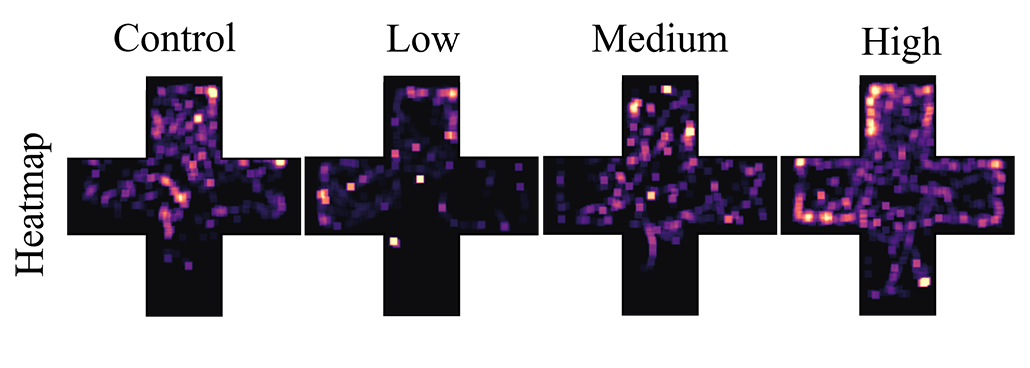
In another set of experiments, Sophia studied young zebrafish that had been exposed to different levels of caffeine. She looked at how far the fish swam and where. More caffeinated fish swam more, she says. They also made erratic choices, spending time in regions of their tank that calm fish typically avoided. Both of these findings hinted that the fish that got more caffeine were more anxious.

But Sophia didn’t stop there. She looked at what changes in the fishes’ brains might have led to this behavior. Sophia measured the activity of four genes involved in brain development. All four were less active in the caffeine-exposed fish, she found.

Takeaways for caffeine drinkers

Interestingly, some genes in the young zebrafish were turned down, or less active, in a way not seen in the neurons from adult rats. So, caffeine may affect the brain differently at different ages, Sophia says. But together, the mouse brain data, the rat neuron experiment and the fish studies all point to the same pattern. Caffeine seems to affect gene activity in neurons. And that in turn may impair brain development and behavior. 

a heat map showing how movement patterns of zebrafish shifted with caffeine exposure
Past caffeine exposure changed the movement patterns of zebrafish. As caffeine exposure increased, fish moved more erratically throughout the four zones of their aquarium. (The bright dots on the heatmaps show where the fish swam.) This evidence points to behavior changes and increased anxiety linked to caffeine.S. Zeng

“I feel that we really don’t talk about caffeine, even though we drink it,” Sophia says. It’s in so many everyday drinks, she adds. Between soda, tea and other beverages, young people may be consuming a lot more of it than they realize.

Sophia suggests greater skepticism about using this drug. People tend to think about caffeine as a helpful tool for focus, she notes, and dismiss potential downsides. But her findings highlight that caffeine comes with trade-offs — and those trade-offs may harm young brains more than we know.

This evolutionary biologist fuses art into her science

11 June 2026 at 11:30

When Victoria Glynn was a teen living in Honduras, she enjoyed making art. But that wasn’t her only interest. “Growing up in Central America, I was just surrounded by all of this amazing biodiversity,” she says. So, when it came to college, Glynn opted to study environmental science.

For undergrad studies, Glynn moved to the United States to attend the University of California, Berkeley. While there, she worked in a lab that genetically engineered yeast to produce biofuel. But she had a problem: Glynn was struggling to find diagrams to accompany talks about her research. Her mom suggested that she use her skills in art and make her own. “At the time, I wasn’t seeing other people doing that,” Glynn says. “It felt like science was in one corner, and all the arts and humanities were in the other.”

Glynn soon found other ways to bridge science and art. As an undergrad, she taught refugees and children who had recently arrived in the United States. She sometimes worked in classrooms where the students spoke many different languages. Art became a “common language for all of us to be on the same page,” she says.

Now as a visiting researcher at the University of Connecticut, Avery Point, Glynn studies how plankton are adapting to high temperatures. In this interview, she shares her experiences and advice with Science News Explores. (This interview has been edited for content and readability.)  

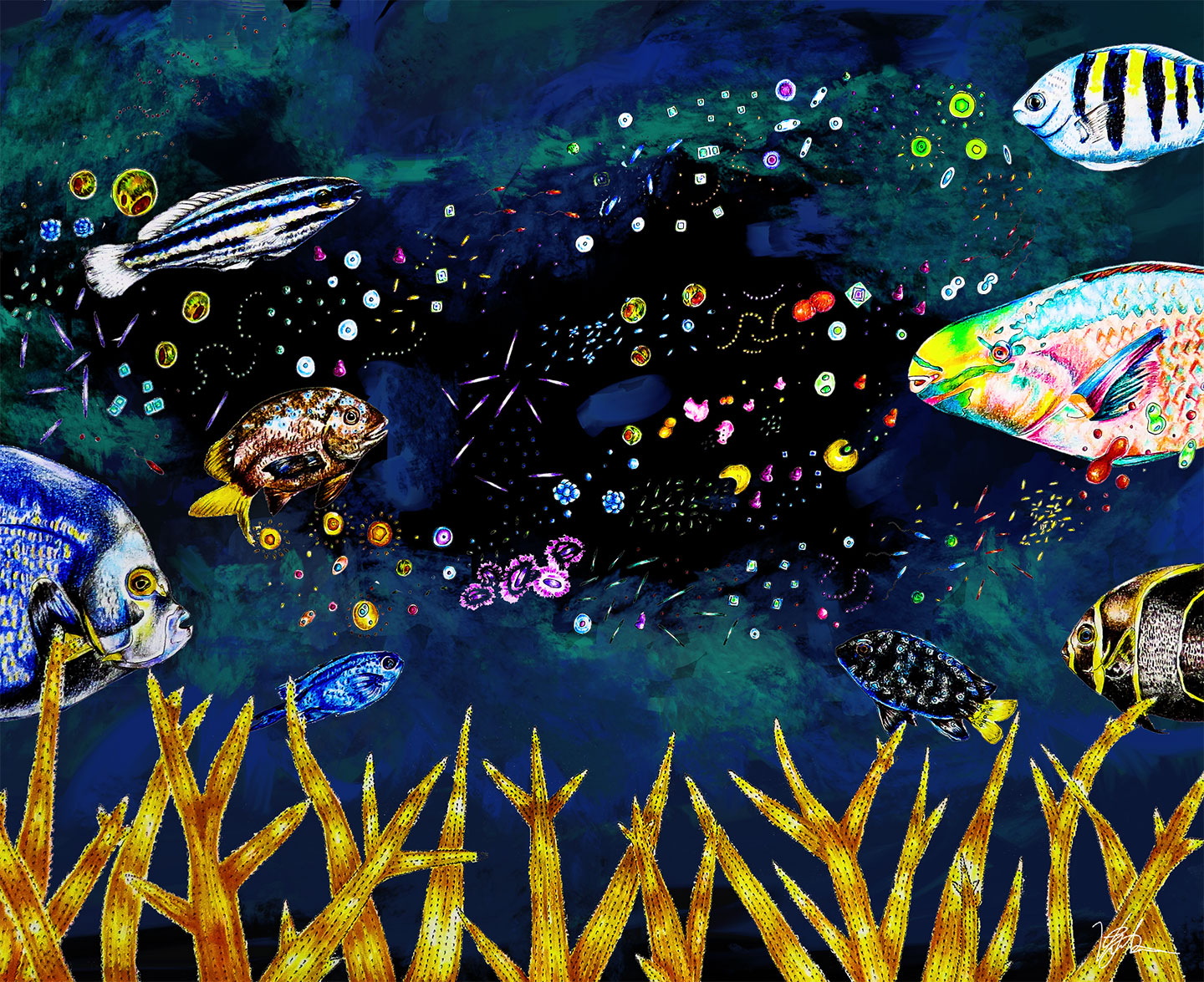
a colorful artwork depicting a reef, various reef dwelling fish and a lot of small organisms floating in the water
Glynn uses traditional media such as colored pencils and watercolor to create scientific illustrations.V. Glynn

What inspired your career?

I think what really inspired me was an undergrad class at Berkeley. One of my best friends recommended that I take this particular genetics course. I was unsure since the course wasn’t a requirement for my degree. The class seemed very removed from my interests at the time, but I still decided to enroll. I felt college was a time to explore and learn from various fields.

I remember something just clicking in my brain during one of the first lectures. Genetics and DNA felt so powerful. All organisms have DNA, which means you can track it and directly measure how it’s changing over time. Essentially, how it is evolving and mutating. After this class, I really wanted to dive into this topic more deeply.

How did you get to where you are today?

I didn’t do a lot of marine biology work until I was in my PhD. The lab I joined for my PhD at McGill University in Montreal, Canada, was looking for someone who did genetics work, preferably in marine invertebrates. I happened to fit the bill and was interested in the project. We would take corals from their home environment and bring them onto a boat to conduct temperature stress experiments. We were interested in seeing how they build up resistance to bleaching.                         

Corals are beautiful animals, but they’re very hard to rear in the lab. They’re very delicate animals that do not like being in tanks. They even struggle out on the reef. That unpredictability makes experiments very difficult.

For my post-doc, I switched to studying plankton to better understand how marine organisms are being affected by warming oceans. I needed an animal that could evolve quickly over multiple generations. Plankton are much easier to grow. In as little as 11 days, you can have adult plankton that lay eggs. Compare that to corals. Some species are so long-lived that they will not reproduce within our lifetime.

How did you decide to study science education?

I loved being an environmental science major, but I often missed that human connection when spending time in the lab. I also felt that sometimes the best researchers were not always the best at communicating their work with the general public. I wanted to share what I was learning with those who are the most affected.

Improved science communication leads to better science. In turn, embracing different backgrounds improves science education. It allows more people who are taking these courses to feel empowered and actually pursue STEM degrees. [STEM stands for science, technology, engineering and math.]

a photo of Victoria Glynn scuba-diving and conducting field work underwater
As an evolutionary biologist, Victoria Glynn has conducted field work underwater, such as sampling corals in Panama’s Las Perlas Archipelago.Michael Connelly

Scuba diving is both a hobby and part of your work. When did you pursue that?

Both of my parents are divers. When I was younger, they would always talk about it. Honduras is also one of the most affordable places to get dive certified. So when I turned 12, I decided to go for it.

As I was applying for my PhD, my mother suggested that I add diving onto my CV. [A CV, or curriculum vitae, is the academic version of a resume.] I doubted whether people were going to care but added it anyway. That was the one line out of my entire CV that my future PhD advisor picked out during our interview. He was looking for someone who could handle both diving in the field and doing molecular work in the lab.

That taught me that the experiences you may not see as valuable in professional settings may be what sets you apart. You don’t know where these experiences are going to lead.

What advice would you give those pursuing careers in STEM?

Oftentimes, you find the most unlikely mentors outside of your direct field of study. I think those can be the most important. Sometimes, those people gave me more powerful personal advice than my formal supervisors did. STEM degrees are difficult. But with a good support system, anything is possible.                                    

Received — 10 June 2026 ⏭ Science News Students

Like living mood rings, these bees change color when it turns humid

10 June 2026 at 11:30

When the weather gets muggy, iridescent bees shift their metallic hue, a new study finds.

The insects are a rich blue-green when the humidity is low. But as moisture levels in the air rise, their color changes: It turns a coppery green.

Many bees have a shimmery exoskeleton. So this reversible mood-ring–like effect might be quite common, scientists now say. The day-to-day color of other bees and insects might similarly change with humidity.

Jorge De La Cruz is a college student at the University of California, Santa Barbara. There, he’s training as an evolutionary biologist. He first noticed the color-change effect while preparing bee specimens for preservation and study. This was at the Cheadle Center for Biodiversity and Ecological Restoration.

Museum scientists often place insect specimens in a moist chamber. It makes them more flexible for mounting and imaging. And under moist conditions, some bees appeared to starkly shift their color. This caught De La Cruz’s attention.

“It can be a bit alarming when you’re not expecting it,” says Madeleine Ostwald. This ecologist works at Queen Mary University of London in England.

De La Cruz and Ostwald teamed up with two other researchers to look into this further. They shared what they learned April 22 in Biology Letters.

An iridescent green bee is shown perched on a purple flower
This sweat bee was photographed in Seattle, Wash. Its exoskeleton changes color with the humidity. Other iridescent insects may pull a similar color-change trick.Mike Davidson/iNaturalist

Humidity changes hue

The team studied two dozen museum bee specimens. All were fine-striped sweat bees (Agapostemon subtilior). The bees were exposed to high and low humidity for 55 hours each. After each exposure, the team took photos.

The researchers also reviewed more than 1,000 photos of living sweat bees. These came from the citizen-science app iNaturalist. Here, too, they noted the humidity present when an image had been taken. 

In dry conditions (less than 10 percent humidity), the bees were blue-green. But at 95 percent humidity, they turned a light, coppery green.

Humidity may cause layers in the bees’ exoskeletons to swell. That may change how those layers reflect light, creating an iridescence. That layering appears to scatter light at different wavelengths, creating colors. If the layers swelled, the space between them would increase. The extra space would reflect longer, redder light.

“Because we saw redder bees in more humid conditions, this fits with that [scientific explanation],” Ostwald says.

Future work with high-powered microscopes might confirm this. Lots of insects produce color with tiny structures rather than pigments, Ostwald says. So, the phenomenon might be widespread.

Color can be really changeable as something responds to the environment, she says — and “in ways we didn’t expect.” It’s important to study the color of the living organism in its natural environment to know its true hue.

Received — 9 June 2026 ⏭ Science News Students

Imagination is not just replaying what we’ve seen and heard

9 June 2026 at 11:30

When you imagine a waterfall, what comes to mind? Maybe a misty cascade into a blue pool surrounded by trees. Perhaps the roar of water splashing down, as well. It’s a big mystery how brain activity differs when imagining a waterfall versus seeing or hearing one in real life. Brain scans now suggest some activity when you imagine something is similar to what happens when you see or hear the real thing.

But that overlap did not appear in brain areas that deal with single senses. Instead, it showed up in high-level brain networks. These are ones that handle inputs from multiple types of senses.

Researchers shared these findings March 31 in Neuron.

a photo of a clearing with a small stream and a waterfall, surrounded by lush green plants and mosses
Imagining a scene such as this one activates various areas of the brain, a new study shows. sara_winter/iStock/Getty Images Plus

Neuroscientist Rodrigo Braga led the research. “When I was a teenager,” he says, “I remember the first time realizing that there’s like a voice I can hear in my head.” This “internal monologue” narrates one’s own thoughts.

“That’s really strange,” Braga recalls thinking. “Why is it that we experience those thoughts and sensations almost as if we’re perceiving them?”

He’s spent years trying to answer that question. He now works at Northwestern University’s Feinberg School of Medicine. It’s in Chicago, Ill. In a new study, his team asked eight people to imagine scenes, faces, someone else speaking, their own internal monologues and other sounds. All the while, an MRI machine scanned their brains.

Having hours of MRI data on all eight people allowed the team to create individualized brain maps for each. These showed how each person’s brain activity changed during imagination.

The imagination prompts that people got were open-ended. One was: “Imagine a castle on a hill.” Another: “Imagine a rock song playing on the radio.” After each prompt, the scientists asked people what they saw and heard in their heads. The questions probed how vivid each imagined experience had been — how clear and realistic it felt.

After completing the brain scans, Braga’s team asked follow-up questions. These explored what made some mental images more vivid than others.

Under the hood of imagination

The researchers grouped their data into two buckets. In one, they put the data on imagined locations and events. In the other, they grouped the data on imagined speech and language.

When people were thinking about locations or events, they reported highly vivid sights in their mind’s eye. Activity also went up in their brains’ “default network A.” This is a system of nerve cells in the brain — neurons — known to process real spatial information.

When people thought about speech or language, they reported hearing highly vivid sounds in their heads. Activity also spiked in their brains’ language network. This system of neurons is usually involved when someone reads or listens to speech.

In short, imaginary sights and sounds both enlisted parts of the brain used to process real experiences.

But imagined sensations did not activate sight- and sound-specific parts of the brain. Rather, the default network A and language network respond to new information — no matter what sense it had entered through.

Do you have a science question? We can help!

Submit your question here, and we might answer it an upcoming issue of Science News Explores

Explaining the data

Other studies have found that when someone imagines a certain object they’ve just seen, vision-specific brain regions light up. In this study, prompts to imagine more general scenes did not do that.

That might be because the basic visual areas of the brain respond to details like edges, colors and lines, says Nathan Anderson. Those fine details might matter when someone is asked to picture a real object they saw. But, he notes, “people don’t necessarily imagine fine details when they are imagining a [general] scene.” So the neurons that handle specific visual details aren’t needed. Anderson is a neuroscientist who took part in the study. He works at Brigham Young University in Provo, Utah.

These findings don’t surprise Stephen Kosslyn. Since the prompts didn’t ask people to imagine detailed sights or sounds, he says it makes sense that the brain regions linked to those tasks didn’t light up. Kosslyn is a neuroscientist at Harvard University in Cambridge, Mass. He did not take part in the new work.

Open-ended prompts are a strength of the study, says Alfredo Spagna. A psychologist, he works at John Cabot University in Rome, Italy, and did not take part in the study. Everyday mental imagery is likely closer to imagining a castle on a hill than it is to picturing the tiny details of something you just saw, he says. So the open-ended prompts used here probably closely mimic what’s happening in our brains day-to-day.

But there’s still much to learn about how the brain conjures sights and sounds that feel so real. “This is one of the many papers that will come out in the next years that try to break down this obscure concept of vividness,” says Spagna.

Received — 8 June 2026 ⏭ Science News Students

Scientists Say: Synesthesia

Synesthesia (noun, “sin-es-THEE-jah”)

Synesthesia is a trait that some people have in which one kind of sensory input triggers other senses. To someone with synesthesia, different colors may have different tastes. Or hearing certain sounds may cause them to see certain shapes.

This phenomenon is not a mental illness. Rather, it is considered a form of neurodiversity. Up to 4 percent of people may have some form of synesthesia.

This trait takes many forms. Grapheme-color is one type. This means that a person sees letters or numbers in different colors. For instance, when a person sees the number 7, it may always appear yellow. About 1 percent of people share this trait.

Another type is called chromesthesia. That’s when hearing a sound causes a person to see colors or shapes around them. Historians think that Vincent van Gogh, a 19th-century painter, may have had this trait. He described seeing colors around him when he played the keys of a piano.

Other famous artists, such as singer and songwriter Billie Eilish, have described this experience, too. “Everything that I make I’m already thinking of what color it is, and what texture it is, and what day of the week it is, and what number it is, and what shape,” the musician told iHeart Radio.

Scientists are not sure exactly what causes synesthesia. But they believe it is at least partly linked to a person’s genes.

In a sentence

Taria Camerino — a chef based in Atlanta, Ga. — was born with a form of synesthesia that links certain sounds with flavors.

Check out the full list of Scientists Say.

NASA’s DART spacecraft changed 2 asteroids’ orbit around the sun

8 June 2026 at 11:30

For the first time, humankind has changed a space rock’s orbit around the sun.

Four years ago, NASA rammed its DART spacecraft into the asteroid Dimorphos. The goal was to see if a space probe could change an asteroid’s motion. Why? It could be useful if a big rock were ever headed for Earth.

Soon after the crash, it was clear that DART had knocked its asteroid closer to Didymos, an even bigger rock that it orbits. Now, NASA reports that the smashup had an even bigger impact. It changed the asteroid duo’s speed as they orbit the sun together.

DART’s crash landing slowed the asteroid pair by 10 micrometers per second. That might not sound like much. But tweaking the motions of space rocks millions of kilometers (miles) from Earth is a huge deal. It could inform plans for shielding our planet from future asteroid strikes.

Researchers shared the findings March 6 in Science Advances.

DART is short for Double Asteroid Redirection Test. The initial goal had been to simply nudge Dimorphos into a tighter orbit around Didymos. Mission leaders aimed to cut 73 seconds off Dimorphos’ nearly 12-hour path around its partner. In reality, the crash shortened Dimorphos’ orbit around Didymos by 32 minutes.

Most of that change came from the impact itself. Like giving the asteroid a big shove, the spacecraft pushed Dimorphos closer to Didymos. The crash also blasted rocks off Dimorphos’ surface. The motion of that flying debris gave the asteroid an extra kick.

But some of the debris knocked off Dimorphos didn’t just leave that space rock. It escaped the gravity of the two-asteroid system altogether. That escaping debris took some momentum away from the duo. As a result, their joint motion around the sun changed, reports Rahil Makadia. He studies planetary defense at the University of Illinois in Urbana–Champaign.

Clues in tiny eclipses

To figure out how much the asteroids’ motion changed, astronomers watched the rocks pass in front of distant stars. As the asteroids passed by, they dimmed some of the stars’ light — like tiny eclipses. These blinks can be seen only from specific locations, which can fall anywhere on Earth.  

Astronomers could predict when Dimorphos and Didymos should pass in front of stars, based on their old path around the sun. By comparing those predictions to observations, they could see how much the asteroids’ path changed after DART’s hit.

Between October 2022 and March 2025, Makadia and the team gathered 22 such measurements. Amateur astronomers provided a lot of these data, Makadia says. “There was an observer who drove two days each way into the Australian outback to get these measurements.”

The asteroids’ orbit around the sun was about 150 milliseconds longer than before the DART impact, the new data show.

The European Space Agency’s Hera spacecraft will reach Didymos and Dimorphos later this year. When it does, the spacecraft could confirm the asteroids’ new orbit.

Didymos and Dimorphos were not a threat to Earth before DART. They aren’t now, either. But knowing how an impact changes one asteroid’s orbit can help figure out how to defend Earth from a dangerously big incoming space rock. That’s crucial, Makadia says, “in case we need to [deflect an asteroid] for real.”

Do you have a science question? We can help!

Submit your question here, and we might answer it an upcoming issue of Science News Explores

Received — 5 June 2026 ⏭ Science News Students

Explainer: What are corals?

5 June 2026 at 11:30

Take a plunge into Australia’s Great Barrier Reef, and you’ll come face to face with a what looks like a gorgeous rocky garden. This dazzling array of corals is the largest living structure on Earth. Some, like staghorn coral, look like leafless bushes sprouting from the ocean floor. Others, such as honeycomb coral, resemble rocks dotted with tiny holes. Then there’s brain coral, which, you guessed it, look like brains. And that’s just a small sample of the brilliant diversity to be found in a reef.

Despite their appearance, corals are animals. These invertebrates are close relatives of jellyfish and sea anemones. Most corals live in colonies of thousands of tiny individuals called polyps growing together. Each polyp sports a cylindrical body topped with a ring of tentacles surrounding its mouth.

“You can think of them as upside-down jellyfish,” says Peter Cowman. At Queensland Museum Tropics in Townsville, Australia, this marine biologist studies the evolutionary history of corals.

a diagram showing the anatomy of a coral polyp, including a zoomed in section showing the nematocysts and zooxanthellae
A coral looks somewhat like an upside-down jellyfish, one that is attached to a skeleton made of calcium carbonate. In the coral’s tentacles are stinging nematocysts that help it catch prey and zooxanthellae that make energy from sunlight.ttsz/iStock/Getty Images Plus

Like their jellyfish cousins, coral polyps use tentacles to feed and defend themselves. These appendages are packed with specialized stinging cells called nematocysts. Each contains a coiled, barbed thread. When touched, the cell “fires” this thread to inject venom into its target. Most corals hunt at night, snagging tiny zooplankton, floating eggs and small fish.

Many corals have a more laid-back way of feeding, too. Inside their tissues, they house algae called zooxanthellae (Zoh-uh-ZAN-thuh-lay). (This is an example of symbiosis, where two creatures benefit by associating together.) These single-celled organisms are photosynthetic. They use light and carbon dioxide to make sugars and proteins. Most of these nutrients are offered to the coral. “In return, the coral gives them a safe apartment to live in,” says Cowman. “They’re the solar-powered roommates.”

Corals that rely on light-powered algae live in shallow, warm waters. It’s here where you find coral reefs. These structures are made by a type of coral called hard or stony corals. “They are the engineers of the reef system,” says Cowman.

Stony corals produce hard skeletons of aragonite, a mineral made of calcium carbonate. Over hundreds to thousands of years, generations of polyps can build up massive reef systems.

Soft corals, like their name implies, don’t make these stony skeletons. Instead, they have bendy structures that move with ocean currents. They can often be found living among reefs, though. “The soft corals are like the decorators,” says Cowman. “They look like underwater swaying trees and fans.”

Some corals — both soft and hard — can live in deep water, up to 6,000 meters (20,000 feet) below the water surface. Stony corals found at these depths are often smaller than their shallow-water counterparts. Most tend to live as single polyps. Some species do create reefs, but they’re less of a team effort. Called “mounds,” these deep reefs grow over the skeletons of old or dead corals on the ocean floor. 

Reefs at risk

The first true corals appeared about 500 million years ago. But many of today’s reef-building corals can be traced back to the end of the Cretaceous Period some 66 million years ago. That’s when an asteroid impact wiped out about 80 percent of all animals (including the nonbird dinosaurs).

“The mass extinction had an effect in the oceans as well,” says Cowman. Existing reef-builders died out. Their extinction allowed stony corals to take their place. Today, corals are found in all of the world’s oceans.

But many are at risk from human activities. These dangers include pollution and destructive or heavy fishing. One of the biggest threats is climate change. High water temperatures and too much sunlight can stress corals, leading to a phenomenon called coral bleaching.

an illustration showing healthy, stressed and bleached coral and what happens to the coral's algae in each stage
When coral is stressed, such as when water temperatures are high, it can lose its algae — and its color. If the stress goes away, the algae may return. If not, the coral remain pale and vulnerable.NOAA

At higher temperatures, the algae produce toxic compounds. “When the water gets too hot, the coral gets stressed and they evict their zooxanthellae,” says Cowman. These microbes are also responsible for a coral’s bright colors. In their absence, the coral’s tissues turn transparent. All that remains visible is the coral’s white skeleton.

Bleaching doesn’t kill the coral immediately. If conditions improve, the coral may recover and even take the algae back in. But if coral go too long without their algal partners, they may get sick or die. “If they can’t get the zooxanthellae back in again, they [will] actually starve to death,” says Cowman.

This bleaching affects coral worldwide. Since 2023, the world’s corals have been experiencing the largest bleaching event on record.

an underwater photo of a coral reef showing a school of fish sheltering under a coral outcrop
Coral reefs, such as this one off Florida, face many risks, including climate change, pollution and overfishing. DurdenImages/iStock/Getty Images Plus

Rainforests of the sea

Many scientists and conservationists are concerned about corals’ future. Coral reefs are among Earth’s most diverse ecosystems. Though they cover less than one percent of the seafloor, coral reefs support at least one-fourth of all marine species. “On land, you think of rainforests as having all that diversity,” says Cowman. “The rainforests of the sea are the coral reefs.”

Corals are important for people, too. Humans rely on many reef-dwelling species for food. Reefs can also buffer coasts against damage from strong waves or storms, says Cowman. Chemical compounds from reef animals have been found to help fight pain and treat cancer. And reefs support tourism around the globe. The food, products, jobs and coastal protection provided by corals are estimated to be worth $2.7 trillion per year.

Says Cowman, “as humans, we rely on reefs a lot in our daily lives, even if we don’t think of it.”

Received — 4 June 2026 ⏭ Science News Students

Some of these Smithsonian secrets might just blow your mind

4 June 2026 at 11:30

Meteorites that are billions of years old. Alienlike worms. A blue whale’s massive jaw bones. These are just some of the millions of marvels at the Smithsonian Institution.

Most are part of the Smithsonian’s National Museum of Natural History collection, a trove of nearly 150 million objects. It includes a spectacular array of preserved life forms, rocks and cultural artifacts from around the world.

Few people have ever seen this vast collection of astonishing objects. The museum in Washington, D.C., only displays a small share of the items. Most sit tucked away in huge storage pods at the Smithsonian’s Museum Support Center (MSC). This site in Suitland, Md., is not open to the public.

But Science News was able to get a behind-the-scenes peek.

Lining MSC’s hushed halls are rows of cream-colored cabinets and kilometers (miles) of shelving. Scientists led us through long corridors, pointing out prime treasures along the way. We saw and touched an abundance of specimens that captivate the mind and eyes. Some items even had odors — like a freeze-dried crabeater seal. It smelled like burnt soy sauce.

But MSC is not just a giant storage unit. It’s a place scientists visit to do research and answer big questions about our planet. Forget the idea that museums are old and dusty, says Kirk Johnson. He’s the director of the National Museum of Natural History. Museums, he argues, are “vastly more vibrant and more important” than most people realize.

A protected collection

MSC opened in 1983 when the Smithsonian needed more space for items in its already overcrowded natural history museum. Each of the center’s five storage pods is about the size of a football field. And they’re nearly three stories tall. A sixth pod is in the works.

Their key goal: Protect the specimens.

MSC carefully controls the temperature and humidity inside each pod. It also shields these storage areas against pests.

A vast collection

148 million
Items in the museum’s collection

11,945
Items on display at the museum

95,287
New items acquired in 2025

34.5 million +
Items in the entomology collection

Security guards patrol the premises 24/7. Along the way, they watch for power outages, floods, flames and explosions. Huge freezers need power to keep tissues and DNA samples ultracold. Dried specimens can be damaged by fire and water. And wet items in alcohol-filled jars are at risk of drying out — or blowing up.

MSC’s stash is part of a “forever” collection. They’re available to study today and in the future. Scientists are now, for instance, analyzing African elephant DNA stored here. The elephant that this genetic material comes from is thought to belong to a population that has long evaded humans.

Past work on bird eggs collected decades ago helped reveal that the insecticide DDT had built up in their shells and thinned them. This nearly drove some species — including the bald eagle — to extinction. Evidence of DDT’s harm to wildlife helped lead the United States to ban the chemical in 1972.

“There’s a cloud of knowledge about the planet that exists only because we have collections in museums,” Johnson says.

Scientists who work here are passionate about the knowledge stored in MSC’s pods. As we moved from one area to another, staff members would race to show us “just one more thing!” A coil of feathered money, for instance, that was once used on the Santa Cruz Islands in the South Pacific.

Items stowed at the MSC or on display at the museum represent everything that we know about the planet, says Rebecca Johnson. She’s the museum’s chief scientist (and unrelated to Kirk). “This is the record of the world,” she says.

In an age of AI, it can be difficult to tell truth from fiction. But MSC’s treasures let us see and touch and smell and study our planet’s reality. “People still want to know what is real,” Rebecca Johnson says. “This is the place where we have the real thing.”

Let’s go on a field trip

Our private MSC tour introduced us to a colossal cache of objects. We saw items that dazzled and brought chills. We wanted to photograph everything. In a place that’s home to millions of objects, how do you pick what to feature?

We chose items with an eye to what stood out in size or peculiarity. We also focused on those with intriguing backstories. We could fill entire books with photos and the histories of these items. Instead, we’ll highlight our favorites.

Most likely to haunt your dreams

The Antarctic scale worm
An Antarctic scale worm in a clear jar filled with alcohol.
Stephen Voss

This giant worm (Eulagisca gigantea, center) has true horror-movie potential. It has mouth parts that can extend out and retract in, as well as a toothed jaw. But don’t worry. These worms typically live on the sea floor. So you’ll likely never encounter a live one. This specimen is part of MSC’s wet collection — stuff preserved in fluid.

Most likely to make you feel very small

The jaw bones of a blue whale

Here, Michael McGowen stands inside the massive lower jaw bones of a blue whale (Balaenoptera musculus). McGowen cares for MSC’s marine mammal specimens. The whale whose jaws he’s posing with was an adult female that once lived off the coast of Antarctica.

A man stands between the jaw bones of a blue whale.
Stephen Voss

Weighing 2 metric tons and measuring nearly 7 meters (23 feet) long, the jaws are the largest bones in the collection. Blue whale jaws, in fact, are the largest bones of any animal ever. McGowen studies the evolution and genetics of whales and other cetaceans. He loves coming to this Whale Bone Repository — a building big enough to house airplanes. “I’m always in awe,” he says.

Most likely to keep calm and carry on

A North Atlantic right whale

This bizarre-looking backbone belongs to a North Atlantic right whale (Eubalaena glacialis). Named Tips, this 14-meter (46-foot) brute appears to have survived a collision with a ship. Squiggles of bone protrude from one section of his vertebrae — a sign of injured tissue that didn’t heal cleanly.

The back bone of a North Atlantic right whale.
Stephen Voss

Tips died in 2010, possibly from being caught in fishing gear. Getting tangled in gear or struck by ships are two major threats to right whales. Fewer than 400 individuals of this endangered species remain.

Biggest buzzkill

The world’s largest mosquito collection

There are some 2 million mosquitoes in MSC’s collection. It’s the most diverse bunch of these bloodsuckers in the world.

A close up photo of pinned mosquitoes.
Stephen Voss

The Uranotaenia sapphirina mosquitoes seen here may not be much of a nuisance — to humans, at least. They’re among just a handful of modern mosquito species that feed on cold-blooded creatures. Their victims include earthworms and leeches, says Yvonne-Marie Linton. She cares for MSC’s insect specimens.

Best dressed

The pink fairy armadillo

In life, this pink fairy armadillo (Chlamyphorus truncatus, left) would have been a fashion designer’s dream. It boasts both a lovely pale pink shell and whitish fur. The shell gets its hue from blood vessels and may help the smallest armadillo species control its body temperature.

Three preserved armadillo specimens on a table.
Stephen Voss

Check out those oversized claws, used for burrowing. They grow even bigger in the greater fairy armadillo (Calyptophractus retusus, middle). And they get bigger still in the giant armadillo (Priodontes maximus, claws shown on right).

Biggest stinker

The tongue orchid
A giant orchid with leaves that look like tongues.
Stephen Voss

This massive plant is part of the Smithsonian Gardens Orchid Collection. It’s one of the largest orchid species on Earth. Bulbophyllum fletcherianum has leaves that can stretch nearly 2 meters (6.5 feet). But it’s known for more than epic leafage.

Its blooms give off the foul stench of rotting flesh. That scent attracts insects, such as blow flies or carrion beetles. Those insects are looking to lay eggs in dead and decaying animals. But when the tongue orchid’s smell draws them in, they help the plant by pollinating it.

Most likely to be mistaken for a mushroom

A Dracula orchid
A three-leaf orchid in a person's hand.
Stephen Voss

The Dracula orchid gets its name from its blood-red coloring and long, pointy structures. The plant (Dracula chimaera ‘Pacifica’) grows in Ecuador and Colombia. To fungus gnats, the orchid’s blooms have the alluring odor of mushrooms. Those flowers kind of look like mushrooms, too. Fine ribs decorate their central, pouchlike petals. This feature mimics the gills on a mushroom.

Most likely to make you take a closer look

The wet collection
Specimens perserved in alcohol-filled jars on shelves.
Stephen Voss

Resting in row upon row of jars, some 25 million MSC specimens sit preserved in fluid. Included among them are sand dollars, shrimp, coral, slipper lobsters and octopuses. Together, they take up roughly 72 kilometers (45 miles) of shelving. That’s more than four times as long as trails to the bottom of the Grand Canyon.

Most of these jars are filled with ethanol, nearly 2 million liters (530,000 gallons) in total. This alcohol evaporates over time. So all of the jars need to be topped off to keep their specimens from drying out.

Most likely to strip the flesh from your bones

The hide beetle

Flesh-eating beetles might sound terrifying. But they feast on the dead, not the living. And it’s the baby beetles — or larvae — that do most of the meat-eating, anyway, explains Inger Toraason. So this hide beetle (Dermestes maculatus) on his hand poses no danger of chowing down. In fact, this insect — and thousands of its buddies — are closer to Toraason’s coworkers than specimens.

Toraason takes care of bone specimens at MSC. Flesh-eating beetles help clean animal bones for him. They eat tissue off specimens being prepped for the museum’s collections. It’s a big job. The beetles cleaned 429 skeletons in 2025 alone. They can strip a hummingbird’s bones in less than a day. A whale skull might take months.

A small beetle in the palm of a hand. Inset is a photo of an owl skeleton in a jar.
Stephen Voss

Beetle-cleaned bones then go through several more steps to be preserved. Toraason picks off any remaining flesh by hand. Then he soaks the bones in a cleaning solution. You can see an example of this with the skeleton of a little owl (Athene noctua, inset).

If Toraason and his coworkers didn’t have beetles on their side, they could simply let flesh rot away in water. But that’s a long process. And it leaves behind just a pile of bones. With the hide beetles, the team gets an intact skeleton at the end. The beetles are “our little unsung heroes of the museum,” he says.

Finest feathers

Bird-of-paradise headdress ornaments
A tagged bird specimen with orange, brown and green feathers.
Stephen Voss

These vibrant ornaments were once used in headdresses by people in what is now Papua New Guinea. Made from Raggiana birds-of-paradise (Paradisaea raggiana), they’re meant to move, says Joshua Bell. At MSC, he curates cultural artifacts from around the world.

Men and sometimes women wore these ornaments while dancing in ritual performances, Bell says. Glinting light and rapid motion would have blurred the red feathers. It would appear almost as if the dancers were transforming into birds themselves.

Most likely to ghost you

Henry the elephant
The skull of an African bush elephant.
Stephen Voss

Every year, some 4 million people walk past Henry, a towering stuffed elephant in the natural history museum in Washington, D.C. Few realize the elephant’s skull (shown) is stored at MSC.

This African bush elephant (Loxodonta africana) was roughly 4 meters tall (13 feet) and weighed 11 metric tons. He’s the largest elephant in any museum. He may have belonged to a group of “ghost” elephants in Angola that gained renown for avoiding humans.

Received — 3 June 2026 ⏭ Science News Students

Nature-inspired rocket-nozzle redesign stands by for liftoff

When it comes to rockets, bell-shaped engines are the norm. But they’re not the most efficient shape. Engineers have relied on this design only because it avoids a known overheating risk faced by a more efficient engine. Now, though, three 17-year-olds have redesigned the nozzle of the more efficient aerospike engine to better manage heat.

They’re hoping that one day their new tech might literally shoot for the stars.

Devin Wanchoo, Michael Obeng and Mazon Ben Chouikha attend Governor’s School at Innovation Park in Manassas, Va. Their new work began as a way to satisfy a class assignment. “We wanted to do something in aerospace. We wanted to do something involving biomimicry. And then we wanted to do something that no one has done before,” says Michael.

Those motivations led them to refine a better rocket system.

three smiling young black men hold their new aerospike nozzle at ISEF
Michael Obeng (left), Mazon Ben Chouikha (middle) and Devin Wanchoo (right) hold a model of their new aerospike nozzle. They’ve improved the heat tolerance of the aerospike design using a novel machine-learning algorithm and some inspiration from Mother Nature. K.G. Carpenter

During their research, the young engineers learned that bell-shaped rocket engines become less powerful the higher they ascend. For decades, engineers have experimented with an alternative that would avoid this limitation: the aerospike engine.

Unfortunately, this design has its own big limitation: It shoots super-hot exhaust gases from the engine right up against its spike structure. Eventually, that heat can “cause the spike body to melt and crack under thermal stress,” Devin says.

Their work won these teens a spot here at the 2026 Regeneron International Science and Engineering Fair, or ISEF. The event is a program of the Society for Science (which also publishes this magazine). The young aerospike researchers were among 1,725 students — from 65 nations or territories — who competed at the 76th annual ISEF. These participants shared nearly $7 million in prizes.

A guiding spike

Imagine a rocket launch. Flames burst downward from the engines and propel the rocket upward. Initially, the flames form a column.

If you were to fly alongside the rocket as it ascends, you’d eventually see the shape of that exhaust change. The column of gases would start to balloon outward.

This 60-second video illustrates why aerospike engines would be so much more efficient than today’s bell-shaped alternatives — if you could get aerospikes to manage the heat of the exhaust gases moving through them.

During liftoff, high atmospheric pressure initially forces the gases into that column shape. But as the rocket climbs, the air pressure weakens — and so does control of the exhaust gases. Now they spread out, reducing lift.

The thrust must go down for the rocket to go up. But higher up, as the gases balloon out, bell-shaped engines “can lose up to 30 percent of their efficiency,” says Devin.

Engineers have been looking to overcome that. And the aerospike engine is one possible solution.

“Unlike a bell nozzle — which needs that giant encasing structure — the aerospike just has its central spike,” Devin explains. It will deliver a strong, reliable upward thrust as long as you have some way “to force gases [down] along the spike wall.”

Those gases flow along the spike’s surface. The spike acts as a guide to direct the gases down so they can’t spread out. But that guiding spike introduces its own problem.

Coming from the engine, exhaust gases “are extremely hot,” notes Michael. The spike’s tip takes a pummeling from those gases. Their heat is “essentially attacking it, attacking it, attacking it,” he says.

What’s more, those gases tend to recirculate along the spike. This helps counter the air pressure’s attempt to weaken the downward flow of the gases, Michael says. Unfortunately, he adds, it also increases the heat.

So what makes this engine so good at maintaining a strong downward flow of exhaust gases, Devin points out, “is the same thing that causes that very aggressive heating of the spike body.”

Typical cooling methods just haven’t been good enough to spare the spike.

Do you have a science question? We can help!

Submit your question here, and we might answer it an upcoming issue of Science News Explores

Nature-inspired

To counter that, the trio looked for inspiration in nature. Living things have evolved different ways to cool themselves. The team considered plant veins, insect exoskeletons, shark tissues and more. Then the trio created ICARUS, a machine-learning algorithm, and used it to test bio-based cooling strategies.

ICARUS, says Devin, is “probably the most novel part” of their project. It’s a simpler, heat-driven version of tools used by the aerospace industry. And it does more than just test ideas. “We built it on a machine-learning layer that was able to suggest [spike shapes] to try,” Devin says.

The young engineers started with shapes suggested by nature. Then they used ICARUS to optimize those designs. For instance, says Mazon, his team might suggest a certain surface pattern or feature. Then ICARUS “might change the width of it [or] the depth of it” to optimize the spike’s heat resistance.

The approach worked. Heat flux refers to how fast heat moves through a material. “We were able to reduce temperatures and heat flux by up to 40 percent,” Devin says.

Human skin inspired their most successful design, Devin says. Pores in our skin release sweat. As it evaporates, it wicks away heat. Mimicking this trick helped “bleed propellant to fight back against that heat creep,” says Devin.

Validating ICARUS

Using what they learned from ICARUS, the team members 3-D printed models of the six most promising designs. Then they put the models under a heat gun and measured how long each took to reach 90° and 110° Celsius (194° and 230° Fahrenheit), says Devin. They also tracked at what temps the models began to warp.

Then they built a copper prototype of their best-performing model. In the final stage of testing, Michael says, they became the first high school students to ever do a cold-flow test on such an engine. A cold-flow test, explains Devin, is “just testing that your engine can pressurize properly and that propellants are flowing.”

This test was “pretty cool,” he says. “We got to verify our ICARUS predictions.”

two young men are getting their engine nozzle aparatus ready for a test, they're in a field
Devin Wanchoo and Michael Obeng prepare to conduct a cold-flow test of their new engine nozzle. They believe they are the first high schoolers to do so with a linear nitrogen oxide/ethanol aerospike system.M. Obeng, M.B. Chouikha and D. Wanchoo

ICARUS can also offer design tips beyond rocketry, Mazon says. For instance, the surface patterns designed to manage heat could even be applied to homes. “If you were to put [these patterns] on wood and you built the house, then it’s very likely to be safer” in terms of withstanding wildfires, he says.

For their work, Devin, Michael and Mazon took home fourth place — and $600 — in ISEF’s Engineering Technology: Statics and Dynamics division.

Received — 2 June 2026 ⏭ Science News Students

Some people use echolocation to get around. Here’s how it works

2 June 2026 at 11:30

Many blind people navigate the world using a cane, guide dog or wearable GPS. But some have something more in their toolkit: echolocation. That’s the ability to sense nearby objects using sound. A new study shows just how master echolocators use this technique to get around.

These people make a sharp clicking sound with their tongue. (Watch the process in action.) Then they listen for its echo to sense where objects are around them. New brain-activity data show that with each click, expert echolocators improve these mental maps of their environment.  

Researchers shared these findings April 6 in eNeuro.

Clicking and listening for echoes can provide information about the location of nearby objects. Or their size. Maybe even their texture. (Bats use this same process to find their way as they flap through the night sky.)

Many studies have shown that in people, echolocation turns on parts of the brain that have to do with sight. They’ve also shown that echolocation improves a lot with practice.

But scientists still don’t know “how this happens,” says Santani Teng. “How the information builds in real time” beyond what can be learned from each individual echo. He and co-author Haydée García-Lázaro work at the Smith-Kettlewell Eye Research Institute. It’s in San Francisco, Calif. As cognitive neuroscientists, the two study how our brains think, learn and process information.

Mental mapping

To better understand human echolocation, they recorded clicks and echoes. They designed these echoes to act as if they were bouncing off a nearby object. Then, the scientists compared how two groups of volunteers responded to these recordings.

The four blind people in one group were all experts in echolocation. The other group of 21 people could see well. They also had no experience with echolocation.

Each volunteer listened to the recorded clicks followed by their echoes. The sounds were played in sets of two, five, eight or 11. After each set, these people were asked to decide whether an object had been to their right or left. As they listened, electrode caps on their heads recorded their brain activity.

The blind echolocators excelled at figuring out an object’s direction. They scored far better than those who could see. In fact, one echolocator figured out an object’s direction after hearing only two sets of clicks and echoes.

The brain data showed that each click-echo pair gives new details about the surroundings. Echolocators combine these additional details over time, “rather than through a single optimal snapshot,” says Monica Gori. She’s a neuroscientist who did not take part in this study. She works at the Italian Institute of Technology in Genoa. She also works with the Institute for Human & Machine Cognition in Pensacola, Fla.  

García-Lázaro says she and Teng want to learn more about “what exactly makes better echolocators.” She’s especially curious about how experts learn to ignore the click and focus only on its echo.

This “is not magic,” says Teng. “Echolocators have a truly remarkable skill, with real-life benefits.”

Do you have a science question? We can help!

Submit your question here, and we might answer it an upcoming issue of Science News Explores

Received — 1 June 2026 ⏭ Science News Students

These 12,000-year-old Native American dice are the oldest in the world

1 June 2026 at 11:30

Ancient cultures across the globe have been playing games of chance — using dice — far, far longer than historians had ever realized, a new study finds. Researchers turned up these gaming pieces from as far back as 12,000 years ago. That makes them the oldest known dice.

These came from western North America. Until their discovery, the oldest known dice were from Mesopotamia, an ancient region in what is now Iraq. The oldest of those were only about 5,500 years old.

Many Native American cultures have a rich history of dice games and still play them today.

Such games could have helped foster social connection, says archaeologist Robert Weiner, who was not part of the new study. If you meet strangers, “how are you going to interact?” he asks. Dice games could have offered one way for strangers to bond. Weiner works at Dartmouth College in Hanover, N.H.

But until now, the roots of early American dice games had been fuzzy. Robert Madden hoped to track down those origins. In the April 2 American Antiquity, he describes the search for the earliest dice in what is now the mainland United States.

Dice defined

Madden, too, is an archaeologist. He works at Colorado State University in Fort Collins. He started his search by sifting through records of Native American artifacts. He was scouting for objects that might be dice.

He set rules for sorting out possible dice. Most Native American dice are two-sided with at least one side marked. So that’s what Madden looked for. He rejected objects with holes. These might have been part of jewelry. Any die candidates also had to be small enough to fit in one’s hand.

A compilation of differet old, dice from Noth America
Early Native American cultures played dice games. Ancient, two-sided dice — some shown here — vary across time in size, shape and markings. But they share a few key features. They’re small enough to hold a few in your hand. Different sides are clearly marked. They don’t have holes, which would have made them usable as jewelry.©Robert Madden

In all, 565 objects met all those criteria. An additional 94 objects were probably dice but would need more details to be sure.

The items came from 57 archaeological sites across 12 U.S. states in the Great Plains and American West. Most of the promising objects were 450 to 2,000 years old. About 31 were 2,000 to 8,000 years old. And at least 14 artifacts dated as far back as 12,000 years ago. Those oldest ones came from Wyoming, Colorado and New Mexico.

Holding deep history

Madden then traveled to examine the oldest of these artifacts in person. He found some objects that had not yet been described or linked to gaming.

“It was amazing to hold these pieces of deep history in my hand,” Madden says. In-person inspections confirmed to him that these ancient objects were in fact dice. Each was made of bone, worn smooth by use and time. Lines had been carefully etched on one side. Some had faint traces of red pigment to mark the different sides.

Especially notable: They looked much like more modern Native American dice.

“If you took dice from 2,000 years ago and the prehistoric ones and put them in a bag and shook it up, it would be really hard to tell the difference between them,” Madden says. “They look very similar.”

Do you have a science question? We can help!

Submit your question here, and we might answer it an upcoming issue of Science News Explores

Weiner agrees. “I don’t think there’s a compelling alternative explanation for many of these objects,” he says.

The new study likely understates the true diversity, in space and time, of dice in Native American cultures. After colonial contact, settlers documented 18 tribes in the eastern U.S. that played dice games. Yet Madden’s search turned up no dice from there. Future research should explore that region, he says.

Finding the oldest dice also pushes back when people first seem to have been experimenting with the concept of probability. It highlights Native American contributions to early intellectual developments, Madden says. That Native Americans used dice to generate randomness this long ago, he says, “is a very exciting connection to make.”

❌