❌

Normal view

Does written language speed up or slow down cultural change?

The written word is one of humanity's most important information technologies. Without it, mathematical and scientific discoveries would be lost to history. But it can also lock ideas in place long after they've stopped making sense.

So does writing speed up cultural change or slow it down?

Russell Gray, a professor in the Department of Linguistic and Cultural Evolution at the Max Planck Institute for Evolutionary Anthropology in Germany, heads a research project investigating how writing affects the way languages change. His team uses methods borrowed from evolutionary biology to trace languages through family trees β€” similar to the way biologists trace species.

Language is one element of culture that researchers can measure to determine whether writing speeds up or slows down cultural change.

"The obvious answer," Gray said, is that writing slows culture down because writing "is all codified and specified and people get trained in it." Gray doesn’t think the obvious answer is necessarily the right one. But other researchers agree that writing can lock in ways of thinking.

"Writing can lead to what learning psychologists sometimes call 'canalization,'" Charles Perreault, an associate professor in the School of Human Evolution and Social Change at Arizona State University, told Live Science in an email. "It can narrow the range of ways people think about a problem. When a rule, method, or story is written down, people may come to see it as the correct version … and may not even consider that a better or different way could exist."

Religious texts and legal codes are good examples. In both cases, the interpretation of rules written hundreds β€ͺ—‬ or even thousands β€ͺ—‬ of years ago shapes the way things are done, long after the circumstances that produced them have changed.

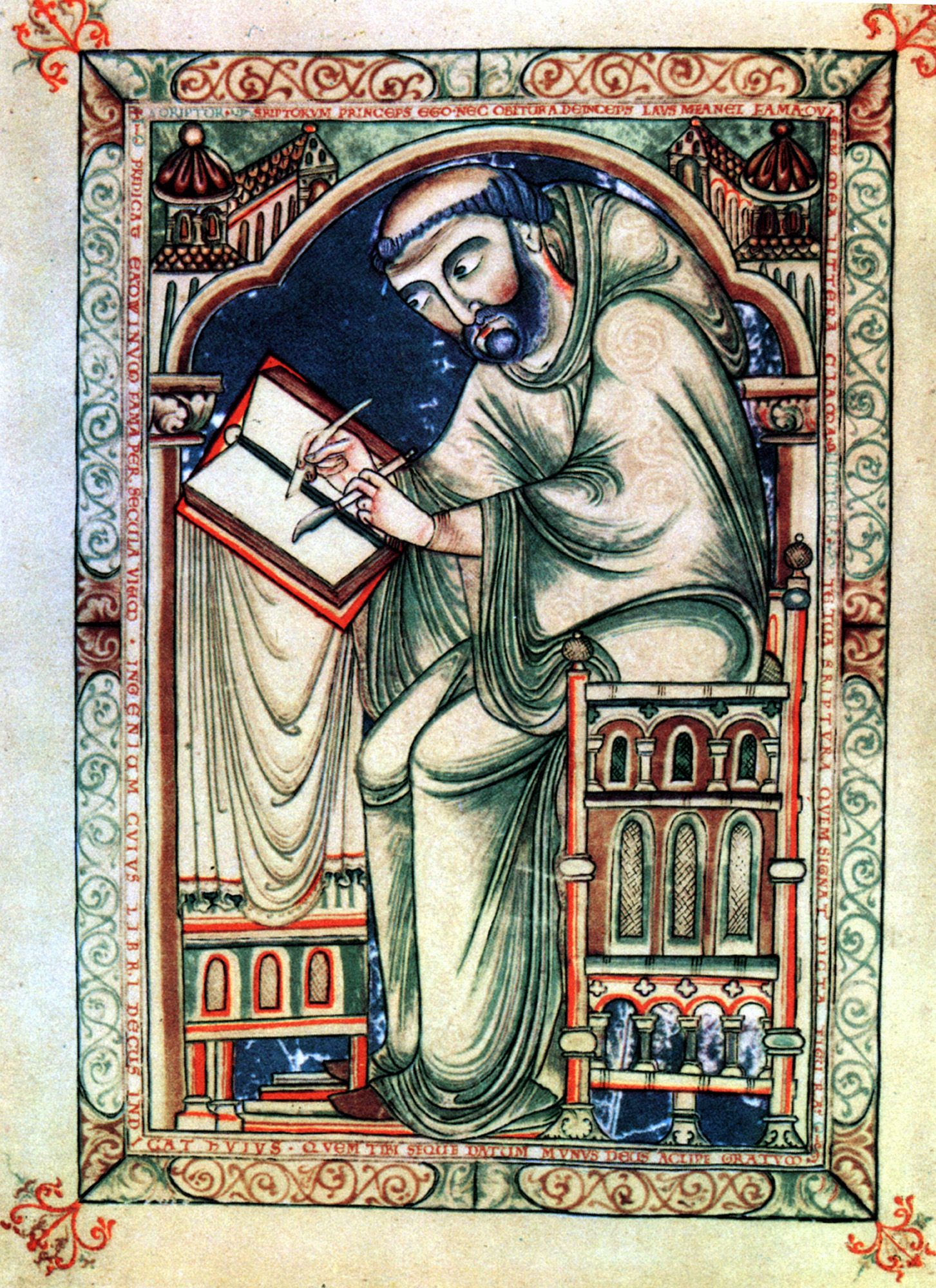
An old illustration of a monk holding a book sitting on a chair.

Eadwine the Scribe, from a 12th Century psalter written at Christ Church, Canterbury by Eadwine. For much of the Middle Ages and before the invention of the printing press, transcriptions written by monks were the primary cultural bridge preserving early Christian writings, and classic Greek and Latin texts, for posterity. (Image credit: UniversalImagesGroup via Getty Images)

This idea shows up in artistic expression, too: A 2017 analysis by ethnomusicologist Patrick Savage looked at more than 4,000 British-American ballads from the 16th through 20th centuries and found that written melodies changed less than those shared through oral tradition.

But there are also ways that writing may speed up cultural change.

"Before writing, much cultural knowledge had to be stored in people's brains," Perreault said. "That has obvious limits."

People forget things they don't study routinely, and when people die, their knowledge often dies with them. Because writing moves information storage beyond the human brain, it can reduce those losses, Perreault said.

"If writing prevents knowledge from being lost, and if it also helps information spread through a society, as with the printing press, then it could accelerate the ratchet effect of cumulative cultural evolution," Perreault said. "But this remains, to some extent, a hypothesis."

By the book

One reason the question of whether written language speeds or slows cultural evolution is that writing is hard to separate from everything that comes with it.

Writing has been separately invented only around four times in human history β€” although "some people argue there's a fifth in India," Gray said β€” which means nearly every writing system on Earth descends from that handful. Those systems spread through contact; trade, war, religion and the other ways humans intermingle had their own effects on cultural change that are hard to untangle from the effects of writing.

Also, "mass literacy is quite recent," Gray said. "If you've got these written varieties that are just used by, often, religious elites, that's potentially going to have much less impact."

So which force wins? Both experts think writing speeds up cultural change, though neither can prove it yet.

"I would say that writing probably speeds up cultural change overall," Perreault said. Gray agreed, though he acknowledged that most people would guess the opposite.

Still, Perreault cautioned, "these are empirical questions that have yet to be answered empirically."

Could we ever create artificial gravity on a spaceship?

Among the many risks astronauts face during long-haul spaceflight, an extended stay in microgravity is one of the most consequential for long-term health, with effects on vision, bones, muscles and many other aspects of the body.

One solution might be artificial gravity —‬ some way to create forces similar to Earth's gravity on a spaceship, akin to the giant rotating ring from Stanley Kubrick's 1968 film "2001: A Space Odyssey."

But is that technology ever coming, or will it remain science fiction?

"There's really no reason it couldn't happen," Torin Clark, an associate professor of aerospace engineering at the University of Colorado Boulder, told Live Science. "From a technical perspective, this is something that could happen in the very near future."

In fact, artificial gravity has almost made its way to space before. The Centrifuge Accommodation Module was a planned 8.2-foot-wide (2.5 meters) centrifuge for the International Space Station (ISS), but the project was canceled in 2005 for budgetary reasons.

"[Artificial gravity] is one of those things β€ͺ—‬ like all of a sudden, it's super popular, and then all of the scientists at NASA and everybody … have a lot of funding to understand how to actually implement this, and then it just dies," Ana Diaz Artiles, an associate professor of aerospace engineering at Texas A&M University, told Live Science. "And then it comes back, and dies, and comes back. I've been going through a couple of these cycles in the time that I've been doing this."

Besides budgetary concerns, there are questions about how such a solution would be implemented.

"Everybody agrees it's a good thing to do. The problem is that we don't know how to implement it," Diaz Artiles said. "How much gravity do you need? How big does [the device] have to be? How long do you need it to be? And how long do you have to use this? Should we use continuous gravity or a short-radius centrifuge, something where you go in and out?"

Researchers have three main approaches for creating artificial gravity. One is the classic sci-fi idea: a giant ring that rotates passengers' entire living quarters so they live and work under forces similar to Earth's gravity.

"You have a relatively long radius, which means you don't have to spin very fast to create gravity," Diaz Artiles said. "But this is massive. You can't get all the parts up there in the same spacecraft β€” you need multiple spacecraft and to assemble everything. So, of course, you can see what a big endeavor this is."

A short-radius centrifuge is a more feasible option. It's essentially a tube with a radius of 6 to 10 feet (1.8 to 3 m) that spins to simulate gravity. A passenger sits or stands inside, with their head closest to the center of rotation, so the spin generates the strongest pull down toward their feet.

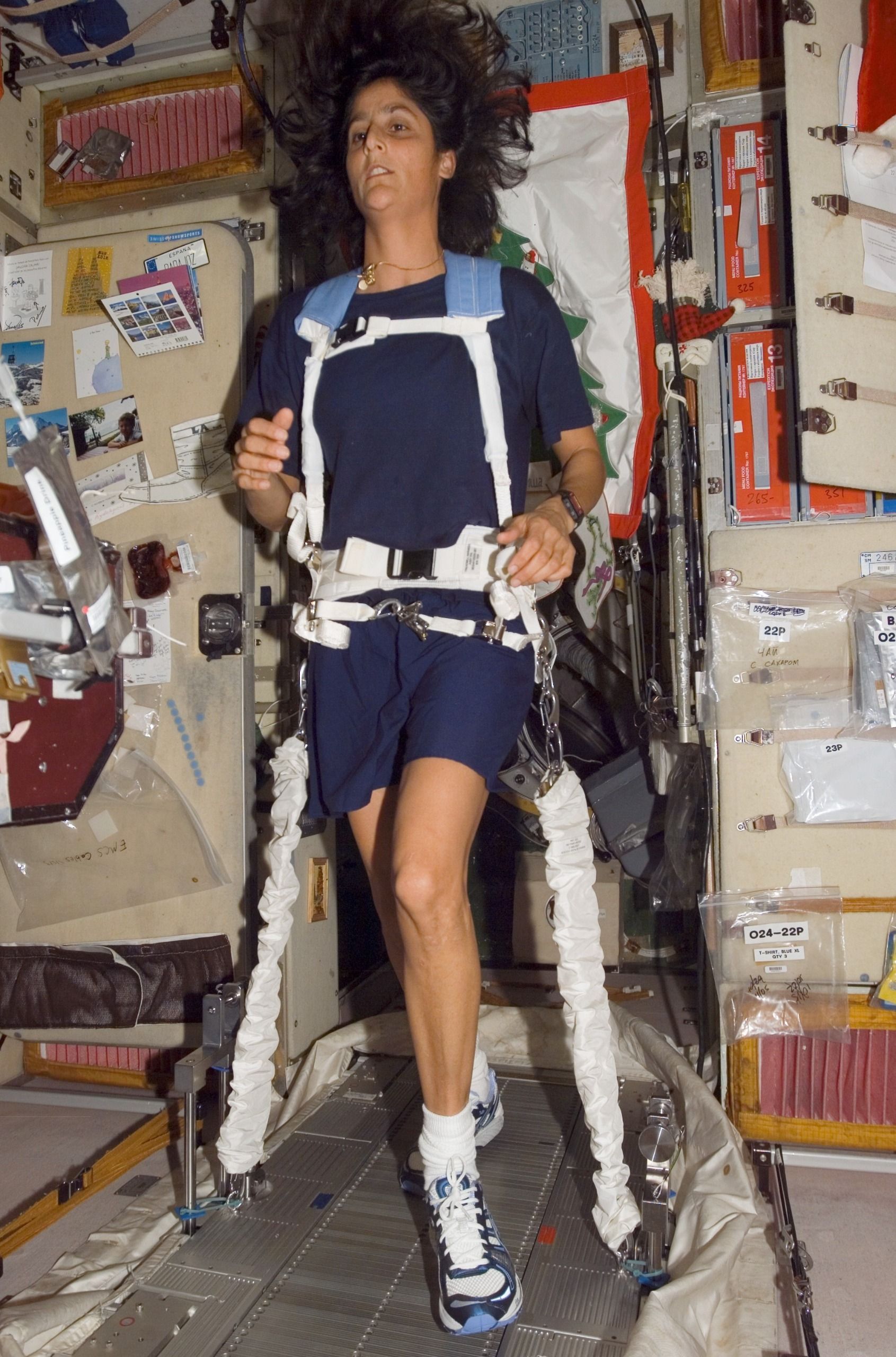
A woman walks on a treadmill in space.

Astronaut Sunita Williams, equipped with a bungee harness, exercises on the Treadmill Vibration Isolation System (TVIS) in the Zvezda Service Module of the International Space Station in 2006. (Image credit: NASA/Crew of Expedition 14, Public domain, via Wikimedia Commons)

Instead of allowing passengers to live in artificial gravity, this smaller device would be used in short daily sessions. "It's kind of like an exercise device," Diaz Artiles said. "In the ISS, you have a treadmill, you have this resistive exercise machine, so you go there for 30 minutes to do your exercise, and then you get out."

The final option is for spacecraft to create gravity via linear acceleration. This works in the same way that an accelerating car pushes passengers back into their seats, except the spacecraft would be oriented to push an astronaut's feet into the floor. To slow down, the spacecraft would turn around, firing its thrusters in the opposite direction to decelerate smoothly while maintaining a roughly similar gravity for its occupants.

"But then you need something like an engine that is able to accelerate all the time," Diaz Artiles said. "And propulsion-wise, I think we're not there yet."

Although a short-radius centrifuge is the most feasible approach in terms of both cost and engineering, it does have some drawbacks. For one, its fast spin can induce the Coriolis cross-coupled illusion β€ͺ—‬ a sensation of tilting or tumbling that happens when you tilt your head off-axis while rotating.

This is the effect that causes motion sickness, Clark said.

However, Clark and his team have found that people can build a tolerance to the sensation with training, simply by being in a slowly spinning centrifuge and gradually increasing the speed when they no longer feel the sensation.

"If you very slowly, incrementally increase the spin rate … and do that not just over one session but over multiple sessions across multiple days, as far as we could tell, anyone can be made to incrementally acclimate to the rotating environment [of] up to 20 to 30 rotations per minute," Clark said.

Would artificial gravity prevent harmful effects on the body?

But researchers still don't know how fast the centrifuge would need to rotate, or how long someone needs to spend inside it, to benefit. Long periods in microgravity can lead to bone and muscle loss, loss of aerobic fitness, blood clots, and visual issues from fluid shifts in the eyes. The hope is that artificial gravity could prevent those effects, but exactly how much gravity is necessary remains an open question.

Studies of people on head-down tilt bed rest β€ͺ—‬ the standard research method for simulating spaceflight deconditioning β€ͺ—‬ have found that 30 minutes a day in a centrifuge did prevent some loss of muscle function.

"Thirty minutes a day … maybe is not enough," Clark said. "Maybe an hour or even two hours a day, and maybe at higher G levels, would be beneficial."

But these studies are expensive and time-consuming. "It's very difficult," Diaz Artiles said. "I think people are interested in this concept, but we just don't have a good answer."

In the end, it's not a technological challenge that's keeping artificial gravity from being used in space; it's knowing the best way to employ it and securing the budget for it.

"We know how to do this. As humans, we have done more difficult things," Diaz Artiles said. "We need the money, but we also need to better understand the need."

See how much you know about human exploration into space with our spaceflight quiz!

❌