Some people from Oceania harbor thousands of genetic variants inherited from the Denisovans — a mysterious group of extinct humans — that are still active in their immune systems today, a new study finds.
The findings, published June 11 in the journal Science, come from the largest-ever map of Denisovan-inherited DNA ever created. The discovery shows that Denisovan DNA "is not just a remnant of ancient liaisons; it continues to influence our biology today," study co-author Serena Tucci, an assistant professor of anthropology and head of the Human Evolutionary Genomics Laboratory at Yale University, said in a statement.
Experiments revealed 3,127 variants inherited from Denisovans that still function in the immune systems of modern-day people; some of these variants switch genes that turn the immune response on or off, according to the new research.
However, because many of the immune system genes identified also affect other bodily functions, it is unclear exactly how these genes benefited survival, study first author Patrick Reilly, an evolutionary genomics researcher at Yale, told Live Science.
Denisovan DNA is active in humans today
Previous research has already found that some modern-day people in Oceania — a region that includes New Guinea, the Solomon Islands and Fiji — have some Denisovan DNA. For example, people from Papua New Guinea are known to carry up to 5% Denisovan DNA in their genomes thanks to prehistoric trysts with the enigmatic group of humans who lived in Asia and disappeared around 30,000 years ago. This is among the highest proportion in the world, with modern-day East Asians typically carrying only around 0.1% Denisovan DNA.
Yet Oceanians are vastly underrepresented in genomic databases. Sequencing the genomes of Oceanians can give a glimpse into the lives of the Denisovans and is essential for closing gaps in health disparities in Pacific Islanders as a whole, Reilly said.
To fill this gap, Tucci and her team sequenced the genomes of 177 Oceanians from 12 populations and compared them to 1,284 previously published genomes from populations worldwide. Then, they compared these segments to the known Denisovan genome and three Neanderthal genomes.
Combined, the team built a catalog containing three times more Denisovan genetic sequences inherited from Denisovans than were previously identified, over 70% of which were unique to Oceanians.
Natural selection increased the frequency of some of these variants in people from Near Oceania, which includes New Guinea, the Bismarck Archipelago and the Solomon Islands in the Pacific Ocean, including genes linked to bone development, metabolism and fertility.
The team also ran experiments to assess whether any of the Densiovan DNA was changing how genes behaved in these populations, Reilly said.
This revealed that Denisovan genetic variants can switch various immune system genes on or off, although the exact immune functions that were targeted varied among the Oceanic populations studied.
Early migrants to Oceania at least 42,000 years ago benefited from Denisovan genes when they entered their new environment and encountered new disease-causing pathogens, Reilly said.
"This is consistent with multiple independent instances of local adaptation in response to novel immune environments and pathogens during human dispersal into the Pacific," the authors wrote in the study.
Although the researchers don't know exactly why natural selection acted on these genes, the findings highlight the major role pathogens played in shaping the way humans and our extinct relatives evolved, Reilly said.
The research is an "outstanding effort to try to understand the biological implications" of the enduring Denisovan genetic variants, Mathilde André, an evolutionary geneticist at the Pasteur Institute in France who was not involved in the study, told Live Science in an email.
The tripling of known Denisovan-inherited genetic sequences, most of which are unique to Oceanians, highlights the need to sequence the genomes from previously unrepresented populations to capture the diversity of Denisovan DNA, André said.
Camera traps from inside the Chernobyl exclusion zone reveal how the occupation of Russian forces at the site in February and March 2022 altered the behavior of wildlife living in the area.
After the invasion, which involved significant armed conflict inside the exclusion zone, mammals like deer and horses became less active and spent less time moving around at night, a new study reports.
Researchers discovered the changes by comparing footage from camera traps collected during the early months of Russia's 2022 invasion with recordings from the same period a year earlier, before the conflict began. The findings, published Thursday (June 18) in the journal Science, offer a rare glimpse of how animals respond to the immediate disruption caused by warfare.
"I wish the opportunity to analyze how the unfolding invasion affected wildlife ha[d] never happened," Svitlana Kudrenko, who conducted the study as part of her PhD at the Albert Ludwig University of Freiburg in Germany, told Live Science in an email. "Unlike in preindustrial times, current interstate conflicts are highly detrimental for wildlife because of a long list of warfare, often operated remotely."
The study took place in the Chernobyl exclusion zone, a roughly 1,000-square-mile (2,600 square kilometers) area surrounding the site of the 1986 Chernobyl nuclear disaster. Following the reactor explosion, authorities evacuated the region and restricted most human activity. Over the decades, with little to no human activity, wildlife populations have flourished, turning the zone into a natural laboratory for scientists studying ecosystem recovery and animal behavior.
But in February 2022, Russian forces seized control of the region during the beginning stages of the invasion of Ukraine. Military vehicles, troop movements, weapons being fired and other wartime disturbances suddenly transformed one of Europe's most unusual wildlife refuges into an active war zone.
To investigate the impact, researchers analyzed data from camera traps already operating in the exclusion zone from 2020 to 2022. Studying the ecological effects of armed conflict is difficult because war zones are dangerous and often hard for researchers to access.
By using the existing network of automated cameras, the scientists captured wildlife responses that would have been impossible to record otherwise. In total, the team analyzed almost 2,000 photographs and videos from the exclusion zone to build a picture of behavioral changes in response to the conflict.
The images and footage revealed responses from 11 wild mammal species, showing that some animals changed their behavior during periods of heavier fighting.
Kudrenko et al (2026)Kateryna KorepanovaKateryna KorepanovaKateryna Korepanova
Several mammal species — including roe deer (Capreolus capreolus), red deer (Cervus elaphus), moose (Alces alces) and red foxes (Vulpes vulpes) — were less active during the occupation than before the conflict, especially at night, the team reported.
The findings suggest that the impact of conflict can ripple through entire ecosystems. While Russia no longer occupies the Chernobyl exclusion zone, the authors highlighted that this study still shows how animal behavior can adapt to warfare.
Camera traps could become a valuable tool for measuring the environmental costs of conflict and understanding how wildlife copes with sudden human disturbances across the globe, the researchers added.
"Our study highlights the need to develop and implement research and conservation strategies focusing on armed conflict impacts on wildlife and environment in general, especially in areas of conservation importance," Kudrenko said.
What do you know about the animal kingdom? Test your knowledge with our animal quiz!
By 2030, data centers could rise to sixth in the world for energy consumption, which would have a land footprint the size of Connecticut and release emissions comparable to those of the U.K. in 2025, depending on how much renewable energy is in the mix.
The findings highlight how much additional pressure AI and the infrastructure that supports it could put on the environment and the climate within the next few years. But why does AI have such a huge footprint, who is benefiting or being left out from the opportunities linked to AI's growth, and what can be done to limit the damage?
Sascha Pare: What would you say is the main takeaway from the report?
Kaveh Madani: The main takeaway of this report is that although in the general discourse AI is perceived as something virtual, or digital, or up in the clouds, there is [a] massive physicality to AI and the supply chains and infrastructure that back it up. And that's one thing that this report has tried to do: to remind people that behind every prompt, every use, every interaction, there is some level of impact on the environment. This is because from the top of the supply chain, where the extraction of critical minerals happens, to the point of manufacturing the hardware, the construction of the data centers, then the operation of data centers, and then dealing with the e-waste, there are major environmental impacts. If we take all of those into account, then we realize that what's digital is not necessarily free of impact. There is always some footprint associated with it, and we have to remember that.
SP: Why does AI have such massive land and water footprints, specifically?
KM: The report outlines the carbon, water and land footprints of AI's energy use. All along the supply chain, from the extraction of critical minerals to the point of disposing and dealing with the electronic waste, we have actions and interventions that require water, require land, and are associated with carbon emissions. So, if you think about, for example, the extraction of critical minerals, we know that during the process, a lot of water is being used and a lot of water is being polluted and poisoned. We published a report in April about the water injustice implications of the critical minerals, showing exactly what is happening where we have the extraction of critical minerals.
You have to decide if you want to continue using your water for agriculture or if you want to put it into data centers.
Kaveh Madani
But let's not forget that the [new] report is focused on AI's energy use, and then tries to argue that the energy production process itself requires also a lot of water and land. If you are using hydropower to provide energy to your data center, you're using a lot of land and a lot of water. This applies to all sorts of energy sources, regardless of being clean or not, or if you consider them renewable or not — they all require water and land. On top of this, of course, you need to build data centers on land, but also you need water for cooling. That's why, throughout the supply chain, throughout the life cycle of AI, we have a lot of water and land use, in addition to carbon emissions.
SP: The report is packed with jaw-dropping statistics about how big AI's environmental footprint could get by 2030. But how significant are the impacts?
KM: First of all, it is very hard to estimate exactly how much energy AI is currently using, but we know that roughly 20% of the current load of data centers can be attributed to AI. We are expecting that to be 40% within a few years. And by then, the data centers that back AI's operations are expected to have an energy demand that is about 3% of the total energy demand of the world. This is equivalent to being the sixth-most-energy-intensive country in the world. The water demand of that is also huge; the water footprint associated with that is enough to satisfy the domestic water needs of 1.3 billion people in sub-Saharan Africa.
SP: Can the environment and communities cope with the projected levels of energy and water consumption needed for AI?
KM: There would be places in the world where big decisions must be made, meaning that you have to decide if you want to continue using your water for agriculture or if you want to put it into data centers. Those would be decisions for the communities — and if the communities are not involved, then the most vulnerable, the poor, will be dealing with the consequences.
A Microsoft Azure data center in Aldie, Virginia. (Image credit: Lexi Critchett/Bloomberg via Getty Images)
At the same time, we know that the world's electricity consumption keeps increasing. That's a major problem, because although we are trying to add more and more renewables to the energy supply systems, the renewables cannot keep up with the increasing electricity demand. This means that not only can we not retire the old systems, but we might also need to use more fossil energy to satisfy this growing demand. And of course, that means more pressure on the fragile environment.
We know some of the data centers are being placed in locations that are already dry or suffering from what we refer to as "water bankruptcy," based on the report we published in January. These are major issues. More pressure on the environment [puts] more pressure on humans, and this recipe means [we could have] a kind of reinforcing degradation loop that would jeopardize both nature and human society.
SP: Who is benefiting the most from AI's expansion, and who is being excluded?
KM: AI expansion is benefiting humanity as a whole. It has changed our lifestyle; it has provided a lot of opportunities and improvements. But at the same time, it has some consequences. The issue that we see right now is that the richer communities and countries of the world are the ones that are benefiting from it the most, and within those communities and countries, it's the rich who are also profiting more from the expansion. If you look at the investment landscape of AI, you can see that there is a lot of push from a number of strong players and private investors. And they don't bear the costs when it comes to pollution, water bankruptcy, land degradation and so on.
If you think about the emissions, they are contributing to global warming, and everybody would suffer from it. Even the countries that don't have AI infrastructure are affected: If you think about where the critical minerals come from, you see a lot of poor communities, poor countries and poor regions in Africa, South America, parts of Asia, where people don't have basic infrastructure — they don't even have clean drinking water and energy infrastructure. They don't benefit from this expansion and the profits and utilities it provides. It's the most vulnerable communities and the poor economies that are going to suffer the consequences, while the other ones will benefit more.
SP: How did you estimate AI's growth by 2030, and how likely is it that your numbers will come true, given the fears that AI is a bubble that's about to catastrophically burst?
KM: We were looking at the data centers, and we still think that our projections are conservative. There is a lot of push from the private sector to further growth. Countries are also seeing investment in AI and data centers as an investment in security, sovereignty and other matters, so there's also a competition there. Some of the investments — some of the decisions about expanding AI — are not necessarily based on comprehensive assessments. Investments remain a bid to stay in the race, and that means more and more push. So we think that what we have projected is probably very conservative.
SP: China is scaling up its energy capacity together with data center buildout, and it is putting data centers in the ocean to try to solve the hardware cooling issue. What do you make of this strategy, and should other countries learn from it?
Chinese companies are testing underwater data centers to solve cooling demands. Here, we see a data center under construction at a shipyard in Nantong, in China's eastern Jingsu province. (Image credit: CN-STR / AFP via Getty Images)
KM: China's more centralized decision-making system provides advantages, but I think we need to be careful about generalizing the information of one or two projects highlighted by the media to the overall strategy.
We know that China has been expanding its renewable energy production capacity, and that's definitely a good thing. We have to make sure that the additional load of AI would not mean more fossil energy and would not compromise the decarbonization process. But at the same time, we should note that just scaling up renewables is not sufficient if you're thinking about decarbonization. We need a massive addition of renewables if we're going to reverse climate change, and we are not seeing strong enough signs of that around the world. So that's something that we have to be worried about.
That has been the challenge created for the world because of the expansion of AI. When it comes to putting things under the ocean, I think we do not yet have enough information and enough experience to judge if those things come with less environmental impact. What we hide would not be impact-free; there are also other impacts to worry about.
SP: What are some other solutions to the pressures AI is putting on the environment and people? How should we approach the rapid expansion to ensure it is fair?
KM: We offer a framework based on a number of principles about making the AI governance system more fair and transparent and sustainable. So, those are the principles suggested, and they bring responsibility to all stakeholders, including the developers and service providers — those who provide the technology and have responsibilities of ensuring that their systems are more transparent and efficient.
Then, we have the governments that have the responsibility of ensuring that information becomes available, that footprints are properly monitored and disclosed and regulated. They can use a range of incentives, mechanisms or penalties to ensure that footprints are reduced across the supply chain — and I insist on that — from the mines to the landfill. So, that can be done; pollution taxes can be charged and so on. [Governments should ensure] that those who have to deal with the consequences also benefit from the profits and the opportunities that data centers bring to their communities. Decisions must be made based on resource availability and the environmental consequences taken into account.
Users also can do a better job of making smarter choices by using AI more responsibly and only when it's absolutely necessary. When using AI, choose the right models, and be mindful of what is happening behind the scenes. Is it really necessary to generate another image? Is it really necessary to generate a video? Is it necessary to use the model in the "thinking mode"? Together, all the stakeholders can make a difference, and users can also call for more transparency and force governments to take action to force the service providers to provide more information and be more transparent.
Editor's note: This interview has been condensed and lightly edited for clarity.
Rainforests are some of the most important and diverse ecosystems on Earth. Found across several continents, these vast forests are home to millions of plants and animal species, many of which can't be found anywhere else. Many rainforests, both tropical and temperate, also play a crucial role in regulating the planet's climate by absorbing carbon dioxide and producing oxygen.
Rainforests vary immensely in size. Some stretch across multiple countries and cover millions of square miles, while others are much smaller but still support incredible biodiversity. Understanding the relative size of these rainforests helps us appreciate their role on our planet and the challenges involved in preserving them.
In this quiz, you'll test your knowledge by sorting the top 10 biggest rainforests from largest to smallest. Click on and drag the blue rectangles to place them in the right order. Remember to log in to put your name on the leaderboard; hints are available if you click the yellow button.
Evidence of two ancient wooden posts aligned with the summer and winter solstices has been discovered near Stonehenge in southwest England. The posts have rotted away, and only traces of the postholes survive. But archaeologists say the structure predated Stonehenge, and they think it was a temporary religious monument until a permanent one was built. They even suggest it may have been a Stonehenge prototype.
Analysis suggests that ancient people used the posts to mark the summer and winter solstices, Phil Harding, an archaeologist at Wessex Archaeology who's leading the project, noted at a news conference on Wednesday (June 17).
"These people were capable of establishing the points on the horizon where the sun rises in the midsummer and sets in midwinter," he said. "This was a pioneering achievement." (The 2026 summer solstice will be celebrated at Stonehenge on June 21.)
Harding's team at Wessex Archaeology, a private firm that often works for the government and local authorities, publicly announced the finds June 18 in the U.K., and a report on their research will be peer-reviewed and published. The ancient monument consisted of the two large, wooden posts, about 400 feet (120 meters) apart, on land near the village of Bulford, a few miles east of Stonehenge.
The land is now controlled by the U.K. Ministry of Defence, but archaeologists have been allowed to excavate there since 2015. They previously found traces of two "henges" — rings of ditches and banks made from earth — and dozens of Neolithic pits from about 5,000 years ago, centuries before Stonehenge was completed. The pits were filled with animal bones, pottery, flints and charcoal, and the researchers think they date to the time that the first phase of Stonehenge was being built.
Solstice alignment
The posts were aligned to point along an axis that marked the direction of sunrise on the summer solstice, or "midsummer's day," and the setting of the sun exactly six months later, at the winter solstice, or "midwinter's day," according to a statement from Wessex Archaeology. The same astronomical alignments are seen at Stonehenge.
The animal bones and other signs of feasting in the pits at Bulford are evidence of large numbers of people gathering for religious festivals. (Signs of ancient feasting have also been found at Stonehenge.)
"When we talk about the solstice, we're talking about religion," Matt Leivers, an archaeologist at Wessex Archaeology and one of the researchers, said in the statement. "What we see at Bulford, and later at Stonehenge, is a way of celebrating and marking the passage of time, but it's also about making sure the world keeps working as it should."
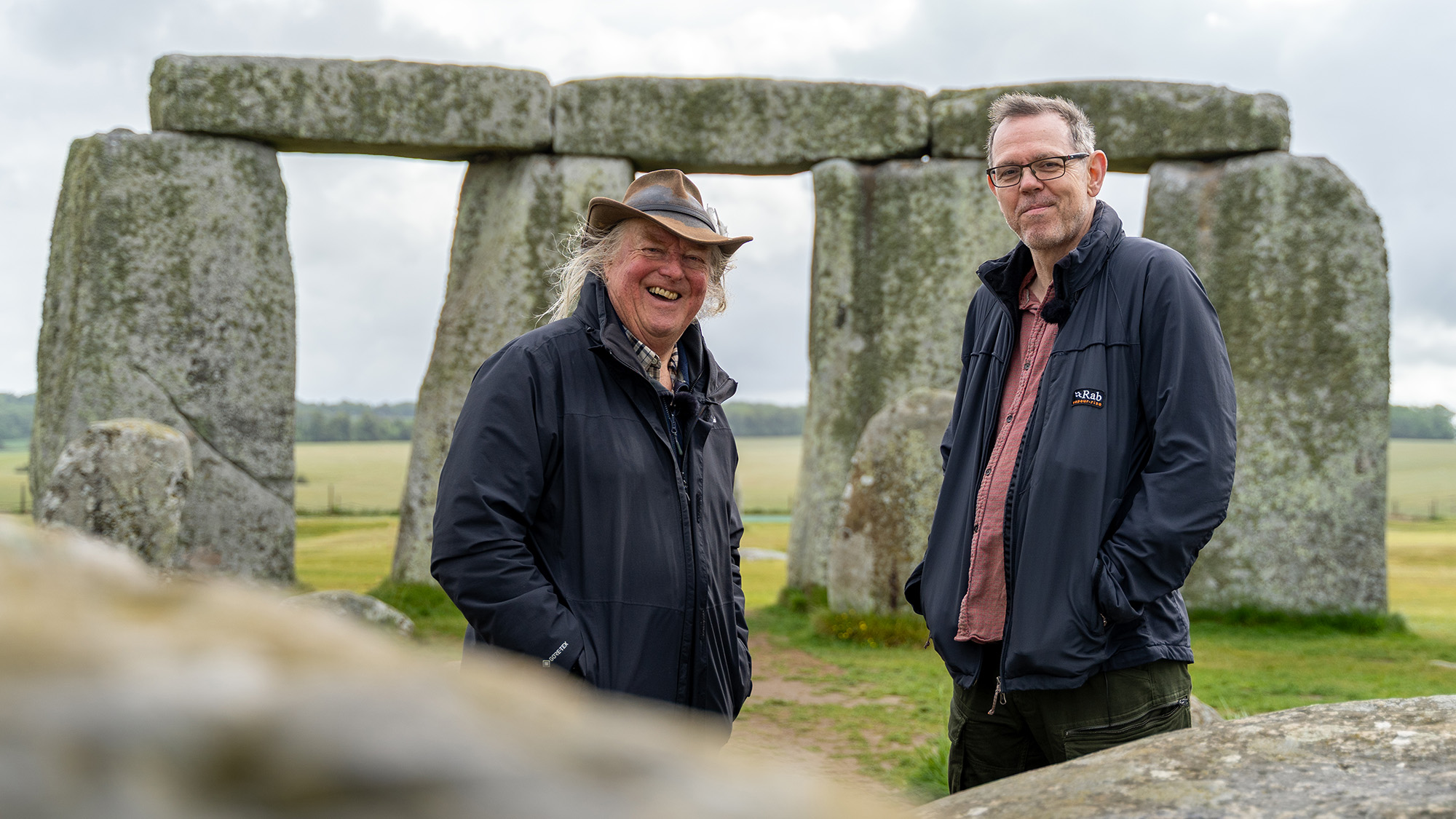
Archaeologists Phil Harding (left) and Matt Leivers led the excavations at the Bulford site, a few miles east of Stonehenge. (Image credit: Wessex Archaeology)
The site predates the largest circles of stones at Stonehenge, which have the same alignments. "What we've discovered at Bulford is 500 years earlier than the famous stones we know so well," Harding said. The researchers even suggest that the Bulford monument may have been a sort of prototype for Stonehenge itself.
Ancient stones
Stonehenge is the world's most famous Neolithic monument, but its original purpose was long a mystery. Archaeological investigations have established that the first earthwork henge was started there about 5,000 years ago, and the famous central stones were added about 500 years later.
Recent discoveries at Stonehenge include evidence of ancient cremations, and many archaeologists now think the monument was originally a burial site. If that's the case, the alignment with sunset on the winter solstice might have represented "new life," as the days then became longer and warmer after the depths of winter. However, no human remains have been found at the Bulford site.
Susan Greaney, an archaeologist at the University of Exeter who was not involved in the research, said the new finds show the importance of the region to prehistoric people. "It is intriguing to think that simple posts were erected here to align with the solstices around 500 years before Stonehenge was built," she told Live Science.
The Bulford monument may have been a temporary "model" for Stonehenge itself, Amanda Chadburn, an independent archaeologist who wasn't involved in the research, told Live Science "If you were designing a very complicated piece of engineering like Stonehenge," she said, "you would have had to understand how to make it before starting."
See how much you know about Stonehenge with our Stonehenge quiz!

 Login