❌

Normal view

James Webb telescope finds one of our galaxy's rarest stars inside the 'Treasure Chest' globule β€” Space photo of the week

6 September 2026 at 11:00

Orange gas floats in deep space.

NASA's James Webb Space Telescope captured the "Treasure Chest," a cometary globule in the star-forming Carina Nebula, on Aug. 6, 2026 (Image credit: ESA/Webb, NASA & CSA, M. Reiter; Acknowledgment: M. H. Γ–zsaraΓ§)
Quick facts

What it is: The Treasure Chest, a cometary globule in the Carina Nebula star-forming region

Where it is: 7,500 light-years away, in the constellation Carina (the Keel)

When it was shared: Aug. 21, 2026

It looks like a gigantic treasure chest left open among the stars β€” but instead of gold and jewels, this strange cosmic structure contains dozens of newborn suns. This new image from the James Webb Space Telescope (JWST) reveals the aptly named Treasure Chest, a colorful cloud of gas and dust in the Carina Nebula, one of the Milky Way's richest star-forming regions.

Located about 7,500 light-years away in the Southern Hemisphere constellation Carina, the nebula stretches roughly 260 light-years across and contains some of the most massive stars in our galaxy, as well as tens of thousands of young protostars. It's also home to the "Cosmic Cliffs," which appeared in JWST's first collection of science images, released in 2022.

The Treasure Chest is a cometary globule, an isolated cloud with a dense, dark head and a sweeping tail. Although such objects are named for their resemblance to comets, this one looks more like a wooden chest with its lid propped open and light spilling from inside.

JWST's Near-Infrared Camera reveals the source of that glow: a compact cluster of about 70 young stars embedded in the dust. The most massive one is a rare O-type star β€” extremely large, bright, and short-lived stars β€” measuring roughly 19 times as massive as the sun.

Astronomers estimate that the cluster is around 1.3 million years old, although earlier estimates suggested it could be as young as 100,000 years. Many of its stars are still surrounded by the gas and dust from which they were born. Over time, radiation from the cluster's stars will disperse that material, exposing stars that are currently hidden.

The Treasure Chest's unusual shape is also influenced by something outside the JWST image. About 39 light-years away, as measured across the sky, is Eta Carinae, the most luminous object in the Carina Nebula. Eta Carinae famously underwent its "Great Eruption" in the 19th century, when it briefly became one of the brightest stars in Earth's night sky. The system contains at least two stars, including one about 100 times as massive as the sun and roughly 5 million times as luminous. Together with the nearby Trumpler 16 star cluster, its intense radiation and stellar winds are blasting away the Treasure Chest's less-dense gas and helping to sculpt the cloud into its distinctive shape.

The Treasure Chest won't always look like this. Radiation and winds from the young stars inside it, combined with the assault from massive stars nearby, will gradually erode the remaining gas and dust. Eventually, the cosmic chest will disappear, revealing its true jewels β€” the stars within it.

Something doesn't add up in the Chandelier Cluster, Hubble telescope finds β€” Space photo of the week

30 August 2026 at 11:00

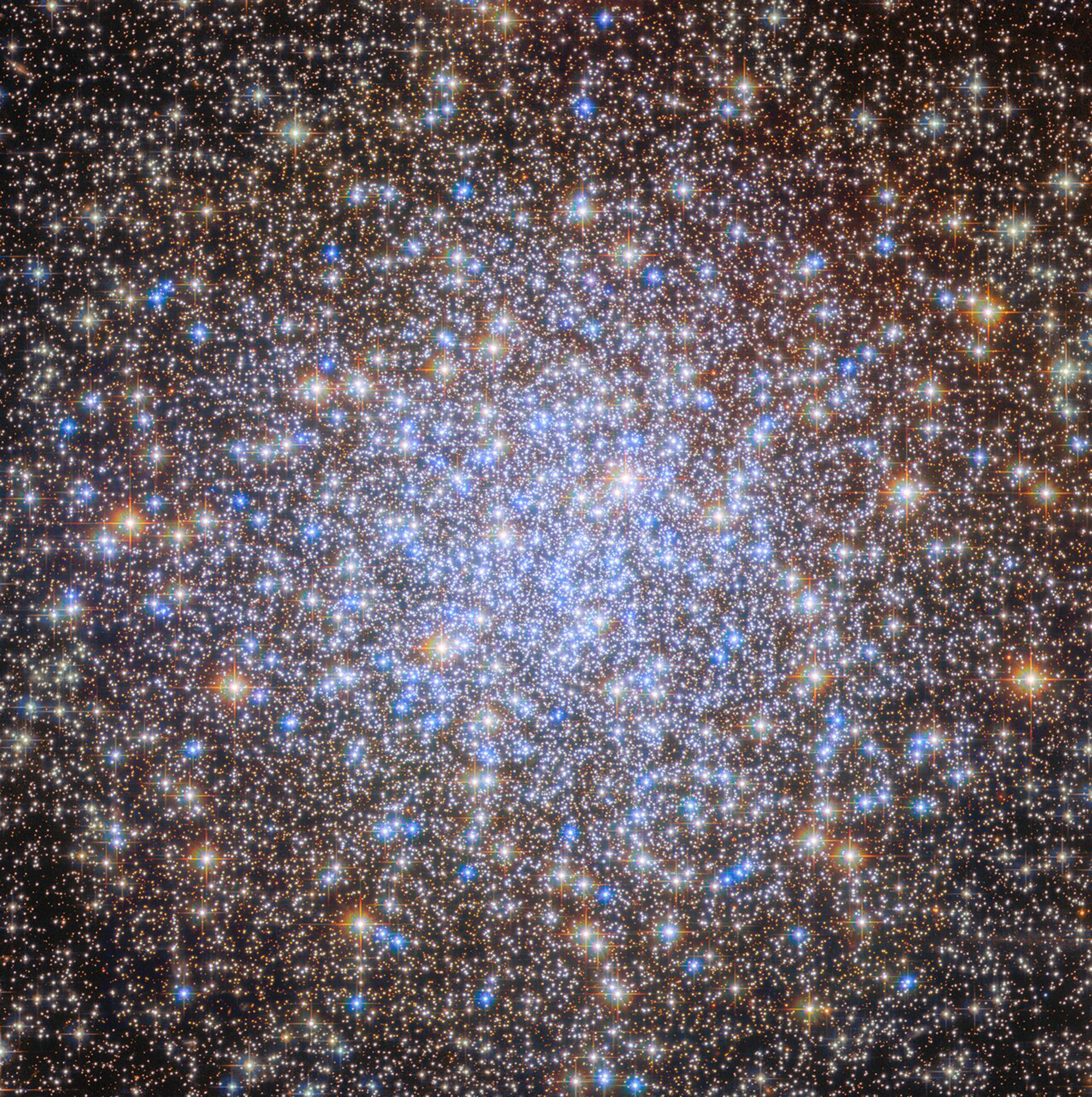
A cluster of brilliant white and golden stars shines in the darkness of space.

NGC 6723 is a globular cluster, an ancient inhabitant of the Milky Way galaxy. (Image credit: ESA/Hubble & NASA, A. Sarajedini, G. Piotto)
Quick facts

What it is: NGC 6723, the "Chandelier Cluster"

Where it is: 27,000 light-years away, in the constellation Sagittarius

When it was shared: June 26, 2026

In this single Hubble Space Telescope image, tens of thousands β€” possibly millions β€” of stars bound tightly by gravity sparkle as one. This is NGC 6723, a glittering globular cluster about 27,000 light-years away, in the constellation Sagittarius.

Also known as the Chandelier Cluster, this swarm of stars is one of about 150 known globular clusters that orbit in the halo of the Milky Way, though others may remain hidden behind thick cosmic dust or crowded star fields at the galaxy's bright core.

Globular clusters like NGC 6723 are among the most ancient structures in our galaxy. What baffles astronomers most is the age of the stars within them. These clusters often contain stars older than 10 billion years, with some dating back almost to the beginning of the universe itself 13.8 billion years ago. They likely formed early in the history of the Milky Way, billions of years before the thin disk of stars where the sun now orbits took shape.

It was once thought that all stars inside a globular cluster formed at the same time, from the same material, during a single burst of star formation. If that were true, the stars would have the same age and chemical composition.

However, Hubble's view demonstrates that this is not the case. The cluster is densely packed at the center, where many bright-blue stars appear concentrated, while orange stars are more prominent toward the edges. Blue stars are younger than orange stars, suggesting that globular clusters can have complex histories, with different populations of stars and subtle chemical differences among them.

Hubble first observed NGC 6723 in visible and near-infrared light as part of a major survey of 65 globular clusters in 2013. It found that massive stars sink toward the center of a cluster, while lower-mass stars drift outward. In 2013 and 2014, Hubble studied NGC 6723 to search for small chemical differences between stars and to measure the spread of ages of stars within the cluster. Two epochs were found, with the second burst of stars happening about 634 million years after the first.

One leading idea is that globular clusters formed when enormous gas clouds collapsed rapidly in the early universe. However, recent simulations also suggest that some globular clusters may be the surviving cores of ancient dwarf galaxies that were stripped of their outer stars by larger galaxies. Either way, they're a fossil remnant hinting at how galaxies evolve.

Globular clusters are not unique to the Milky Way. They are found around many kinds of galaxies, including spirals, giant ellipticals and dwarfs. The Andromeda galaxy, the nearest large spiral galaxy to the Milky Way, is estimated to host about 460 globular clusters, while the giant elliptical galaxy M87 contains roughly 15,000 globular clusters, according to NASA.

❌