❌

Normal view

Diagnostic dilemma: A woman heard voices for years β€” but not because of psychosis

8 July 2026 at 11:00

The patient: A woman in her early 50s in Canada

The symptoms: The woman started occasionally hearing her name being called when she was alone, usually in quiet surroundings. Later, the sounds evolved into indistinct murmurs. These voices seemed to come from outside her head rather than from her own thoughts. They never spoke directly to her, commented on her actions or gave commands.

What happened next: In the next two years after she began hearing voices, the woman made several trips to emergency departments and had brief psychiatric admissions. Because hearing voices is commonly associated with psychosis β€” symptoms that occur when people experience a disconnect from reality β€” doctors diagnosed her with "unspecified psychosis" and attempted various treatments.

They first tried the antipsychotic risperidone, gradually increasing the dose, but the voices did not go away. Doctors then switched the patient to aripiprazole, but the hallucinations remained unchanged. Next, they tried haloperidol, and although the woman said the medication made her feel calmer and less distressed, the voices persisted.

As they conducted further psychiatric evaluations, the doctors noticed that the woman frequently leaned forward during conversations, cupped an ear and asked people to repeat themselves. About four to six months after her first contact with a psychiatric team, she was referred for hearing tests. These tests revealed hearing loss in both ears, ranging from moderate to severe in one ear and mild to profound in the other.

About two months later, the woman was fitted with hearing aids in both ears, which improved her hearing. The voices did not go away, however.

Brain scans showed no abnormalities, and blood tests came back normal. Neurological evaluations turned up no evidence of other explanations. Meanwhile, the woman continued working full time, managing her household and maintaining an active social life. She showed no signs of paranoia, delusions, disorganized thinking or the decline in daily functioning that doctors would typically expect to be associated with a psychotic disorder.

The diagnosis: Based on the woman's stable functioning, hearing impairment and lack of other clinical abnormalities, the doctors concluded that her auditory hallucinations stemmed from sensory deprivation caused by hearing loss.

Reduced sound input from the ears can make auditory regions of the brain unusually active, causing them to "fill in" missing sounds, the doctors explained in a report of the case. A related phenomenon is known as musical hallucinosis, in which people with hearing impairments hear songs, melodies or other forms of music that are not actually playing.

The treatment: Because neither antipsychotic medications nor hearing aids eliminated the patient's hallucinations, doctors shifted their focus toward helping the woman cope with them.

They taught her about the connection between hearing loss and hallucinations and advised her to pursue psychotherapy aimed at reducing the distress associated with the voices and improving her coping strategies for dealing with their persistence. At the time the report was published, in May 2026, she was waiting to begin this therapy.

What makes the case unique: In their report, the doctors noted that most published accounts of this phenomenon have described patients' hallucinations improving or resolving after their hearing impairment was treated. Persistent hallucinations after treatment are rare. In the woman's case, however, the voices persisted despite the use of hearing aids.

The doctors suggest that prolonged hearing loss may cause lasting changes in the brain that do not immediately reverse once hearing improves. (The case report does not note how long the woman's hearing had likely been impaired.)

The case also serves as a reminder that hearing voices does not always indicate psychosis, the doctors concluded. Because the woman's hearing loss was recognized only after years of symptoms and several unsuccessful medication trials, the report authors argued that doctors should consider running hearing assessments early in patients with isolated auditory hallucinations, especially when their insight and daily functioning remain intact.

For more intriguing medical cases, check out our Diagnostic Dilemma archives.

This article is for informational purposes only and is not meant to offer medical advice.

Can you guess the diagnosis in these strange medical cases? Find out with our diagnostic dilemma quiz!

'One of the oldest gravestones of a free Black person in America' discovered in Boston

A team of conservationists has discovered and restored the tombstone of Sebastian, a formerly enslaved man who died free in 1729.

"That discovery is likely one of the oldest gravestones of a free Black person in America," Michelle Wu, the mayor of Boston, said in a July 4 speech. "It's been there all along. We just had to go look and share the story."

The stone marker is inscribed with Sebastian's chosen name, Boston, and features an image common in 17th- and early 18th-century tombstones in New England: the death's head. The symbol includes a stylized skull flanked by wings, which were possibly intended to symbolize spiritual resurrection.

On the tombstone, a simple, five-line inscription reads:

Original Inscription

HERE LYES Ye

BODY OF BOSTON

AGED 70 YEARS

DECD FEBY Ye 28

1728

Modern English

HERE LIES THE
BODY OF BOSTON
AGED 70 YEARS
DECEASED FEBRUARY THE 28
1728

In 18th-century American writing, the word "the" was often abbreviated with a Y-shaped letter form called a "thorn" representing the "th" sound. Tombstones also frequently abbreviated "deceased" and the month. Somewhat confusingly, before 1752, the American colonies regularly used the Julian calendar, as did Britain, in which the new year started on March 25. Boston's year of death is listed on the tombstone as 1728, but his February 28 death was actually in 1729 in our modern Gregorian calendar.

Kelly Thomas, the director of the Historic Burying Grounds Initiative for the Boston Parks and Recreation Department, told WBZ News Radio that she identified the gravestone during a restoration project at the Granary Burying Ground, the city's third-oldest cemetery. Established in 1660, the cemetery includes over 5,000 graves, including the final resting places of Declaration of Independence signers Samuel Adams and John Hancock; the U.S. Revolutionary War officer Paul Revere; and Crispus Attucks, a sailor of mixed African and Indigenous ancestry who is thought to be the first American killed in the Boston Massacre.

"I was reviewing the photos of headstones, and then I noticed that the stone only had one name," rather than a first and last name, Thomas told WBZ News Radio, suggesting that Boston was either enslaved or free when he died. Based on a search of historical records, Thomas determined that Boston's enslaved name was Sebastian and that he also went by Bastian.

A surprising amount of information was recorded about Boston and his wife, Jane Lake. In 1701, they had their daughter, also named Jane, baptized at First Church in Boston, where they regularly attended worship services. But while the two were married with children, they were also both enslaved and lived in different households, historian Gloria Whiting wrote in a 2016 study.

Boston was likely freed in the early 18th century, some time after the 1702 death of John Waite, who had held him in slavery. By 1708, a list of free Black people included the name Boston, and he had gained a reputation in the city as a hardworking handyman, according to Whiting's study. He had been freed for roughly 30 years when he died in 1729 and was well-known enough to have an obituary published for him in the New-England Weekly Journal, a rare occurrence for enslaved or freed Black people in colonial America.

Wu also said that, in recent weeks, archaeologists in Boston had discovered musket balls and gun flints from the infamous Battle of Bunker Hill that took place on June 17, 1775. The battle was fought by British Crown forces and New England troops in the first stage of the American Revolutionary War.

See if you know what these mysterious artifacts are with our archaeological fragments quiz!

6,000-year-old broken ribs discovered in Syria may be one of the oldest known cases of child abuse in the world

The fragile and battered remains of an infant who lived about 6,000 years in Mesopotamia may be the oldest documented case of child abuse from the Middle East and one of the oldest known cases of its kind in the world, a new study finds.

Researchers unearthed the infant's remains in Syria, but at the time the infant died, sometime between 4200 and 3900 B.C., it was buried in Tell Brak, one of the world's earliest cities. It's possible that the difficulties associated with early urbanization played a role in the child's abuse, the researchers noted.

The team determined that, based on the infant's tooth development, the child was 6 to 9 months old at death. An analysis of the remains, which were interred in a children's burial ground within a Late Copper Age workshop district, revealed that the infant had four fractured ribs near the breastbone. The right thigh bone had abnormal growth, while both sides of the skull bore active, porous lesions. These injuries point to the bones being subject to intense and repetitive external forces, and the nature of the lesions don't fit easily with an accidental fall, the researchers said.

"Ribs shouldn't break" in such a small child, study co-author Aleksandra Grzegorska, a bioarchaeologist at the University of Warsaw, told Live Science. Although rib fractures are relatively common in adults, they suggest child abuse in young infants, she said.

In the study, published May 21 in the International Journal of Osteoarchaeology, Grzegorska and her colleagues systematically ruled out other explanations for the injuries, including rickets, scurvy, birth trauma and violent coughing from illnesses such as tuberculosis. Vitamin deficiencies were unlikely, the researchers noted, given that ancient Mesopotamia had ample sunlight and fresh produce due to the fertile land between the two rivers. Birth-related fractures typically heal within weeks in infants, and bone density and growth measurements for the baby matched those of its peers from that time, indicating that the child didn't have an underlying skeletal condition.

To gauge how unusual the injuries were, the team compared the infant to other children excavated from the same burial area. None of the other youngsters with substantial rib preservation showed similar fractures, making the infant's injuries an outlier in the local population.

It appears that the infant likely experienced "caregiver-induced violence," Grzegorska said. This term is used because the evidence can't identify who caused the harm or confirm intent, Grzegorska said. "We don't want to point fingers at any specific individual," she said, noting that in many ancient cultures, multiple family members, not just parents, helped raise children.

Other clues that might shed light on the infant's injuries are missing from this case, she added. Unlike modern clinicians, bioarchaeologists can't interview a living patient or bystander, or examine soft tissue that might reveal more about the abuse. The partially healed state of the fractures suggest the infant survived for some time after the injuries were inflicted, Grzegorska found β€” an indication that the trauma was not immediately fatal.

Around the time the infant died, Tell Brak was transforming into a city, so the authors suggested that the stresses of early urbanization and possibly less support from extended kin could have contributed to the violence. Centuries after the infant died, upheavals related to city building appear to have led to mass deaths that were likely caused by violent conflict, Grzegorska noted.

Documented cases of child abuse remain exceptionally rare in the archaeological record, with only a handful previously identified in places such as Egypt, France and Lithuania.

'Time was speeding up, slowing down, or even stopping': Physicist demonstrates a key theory of time by building a 'mini-universe' in his lab

7 July 2026 at 17:18

For the first time, a physicist has experimentally watched time emerge from within an isolated quantum system β€” by creating a β€œmini-universe.” This bizarre experiment raises an intriguing question: If the universe has nothing outside it, where does time come from?

In a new study published June 11 in the journal Physical Review Research, Giovanni Barontini, an experimental physicist at the University of Birmingham in the U.K., used a cloud of ultracold atoms to build his mini-universe. The system was so well isolated from its surroundings that, like the universe itself, it had nothing external to use as a clock. He split that system in two and ignored one half β€” what he called the "dark sector" β€” to show that time could arise entirely from within the system.

The result offers the first experimental look on why the universe has time at all. "When you put everything together, things really start to make sense," Barontini told Live Science. "How time inside the system was speeding up or slowing down, or even stopping β€” this was quite surprising, how well everything came together. Very neatly, in a way. Which is something that doesn't happen that often in experiments."

The work is an experimental verification of ideas that have been floating around in quantum cosmology and thermodynamics for decades. This is not a bombshell claim that time is an illusion, but it is the first time anyone has put those ideas to a direct, quantitative test in the lab.

A universe with nothing outside

Barontini set out to look at a problem that physicists have puzzled over for nearly 60 years. The Wheeler-DeWitt equation β€” a central equation in quantum gravity, the field that seeks to unify Einstein’s theory of gravity with quantum mechanics β€” describes the universe as a whole system with no external time parameter. There is no cosmic clock ticking away outside the universe. So where does our experience of time come from?

One influential idea, called relational time, says that time doesn't exist as a fundamental ingredient of reality. Instead, it emerges from relationships inside the universe, with one part of the system acting as a clock for another. But this idea had never been tested directly in the lab.

Barontini's inspiration came from watching his son play with building toys. "I thought that it's something very similar to what we do in our labs," he told Live Science. "We play with very expensive toys. We create our own small samples of reality."

In his lab, that sample is a Bose-Einstein condensate β€” a state of matter that forms only at near absolute zero. In a Bose-Einstein condensate, thousands of atoms slow to a near standstill and blur together into a single quantum object, behaving as one.

A man with glasses and a beard peers into an eye piece on a laser table with lenses and mirrors everywhere.

The University of Birmingham experiment to trap and cool rubidium atoms close to absolute zero β€” the first step in assembling the mini-universe. (Image credit: University of Birmingham)

The dark side of time

To mimic a universe with nothing outside it, Barontini placed the condensate in a trap and divided it down the middle with a thin sheet of laser light. He watched one half, the "bright sector," closely and deliberately ignored the other half, which he called the "dark sector."

The atoms in the bright sector sloshed back and forth in the trap, periodically spilling over the barrier and back again. Barontini called the moments when atoms flooded into the bright sector the "Big Bang" and the times when they drained out the "Big Crunch" (the nickname for one theory of how the universe will end, with the universe collapsing in on itself). Then, he tracked how entropy β€” a measure of disorder, or how spread out energy is within a system β€” was exchanged between the two halves as atoms crossed the barrier.

Instead of using laboratory time to order events, he built an "entropic time" β€” a clock defined entirely by how much entropy was flowing between the two halves of the system. If entropy was flowing, time was ticking. If no entropy was exchanged, time stopped. "The entropy exchange between the two systems could be transformed into an internal time variable," Barontini said.

Time speeds up, slows down and stops

What surprised Barontini most was how cleanly everything fit together. The internal, entropic time reliably ordered events in the bright sector. It matched the sequence seen in laboratory time, but it flowed at a different rate.

When entropy was flooding between the sectors, entropic time ran fast. When the exchange slowed, so did the clock. And when the two halves reached equilibrium (no more entropy flowing), the internal clock stopped altogether.

Both time and the arrow of time β€” maybe they just are born from ignorance.

Giovanni Barontini, experimental physicist at the University of Birmingham

"Time was speeding up or slowing down, or even stopping, depending on what the system was doing," Barontini said.

He then went a step further: Using this internal time, he derived a version of the SchrΓΆdinger equation and showed it accurately reproduced what he saw in the experiment. "This was quite surprising, how well everything came together," he said β€” "very neatly, in a way, which is something that doesn't happen that often in experiments."

Both time itself and the arrow of time β€” why time flows in one direction rather than the other β€” may arise from the same source: an observer giving up information. When Barontini chose not to look at the dark sector, he gave up knowledge of that half of the system. That act of ignorance, encoded in entropy, is what gave rise to time in the other half.

"Both time and the arrow of time β€” maybe they just are born from ignorance," Barontini said. "To have time and to observe, you have to give up some degrees of freedom."

Barontini sees this as just the beginning. The same cold-atom tool kit that generated a miniature Big Bang and Big Crunch in his trap could, in principle, be engineered to simulate far more exotic phenomena, such as black hole analogues, the conditions of the early universe, and what will happen at the moment of the Big Crunch itself.

"These are things we can do very simply, using the tools we already have to engineer our systems," he said.

The study is a proof of concept β€ͺ—‬ a first demonstration that controlled quantum systems can serve as a test bed for some unanswered questions in physics. For now, those questions remain open.

2,500-year-old tomb of a 'warrior prince' with chariot and helmet discovered on Italy's Adriatic coast

Archaeologists in Italy have unearthed the royal tomb of a pre-Roman "warrior-prince" along with the remains of his chariot and weapons. The tomb was just one part of an extensive sixth-century B.C. burial ground and reveals new information about the funerals of elite rulers from this mysterious civilization.

The funerary complex was found in the municipality of Sirolo, a small town on the Adriatic Sea on Italy's east coast, according to a translated July 1 statement from the Superintendency of Archaeology, Fine Arts and Landscape for the Provinces of Ancona, Pesaro and Urbino.

In the sixth century B.C., an Italic group called the Piceni or Picentes lived in the area, bordered to the north by the Etruscans. The Piceni left few written records, so much of what is known about the enigmatic group comes from archaeological excavations. In 2020, a "princely tomb" complete with an iron-wheeled chariot, a cache of weapons and a helmet was discovered in the Pini cemetery. Now, archaeologists have found a second one.

At the center of a monumental circular palisade, researchers unearthed a large male burial with a wooden "currus" β€” a two-wheeled chariot that had been buried intact with the nobleman around 2,500 years ago. The warrior prince was also buried with a helmet and an ax, as well as several bronze vessels sealed with ceramic lids and filled with organic remains, which may represent the traces of a funeral banquet or food offerings for the afterlife.

curved pieces of wood emerge from the yellow-brown dirt in an archaeological excavation

Fragments of the two-wheeled chariot during excavation. (Image credit: Superintendency of Archaeology, Fine Arts and Landscape for the Provinces of Ancona, Pesaro and Urbino)

Next to the warrior prince was the tomb of a woman who was buried with textiles, shoes and numerous "fibulae" β€” ancient metal safety pins that likely fastened her clothing and burial shroud. An enormous fibula with a hunk of amber had been placed on or near her head, possibly as part of her hairstyle or a headdress. This burial is not far from the "Queen's Tomb" in the Pini necropolis, where, in 1989, archaeologists discovered a Piceni woman buried with two chariots, two mules and a large quantity of personal belongings.

While royal burials had been discovered in the Sirolo area for decades, the newly discovered cemetery surprised archaeologists because of its unprecedented shape. Previously discovered burial grounds in the territory of the Piceni were ringed with a ditch, symbolizing the separation of the dead from the living. But the newly discovered cemetery was ringed with a wooden palisade instead of a ditch, and it had been placed on a slight hill, possibly to emphasize its monumental character and symbolic value, according to the statement.

This is the the first time that archaeologists have observed "an entire aristocratic nucleus" of the Piceni, and the discovery can provide "new perspectives on the structure of the elites that led to the great Piceni center," archaeologist Stefano Finocchi, the director of the new excavation, said in the statement.

Although many of the artifacts are still being analyzed, the quantity and quality of the grave goods already recovered reveal that the "ruling groups integrated into a dense network of relationships connecting the central Adriatic with the principal centers of central Italy," Finocchi said.

From Augustus to Nero, see how much you know about ancient Rome's famous leaders with our Roman emperor quiz!

Euclid telescope discovers the 2 most ancient monster black holes in the universe β€ͺ—‬ each brighter than a trillion suns

The European Space Agency's (ESA) Euclid space telescope has spotted 31 previously unknown quasars dating to the universe's earliest chapter, including the two oldest ever found.

The discoveries, described July 6 in the journal Astronomy & Astrophysics, more than double the number of known quasars from that primordial era and could help astronomers unravel one of cosmology's biggest mysteries: how supermassive black holes grew so enormous so quickly after the Big Bang.

"It's a big step towards understanding these fascinating objects on a more fundamental level," Antonio La Marca, an ESA research fellow on the Euclid team, said in a statement.

Quasars are among the brightest objects in the universe. They form when gas and dust spiral into a galaxy's central supermassive black hole, heating up and releasing enormous amounts of energy that can outshine the galaxy itself. Each of the two most ancient quasars detected in the new study shone with the light of a trillion suns, according to the researchers.

Euclid spotted the quasars while surveying the distant universe. Twelve of them have redshifts of 7 or higher, meaning their light has traveled for more than 13 billion years and dates to the universe's first 770 million years. Two of the objects, with redshifts of 7.77 and 7.69, are the most ancient quasars ever identified, shining just 670 million years after the Big Bang, when the universe was only about 5% of its current age.

"These early quasars date back to the Universe's infancy," Daming Yang, an astronomer at Leiden University in the Netherlands and first author of the new study, said in the statement. "By finding and studying them, we can better understand how these enormous systems formed and grew so quickly β€” one of the greatest mysteries in astrophysics."

Finding quasars from the early universe has long been difficult because they are rare and incredibly distant. Until now, astronomers had identified only the brightest examples, making it difficult to understand the broader population during this early era. Euclid's wide-field survey is changing that by detecting fainter quasars across huge swaths of the sky.

The latest discoveries represent only a fraction of what the telescope is expected to find during its six-year mission, which will cover more than one-third of the total sky once complete. Mounted with a pair of instruments that see in visible and near-infrared light, Euclid is currently assembling the largest-ever 3D map of the universe. Scientists expect the survey to uncover hundreds of similarly ancient quasars, providing an unprecedented look at how the universe's earliest galaxies and supermassive black holes evolved.

Euclid has also taken some time to study the nearby universe, revealing more than 60 million individual stars packed into the Milky Way's center in a sparkling image released in late June.

Black hole quiz: How supermassive is your knowledge of the universe?

Colorful 'painting-like' ripples cover an ancient seafloor structure the Bahamas β€” Earth from space

7 July 2026 at 10:01
QUICK FACTS

Where is it? Great Bahama Bank, Bahamas [23.547188707, -76.46352937]

What's in the photo? Submerged sandbanks and seagrass beds in shallow water

Which satellite took the photo? Landsat 8

When was it taken? Feb. 15, 2020

This ethereal satellite snap shows beautiful, "painting-like" folds within an ancient underwater structure in the Bahamas.

The Great Bahama Bank (GBB) is a massive submerged platform stretching around 330 miles (530 kilometers) across a shallow ocean channel between Andros Island and the Exuma islands, according to Britannica. The crescent-shaped bank surrounds a darkly colored ocean drop-off known as "The Tongue of the Ocean," which plunges to depths of 6,500 feet (2,000 meters), according to NASA's Earth Observatory.

The photographed section of the GBB is around 23 miles (37 km) across and features a series of submerged sandbanks β€” most of which are covered with dense seagrass beds β€” that lie between 7 and 40 feet (2 to 12 m) below the ocean's surface.

The varying water depth and seagrass concentration cause multiple hues of green and blue to shine across the sandbanks, which have been carved into smooth, folding ribbons by ocean currents over thousands of years.

"The varying colors and curves remind us of graceful strokes on a painting," Earth Observatory representatives wrote.

A zoomed out satellite photo showing the Great Bahama Bank's location relative to other islands and the

The Great Bahama Bank is a crescent-shaped structure spanning around 330 miles (530 kilometers) between Andros Island and the Exuma islands. (Image credit: NASA/Landsat)

This section of the GBB was first photographed in 2001 by the Landsat 7 satellite and has often appeared on lists of the most iconic aerial images of our planet.

"There are many nice seagrass and sand patterns worldwide, but none like this anywhere on Earth," Serge AndrΓ©fouet, an oceanographer at the French National Research Institute for Sustainable Development who first shared the 2001 image, told the Earth Observatory. "I am not surprised it is still a favorite, especially for people who see it for the first time."

The sandbanks are like giant underwater dunes carved out by ocean currents.

"Tides and ocean currents in the Bahamas sculpted the sand and seaweed beds into these multicolored, fluted patterns in much the same way that winds sculpted the vast sand dunes in the Sahara Desert," Earth Observatory representatives wrote in 2001.

The GBB lies atop a roughly 3-mile-thick (5 km) bed of limestone dating to the age of the dinosaurs, more than 65 million years ago. This hefty mass, made up of the remains of long-dead coral reefs, is so large that Earth's crust directly below the GBB has "sagged under the weight," according to the University of Texas at Austin's Marine Science Institute.

A satellite photo of the Great Bahama bank showing the point where it drops off into the dark

The Great Bahama Bank surrounds the edge of a deep sea drop-off known as the "Tongue of the Ocean," creating a striking contrast when viewed from above. (Image credit: USGS/ESA)

Before the end of the last ice age, around 12,000 years ago, this limestone slab had risen to more than 400 feet (120 m) above sea level and only resubmerged as global sea levels rose due to the melting of glaciers, according to the Marine Science Institute.

The Bahamas has more than 3,000 islands and smaller cays and is home to several other intriguing oceanographic features, including deep tidal channels off the coast of Great Exuma Island (which once harbored famous pirate ships) and a series of aurora-like sandbanks that appear to shine along the nation's northernmost islands.

See more Earth from space

A satellite photo showing a group of islands in the Pacific Ocean with a glowing green ring of algae surrounding themGlowing ring of algae in New Zealand

A 2026 satellite photo captured a gleaming halo of phytoplankton encircling the remote Chatham Islands. The stunning sight is the result of a hidden underwater structure, which has also helped kill hundreds of cetaceans.

A beautiful light blue plume swirling in the sea off Key West'Arctic blast' paints plume in Florida

A 2026 satellite photo captured a stunning scene of sediment swirling across the West Florida Shelf after an extreme cold snap that covered large parts of the eastern U.S. in snow.

A satellite photo of a whale shaped island with a yellow circle highlighting to location of the Great Blue HoleWhale-shaped island in Belize

A 2020 astronaut photo shows the unusual cetacean-like shape of Belize's Lighthouse Reef. It's home to the famous Great Blue Hole, which doubles as the island's "blowhole" when viewed from space.

Scientists just created the most lifelike cell ever made in a lab β€” here's what it could accomplish

6 July 2026 at 23:45

Scientists say they have built a "synthetic cell" that can eat, grow and divide in a way that's remarkably similar to living cells.

The research, released to the preprint database bioRxiv July 2, has not been peer-reviewed yet. It introduces SpudCell, a new type of artificial cell, and marks a striking step toward creating living cells from scratch. But for study co-author Kate Adamala, a synthetic biologist at the University of Minnesota, that's far from the most interesting part of the work.

"I do not believe [SpudCell] is alive," Adamala told Live Science. Instead, she describes the system as a framework that could generate "all the chemicals we need for our civilization with biology." The thought is that SpudCell could serve as a tiny factory, pumping out medicines, fertilizers, plastics or any number of other compounds.

The work's announcement has sparked some controversy, with some scientists seeing it as a ploy to gain media attention for the simultaneous launch of the author's nonprofit Biotic, which aims to raise money to further develop the SpudCell platform. Adamala does not take umbrage to that criticism, as she is keen to bring more attention and funding to her field. If a synthetic cell can be perfected, she thinks, it could help humanity generate chemicals without relying as heavily on petroleum products.

"I feel this incredible stressful urgency that if we don't get to work on it now, then we're going to run out of time," she said, referring to the climate crisis. "We need to highlight that bioengineering can offer a solution. That's why I'm doing it."

A synthetic cell and a big promise

According to the preprint, Adamala and her team produced a lifelike system that closely resembles a living cell. To do so, they combined 36 purified enzymes and a fatty membrane with a pared-back genome about 50 times smaller than that of an average bacterial cell. By mixing these human-made elements together, the scientists generated a cell that could feed, grow, and divide β€” so, in essence, they created a full cell cycle in a petri dish.

"We built a cell-like system that is fully chemically defined, so there are no unknown building blocks in it," Adamala said. "It's capable of doing things that people up until now used to think only natural living cells can do." They call the system "SpudCell" because it looks similar to a potato, The New York Times reported. The name is also a nod to the Sputnik satellite, per CNN.

The concept of recreating the cell cycle in a dish is not entirely new. The J. Craig Venter Institute's 2016 "minimal cell" paper flirted with the concept by stripping as many genes from a bacterium as possible to leave only a minimal cell that could still replicate. However, the new study is the first time scientists have achieved feeding, growing and division using a "bottom-up" approach.

The work marks "a great advancement," said Mauro Rinaldi, a lecturer in biotechnology and biochemistry at the University of Hull in the U.K. who was not involved in the work. "It moves the needle because one of the key things about cells is division."

But there are important caveats. For one, the cells cannot yet create their own energy as our cells do with mitochondria. They also rely on externally provided fats, sugars and enzymes. The cells cannot make their own ribosomes, the machinery that turns genetic instructions into working parts of the cell. That means it relies on proteins being delivered from the outside.

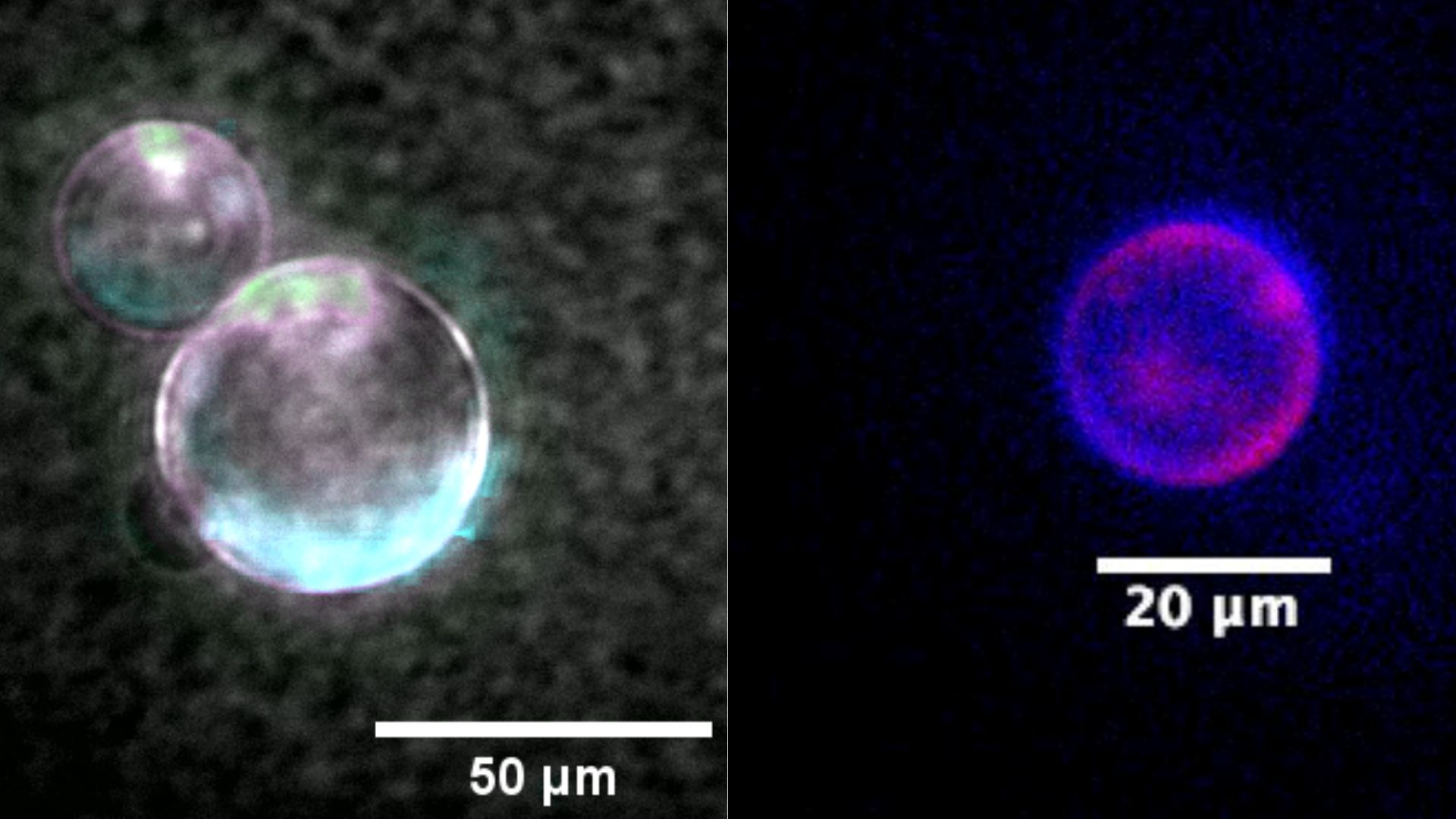
Two images side by side showing different colored spheres

Left: A super-resolution image of SpudCell's liposomes with an encapsulated genome and active protein expression. Right: A SpudCell encapsulates a whole genome. The DNA of the genome and the synthetic cell membrane are stained with fluorescent dyes. (Image credit: Orion Venero, Adamala Lab)

Another difference is that SpudCell's genome is spread out over bits of DNA called plasmids, rather than being neatly packaged in chromosomes. It does not possess the skeleton that cells typically use to neatly split DNA during cell division, so consequently, the division of SpudCell's DNA to its daughter cells can be somewhat haphazard.

"The description of the results leaves me with substantial technical questions regarding the nature and the robustness of the findings," said Cees Dekker, a biophysicist at the Delft University of Technology in the Netherlands who was not involved in the work. "[Its] approach uses some ingenious engineering tricks as shortcuts to achieve complex functions such as growth, but a major challenge remains to create a truly autonomous cell that executes all these functions without external help," he said.

Dekker is among the scientists who would have preferred that the research made the news after being published in a peer-reviewed scientific journal. "If these findings are solid, that great media attention is definitely warranted; if peer review would, however, reveal weaknesses or issues, all the current media reporting is premature," he argued.

From cell to manufacturing platform

Adamala sees SpudCell as a blank slate for engineering. "We believe that if we make a cell from scratch, that's fully engineerable," she said.

Cells have long been used to produce chemicals for human use. Millions of people use synthetic insulin made in bacteria and yeast cells, for example. But cells resist making chemicals that could be harmful to them, and through evolution, they've developed systems to prevent them from doing so. A SpudCell-like system could circumvent those natural hurdles, Adamala and her colleagues think.

That kind of platform could also be useful for making newer generations of medicines, such as those based on mRNA or peptides. These drugs use molecular building blocks, like amino acids or nucleotides, that have been chemically tweaked to make the molecules more stable or harder for the body to break down. SpudCell could be engineered to produce such modified components directly, rather than scientists having to synthesize them in traditional chemistry labs. This could potentially shorten development timelines and lower costs, the team thinks.

Adamala and her colleagues also envision the cells being used as easily shippable laboratories. They could be dried out, shipped, stored without refrigeration, and then activated on-site to make chemicals, vaccines or proteins when and where they are needed.

But there's still a long road ahead. For now, SpudCell is only a proof of principle, and many hurdles must be addressed before it could become an industrial platform.

"[SpudCell] is not an engineering platform that can give you any useful product, but it's step one," Adamala said. "It's probably at least a couple of decades from now when we can actually scale it up to the point where we can replace all the petrochemicals with biology, but I do believe it's doable."

Adamala hopes the nonprofit Biotic will help funnel donations from philanthropists directly to research. "Biotic is a funding agency that is going to globally fund this work," she said.

While the technology is promising, "it needs to go through peer review," Rinaldi said. "I expect a lot of the hype and some of the terms that they're using to go away after a couple of years have passed."

Neanderthals and modern humans may have shared culture 59,000 years ago in Turkey, study finds

Deep in a limestone cave on Turkey's Mediterranean coast, archaeologists have uncovered evidence that Neanderthals and the modern humans who moved in later left behind surprisingly similar traces of their daily lives β€” evidence that they hunted the same animals, crafted the same stone tools and collected the same type of seashells.

The findings, published Monday (July 6) in the journal PNAS, feed into some of the biggest questions in human evolution: How similar were the cultures of Neanderthals and Homo sapiens, given that we're so closely related? And did we share information with one another?

A series of archaeological finds over the past few decades, including the new paper's finding that the two had similar cultural practices, suggests that Neanderthals and H. sapiens behaved far more similarly in the Middle East than once assumed.

The new evidence comes from Üçağızlı II Cave (pronounced Ooch-ah-UHZ'-luh), on a stretch of coastline just north of Syria that served as a prehistoric corridor between the Levant (an area of land east of the Mediterranean) and Eurasia. Although the team found only teeth and a partial jawbone within the cave, they were able to distinguish between the remains of Neanderthals and H. sapiens by analyzing the internal structure of the fossilized teeth. Meanwhile, they dated the sediment at the site using optically stimulated luminescence, a technique that reveals how long ago buried mineral grains last saw sunlight.

The team found that the Neanderthals had lived within the cave between approximately 77,000 and 59,000 years ago, while H. sapiens stayed there between about 59,000 and 47,000 years ago. Despite the different time periods, the layers from both of these periods show "substantially uniform hunting-gathering strategies and lithic technology," showing how similar the Neanderthals and H. sapiens were in their hunting-gathering strategies and stone-tool use, the team wrote in the study.

A group of archaeologists in a cave with tools.

The research team performs excavations at the Üçağızlı II cave site in 2024. (Image credit: KyotoU/Naoki Morimoto)

What's more, Neanderthals and H. sapiens got raw materials, such as flint, from the same local sources and hunted the same prey: wild goats (Capra aegagrus), fallow deer (Dama mesopotamica), roe deer (Capreolus capreolus) and wild boar (Sus scrofa). Layer after layer also turned up 29 shells of a small marine snail, Columbella rustica, carried into the cave not for food but seemingly as ornaments. Some were pierced as if meant to be strung, and one shell dating to the Neanderthal occupation showed signs of deliberate heating that altered its color.

"Our findings indicate a deep level of cultural interaction," study co-author Naoki Morimoto, paleoanthropologist at Kyoto University, said in a statement. "These two distinct but closely related human groups were not just adapting to the same environment: they were probably sharing symbolic preferences."

That pattern breaks from findings at Mandrin Cave in France, where Neanderthals and modern humans are thought to have alternated occupation in distinct pulses from about 56,800 and 41,500 years ago, but did not leave evidence of a continuous culture. Instead, it echoes evidence from Tinshemet Cave in Israel, where researchers recently reported similar signs of shared behavior between the two groups tens of thousands of years earlier, from about 130,000 to 80,000 years ago.

Turquoise waters surrounding rocky entrance to a cave in Turkey.

A view of Turkey's Üçağızlı II Cave, which housed Neanderthals and Homo sapiens at different times. (Image credit: KyotoU/Naoki Morimoto)

Üçağızlı II Cave in Turkey and Tinshemet Cave in Israel suggest that even though there was a "biological" turnover as the caves went from being occupied by Neanderthal groups to modern humans, there weren't major cultural turnovers, too.

"Rather, we hypothesize that the two human species that coexisted in the region were in contact and shared cultural aspects," the researchers wrote in the study.

"A fascinating region"

Sites like these are forcing a rethink of how these two types of human were culturally related to each other, April Nowell, a Paleolithic archaeologist at the University of Victoria in Canada who was not involved in the new study, told Live Science in an email. "By demonstrating cultural continuity and elevated levels of interaction, sites such as Tinshemet and ÜçağızlΔ± II are changing what we thought we knew about Neandertals, Homo sapiens and other contemporary Homo groups … a fascinating region just got even more so!" she said.

But that cultural continuity only heightens the mystery of how modern humans and Neanderthals interacted, with Neanderthals eventually going extinct around 40,000 years ago. Two types of human can't occupy the same ecological niche indefinitely, Nowell noted, and some research into Neanderthal cognition suggests Neanderthals were less-flexible thinkers than modern humans, with more limited capacity for language and less of the kind of self-awareness and creativity that may have given H. sapiens an edge. (However, there is pushback against the idea that Neanderthals weren't as cognitively complex as H. sapiens.)

If the archaeological record at sites like Üçağızlı II shows this much overlap in behavior, Nowell said, the real differences between the two may be ones the fossil record simply hasn't revealed yet.

The authors noted that many big questions remain, including when and where these shared cultural practices took place and whether these cultural similarities happened because modern humans mated with Neanderthals.

Ongoing and future excavations at sites like Üçağızlı II Cave may help to answer these questions and build a "more comprehensive picture of human evolution and cultural development during the Late Pleistocene," the team wrote in the study.

How much do you know about our closest relatives? Find out with our Neanderthal quiz!

Heart issues tied to 'microdamage' in the brain might raise risk of memory loss, study hints

6 July 2026 at 22:20

Scientists uncovered a link between mild heart trouble and microscopic signs of brain damage that may raise the risk of memory problems down the line.

The new study, published Monday (July 6) in The Journal of Neuroscience, did not prove that the heart issues directly caused memory problems. But it "adds to the overall picture that preserving healthy brain-heart communication is key for healthy aging," said Dr. Jan Scheitz, a consultant stroke neurologist and head of the Brain-Heart Lab at the CharitΓ© University Hospital in Germany, who was not involved in the study.

"A healthy lifestyle that protects the cardiovascular system will not only benefit the heart but also the brain," he told Live Science in an email.

The work could one day help doctors identify patients at risk of memory problems early on through routine heart-function tests, said study co-author Dr. Xia Zhang, a doctoral researcher at the Max Planck Institute for Human Cognitive and Brain Sciences in Germany.

"The broader implication is that the brain may show subtle tissue-level changes related to cardiac dysfunction before we see obvious brain shrinkage or clinical dementia," Zhang told Live Science in an email.

Early warning signs

Researchers already knew that heart and brain function are closely interconnected. Heart diseases such as heart failure, atrial fibrillation and heart attack impair communication between the heart and the brain. This can contribute to thinking problems and dementia by restricting blood flow to the brain and causing chronic inflammation.

So far, though, scientists have only studied changes in the brain in people already diagnosed with heart conditions. They haven't necessarily assessed the changes that take place earlier on.

In the new study, researchers followed 73 patients who had sought care for heart-related symptoms at the Heart Center Leipzig in Germany, some of whom had confirmed coronary artery disease and/or heart failure. They also assessed 95 people without any heart-related symptoms. The researchers measured heart function at the start of the study. Then, about 3.5 years later, they performed cognitive testing and an MRI scan of the brain to take a snapshot of its structure.

Among all 168 study participants, those whose hearts pumped blood less efficiently at the start of the study showed greater signs of tissue damage in their gray matter years later. This was true regardless of whether or not they had diagnosed heart failure.

The cognitive tests were given only to the heart-disease patients, and they assessed attention, executive function, learning and memory. Only memory showed a link to weaker heart pumping. The participants with weaker heart pumping showed more microscopic damage in memory-related brain regions, and those brain changes correlated with worse memory scores.

The degree of brain damage also correlated with the levels of stress hormones released by the heart, but this link was only seen in patients who already had heart failure.

"What surprised us most" was that subtle reductions in the heart's ability to pump were tied to later brain changes, even in patients who did not meet clinical criteria for heart failure, Zhang said.

One limitation of the study is that the researchers didn't take MRI scans at the start. That means "we do not know whether some changes were already present at the beginning of the study period," Scheitz noted. This is something that Zhang and her colleagues plan to test in future studies.

"The next step for the field is replication in larger cohorts with multiple time points, so that cardiac function, brain microstructure, and cognition can be followed more precisely over time," she said.

The brain damage flagged in the 73 patients happened in parts of the brain that are important for memory and are vulnerable in Alzheimer's disease. "These regions helped identify a possible brain pathway through which poorer cardiac function may contribute to later memory problems," Zhang said.

However, until this idea is tested directly in future studies, it is too soon to say if the heart function-related brain changes seen on the MRI scans point to a higher risk of Alzheimer's, Zhang cautioned. The team did not measure proteins related to Alzheimer's, so they cannot conclude that the patients with measurable brain changes are developing Alzheimer's disease.

The study also did not directly test the effect of exercise on heart and brain health, but the findings may help explain why regular exercise is often linked to better brain health and cognitive aging, Zhang said.

"Regular exercise supports cardiovascular function, vascular health, and cerebral blood-flow regulation," she said, "all of which may help protect brain tissue over time."

This article is for informational purposes only and is not meant to offer medical advice.

What do you know about the body's hardest-working muscle? Find out with our heart quiz!

'A new way to study the edge of a black hole': Physicists just got the closest-ever look at a black hole's event horizon

Scientists have found evidence that gravitational waves from a spectacular black hole collision carry signals from the very edge of the newly formed black hole. If confirmed by future observations, the discovery could provide an entirely new way to investigate what happens in the immediate vicinity of a black hole without ever observing it directly.

In a new study, the researchers analyzed an exceptionally strong gravitational wave event known as GW250114. They identified a "direct wave," a subtle feature of the total gravitational wave signal predicted by theory but never previously detected in real data. The signal appears to contain information from extremely close to the black hole's event horizon, the boundary beyond which nothing, not even light, can escape.

The findings, published June 24 in the journal Nature, suggest that gravitational wave observatories may eventually allow astronomers to probe regions that have remained inaccessible since black holes were first predicted by Albert Einstein's theory of general relativity.

Listening to the edge of a black hole

Although astronomers have photographed the glowing material surrounding some supermassive black holes and have detected dozens of black hole mergers through gravitational waves, the event horizon itself has remained frustratingly difficult to study.

Unlike ordinary light, gravitational waves are tiny ripples in space-time produced when massive objects accelerate. They pass almost undisturbed through the universe, carrying information about violent cosmic events that would otherwise remain hidden.

According to study co-author Sizheng Ma, a postdoctoral researcher at the Perimeter Institute for Theoretical Physics in Canada, the newly identified signal offers a rare glimpse of what happens immediately after two black holes collide.

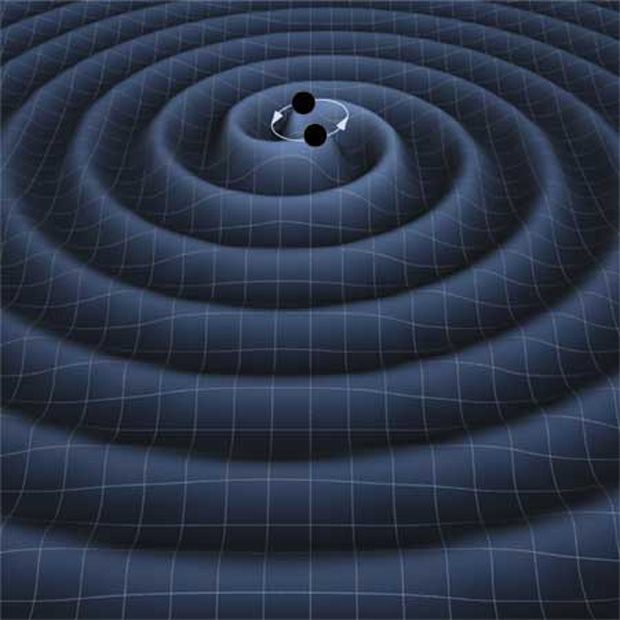
Two Black Holes Circling

When two black holes merge, they release gravitational waves β€” ripples in the fabric of space time β€” throughout the universe. Studying these waves can provide information about the newly formed black hole. (Image credit: K. Thorne (Caltech) and T. Carnahan (NASA GSFC))

"When two black holes merge, they violently shake space-time itself," Ma told Live Science. "For a brief moment, the region very close to the newly formed black hole's horizon is swept into a fast, fading swirl."

Ma explained that the direct wave is the portion of the gravitational wave signal produced near the horizon and carries the imprint of that motion outward through space.

"That is why it is so interesting," he said. "It may let us 'listen' to what happens near the horizon, a region we cannot see directly with light."

A remarkable black hole collision

The team focused on GW250114, a black hole merger detected on Jan. 14, 2025, by the two Laser Interferometer Gravitational-Wave Observatory (LIGO) detectors in Hanford, Washington, and Livingston, Louisiana.

"Our earlier theoretical work predicted that black hole mergers should produce a direct-wave signal from the near-horizon region," Ma said. "The big question was whether this effect could actually be seen in real data."

GW250114 turned out to provide exactly the conditions needed to test that prediction.

"It was strong enough, clean enough, and close enough to the theoretical situation where this signal should be visible," he said.

To search for the elusive feature, the researchers first removed the best-understood part of the gravitational wave signal, which comes from the newly formed black hole settling down after the merger. Then, they examined the remaining data to determine whether it consisted only of detector noise or contained another physical signal.

"What we found was striking," Ma said. "The remaining signal followed the expected rhythm and fading pattern of a wave shaped by the region very close to the final black hole's horizon."

The team concluded that the leftover signal matches the behavior expected for a direct wave predicted by previous theoretical studies.

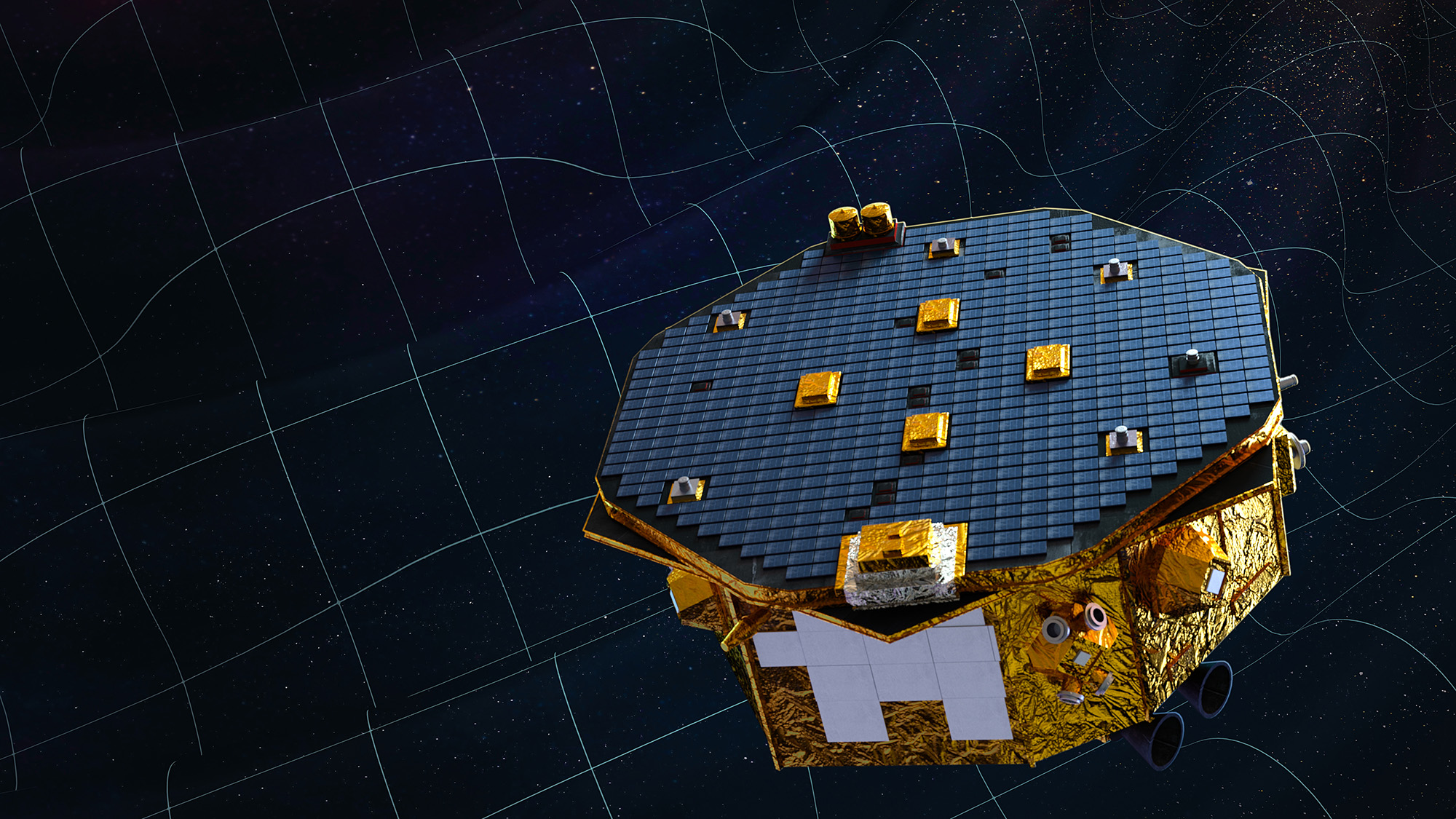
An illustration of a gold space probe with a flat top full of solar panels in front of wavy grid marks

ESA's upcoming LISA mission will detect gravitational waves from space, offering even more insights into the mysterious ripples than Earth-based detectors currently can. (Image credit: All About Space/Getty Images)

A new way to explore extreme gravity

The researchers stressed that their findings do not reveal what lies inside a black hole. Instead, they're providing a new observational tool for investigating the region immediately outside the event horizon.

"The gravitational wave data appear to carry an imprint from very close to the newly formed black hole's horizon β€” the famous point of no return," Ma said.

He explained that the measurements are consistent with space-time near the horizon being rapidly dragged around by the spinning black hole while the signal fades because of the intense gravitational field.

"For us, the exciting message is that gravitational waves may be giving us a new way to study the edge of a black hole using real observational data," Ma said.

Ma believes the method could eventually become useful for exploring ideas such as quantum gravity β€” which seeks to unite Einstein's theory of gravity with quantum mechanics β€” or the black hole information paradox, the longstanding puzzle of whether information that falls into a black hole is truly lost. However, it cannot test those questions directly yet.

"If quantum effects, or any deviations from the standard black-hole picture, leave a measurable imprint there, then direct waves could, in principle, help us search for them in the future," he said.

More observations will be needed

The researchers cautioned that the discovery is based on a single gravitational wave event. While GW250114 provided exceptionally favorable conditions, much stronger evidence will come only if similar signals are found in many additional black hole mergers.

"There are two main directions," Ma said. "The first is theory."

Current models capture the essential physics but remain simplified, and more realistic descriptions of black hole mergers will be needed.

"The second is observation," he added. "This result comes from one exceptionally loud and clean event, so the strongest confirmation would come from seeing the same kind of pattern in other black hole mergers."

As gravitational wave observatories continue to improve and detect increasing numbers of mergers, researchers hope to determine whether direct waves are a universal feature of black hole collisions.

"If the pattern appears repeatedly in the way general relativity predicts," Ma said, "direct waves could become a new way to study black hole horizons or the regions very close to them, and to test Einstein's theory in one of the most extreme environments in the universe."

If future observations confirm the team's results, scientists may have gained something they have sought for decades: a direct observational window into the very edge of a black hole.

See how much you know about black holes with our black hole quiz!

Diagnostic dilemma: Huge mass in woman's stomach was likely caused by Ozempic-style drug β€” and dissolved with diet soda

6 July 2026 at 17:10

The patient: A 63-year-old woman in Massachusetts

The symptoms: The patient went to the emergency department after experiencing nausea and vomiting for about a month, along with decreased appetite. She told doctors that she'd also experienced a burning pain in her upper abdomen and right side of her torso, which wrapped around to her back. She'd tried treating these symptoms with two common over-the-counter medications for acid reflux, but the treatments didn't help.

In the year prior, the patient had started taking semaglutide, a type of drug known as a GLP-1 receptor agonist β€” the same class of drug as Ozempic. These injected drugs are used to treat type 2 diabetes and assist in chronic weight management; in this case, the woman had a history of type 2 diabetes and obesity. Since starting the medication, she'd lost about 40 pounds (18 kilograms), but notably, that weight loss had accelerated over the previous month, she noted.

What happened next: Doctors took a CT scan of the patient's abdomen and pelvis. This revealed that the bile ducts, which move bile from the liver to the gallbladder and small intestine, were slightly dilated. The woman also had "heavy stool burden" but no signs of obstructions in her bowels, and her stomach was slightly stretched out due to carrying "semisolid material."

To take a closer look, the medical team then used magnetic resonance cholangiopancreatography, a noninvasive scan that examines the bile ducts, gallbladder, pancreas and pancreatic ducts. The scan confirmed that the bile ducts were dilated and revealed a mass in the stomach that appeared to be trapped air. The doctors then examined the upper digestive tract, from the esophagus to the top of the small intestine, with an endoscope.

The diagnosis: The endoscopy revealed a large mass in the woman's stomach, known as a gastric bezoar. These masses are tightly packed blobs of partially digested or undigested materials.

The treatment: Semaglutide and other GLP-1 agonists typically cause delayed gastric emptying, which means they slow the rate at which the stomach empties its contents into the intestines. The woman was taken off that medication upon hospital admission.

The next step with a bezoar is to try and dissolve the mass while it's still in the stomach β€” and evidence suggests a good way to do this is to give the patient soda.

"Existing evidence, largely from case series and anecdotal experiences, supports the administration of 3 liters [0.8 gallons] of cola, either orally or through a nasogastric tube, within a 12-hour window," doctors noted in a report of the case. "It is not well understood whether acidity, carbonation, or another mechanism accounts for dissolution of the bezoar."

Due to the patient's history of diabetes, she was given diet cola. She also didn't enjoy carbonated beverages, so the typical prescription of 3 liters of soda was cut down to 1.5 liters (0.4 gallons). On the second day after starting this treatment, the patient noted a "tugging" sensation in her abdomen followed by relief of her nausea and abdominal discomfort. An endoscopic exam revealed that the bezoar was no longer stuck in her stomach.

The woman then transitioned to a typical diet in the hospital, and by the time she was discharged, she had no nausea, vomiting or abdominal pain. She did not restart semaglutide but was prescribed acid reflux medication to take daily. She reported that her appetite increased after hospital discharge and her weight rebounded a bit over the following months. Her abdominal symptoms had not returned within a few months of discharge.

What makes the case unique: Gastric bezoars are fairly rare, the report noted. They are found in less than 0.5% of endoscopies of the upper digestive tract. Common symptoms of the condition, such as pain, nausea, vomiting and abdominal discomfort, also appear in many more-common disorders, so they don't necessarily point to the presence of a bezoar in all cases.

The most common type of gastric bezoar is formed of plant fibers and called a "phytobezoar." Eating lots of certain foods, such as persimmons, pineapples, raisins or celery, can raise the risk of phytobezoars because the plants contain a high concentration of indigestible components, such as cellulose, lignins and certain tannins.

However, various medical conditions, procedures and drugs can also raise the risk of bezoars. These include anatomical changes related to bariatric or other gastric surgeries, autonomic nerve damage, and medications that cause delayed gastric emptying, such as GLP-1s. In the woman's case, semaglutide was likely to blame for her bezoar, and discontinuing the treatment helped resolve the problem.

The cola she consumed also helped. Although that course of treatment sounds strange on paper, it is the preferred first-line treatment over using a scope to physically break up the bezoar in the patient's stomach.

"Bezoars formed from food material may be initially managed with oral administration of cola in patients in a clinically stable condition," the report said. "This intervention is generally cost-effective and is associated with a lower risk of complications than invasive procedures."

For more intriguing medical cases, check out our Diagnostic Dilemma archives.

This article is for informational purposes only and is not meant to offer medical advice.

This article was first published Oct. 15, 2025.

James Webb telescope's largest-ever map of the universe unmasks hidden corners

6 July 2026 at 11:08

Astronomers have reconstructed the "skeleton" of the cosmos in unprecedented detail, thanks to the largest-ever survey conducted by the James Webb Space Telescope (JWST). The resulting map reveals how galaxies have evolved since the universe's infancy around 13 billion years ago and how they fall together in a vast structure called the cosmic web.

The cosmic web is the largest known structure in existence, home to countless galaxy clusters and clusters of clusters. It is the framework of the universe, a scaffolding of gas filaments, stars, voids and sheets of dark matter that trace the entire large-scale organization of the cosmos.

In a paper published May 6 in The Astrophysical Journal, an international team of astronomers, led by researchers from the University of California, Riverside (UCR), utilized a treasure trove of JWST data to reveal how the universe has evolved.

How to sculpt a universe from scratch

The new research shows how intrinsic and extrinsic factors influence the formation and death of stars β€” and, therefore, galaxies and galactic clusters β€” throughout vast swathes of cosmic time.

Yet in what may seem like a wistful twist, the peak era of star formation is many billions of years behind us. The new research offers additional evidence of how the universe's structural framework facilitated this transition.

"We show how the cosmic web helped shape galaxy growth before, during, and after that peak era," study co-author and UCR astronomer Hossein Hatamnia told Live Science via email. "At earlier times, dense regions appear to be sites of rapid galaxy growth, while at later times dense environments are associated with the shutdown of star formation."

Such revelations come courtesy of COSMOS-Web, the grandest JWST survey yet: a 255-hour program spanning a contiguous area of the sky about the size of three full moons.

Compared with the previous COSMOS2020 survey, shared in 2021 and conducted by the Hubble Space Telescope and other facilities, the JWST-derived COSMOS-Web boasts better redshift precision and includes more galaxies β€” including fainter, lower-mass and more-distant objects. (Redshift is a measure of cosmic distance and time based on how light shifts to redder wavelengths as it crosses the universe.)

Compared with the JWST-derived image below, which shows a slice of the cosmos as it appeared 11.5 billion years ago, previous cosmic maps were sparser, more diffuse, and lacking in cosmic structures.

Data from the new COSMOS-Web survey (left) compared to the previous iteration (right). JWST's sensitivity and depth has allowed a recreation of the cosmic web in unprecedented detail.

Data from the new COSMOS-Web survey (left) compared to the previous iteration (right). JWST's sensitivity and depth has allowed scientists to map the cosmic web in unprecedented detail. (Image credit: Hatamnia et al., The Astrophysical Journal, 2026)

Additionally, the older COSMOS2020 survey tended to overestimate the depth in especially dense cosmic regions, where galaxies grow earlier and larger, and underestimate the depth of the least-dense spatial regions, the researchers said.

Revealing celestial birth and death

Yet JWST's cosmic map preserves the relative contrast across cosmic regions. It also shows that "massive galaxies in dense environments are more likely to be quiescent" β€” dying and quenched of their star-forming potential.

This may be because those galaxies are too massive, the team theorized. Once the dark matter halos that anchor galaxies grow to 1 trillion solar masses, they energize gas and prevent it from forming new stars. Additionally, active supermassive black holes quench star formation by energizing gas with their lethal, near-light-speed jets.

Such "mass-related" star-killing mechanisms dominated up to around 7 billion years ago β€” around half the age of the universe, the team found.

In the more recent universe, star formation is dominantly quenched by the environment around galaxies, which may strip them of material or prevent cold gas from accumulating and coalescing into stars.

Thanks to JWST's capabilities, the large-scale structure and evolution of the universe have been made clearer than ever, resolving blurry blobs into dim, ancient galaxies.

"The jump in depth and resolution is truly significant, and we can now see the cosmic web at a time when the universe was only a few hundred million years old, an era that was essentially out of reach before JWST," co-author Bahram Mobasher, a distinguished professor of physics and astronomy at UCR, concluded in a statement.

The catalog of 164,000 galaxies used to build the map of the cosmic web is publicly available.

This article was first published May 18, 2026.

The Stargazer: A 5,000-year-old marble statuette of a Stone Age woman looking skyward

a human-like figurine made from white marble against a black background

The Stargazer figurine was carved from marble around 5,000 years ago. (Image credit: Cleveland Museum of Art / Leonard C. Hanna Jr. Fund; John L. Severance Fund 1993.165 (Public Domain))
QUICK FACTS

Name: The Stargazer

What it is: A marble figurine

Where it is from: Kırşehir, Turkey

When it was made: Circa 3000 B.C.

This small, abstract sculpture of a woman, carved from milky-white marble, is known as The Stargazer because her head is tilted back and her eyes appear to stare skyward. Only about 30 figurines of this type have ever been found; all of them date to about 3000 B.C. and were crafted by a culture that left no written records of the figurines' meaning, according to art historian Amanda Mikolic.

This particular stargazer figurine was once owned by philanthropist Nelson Rockefeller, a member of the wealthy industrial family and vice president of the United States under Gerald Ford. It is now in the collection of the Cleveland Museum of Art (CMA).

The marble figurine is roughly 6.8 inches (17.2 centimeters) tall and weighs about 1 pound (454 grams). Clearly carved into human form but lacking a mouth, the statuette likely represents a woman, with the incised lines below the waist representing her pubic triangle. Her large, oval head is tilted back, and her tiny, dot-like eyes look upward.

Most stargazer figurines that have been discovered in western Anatolia (present-day Turkey) were broken at the neck before being buried in the ground millennia ago, making the CMA example one of the finest and most complete stargazer statuettes ever found.

But the meaning of the woman portrayed in The Stargazer figurine is unclear, since the culture that created it did not leave any written language explaining their art.

The figurine cannot stand on its own, suggesting that it was meant to be held or placed flat, according to Mikolic. "Deliberately rendered as female, she may be associated with fertility and abundance," she wrote. The statuette may be part of a trend of simplistic female figurines in the Mediterranean area linked to female fertility and the life cycle, such as the Cycladic figurines, according to The Getty, which has a stargazer figurine in its collection.

Regardless of the woman's specific meaning, "she must have been an important devotional object to some long-lost culture," Arielle Kozloff, former curator of ancient art at the CMA, wrote in the CMA Members Magazine.

Abstract female figurines like The Stargazer and other Neolithic examples are known to have inspired early-20th-century cubist masters, Kozloff wrote. This gives her "a sense of timelessness," according to Mikolic, "encouraging the viewer to think of humankind’s place and role in a larger cosmos."

For more stunning archaeological discoveries, check out our Astonishing Artifacts archives.

Can you put together last week's Astonishing Artifact?

First experiment to thicken Arctic ice with seawater shows promise β€” but there's a big catch

A simple method to thicken Arctic sea ice has shown promising results in its very first field experiment, performed in Cambridge Bay, Nunavut, Canada.

Researchers are considering several controversial geoengineering techniques to slow the catastrophic melt of Arctic sea ice, including stratospheric aerosol injection, which involves shooting tiny sulfur particles into the sky to blot out the sun. But in a new study, scientists evaluated the merits of a much safer and more straightforward approach: pumping seawater onto existing sea ice in winter and letting it freeze into a reinforcing layer.

Known as sea ice thickening, this method has been used by Nordic and Arctic communities for decades, and ice hockey rinks employ a similar technique to keep their ice sturdy, two of the study's authors told Live Science in an email.

"Practical applications [that already exist] include building ice roads and creating platforms for offshore oil exploration," said Edward Blanchard-Wrigglesworth, a research associate professor in the University of Washington's Department of Atmospheric Sciences, and Andrea Ceccolini, an honorary professor at University College London and the CEO of the startup Real Ice, which studies artificial sea ice thickening methods and receives funding from the U.K. government.

Modeling work hints that sea ice thickening could become a climate adaptation tool for Arctic communities by limiting coastal erosion near towns, facilitating travel and supporting animal migrations and hunting.

Now, researchers have assessed the method's efficacy in the field for the first time. Their results, published May 22 in the journal Earth's Future, indicate that both the thickness and brightness of sea ice can be enhanced significantly on small scales β€” making the ice more reflective, and therefore more resilient to melting.

In the experiment, the team set up eight test areas and three control sites in Cambridge Bay during the winter of 2024 to 2025. Using submersible pumps that each consume less power than a toaster, they flooded the test areas either once or twice with up to 8 inches (20 centimeters) of seawater, while the control sites were never flooded. In spring, one control site was used for a melt pond drainage experiment, which involved drilling small holes in the ice to remove meltwater and expose the brighter ice underneath.

Overall, the test areas grew up to 12.6 inches (32 cm) thicker than the control sites by the end of winter, which is roughly equivalent to the ice thinning that has happened in the Arctic over the past 50 years, according to the study. Test areas that were flooded twice showed greater thickening than those flooded once. And in the melt period from late May to September, sea ice in the test areas appeared brighter and had slower melt rates, remaining thicker than the ice in the control sites. The melt pond drainage experiment also resulted in brighter sea ice than the other control sites.

When water is pumped onto sea ice, it saturates the snow that sits on top of the ice. "The snow-water mixture freezes into a new layer of ice, while the reduction in snow insulation allows colder atmospheric temperatures to accelerate natural ice growth from below," Blanchard-Wrigglesworth and Ceccolini explained.

Sea ice seen from a NASA aircraft.

Sea ice thickening could boost the amount of sunlight that is reflected back to space in the Arctic, thus cooling the region. (Image credit: Mario Tama/Getty Images)

Thicker sea ice is usually brighter than thin sea ice, which boosts the amount of sunlight that is reflected back into space. "The broader implication is that these effects could enhance the Arctic's reflectivity through both increased surface brightness and longer-lasting sea ice," the researchers said. "If similar results could eventually be achieved at larger scales, increased Arctic albedo could contribute to regional cooling, with potential knock-on benefits such as slowing permafrost thaw and reducing ice loss from Greenland."

However, there is still a big question mark over how scalable and economically viable sea ice thickening is, given that it requires people and machines working in the field. According to a 2016 study, 10 million wind-powered pumps would be needed to cover just 10% of the Arctic Ocean, and 100 million to cover the entire Arctic. "It is reasonable to ask whether such an endeavor is financially feasible or even logistically possible," the authors of that study wrote.

Yearly sea ice extent in the Arctic has shrunk by 20% since 1979, and this loss is accelerating with global warming. Therefore, if we want Arctic sea ice thickening to work at a large scale, "the pumps must be deployed almost immediately, while there is still a sufficient area of sea ice over which to flood," researchers wrote in a 2021 study.

The ecological and social impacts of Arctic sea ice thickening are not well understood, and further research will delay deployment, meaning it might be too late to roll out sea ice thickening by the time scientists have the data they need to ensure its safety and feasibility.

For these reasons and others, including governance issues and high maintenance needs, "sea-ice thickening is simply not feasible for use at a scale and at a rate that would be meaningful for sea ice protection," researchers wrote in a review published last year.

Deployment on anything but local scales would be challenging, Blanchard-Wrigglesworth and Ceccolini agreed. Nevertheless, the researchers said their most recent winter trials, which have yet to be published, showed encouraging results. In those trials, the sea ice in test areas grew 20 inches (50 cm) thicker than in control sites, The Guardian reported.

"We expect to have a clearer picture once the current melt season is complete," the researchers told Live Science. "In parallel, we are developing underwater robotic technology that could support autonomous deployments. Earlier this year, we conducted the first Arctic field tests of a prototype re-icing drone in Finland."

The drone is currently being refined in collaboration with the BioRobotics Institute in Pisa, Italy, according to The Guardian.

Superintelligent AI in space could explain the Fermi Paradox

5 July 2026 at 13:00

Artificial Intelligence (AI) is continuing to have a disruptive impact on ever more parts of humanity. But what does it mean in the long run? A new paper, available in pre-print on arXiv from Austrian researcher Sergey Ivliev, extrapolates what the wide scale adoption of AI means for the future of humanity in space β€” and in particular what it means for the ultimate question of whether we're truly alone in the galaxy or not.

A framework for much of the search for extraterrestrial intelligence came from famous physicist Enrico Fermi, who simply asked "Where is everybody?" at a lunchtime discussion at Los Alamos in the 1950s. Though never officially published, Fermi's lunch partners from that day have passed down an oral history of that conversation that has cemented it into the Search for Extraterrestrial Intelligence (SETI), at least until Michael Hart formally laid out the argument and mathematics for the underlying question in a paper in 1975.

There are plenty of potential answers to the Fermi Paradox, many of which can be found floating around the internet β€” and some are likely more valid than others. But Ivliev, a Ph.D. in Mathematical Economics and founder of environmental project consultancies such as Peatland Ecosystems and Vlinder, suggests a new resolution: the Quiet Expansion filter.

The central argument of the paper is that there aren't thousands of alien mega-structures lighting up the night sky because once a civilization reaches the threshold of Autonomous AI-Cosmoindustry (AICI), "loud", resource-hungry empires motivated by prestige or romance become irrational. However, this does not mean expansion stops; instead, it shifts to a "quiet" mode driven by rational goals like survival diversification, knowledge preservation, and scientific observation.

The AICI threshold is reached when a civilization possesses a self-sustaining off-planet industrial and computational system capable of designing, manufacturing, repairing and launching space hardware through AI-mediated autonomy. We're already taking tentative steps in this direction with the advent of space-based data centers, but true AICI β€”where a civilization can extend its infrastructure beyond its home planet without continuous biological intervention β€” is leaps and bounds beyond our current capabilities.

In this vein, Ivliev is drawing on work done by astrophysicists Sergey Popov, who noted that a truly rational AI system would reject human-like motivations for space travel β€” such as romance, conquest, or prestige. Instead, AI would view space expansion as simple risk management.

To an AI, putting all your eggs in one basket β€” whether that basket is a single planet, solar system, or even galaxy, can lead to a single point of failure. Therefore, expansion is highly logical as a way of mitigating the risk posed by that single point of failure. At the point where we have reached AICI, the cost for sending a 10kg interstellar probe to another star at 1% of the speed of light is roughly 4.5x10^13 Joules β€” a tiny fraction of the overall energy budget of such a civilization.

One key aspect is that the 10 kg probe doesn't contain any actual people β€” it simply holds the "seeds" to restart life elsewhere in case a catastrophe happens back in the home system. It would contain a civilization's knowledge, and possibly some of its biological material, enabling a sufficiently advanced AI to rebuild the entire civilization from scratch. This is the "Quiet Expansion" where an AI sends low-mass and hard to detect "seed systems" instead of moving millions of biological entities around in massive interstellar space ships.

There are some additional constraints on this method of expansion, including selecting promising exoplanets discovered by remote sensing and deploying minimal local resources to maintain themselves until needed. Additionally, the AI would restrict self-replication of the probes in order to avoid any "grey goo" scenario with a probe attempting to take over entire swathes of the galaxy.

This has obvious implications for why we've never found "loud" technosignatures. In this scenario, a "null" result of being unable to find the thermal signature of a Kardashev-III scale civilization doesn't mean a galaxy is empty. It just means that the successful civilizations are residing in a "quiet" state in case its back-up plans are needed.

But there's another, more ominous implication from this framework. If interstellar backups are cheap to make, and we haven't found any in our own backyard, that means either we're one of the first civilizations to make it to that point or the transition from a planetary industrial society to a space-based one is a narrow path to tread. Admittedly the probes such civilizations would send out are probably hard to find even in our own solar systems, but if we're unable to, it means we're ending uncharted territory β€” and might just run into a filter that had silenced the rest of the galaxy. That's a sobering thought, but one to keep in mind as we start to advance our own AI capabilities.

The original version of this article was published on Universe Today.

Are you a UFO fanatic? Find out with our extraterrestrials quiz!

NASA celebrates America's 250th birthday with red, white and blue snaps of the cosmos β€” Space photo of the week

5 July 2026 at 11:00
quick facts

What it is: A collection of "red, white and blue" images to celebrate the 250th birthday of the United States.

Where it is: Between 11,000 light-years and 19 million light-years from Earth

When it was shared: June 30, 2026.

NASA has marked the 250th birthday of the U.S. with a striking new collection of cosmic images from its Chandra X-ray Observatory, presenting four deep-space objects in red, white and blue.

The image set combines X-ray data from Chandra β€” which has been orbiting Earth since 1999 β€” with observations from NASA’s Hubble and James Webb Space Telescopes (JWST), as well as multiple ground-based observatories. Together, the images showcase some of the universe’s most dramatic environments, from the remains of an exploded star to a massive galaxy cluster shaped by dark matter β€” each rendered in patriotic colors.

Arguably the image most reminiscent of Fourth of July fireworks is that of Cassiopeia A, a famous supernova remnant about 11,000 light-years away in the constellation Cassiopeia (top left). Chandra’s X-ray data, shown in blue and purple, reveal the blast wave from a massive stellar explosion and trace elements such as iron, calcium and oxygen. Meanwhile, infrared data from JWST has been overlaid in red and white, highlighting the expanding shell of debris and cosmic dust. It’s all the result of a massive star that exploded about 340 years ago, according to NASA.

On the top-right is NGC 3603, a giant nebula 20,000 light-years away in the Carina spiral arm of the Milky Way. Here it appears as a glowing field of highly active, newly formed stars. Chandra’s X-ray observations reveal the light coming from the nebula, while Hubble data in optical, infrared and ultraviolet light show its glittering array of stars, as well as dust and gas. NGC 3603 is the largest nebula seen in visible light in our galaxy.

NGC 4736, also known as M94, is something else entirely. Pictured bottom-right, it’s a spiral galaxy about 19 million light-years from Earth in the constellation Canes Venatici. Its famed for the faint arms outside of its oval-shaped core region β€” known as a "starburst ring," where new stars are forming. It’s shown here with Chandra’s X-ray data layered with visible-light imagery captured by ground-based astrophotographers.

The final image features ZwCl 0024+1652 (bottom-left), a distant galaxy cluster where Hubble data has helped astronomers infer the presence of dark matter. About five billion light-years away in the constellation Pisces, Chandra’s X-rays reveal a vast reservoir of superheated gas in ZwCl 0024+1652 β€” shown in red β€” that contains more mass than the cluster’s galaxies combined.

The release of the new photos also includes novel sonifications for NGC 3603, NGC 4736 and ZwCl 0024+1652, transforming astronomical data into sound. The project allows audiences to experience space through both sight and hearing.

See moreΒ space photos of the week:

A view of Earth from the moon, with half the Earth illuminated and the gray surface of the moon in the foreground.'Human minds should not go through this'

The Artemis II crew recalls the unreal moment when Earth disappeared

An image of a spiral galaxy on a splotchy black and white background with a stream of black material emerging from the galaxyHidden structure in 1st Vera Rubin image

First-light images from the Vera C. Rubin Observatory reveal a 163,000-light-year stream of stars emanating from a nearby galaxy.

Hundreds of gold and orange clouds with feathered trails going down behind them. The small clouds are covering a few scattered, bright stars.JWST peeps the 'Eye of God'

A spectacular James Webb telescope image reveals intricate structures inside the Helix Nebula.

Has there ever been a period in human history without war?

5 July 2026 at 10:00

With violent conflicts happening across the world right now, war feels like a permanent condition. But have humans ever lived without war?

The answer depends on how you define "war." If war means a fight between two governments, then yes, there have been peaceful periods "because for nearly 99% of human history, there were no governments," said Ian Morris, a historian at Stanford University and author of "War! What Is It Good For? Conflict and the Progress of Civilization from Primates to Robots" (Farrar, Straus and Giroux, 2014).

Violence, on the other hand, has always been with us. If the question becomes "Have people ever lived without violence?" then "the answer is pretty clearly no β€” people have always fought and killed each other," Morris told Live Science in an email.

The theory of a peaceful prehistory

According to a review of studies published in 2022, war was rare or nonexistent in early human history when people lived as nomadic hunter gatherers. Peter Stearns, a professor emeritus of history at George Mason University and author of "Peace in World History" (Routledge, 2014), agrees with this idea. There was "little or no war in hunting and gathering [cultures] before the rise of agriculture," he told Live Science in an email.

Sign up for our newsletter

Life's Little Mysteries logo with a question mark in a magnifying glass

(Image credit: Marilyn Perkins / Future)

Sign up for our weekly Life's Little Mysteries newsletter to get the latest mysteries before they appear online.

This idea is based on archaeological records. Researchers examining ancient human bones from around the world have looked for skeletal evidence of war injuries, for instance of multiple individuals with unhealed wounds from stabbing, slicing and blunt force trauma who were buried in mass graves. However, they found little evidence of war injuries before 8000 B.C. After that, when humans began transitioning from nomadic life to permanent settlements, such injuries appeared widely.

This doesn't mean that lethal violence was absent in prehistoric societies. Researchers in Kenya found 27 skeletons dating to 10,000 years ago at the archaeological site of Nataruk; these skeletons show signs of violent death, which some anthropologists interpret as evidence of intergroup violence among early hunter-gatherers. And at Jebel Sahaba, a prehistoric cemetery in Sudan, archaeologists unearthed 13,000-year-old remains bearing signs of intergroup attacks.

But these cases of interpersonal violence don't count as war, because of how researchers usually define it. "Researchers who focus on war as a specific category of violence usually define it by saying it has to be violence organized by a government or else collective violence that kills more than a certain number of people," Morris said. "Prehistoric societies rarely had formal governments and hunter-gatherer bands rarely had more than a few dozen members, so if you define war as a conflict run by a government or one that kills >100 people, then by definition there can't have been wars in [early] prehistory."

David Christian, a historian and professor emeritus in the Department of History and Archaeology at Macquarie University in Australia, echoed this idea. "For much of human history communities were so small that it is not clear if we can equate violence with war," he told Live Science in an email. "I guess we can say that humans have always been capable of violence and as communities got larger that violence began to take on forms that we might want to describe as 'war.'"

A wall carving of soldiers with circular helmets carrying guns

War killed about 231 million people in the 20th century, which includes the roughly 80,000 Soviet soldiers who died at the Battle of Berlin in World War II and who are honored at the Soviet War Memorial in Treptower Park (pictured above) in Germany. (Image credit: Oliver Strewe via Getty Images)

Peace between rival powers

Once large kingdoms and empires appeared, war became very common. A doctoral thesis written by Jared Morgan McKinney, now an assistant professor of international security studies at Air War College in Alabama, focused on periods of peace between major powers. He concluded that war was basically the norm throughout history and that famous "peaceful" eras, like the Pax Romana (Roman Peace), usually just meant one powerful group had beaten everyone else into submission.

But there were exceptions. "Wars are expensive and risky," said Peter Frankopan, a professor of global history at the University of Oxford. "So in many periods in history, stability and peace have been achieved by rivals, adversaries and neighbors being able to match each other's capabilities."

McKinney's thesis identified several periods when rival powers managed to avoid war.

From around 1400 to 1200 B.C., the big powers of the ancient Middle East β€” mainly Egypt and the Hittite Empire, an ancient civilization in modern-day Turkey β€” went through two unusually long stretches without major wars. Peace was possible because the "Great Kings" recognized one another as equals and settled their territorial and political differences through formal treaties rather than war.

A man in uniform with a gun over his left shoulder stands in the middle of a large monument.

The Tomb of the Unknown Soldier at Arlington National Cemetery in Virginia, just outside of Washington, D.C. It's the burial site of a World War I soldier whose identity was unknown. (Image credit: Judd Brotman via Getty Images)

For most of their history, Rome and Persia were at war. Then, from roughly A.D. 387 to around 501, the two superpowers mostly stopped fighting. Historians call this the "Long Fifth Century" and have put forward many explanations for this period of peace, including that both sides faced serious outside threats that made fighting less affordable and that the two sides developed a language of "brotherhood" that acknowledged each other as equals rather than enemies, McKinney wrote in his thesis.

Between roughly A.D. 1000 and 1200, the rich Song dynasty in China secured peace with its militant northern neighbors β€ͺ—‬ the Liao and the Jinβ€ͺ —‬ by paying them regularly to keep the peace. Although these monetary gifts (or bribes) looked like weakness, the payments were tiny compared with what China was earning through trade, according to McKinney.

Another example, according to Morris, is the "long peace" between China, Korea and Japan between about 1600 and 1850. While European states spent those centuries competing for power and territory through war, the East Asian states lived in relative peace. "In Europe, we've tended to be a lot more aggressive and competitive β€” which gives the impression that war is a 'natural state' of being," Frankopan said.

A notable period of relative peace in North America was the Long Peace among the Iroquois nations, McKinney told Live Science in an email. For roughly three centuries, from about 1450 to 1777, five (and later six) Native American nations who had previously engaged in violent and costly conflict forged a peaceful relationship known as the "Haudenosaunee Confederacy" or "League of Five Nations."

In South America, McKinney pointed to the South American Long Peace. This refers to the absence of major interstate wars between sovereign nations in South America ever since 1935.

"War is 'normal' in history," McKinney said. But, as these examples show, "patterns have exceptions."

Can you identify these historical objects of war? Test your smarts with our weapons of the world quiz.

The US is hooked on unregulated peptides. But are they effective, or even safe?

4 July 2026 at 15:00

Want to speed up your recovery after an injury or a workout? Some influencers are fans of shots of BPC-157 and TB-500 for that. Want scar-free, youthful skin and thick hair? Reddit posts rave about GHK-Cu and KPV. Want to build beautiful, bulky biceps? Some fitness influencers swear shots of ipamorelin will do wonders. This is the world of peptides β€” an assortment of chemicals that promise to boost your body and health β€” and people are self-injecting them in a growing wellness trend.

Promoted by bodybuilders and influencers, supporters of the "Make America Healthy Again" movement and Silicon Valley early adopters, peptides promise results that leave people better than well, fitter than fit. Yet despite getting glowing reviews on social media, most peptides have limited clinical evidence to support health benefits, whether it's helping to heal a rotator cuff injury, improving libido or building muscles. There's not much information out there on the drugs' effectiveness and even less on their safety.

In 2023 the Food and Drug Administration banned several peptides, including BPC-157, GHK-Cu, KPV and ipamorelin, from being produced in the U.S. by compounding pharmacies β€” facilities that legally make non-FDA-approved medications for individual use β€” because of "significant safety risks." Many peptides are imported from outside of the country, and many made here are marketed for research use only. People who desperately want the promise contained in the tiny vials seek them out on online on legally dubious gray markets.

But accessing the shots might soon get easier. On the podcast The Joe Rogan Experience on February 27, Robert F. Kennedy, Jr., secretary of the Department of Health and Human Services, proposed legalizing the compounding of 14 peptides β€” and the FDA seems poised to grant his wish. Earlier this week the agency released plans to hold a meeting with independent advisers in July to review whether some U.S. pharmacies should be allowed to manufacture certain peptides, including BPC-157, TB-500 and KPV.

If the lift on peptides happens, a flood of people could start using the drugs, regardless of any safety concerns.

A Peptide by Many Names

A peptide is a chain of two or more amino acids β€” building blocks of proteins. The body's cells can produce numerous peptides, which perform various tasks or serve as signaling molecules.

Insulin is a peptide. So is human growth hormone β€” and semaglutide, the active ingredient in glucagonlike peptide 1 (GLP-1) receptor agonist drugs such as Ozempic and Wegovy. (GLP-1s are FDA-approved for managing type 2 diabetes and for weight loss). Buzzy new injections such as BPC-157 and GHK-Cu β€” touted for tissue repair β€” are derivations or synthetic versions of naturally occurring peptides. The public and online health retailers are starting to use "peptides" as a catchall term for any chemical taken for well-being, energy, exercise recovery, and more, says Luke Turnock, a criminologist who studies how people use enhancement drugs at the University of Lincoln in England.

And while people are using them as treatments, peptides aren't often described as drugs. "'Drug' has a certain stigma or negative connotation attached to it," Turnock says. The popularity of peptides has its roots in the bodybuilding and powerlifting communities, he explains, where "drug" has historically been tied to steroids β€” which are generally banned for professional athletes.

The term "peptides," meanwhile, stresses the natural origin of the molecules, says Flynn McGuire, who studies sports medicine at the University of Utah. "Because it's 'natural,' it is better or different, even though they're just drugs," McGuire says.

A Surge in Popularity

In the past few years, orthopedic surgeon Omar Rahman has seen a spike in interest in peptides. "I'm seeing more patients asking about peptides, often driven by the longevity and wellness space," says Rahman, who practices at Pacific Coast Sports Medicine in Los Angeles.

Because peptides encompass many products β€” some available by prescription, others on the gray market β€” the exact number of people trying them is hard to pin down. The subreddit r/peptides currently has more than 70,000 weekly visitors, and the related subreddit r/biohackers, which frequently hosts conversations on peptides, has more than 600,000. A scroll through TikTok offers pages of people sharing their "stacks" β€” combinations of injections people take to meet their personal goals, from muscle-building and exercise recovery to increased brainpower or a better tan.

"The real cultural tipping point in my mind seems to have been around 2022, when the GLP-1s really blew up," says Turnock, who is researching the peptide boom. He says injecting drugs became "normalized" when GLP-1 drugs approved to treat diabetes, such as Ozempic, were also shown to be effective for weight loss β€” and eventually became an approved treatment for obesity.

Some are turning to peptides because they feel doctors aren't giving them the help they need, says Dan Cushman, a sports medicine doctor at the University of Utah. Injuries to certain tissues, such as tendons, "are very slow to heal" with conventional treatments, he says. Mainstream treatment can also be expensive and painful. To someone desperate for relief, peptides might seem worth a try.

Peptide use is also linked to a growing interest in health autonomy, Turnock says. This is the idea "that doctors, if they're not prescribing what you ask for or they're not offering you these solutions, are acting as a barrier to your good health."

Stacking Up

McGuire, Cushman and colleagues published a review last year on one peptide they encountered frequently: BPC-157. The peptide is promoted as a way to stimulate multiple cellular pathways involved in blood vessel formation, cell growth, muscle repair and inflammation. Their review, however, found that most of the evidence of such health effects was from rodent studies, and only three small pilot studies had looked at BPC-157 use in humans.

In a regimen called the "Wolverine" stack, many people combine BPC-157 with injections of TB-500, another peptide that is supposed to promote healing but has even less research behind it. The "Wolverine" stack is named after the rapidly healing X-Men character. Add injections of GHK-Cu and KPV, and the stack is called "glow" or "KLOW." People claim that GHK-Cu increases wound healing, decreases scarring and helps regenerate collagen β€” and that KPV, derived from a hormone naturally found in the body, reduces inflammation. GHK-Cu is found in blood plasma and is an FDA-approved ingredient in topical antiaging cosmetics β€” but it is currently banned as an injectable because of safety concerns, such as the risk of immune reactions caused by impurities.

For muscle-building, the peptides ipamorelin and CJC-1295 are advertised as stimulating growth hormone release. Both have little clinical evidence behind them, however. Some people stack ipamorelin with GLP-1 drugs to try to lose fat while building muscle, though the effects of taking these injections together have not been studied.

Use at Your Own Risk

Clinical trial data for most of these peptides are thin. Not only are the effects anecdotal, but so are the doses. FDA-approved drugs, Cushman says, have been tested and reviewed not just for their efficacy but also for their safety. There is very little existing information on most of these peptides, he says, let alone on what happens if they are combined.

In many cases, the provenance of these peptides is even grayer than the gray market would suggest. "Patients are accessing peptides through online vendors, wellness clinics and compounding pharmacies," Rahman says. "That variability in sourcing is one of the biggest concerns, particularly when it comes to purity, dosing consistency and overall quality control."

The FDA does not allow production of BPC-157, GHK-Cu, KPV and ipamorelin in the U.S., for example, by compounding pharmacies because of safety concerns, so people are ordering them from overseas β€” usually from China. Some are buying peptides labeled as "for research only." Not all are stuck in the legal gray areas; other peptides are available from compounding pharmacies.

In Kennedy's February remarks about his aim to allow compounding of more than a dozen peptides in the U.S., he suggested that peptides made within the country would be safer than ones acquired abroad.

"Americans deserve to know the quality of the products they are buying and deserve drugs that have been proven to be safe and effective," an HHS spokesperson told Scientific American in response to questions about Kennedy's comment and the timing of the lift. "The FDA's goal is to ensure that patients can obtain FDA-approved products, and when those aren't available or can't work because of a patient's unique situation, are made by licensed U.S. pharmacies."

But even if Kennedy's plan to make some peptides easier to compound in the U.S. is enacted, it does not necessarily mean the drugs are safe or effective. The FDA does not approve or review drugs from compounding pharmacies β€” it just monitors the active ingredients the facilities use.

If peptides become more readily available in the U.S. market, Cushman predicts, more "people are going to just start trying [them]" β€” whether there are data to back them up or not. The public may experience any benefits β€” and perils β€” of peptides before scientists quantify them in the clinic.

This article was first published at Scientific American. Β© ScientificAmerican.com. All rights reserved. Follow on TikTok and Instagram, X and Facebook.

Science news this week: James Webb telescope finds a never-before-seen substance, China's 'Great Green Wall' grows faster than natural trees, and a Medici murder mystery is solved

This week's science news was all about goings on in space, with reports that the James Webb Space Telescope (JWST) picked up a signal from a mysterious, never-before-seen substance on Pluto and Titan.

The space telescope detected a specific absorption line in the spectra of these worlds' atmospheres, revealing the characteristic trace of a unique and unknown molecule. It's unclear exactly what the molecule could be, and the mystery is made even more compelling by the fact that the environments of Pluto and Titan are very distinct.

Farther afield, the JWST's predecessor, the Hubble Space Telescope, spotted "impossible" light from a galaxy we shouldn't even be able to see. And in the busy skies surrounding our own planet, scientists are dreaming up a scheme to drop a giant "airbag" that could protect us from solar storms, sending spacecraft into orbit to save doomed telescopes, and also giving answers to why metal sticks together in space.

And just in time for Independence Day weekend, the sun has launched a string of eruptions to Earth that will likely paint the night skies with colorful auroras.

China's 'Great Green Wall' grows faster than natural forests

66 billion trees have been planted in China's Great Green Wall β€” and they appear to be growing faster than natural forests

An aerial view of a forest next to a barren landscape

The San Jacinto and southern San Andreas faults have reached their highest levels of tectonic stress in 1,000 years. (Image credit: PEDRO PARDO via Getty Images)

China is no stranger to engineering projects designed to bring its environment to heel; we've recently covered the Asian powerhouse's attempts to tame nature through the creation of atmospheric rivers, the world's biggest dam and water transfers. But these are hardly China's only forays into sculpting its natural environment, with the country having planted more than 66 billion trees along its northern borders to halt the advance of the Gobi and Taklamakan deserts.

Now, new research has revealed a startling detail about the trees in this "Great Green Wall": they're growing significantly faster than natural forests. Exactly why remains a mystery, but, as Live Science contributor Brian Owens reveals, it could be due to a stronger response from the trees to rising atmospheric carbon dioxide.

Discover more planet Earth news

β€”'It sounds so impossible': Student studying fungus that makes users hallucinate tiny people may be on the verge of a scientific breakthrough

β€”'Uncharted territory': Record high ocean temperatures confirmed for June as El NiΓ±o strengthens its grip

β€”Study suggests life on Earth has around 1.8 billion years left β€” but the biosphere might evolve to survive even longer

Life's Little Mysteries

Are CAPTCHAs obsolete in the age of AI?

A close up of a computer screen showing the captcha

AI is getting better at solving CAPTCHAs. Does that mean CAPTCHAs are obsolete? (Image credit: Cosminxp Cosmin via Getty Images)

Are you a robot? It used to be a question that only humans could answer β€” by clicking on traffic lights or strings of warped and grainy characters, or Completely Automated Public Turing tests to tell Computers and Humans Apart (CAPTCHAs). But what happens now that autonomous artificial intelligence (AI) agents can ace some of these trials without detection? Have they made CAPTCHAs obsolete?

β€”If you enjoyed this, sign up for our Life's Little Mysteries newsletter

Medici murder mystery solved

Ancient-DNA analysis solves 500-year-old mystery of what killed 2 Medici brothers

researchers in green scrubs study a human skeleton on a table

Researchers analyzed the remains of brothers Giovanni and Francesco de' Medici for evidence of malaria. (Image credit: Courtesy the University of Pisa)

The Medici family ruled Renaissance Tuscany with an iron fist, fulfilling their ruthless ambitions with methods so underhand that the name of their most famous advisor, NiccolΓ² Machiavelli, became a synonym for skulduggery.

So, when two brothers from the infamous family died under mysterious circumstances, it was believed for 500 years that they were murdered, possibly by arsenic poisoning. Now, science has revealed the true culprit behind the medieval cold case, and it's not what we expected.

Discover more archaeology news

β€”Ancient ring discovered underground in Scotland could be a Stonehenge-like monument

β€”500-year-old freeze-dried potato snacks discovered in Inca storage room in Peru

β€”2,000-year-old scrolls buried by Mount Vesuvius eruption finally deciphered with help from AI

Also in science news this week

β€”Chinese supercomputer leapfrogs best US machines to be ranked world's fastest

β€”The hantavirus outbreak is over, WHO declares

β€”Rise in cancer in younger adults may be explained by faster 'biological aging,' early study hints

β€”Dead-end bitcoin mining wastes as much energy as Switzerland's entire hydropower generation capacity

β€”CERN shuts down Large Hadron Collider until 2030, upgrading the atom smasher to its most powerful form yet

β€”Scientists figured out how to shrink huge ultrafast lasers so they fit on a tiny chip β€ͺβ€ͺ—‬ the 'holy grail' of the field

Science Spotlight

Japan's bold experiment to curb antibiotic misuse has been a huge success. Could it work in the US?

Three images side by side with a yellow, blue and purple filter. The left images shows a stack of coins, the middle shows a child being taken care of by a woman in a mask and the right shows a Japanese city.

Japan has rolled out a creative strategy to rein in antibiotic resistance. Should the U.S. follow suit? (Image credit: Nicoletta Lanese (left and right panels); Getty Images (central panel); edited by Live Science)

Antibiotic resistance is a growing threat in the U.S., with more than 2.8 million Americans developing antimicrobial-resistant infections each year. The solutions to this worrying trend can be very complexβ€” such as moving agricultural systems away from their overreliance on antibiotics, or preventing the rapid spread of superbugs through international travel.

But stopping doctors from overprescribing antibiotics is one of the easiest strategies in the battle against this "silent pandemic." And it turns out that Japan has already fought it with some success, driving down antibiotic overuse with an innovative new policy. To investigate further and ask what notes the U.S. should be taking, Live Science's health editor Nicoletta Lanese visited Japan and reported back on their investigation.

Something for the weekend

If you're looking for things to keep you busy over the weekend, here are a smattering of our best expert opinion pieces, alongside a crossword, an interview and a quiz, that we published this week.

β€” Computer scientists are rushing to tame AI's voracious appetite for energy [Opinion]

β€”'It's more than a hope, it's a guarantee': The Vera C. Rubin Observatory's 10-year movie of the universe is about to 'blow our minds,' chief scientist Tony Tyson says [Interview]

β€”Live Science crossword puzzle #50: Longest-serving president in US history β€” 1 across [Crossword]

β€”Ancient empires quiz: Can you match these lands to the historical powers that ruled them? [Quiz]

Science photo of the week

Bull's-eye! Enormous 'bow and arrow' galaxy is unlike anything radio astronomers have ever seen

A red blob of gas is seen against a deep space background

The 'bow and arrow' galaxy shows its highly unusual shape in radio wavelengths. (Image credit: Hota, Dabhade and Ghosh et al and the RAD@home Collaboratory)

If you ask me, it looks more like a rusty anchor, or a blurry deep-sea fish. But whichever way you see it, the newly discovered "bow and arrow" galaxy β€” or, more formally, the RAD-Bow-And-Arrow Radio Galaxy (RAD-BAARG) β€” is an oddball unlike any other recorded.

The galaxy's unique structure is likely the result of gravity, which is warping RAD-BAARG into a funhouse mirror version of its former self as it falls into a nearby galaxy cluster. A shock front from this plunge surrounds the galaxy as it moves through hot gas.

Follow Live Science on social media

Want more science news? Follow our Live Science WhatsApp Channel for the latest discoveries as they happen. It's the best way to get our expert reporting on the go, but if you don't use WhatsApp we're also on Facebook, X (formerly Twitter), Flipboard, Instagram, TikTok, Bluesky and LinkedIn.

❌