❌

Normal view

The Draconids, an unpredictable shower that can bring hundreds of meteors per minute, has begun

7 October 2026 at 12:00

The Draconids, one of the year's most unpredictable meteor showers, will peak this week. Although only a few "shooting stars" are expected, the shower has a history of producing spectacular meteor storms with little warning.

The Draconid meteor shower takes place Oct. 6-10 each year, peaking on Oct. 8-9, when around 10 "shooting stars" per hour are expected. Whereas most meteor showers are best seen after midnight or during the dark hours before dawn, the best time to view the Draconids is in the evening, according to Timeanddate.com, making it one of the more convenient meteor showers of the year. Just after dark Thursday (Oct. 8) will be the best time to look.

The Draconids are different from most other showers because their radiant β€” the point from which their meteors appear to originate β€” is in the constellation Draco, the Dragon, which is highest in the sky in the evening. It's also circumpolar in much of the Northern Hemisphere, so it never sets below the horizon. However, there's no need to stare directly at Draco, because meteors can appear anywhere in the sky.

This year, the Draconid meteor shower peaks at the perfect time of the month for dark skies. Because the new moon occurs Saturday (Oct. 10), there will be no significant moonlight when the Draconids reach maximum activity.

However, the Draconids are notoriously unpredictable; while just a handful of meteors per hour are expected, the shower can sometimes produce huge meteor storms. For example, during the Draconids' peak in 1933, Europe saw 500 meteors per minute, according to NASA, and during the 1946 peak, 50 to 100 meteors were seen per minute in the U.S.

The source of the Draconids is Comet 21P/Giacobini-Zinner, which was discovered in 1900 and orbits the sun every 6.6 years. It was last in the inner solar system in 2025 and will return in 2031.

Each October, Earth passes through streams of dust and debris left along the comet's orbit. When those tiny particles strike Earth's atmosphere, they heat up and vaporize, creating streaks of light in the night sky.

Most observers will probably see only a few Draconids this year, but with a meteor shower this unpredictable, it's always worth looking up. The best way to see the Draconids is with the naked eye, but a good pair of stargazing binoculars or a nice backyard telescope will help you enjoy the feast of fall skywatching events on the horizon. Amazon has great deals on skywatching gear this week, so it's a perfect time to get involved.

Jupiter will disappear behind the moon in a once-in-a-decade alignment tomorrow

5 October 2026 at 21:20

You may have watched the moon block out the sun during a solar eclipse, but have you ever seen it do that to a planet? Early Tuesday (Oct. 6) morning, skywatchers across much of eastern North America will have an opportunity to watch a crescent moon pass directly in front of Jupiter. The rare alignment won't happen again for 11 years.

During the event, known as a lunar occultation, Jupiter will disappear behind the moon for up to about an hour before suddenly reappearing. The occultation will be visible before dawn from much of the eastern and central U.S., Canada and the Caribbean, while parts of Africa will experience the event during daylight, according to In-The-Sky.org.

The moon will be a beautiful waning crescent, just 20% illuminated, and Jupiter will shine brightly alongside it. The pair will rise together in the east early Tuesday morning and gradually appear to move closer as the moon travels eastward against the background stars.

When the occultation begins, Jupiter will remain hidden behind the moon for roughly an hour. No telescope will be needed to watch Jupiter disappear and reappear. However, a pair of binoculars or a small telescope will make the event much more dramatic.

Through a telescope, Jupiter will look like a tiny disc rather than a point of light and will take about a minute to disappear completely behind the moon. An easy way to photograph the event is to use a smart telescope to image the moon. (Here's everything you need to know about lunar photography).

Below are the times when Jupiter will disappear and reappear in 10 major cities Tuesday morning, according to the International Occultation Timing Association.

  • Chicago: 3:22-4:17 a.m. CDT
  • Atlanta: 4:15-5:17 a.m. EDT
  • Detroit: 4:16-5:20 a.m. EDT
  • Miami: 4:20-5:09 a.m. EDT
  • Washington, D.C.: 4:20-5:24 a.m. EDT
  • Philadelphia: 4:22-5:26 a.m. EDT
  • New York: 4:23-5:27 a.m. EDT
  • Toronto: 4:25-5:22 a.m. EDT
  • Boston: 4:26-5:30 a.m. EDT
  • Montreal: 4:30-5:26 a.m. EDT

Outside the occultation path, Jupiter won't disappear at all. Instead, it will appear to be skimmed by the crescent moon β€” still a potentially spectacular sight that could produce some amazing photos. From across much of the world, the crescent moon and Jupiter will appear exceptionally close together.

The next lunar occultation of Jupiter visible from North America will occur on Nov. 27, 2037, according to When The Curves Line Up.

Haunting Hubble telescope image captures cosmic cycle of destruction and creation —‬ Space photo of the week

13 September 2026 at 11:00
Quick facts

What it is: The nebula LHA 120-N44

Where it is: 160,000 light-years away, in the constellation Dorado

When it was shared: Sept. 3, 2026

It looks like a gigantic hole punched through a cloud, but this spectacular new image from the Hubble Space Telescope captures something more complicated: a cosmic cycle of destruction and creation, with one generation of stars tearing apart its birthplace while simultaneously helping a new generation form.

LHA 120-N44 (N44, for short) is a nebula that lies about 160,000 light-years away in the Large Magellanic Cloud, a small galaxy that orbits the Milky Way. From Earth, it appears in the constellation Dorado. This enormous, empty-looking region measures roughly 210 by 140 light-years. To put that into context, consider that Alpha Centauri, the closest star system to ours, is a mere 4.4 light-years distant. Thanks to that giant, hole-like appearance, this nebula is known as a superbubble, a cavity carved out by a cluster of hot, massive stars near its center.

Those stars are bent on destruction. Just like our star's solar wind, which creates auroras on Earth and defines the extent of the solar system, these stars' powerful winds blast material into space. Meanwhile, the most massive of these stars eventually explode as supernovas, pushing even more gas aside. The collective radiation from both these old and young stars carves the nebula's giant cavity.

So what happened to that expelled gas? Most of it has been pushed outward and compressed into a dense shell of gas and dust surrounding the superbubble. Within that shell, new stars are forming β€ͺ—‬ so the same massive stars that destroy the gas cloud that created them also may help to produce their replacements.

This is known as "stellar feedback" β€” when massive stars heat, ionize and disperse the gas and dust around them, making star formation impossible in their vicinity. Meanwhile, their winds can squeeze neighboring gas clouds until they become dense enough to collapse under their own gravity and make new stars.

This Hubble image of N44 contains almost half a million stars, including those in the nebula and some lying along the same line of sight. About 30,000 of them are young stars yet to fuse hydrogen in their cores β€” the reaction that powers stars like the sun. With so many young protostars not yet hot and dense enough to become full-fledged main-sequence stars, N44 gives astronomers a rare opportunity to attempt an answer to what may seem like a very simple question: how long does it take to make a star?

A Harvest Moon with 5 planets on the side: September is the best month for stargazing, β€ͺand this year is extra special

10 September 2026 at 11:00

There may be no better month to get outside and look at the stars than September, when warm evenings meet rapidly lengthening nights, the Milky Way remains visible overhead, and the changing seasons can increase your chances of seeing the northern lights.

For stargazers in the Northern Hemisphere, summer presents an obvious problem: Darkness arrives late. By September, however, sunset is getting noticeably earlier each evening, providing far more time under dark skies with mild weather in most locations. Days can still feel summery, while nights tend to remain pleasant enough to spend hours outside with a pair of stargazing binoculars or a good backyard telescope. The only challenge is finding a clear sky.

The balance between daylight and darkness changes particularly quickly around the fall equinox, which occurs on Sept. 22 this year. That's when the sun crosses Earth's equator, bringing day and night close to equal in length around the world. From then on, nights become longer than days across the Northern Hemisphere until the winter solstice on Dec. 21.

As an occasional bonus, auroras tend to occur more frequently around the equinoxes. During this time, the orientation of Earth's magnetic field creates favorable conditions for interactions with the solar wind (the cause of auroras), but there are never any guarantees.

September stargazing highlights

This month, there's plenty happening overhead.

All five planets visible to the naked eye can be seen during September, although not simultaneously; Venus and Mercury are visible in the evening, while Mars and Jupiter come out in the morning. Saturn is visible for much of the night, while Neptune reaches opposition on Sept. 26, meaning it is on the opposite side of Earth as the sun, offering the closest and most direct viewing opportunity.

The moon also passes close to several bright planets during the month (it passed Jupiter before dawn on Sept. 8 and will nudge Venus after dark on Sept. 13 and 14), while the full Harvest Moon rises on Sept. 26, with Saturn following after it minutes later.

September is also one of the last good opportunities of the year for Northern Hemisphere observers to see the brightest parts of the Milky Way in the evening. The star-rich regions of Sagittarius and Scorpius are sinking toward the western horizon, while the iconic Great Square of Pegasus rises in the East to announce the arrival of the autumn sky.

With all those cosmic treats on tap, this month certainly hits the sweet spot for stargazers.

James Webb telescope finds one of our galaxy's rarest stars inside the 'Treasure Chest' globule β€” Space photo of the week

6 September 2026 at 11:00

Orange gas floats in deep space.

NASA's James Webb Space Telescope captured the "Treasure Chest," a cometary globule in the star-forming Carina Nebula, on Aug. 6, 2026 (Image credit: ESA/Webb, NASA & CSA, M. Reiter; Acknowledgment: M. H. Γ–zsaraΓ§)
Quick facts

What it is: The Treasure Chest, a cometary globule in the Carina Nebula star-forming region

Where it is: 7,500 light-years away, in the constellation Carina (the Keel)

When it was shared: Aug. 21, 2026

It looks like a gigantic treasure chest left open among the stars β€” but instead of gold and jewels, this strange cosmic structure contains dozens of newborn suns. This new image from the James Webb Space Telescope (JWST) reveals the aptly named Treasure Chest, a colorful cloud of gas and dust in the Carina Nebula, one of the Milky Way's richest star-forming regions.

Located about 7,500 light-years away in the Southern Hemisphere constellation Carina, the nebula stretches roughly 260 light-years across and contains some of the most massive stars in our galaxy, as well as tens of thousands of young protostars. It's also home to the "Cosmic Cliffs," which appeared in JWST's first collection of science images, released in 2022.

The Treasure Chest is a cometary globule, an isolated cloud with a dense, dark head and a sweeping tail. Although such objects are named for their resemblance to comets, this one looks more like a wooden chest with its lid propped open and light spilling from inside.

JWST's Near-Infrared Camera reveals the source of that glow: a compact cluster of about 70 young stars embedded in the dust. The most massive one is a rare O-type star β€” extremely large, bright, and short-lived stars β€” measuring roughly 19 times as massive as the sun.

Astronomers estimate that the cluster is around 1.3 million years old, although earlier estimates suggested it could be as young as 100,000 years. Many of its stars are still surrounded by the gas and dust from which they were born. Over time, radiation from the cluster's stars will disperse that material, exposing stars that are currently hidden.

The Treasure Chest's unusual shape is also influenced by something outside the JWST image. About 39 light-years away, as measured across the sky, is Eta Carinae, the most luminous object in the Carina Nebula. Eta Carinae famously underwent its "Great Eruption" in the 19th century, when it briefly became one of the brightest stars in Earth's night sky. The system contains at least two stars, including one about 100 times as massive as the sun and roughly 5 million times as luminous. Together with the nearby Trumpler 16 star cluster, its intense radiation and stellar winds are blasting away the Treasure Chest's less-dense gas and helping to sculpt the cloud into its distinctive shape.

The Treasure Chest won't always look like this. Radiation and winds from the young stars inside it, combined with the assault from massive stars nearby, will gradually erode the remaining gas and dust. Eventually, the cosmic chest will disappear, revealing its true jewels β€” the stars within it.

Something doesn't add up in the Chandelier Cluster, Hubble telescope finds β€” Space photo of the week

30 August 2026 at 11:00

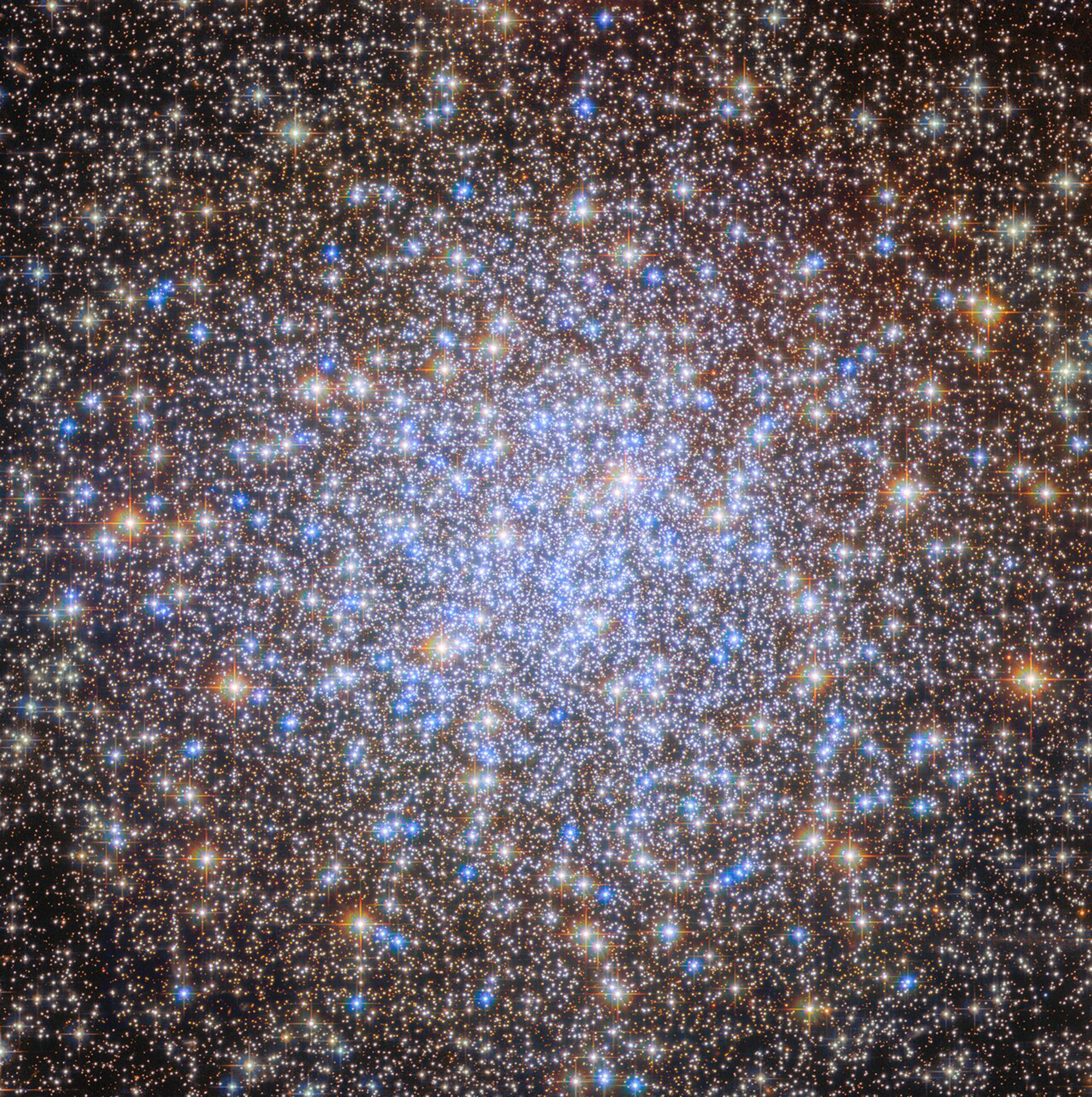
A cluster of brilliant white and golden stars shines in the darkness of space.

NGC 6723 is a globular cluster, an ancient inhabitant of the Milky Way galaxy. (Image credit: ESA/Hubble & NASA, A. Sarajedini, G. Piotto)
Quick facts

What it is: NGC 6723, the "Chandelier Cluster"

Where it is: 27,000 light-years away, in the constellation Sagittarius

When it was shared: June 26, 2026

In this single Hubble Space Telescope image, tens of thousands β€” possibly millions β€” of stars bound tightly by gravity sparkle as one. This is NGC 6723, a glittering globular cluster about 27,000 light-years away, in the constellation Sagittarius.

Also known as the Chandelier Cluster, this swarm of stars is one of about 150 known globular clusters that orbit in the halo of the Milky Way, though others may remain hidden behind thick cosmic dust or crowded star fields at the galaxy's bright core.

Globular clusters like NGC 6723 are among the most ancient structures in our galaxy. What baffles astronomers most is the age of the stars within them. These clusters often contain stars older than 10 billion years, with some dating back almost to the beginning of the universe itself 13.8 billion years ago. They likely formed early in the history of the Milky Way, billions of years before the thin disk of stars where the sun now orbits took shape.

It was once thought that all stars inside a globular cluster formed at the same time, from the same material, during a single burst of star formation. If that were true, the stars would have the same age and chemical composition.

However, Hubble's view demonstrates that this is not the case. The cluster is densely packed at the center, where many bright-blue stars appear concentrated, while orange stars are more prominent toward the edges. Blue stars are younger than orange stars, suggesting that globular clusters can have complex histories, with different populations of stars and subtle chemical differences among them.

Hubble first observed NGC 6723 in visible and near-infrared light as part of a major survey of 65 globular clusters in 2013. It found that massive stars sink toward the center of a cluster, while lower-mass stars drift outward. In 2013 and 2014, Hubble studied NGC 6723 to search for small chemical differences between stars and to measure the spread of ages of stars within the cluster. Two epochs were found, with the second burst of stars happening about 634 million years after the first.

One leading idea is that globular clusters formed when enormous gas clouds collapsed rapidly in the early universe. However, recent simulations also suggest that some globular clusters may be the surviving cores of ancient dwarf galaxies that were stripped of their outer stars by larger galaxies. Either way, they're a fossil remnant hinting at how galaxies evolve.

Globular clusters are not unique to the Milky Way. They are found around many kinds of galaxies, including spirals, giant ellipticals and dwarfs. The Andromeda galaxy, the nearest large spiral galaxy to the Milky Way, is estimated to host about 460 globular clusters, while the giant elliptical galaxy M87 contains roughly 15,000 globular clusters, according to NASA.

❌