
❌

Normal view

Sound waves come in quantum jumps

12 October 2026 at 17:00

In the 1980s, scientists measured quantized jumps in the energy of ions for the first time. In the 2000s, it was photons’ turn. Now, thanks to a tour de force of device engineering and nanofabrication, researchers at Stanford University in the US are reporting that phonons – mechanical vibrations like those that carry sound – also display this quantum behaviour.

“We could see it by eye [in the data], which was very satisfying,” team leader Amir Safavi-Naeini tells Physics World. “I’ve been fascinated with the interface between the quantum world and the classical world and trying to move that interface closer to daily experience…and now we have mechanical objects.”

Laying the groundwork

The Stanford team’s recipe for observing quantum jumps in phonons begins with thin films of lithium niobate (LiNbO3). Although bulk samples of this material had been available since the 1950s, the commercialization of thin-film LiNbO3 a decade ago was a game changer for Safavi-Naeini and his colleagues once they worked out how to process the material.

Because LiNbO3 is piezoelectric, placing it under stress – from a vibration, say – produces a voltage. This voltage allows vibrational quanta to couple to superconducting qubits, after which the qubit states can be “read out” to determine whether a phonon was present or not.

The problem was that initially, the phonons had lifetimes of only 800 nanoseconds – well short of the millisecond the team needed to observe them falling from an excited state to the ground state. Extending these phonon coherence times “took a lot of work by a number of graduate students in my group,” Safavi-Naeini says.

After probing various sources of dissipation, including material properties that cause quantum excitations to lose coherence, the researchers realized that surface defects were key offenders. They therefore switched from polymer processing, which left a residue, to shadow masks that superimpose one chip over the other and evaporate metal through it. “There were probably three generations of students that worked on getting that four to five orders of magnitude increase in the performance of the devices,” Safavi-Naeini says.

A moving image showing the motion of the nanomechanical resonator
The voltage profile of the nanomechanical resonator in motion. In the crystal used for the mechanical resonator, mechanical motion and electrical potentials are inherently coupled, so the motion profile has an accompanying electric potential profile. (Courtesy: Erik Szakiel)

Once they’d extended their phonon lifetimes, the researchers had to find a way of combining their “very clean, long-lived” mechanical and superconducting systems without destroying either. For this, Safavi-Naeini credits past and present students Takuma Makihara and Erik Szakiel, who spent most of their PhDs tackling issues with the mechanical oscillators before finding a way to couple them to the superconducting systems. “That was the last piece,” Safavi-Naeini recalls. “Once we had that, we could do these experiments.”

Spot the missing phonon

Because the superconducting qubits detect whether an even or odd number of phonons is present in the LiNbO3 (which at very low energies amounts to determining whether a phonon is there at all), they are effectively performing a parity measurement. That could make the Stanford team’s system useful for quantum error correction, where the goal is to find out whether an error has crept in without actually measuring the quantum states, since doing so would destroy their useful quantum characteristics.

One of the most common sources of error in superconducting qubits is the loss of an excitation, such as when a phonon decays. However, if data is encoded into phonons in pairs and the system detects an odd number of them, this loss becomes apparent without measuring all the states. This so-called “binomial” code has already been implemented for microwave photons, and Safavi-Naeini explains that it works best for long-lived particles – a further benefit of the team’s long-lived phonons.

Protein and gravity measurements

The Stanford researchers are now collaborating with Michael Roukes and colleagues at the California Institute of Technology (Caltech) to explore possible applications in high-precision measurements of single protein masses. They are also interested in fundamental science questions such as whether it’s possible to generate entanglement between mechanical systems through gravitational fields.

However, Safavi-Naeini cautions that their phonon lifetimes would need to be much longer – a factor of 10 for error correction and mass spectrometry, and for gravity perhaps as much as six orders of magnitude, with further modifications to the experimental set-up also required – before they can achieve these goals. “The hope is that by figuring out the fundamental sources of loss in these materials we can build our way up to those experiments in the coming decade,” he says. “Every time you improve, you hit some new source of noise, you understand it, then you can deal with it, and then you go to the next one. It’s a fun physics problem.”

The research is published in Science.

The post Sound waves come in quantum jumps appeared first on Physics World.
Geophysicist identifies a maximum practical viscosity

27 July 2026 at 09:00

At what point does a material become so viscous that it cannot flow? The question is a tricky one because some apparently solid objects are not as rigid as they seem. A glacier, for example, may look immobile, but when viewed over long-enough timescales, its slow flow becomes apparent.

Now, thanks to satellite observations of tectonic plate deformations as well as physical and geodynamic modelling, geophysicist Masaki Yoshida of Ritsumeikan University, Japan, claims to have found an answer. The upper limit for viscosity, he says, is 1028 Pascal-seconds (Pa s), and the new boundary could yield insights into Earth’s geodynamics.

Viscosity is a measure of a material’s resistance to flow. Gases such as air and hydrogen have a viscosity of 10-5 Pa s at room temperature; the viscosity of liquid water is 10-3 Pa s; and glaciers have a viscosity of 1013–1017 Pa s depending on factors such as temperature, stress and microstructure. At the upper end, Yoshida says that the long-held view, based on rock deformation experiments, is that the viscosity of tectonic plates at the Earth’s surface (where temperatures are relatively low) is 1070 Pa s.

This number is so high that for most purposes, it might as well be infinite, meaning that these plates should behave like rigid bodies. But this accepted wisdom poses a problem: “I realized that I was unable to explain to my students why plates with such high viscosity bend and subduct into the mantle,” Yoshida tells Physics World.

Observed flow and flow parameters

To determine the “effective viscosity” of rock under the temperature and pressure conditions on Earth, Yoshida began by analysing satellite data showing tectonic plate deformations over tens to hundreds of kilometres. Using these data, he could ascertain strain rates – deformations in the plate over a given distance and time – as small as 10-9 per year.

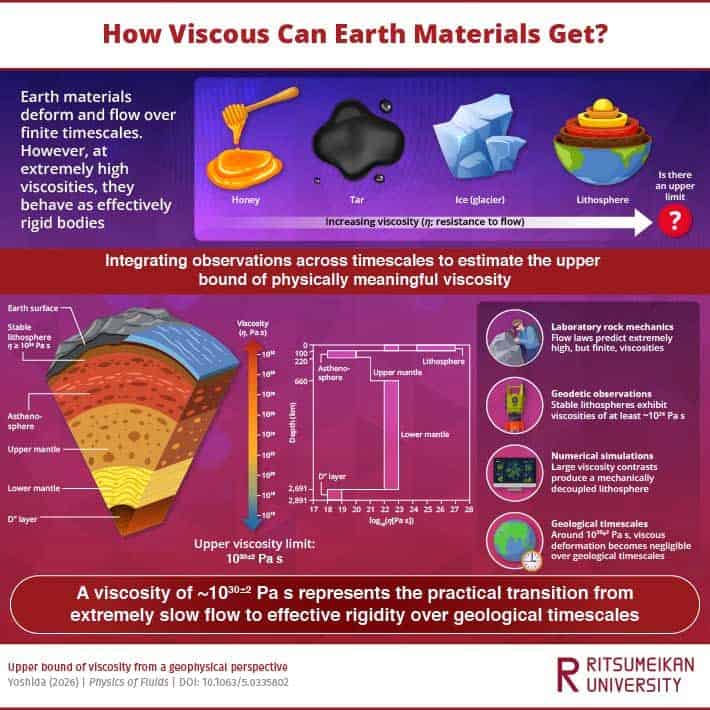
Infographic comparing somewhat viscous substances like honey and tar with extremely viscous ones like glaciers and the Earth's lithosphere. A caption states that "a viscosity of 10^30±2 Pa s represents the practical transition from extremely slow flow to effective rigidity over geological timescales."
Slow flow: Geodetic observations, laboratory rock-deformation experiments and numerical simulations suggest that there is a geophysically meaningful upper bound of viscosity that marks the transition from deformable flow to effectively rigid behaviour over geological timescales. (Courtesy: Masaki Yoshida/Ritsumeikan University)

By comparing regions under similar stress levels, Yoshida obtained an indication of comparative effective viscosity, which depends on factors such as temperature, composition, grain size, water content, stress state, deformation mechanism and structural heterogeneity. After accounting for assumed stresses, these observations suggested that observed viscosity maxes out at 1028 Pa s.

Yoshida also considered empirical descriptions for the viscosity of various minerals under different types of deformation using parameters from the literature. These yielded a similar upper bound of 1030+/-2 Pa s. Numerical simulations further corroborated this value as a viscosity maximum.

Importance of an upper bound

Taras Gerya, a geodynamicist at ETH Zürich in Switzerland who was not involved in the study, calls Yoshida’s work “an interesting discussion on the significance of viscous deformation for the lithosphere”. However, he notes that, given a realistic stress level of 30 MPa, the maximum viscosity identified gives a cumulative viscous deformation of just 8.5 m for the full 4.5 billion years of Earth’s history. That, he says, is “1000 times smaller than elastic deformation for the same deviatoric stress level”.

While pinning down an exact magnitude for such high viscosities may not greatly change models of deformation, Yoshida thinks that delineating an upper bound may nevertheless improve our understanding of the physical quantities that characterize the behaviour of matter. He also points out that thermal conductivity, which indicates how easily heat is transferred in materials, ranges over only about five orders of magnitude from water to diamond, making it “surprising that viscosity spans a range of about 35 orders of magnitude”.

Yoshida is keen to explore other implications of these results. During the first hundreds of millions of years of Earth’s existence, when it formed and rapidly cooled, he explains that it was covered by a single rigid lid known as the lithosphere. Plate boundaries and motion didn’t emerge until later, approximately 4 billion years ago. “I believe that the question of why plate motion began after the rigid lid formed is closely related to the results of this study,” he says.

The research is published in Physics of Fluids.

The post Geophysicist identifies a maximum practical viscosity appeared first on Physics World.

‘Back to the future’ messages are more efficient

3 July 2026 at 09:26

Science fiction has long embraced the idea of travelling backward in time, but the advent of Einstein’s general theory of relativity transformed these ideas from fantasies into potential – albeit contested – realities. In particular, solutions to the equations of general relativity known as closed time-like curves (CTCs) seem to allow a system’s trajectory to return to a previous point in time. Although the existence of CTCs has never been proven, their admissibility within general relativity has inspired many physicists to study their implications, which include increases in information processing speeds as well as retrograde time travel.

Inspired by the 2014 film Interstellar, in which a father sends messages to his daughter in the past, Kaiyuan Ji and Mark Wilde of Cornell University, together with Seth Lloyd at the Massachusetts Institute of Technology, have now investigated the potential advantages of a retrograde messaging channel based on a CTC. As well as deriving an exact expression for the information capacity of such a channel, they showed that this capacity exceeds that of regular channels that do not involve backward time travel.

Post-selected CTC models

To model their CTC, the researchers used an approach that Lloyd and his then-collaborators developed 15 years ago. This approach exploits the mathematical equivalence between a CTC and the combined operations of quantum teleportation and post selection, so it is often referred to as a post-selected CTC model. Previous analyses established that this model disallows time-travel paradoxes such as going back in time to kill your grandfather, while still preserving correlations between the system that travels backward in time and the environment.

The latter feature is important, Ji notes, because quantum CTC models without it have a distinct drawback: “If you travel through that closed time-like curve, you end up in the past, but basically you lost all the memory of what has happened before you do time travel,” he explains.

A further advantage of the team’s chosen model is that it does not prohibit causal loops in which correspondents in the past and future influence each other. To return to the Interstellar scenario, Ji explains that while the daughter is influenced by her father’s message, she also influences her father, because he witnessed how she decoded the message and therefore used that information to optimize his encoding protocols.

The existence of causal loops in the model allowed Ji and his colleagues to formulate an expression for the channel’s bit capacity. It also pointed towards the best way of maximizing that capacity. The optimal strategy, Ji explains, would involve the father using his memory from the past when encoding his message to the past, which makes sending messages to the past more efficient (and capable of a higher bit capacity) than sending messages to the future. “The causal loop is essential to the design of the optimal communication protocol in this retro causal communication setting,” he tells Physics World. “It is not possible in standard communication from the past to the future.”

Capacity for messages

The CTC can also be used to form a quantum channel capable of transmitting either regular classical data or quantum data back in time. Using their expression for the channel’s bit capacity, the researchers were able to show that its classical bit capacity is twice that of its quantum counterpart.

Nicole Yunger Halpern, a theoretical physicist at the University of Maryland who has studied some implications of CTCs for metrology but was not involved in the current work, describes the research as “creative and technically impressive”. She points out that while calculating a communication channel’s capacity is a common challenge in the field of information theory, obtaining straightforward answers can be difficult. “The authors combined this workaday task with a highly unusual (retrocausal) setting and, moreover, obtained a simple solution,” Halpern says.

Not everyone is sold on the mathematical format of post-selected CTC models, though. Scott Aaronson, a computer scientist at the University of Texas at Austin, US, who has previously studied the speed advantages of information processing using CTCs, believes that studies with this approach “attempt to model time travel but don’t fully succeed at it”. However, with respect to the question of channel capacity, Aaronson concedes it may be “interesting to prove things”.

While the current model considered the effects of distortion (“noise”) on messages in the channel, Ji suggests it might be interesting to broaden this to include noise in the memory of the process – like the father in Interstellar having a hazy recall of his daughter’s decoding protocol. Ji also notes that the post-selection CTC model has some mathematical equivalence with black hole final state projections, and he says it might be interesting to explore these connections, too.

The research is described in Physical Review Letters.

The post ‘Back to the future’ messages are more efficient appeared first on Physics World.

Physicists create mechanical memory device from slap-bracelet-like structures

1 June 2026 at 16:24

In today’s technologies, mechanical mechanisms generally provide the brawn while electronics supplies the brains. This is partly because it is challenging to write information into mechanical memories without resetting each bit individually. However, that could change as researchers led by Pedro Reis at École Polytechnique Fédérale de Lausanne in Switzerland and Martin van Hecke at AMOLF in the Netherlands have now found a practical means of writing mechanical bits. Their technique, which they describe in Science Advances, uses structures that resemble children’s slap bracelets placed on a rotating turntable. While they acknowledge it is unlikely to replace electronic memories, they argue that it could have specialist applications and might produce insights that translate into electronic innovations.

“The framework we propose could be very useful, for example, in the domain of physical intelligence, where you provide hardware with capabilities that don’t require essentially a brain or an electronic control system to do individual tasks,” Reis says.

Mechanics for memory

Reis and van Hecke’s interest in mechanical memory stems from their research on metamaterials, which are materials that are defined not just by their composition, but also by the structures within them. Mechanical systems offer a tangible means of getting to grips with the complex behaviour of these metamaterials. “Often, all sorts of things that we do rely on nonlinear responses,” van Hecke notes, adding that such responses are much easier to study in mechanical systems than in optical devices.

A metamaterial made up of an array of switchable mechanical elements could function as a form of mechanical memory. However, to be practical, it needs to be possible to flip the states of individual mechanical bits using global controls, as opposed to addressing them individually. Otherwise, writing data will be very fiddly.

A solution emerged from Reis’ interest in rotating platforms, which he describes as “a very versatile way of loading mechanical systems”. While the pair had been friends for more than two decades, they had been working independently until, during a visit, the penny dropped and they realized that placing the metamaterial array on a rotating platform could provide the control they needed.

Because the angular velocity of the platform sends its momentum outwards, each mechanical object experiences a force in the radial direction, known as the centrifugal force. If this angular velocity is not constant, the object will experience an additional force in the orthogonal azimuthal direction, known as the Euler force. “So you have a complex force and bi-directional field that is highly tuneable,” says Reis. “And this tuneability is what we realized is very powerful.”

A rotating array

To construct their array, the researchers used clamped beams with two stable mechanical states – a little like a slap bracelet can be coiled up or flat, except these beams could either curve to the right or to the left. To individually address different beams, they ensured that each beam was unique in its width, the angle it was clamped at, and so on, all of which affect how much force is needed for a beam to ping into the opposite state. By tuning the parameters of each clamped beam and the angular acceleration of the rotating platform, they could engineer the applied force to switch (or not switch) specific beams, thereby writing data into the array purely by rotating the platform.

Doing this accurately requires a level of precision in acceleration control that surpasses what standard lab motors can achieve. However, the researchers say they were able to team up with a local company that had designed high-spec rotating platforms for its high throughput silicon chip production process. By programming platforms with five tailored clamped beams and the right rotation functions, they showed they could write the letters of the alphabet in ASCII script.

“This is a significant advance because it points toward future smart devices and robots that can be reprogrammed remotely without complex wiring or electronics, using only carefully designed motion‑based signals driven by a sole dynamic driving strategy,” explains Damiano Pasini of McGill University, Canada, who studies systems for mechanical computing but was not involved with this work directly.

Reis says he is excited about the scalability of the approach and its potential in high throughput experiments. Meanwhile, van Hecke is looking into how the idea might transfer to other systems, such as applying engineered force functions to crumpling sheets of complex glasses. “It just opens up possibilities for both studies, really fundamental studies of complex systems, but also real applications where you use this dynamic idea,” he tells Physics World.

The post Physicists create mechanical memory device from slap-bracelet-like structures appeared first on Physics World.

❌