❌

Normal view

How NASA Science and Artemis Are Shaping the 2026 FIFA World Cup 
8 June 2026 at 20:36
Researchers tested soccer balls aboard the International Space Station to study how internal mass affects motion and stability in microgravity.
NASA

As the FIFA World Cup approaches, NASA is bringing space science and engineering to soccer fans worldwide. From June 11 to July 19, 2026, NASA will host an exhibit at FIFA Fan Festival™ Houston where visitors can learn how research aboard the International Space Station benefits life on Earth and experience missions in low Earth orbit, the Moon, and beyond through the Artemis program. 

On June 11, as the FIFA World Cup begins, NASA’s exhibit at Fan Festival Houston will open to the public. The event is free to attend and open for every match of the tournament in East Downtown, Houston. On June 20, Johnson Space Center Director Vanessa Wyche will introduce select Artemis II crew members following their historic mission around the Moon. The crew will participate in World Cup activities ahead of the Netherlands-Sweden match in Houston and will appear on the Fan Festival Houston main stage to share their experience with fans. 

The connection between NASA and the World Cup goes beyond the exhibit floor, reaching all the way to orbit. NASA spinoff technologies are innovations developed for space exploration that go on to shape commercial products and everyday life – even on the soccer field. 

For more than 25 years, research aboard the International Space Station has enabled breakthroughs in science, technology, and human health while advancing innovations that benefit people on Earth. That work includes studies that improve understanding of the aerodynamics and physics involved in soccer ball flight. 

In partnership with the ISS National Laboratory in 2019, researchers used the station’s microgravity environment to study how a soccer ball’s internal mass affects its motion, stability, and rotation. The findings have improved understanding of how embedded technologies, including match-ball sensors, can influence performance during play. The research contributed to studies used in the development and evaluation of soccer balls for major international tournaments, including FIFA World Cup competition. 

Understanding the relationship between an object’s center of mass and its geometric center is key to predicting how free-flying objects move, including spacecraft, satellites, and aircraft. 

Since 2022, Adidas has embedded electronics inside official match balls used in major tournaments. The sensors track speed, position, and contact in real time to support officiating and broadcast technology. But those sensors also add mass in specific locations inside the ball, and uneven mass distribution can affect how a ball moves through the air. 

The space-based research has helped improve understanding of how internal mass, including embedded sensors, can influence stability and rotation in real-world playing conditions. 

This work builds on earlier research into how spinning objects behave in microgravity. 

Engineers at NASA’s Ames Research Center in Silicon Valley, California tested Adidas’ Brazuca ball, developed for the 2014 FIFA World Cup, in wind tunnel conditions at the Fluid Mechanics Laboratory. Researchers studied aerodynamic behavior, including how low-spin kicks can produce “knuckling,” where the ball moves unpredictably due to unstable airflow across the seams. NASA engineers measured the speeds and flow conditions where this effect was most pronounced. 

Adjustments in panel shape, seam depth, and surface texture can influence flight consistency, helping determine whether a ball curves, dips, or holds its line during play. 

Now, NASA and Adidas are presenting that science through a STEMonstration that compares how differently balanced soccer balls spin and move in microgravity. The experiment shows how the same physics that governs motion in space also shape the game millions watch on Earth. 

Through research aboard the International Space Station and technology developed for exploration, NASA continues to demonstrate how discoveries made for space can benefit people on Earth—including athletes and fans participating in the world’s most popular sport. 

Watch the soccer ball STEMonstration video: 

The post How NASA Science and Artemis Are Shaping the 2026 FIFA World Cup  appeared first on NASA Science.
Roman Community Events Files

8 June 2026 at 20:11

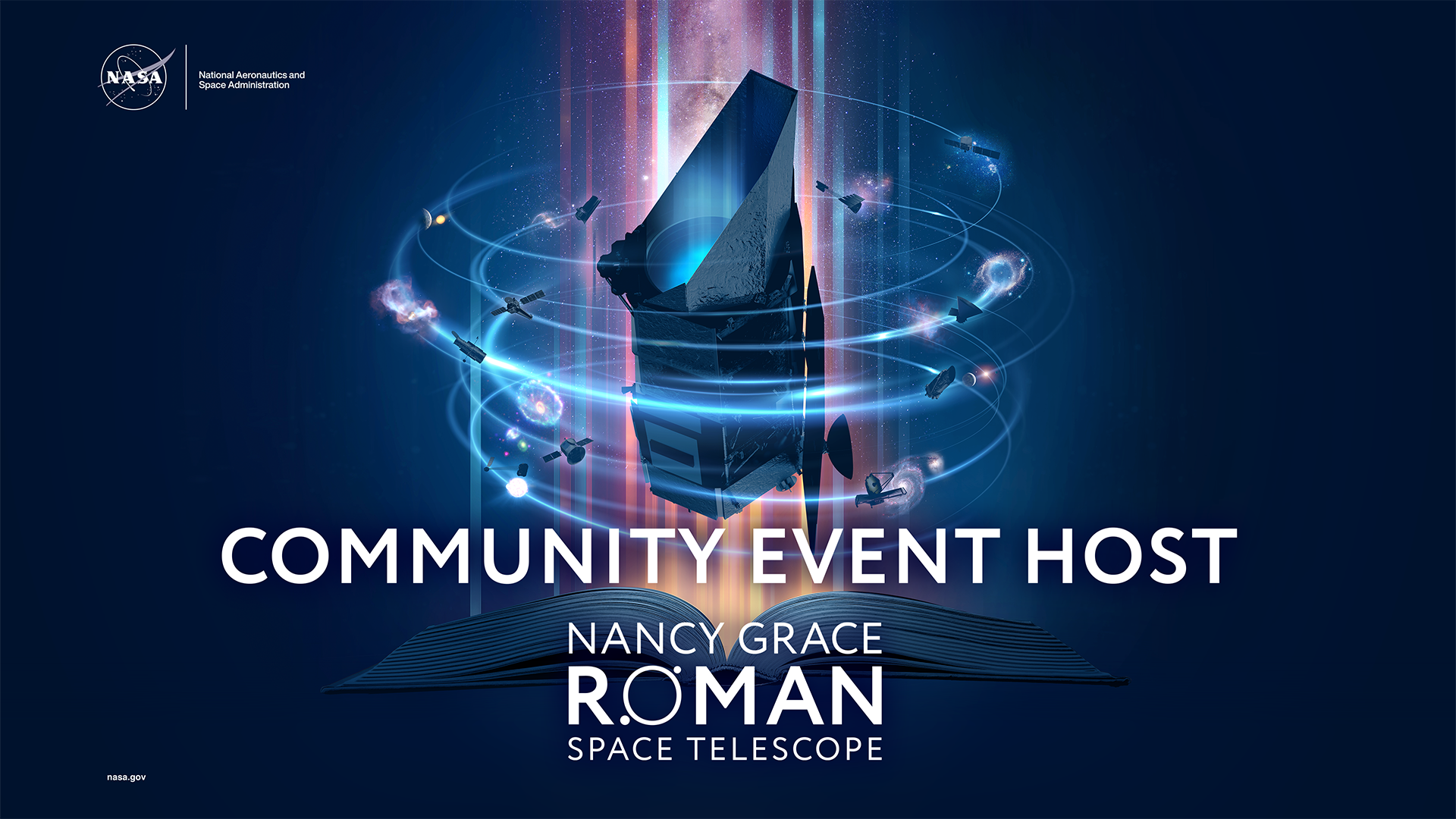
Find files, images, and graphics to use at your own Roman Space Telescope Community Events.

ROMAN Community Event Host

Download the “Community Event Host” Poster

ROMAN Community Event Host

Vertical Poster For Print:
24×36 (with bleed) PDF

Jun 8, 2026

PDF (71.34 MB)

ROMAN Community Event Host

Vertical Poster For Print:
24×36 (with bleed) PNG

Jun 8, 2026

PNG (45.24 MB)

ROMAN Community Event Host

Vertical Poster For Print:
11X17 (with bleed) PDF

Jun 8, 2026

PDF (21.31 MB)

ROMAN Community Event Host

Vertical Poster For Print:
11X17 (with bleed) PNG

Jun 8, 2026

PNG (13.04 MB)

ROMAN Community Event Host

Horizontal TV Monitor Display:
4K UHD (2160p) PDF

Jun 8, 2026

PDF (18.11 MB)

ROMAN Community Event Host

Horizontal TV Monitor Display:
4K UHD (2160p) PNG

Jun 8, 2026

PNG (5.59 MB)

ROMAN Community Event Host

Horizontal TV Monitor Display:
Full HD (1080p) PDF

Jun 8, 2026

PDF (6.06 MB)

ROMAN Community Event Host

Horizontal TV Monitor Display:
Full HD (1080p) PNG

Jun 8, 2026

PNG (1.69 MB)

The post Roman Community Events Files appeared first on NASA Science.
Crew Begins Week with More Cartilage Printing and Plant Harvesting

8 June 2026 at 19:14
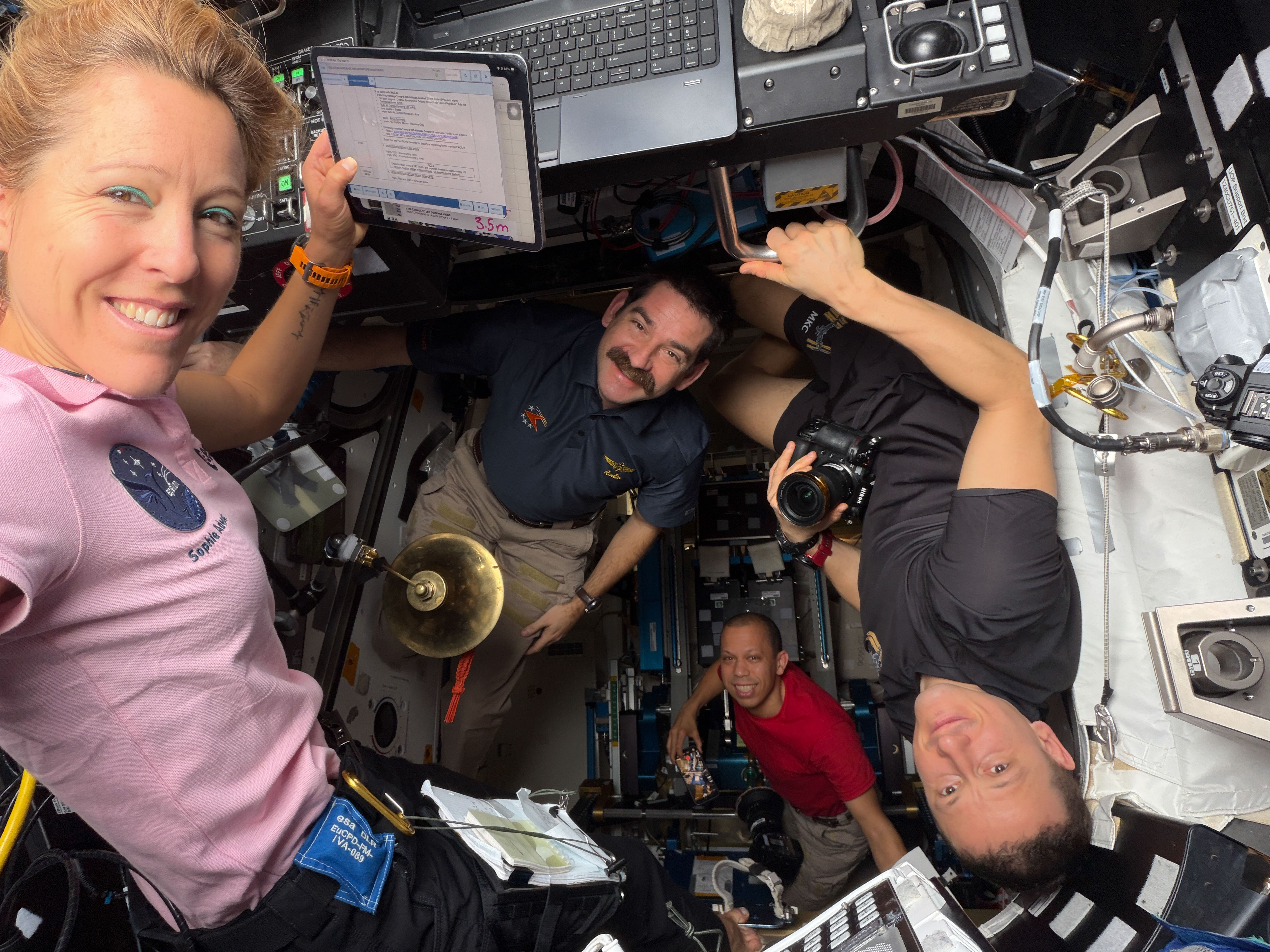
Expedition 74 crew members (from left) Sophie Adenot of ESA (European Space Agency), NASA astronauts Jack Hathaway and Chris Williams, and Roscosmos cosmonaut Sergey Kud‑Sverchkov pose for a portrait together inside the International Space Station’s cupola and Tranquility module.
ESA/Sophie Adenot

Expedition 74 began the week bioprinting human cartilage tissue and harvesting alfalfa plants aboard the International Space Station to advance health and promote self-sustainable space crews. The orbital residents also retrieved materials exposed to the external space environment and conducted their own ultrasound vein scans to continuously learn how living in space affects physics and biology.

NASA flight engineer Jessica Meir opened up the Kibo laboratory module’s Life Science Glovebox on Monday and set up a bioprinter to produce viable cartilage tissues aboard the orbiting laboratory. NASA flight engineer Chris Williams assisted Meir collecting the frozen cartilage samples for thawing then mixing the living cells with a gel-like bioink for placement in a printing cartridge. The biotechnology study tests the manufacturing of cartilage in weightlessness to increase its stability for printing on demand implants using a patient’s own cells to treat a range of health conditions.

Earlier, Williams began his shift with NASA flight engineer Jack Hathaway harvesting alfalfa plants inside the Columbus laboratory module’s Veggie facility. The astronauts collected the plants and roots for photographing, placed the botanical samples inside foil, then stowed them inside a science freezer for later analysis for the Veg-06 study. Insights may lead to the development of advanced methods to grow plants for food on future space missions.

Afterward, Hathaway scanned Williams neck, shoulder, and leg veins using the Ultrasound 3 biomedical device as doctors on the ground monitored in real time. Roscosmos cosmonauts Sergey Kud-Sverchkov and Sergei Mikaev also took turns scanning each other’s veins with the Ultrasound 3. The ultrasound imagery will help researchers protect crew members from space-caused blood clots.

Flight engineer Sophie Adenot of ESA (European Space Agency) and Meir joined each other during the first half of their shift retrieving containers of samples from Kibo’s airlock that were placed outside the orbital outpost for a materials exposure test. The samples included radiation shields, crew suit fabrics, optical fibers, and more to help engineers build robust technologies that can survive harsh environments both on Earth and in space.

Sergey Kud-Sverchkov and Sergei Mikaev, the orbiting lab’s commander and flight engineer, spent the majority of their shift inspecting and servicing the Zvezda service module’s treadmill. The space station’s other treadmill, COLBERT, is located in the Tranquility module.

Roscosmos flight engineer Andrey Fedyaev spent the first half of his shift locating and identifying computer components and video gear in the Zarya module to update the station’s inventory management system. Fedyaev wrapped up his day studying using artificial intelligence tools to boost crew efficiency and communications.

Learn more about station activities by following the space station blog, @space_stationon X, as well as the ISS Facebook and ISS Instagram accounts.

Get the latest from NASA delivered every week. Subscribe here.

The post Crew Begins Week with More Cartilage Printing and Plant Harvesting appeared first on NASA Science.

HWO Detector System Development Study

8 June 2026 at 19:17

HWO Detector System Development Study; Responses Due 7 July 2026

8 June 2026

The Habitable Worlds Observatory Technology Maturation Project Office and Columbus Technologies are excited to invite you to participate in a Detector System Development Study focused on developing critical detector technologies for the Habitable Worlds Observatory. This request for proposals seeks information from qualified organizations capable of supporting detector technology maturation studies to advance candidate technologies toward Technology Readiness Level 5. Specifically, we are seeking responses to address one or more of the following detectors categories: photon-counting detectors for visible and near-infrared coronagraph applications, far-ultraviolet detectors, and large-format detectors for near-ultraviolet and visible applications. Details regarding the call for proposals, eligibility, required deliverables, and study phases are available at the Columbus Technologies website.

Respondents located at Government agencies including the Jet Propulsion Laboratory or NASA Centers (e.g., Goddard Space Flight Center, Ames Research Center, etc.) should submit their responses directly to Daniel Kelly (daniel.p.kelly@nasa.gov).

Note: Responses are due by 7 July 2026.

News Straight to Your Inbox

Subscribe to your community email news list

We will never share your email address.

Privacy Policy

Sign Up
This cropped horizontal image has layers of semi-opaque rusty red colored gas and dust that starts at the bottom right and goes toward the top left. There are three prominent pillars rising toward the top left. The left pillar is the largest and widest. The peaks of the second and third pillars are set off in darker shades of brown and have red outlines.

The post HWO Detector System Development Study appeared first on NASA Science.

NASA-DARES Draft Strategy Open for Public Comment

8 June 2026 at 19:16

NASA-DARES Draft Strategy Open for Public Comment; Comments Due 2 July 2026

8 June 2026

The NASA Astrobiology Program and DARES Task Force 2 are pleased to announce the opening of the public comment period for the draft Decadal Astrobiology Research and Exploration Strategy (NASA-DARES).  

The draft report, available in slide form, is available here: NASA-DARES Draft [PDF] . NB: Findings from Focus Area 9: Astrobiology in Society are forthcoming. 

An abbreviated summary, presented at AbSciCon, is available for viewing here: NASA-DARES Presentation Video. The NASA-DARES presentation begins at approximately 38:27 in the recording. 

Feedback on the draft Strategy should be submitted according to the following guidelines: 

  • Email comments to HQ-RFIastrobio@mail.nasa.gov with the subject line “NASA-DARES Public Comment”.  
  • As relevant, please indicate the Focus Area(s) addressed by your comment at the beginning of your response. 
  • Comments may be submitted by an individual or on behalf of a community group, organization, or other collective body. 
  • Anonymous submissions will not be considered. 
  • Comments will only be accepted as attached PDF files or as in-line email text. 
  • Comments must be received no later than 11:59p Eastern on 2 July 2026. Comments received after this deadline will not be considered. 

As a reminder, NASA-DARES is a non-consensus document. NASA-DARES is not intended to rank priorities, prescribe funding decisions, direct mission selections, establish policy, or replace decadal surveys or other consensus reports. The report is intended to capture a broad range of topics relevant to NASA Astrobiology. Inclusion in NASA-DARES should not be interpreted as an indication of future funding, programmatic priority, mission implementation, or agency commitment. 

For inquiries related to this public comment period, please send an email to HQ-RFIastrobio@mail.nasa.gov addressed to Drs. Rachel L. Harris, Hannah Jang-Condell, and Becky McCauley Rench. Kindly use the subject line “Question RE: NASA-DARES Public Comment Period” when submitting your questions.

News Straight to Your Inbox

Subscribe to your community email news list

We will never share your email address.

Privacy Policy

Sign Up
This cropped horizontal image has layers of semi-opaque rusty red colored gas and dust that starts at the bottom right and goes toward the top left. There are three prominent pillars rising toward the top left. The left pillar is the largest and widest. The peaks of the second and third pillars are set off in darker shades of brown and have red outlines.

The post NASA-DARES Draft Strategy Open for Public Comment appeared first on NASA Science.

IXPE Cycle 4 Pre-Proposal Workshop Announcement

8 June 2026 at 19:15

IXPE Cycle 4 Pre-Proposal Workshop Announcement; Register by 25 June 2026

8 June 2026

We are pleased to send out this first announcement for a pre-proposal workshop in preparation for Cycle 4 of the IXPE General Observer (GO) program.

IXPE (the Imaging X-ray Polarimetry Explorer) provides unique and powerful X-ray polarization capabilities and has been providing crucial insights into our understanding of X-ray production and the geometry of multiple classes of objects such as neutron stars and pulsar wind nebulae, as well as stellar and supermassive black holes, among others. Overall, IXPE provides simultaneous imaging, spectral, timing, and polarization data for 2-8 keV X-rays.

The workshop will be held virtually on Tuesday 30 June 2026, from 12 noon to 3p Eastern (9a to 12 noon Pacific). This session is presented to update the community on opportunities to propose for the upcoming Cycle 4 IXPE GO program, highlighting any changes from previous cycles. A description of the IXPE mission and a summary of its major scientific achievements will be presented. Opportunities for participation through the General Observer Program, which supports a broad range of opportunities, will be described in detail in an interactive forum. Presentations on user support services, data analysis and software tools, catalogs and other online resources will also be included, followed by ample time for general questions and discussion.  More information can be found on the GO program website.

Registration is open to everyone. The meeting link will be sent via e-mail a day before the start of the meeting to all registered participants. There is no fee to participate in the workshop. Please register on or before 25 June 2026 to receive the link. To receive the link for the workshop, please register your interest by filling out this Google form.

News Straight to Your Inbox

Subscribe to your community email news list

We will never share your email address.

Privacy Policy

Sign Up
This cropped horizontal image has layers of semi-opaque rusty red colored gas and dust that starts at the bottom right and goes toward the top left. There are three prominent pillars rising toward the top left. The left pillar is the largest and widest. The peaks of the second and third pillars are set off in darker shades of brown and have red outlines.

The post IXPE Cycle 4 Pre-Proposal Workshop Announcement appeared first on NASA Science.

HELIOTECH and Orbital Flight Symposium

8 June 2026 at 19:15

HELIOTECH and Orbital Flight Symposium; Abstracts Due 17 June 2026

8 June 2026

We are thrilled to let you know that both registration and abstract submission are officially open for NASA’s 2026 Joint HELIOTECH and Orbital Flight Symposium! By bringing together NASA’s Heliophysics Technology Symposium and Heliophysics Orbital Flight Missions, this joint meeting aims to spark innovation and foster essential collaboration for advancing technology needed to explore not only the Sun-Earth-Moon system but also Mars and destinations beyond. Our intention is to create an engaging forum where technologists, scientists, and mission Principal Investigators (PIs) can connect, share, and collaborate.

Event Details:

  • Dates: 31 August – 4 September 2026
  • Location: Johns Hopkins Applied Physics Laboratory, Laurel, Maryland
  • Format: Hybrid—join us in person or virtually via Zoom

Call for Abstracts: Abstract submission is now open and will close on 17 June 2026. If you’re interested in presenting, please submit your abstract using the link below. Abstracts should be a maximum of 2,000 characters and entered directly into the submission Google form. Be sure to specify your preferred presentation type: oral (in-person preferred or remote) or poster (in-person only).

Registration: Registration for the symposium is now open as well, through the symposium website! We encourage everyone to register early, whether you’re attending on-site or virtually.

For additional information about the agenda, lodging, and ongoing updates, please visit our symposium website. We look forward to your participation and contributions and hope to see everyone for an exciting and impactful event! 

News Straight to Your Inbox

Subscribe to your community email news list

We will never share your email address.

Privacy Policy

Sign Up
This cropped horizontal image has layers of semi-opaque rusty red colored gas and dust that starts at the bottom right and goes toward the top left. There are three prominent pillars rising toward the top left. The left pillar is the largest and widest. The peaks of the second and third pillars are set off in darker shades of brown and have red outlines.

The post HELIOTECH and Orbital Flight Symposium appeared first on NASA Science.

Upcoming SIG and SAG Activities, 15 June – 17 June 2026

15 June 2026 at 18:59

Upcoming Science Interest Group & Science Analysis Group Activities

Please note also the following upcoming activities relevant to the Program Analysis Groups:

Monday 15 June at 1p Eastern (10a Pacific)

Wednesday 17 June at 1p Eastern (10a Pacific)

Wednesday 17 June at 2p Eastern (11a Pacific)

News Straight to Your Inbox

Subscribe to your community email news list

We will never share your email address.

Privacy Policy

Sign Up
This cropped horizontal image has layers of semi-opaque rusty red colored gas and dust that starts at the bottom right and goes toward the top left. There are three prominent pillars rising toward the top left. The left pillar is the largest and widest. The peaks of the second and third pillars are set off in darker shades of brown and have red outlines.

The post Upcoming SIG and SAG Activities, 15 June – 17 June 2026 appeared first on NASA Science.

Supersonic!

8 June 2026 at 16:28
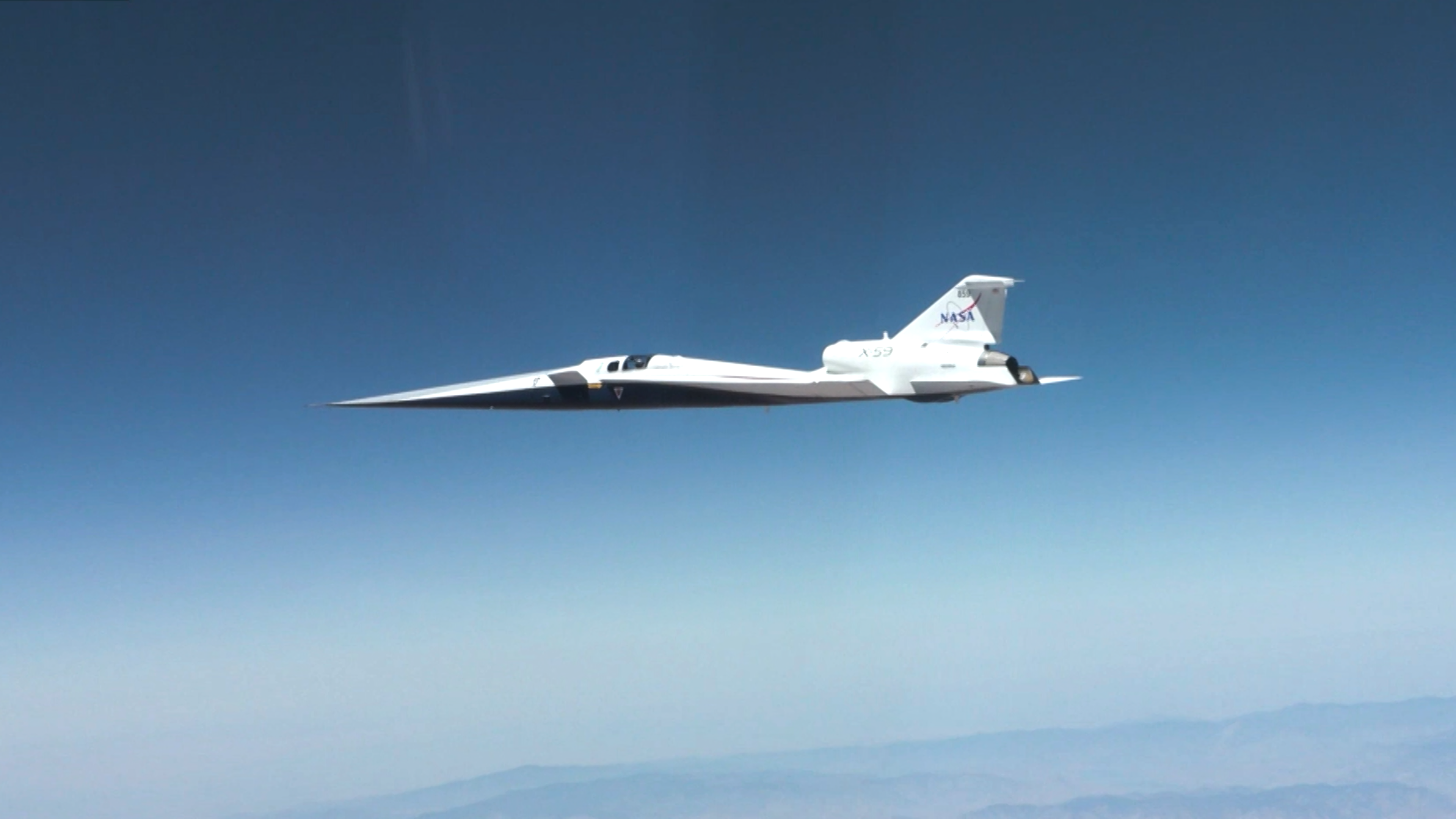
NASA’s X-59 quiet supersonic research aircraft flies through the blue sky. The plane has a distinctive long, sharp nose. There are mountains visible at the bottom of the photo.
NASA/Lori Losey

On June 5, 2026, NASA’s experimental X-59 aircraft flew faster than the speed of sound for the first time, setting the stage for demonstrating its quiet supersonic capabilities later this year. NASA test pilot Jim “Clue” Less took off and landed at Edwards Air Force Base in California, reaching a top speed of approximately Mach 1.1 (713 mph). The flight lasted 81 minutes, with the team focusing on flying qualities at both subsonic and then supersonic speeds.

The X-59 is the centerpiece of NASA’s Quesst mission, which aims to demonstrate quiet supersonic flight and help enable commercial supersonic flight over land worldwide. These advancements will help travelers reach their preferred destinations faster, spending less time in the air.

Learn more about the milestone and Quesst.

Image credit: NASA/Lori Losey

The post Supersonic! appeared first on NASA Science.

NASA’s INCUS Satellites Progress Toward Launch

8 June 2026 at 16:22
2 Min Read

NASA’s INCUS Satellites Progress Toward Launch

A complex spacecraft partially wrapped in gold-colored foil and featuring a large rectangular solar panel stands on a metallic support structure against a solid blue background.
PIA26614
Credits: Blue Canyon Technologies

Downloads

NASA’s INCUS Satellites Progress Toward Launch

JPEG (10.32 MB)

Description

One of the three satellites that make up NASA’s INCUS (Investigation of Convective Updrafts) mission sits on a fixture at the facilities of Blue Canyon Technologies in Lafayette, Colorado. The satellite completed testing in preparation for launch in late May 2026. The mission will make the first space-based survey of the dynamics of tropical convective storms.

The three nearly identical satellites will fly in tight coordination in low Earth orbit, with the first and second satellites separated by 30 seconds, and the second and third satellite separated by 90 seconds. 

Each satellites carries a radar designed to observe the vertical motion of air and water — known as convective mass flux — as storms develop and evolve. The middle satellite will also carry a microwave radiometer.

The INCUS mission is set to launch in 2027 from NASA’s Wallops Flight Facility in Virginia.

Funded through the Earth Venture Mission-3 acquisition under NASA’s Earth System Science Pathfinder Program and led by principal investigator Sue van den Heever at Colorado State University in Fort Collins, INCUS is one of several missions fulfilling the clouds, convection, and precipitation requirements of NASA’s Earth System Observatory, a set of interconnected missions set to study our home planet’s dynamic natural systems and how they interact. The mission is also part of FALCON (Fleet for the Atmosphere Linking Commercial Observations with NASA), a fleet of atmosphere-observing satellites that will combine hardware contributions from NASA centers, universities, and commercial partners.

The post NASA’s INCUS Satellites Progress Toward Launch appeared first on NASA Science.

Cast

8 June 2026 at 15:46

The Cast

Illustration of the LINK and Swift satellites

About Swift

The Neil Gehrels’ Swift Observatory is NASA’s astrophysics multitool, capable of quickly observing a wide range of cosmic objects in visible, ultraviolet, X-ray, and gamma-ray light. It launched as the Swift Gamma-ray Observatory on Nov. 20, 2004. In 2018, the agency renamed it in honor of Neil Gehrels, who helped develop the mission and served as its first principal investigator.

At launch, Swift was a first-of-its kind multiwavelength observatory designed to study gamma-ray bursts, the most powerful explosions in the cosmos, using its three telescopes.

The spacecraft, which was built by Northrop Grumman (formerly General Dynamics), is named after the bird for its ability to rapidly turn to study bursts and their afterglows, which has made it a key player in NASA’s fleet of spacecraft that participate in time-domain astronomy, the study of astronomical objects across various divisions of time, from microseconds to decades or more.

Swift is also important to multimessenger astronomy, which involves detecting light — the best-known astrophysical “messenger” — emitted from sources discovered by observatories sensitive to non-electromagnetic signals, like high-energy particles and space-time ripples called gravitational waves. It has contributed to the study of everything from comets in our solar system to black hole activity in distant galaxies.

In January 2025, the Swift team realized the spacecraft would re-enter the atmosphere in the summer of 2026. NASA decided to attempt to boost the observatory to advance U.S. private spacecraft servicing, demonstrating a key capability for the future of space exploration, and extend Swift’s scientific lifetime.

Lead NASA center:Goddard Space Flight Center
Operations center:
Pennsylvania State University’s Eberly College of Science
Launch: November 20, 2004
Wavelengths: Visible, ultraviolet, X-ray, gamma-ray
Height: 18.5 feet (5.6 meters)
Weight: 3,200 pounds (1,470 kilograms)
Solar panel length: 13 feet (4 meters)
Infographic of some of Swift’s science highlights
This infographic highlights some of the achievements of NASA’s Neil Gehrels Swift Observatory, which has become the agency’s astrophysics multitool since launching in 2004. The spacecraft studies a wide range of objects, from those near Earth, to stars, black holes, and gamma-ray bursts — the most powerful explosions in the cosmos.
NASA’s Goddard Space Flight Center
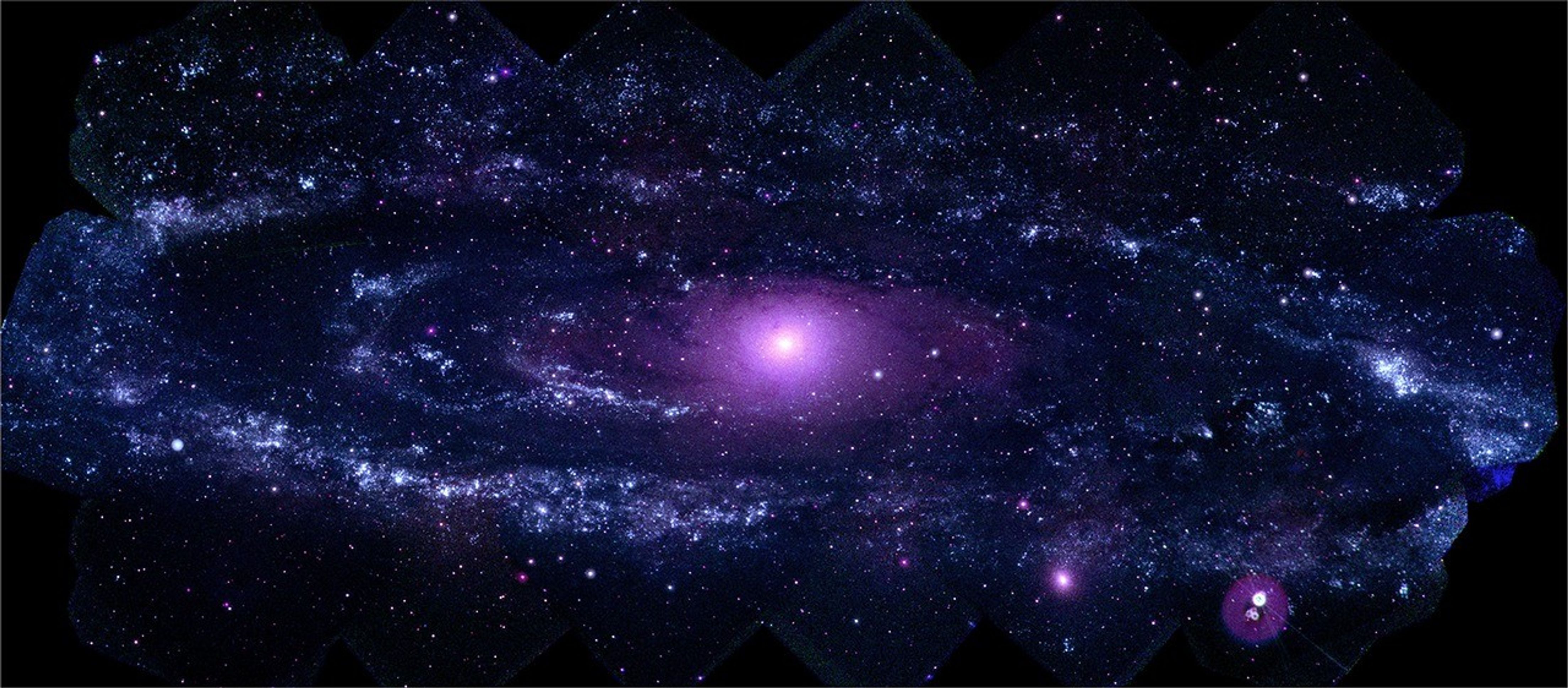
Swift's UV Portrait of the Andromeda Galaxy
Swift viewed our neighboring spiral galaxy Andromeda, also called M31, in ultraviolet light. The image was made from 330 snapshots from Swift’s Ultraviolet/Optical Telescope. Some 20,000 ultraviolet sources are visible in the image, including M32, a small galaxy in orbit around M31. Dense clusters of hot, young, blue stars sparkle in the disk beyond the galaxy’s smooth, redder central bulge.
NASA/Swift/Stefan Immler (GSFC) and Erin Grand (UMCP)
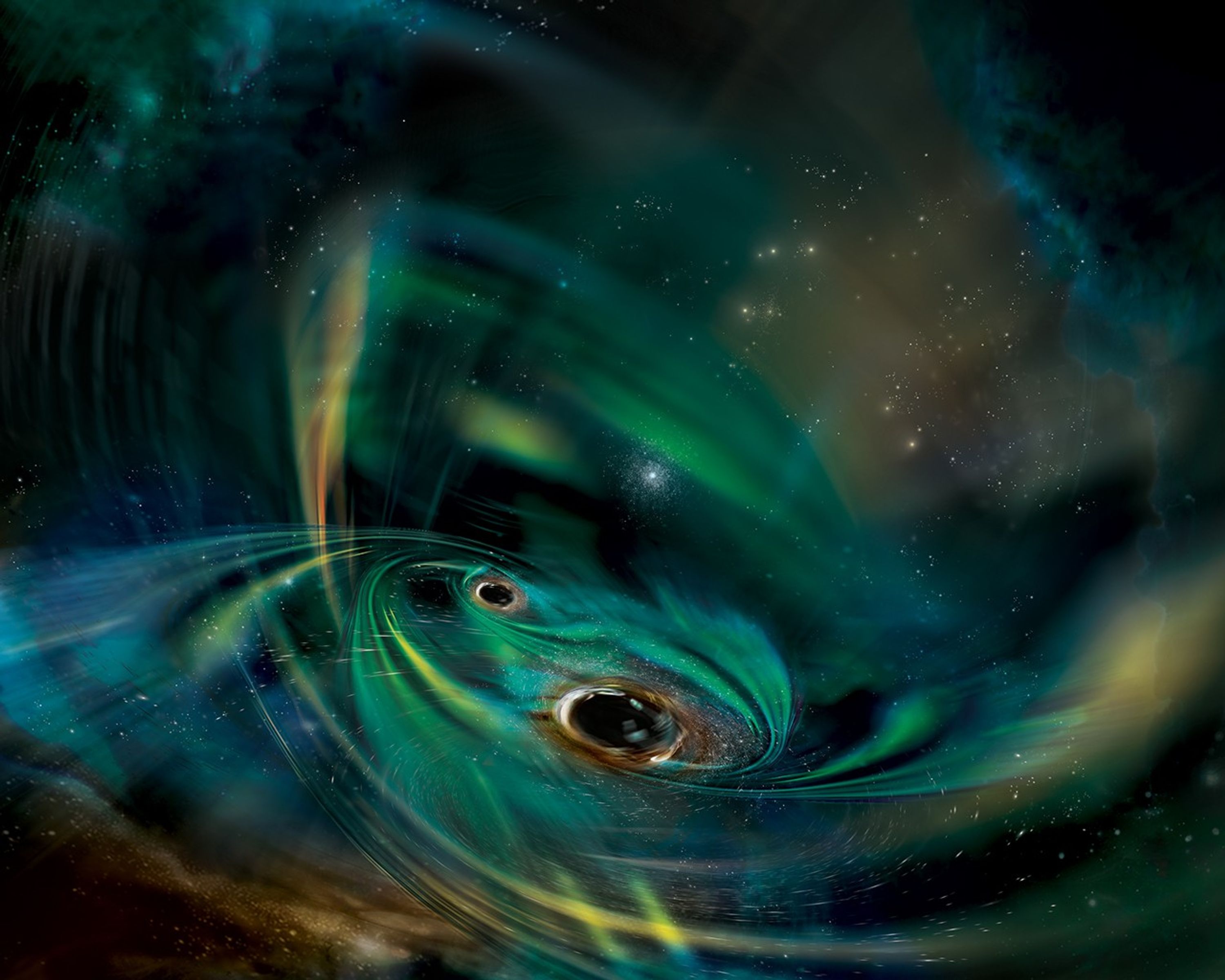
Two black holes are illustrated orbiting in a cloud of gas.
A pair of monster black holes swirl in a cloud of gas in this artist’s concept of AT 2021hdr, a recurring outburst studied by Swift and the Zwicky Transient Facility at Palomar Observatory in California.
NASA/Aurore Simonnet (Sonoma State University)

About LINK

NASA contracted Katalyst Space, in Flagstaff, Arizona, to boost Swift in September 2025. The company had one year to design, build, test, and launch its LINK robotic servicing spacecraft to meet, grab, and lift Swift.

The Katalyst team constructed LINK at its Broomfield, Colorado, facility and tested it there and at NASA’s Goddard Space Flight Center in Greenbelt, Maryland.

LINK will launch on a Northrop Grumman Pegasus XL rocket in June 2026. Once in space, the Katalyst team will spend several weeks checking out the satellite’s major systems, including power, navigation, and sensors.

Then LINK will approach Swift and complete a visual survey. The Katalyst team has identified several potential grab points, but after 20 years of wear and tear in space, those locations need to be verified with the Swift team before moving forward.

After the inspection is complete, LINK will use its three robotic arms to secure Swift before slowly boosting it to nearly its original orbit of around 370 miles (600 kilometers) over the course of several months. LINK’s three ion thrusters are powered by about 130 pounds (60 kilograms) of xenon gas.

Once the lift is complete, LINK will detach from Swift and re-enter Earth’s atmosphere.

Company: Katalyst Space
Launch: June 2026
Height: 5 feet (1.5 meters)
Weight: 935 pounds (425 kilograms)
Solar panel length: 20 feet (6 meters)
Propulsion: Three xenon-fueled thrusters
Robotic arms:Three, deployed after launch
People maneuver a spacecraft into a large chamber.
Engineers from Katalyst Space Technologies in Flagstaff, Ariz., stabilize their LINK robotic servicing spacecraft as it moves into a vibration chamber at NASA’s Goddard Space Flight Center in Greenbelt, Md., on April 15, 2026. The vibration chamber simulated the intense shaking LINK will experience during launch.
NASA/Scott Wiessinger
Two people stand next to a spacecraft inside a large black chamber.
Kieran Wilson, LINK’s principal investigator at Katalyst, and Hunter Robertson, a space systems engineer at Katalyst, stand next to their spacecraft inside the SES (Space Environment Simulator) at NASA Goddard on April 17, 2026, ahead of thermal vacuum testing. During testing in the SES, LINK fired its three thrusters, deployed one of its three arms, and experienced space-like hot and cold temperatures.
NASA/Sophia Roberts
Engineers in clean suits unbox a satellite.
Engineers from Katalyst Space unpack LINK at NASA Goddard on April 14, 2026. The satellite underwent vibration and thermal testing ahead of launch in June.
NASA/Sophia Roberts

About Pegasus XL

The Pegasus XL was the first U.S. air-deployed orbital launch vehicle and the first commercially developed launcher. Originally produced by Orbital Sciences Corporation, the rockets are now operated by Northrop Grumman, which is headquartered in Falls Church, Virginia.

The Pegasus XL can carry payloads up to about 1,000 pounds (450 kilograms).

To launch the Pegasus XL, Northrop Grumman’s Stargazer, a modified L-1011 aircraft, carries the rocket to around 40,000 feet before releasing it. After several seconds in free-fall, the Pegasus XL fires the first of its three-stage rocket motors, typically delivering its payload into orbit in about 10 minutes.

Because Northrop Grumman can launch the Pegasus XL from almost anywhere in the world, Katalyst selected the rocket for deployment to reach Swift’s low-inclination orbit near the equator on the mission’s condensed timeline.

LINK will take off from above Kwajalein Atoll, part of the Republic of the Marshall Islands in the South Pacific Ocean.

Company: Northrop Grumman
Length: 57 feet (17 meters)
Weight: 53,000 pounds (24,000 kilograms)
Payload weight: Up to 1,000 pounds (450 kilograms)
Launch altitude: 40,000 feet
Launch location:Kwajalein Atoll, Marshall Islands
An airplane with a rocket attached to the bottom
Northrop Grumman’s modified L-1011 Stargazer takes off from Vandenberg Air Force Base in California on Oct. 1, 2019. The company’s Pegasus XL rocket, containing NASA’s ICON (Ionospheric Connection Explorer), is attached beneath the aircraft.
NASA/Randy Beaudoin
An Orbital Sciences technician completes final checks of NASA's Nuclear Spectroscopic Telescope Array, or NuSTAR, before the Pegasus payload fairing is secured around it.
A technician completes final checks of NASA’s NuSTAR (Nuclear Spectroscopic Telescope Array) before the Pegasus payload fairing is secured around it ahead of the satellite’s launch in 2012.
NASA
Watch how a Pegasus XL rocket, dropped by Stargazer, carried NASA's Cyclone Global Navigation Satellite System into orbit.
Northrop Grumman

Artist's concept of the Swift spacecraft in orbit

Swift Boost Mission Homepage

Get the highlights of the plan to lift NASA’s Swift.

Illustration of the LINK and Swift satellites

Timeline

Catch up on the progress of the Swift Boost Mission.

A spacecraft against a white background

Swift Blog

Subscribe to keep up with Swift boost news.

The post Cast appeared first on NASA Science.

Timeline

8 June 2026 at 15:42

The Timeline

Illustration of the LINK and Swift satellites

  • January 2025

    NASA analysts generate annual altitude forecasts for the agency’s fleet of spacecraft in low-Earth orbit. In November 2023, predictions for NASA’s Neil Gehrels Swift Observatory showed a split in its re-entry possibilities, with some showing re-entry in the following two years and others much later, in the 2030s. In 2024, the Sun reached its solar maximum, triggering intense space weather that was more active than expected. The activity caused Earth’s atmosphere to expand slightly and increased its drag on Swift. By January 2025, almost all the models had Swift re-entering by the summer of 2026.

    On the left, the Sun shown in gold. It's fairly uniform and labeled Solar Minimum. On the right, the Sun in gold has several bright active regions. It's labeled Solar Maximum.
  • August 2025

    NASA supported concept studies from two U.S. companies to raise Swift to a higher orbit as part of its effort to drive the development of the nation’s private spacecraft servicing industry and demonstrate a key capability for the future of space exploration.

    Read more

    Artist's concept of the Swift spacecraft in orbit
  • September 2025

    NASA awarded Katalyst Space, based in Flagstaff, Arizona, $30 million to move forward with an attempt to boost Swift. The company had less than a year to design, build, test, and launch its LINK satellite to meet, grab, and lift the observatory.

    Read more

    Katalyst logo
  • November 2025

    Katalyst selected Northrop Grumman’s Pegasus XL rocket to launch LINK. Northrop Grumman’s Stargazer, a modified L-1011 aircraft, can deploy the Pegasus XL almost anywhere. By launching from Kwajalein Atoll part of the Republic of the Marshall Islands in the South Pacific Ocean, Northrop Grumman can deliver LINK directly into Swift’s low-inclination orbit close to the equator.

    An airplane with a rocket attached to the bottom
  • December 2025

    Normally, Swift points to different areas of the sky to observe science targets with its Ultraviolet/Optical and X-ray telescopes. In December 2025, Swift’s operations team at Pennsylvania State University’s Eberly College of Science in University Park began altering the spacecraft’s science strategy to reduce drag and extend Swift’s time above the 185-mile (300-kilometer) mark for as long as possible. Below this point, a boost attempt becomes more difficult. The team replaced around 25% of science targets with spots on the sky that caused Swift to be pointed in the most streamlined position possible.

    A spacecraft against a black background
  • February 2026

    The December operational changes helped slow Swift’s descent. The team switched entirely to selecting pointing positions that minimized drag. This meant observations with the Ultraviolet/Optical and X-ray telescopes stopped.

    Read more

    The Swift spacecraft in space.
  • April 2026

    Katalyst finished LINK’s integration at its Broomfield, Colorado, facility. The spacecraft is about 6 feet (1.8 meters) tall, weighs around 880 pounds (400 kilograms), and has three robotic arms and three xenon-fueled thrusters. Each of its two solar arrays span around 20 feet (6 meters).

    People maneuver a spacecraft into a large chamber.
  • April 2026

    The Swift team paused observations with the spacecraft’s Burst Alert Telescope. The change reduced the amount of power Swift had been using, allowing the operations team to point the solar panels to the optimal position to further reduce drag. Prior operational changes had already extended Swift’s time above the 185-mile mark until the fall of 2026.

    Read more

    A spacecraft against a white background
  • May 2026

    Katalyst completed vibration and thermal vacuum testing at NASA’s Goddard Space Flight Center in Greenbelt, Maryland. These assessments replicate some of the conditions LINK will experience during launch and in orbit. LINK used the Space Environment Simulator chamber, which Swift also used over 20 years ago.

    Read more

    Two people stand next to a spacecraft inside a large black chamber.
  • June 5, 2026

    The Katalyst team arrived with LINK at NASA’s Wallops Flight Facility in Virginia. Northrop Grumman began installing the satellite into the Pegasus XL rocket inside the Horizontal Integration Facility there.

    Explore

    The horizontal integration facility, which is a large white building.
  • Upcoming …

    Northrop Grumman will attach the Pegasus XL to the bottom of its Stargazer, a modified L-1011 aircraft, at NASA Wallops before it departs for the Kwajalein Atoll, part of the Republic of the Marshall Islands in the South Pacific Ocean. From there, the plane will climb to about 40,000 feet (12,000 meters) and drop the rocket. The Pegasus XL’s three solid rocket motors will fire in sequence and deliver LINK to orbit.
     
    After launch, the Katalyst team will assess LINK’s major systems, including power, navigation, and sensor arrays before it approaches Swift. Engineers will spend several weeks surveying the observatory to assess potential grab points. When LINK has secured Swift, it will fire its own ion thrusters to slowly raise the observatory’s orbit over the course of several months.

    Illustration of the LINK and Swift satellites
    Katalyst Space

Artist's concept of the Swift spacecraft in orbit

Swift Boost Mission Homepage

Get the highlights of the plan to lift NASA’s Swift.

People in cleans suits work on a spacecraft in a large chamber.

Cast

Learn more about Swift, LINK, and Pegasus XL.

A spacecraft against a white background

Swift Blog

Subscribe to keep up with Swift boost news.

The post Timeline appeared first on NASA Science.

Cosmic Origins Seminar, 10 June 2026

8 June 2026 at 13:53

Cosmic Origins Seminar

Location

Virtual

Dates

10 June 2026
12:00pm – 1:00pm ET
9:00am – 10:00am PT 

Community

Cosmic Origins

Type

Seminar

The ASTRA Initiative

Speaker

Jessica Gaskin

The ASTRA initiative will promote new strategic mission concepts for astrophysics, see here. We would like to encourage you to think about new strategic mission concepts for the coming decades of astrophysics.

As part of ASTRA, the Community Science (Ad ASTRA) Workshop will take place 1-3 September 2026 in Pasadena. New concept ideas will be discussed at this event.

To join the ASTRA initiative, mission concept template is now available, see here. There are also instructions for submission. Submitted concept ideas will be discussed at the September workshop.

Seminar Connection

Join the Seminar

News Straight to Your Inbox

Subscribe to your community email news list

We will never share your email address.

Privacy Policy

Sign Up
Angled from the upper left corner to the lower right corner is a cone-shaped orange-red cloud known as Herbig-Haro 49/50. This feature takes up about three-fourths of the length of this angle. The upper left end of this feature has a translucent, rounded end. The conical feature widens slightly from the rounded end at the upper right down to the lower right. Along the cone there are additional rounded edges, like edges of a wave, and intricate foamy-like details, as well as a clearer view of the black background of space. In the upper left, overlapping with the rounded end of Herbig-Haro 49/50, is a background spiral galaxy with a concentrated blue center that fades outward to blend with red spiral arms. The background of space is speckled with some white stars and smaller, more numerous, fainter white galaxies throughout.

The post Cosmic Origins Seminar, 10 June 2026 appeared first on NASA Science.

HWO SIG Seminar, 10 June 2026

8 June 2026 at 13:52

HWO SIG Seminar

Habitable Worlds Observatory Science Interest Group

HWO SIG about HWO SIG Seminar

Location

Virtual

dates

10 June 2026
10:00am PT / 1:00pm ET

Community

HWO SIG

Type

Seminar

Agenda

HWO SIG Host: Jessie Christiansen

TopicSpeaker
HWO Events at the AASRob Zellem / Raissa Estrella
CSIT UpdateScott Gaudi
Where HWO Fits into ASTRA / the Astro2030 DecadalJessica Gaskin
Pre-Proposal Instrument Study Meeting Report OutAki Roberge

Seminar Connection

Join the Seminar

News Straight to Your Inbox

Subscribe to your community email news list

We will never share your email address.

Privacy Policy

Sign Up
Angled from the upper left corner to the lower right corner is a cone-shaped orange-red cloud known as Herbig-Haro 49/50. This feature takes up about three-fourths of the length of this angle. The upper left end of this feature has a translucent, rounded end. The conical feature widens slightly from the rounded end at the upper right down to the lower right. Along the cone there are additional rounded edges, like edges of a wave, and intricate foamy-like details, as well as a clearer view of the black background of space. In the upper left, overlapping with the rounded end of Herbig-Haro 49/50, is a background spiral galaxy with a concentrated blue center that fades outward to blend with red spiral arms. The background of space is speckled with some white stars and smaller, more numerous, fainter white galaxies throughout.

The post HWO SIG Seminar, 10 June 2026 appeared first on NASA Science.

ASTRA Initiative Seminar, June 12, 2026

8 June 2026 at 13:46

ASTRA Initiative Seminar

Location

Virtual

Dates

12 June 2026
12:00pm-1:00pm ET /
9:00am-10:00am PT 

Community

Cosmic Origins

TYpe

Seminar

Ground- and Space-Based Astronomy in the 2030s/2040s 

Speaker

Rob Petre, NASA / GSFC

Abstract

The three Astrophysics Program Analysis Groups (PAGs) – the Cosmic Origins Program Analysis Group (COPAG), the Exoplanet Exploration Program Analysis Group (ExoPAG), and the Physics of the Cosmos Program Analysis Group (PhysPAG) – have been asked to jointly report up to six community prioritized mission concepts, in addition to the X-ray and Far-IR flagship mission concepts recommended by Astro2020, to the NASA Astrophysics Division Director, for consideration for entrance into the ASTRA Initiative. These concepts should be selected in the context of the current and planned international suite of ground- and space-based observatories. In this talk we present results adapted from one of the Habitable Worlds Observatory (HWO) Community Working Groups, in which we lay out the context of ground- and space-based observatories and missions expected to operate in the 2030s/40s. We summarize outputs from our community-driven mission database, which outlines the science goals and capabilities of observatories and missions expected to operate during that time period. This information enables identification of synergies between these planned facilities and potential new concepts, as well as capability gaps in the planned suite of observatories that could be filled by entrants to the ASTRA Initiative.

Seminar Connection

Join the Seminar

News Straight to Your Inbox

Subscribe to your community email news list

We will never share your email address.

Privacy Policy

Sign Up
Angled from the upper left corner to the lower right corner is a cone-shaped orange-red cloud known as Herbig-Haro 49/50. This feature takes up about three-fourths of the length of this angle. The upper left end of this feature has a translucent, rounded end. The conical feature widens slightly from the rounded end at the upper right down to the lower right. Along the cone there are additional rounded edges, like edges of a wave, and intricate foamy-like details, as well as a clearer view of the black background of space. In the upper left, overlapping with the rounded end of Herbig-Haro 49/50, is a background spiral galaxy with a concentrated blue center that fades outward to blend with red spiral arms. The background of space is speckled with some white stars and smaller, more numerous, fainter white galaxies throughout.

The post ASTRA Initiative Seminar, June 12, 2026 appeared first on NASA Science.

Cosmic Origins at AAS 248, June 2026

14 June 2026 at 13:41

Cosmic Origins at AAS 248

The 248th Meeting of the American Astronomical Society

Cosmic Origins about Cosmic Origins at AAS 248

Location

Pasadena, California

Dates

14-18 June 2026

Community

Cosmic Origins

Type

Meeting

AAS Meeting 248

Joint AAS with HEAD and Laboratory Astrophysics Divisions Meeting

To be held 14-18 June 2026 at the Pasadena Convention Center.

The meeting will be jam-packed with great scientific content and provide ample opportunity for networking with friends and colleagues.

Meeting Overview about Joint AAS with HEAD and Laboratory Astrophysics Divisions Meeting
Pasadena Convention Center

The 248th AAS meeting (joint with HEAD and Laboratory Astrophysics Divisions) will be held 14-18 June in Pasadena, California.

Join us in the exhibit hall at the NASA booth and attend the NASA session

All times Pacific

Tuesday, 16 June 2026

TimeEventLocation
10:00am ‑ 11:30amNASA’s Big Science, Small MissionsPasadena Convention Center – Conference Center, 204

Summary

The opportunity to conduct focused science programs with small missions has increased as access to space becomes easier and more cost effective. This expansion opens the door to greater community participation in space missions, including by early-career scientists and those who may not have prior experience in building and designing such missions. This session seeks to bring together experts from the suborbital and low cost access to space community to hare their mission design process and experience launching missions for dedicated science.

As we approach the Astro2030 decadal survey it is timely to start discussions on innovative ways to perform science observations cheaper and faster by leveraging commercial capabilities for missions of all sizes.

NASA’s Big Science, Small Missions Session Agenda

Join the Session

TimeTopicSpeaker
10:00am ‑ 10:05amWelcomeSwara Ravindranath (NASA GSFC)
10:05am ‑ 10:15amFORTIS Sounding RocketEmily Witt (Johns Hopkins University)
10:15am ‑ 10:25amBlackCAT CubeSatAbe Falcone (Pennsylvania State University)
10:25am ‑ 10:35amSunRISE CubeSat ConstellationJoseph Lazio (University of Michigan)
10:35am ‑ 10:45amSPHEREx Medium Explorer MissionRoberta Paladini (IPAC/Caltech)
10:45am ‑ 10:55amLandolt Pioneer MissionPeter Kurczynski (NASA GSFC)
10:55am ‑ 11:05amNon‑Traditional Path to MissionsSanchayeeta Borthakur (Arizona State University)
11:05am ‑ 11:10amBreak
11:10am ‑ 11:30amPanel DiscussionPanel Moderator: Swara Ravindranath (NASA GSFC)
Drew Miles (Caltech)
Pablo Saz Parkinson (NASA HQ)
Joseph Lazio (University of Michigan)
Abe Falcone (Pennsylvania State University)
David Ardila (JPL)

Thursday, 18 June 2026

TimeSessionLocation
10:00am ‑ 11:30amSpecial Session: Planning for the Future of Astrophysics and the ASTRA Initiative Pasadena Convention Center ‑ 
Ballroom G

ASTRA Initiative Special Session

TimeTopicSpeakerPresentation
10:00am ‑ 10:10amIntroduction from the NASA Astrophysics Division DirectorShawn Domagal‑Goldman
10:10am ‑ 10:25amThe ASTRA Initiative: Overview & Path ForwardJessica Gaskin, NASA HQ
10:25am ‑ 10:40amInnovation for Astrophysics Workshop: Initial FindingsKendra Short, JPL
10:40am ‑ 10:55amAd ASTRA Community Science WorkshopPeter Kurczynski, NASA/GSFC
10:55am ‑ 11:30amPanel DiscussionFrancesca Civano, NASA/GSFC

Other Cosmic Origins Related Sessions

DaySession TitleTimeLocations
Monday, 15 JuneEverything but Exoplanets: The Transformative General Astrophysics of the Habitable Worlds Observatory10:00am ‑ 11:30amBallroom G
Nancy Grace Roman Space Telescope 12:45pm ‑ 1:45pmBallroom A
(Town Hall)
NASA Update12:45pm ‑ 1:45pmBallroom DE
(Town Hall)
The PRobe Infrared Mission for Astrophysics (PRIMA)2:00pm – 3:30pmBallroom G
Wednesday, 17 JuneThe NASA Astrophysics ROSES Program11:00am ‑ 12:00pmSplinter 204
NASA Infrared Telescope Facility – The Next Decade12:45pm ‑ 1:45pmTown Hall Ballroom F

News Straight to Your Inbox

Subscribe to your community email news list

We will never share your email address.

Privacy Policy

Sign Up
Angled from the upper left corner to the lower right corner is a cone-shaped orange-red cloud known as Herbig-Haro 49/50. This feature takes up about three-fourths of the length of this angle. The upper left end of this feature has a translucent, rounded end. The conical feature widens slightly from the rounded end at the upper right down to the lower right. Along the cone there are additional rounded edges, like edges of a wave, and intricate foamy-like details, as well as a clearer view of the black background of space. In the upper left, overlapping with the rounded end of Herbig-Haro 49/50, is a background spiral galaxy with a concentrated blue center that fades outward to blend with red spiral arms. The background of space is speckled with some white stars and smaller, more numerous, fainter white galaxies throughout.

The post Cosmic Origins at AAS 248, June 2026 appeared first on NASA Science.

DGCE SIG Seminar, 25 June 2026

8 June 2026 at 13:36

DGCE SIG Seminar

Diffuse Gas in Cosmic Ecosystems Science Interest Group

DGCE SIG about DGCE SIG Seminar

Location

Virtual

Dates

25 June 2026
4:00pm ET / 1:00pm PT

Community

DGCE SIG

Type

Seminar

Cosmic Origins Science in the New Landscape of Space Astrophysics

Speaker

Swara Ravindranath, Deputy Chief Scientist of NASA’s Cosmic Origins Program (NASA GSFC)

Abstract

Cosmic Origins Science covers a broad range of topics that are fundamental to our understanding of the evolution of structure in the Universe and the physical processes that can explain the formation of galaxies, stars, and planets that we observe today. The various space telescopes that operate across the electromagnetic spectrum have been crucial to address some of the most fundamental questions related to our cosmic origins. The landscape of Space Astronomy is evolving fast with innovative technology, industry partnerships, and new commercial launch capabilities. In this talk, I will review the Cosmic Origins Program and discuss the new opportunities that offer strategic pathways for focused-science missions.

Seminar Connection

Join the Seminar

News Straight to Your Inbox

Subscribe to your community email news list

We will never share your email address.

Privacy Policy

Sign Up
Angled from the upper left corner to the lower right corner is a cone-shaped orange-red cloud known as Herbig-Haro 49/50. This feature takes up about three-fourths of the length of this angle. The upper left end of this feature has a translucent, rounded end. The conical feature widens slightly from the rounded end at the upper right down to the lower right. Along the cone there are additional rounded edges, like edges of a wave, and intricate foamy-like details, as well as a clearer view of the black background of space. In the upper left, overlapping with the rounded end of Herbig-Haro 49/50, is a background spiral galaxy with a concentrated blue center that fades outward to blend with red spiral arms. The background of space is speckled with some white stars and smaller, more numerous, fainter white galaxies throughout.

The post DGCE SIG Seminar, 25 June 2026 appeared first on NASA Science.

Community Science (Ad ASTRA) Workshop, Sept 2026

11 June 2026 at 12:40

Community Science (Ad ASTRA) Workshop

The workshop will take place in Baxter Lecture Hall on the Caltech campus in Pasadena, California

ASTRA Initiative about Community Science (Ad ASTRA) Workshop

Location

Pasadena, California
& Virtual

Dates

1-3 September 2026

Community

Cosmic Origins

Type

Workshop

The Community Science (Ad ASTRA) Workshop is organized by the NASA Astrophysics Division to engage the community in defining future large, strategic astrophysics missions. Structured over three thematic days—Science, Capabilities, and Missions—the workshop provides a comprehensive framework to connect scientific priorities with technological readiness and mission implementation. Across all three days, plenaries, panels, breakout sessions, and poster contributions are designed to maximize community input. The outcomes of the workshop will help NASA prioritize mission concepts and shape a balanced, forward-looking astrophysics portfolio.

This workshop is organized by the NASA Astrophysics Program Offices in partnership with the Infrared Processing and Analysis Center (IPAC).

Important Dates: 

  • Registration opens: March 31, 2026
  • Abstract deadline: June 24, 2026
  • Contributed talks/posters selection: July 1, 2026
  • Deadline for in-person registration: August 15, 2026
  • Deadline for virtual registration: August 31, 2026

Session Connection: Join the Session

Day 1 Science

TimeTopicSpeakersPresentations
8:30amIntroduction to ASTRAShawn Domagal-Goldman, APD Director
9:00amPlan for the Workshop: Deliverables and Mandate (Day 1 focus)Jessica Gaskin, APD AD for Concept and Tech Development
9:20amHow did we get here: PhysPAGManel Errando, PhysPAG EC chair
9:40amHow did we get here: COPAGShouleh Nikzad, COPAG EC Chair
10:00amHow did we get here: EXOPAGIan Crossfield, ExoPAG EC Chair
10:20amMorning Break
11:00amPressing Science Questions for Space Missions in the 2030s and Beyond

Parallel Breakout Sessions:
-Compact Objects and Energetic Phenomena
-Cosmology
-Galaxies
-Exoplanets & Astrobiology
-Stars and Stellar Populations
Contributed presentations from community members (TBA after abstract selection)
12:30pmLunch
Afternoon
2:00pmPressing Science Questions for Space Missions in the 2030s and Beyond

Parallel Breakout Sessions:
-Compact Objects and Energetic Phenomena
-Cosmology
-Galaxies
-Exoplanets & Astrobiology
-Stars and Stellar Populations
Contributed presentations from community members (TBA after abstract selection)
3:30pmAfternoon Break
4:00pmSynthesis Panel on Pressing Science Questions for Space Missions in the 2030s and BeyondBreakout Session Moderators
5:00pmEvening Reception
7:00pmEnd of Day 1

Day 2 Capabilities

Session Connection: Join the Session

TimeTopicSpeakersPresentations
9:00amPlan for the Workshop: Deliverables
and Mandate (Day 2 focus)
EC PAG Chairs
9:10amInnovation Workshop SummaryInnovation Workshop SOC speaker
9:50amNASA Strategic Technology GapsChief Technologist from PAGs
10:10amMorning Break
10:40amEmerging Technologies (session)Presentations from 
community/industry members (TBA)
12:30pmLunch
Afternoon
2:00pmAstrophysics Technology: Capabilities Needed

Parallel Breakout Sessions: What are 
the capabilities needed (software and hardware, platform, location) relevant
to the ASTRA submitted mission concepts?

-Breakout categories TBD
Contributed presentations from 
community members (TBA after
abstract selection)
4:00pmAfternoon Break
4:45pmSynthesis panel to summarize the breakout sessions on capabilitiesBreakout Session Moderators
5:45pmEnd of Day 2

Day 3 Wrap UP

Session Connection: Join the Session

TimeTopicSpeakersPresentations
9:00amPlan for the workshop: Deliverables and Mandate (Day 3 focus)EC PAG Chairs
9:10amBeyond the Selection: The Path ForwardJessica Gaskin, APD AD for Concept and Tech Development
9:50amWorkshop synthesis 1: Key Science Questions for the 2030s and Beyond
TBA
10:50amMorning Break
11:20amWorkshop synthesis 2: Key Technology Capabilities for the 2030s and BeyondTBA
12:20pmLunch
Afternoon
2:00pmBuilding the Future: Community consensus on Science, Capabilities, and Missions for the next decadesTBA
3:30pmClosing RemarksTBA
4:00pmEnd of Day 3

Selected Abstracts

News Straight to Your Inbox

Subscribe to your community email news list

We will never share your email address.

Privacy Policy

Sign Up
Angled from the upper left corner to the lower right corner is a cone-shaped orange-red cloud known as Herbig-Haro 49/50. This feature takes up about three-fourths of the length of this angle. The upper left end of this feature has a translucent, rounded end. The conical feature widens slightly from the rounded end at the upper right down to the lower right. Along the cone there are additional rounded edges, like edges of a wave, and intricate foamy-like details, as well as a clearer view of the black background of space. In the upper left, overlapping with the rounded end of Herbig-Haro 49/50, is a background spiral galaxy with a concentrated blue center that fades outward to blend with red spiral arms. The background of space is speckled with some white stars and smaller, more numerous, fainter white galaxies throughout.

The post Community Science (Ad ASTRA) Workshop, Sept 2026 appeared first on NASA Science.

GW SIG Seminar, 10 June 2026

8 June 2026 at 13:00

GW SIG Seminar

Gravitational Wave Science Interest Group

GW SIG about GW SIG Seminar

Location

GSFC B34, W150
& Virtual

Dates

10 June 2026
11:00am – 12:00pm ET

Community

GW SIG

Type

Seminar

Expected Science from deciHz Gravitational Waves

Speaker

Cole Miller, University of Maryland

Abstract

Astrophysical sources have already been detected in gravitational waves, in the tens to hundreds of Hertz range with LIGO, Virgo, and KAGRA, and in the few to tens of nanohertz range with pulsar timing arrays.  New sources and physics will also be available with the planned LISA mission, at millihertz frequencies.  Here I will talk about the remarkable prospects for physics and astrophysics in the decihertz range, including multimessenger science, essential information about stellar-mass and intermediate-mass black holes, tests of general relativity, and the possibility of a primordial background of gravitational waves.  

Seminar Connection

Join the Seminar

News Straight to Your Inbox

Subscribe to your community email news list

We will never share your email address.

Privacy Policy

Sign Up
This cropped horizontal image has layers of semi-opaque rusty red colored gas and dust that starts at the bottom right and goes toward the top left. There are three prominent pillars rising toward the top left. The left pillar is the largest and widest. The peaks of the second and third pillars are set off in darker shades of brown and have red outlines.

The post GW SIG Seminar, 10 June 2026 appeared first on NASA Science.

Habitable Worlds Observatory SIG Seminar, 10 June 2026

10 June 2026 at 15:47

Habitable Worlds Observatory SIG Seminar

Location

Virtual

dates

10 June 2026
10:00am PT / 1:00pm ET

Community

HWO SIG

Type

Seminar

Agenda

HWO SIG Host: Jessie Christiansen

TopicSpeaker
HWO Events at the AASRob Zellem / Raissa Estrella
CSIT UpdateScott Gaudi
Where HWO Fits into ASTRA / the Astro2030 DecadalJessica Gaskin
Pre-Proposal Instrument Study Meeting Report OutAki Roberge
Session Recording

Downloads

HWO and the ASTRA Initiative

Jun 10, 2026

PDF (1.92 MB)

Seminar Connection

Join the Seminar

News Straight to Your Inbox

Subscribe to your community email news list

We will never share your email address.

Privacy Policy

Sign Up
This cropped horizontal image has layers of semi-opaque rusty red colored gas and dust that starts at the bottom right and goes toward the top left. There are three prominent pillars rising toward the top left. The left pillar is the largest and widest. The peaks of the second and third pillars are set off in darker shades of brown and have red outlines.

The post Habitable Worlds Observatory SIG Seminar, 10 June 2026 appeared first on NASA Science.

❌