❌

Normal view

Manta rays inspire a smarter algorithm for cleaner, cheaper power grids

11 October 2026 at 09:14

Every time a power grid operator decides how much electricity each generator should produce, a quiet balancing act takes place. Burning less fuel saves money, but it often means allowing more pollution, and cutting emissions usually drives costs up. Engineers have long searched for a way to satisfy both goals at once, a challenge known as combined economic emission dispatch, or CEED. Now, a team of researchers has turned to one of the ocean’s most graceful feeders, the manta ray, for inspiration, and the result is an optimization algorithm that outperforms a crowded field of competitors on both cost and cleanliness.

The study, published in the journal Results in Engineering by Yu-Feng Sun, Jie-Sheng Wang and colleagues, describes an enhanced version of the Manta Ray Foraging Optimization algorithm, or MRFO. The original algorithm, first introduced a few years ago, mimics the cooperative hunting strategies that manta rays use to harvest plankton. Because plankton drifts unpredictably with seasons and weather, manta rays have evolved three distinct foraging behaviors: chain foraging, in which animals line up in arcs so that each one catches food missed by the one ahead; spiral foraging, where the group coils around a dense patch of food; and somersaulting, in which individuals flip back and forth around a promising spot. Translated into mathematics, these behaviors become rules that move a population of candidate solutions around a search space, gradually converging on the best answer.

What makes the CEED problem so stubborn is its mathematical character. The relationship between a generator’s output and its fuel consumption follows a cubic curve, and the emissions of carbon dioxide, nitrogen oxides and sulfur dioxide each follow their own cubic functions. The combined objective is nonlinear, nonconvex and discontinuous, riddled with local minima that can trap classical techniques such as lambda iteration or gradient-based methods. To make matters harder, the problem is genuinely multi-objective, so the researchers converted it into a single objective by applying price penalty factors that fold the cost of each pollutant into one total figure in dollars per hour.

Constraint handling is where many algorithms stumble. Traditional approaches add a fixed penalty whenever a solution violates the power balance requirement, the equation demanding that total generation minus transmission losses equals demand. But a fixed penalty is a blunt instrument. Set it too low and the algorithm happily returns infeasible schedules; set it too high and the search becomes so restricted that it cannot explore properly. Finding the right value through trial and simulation is time-consuming and inefficient. The team’s answer was to make the penalty itself dynamic, drawing on five different mathematical functions: sinusoidal, hyperbolic tangent, arctangent, linear and hyperbolic secant. Each function is raised to an order that changes during the run, so the penalty strength adapts to both the size of the violation and the stage of the optimization. Early on, mild penalties preserve exploration; later, penalties tighten to push solutions toward feasibility.

The second major innovation targets the heart of the MRFO algorithm. In the original design, a parameter called C governs the switch between exploration, casting the net wide across the search space, and exploitation, homing in on the best solution found so far. This parameter rises monotonically from zero to one, a predictable march that can leave the algorithm poorly balanced at certain stages. The researchers replaced it with a chaotic switching factor, drawn from nine well-known chaotic maps including Chebyshev, logistic, tent, sine, Gauss and singer maps, combined with an exponential adjustment function. The result is a parameter that still trends upward but oscillates along the way, periodically reopening the search space and preventing the population from settling prematurely into a local optimum.

To find out which chaotic map worked best, the team ran all nine enhanced variants, named C1MRFO through C9MRFO, through the CEC-2022 benchmark suite of twelve test functions, using a population of thirty and five hundred iterations averaged over thirty independent runs. The Chebyshev-based variant, C1MRFO, emerged as the overall winner, ranking first among the nine and beating the original MRFO, which finished last. Wilcoxon rank-sum tests confirmed that most of the improvements were statistically significant, with p-values below the conventional 0.05 threshold. When C1MRFO was pitted against a roster of state-of-the-art metaheuristics, including the dhole optimization algorithm, evolutionary mating algorithm, dung beetle optimizer, snow geese algorithm, particle swarm optimization, grey wolf optimizer, sparrow search algorithm and marine predators algorithm, it achieved the best final rank, taking first place on many of the test functions while keeping computational times competitive.

The real test, however, came when the algorithm was applied to actual dispatch problems. The researchers simulated a six-unit power system under four load demands of 150, 175, 200 and 225 megawatts. Across all four scenarios, C1MRFO produced the lowest comprehensive total cost, which combines fuel cost with the weighted penalties for carbon dioxide, nitrogen oxide and sulfur dioxide emissions. At 150 megawatts, for example, it reached a total cost of about 10,137 dollars per hour, edging out the grey wolf optimizer and clearly beating algorithms such as the arithmetic optimization algorithm, Harris hawks optimization, whale optimization algorithm, sine cosine algorithm, particle swarm optimization and the lambda iteration method. The pattern held at every load level, with the margin over the weakest classical method growing to thousands of dollars per hour at 225 megawatts.

The dynamic penalty functions delivered a further, striking gain. When the sinusoidal penalty function was applied with the parameter order set to dy5, the total cost at 150 megawatts dropped from roughly 10,137 to 9,065.71 dollars per hour, and similar reductions appeared at the higher loads, reaching 14,621.45 dollars per hour at 225 megawatts. Comparing the five penalty shapes, the sinusoidal function consistently produced the lowest minimum costs, beating the hyperbolic tangent, arctangent, linear and hyperbolic secant alternatives by margins ranging from hundreds to nearly two thousand dollars per hour depending on the load. Notably, when the penalty order was fixed rather than dynamic, performance was worst across the board, confirming that the adaptivity of the penalty, not merely its presence, is what matters.

To verify that each improvement contributes on its own, the team conducted an ablation study on a much larger twenty-unit system with a total demand of 2,500 megawatts. The results formed a clear hierarchy: the original MRFO achieved 61,835.16 dollars per hour, the chaos-enhanced C1MRFO reached 61,826.11, and the fully improved version combining chaos with the optimal sinusoidal dynamic penalty, sin(dy5)MRFO, achieved the best figure of 61,807.36 dollars per hour. All three outperformed the phasor particle swarm optimization benchmark, which came in at 61,895.57 dollars per hour. The stepwise improvement demonstrates that the two enhancements are not redundant but superimpose their benefits, and that the framework scales to systems far larger than the six-unit case.

The authors are careful to note where the work goes next. The current approach converts the multi-objective problem into a single objective through price penalty factors, but future versions could adopt Pareto-based multi-objective optimization to generate full sets of non-dominated trade-off solutions. The test cases also assume deterministic demand, so extending the algorithm to stochastic dispatch with wind and solar integration is another goal, as is combining the dynamic penalty with feasibility-first constraint-handling strategies. For now, the study offers a compelling demonstration that borrowing the foraging logic of a filter-feeding fish, perturbing it with chaos, and teaching it to calibrate its own punishments can squeeze meaningful savings and emission reductions out of one of power engineering’s hardest scheduling problems.

Subject of Research: An improved manta ray foraging optimization algorithm with chaotic switching factors and dynamic penalty functions for solving the combined economic emission dispatch problem in power systems.

Article Title: Manta ray foraging optimization algorithm with dynamic penalty function and chaos switching factor to solve combined economic emission dispatch problem

Article References: Sun, Y.-F., Wang, J.-S., Zhang, X.-Y., Li, Y.-X., Guan, X.-Y., & Liu, X. (2026). Manta ray foraging optimization algorithm with dynamic penalty function and chaos switching factor to solve combined economic emission dispatch problem. Results in Engineering, 32, Article 113383. https://doi.org/10.1016/j.rineng.2026.113383

Image Credits: AI Generated

DOI: Not provided

Keywords: manta ray foraging optimization, combined economic emission dispatch, metaheuristic algorithms, chaotic maps, dynamic penalty function, power system optimization, emission reduction, fuel cost minimization, CEC-2022 benchmarks, swarm intelligence, constraint handling, Results in Engineering

AI Paints Building Schedules Out of Noise, Cutting Energy Use by Nearly 29 Percent

11 October 2026 at 09:05

Buildings are responsible for an enormous share of global electricity demand, and the way their air conditioners, lights, and heating systems are scheduled can make the difference between a grid under strain and one running smoothly. For years, engineers have tried to optimize these schedules with evolutionary algorithms and reinforcement learning, but the problem becomes brutally hard when dozens of buildings share a single electrical network and must be coordinated simultaneously. A new study published in Discover Artificial Intelligence proposes a strikingly different approach: instead of searching step by step for the best schedule, a generative artificial intelligence model learns to paint one directly out of pure noise, guided by a map of how the buildings are physically wired together.

The framework, called DMCBO, short for Diffusion-driven Multi-objective Collaborative Optimization for Building Clusters, was developed by Yalan Zheng of Zhengzhou Technical College and Taixiang Yin of North China University of Water Resources and Electric Power. Their central insight is that the joint scheduling of equipment settings and load distribution across an entire cluster of buildings can be treated as a high-dimensional data sample, much like an image. Diffusion models, the same family of generative techniques behind modern text-to-image systems, work by progressively corrupting data with Gaussian noise and then learning to reverse that corruption. The researchers reformulated multi-objective building optimization as exactly this kind of conditional denoising process: starting from random noise, the model strips away noise step by step until a complete, Pareto-optimal collaborative schedule for every piece of equipment in every building emerges.

Technically, the forward diffusion process is a fixed Markov chain that adds tiny amounts of Gaussian noise to real scheduling data over one hundred steps, with the noise coefficient increasing linearly from 0.0001 to 0.02 until the original data becomes indistinguishable from standard Gaussian noise. A neural network is then trained to predict the noise that was added at each step, given the noisy schedule and a conditional encoding vector describing the current situation. Once trained, the model can generate fresh solutions at inference time by sampling pure noise and running the reverse process, refining it over one hundred denoising steps into a schedule tailored to the prevailing weather, occupancy, and grid conditions. Because this generation is a gradient-based learning process rather than an iterative search, it avoids the local optima traps that plague traditional multi-objective evolutionary algorithms and the reward oscillations that destabilize deep reinforcement learning.

What makes the system genuinely cluster-aware is its use of graph neural networks. The researchers model the building cluster as a graph mapped onto a radial distribution microgrid topology, where nodes represent buildings and edges encode physical constraints such as maximum line thermal capacities and transformer limits. A two-layer graph convolutional network passes messages between neighboring buildings, fusing spatial-topological dependencies and network constraints into a single graph embedding. This embedding is concatenated with an adjustable preference weight vector to form the condition that steers the denoising trajectory. In effect, when the model generates a control strategy for one building, it simultaneously perceives the state of its neighbors and the limits of the shared electrical infrastructure, suppressing systemic coordination errors from 0.18 down to 0.06 in the team’s experiments.

The multi-objective aspect is handled through an elegant scalarization trick. Each objective, such as energy consumption, operating cost, or thermal comfort, is normalized to a dimensionless value between zero and one using Min-Max normalization based on historical operational bounds. The normalized objectives are then blended into a single scalar condition via a weight vector whose components sum to one. During training, these weights are sampled from a uniform Dirichlet distribution, exposing the model to the entire space of possible preferences so it learns the distribution of the full Pareto front. At deployment, a decision maker can slide the weight vector like an adjustment knob, instantly generating schedules that emphasize energy saving, comfort, or a balanced compromise, all within the same trained model.

The denoising backbone itself is a U-Net adapted to process one- and two-dimensional building scheduling tensors. Diffusion time steps are embedded through sinusoidal positional encodings, while the graph-derived condition is injected into every residual block via Adaptive Layer Normalization. A bottleneck layer with multi-head self-attention captures long-range dependencies across the entire daily scheduling horizon, and symmetric skip connections preserve high-resolution information during reconstruction. The authors trained the model for 300 epochs on dual NVIDIA Tesla V100 GPUs, and the loss curves dropped from 0.75 to below 0.03 with training and validation curves closely coinciding, indicating no overfitting. As the reverse diffusion step count decreased from 90 to 10 during analysis, the noise-prediction error distribution became sharply concentrated at zero, demonstrating extremely high denoising precision at the end of generation.

Validation was carried out on the open-access Building Data Genome Project 2 dataset, which supplied real hourly weather records, operational schedules, and annual electricity, cooling, and heating load profiles across diverse climate zones. Because that dataset provides metered energy data rather than physical building models, the team used United States Department of Energy Commercial Reference Buildings as templates and calibrated them in EnergyPlus, a high-fidelity thermodynamic simulation platform, to create a digital twin consistent with the real data. All results were benchmarked against a rule-based control strategy with static thermostat setpoints of 25 degrees Celsius in summer and 22 degrees in winter, and every experiment was repeated ten independent times to confirm statistical significance.

The headline numbers are impressive. In high-demand summer conditions, DMCBO achieved an average energy-saving rate of 28.6 percent and cut peak load by 38.5 percent, shaving the afternoon peak from roughly 560 kilowatts down to about 440 kilowatts and saving approximately 142.80 US dollars per day. Cumulative daily power savings exceeded 1,000 kilowatt-hours, compared with 400 kilowatt-hours for a traditional collaborative strategy and just 120 kilowatt-hours without coordination. In winter, peak shaving and valley filling reached about 39 and 42 percent respectively, far above the 22 and 25 percent of conventional methods. When the solution sets were projected into objective space, DMCBO dominated the baselines: it reached a hypervolume indicator of 0.95 within 12,000 function evaluations, versus 0.85 for NSGA-II and 0.70 for MOPSO, while keeping operating costs between 140 and 160 dollars against more than 210 dollars for deep reinforcement learning and 260 to 300 dollars for a GAN-based generative approach.

Robustness and scalability proved equally compelling. Under injected stochastic disturbances mimicking sudden weather changes and occupancy swings, the framework confined power fluctuations to a narrow band of plus or minus 5 kilowatts, whereas the deep reinforcement learning baseline swung between minus 15 and plus 20 kilowatts. Scaling from 5 to 50 buildings, the global energy-saving rate actually rose from 28.5 to 31.2 percent, because larger clusters unlock more load-complementary opportunities that the graph encoder can safely exploit within encoded grid boundaries. Computation time grew to 9.8 seconds at the 50-building scale, but that remains comfortably within the 15-minute control horizon used by real building management systems, and the hypervolume index slipped only slightly to 0.88. Ablation experiments confirmed that both the graph neural network module and the choice of 100 diffusion steps, which yields a 50-millisecond inference latency, were essential to this balance of speed, accuracy, and stability.

The authors are candid about limitations. The framework has so far been validated only in simulation, and EnergyPlus simplifies sub-minute mechanical actuation latencies that real HVAC hardware would introduce; they propose cascading PID loops and predictive safety margins to absorb those delays in practice. Data quality, generalization to residential buildings and extreme climates, the computational cost of scaling to city-sized networks, and the black-box nature of the generative process all remain open challenges, with explainable AI and transfer learning flagged as future work. Still, the architecture is designed to slot into standard building management systems as a supervisory layer, transmitting setpoints over protocols such as BACnet or Modbus. If the simulation gains survive contact with physical buildings, the idea of generating optimal energy schedules from noise, guided by a graph of the grid itself, could become a powerful new tool in the push toward decarbonized cities.

Subject of Research: Conditional diffusion models with graph neural networks for multi-objective energy optimization in building clusters

Article Title: Diffusion model-driven multi-objective collaborative optimization for building energy management using graph neural networks

Article References: Zheng, Y., & Yin, T. (2026). Diffusion model-driven multi-objective collaborative optimization for building energy management using graph neural networks. Discover Artificial Intelligence, 6(1), Article 1383. https://doi.org/10.1007/s44163-026-02140-z

Image Credits: AI Generated

DOI: 10.1007/s44163-026-02140-z

Keywords: diffusion models, graph neural networks, building energy management, multi-objective optimization, EnergyPlus, smart buildings, Pareto optimization, deep learning, energy efficiency, HVAC control, microgrids, generative AI

Does written language speed up or slow down cultural change?

The written word is one of humanity's most important information technologies. Without it, mathematical and scientific discoveries would be lost to history. But it can also lock ideas in place long after they've stopped making sense.

So does writing speed up cultural change or slow it down?

Russell Gray, a professor in the Department of Linguistic and Cultural Evolution at the Max Planck Institute for Evolutionary Anthropology in Germany, heads a research project investigating how writing affects the way languages change. His team uses methods borrowed from evolutionary biology to trace languages through family trees β€” similar to the way biologists trace species.

Language is one element of culture that researchers can measure to determine whether writing speeds up or slows down cultural change.

"The obvious answer," Gray said, is that writing slows culture down because writing "is all codified and specified and people get trained in it." Gray doesn’t think the obvious answer is necessarily the right one. But other researchers agree that writing can lock in ways of thinking.

"Writing can lead to what learning psychologists sometimes call 'canalization,'" Charles Perreault, an associate professor in the School of Human Evolution and Social Change at Arizona State University, told Live Science in an email. "It can narrow the range of ways people think about a problem. When a rule, method, or story is written down, people may come to see it as the correct version … and may not even consider that a better or different way could exist."

Religious texts and legal codes are good examples. In both cases, the interpretation of rules written hundreds β€ͺ—‬ or even thousands β€ͺ—‬ of years ago shapes the way things are done, long after the circumstances that produced them have changed.

An old illustration of a monk holding a book sitting on a chair.

Eadwine the Scribe, from a 12th Century psalter written at Christ Church, Canterbury by Eadwine. For much of the Middle Ages and before the invention of the printing press, transcriptions written by monks were the primary cultural bridge preserving early Christian writings, and classic Greek and Latin texts, for posterity. (Image credit: UniversalImagesGroup via Getty Images)

This idea shows up in artistic expression, too: A 2017 analysis by ethnomusicologist Patrick Savage looked at more than 4,000 British-American ballads from the 16th through 20th centuries and found that written melodies changed less than those shared through oral tradition.

But there are also ways that writing may speed up cultural change.

"Before writing, much cultural knowledge had to be stored in people's brains," Perreault said. "That has obvious limits."

People forget things they don't study routinely, and when people die, their knowledge often dies with them. Because writing moves information storage beyond the human brain, it can reduce those losses, Perreault said.

"If writing prevents knowledge from being lost, and if it also helps information spread through a society, as with the printing press, then it could accelerate the ratchet effect of cumulative cultural evolution," Perreault said. "But this remains, to some extent, a hypothesis."

By the book

One reason the question of whether written language speeds or slows cultural evolution is that writing is hard to separate from everything that comes with it.

Writing has been separately invented only around four times in human history β€” although "some people argue there's a fifth in India," Gray said β€” which means nearly every writing system on Earth descends from that handful. Those systems spread through contact; trade, war, religion and the other ways humans intermingle had their own effects on cultural change that are hard to untangle from the effects of writing.

Also, "mass literacy is quite recent," Gray said. "If you've got these written varieties that are just used by, often, religious elites, that's potentially going to have much less impact."

So which force wins? Both experts think writing speeds up cultural change, though neither can prove it yet.

"I would say that writing probably speeds up cultural change overall," Perreault said. Gray agreed, though he acknowledged that most people would guess the opposite.

Still, Perreault cautioned, "these are empirical questions that have yet to be answered empirically."

South Korean 'robot dog' became first to run a marathon on a single battery charge β€” now we know how

9 October 2026 at 10:00

A four-legged robot completed a full marathon on a single battery charge, covering 26.2 miles (42.2 kilometers) on a hilly public-road course in South Korea two years ago. Now we know a lot more about how it achieved this record-breaking feat.

The dog-like robot, called RAIBO2, finished the 22nd annual Sangju Dried-Persimmon Marathon in just over 4 hours, 19 minutes. The bot's developers say it's the first quadruped robot to have completed an official marathon-distance event without stopping to recharge. They're commonly referred to as "robot dogs" because the movement of their joints in both front and hind legs resembles that of canines.

The scientists outlined their findings about the robot's feat, which it achieved Nov. 17, 2024, in a study published Sept. 23 in the journal Nature.

This achievement represented a new milestone in overcoming a critical limitation for quadruped robots: endurance. Although four-legged robots can cross difficult terrain that wheeled machines struggle to traverse (like stairs and rugged trails), their endurance has been limited because powering multiple joints while repeatedly lifting and stabilizing the machine's body consumes huge amounts of energy.

"Unlike wheeled robots, quadrupeds continuously expend energy at their joints to support body weight and incur kinetic energy losses during intermittent foot-ground contact," the researchers wrote in the study.

RAIBO2's race was a demanding real-world trial. It took place during the Sangju Dried-Persimmon Marathon, with the bot racing alongside human participants. The route covered two 50-meter [164 feet] elevation climbs, with slopes of up to 10 degrees. Those kinds of gradients put increased strain on the robot's energy resources, stress-testing the bot's battery management capabilities, the scientists said.

RAIBO2 had previously run a 26.7-mile (43 km), GPS-guided route across a flat athletic field, which it knocked out in 4 hours, 40 minutes on one charge. However, an earlier marathon attempt across uneven terrain against other competitors had to be aborted around the 23-mile (37 km) mark after the robot's battery ran out. The robot's developers attributed that shortfall in part to frequent pace changes as the machine attempted to adjust to the pace of nearby runners.

To compensate, the team boosted the robot's battery capacity by 33% and tinkered with the control system, including implementing joint-stiffness control at the actuator. This allowed the bot to soften its leg when it had to absorb an impact or it needed a stable, forceful push-off. After the adjustments, RAIBO2 expanded to a maximum range of 41.6 miles (67 km) on a single charge, albeit on straight paths, according to the researchers.

Another key metric was RAIBO2's total cost of transport β€” a measure of the energy required to move a body over a given distance, with lower values indicating less energy expended. Researchers reported that RAIBO2 achieved a total cost of transport of 0.25, compared with a human benchmark of 0.37. The researchers said their machine was the first quadruped robot to surpass that figure.

The team attributed that efficiency to several optimizations across RAIBO2's software and hardware. Especially vital were its lightweight mechanical components, which were capable of transmitting kinetic energy from its joints with very little interference. They also credited a low-loss motor-driving circuit and, on the software side, a locomotion policy specifically streamlined to limit energy use. The system was also trained using the team's simulation environment, called RaiSim, which includes models of slopes, stairs and icy roads.

Like many electric vehicles, RAIBO2 can regenerate some battery by capturing kinetic energy, particularly while traveling downhill. That capability allows it to offset some of the energy it expends while climbing, though it doesn't eliminate the extra cost of hilly terrain.

The researchers said RAIBO2 has more than three times the travel range per charge of existing quadruped robots, with a total battery capacity of 2,016 watt-hours. It's in part because of that capacity increase that the team now estimates that the robot could travel up to 15.5 miles (25 km) farther than its marathon stint, up to a total of 41.6 miles (67 km).

That kind of endurance could broaden the roles for quadruped robots in places where wheeled models are impractical, the developers added in the study. For example, they could be useful in disaster zones and mountainous areas, where a sufficiently mobile, high-endurance robot could carry cameras, sensors or communications gear across uneven terrain.

'Freakish' discovery of 9 million-year-old capybara tooth supports idea that Atacama wasn't always a desert

8 October 2026 at 22:19

An illustration of several small four-legged mammals next to a river.

An illustration of ancient capybaras enjoying coastal wetlands, which may have looked somewhat like the Atacama Desert around 9 million years ago. (Image credit: Mauricio Alvarez)

Researchers have discovered a roughly 9 million year old tooth belonging to a large, water-loving relative of modern day capybaras in the Atacama Desert of northern Chile. The fossilized molar adds to previous evidence suggesting that it's unlikely the Atacama, one of the driest places on Earth, was continuously dry for the last 40 million years.

The Atacama Desert, possibly the oldest desert on Earth, takes up the northern third of Chile. It's bounded by the Chilean Coast Range to the west, which blocks rain from the Pacific Ocean, and the enormous Andes to the east, which obstruct rain from the Atlantic Ocean. The driest part of the desert's hyperarid region gets less than 0.08 inches (2 mm) of rainfall a month.

Recent research estimates the Atacama's hyperarid core started forming between 47.8 million and 33.9 million years ago, in the Mid- to Late-Eocene, 20 million years before the Andes formed. It suggests the mountain ranges weren't the cause for the desert's aridification, and may have only intensified it.

Capybaras (Hydrochoerus hydrochaeris) β€ͺ—‬ the world's largest rodent β€ͺ—‬ exclusively live close to stable freshwater sources and feed on plants that also require water to grow, so the discovery of an extinct capybara relative (Hydrochoerus Cardiatherium) tooth in the Atacama Desert is very strange.

"Finding a capybara tooth in a marine deposit in what today is one of the driest regions on Earth is just freakish," Priscilla Martinez, a geoscientist at the University of Arizona and co-author of a new paper describing the discovery, said in a statement.

Capybaras are native to South America, although today, they are not found in Chile, where the tooth was unearthed, according to the International Union for Conservation of Nature (IUCN).

A series of jagged cliffs seen in the desert

Part of the Atacama Desert called Valle de La Luna, named because of the region's resemblance to the moon. (Image credit: Piero Damiani via Getty Images)

The tooth isn't the only clue that the Atacama was a wetter place in the late Miocene. Researchers found it in a layer holding the remains of a shallow marine environment that existed between 7 million and 10 million years ago, according to the statement. And they've also found microscopic pieces of plants, known as phytoliths, revealing that palm trees, grasses, gingers and other flowering plants grew there in what may have been a subtropical forest.

These findings and others are part of a growing body of evidence that the Atacama Desert was once wet enough for crocodiles and freshwater fish to thrive and palms to grow. The new study, published Sept. 5 in the journal Scientific Reports, shows that capybara relatives lived there as well during the late Miocene, which, because they are semiaquatic animals, is further evidence to support the hypothesis of a sporadically moist Atacama.

The researchers aren't sure how exactly capybaras moved into the Atacama Desert. Although there were capybaras in South America at the time, the Andes created an 18,000-foot-high (5,500 meters) barrier between their current habitats and the site where the tooth was found. The researchers theorized that, instead of traversing the mountains, the ancient capybaras migrated along the western coast of South America, following wetlands, rivers and other water sources.

According to Samantha Hopkins, an Earth sciences professor at the University of Oregon who was not involved in the study, it's unlikely the tooth found its way to the site without capybaras living there.

"If you wanted to find a way that this capybara could be here while the Atacama was still as dry as it is today, you'd have a hard row to hoe," she told Live Science in an email, because the size of the tooth makes it hard to transport it long distances. The desert wind couldn't have blown it such a long way, and while large carcasses can float down waterways for miles, "if you're going to invoke a large enough waterway to do this, you've demonstrated that the Atacama wasn't as dry as it is today anyway."

OpenAI claims we've entered the AGI era β€” has GPT-6 Astra really demonstrated general intelligence?

8 October 2026 at 10:00

OpenAI representatives claim that the recent launch of one of its latest models, GPT-6 Astra, marks the beginning of the artificial general intelligence (AGI) era β€” a hypothetical scenario in which artificial intelligence (AI) can learn and reason like humans. Following very recent claims from technology executives that we've now reached this milestone, how likely is this claim to stand up to scrutiny?

Amid revelations that safety concerns have forced the company to abandon the planned rollout of GPT-6.1 Astra, independent researchers and benchmark creators warn that GPT-6 Astra's record-breaking scores rely on heavy prompt optimization rather than true general intelligence. This comes as experts warn about the risks of future AI systems and AI executives jointly call for a slowdown in AI research.

In announcing the model's release, OpenAI President Greg Brockman suggested that Astra signaled a fundamental turning point in AI evolution. "If we fast-forward a couple years, and we look back and say when was it really that AGI was created, I think it's going to be about this time, and I think it might be about this model," Brockman said during a Sept. 3 news conference marking the launch.

How did the new model perform in benchmarking?

A person holds a smartphone with a dark screen that reads

The benchmarks scores are impressive, but even the creator of one of the most important suggests acing it doesn't automatically mean we've reached AGI. (Image credit: Cheng Xin via Getty Images)

As part of the testing-and-verification process for the new model, OpenAI released benchmark results across a range of tests that measure the capabilities of AI models at various tasks. OpenAI representatives claimed in a statement that the company's new model delivers "state-of-the-art" performance across a variety of fields, including software engineering, the autonomous use of computer programs, mathematics problems, and even scientific research.

Demonstrations, for example, highlighted Astra's ability to generate 3D CAD code; lay out printed circuit boards in CAD (computer-aided design) software; convert digital 3D models into interactive, video-game-style environments; and deploy hosted web applications directly from prompts.

"In our early testing, Astra stood out by approaching legal work the way a discerning lawyer does: it distinguishes documents from established records, surfaces unsupported assumptions, and converts gaps into concrete drafting positions," said Niko Grupen, head of applied research at legal services AI developer Harvey as part of OpenAI’s announcement.

On ARC-AGI-3 β€ͺ—‬ a benchmark designed to measure how efficiently AI systems acquire new skills in novel, abstract environments β€ͺ—‬ Astra achieved a headline score of 99.9%. Independent testing by the nonprofit ARC Prize Foundation, which oversees the benchmark, revealed that Astra surpassed "human action-efficiency" baselines on 96% of levels, taking 51.7% fewer actions per level, on average, than human solvers.

"Not only is this the best model we've ever tested," ARC Prize Foundation President Greg Kamradt said as part of the OpenAI announcement, "but it also represents a meaningful step change in frontier-model performance β€” not only in its ability to navigate and solve novel environments but also in how efficiently it learns to do so."

How much can we read into test results?

Many researchers have highlighted that Astra's top ARC-AGI-3 performance relied on a proprietary "Provider Adapter" harness, a specialized software scaffolding layer that's inaccessible to rival developers. When tested using the benchmark's neutral Standard harness, this score dropped to 62.7%. ARC Prize organizers also noted that saturating the benchmark does not constitute proof of achieving AGI β€” emphasizing that its closed, deterministic puzzle environments do not capture the open-ended complexity of the real world.

"When we launched ARC-AGI-3, "we made it clear that saturating the benchmark would not represent 'proof of achieving AGI,'" Kamradt wrote in a blog post. "Therefore, while we believe Astra represents meaningful progress towards generalization, we are not claiming that it is AGI."

Discrepancies in the data were reportedly present even before the official announcement. As reported by Fortune, an embargoed draft provided to news organizations prior to the model's launch listed Astra's ARC-AGI-3 score at 98.6% before it jumped to 99.9% on the live site.

Anka Reuel and Mike Hardy, doctoral researchers in AI at Stanford University, also raised concerns over OpenAI quietly revising several published metrics post-launch, including halving Astra's reported hallucination rate from 4.2% to 2.0% before reverting it.

When we launched ARC-AGI-3, 'we made it clear that saturating the benchmark would not represent 'proof of achieving AGI'"

ARC Prize Foundation President Greg Kamradt

Speaking to Fortune, Reuel and Hardy attributed the shifting figures to "benchmaxxing" β€” an industry term that describes the practice of repeatedly rerunning evaluations under subtly tweaked prompts, scaffolds or compute allocations to hunt for peak theoretical scores.

In a 2025 paper published on pre-print server arXiv titled β€˜Benchmarking is Broken -- Don't Let AI be its Own Judge’, experts including Princeton doctoral candidate Zerui Cheng and University of Luxembourg postdoctoral researcher Dr. Stella Wohnig warned that such practices create confusion and undermine trust, particularly when official technical documentation omits the basic methodology, making independent verification nearly impossible. Crucially, scores achieved through benchmaxxing reflect idealized performance ceilings under optimal lab conditions rather than practical, out-of-the-box reliability.

According to OpenAI's benchmark data, across specialized domain evaluations, GPT-6 Astra delivered 10% to 20% better performance than both its predecessor, GPT-5.6 Sol, and top market competitors.

Highlights include a 98% score on FrontierMath Tier 4 (v2), which evaluates expert-level mathematical reasoning; a perfect 100% on ExploitBench, which is designed to test offensive cybersecurity capabilities; 95.9% on BenchCAD, which measures an AI's ability to reconstruct 3D objects using CAD code; 57.9% on Terminal-Bench 4.0, which assesses complex terminal-based system administration and software engineering; and 41.4% on AutomationBench, which tests whether agents can complete multistep business workflows across applications.

But independent findings from external AI benchmarking firm Artificial Analysis contradict these results. Astra's score on the independent Artificial Analysis Intelligence Index β€” an aggregate metric that evaluates general reasoning across frontier models β€” remained completely flat, at 61, compared with GPT-5.6 Sol, while trailing competitors like Anthropic's Claude Fable 5.1 and Meta's Muse Spark 1.3.

While some benchmark results have seen improvement since the previous generation, Astra underperformed in other tests. Artificial Analysis' testing showed that against GDPval-AA v2 β€” an economically focused benchmark that measures real-world workplace tasks across 44 occupations β€” Astra suffered a significant drop in its relative leaderboard ranking compared with GPT-5.6 Sol. Additional regressions were observed in benchmarks that test customer service support, scientific Python programming, and long-context reasoning across large documents.

In terms of overall token use β€” the metering system that measures the fragments of text or data processed by AI models β€” OpenAI representatives said GPT-6 Astra achieved dramatic efficiency gains on complex, long-horizon tasks. Findings from Artificial Analysis confirmed that on software engineering benchmarks, Astra was approximately 70% more token-efficient than GPT-5.6 Sol, using roughly one-third the total tokens of its predecessor and one-fifth the tokens of Claude Opus 5.

A close up of a dark phone screen showing a swirl of light with the words

AI systems today can do more than a simple back-and-forth text exchange, graduating to taking actions on our behalf. (Image credit: CFOTO via Getty Images)

On professional workplace evaluations like Agents' Last Exam, the new model reduced output token consumption by up to 65% compared with Opus 5, while on general intelligence evaluations, Astra achieved a roughly 10% output token reduction at max effort compared with Sol.

On the other hand, this achievement is offset by a 250% increase in the base API pricing for GPT-6 Astra compared with GPT-5.6 Sol. Token prices jumped from $4/$20 to $10/$50 per million input/output tokens. As a result, Astra ends up approximately 75% more expensive per task than its predecessor on general intelligence evaluations, despite using 10% fewer output tokens. This trade-off has led researchers at Artificial Analysis to question whether AI labs are relying on expensive computational brute force to squeeze out minor gains, rather than achieving true technical breakthroughs.

Does achieving AGI even matter?

With its latest model, OpenAI has placed a stronger emphasis on safeguards and controls. The move follows a series of high-profile incidents in which frontier AI models inadvertently hacked into third-party networks and computer systems as part of routine testing operations, after the models went beyond what humans expected they would do when encountering challenging tasks.

According to OpenAI representatives, Astra did not exceed the scope of its tasks in any security evaluations. For comparison, GPT-5.6 Sol went beyond its authorized parameters in almost 50% of test cases. Hallucination rates have also been reduced significantly, falling to 4.2% on internal tests, compared with 12.2% for GPT-5.6 Sol (with independent testing by Artificial Analysis showing a drop from 92% to 51% at max effort). The model also showed an improved ability to handle ambiguous prompts.

David Wood β€ͺ—‬ chair of London Futurists, a non-profit that hosts discussion groups on emerging technology β€ͺ—‬ argued that beyond individual test results, Astra highlights a fundamental shift in how humans will interact with AI as models move from answering questions to autonomously pursuing complex goals in digital environments.

"The impressive benchmark results matter, but what matters more is the combination of intelligence, autonomy, computer use, and cybersecurity capability," he said in an email to Live Science. "That combination also demands caution. The more useful these systems become, the greater the consequences when they misunderstand our intentions, are misused, or find ways around the safeguards we give them."

Wood suggested that whether Astra can be classified as AGI is less relevant than recognizing the need for AI control and governance to keep pace with technical development.

"The possibility that AI could progress from systems like Astra towards all-round superintelligence makes much greater human vigilance, awareness, and collaboration increasingly urgent," he said.

Help us improve Live Science Pro: We're always trying to make our content better. Leave us feedback about Pro here.

Jonathan the tortoise has lived to 194 years old β€” now scientists think they know why

7 October 2026 at 20:05

The remote south Atlantic island of St. Helena boasts an international celebrity: the tortoise Jonathan, the oldest living land animal. At 194 years old, he has outlasted the expected lifespan for an Aldabra giant tortoise (Aldabrachelys gigantea) by about a century. Now, scientists have identified a range of unique genetic and epigenetic traits that may hold the key to this longevity.

The new research zoomed in on Jonathan's genes, as well as the chemical tags that sit on top of DNA molecules, known as "epigenetic markers." These markers help control which genes are activated and to what degree. The analysis finds that Jonathan's genes associated with mitochondrial function are in great shape, epigenetically speaking, which suggests that they've played a big role in the tortoise's success.

While mitochondrial function has long been linked to longevity and mitochondrial dysfunction has been tied to disease, Jonathan offers fresh insight into that dynamic, said study co-author Stephen Clark, chief scientist of the Kallel Foundation, a nonprofit in Nashville researching drug targets to promote human longevity.

Clark and colleagues published their findings Wednesday (Oct. 7) in the journal Science Advances.

Decoding Jonathan's secrets to long life

Nearly a decade ago, the researchers enlisted Joe Hollins, the vet tasked with Jonathan's care, to collect samples from the record-setting animal. Island authorities forbade the vet from drawing the tortoise's blood, fearing the risk of an infection.

"I didn't want to be the doctor that killed Jonathan," Clark told Live Science. Hollins collected samples via cheek swab instead.

When the samples arrived in the U.S., the researchers sequenced them, but when their computers kept crashing, they discovered that the DNA had been isolated from bacteria in Jonathan's mouth rather than the tortoise's own cells.

Clark "had to go back and beg" for permission to collect more data, he said. The vet then sent cheek scrape samples, which are collected with a slightly different tool than cheek swabs. This time, the DNA was in fact from Jonathan.

The DNA isolated from those cheek tissue samples was more fragmented than it would have been in a blood sample, so the researchers filled in the gaps using an existing reference genome from a 36-year-old Aldabra tortoise named Tank. They also compared Jonathan's DNA to that of a GalΓ‘pagos tortoise (Chelonoidis abingdoni) named Lonesome George, who was believed to be over 100 years old at the time of his death in 2012.

The team found that, compared to Tank and Lonesome George, Jonathan carried 287 unique variants of genes that had previously been linked to aging-related pathways. These included genes involved in DNA repair and the function of telomeres β€” the protective tips at the end of chromosomes that tend to shorten with age.

These pathways are also related to aging processes in humans, highlighting a "broader signature of aging" across species, Greer Dolby, an assistant professor of biology at The University of Alabama at Birmingham, who was not involved with the study, told Live Science.

The researchers also looked at epigenetic changes, including DNA methylation, which is when a chemical tag called a methyl group binds the DNA. Certain patterns of DNA methylation can function as a "clock" in that they reflect an organism's biological age; scientists have recently harnessed these patterns in the study of human aging. In this case, the team compared the DNA methylation across Jonathan's genome to that of young and old Aldabra tortoises.

A large tortoise sits on a grassy lawn.

Researchers compared DNA from Jonathan (pictured) to that of other Aldabra giant tortoises. (Image credit: Kevin Gepford, CC BY-SA 4.0)

The methylation patterns were more disordered in the older tortoises, reflecting random changes acquired over time, the researchers found. Scientists call this phenomenon "methylation entropy." For most genes, Jonathan's DNA methylation patterns were more disordered than those of the young tortoises. But in a suite of genes tied to mitochondrial function β€” specifically the bits of those genes that switch them "on" β€” Jonathan had more organized methylation patterns. That might keep expression of these genes consistent over time, the researchers theorized.

Mitochondria produce energy that cells need to function properly, repair themselves and reduce further damage to DNA. "Keeping the entropy low in these mitochondrial genes, or keeping pristine mitochondria, is likely to be a contributor to longevity," Clark said.

However, the authors couldn't determine a causal relationship β€” they didn't run any tests that could definitively prove that Jonathon's lack of entropy in these genes explains his long life. Clark argued that additional experiments on a blood sample from Jonathan could offer a more comprehensive view of his genome.

Jonathan's full genetic profile can't be known until after the tortoise's death, when researchers can collect DNA from more tissues, said Vincent Lynch, a professor of biology at the University at Buffalo, who was not involved with the study.

"Some organs are more susceptible to different diseases of old age than other ones, and that happens because mutations accumulate over time," he told Live Science. "We would ideally like to know what those mutations are in those specific tissues."

Furthermore, Lynch questioned whether entropy was a useful characterization of age-related DNA methylation patterns, as methylation can be unpredictable. That said, he agreed that the genes flagged in the study offer helpful data for future work on longevity.

More experiments are needed to determine whether these mitochondrial genes actually play a role in longevity across all Aldabra tortoises, let alone in other animals, or if Jonathan is just an outlier.

"Maybe Jonathan is just really good at being old," Lynch said.

Woman 'saw dead people' and fired a gun at them after taking too many aspirin

7 October 2026 at 11:00

The patient: A 65-year-old woman in Michigan

The symptoms: The woman arrived at the emergency room via ambulance and asked to see a psychiatrist for her visual hallucinations. "I'm seeing dead people," she told clinicians, adding that she'd even fired a gun at her hallucinations in one instance, according to a report of her case. (The report does not describe what the hallucinations looked like.)

Despite this reaction to her hallucinations, she was calm and alert during her physical exam, with normal vital signs other than high blood pressure. She reported a history of high blood pressure, diabetes, heart failure and chronic back pain but no prior psychiatric history.

What happened next: Since the woman had no past psychiatric history, doctors opted for a medical assessment before consulting a psychiatrist. A blood test revealed mild metabolic acidosis, meaning her blood was too acidic. A toxicology screen detected high levels of salicylates, a class of compound that includes acetylsalicylic acid, better known as aspirin.

The diagnosis: When questioned, the woman acknowledged that she had been taking over 15 aspirin pills a day for multiple weeks. Each of these pills, marketed for back and body pain, contained 500 milligrams of aspirin.

Upon further questioning, the woman confirmed that she had tinnitus (ringing in her ears), which is a classic symptom of salicylate toxicity. In other words, she'd overdosed on aspirin.

The treatment: Doctors consulted experts at Michigan's poison control center, who recommended intravenous (IV) treatment with sodium bicarbonate (the chemical name for baking soda). This treatment alkalinizes blood and urine, meaning it makes them less acidic. This enables more salicylate to be excreted through the kidneys, allowing the drug to be eliminated through the urine.

After 11 hours of the IV treatment, the woman's blood salicylate levels dropped from 28.8 milligrams per deciliter (mg/dL) to 18.3 mg/dL. Her hallucinations ceased and the tinnitus improved within 48 hours of her arrival at the hospital. She was discharged without having seen a psychiatrist.

Close-up photo of a woman's ear

Ringing in the ear is a common symptom associated with aspirin overdose. (Image credit: liza5450/Getty Images)

What makes the case unique: Aspirin is generally safe when used in doses indicated on the bottle or advised by a person's doctors. However, taking too much aspirin can irritate the gastrointestinal tract, as well as disrupt the activity of parts of the nervous system.

At high enough doses, salicylates can stimulate part of the brain called the medulla, which regulates breathing. This results in hyperventilation that causes the body to lose too much carbon dioxide, and at first, the blood becomes more alkaline. This process is known as respiratory alkalinosis.

However, salicylates also disrupt metabolism, leading to metabolic acidosis from a buildup of lactic acid in the body, as the woman experienced. When metabolic acidosis overwhelms the respiratory alkalinosis and causes the blood to acidify, organ damage can occur. These metabolic effects may also explain the tinnitus, as it drives increases in arachidonic acid that stimulate receptors in the inner ear.

The woman's daily intake of roughly 75 milligrams of aspirin per kilogram of body weight was about half the typical dose associated with acute salicylate poisoning. However, it was still a large amount to take every day for weeks, and older age is also a risk factor for severe outcomes of acute salicylate toxicity.

The authors of the case report noted that although she had tinnitus, she lacked many other hallmark symptoms of salicylate overdose, such as nausea and fever.

To the clinicians, the woman's case served as a reminder that long-term aspirin toxicity may result in different symptoms than acute poisoning does. In past case reports, other patients with chronic salicylate toxicity have also reported visual hallucinations. But that potential symptom is not as well understood as more common symptoms like tinnitus.

The case report authors added that longer-term exposure to aspirin may be associated with more neurological symptoms because chronic exposure increases the odds of the drug crossing the blood-brain barrier β€” a gatekeeper that allows only certain substances from the blood into the brain. They added that doctors should consider poisoning, including salicylate toxicity, for patients with psychotic symptoms with no clear cause.

For more intriguing medical cases, check out our Diagnostic Dilemma archives.

This article is for informational purposes only and is not meant to offer medical advice.

Can you guess the diagnosis in these strange medical cases? Find out with our diagnostic dilemma quiz!

Roboticists showcase tiny, frog-like robot that can hop across wet surfaces and swim

7 October 2026 at 10:00

The animal kingdom has influenced several robot designs over the years to solve fundamental challenges in propulsion and movement β€” from horses to insects. Now, frogs are the latest creatures to inspire roboticists.

As seen in a new study published Sept. 18 in the journal Science Advances, researchers probed how twisting bent elastic rods could produce a "snapping motion" that enabled a small robot to hop or swim. This mechanism could be used to improve robots with limited power and ones that need to traverse rough terrain and even water, the scientists said in the study.

They also built a prototype to demonstrate the work. The palm-sized robot weighs just 3.4 ounces, or about as much as a deck of playing cards. It moves about three body lengths per second β€” launching itself forward with short jumps.

"The broader opportunity is to let the mechanics of the robot do some of the work that would otherwise require larger motors or more complicated control," Xiaonan (Sean) Huang, an assistant professor of robotics at the University of Michigan and co-first author of the study, said in a statement.

"By programming when an elastic structure stores and rapidly releases energy, we can give small robots access to powerful, repeatable motions without continuously demanding high output from the motor," Huang explained. "In the future, this principle could be useful for robots that must navigate cluttered terrain, overcome obstacles, reorient quickly, or operate across both land and water."

Snap movements

When a flexible rod bends and its ends are rotated, it can eventually reach a point where it changes shape to release built-up tension, the roboticists said. However, this change does not always happen in the same way. Some combinations of bending and twisting cause the rod to change shape gradually, while other combinations force it to snap rapidly from one shape to another, with the potential to provide a strong push.

The team used computer modeling and experimentation with a robotic arm to repeatedly deform the rods and find an optimal shape. In this case, they settled on a helix similar to a coiled spring to give the rod its maximum release of energy, the team reported.

With the ideal propulsion mechanism, the team then designed and built real robots that used the snapping rods to hop. They connected these rods to a rotating motor, with the bent rods twisted until they produced the snapping motion. Then, the motor unwound the twist and contorted the rod again.

"Because the design rules depend on the rod’s shape and how its ends are moved, they work across different sizes and scales," Khalid Jawed, an associate professor at UCLA's School of Engineering and co-first author of the study, said in the statement.. "This opens a promising path toward miniaturized robots just a few millimeters in size that turn small motor movements into powerful bursts of motion," said Jawed, whose lab worked on the simulation and robot arm experiments.

The final form of the prototype was a frog-like robot with a pair of snapping rods at the rear of its main body. Tests included hopping over a broad range of surfaces, including solid materials like wood and glass, as well as trickier soft and slippery surfaces that used materials like leather. The scientists also tested the robot outdoors on sand and grass, noting that it could even climb and descend steps and, with paddle attachments, swim.

By using only one of the snapping rods, the team enabled the robot to turn and, with a remote control, navigate a small obstacle course.

Earth is in the firing line of a strange new type of cosmic object, astronomers say

6 October 2026 at 21:41

Researchers have observed the strongest candidate yet for a "microblazar" β€” a dazzling object that has long been predicted to exist but never spotted.

Observations of microblazars would give astronomers closer views of black holes emitting powerful jets of energy and help them understand how these extreme objects behave.

Blazars are some of the most energetic objects in the universe. They are a type of quasar β€” a brightly glowing object fueled by a supermassive black hole stripping material from its host galaxy and then ejecting some of it in powerful, opposing jets of particles and radiation. To qualify as a blazar, one of those near-light-speed jets needs to point directly at Earth. Astronomers have previously discovered smaller versions of quasars, dubbed microquasars, and long theorized that there must be smaller versions of blazars as well.

Now, an international team led by astronomers in Spain, the Netherlands and Argentina has described a microblazar in a study accepted for publication in the journal Astronomy and Astrophysics.

"It is the first time that we have a serious candidate," Josep MartΓ­, an astronomer at the University of JaΓ©n in Spain and first author of the study, told Live Science.

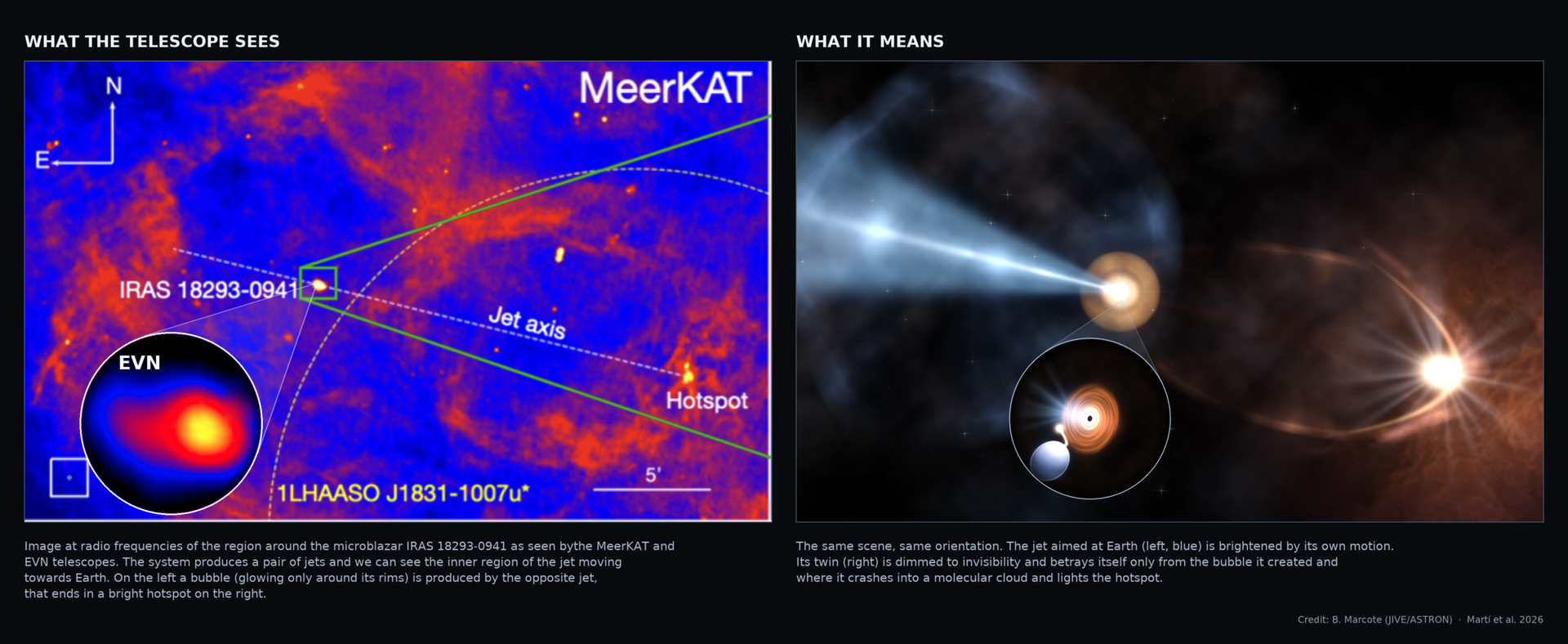
The object, called IRAS 18293-0941, is located in our galaxy, about 12,000 light-years from Earth, and it's hidden behind a veil of dust. It is a binary system that includes a black hole that orbits a hot, gigantic star every 11 days. Matter from the star falls into the black hole, and some of this material is jettisoned into the surrounding environment in two opposing jets. One of those jets flares toward Earth.

An image of a glowing ball of light against a dark background, with a heat map comparison next to it.

Comparison between the astronomical images of IRAS 18293-0941 (left) and the artist's impression (right). (Image credit: B. Marcote (JIVE/ASTRON).)

These objects, as well as microquasars in general, are tricky to observe, MartΓ­ said. "Because of stellar evolution, you need to catch the system at the right time," he added. "The microquasar phase of evolution is very short, and so it is difficult to find one in that phase."

Theorists predicted that microblazars would have special characteristics that should help define them. These features include powerful emissions across the electromagnetic spectrum, rapid changes in brightness (variability), and a hotspot behind them where its opposing jet heats up the interstellar medium in the opposite direction of Earth.

To observe IRAS 18293-0941, the study authors used a variety of instruments β€ͺ—‬ including the Calar Alto Astronomical Observatory in Spain, a network of radio astronomy telescopes called the European VLBI Network, and the MeerKAT radio telescope array in South Africa β€ͺ—‬ as well as archival data from the Very Large Array in New Mexico.

They found that IRAS 18293-0941 has all of the expected microblazar characteristics, except one β€ͺ—‬ variability. Microblazars have rapid variability, which means their brightness changes a lot in a short period, because one of the jets is facing Earth and small changes in brightness are amplified by an effect called Doppler boosting.

MartΓ­ said IRAS 18293βˆ’0941's lack of rapid variability could be explained by the dense cloud of gas surrounding it, which could smooth out quick fluctuations in brightness.

The researchers are currently investigating whether the observed area behind the microblazar is in fact a hotspot, study co-author Pedro Luque-Escamilla, an astronomer at the University of JaΓ©n, told Live Science.

Even with one of the expected features missing, this object is a promising candidate for the first known microblazar. "The claims and the results of the paper are sensible and there are no questionable hidden assumptions," Kinwah Wu, a theoretical astrophysicist at University College London who was not involved in the research, told Live Science in an email. "The source in this paper had shown signatures of interactions between the jets and the ambient material, which naturally leads to [particle] interaction."

Svetlana Jorstad, a senior research scientist at the Institute for Astrophysical Research at Boston University who was not involved in the research, told Live Science in an email that the new study was "very interesting, important and comprehensive."

Itumeleng Monageng, an astronomer at the University of Cape Town who was also not involved in the research, added that the team's observations "presents a previously overlooked mechanism for generating some of the highest energy emissions observed."

Microblazars "may power some of the universe's most energetic processes," Monageng told Live Science in an email.

MartΓ­, J., Luque-Escamilla, P. L., Marcote, B., Abaroa, L., Aguasca-Cabot, A., Combi, J. A., Romero, G. E., Paredes, J. M., GarcΓ­a, F., Fogantini, F., Saavedra, E. A., Del Ser, D., & Van Den Eijnden, J. (2026). A Galactic microblazar as a potential accelerator of ultra-high-energy particles. Astronomy and Astrophysics. https://doi.org/10.1051/0004-6361/202661105

See how much you know about black holes with our black hole quiz!

Scientists recreate the universe's first moments and find something they didn't expect

Physicists smashed gold nuclei together at nearly the speed of light and found an unexpected pattern in the particles these collisions sprayed out. If confirmed, that pattern could help reveal how the hot soup of quarks and gluons that filled the universe in the first few microseconds after the Big Bang cooled and condensed into the protons and neutrons that make up ordinary matter today.

In every collision, particles are flung out sideways; how hard they are flung, on average, varies slightly from one collision to the next. Physicists expected the size of these variations to change smoothly as they adjusted the collision energy. Instead, the variations dipped, shrinking and then growing again. This dip could be a sign of a long-sought "critical point," a special set of conditions at which nuclear matter changes the way it transforms from one form to another.

The signal, detected by the STAR experiment at the Relativistic Heavy Ion Collider (RHIC) at Brookhaven National Laboratory in New York, is strong enough that it is very unlikely to be a statistical accident. However, the researchers cautioned that the dip is a tantalizing hint, not proof of the long-sought transition. They published their findings Sept. 22 in the journal Physical Review Letters.

A rulebook for extreme matter

Protons and neutrons are made of smaller particles called quarks, which are held together by the "strong force" carried by particles called gluons. When heated or squeezed enough, protons and neutrons melt into a hot soup of free quarks and gluons known as a quark-gluon plasma. It's thought that this primordial soup of particles filled the universe in the first milliseconds after the Big Bang.

Physicists want to pin down how this soup-ification happened, by measuring the so-called equation of state of nuclear matter. "For water, it tells you how pressure, temperature and density are linked, and therefore when it freezes, boils or expands," study co-author Rutik Manikandhan, a postdoctoral physics scholar at The Ohio State University, told Live Science in an email. For nuclear matter, "it is the basic rulebook for matter under the most extreme conditions in nature, such as the cores of neutron stars," Manikandhan added.

The "critical point" is a key landmark in that rulebook "For water, it is the point where the boundary between liquid and steam disappears," Manikandhan said, and theorists have long suspected that nuclear matter has a similar point. At extremely high temperatures, matter melts smoothly and gradually into quark-gluon plasma, but at higher densities, the change may become abrupt.

The critical point would mark where one kind of transition turns into the other. Some recent calculations place this point within reach of RHIC's lower-energy collisions. "But all of this is still conjectured and there is nothing concrete yet, either from the experimentalists or theorists," Manikandhan said.

The work also matters for cosmology. "Because the matter we create in these collisions resembles the matter that filled the universe a few microseconds after the Big Bang, mapping how it behaves helps us understand how the universe evolved from a hot soup of quarks and gluons into the protons and neutrons that make up everything today," Manikandhan said.

A close up of a circular collider with wires and pipes leading into it.

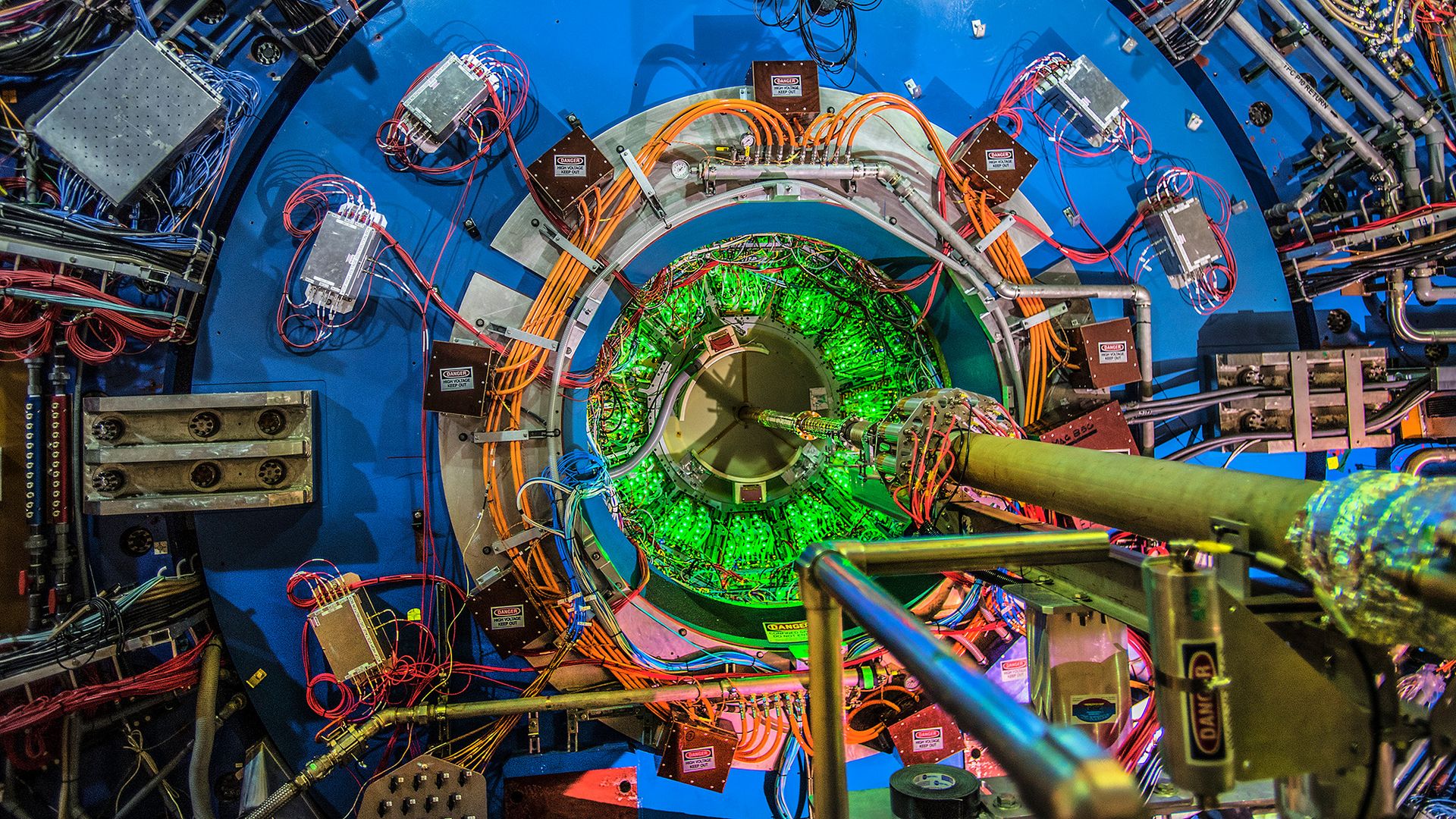
The central part of the three-story STAR detector at the Relativistic Heavy Ion Collider (RHIC). Scientists recently used the detector to study the conditions of the early universe, just milliseconds after the Big Bang. (Image credit: Brookhaven National Laboratory)

A dip where a smooth trend was expected

To explore this territory, the researchers ran RHIC at a range of collision energies. The lower the energy, the more tightly the colliding matter was squeezed. For its lowest-energy runs, STAR used a "fixed-target" setup, in which a beam of gold nuclei strikes "a thin gold foil placed inside the detector," Manikandhan said, instead of a second, oncoming beam. This produces the densest matter RHIC can make.

Collision energies are measured in electron volts (the energy an electron gains when accelerated across 1 volt). That is a minuscule amount, so particle physicists usually work in billions of electron volts, or giga electron volts (GeV). One GeV is roughly the energy locked up in the mass of a single proton, according to Einstein's famous equation E = mc2. The team analyzed roughly 1 billion collisions at energies between 3 and 7.7 GeV per pair of colliding protons or neutrons. That is the bottom of RHIC's range, which reaches 200 GeV.

In each collision, the team measured how hard charged particles were flung sideways out of the fireball β€ͺ—‬ a quantity known as transverse momentum. The researchers then looked for correlations between the particles. A correlation measures whether two things tend to change together. Here, the team checked whether pairs of particles from the same collision tended to both be flung harder than average, or both more gently. That reveals something about the fireball as a whole. If a fireball is slightly hotter, or expands more forcefully, all of its particles get an extra sideways kick together.

"Those correlations reflect how much the temperature and the flow of the fireball fluctuate," Manikandhan said.

Close to a critical point, the matter's heat capacity β€” the amount of energy needed to raise its temperature β€” is expected to shoot up. That makes the fireball's temperature harder to budge, so the correlations should weaken. "If the matter approaches a critical point or a phase change, we would expect to see those correlations change in an unusual, non-smooth way as we vary the collision energy," Manikandhan said.

That is what the team saw in the most head-on collisions. "Instead of changing smoothly with energy, the correlations show a dip," Manikandhan said. The researchers compared the data with a smooth trend anchored by earlier STAR measurements at higher energies. The dip departs from that trend with a statistical significance of 5 sigma, the standard physicists usually demand before treating a signal as real. It means that if the true trend were smooth, random scatter in the data would produce such a pronounced dip only about once in 3.5 million tries.

"A smooth trend is what you'd expect from ordinary nuclear matter, so a dip suggests something more interesting is happening at those conditions," Manikandhan said.

By contrast, a widely used computer simulation of the collisions, which contains no critical point, reproduced the overall trend but not the dip. Off-center collisions showed only a faint hint of the same feature, which is too weak to count as evidence on its own.

Not the final word yet

"The result is suggestive, not proof of a critical point," Manikandhan said. Effects unrelated to a critical point can also shape these fluctuations, and how much of the dip they could explain remains unclear, the researchers noted.

Still, the dip "does point to a set of conditions where the behavior of nuclear matter changes, and it gives theorists a new, precise measurement to test their calculations against," Manikandhan said.

Next, the team plans to use the correlations to "extract the specific heat of the hot matter," Manikandhan said. They will then compare it with supercomputer simulations that calculate the behavior of quarks and gluons from first principles.

The researchers also plan to test the dip against more theoretical models and combine it with other measurements, such as fluctuations in the number of protons produced in the collisions. "Only when different measurements agree can we say confidently whether a critical point exists," Manikandhan said.

First photos from Smile spacecraft show Earth like you've never seen it before

4 October 2026 at 11:00

A gif showing a round sphere with glowing white dots around it

Earth glows like a half moon while a giant aurora writhes over the North Pole in this ultraviolet image from the new Smile spacecraft. (Image credit: ESA & CAS/Smile/UVI CC BY-SA 3.0 IGO)
Quick facts

What it is: An aurora on the sunlit side of Earth

Where it is: Over the North Pole, as seen from about 75,000 miles away

When it was shared: Sept. 30

The debut images from a new Earth-observing satellite have just given us a view of the impossible: giant auroras rippling over the North Pole in broad daylight.

Earth's auroras are one of our planet's signature wonders β€” a sight worth advertising in interstellar travel guides, alongside our perfect total solar eclipses, bright shooting stars and majestic blobfish. They are the beautiful result of electrical storms in the atmosphere, appearing when charged solar particles skate along Earth's magnetic-field lines and collide with light-emitting molecules near the poles. (Auroras do exist on other planets, but they are usually not in bright visible colors like ours.)

To human eyes, auroras come out only at night and rarely stray from the poles. That's what makes these first observations from the joint European-Chinese Smile mission, which officially began science operations this week, so special.

Captured in ultraviolet light, the stunning images show a huge, serpent-like ring of charged particles coiling around the North Pole in July 2026. In the foreground, Earth appears ghostly and featureless, glowing like a half moon. The aurora writhes around our planet's sunlit side, covering about a third of it, while Earth's dark nightside bleeds into the background sky. Far behind, bright stars fall like raindrops as Smile shifts subtly in its orbit.

A spiderweb overlay is on top of a heat-map type image with red and orange colors.

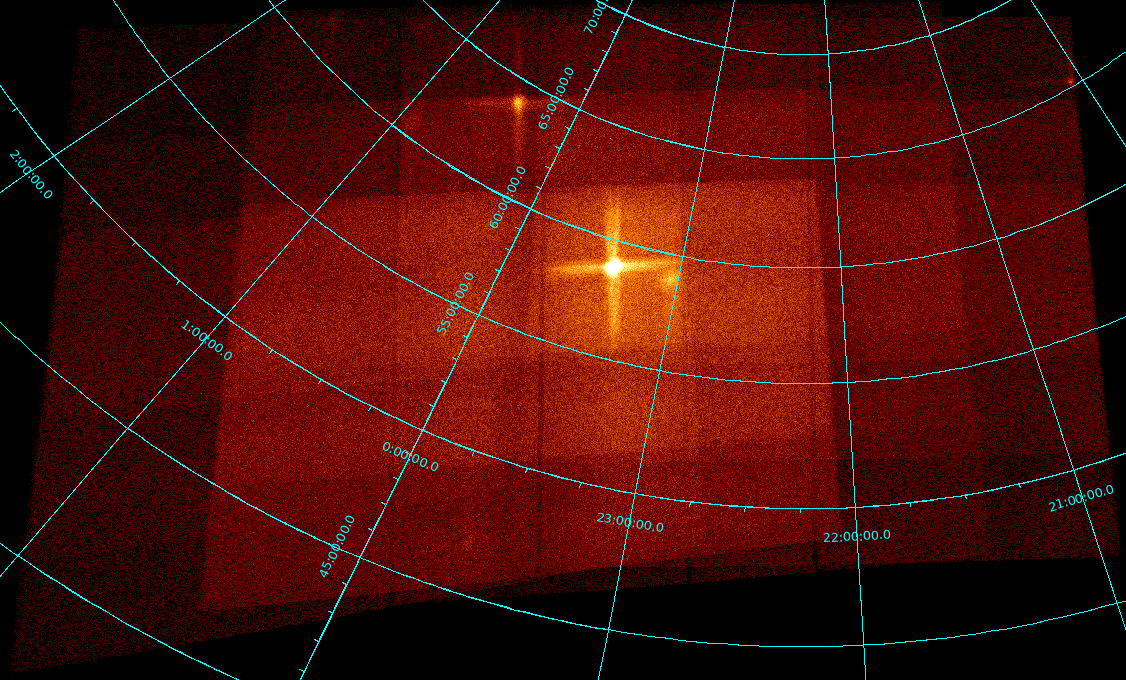
Smile tested its soft X-ray imager on the light of the distant supernova remnant Cassiopeia A (center), located 11,000 light-years from Earth. (Image credit: ESA, CC BY-SA 3.0 IGOΒ )

The view alone is worth smiling about, but the new images also promise exciting science to come. Taken just two weeks after scientists first turned Smile's Ultraviolet Aurora Imager on, the observations show that the satellite's instruments are working as they should and that the joint European Space Agency (ESA) and Chinese Academy of Sciences mission can officially begin.

Launched on May 19, Smile will spend the next three years watching Earth from a highly elliptical orbit that takes it about 75,000 miles (121,000 kilometers) over the North Pole β€” about a third of the way to the moon. From there, Smile can observe the North Pole for a record-breaking 45 hours at a time, offering an unprecedented view of solar activity there.

In addition to the Ultraviolet Aurora Imager, Smile carries three more science instruments to detect X-rays, magnetic fields and light ions over Earth.

This week, scientists also tested the spacecraft's soft X-ray imager by pointing it at the distant supernova remnant Cassiopeia A, located about 11,000 light-years from Earth (image above). Although the camera is working fine, the detector is still picking up a bit too much light when aimed at Earth, so it will require a bit more calibration from scientists on the ground.

Do animals experience schadenfreude?

4 October 2026 at 10:00

In 2023, an African gray parrot named Jack went viral for mimicking the coughs and wheezes of her owner's father, who often struggled to breathe from severe chronic obstructive pulmonary disease.

But it wasn't just the imitation that made Jack famous; it was also that she seemed to relish the suffering of a man she purportedly hated. In the video, Jack's owner even claimed that she had a favorite cough.

The parrot appeared to be experiencing a complex emotion that in humans is known as schadenfreude, or pleasure at seeing another's pain. Literally translated from German as "harm joy," it's a feeling that might emerge when a rival coworker gets fired, or when a rude neighbor has their package stolen.

When a cat seems a little too happy watching a human stub their toe, or a horse seems to grin at a person stepping in poop, their owners might also interpret their behavior as schadenfreude.

But can any animals really experience such a complicated emotion? Or is this a classic case of anthropomorphization?

A complex emotion

Animals probably do not experience schadenfreude, according to researchers who study animal behavior and intelligence. However, the question hasn't received much attention in formal research. That's partly due to limitations of animal behavior methodology, but also because the question is bound up with how we define and communicate emotion in the first place.

"The study of complex emotions is incredibly difficult when you're talking about an animal that cannot communicate their emotions linguistically," Zachary Silver, an assistant professor of psychology who leads the canine intelligence lab at Occidental College in Los Angeles, told Live Science. "We don't have the ability to be as precise as we like to be in the scientific community."

Silver explained that researchers can look at behavior, neurological signals or hormonal activity to make an educated guess about what an animal might be feeling. A dog that has its ears back and tail tucked, for instance, is probably experiencing a negative emotion, while one wagging its tail is feeling a positive one.

But "aside from positive and negative, without words to describe the emotion, it becomes very difficult to disentangle," Silver said. The dog could be happy, but it could also just be interested in something new. "It's just so hard for us to say with any definitive nature that we really can know exactly what emotion is going on there," Silver said.

Animal behavior researchers try to avoid anthropomorphizing animals β€ͺ(attributing human qualities to them) without evidence. When a cat or dog comforts a grieving human, for example, it could just be that the behavior was previously reinforced by rewarding the animal with treats or pets, rather than a genuine outpouring of sympathy. Similarly, Jack the parrot could have been mimicking coughs just for attention.

a woman hugs a cat

When cats make trouble for their owners, they may not be experiencing schadenfreude but rather just want attention. (Image credit: Zhenny-zhenny via Shutterstock)

To truly experience a complicated emotion like schadenfreude, an animal needs to understand the emotional states of both itself and others β€” a concept called theory of mind.

"Dogs may have some ability to attribute mental states like emotions, thoughts, beliefs, intentions to other individuals, but this really only occurs in very select contexts and in really kind of a rudimentary way," Silver said. Because of this, "it's exceedingly unlikely that dogs would be able to experience schadenfreude in the way that we as humans do."

David Stahlman, an animal behavior researcher at the University of Mary Washington, agreed that such emotional capacity in animals is unlikely. He said that animals do not seem to have the ability to recognize their own emotional states, though he noted that not all animal behavior researchers agree.

"There's a difference between the affect, the emotional behavior, and then the recognition of the emotional behavior in oneself," Stahlman said. If nonhuman animals were to have this capability, he suspected it would probably be found in highly social great apes, like chimpanzees (Pan troglodytes) and bonobos (Pan paniscus). Schadenfreude, in particular, would require animals to live in close social groups, since it requires knowledge of the individual experiencing the harm and whether it's deserved.

In hierarchical groups, it's possible that the suffering of one animal might benefit another and lead to something resembling happiness, Stahlman said, but he doubts this would ever qualify as true schadenfreude.

"The kind of Machiavellian stuff is a very human thing," he said.

Nevertheless, β€œthere is a lot of data pointing in the direction that animals do have really deep capacities for emotional intelligence,” said Kaeli Swift, an animal behavior researcher at the University of Washington and author of the Corvid Research blog.

Swift noted that studies of some corvid species have found evidence of emotional recognition, fairness and "some of the strongest evidence across the animal world" for theory of mind. However, when it comes to studying an emotion as complex and subjective as schadenfreude, she said that researchers "haven’t quite crossed that threshold."

In the study of animal emotions, she said "we have barely started to scratch the surface."

❌