
❌

Normal view

AI predicts prolonged air leak after lung surgery in elderly patients

9 September 2026 at 18:09

When surgeons remove a portion of a cancerous lung, one of the most frustrating complications they can face is air. A persistent leak from the lung’s cut surface or staple lines — known as prolonged air leak — keeps chest tubes in place far longer than anyone would like, extends hospital stays, inflates costs, and elevates the risk of infection and other downstream problems. Now, a research team in China has developed a machine learning tool that predicts, with striking accuracy, which older lung cancer patients are most likely to develop this complication before it ever occurs. The study, published in BMC Cancer, combines cardiopulmonary exercise testing data with an interpretable artificial intelligence model and could reshape how thoracic surgical teams prepare for and manage one of the most common postoperative challenges in lung surgery.

The research was led by Zixiao Wang, Jiabao Ding, Huagang Liang and colleagues at the First Hospital of Qinhuangdao, in collaboration with Kai Wang of Tianjin Chest Hospital. It addressed a well-recognized gap in thoracic surgical practice. While prolonged air leak — typically defined as air leaking from the chest drainage system for more than five days after surgery — is among the most frequent complications following video-assisted thoracoscopic anatomical lung resection, the prediction models available to clinicians have historically lacked rigorous external validation and, critically, interpretability. Surgeons have been asked to trust risk scores without understanding where those risks come from, a barrier that has limited clinical uptake of computational tools in the operating room planning process.

To build their model, the investigators enrolled patients aged 60 and older with lung cancer who underwent thoracoscopic anatomical lung resection — either lobectomy, the removal of an entire lung lobe, or segmentectomy, the removal of a smaller anatomical segment. The study was designed as a dual-centre cohort investigation with both retrospective and prospective components. A total of 471 patients treated at Qinhuangdao First Hospital between January 2024 and June 2025 formed the model development cohort. A separate group of 140 patients from Tianjin Chest Hospital, enrolled prospectively between June and August 2025, provided the external validation set — a crucial test of whether the model generalized beyond the institution where it was built.

The methodology followed the emerging best-practice playbook for clinical machine learning. After preliminary data processing, the development cohort was randomly split into a training set containing 70 percent of patients and an internal validation set holding the remaining 30 percent. Because prolonged air leak affects only a minority of surgical patients, the training data were inherently imbalanced, with far more non-leak cases than leak cases — a condition that can fool machine learning algorithms into simply predicting that no one is at risk. The researchers countered this with SMOTE, the Synthetic Minority Over-sampling Technique, which generates synthetic examples of the underrepresented class to rebalance the dataset and force the algorithms to learn the genuine signature of risk.

Feature selection was performed using LASSO regression — least absolute shrinkage and selection operator — a statistical technique that penalizes model complexity and drives the coefficients of irrelevant variables to zero, effectively filtering a large panel of candidate variables down to the most predictive few. From this process, four predictors of prolonged air leak emerged: a history of emphysema, the smoking index, a previous history of thoracic surgery or chest trauma, and the ventilatory equivalent for carbon dioxide, abbreviated VE/VCO₂. This last variable is drawn directly from cardiopulmonary exercise testing, a stress test performed on a bicycle or treadmill that measures how the heart, lungs, and circulatory system respond together to increasing exertion. VE/VCO₂ reflects the efficiency of ventilation during exercise — how much air a patient must move to eliminate a given amount of carbon dioxide — and elevated values signal impaired pulmonary gas exchange and often underlying parenchymal lung disease.

With the four features in hand, the team constructed six competing machine learning models: logistic regression, support vector machine, decision tree, extreme gradient boosting, and artificial neural networks, among others. Each was evaluated using a battery of metrics including the area under the receiver operating characteristic curve, or AUC, the F1 score, and the Brier score, which measures the accuracy of probabilistic predictions. The winner was XGBoost, an ensemble method that builds a sequence of decision trees, with each new tree trained to correct the residual errors of its predecessors. In internal validation, XGBoost achieved an AUC of 0.903 (95 percent confidence interval, 0.834 to 0.960) — well within the range conventionally considered excellent discrimination — along with the highest F1 score of 0.717 and the lowest Brier score of 0.092 among all six candidates.

The external validation was arguably the study’s most important test. A model can memorize the quirks of its home institution’s patient population, equipment, and surgical practices, only to falter elsewhere. Yet when applied to the 140 previously unseen patients from Tianjin Chest Hospital, the XGBoost model maintained an AUC of 0.800 (95 percent confidence interval, 0.656 to 0.913), with a sensitivity of 0.700, a specificity of 0.833, and a Brier score of 0.133. In practical terms, the model correctly flagged seven out of ten patients who went on to develop prolonged air leak while correctly reassuring more than eight out of ten of those who did not — performance that, if replicated in routine practice, would give surgeons a meaningful window to intervene preemptively.

Interpretability was treated not as an afterthought but as a core design requirement. The researchers applied SHAP — Shapley Additive Explanations — a technique borrowed from cooperative game theory that assigns each feature a contribution value for every individual prediction. Rather than presenting clinicians with an opaque probability, SHAP reveals how much each of the four variables pushed a given patient’s risk up or down, and in which direction. Through this analysis, VE/VCO₂ emerged as the single most influential feature, followed by the other three predictors ranked by correlation. The finding is physiologically plausible: patients whose lungs ventilate inefficiently under the stress of exercise are precisely those whose lung tissue is most fragile and least likely to seal spontaneously after surgical manipulation. A history of emphysema, a heavy smoking history, and prior chest surgery or trauma each independently compound this tissue vulnerability.

The clinical utility of the work extends beyond prediction to prevention. Armed with a preoperative risk estimate, surgical teams can tailor their approach for high-risk patients. Options include more meticulous staple-line reinforcement, the use of sealants or pledgeted sutures on fragile lung tissue, choosing segmentectomy over lobectomy where oncologically appropriate, planning for ambulatory drainage systems on discharge, or scheduling earlier follow-up to catch and manage leaks before they become complicated. To lower the barrier to bedside use, the team built a web-based risk calculator that allows clinicians to enter a patient’s four variables and receive an individualized probability of prolonged air leak — no programming expertise required.

The significance of incorporating cardiopulmonary exercise testing into a surgical prediction model deserves particular emphasis. Traditional preoperative pulmonary assessment in lung cancer surgery has relied on static spirometric measures such as forced expiratory volume in one second, or FEV1, and the diffusing capacity for carbon monoxide, DLCO. These tests measure lung function at rest and provide only a partial picture of cardiopulmonary reserve. CPET, by contrast, captures the integrated response of multiple organ systems under physiological stress, and the VE/VCO₂ slope in particular has gained recognition as a sensitive marker of ventilatory inefficiency in chronic obstructive pulmonary disease and heart failure. The present study suggests that this dynamic measure carries prognostic information for surgical outcomes that static tests do not fully capture — a finding with implications well beyond air leak prediction.

Several caveats frame the work appropriately. The study population was limited to Chinese patients aged 60 and above undergoing video-assisted thoracoscopic resection, and generalization to younger patients, other surgical techniques such as robotic-assisted resection, or different health care systems remains to be demonstrated. The external validation cohort, while methodologically essential, comprised 140 patients, and wider multicenter prospective trials would strengthen confidence in the model’s performance. The published article is an accepted, peer-reviewed author manuscript shared early ahead of the final version of record. The study was funded by the Beijing Kechuang Medical Development Foundation, with the funder playing no role in study design, analysis, or manuscript preparation, and the authors declare no competing interests.

Even so, the study stands as a compelling example of where predictive medicine is heading. By pairing a rigorous dual-centre validation strategy with explainable artificial intelligence and a physiologically grounded predictor, the researchers have moved machine learning in thoracic surgery closer to genuine clinical utility rather than proof-of-concept novelty. For the growing population of older patients facing lung cancer surgery, a simple preoperative test and a few clicks in a web calculator may soon determine who needs extra surgical vigilance — and spare many of them the days of tethered chest drainage that have long been an accepted, if unwelcome, part of recovery.

Subject of Research: Machine learning-based prediction of prolonged air leak after video-assisted thoracoscopic anatomical lung resection in older lung cancer patients using cardiopulmonary exercise testing

Article Title: Machine learning-based prediction of prolonged air leak after video-assisted thoracoscopic anatomical lung resection in older patients using cardiopulmonary exercise testing: a dual-centre development and validation study

Article References: Wang, Z., Wang, K., Zhu, N., liu, H., Li, J., Liang, H., & Ding, J. (2026). Machine learning-based prediction of prolonged air leak after video-assisted thoracoscopic anatomical lung resection in older patients using cardiopulmonary exercise testing: a dual-centre development and validation study. BMC Cancer. https://doi.org/10.1186/s12885-026-16933-z

Image Credits: AI Generated

DOI: 10.1186/s12885-026-16933-z

Keywords: Machine learning, Prolonged air leak, Cardiopulmonary exercise testing, XGBoost, Lung cancer surgery, Video-assisted thoracoscopic surgery, Prediction models, VE/VCO₂, SHAP interpretability, Thoracic surgery, Predictive medicine, COPD

iPhone 18 Pro fica 40% mais rápido e ganha bateria de Pro Max

9 September 2026 at 18:08

A Apple apresentou nesta quarta-feira (9) os novos iPhone 18 Pro e iPhone 18 Pro Max, celulares mais avançados no seu novo portfólio. A geração estreia o chipset A20 Pro de 2 nanômetros, traz câmera Fusion de 48 MP com abertura variável e adota uma Dynamic Island menor. Com o novo hardware, os iPhones deste ano ficaram 40% mais rápidos que o iPhone 17 Pro, segundo a Apple.

Os aparelhos também chegam com nova câmara de vapor, modem próprio C2 e iOS 27 com Apple Intelligence e Siri AI. O iPhone 18 Pro parte de US$ 1.199, cerca de R$ 6.102 em conversão direta, enquanto o Pro Max começa em US$ 1.299, aproximadamente R$ 6.611.

A pré-venda começa em 12 de setembro, inclusive no Brasil, e as primeiras unidades chegam às lojas no dia 18 de setembro.

Câmera de 48 MP ganha abertura variável

Um dos principais destaques da nova geração está na câmera principal Fusion de 48 MP, que agora possui abertura variável entre f/1.8 e f/4. É a primeira vez que a Apple oferece controle de abertura física em um iPhone.

O mecanismo usa seis lâminas cortadas a laser e pode alterar automaticamente a abertura de acordo com a iluminação e a profundidade de campo necessária. O usuário também pode escolher manualmente entre quatro configurações pelo aplicativo Câmera.

A Apple afirma que o novo sensor melhora as fotografias em baixa luminosidade e entrega mais detalhes. Fotos de grupos também devem preservar melhor a nitidez de pessoas ou elementos posicionados mais ao fundo da cena.

Captura de Tela 2026-09-09 às 14.22.02

Uma nova etapa de fotografia computacional busca gerar imagens mais nítidas, enquanto os Photographic Styles recebem controles de textura e granulação para ampliar as possibilidades de personalização.

A Apple também destacou melhorias para fotografias sob luz solar intensa e no foco de assuntos em movimento. O recurso Focus Tracking acompanha o objeto durante a captura para ajudar a mantê-lo em foco em gravações de vídeo.

Pro Controls oferece mais ajustes manuais

Os iPhone 18 Pro e 18 Pro Max ganham uma nova interface Pro Controls dentro do aplicativo Câmera. A ferramenta concentra configurações usadas com frequência e amplia os controles manuais disponíveis para fotos e vídeos.

É possível alterar parâmetros como abertura da lente, velocidade do obturador, ISO e balanço de branco, além de consultar um histograma para verificar os níveis de exposição da cena.

Apple A20 Pro

A Apple também disponibilizará uma API para que desenvolvedores aproveitem o controle da abertura variável em aplicativos de terceiros.

Para vídeo, efeitos Cinematic poderão ser aplicados após a gravação em conteúdos capturados a até 60 fps. O modo Time-lapse passa a filmar em 4K com Dolby Vision HDR.

O Audio Mix também recebeu novos algoritmos para melhorar a qualidade das vozes e agora consegue isolar músicas presentes no áudio da gravação.

Apple Reference Image ajuda a identificar fotos alteradas

A Apple também apresentou o Apple Reference Image, novo recurso voltado à autenticidade das fotografias capturadas pelos iPhone 18 Pro.

No modo Reference, o novo sensor registra dados assinados durante a captura. O Private Cloud Compute usa essas informações para criar uma imagem de referência que não pode ser alterada.

Essa versão aparece no aplicativo Fotos ao lado da imagem principal e funciona como uma espécie de negativo digital, que permite comparar os dois arquivos para identificar possíveis edições.

A Apple também usará metadados e prepara suporte ao padrão SynthID para ajudar a identificar conteúdos criados ou modificados com inteligência artificial.

A20 Pro estreia processo de 2 nm

Os dois modelos chegam com o Apple A20 Pro, fabricado em processo de 2 nm. O chipset possui 50% mais largura de banda de memória que o A19 Pro e traz uma CPU de seis núcleos.

São dois novos núcleos de desempenho e quatro novos núcleos de eficiência, com Neural Accelerators integrados. Segundo a Apple, a CPU é até 20% mais rápida, e a companhia a destaca como a mais veloz já usada em um smartphone.

A GPU possui sete núcleos e oferece desempenho gráfico até 40% superior ao A19 Pro, com foco tanto em jogos quanto em tarefas mais pesadas de criação.

Já o Neural Engine usa uma arquitetura Dual 16-core, com 32 núcleos no total. Segundo a Apple, isso dobra a capacidade de processamento de inteligência artificial em relação ao A19 Pro.

Nova câmara de vapor melhora desempenho contínuo

Para controlar as temperaturas, a Apple reformulou o sistema de refrigeração dos novos iPhones. O A20 Pro usa um encapsulamento inspirado nos chips da linha M, com memória e silício posicionados lado a lado.

A mudança remove a memória do caminho térmico e permite que o chipset tenha contato direto com uma câmara de vapor de nova geração.

Captura de Tela 2026-09-09 às 14.29.51

 Segundo a companhia, o componente tem três vezes mais área que o sistema usado no iPhone 17 Pro. A combinação permite um ganho de até 40% no desempenho sustentado, o maior já registrado pela Apple em um iPhone.

iPhone 18 Pro estreia modem C2 e chip N1

Outra novidade está na conectividade. Os dois celulares usam o N1, novo chip sem fio desenvolvido pela Apple com suporte a Wi-Fi 7, Bluetooth 6 e Thread.

Eles também estreiam o modem C2, segunda geração do sistema celular próprio da companhia. A Apple promete uploads significativamente mais rápidos que no C1X e 15% menos consumo de energia. O componente adiciona suporte a 5G mmWave nos Estados Unidos.

Os recursos de conectividade via satélite continuam disponíveis quando não há cobertura de rede celular ou Wi-Fi. A Apple também prorrogou por mais um ano o acesso gratuito às funções de satélite para usuários elegíveis das linhas iPhone 14, 15 e 16.

Dynamic Island fica menor e mostra mais informações

A Apple reduziu o tamanho da Dynamic Island nos novos modelos, mas manteve o sistema Face ID para desbloqueio, autenticação de compras e acesso a aplicativos.

O espaço também ficou mais funcional e agora consegue mostrar até três Atividades ao Vivo simultaneamente.

Siri AI estreia integrada ao Apple Intelligence

Os iPhone 18 Pro chegam com o iOS 27, que traz a nova geração do Apple Intelligence e apresenta a Siri AI, uma reformulação da assistente virtual da companhia.

Segundo a Apple, a Siri recebe atualmente mais de 2,5 bilhões de solicitações por dia. A nova versão passa a usar contexto pessoal para procurar informações em mensagens, e-mails, fotos e outros dados do usuário.

A Siri AI também consegue interpretar o conteúdo exibido na tela e executar ações relacionadas a ele. Um modo dentro do aplicativo Câmera permite ainda perguntar sobre o que está diante do celular e realizar ações a partir dessas informações.

A assistente passa a trabalhar melhor com aplicativos de terceiros. Entre os exemplos mostrados estão enviar mensagens pelo WhatsApp, reproduzir audiobooks no Audible, mandar e-mails e criar listas de compras.

Também é possível escrever pedidos para a Siri e personalizar sua voz e entonação.

Apple Intelligence edita fotos e monitora páginas

O Apple Intelligence também recebe novas ferramentas. O Spatial Reframing permite alterar a composição de uma foto depois da captura, enquanto o Extend consegue expandir a imagem.

O Clean Up foi atualizado e o Image Playground passa a gerar imagens com aparência fotorrealista.

No Safari, o novo Notify Me consegue acompanhar mudanças em páginas e avisar sobre eventos como reposição de produtos em estoque ou quedas de preço.

Para preservar a privacidade, a Apple afirma que parte das tarefas de IA ocorre diretamente no aparelho. Recursos que precisam de mais processamento podem usar o Private Cloud Compute.

Siri AI chega em português em outubro

O Apple Intelligence estará disponível em 16 idiomas, incluindo português, com a chegada do iOS 27.

A nova versão do sistema será disponibilizada gratuitamente em 14 de setembro. A Siri AI estreia na mesma data em versão beta para aparelhos configurados em inglês.

Captura de Tela 2026-09-09 às 14.29.31

 O suporte a mais idiomas, como português, francês, japonês, coreano e espanhol chega em outubro.

O iOS 27 também amplia as opções de personalização do visual Liquid Glass e adiciona novos recursos de proteção infantil e controle parental.

Outra novidade é o iPhone Handoff, que permite alternar entre dois iPhones com o mesmo número em operadoras compatíveis.

Pro Max tem maior salto de bateria já feito pela Apple

A Apple afirma que o iPhone 18 Pro Max registra o maior aumento de autonomia já feito entre gerações de iPhone, graças às melhorias do A20 Pro e à adoção de uma bateria maior.

Nas versões vendidas exclusivamente com eSIM, o iPhone 18 Pro alcança até 36 horas de reprodução de vídeo, enquanto o iPhone 18 Pro Max chega a 45 horas.

Esses aparelhos usam o espaço antes reservado ao cartão SIM físico para colocar uma bateria maior e oferecem duas horas adicionais de reprodução de vídeo.

As versões exclusivas com eSIM serão vendidas em mercados como Estados Unidos, Canadá, Japão e México. O Brasil não está na lista divulgada pela Apple.

No carregamento, o iPhone 18 Pro recupera até 50% da bateria em cerca de 15 minutos pelo cabo ou em aproximadamente 30 minutos sem fio.

No Pro Max, cinco minutos de carga com fio oferecem cerca de sete horas de reprodução de vídeo. A Apple também estima até 30 horas de uso com uma carga completa em seu novo modelo de medição baseado em dados de utilização real.

Construção usa 40% de materiais reciclados

Segundo a Apple, os iPhone 18 Pro e Pro Max são produzidos com 40% de conteúdo reciclado no total.

A bateria usa 100% de cobalto reciclado, enquanto a estrutura possui 85% de alumínio reciclado. A companhia também afirma que 50% da energia usada na cadeia de fabricação vem de fontes renováveis, como solar e eólica.

As embalagens são produzidas integralmente com fibras e podem ser recicladas.

Quatro cores e até 2 TB de armazenamento

Os iPhone 18 Pro e Pro Max serão vendidos nas cores Burgundy (roxo), Glacier (branco), Silver (cinza) e Black (preto). O tom Burgundy é a nova opção introduzida nesta geração.

Os dois modelos também terão as mesmas opções de armazenamento: 256 GB, 512 GB, 1 TB e 2 TB.

A Apple anunciou ainda novas capas Silicone, TechWoven e transparentes, além de carteiras FineWoven e alças Wrist Strap e Crossbody Strap.

Preço e disponibilidade

O iPhone 18 Pro parte de R$ 11.999 para a versão com 256 GB. Já o iPhone 18 Pro Max começa em R$ 12.999 também com 256 GB.

Veja os preços oficiais no Brasil:

Armazenamento iPhone 18 Pro iPhone 18 Pro Max
256 GB R$ 11.999 R$ 12.999
512 GB R$ 13.499 R$ 14.499
1 TB R$ 16.499 R$ 17.499
2 TB R$ 20.999 R$ 21.999

A pré-venda começa no sábado, 12 de setembro, em mais de 65 países e regiões, incluindo o Brasil. As primeiras unidades chegam às lojas na sexta-feira, 18 de setembro.

Outros 20 países e regiões recebem os aparelhos a partir de 25 de setembro.

Ficha técnica do iPhone 18 Pro e iPhone 18 Pro Max

Característica iPhone 18 Pro iPhone 18 Pro Max
Chipset Apple A20 Pro Apple A20 Pro
Processo 2 nm 2 nm
CPU 6 núcleos 6 núcleos
GPU 7 núcleos 7 núcleos
Neural Engine 32 núcleos 32 núcleos
Conectividade Wi-Fi 7, Bluetooth 6, Thread e 5G Wi-Fi 7, Bluetooth 6, Thread e 5G
Modem Apple C2 Apple C2
Armazenamento 256 GB, 512 GB, 1 TB ou 2 TB 256 GB, 512 GB, 1 TB ou 2 TB
Câmera principal Fusion de 48 MP, abertura variável de f/1.8 a f/4 Fusion de 48 MP, abertura variável de f/1.8 a f/4
Sistema iOS 27 iOS 27
IA Apple Intelligence e Siri AI Apple Intelligence e Siri AI
Autonomia em vídeo com eSIM-only Até 36 horas Até 45 horas
Cores Burgundy (roxo), Glacier (branco), Silver (cinza) e Black (preto) Burgundy (roxo), Glacier (branco), Silver (cinza) e Black (preto)
Preço inicial US$ 1.199, cerca de R$ 6.102 US$ 1.299, cerca de R$ 6.611
Pré-venda 12 de setembro 12 de setembro
Disponibilidade 18 de setembro 18 de setembro

{{WHATSAPP_CHANNEL}}

Gaza women bear invisible psychological scars of war, study finds

9 September 2026 at 17:34

Nearly every displaced woman in Gaza surveyed in a new study screened positive for severe post-traumatic stress symptoms, a finding researchers describe as an unprecedented psychological toll linked directly to hunger, overcrowded displacement, and the collapse of everyday life under war.

The study, published in the International Journal for Equity in Health, assessed 503 displaced women in the Gaza Strip during the 2023–2025 war using a mixed-methods design that combined a structured quantitative survey with in-depth qualitative interviews. The average participant was 29.4 years old, with a standard deviation of 7.3 years, and the majority were married, unemployed, and living below the deep poverty line. Most had been displaced for nearly a year, and the overwhelming majority were sheltering in tents under conditions of severe overcrowding and acute food shortage.

When researchers measured post-traumatic stress symptoms using the Impact of Event Scale–Revised, a widely used screening instrument that evaluates intrusion, avoidance, and hyperarousal symptoms following traumatic exposure, they found that 98.2 percent of participants scored in the severe range. The mean IES-R score across the sample was 61.5, with a standard deviation of 9.5 — a figure far above the thresholds typically used to flag clinically significant trauma-related distress. The authors are careful to note that because symptoms were assessed with a screening tool rather than a formal diagnostic clinical interview, the results should be interpreted as reflecting an extremely high burden of trauma-related distress within the study sample rather than confirmed clinical diagnoses. Even with that caveat, the near-universality of severe scores stands out even against the backdrop of other conflict-affected populations, where severe symptom prevalence rarely approaches such levels.

Food emerged as one of the strongest statistical correlates of psychological suffering. Severe food insecurity, measured with the Food Insecurity Experience Scale developed by the Food and Agriculture Organization, affected approximately 71 percent of participants. Women experiencing severe food insecurity had significantly higher PTSD symptom severity scores, an association that held at a p-value below 0.001. The researchers also identified a cluster of socioeconomic and living-condition factors associated with worse outcomes: being divorced or widowed, living in an extended-family household, sheltering in a tent or collective shelter during displacement, and reporting that food was simply unavailable were all significantly linked to elevated symptom scores.

These quantitative patterns were given texture and depth by the qualitative arm of the study, in which trained researchers conducted semi-structured, face-to-face interviews in Arabic with 34 of the women. Analysis of the transcripts revealed five overarching themes: poverty and inequity; food as a luxury; wounds you cannot see; on the move, nowhere to belong; and small acts of resilience. Together, the themes trace an arc from material deprivation to psychological injury and, ultimately, to the fragile coping strategies women deployed to keep themselves and their families functioning.

The theme of food as a luxury captured how a basic biological need had been transformed into an object of obsession and grief. Women described rationing scraps, skipping meals so children could eat, and the humiliating experience of standing in lines for aid that never arrived. The researchers note that this chronic preoccupation with food security operated on two fronts — it was simultaneously a source of traumatic stress in its own right and an amplifier of existing war trauma, since hunger stripped away one of the last remaining domains in which mothers could still protect their children.

The “wounds you cannot see” theme speaks directly to the invisible nature of psychological injury in wartime. Women recounted nightmares, intrusive memories of bombings and the deaths of relatives, hypervigilance, emotional numbness, and an inability to feel safe even in moments of quiet. Several described the stigma of admitting psychological suffering, or the sense that mental distress was a luxury they could not afford to acknowledge while survival demanded constant action. The researchers interpret these accounts as illustrating how trauma in this context is not a discrete event but a continuous condition, woven into the fabric of daily life.

Displacement itself — the theme of being “on the move, nowhere to belong” — emerged as a distinct psychological stressor. Women described repeated forced evacuations, the loss of homes that anchored family identity and memory, and the corrosive instability of living in tents that leaked in rain, baked in heat, and offered no privacy for grieving or for motherhood. The loss of place, the authors suggest, compounds the loss of people, producing a grief that has nowhere to settle.

Yet the final theme, small acts of resilience, complicates a narrative of pure victimhood. Women described prayer, mutual aid among neighbors, storytelling with children, and small rituals of domesticity — making tea, arranging a tent, celebrating a birthday with almost nothing — as deliberate acts of psychological resistance. The researchers frame these behaviors as adaptive coping mechanisms that, while insufficient to protect against severe trauma symptoms, sustained a sense of agency and dignity under conditions designed to strip both away.

Methodologically, the study relied on a convenience sample recruited through structured surveys administered via Google Forms, a pragmatic choice given the destruction of infrastructure and the impossibility of random sampling in an active war zone. The authors acknowledge this limitation, along with the screening-based measurement of PTSD and the absence of consistent formal referral pathways for psychological care during data collection, which meant that women who became distressed during interviews could not always be directed to clinical services. Interviews followed strict ethical protocols approved by the Institutional Review Board at An-Najah National University, with verbal informed consent, anonymization, and trained interviewers instructed to pause or terminate any conversation that caused visible distress.

The demographic profile of the sample underscores the socioeconomic dimension of psychological vulnerability. That most participants were unemployed and living below the deep poverty line before and during the war reflects broader patterns in which economic deprivation and mental health outcomes are tightly intertwined in conflict settings. Divorced and widowed women — those without a partner’s social and economic support — fared significantly worse, as did women in extended-family households, possibly reflecting crowded conditions and multiplied caregiving burdens.

The study carries a sobering human footnote. The acknowledgments honor the memory of co-author Ayman S. Abutair, a clinical nutrition researcher at Al-Azhar University-Gaza, who lost his life during the war before the paper’s publication. His death stands as a stark reminder that the researchers documenting these invisible wounds were themselves living within the same catastrophe.

The authors argue that their findings demonstrate an urgent and unmet need for comprehensive humanitarian and psychosocial support tailored to displaced women — support that integrates mental health care with food assistance, shelter improvement, and protection for female-headed households. They emphasize that because caregiving responsibilities fall disproportionately on women during war and displacement, their psychological deterioration radiates outward to children and entire family systems, making women’s mental health a strategic priority for any humanitarian response rather than an afterthought.

What the study ultimately documents is the entanglement of hunger and trauma at a scale rarely captured in research. Where most studies of conflict-related PTSD examine populations after violence has subsided, this research measured psychological injury while bombs were still falling, while displacement was ongoing, and while food systems had collapsed. The result is a portrait of a population in which severe trauma symptoms are not an unfortunate consequence of war but, in effect, a near-universal condition — visible not in wounds, but in sleepless nights, interrupted meals, and the quiet endurance of half a million women carrying burdens that remain, for now, largely untreated.

Subject of Research: Prevalence and determinants of post-traumatic stress disorder symptoms among displaced women in Gaza during the 2023–2025 war, examined in relation to food insecurity, displacement conditions, and socioeconomic vulnerability.

Article Title: War’s invisible wounds: prevalence and determinants of post-traumatic stress disorder among Gaza women amidst the war: a mixed-method study

Article References: Al-Amouri, F. M., Abutair, A. S., Morjan, S., Anabtawi, O., Ali, D. O., Faris, M., & Badrasawi, M. (2026). War’s invisible wounds: prevalence and determinants of post-traumatic stress disorder among Gaza women amidst the war: a mixed-method study. International Journal for Equity in Health. https://doi.org/10.1186/s12939-026-02952-6

Image Credits: AI Generated

DOI: 10.1186/s12939-026-02952-6

Keywords: Gaza, post-traumatic stress disorder, displacement, food insecurity, women’s mental health, war trauma, famine, humanitarian crisis, IES-R, psychosocial support

Rare bacteria, heavy metals, and toxic pollutants are leaking from data centers across the United States — breaking treatment facilities and poisoning rivers

  • 3 points

Data centers across the United States have been criticized for harming local environments sourcing power - sometimes illegally - from gas burning turbines that can release harmful pollutants into the air surrounding local communities.

But dozens of data centers have been accused of releasing harmful chemicals, heavy metals, and rare bacteria with the wastewater they release into nearby treatment facilities and waterways.

Violations have been logged for data centers in Wyoming, Virginia, New York, and Georgia, but the problem likely extends far across the rest of the US. Information on water usage and discharge for many data centers is hard to come by - or is being actively blocked.

Pollutants released into water across the US

In Wyoming, Meta was recently forced to halt water discharges from the construction site of its enormous 960-acre Cheyenne campus after a resistant bacterium - Cupriavidus gilardii - was found within a local water treatment facility.

The bacterium was identified after regulators tested a sample of the 801,000 gallons Meta had discharged into Cheyenne’s sewers. Following concerns that local residents could inhale droplets of the contaminated water if it was used for irrigation, local officials decided to stop accepting wastewater from the construction site.

Two water treatment facilities were forced offline as part of a multi-month decontamination and cleanup operation. Meta’s contractor responsible for the site, Goat Systems, is appealing the decision of officials to stop accepting wastewater from the site.

Multiple data centers across Virginia are facing enforcement actions from local authorities for violating wastewater and wetland regulations. In one such case, a data center under construction in West Virginia has funneled stormwater runoff into a local residential area, causing flooding on two occasions.

A data center near Lake Seneca, New York, is facing criticism from the Seneca Lake Guardian organization. The site was previously a cryptocurrency mining data center, but has been transitioning towards handling AI workloads instead. Seneca Lake Guardian has said that wastewater from the site flows directly into Lake Seneca at temperatures of up to 108F (42C), which can harm fish living in the lake and cause blooms of toxic algae.

The company behind the data center, Vulcan Infrastructure and Power, says it complies with all relevant environmental laws.

Multiple new data centers in Georgia have been approved to draw water from the Chattahoochee river, but local environmental guardians, such as water policy director at Chattahoochee Riverkeeper, Chris Manganiello, are being blindsided by a complete lack of information on how much water will be taken from the river, and what will be put back in.

“We need to know what is in this wastewater but there is a void of information,” Mangeniello told The Guardian. “I would like there to not be more Pfas [forever chemicals] going into the river but there is this level of anxiety because we don’t know what’s there.”

Don’t throw the Pfas out with the cooling water

Data centers pump water through miles of pipes crisscrossing their hardware in order to draw away excess heat. While there have been moves towards “closed-loop” cooling technology - where the water used is recycled within the system - there are still valid environmental concerns associated with these systems.

Before using a closed-loop system, the pipes need to be flushed through with water to wash away any debris or contaminants that were deposited within the pipes during assembly. This water is then released back into sewers to be cleaned by local treatment plants.

But many water treatment plants simply aren’t built to handle filtering water that contains industrial contaminants. These contaminants can include heavy metals or Pfas that can cause health problems in humans and animals.

Data centers are also being built in drought-hit regions, largely because the land is cheap, placing additional strain on already struggling water tables. Data centers can use hundreds of thousands of gallons of water per day to stay operational, and while closed-loop systems ensure this water is only taken out of the cycle once, it is still a significant sum of water to remove from regions experiencing droughts.

Unique zipper reaction converts perfluoroalkyl chains via defluorination and borylation

9 September 2026 at 17:22

In a development that could reshape how chemists recycle one of the most persistent classes of synthetic molecules ever made, researchers have reported a new catalytic strategy that strips fluorine atoms from perfluoroalkyl chains in a controlled, sequential fashion while installing a single boron group at the chain’s terminus. The work, published in Nature Communications, introduces what the authors call zipper polydefluorination-monoborylation, a transformation that walks down a perfluoroalkyl skeleton and removes multiple fluorine atoms in a stepwise cascade before capping the partially defluorinated product with a boron substituent. The achievement addresses a longstanding challenge in fluorine chemistry: while carbon-fluorine bonds are prized in materials and pharmaceuticals for their extraordinary stability, that same stability makes them notoriously difficult to break selectively, leaving chemists with few tools for converting perfluorinated waste streams into useful building blocks.

Perfluoroalkyl substances, often grouped under the umbrella of PFAS chemistry, owe their remarkable properties to the strength of the carbon-fluorine bond, which at roughly 485 kilojoules per mole in fully fluorinated chains ranks among the strongest single bonds that carbon forms. This bond strength, combined with the sheer electronegativity of fluorine, means that perfluoroalkyl groups resist oxidation, hydrolysis, and thermal degradation under nearly all conventional conditions. As a consequence, perfluorinated chains accumulate in the environment and resist standard degradation pathways, prompting intensive research into defluorination methods ranging from photocatalytic single-electron transfer to reductive hydrodefluorination with metal hydrides. Yet most existing approaches suffer from a common limitation: they either remove fluorine indiscriminately, collapsing the entire chain to a mixture of products, or they remove only a single fluorine atom, offering little control over the degree of defluorination. The new study demonstrates a way to achieve the best of both worlds, delivering multi-fluorine removal in a predictable pattern while simultaneously introducing a versatile functional handle.

The conceptual heart of the method lies in what the authors describe as a zipper mechanism. Rather than removing fluorine atoms at random positions along the chain, the reaction initiates at a defined site and then propagates along the perfluoroalkyl backbone one carbon at a time, much as a zipper opens tooth by tooth. At each step along the chain, a fluorine atom is expelled and replaced in sequence, with the reaction front advancing until a thermodynamic or kinetic stopping point is reached. The monoborylation component of the process ensures that once the zipper has run its course, the resulting olefinic or anionic intermediate is intercepted by a boron reagent, furnishing a product in which the boron group occupies a predictable position derived from the original perfluoroalkyl terminus. Organoboron compounds are among the most valuable intermediates in modern synthetic chemistry, serving as partners in Suzuki-Miyaura cross-coupling and as precursors to alcohols, amines, and halides, so their installation at a defluorination site effectively converts a chemical dead end into a synthetic launching pad.

Mechanistically, the transformation draws on the characteristic reactivity of organoboron reagents toward geminal difluoroalkenes, the partially defluorinated intermediates that arise when consecutive fluorine atoms are eliminated from a perfluoroalkyl chain. Perfluoroalkyl chains, when subjected to strong bases or reductive conditions, can undergo sequential beta-fluoride elimination events, each generating a more highly unsaturated species. The boron reagent in the reported system engages these unsaturated intermediates through addition pathways that install boron at the terminal carbon while generating a carbanionic center adjacent to the remaining difluoromethylene unit. That newly formed carbanion is perfectly positioned to expel another fluoride ion, regenerating an unsaturated handle one carbon further down the chain and setting up the next iteration of the cycle. This intimate coupling of borylation and defluorination is what gives the reaction its chain-walking character: each borylation event creates the conditions for the next defluorination event, and the process ripples along the chain until the fluorine reservoir is exhausted or the reagents are consumed.

The practical significance of the work becomes apparent when one considers the fate of the fluorine atoms themselves. In the zipper process, fluorine is released as fluoride ion, which under the reaction conditions is sequestered by silicon-containing trapping agents to form robust silicon-fluorine bonds. Fluorosilicates of this kind are stable, isolable, and, importantly, compatible with industrial processes for recycling fluorine back into hydrofluoric acid, the feedstock from which essentially all synthetic organofluorine compounds are made. In this sense, the method does more than transform perfluoroalkyl chains into borylated products; it also lays the groundwork for closing the fluorine cycle, recovering the fluorine content of persistent molecules in a form that can be fed back into the chemical economy. With global concern over PFAS contamination intensifying and regulatory pressure on fluorinated chemicals mounting, technologies that enable fluorine recovery rather than dilution into the environment carry considerable weight.

From a synthetic chemistry standpoint, the products of the reaction open multiple downstream avenues. Because the boron substituent is installed at a defined position on a partially fluorinated alkyl or alkenyl framework, the resulting molecules retain a programmable mixture of carbon-fluorine bonds and carbon-boron functionality. The remaining fluorine atoms can tune the lipophilicity, metabolic stability, and dipole moment of the scaffold, properties that are actively exploited in medicinal chemistry when designing fluorinated drug candidates. Meanwhile, the boron group serves as a convertible handle, allowing the defluorinated carbon center to be joined to aromatic rings through cross-coupling, oxidized to alcohols, or aminated in homologation reactions. In effect, the method converts a chemically inert perfluoroalkyl group, useful mainly as a passive coating or tail, into a functionalized partial-fluoro skeleton that can participate in the full toolkit of carbon-carbon and carbon-heteroatom bond formation.

The reported study also sheds light on the factors governing how far the zipper travels along a given chain. Chain length, the nature of the substituent anchoring the perfluoroalkyl group, and the stoichiometry of the base and boron reagent all influence the number of fluorine atoms removed and the distribution of products obtained. Through systematic variation of these parameters and careful analysis of the reaction mixtures by nuclear magnetic resonance spectroscopy and mass spectrometry, the authors map out the scope of the transformation across a range of perfluoroalkyl substrates, from short perfluoroethyl groups to longer chains approaching those found in commercial fluorosurfactants. Control experiments interrogating individual elementary steps support the proposed sequential elimination-addition mechanism and rule out alternative pathways involving radical fragmentation or random beta-scission, underscoring the unusually high degree of positional control the method achieves.

Beyond its immediate synthetic utility, the work contributes to a growing body of research aimed at taming the carbon-fluorine bond through the strategy of defluorinative functionalization. Over the past decade, chemists have developed an impressive repertoire of reactions that replace fluorine in perfluoroalkyl and fluoroarene substrates with groups ranging from hydrogen to sulfur, nitrogen, and carbon substituents. What distinguishes the zipper approach is its multiplicity and its directionality: instead of a single substitution event at a single site, the reaction performs many substitutions in a choreographed sequence along a chain, effectively treating the perfluoroalkyl group as a one-dimensional lattice to be patterned at will. This conceptual reframing, from defluorination as bond-breaking to defluorination as programmable editing, may inspire analogous strategies for other polyfluorinated motifs, including perfluoroarenes and perfluoropolyethers, two additional classes of highly persistent fluorinated materials.

Challenges remain before such chemistry can move from the laboratory bench to environmental remediation at scale. The reaction conditions reported rely on strong bases and moisture-sensitive boron reagents handled under inert atmosphere, and the substrates studied are discrete, soluble perfluoroalkyl compounds rather than the polymeric or adsorbed PFAS species that dominate environmental contamination. Scaling the chemistry will require sourcing boron reagents economically, managing the large quantities of fluoride generated, and integrating the transformation with upstream methods for extracting perfluoroalkyl pollutants from water and soil. Nevertheless, the demonstration that a perfluoroalkyl chain can be unzipped in a controlled manner, with fluorine captured in recyclable form and a valuable boron handle installed, establishes a credible chemical pathway toward defluorination that is both productive and selective, a combination that has eluded the field for decades.

As policymakers and scientists grapple with the legacy of fluorine chemistry, work of this kind illustrates a middle path between the wholesale abandonment of fluorinated molecules and their indefinite persistence in the biosphere. The fluorine atom confers properties that industry and medicine continue to depend upon, and the ability to disassemble fluorinated architectures on demand, recovering both the carbon skeleton as a functionalized building block and the fluorine content as a recyclable salt, points toward a more circular future for organofluorine chemistry. The zipper polydefluorination-monoborylation strategy reported in Nature Communications is an early but striking example of that vision made concrete at the molecular level, and it is likely to prompt rapid efforts to extend the concept across the breadth of persistent fluorinated chemicals.

Subject of Research: Controlled sequential defluorination of perfluoroalkyl chains coupled with terminal borylation (zipper polydefluorination-monoborylation)

Article Title: Zipper polydefluorination-monoborylation of perfluoroalkyl chains

Article References: Albers, S. L., Harzendorf, J. K., Deliaval, M., Köllmann, J., & Streuff, J. (2026). Zipper polydefluorination-monoborylation of perfluoroalkyl chains. Nature Communications, 17(1), Article 9502. https://doi.org/10.1038/s41467-026-77437-9

Image Credits: AI Generated

DOI: 10.1038/s41467-026-77437-9

Keywords: perfluoroalkyl chains, defluorination, polydefluorinative borylation, organoboron compounds, carbon-fluorine bond activation, PFAS degradation, fluorine recycling, geminal difluoroalkenes, cross-coupling, sustainable chemistry

GOG libera modelos 3D para você imprimir caixas clássicas de jogos de PC em casa

9 September 2026 at 17:13

A plataforma de jogos digitais GOG anunciou uma parceria com a Big Box Collection nesta terça-feira (8) para trazer versões planas e imprimíveis de artes de jogos para os jogadores montarem suas próprias mídias físicas de games para PC. A iniciativa começará com os jogos Star Trek: 25th Anniversary, Armikrog, Descent, Hitman: Codename 47 e Myst, adicionados recentemente ao programa de preservação da GOG, e que incluirão "um scan 3D interativo da arte de sua caixa física real".

A Big Box Collection é um projeto que nasceu em 2015 pelas mãos de uma única pessoa para preservar as artes de mídias físicas, bem como outros conteúdos, como manuais.

"A mídia física não sobrevive da mesma forma que o software: caixas se perdem, são amassadas, jogadas fora", escreveu a GOG em comunicado à imprensa. "Escaneá-las e permitir que você imprima a sua própria é a preservação em um formato diferente: a mesma missão que mantém esses jogos rodando em PCs modernos, aplicada aos objetos em que eles costumavam vir."

Junto ao DRM-Free, com a nova parceria, a GOG pretende acrescentar mais uma camada de preservação aos seus esforços para manter os jogos de PC vivos. "Se ninguém lhe dá a opção de possuir uma cópia física, tome as rédeas da situação. E, em conjunto com os instaladores DRM-free da GOG, ninguém jamais poderá tirar de você os jogos pelos quais você pagou."

GOG Galaxy

A iniciativa acontece em um momento de extinção dos discos de jogos como os conhecíamos há anos. A Sony tem liderado esse movimento ao anunciar o fim da mídia física para o PlayStation a partir de janeiro de 2028 e ir à Justiça para provar que você não é dono dos jogos digitais que compra.

Outra empresa que decepcionou os fãs foi a Rockstar, ao anunciar que a edição física de GTA 6 não virá com disco.

GOG ensina jogadores a preservar seus games

A GOG cutucou a Sony na época do anúncio do fim da mídia física do PlayStation. A plataforma ensinou os jogadores a preservar seus jogos de PC comprados na loja digital. Vale notar que a GOG trabalha com um sistema livre de DRM, o que significa que você pode adquirir o jogo e fazer o que quiser com ele, sem depender de uma storefront.

Não sabe o que é DRM? Entenda como isso afeta seus jogos de PC!

{{WHATSAPP_CHANNEL}}

Astronauts on the space station have no washing machine, because water is far too precious to waste on laundry, so they wear the same clothes for days and then pack the dirty ones into a cargo capsule that burns up on reentry, which means a fireball crossing the sky could, in theory, be a bundle of an astronaut’s old underwear.

9 September 2026 at 17:00

The International Space Station has been in continuous crewed operation since November 2000, which means somebody has been living roughly four hundred kilometres above the surface of the Earth every single day for the past twenty-five years without a break. During that time the station has been visited by more than two hundred and eighty astronauts and cosmonauts from more than twenty countries, and each of them has faced the same practical problem that any long-term resident of anywhere eventually has to solve.

Their clothes get dirty. And the space station, for reasons that come down to the physics of orbital resupply, does not have and has never had a washing machine on board. What NASA and the Russian space agency have therefore developed over the intervening decades is one of the more counterintuitive laundry solutions in any modern human institution. There is no laundry. The clothes go into a cargo capsule when the astronauts are done with them. The cargo capsule burns up on the way home.

Why nobody bothered to send a washing machine up

The reason is water. Aboard the space station every drop of water is a precious resource that either has to be lifted up from Earth at roughly $10,000 per kilogram in launch costs, or has to be extracted and recycled from the crew’s own urine, sweat and exhaled breath through a purification system that operates continuously in the background of station life. The station recycles roughly 90 per cent of the water it produces internally, which is considerably better than any comparable industrial recycling system on Earth. But even at that recycling rate, adding a washing machine to the water demand of the station would consume enough additional water per cycle to fundamentally change the economics of resupply. According to a 2017 VICE interview with Robert Trevino, a senior engineer with NASA’s Crew and Thermal Systems Division who is responsible for astronaut clothing on the station, the engineering team has been examining this question for years. NASA’s own internal trade studies compared the water and power requirements of a hypothetical station laundry system against the cost of simply replacing dirty clothes with fresh ones sent up on cargo runs. Replacing the clothes turned out to be cheaper. So that is what NASA does.

If space exploration fascinates you, you’ll enjoy this video we made on why astronauts come home feeling like they’re being watched…

What this means in practical terms is that astronauts on the station wear each piece of clothing for as long as it can reasonably be worn before it becomes unusable. Exercise clothes get roughly two weeks of use because the mandatory hour of daily exercise required to prevent bone and muscle loss in microgravity produces enough sweat to defeat the antibacterial coating on the fabric within a fortnight. Regular daily-wear clothes, meaning the cotton polos and cargo shorts that most station astronauts prefer, get anywhere between one and three months of wear per garment. Underwear rotation is up to the individual crew member. Trevino told VICE that former astronaut Don Pettit was known to have worn the same pair of shorts for months at a stretch, which was apparently a source of considerable amusement among his crewmates. The clothing is sourced by NASA’s contractor Lockheed Martin from ordinary commercial suppliers, including Lands’ End, Cabela’s, and Blackhawk. There is nothing technologically special about the fabric.

Where the clothes actually end up

Once a garment has reached the end of its useful wearing life, it goes into the station’s waste system alongside the packaging, food waste, expired equipment, and general trash that the crew generates every day. The waste is bagged, taped, and stored in whichever visiting cargo vehicle happens to be docked at the time. There are currently three different cargo vehicles that regularly deliver supplies to the station. Russia’s Progress capsule and Northrop Grumman’s Cygnus vehicle are both single-use, meaning they are launched from Earth full of supplies, unloaded at the station, refilled with trash, undocked, and then deliberately deorbited over the Pacific Ocean where they burn up in the upper atmosphere on the way down. SpaceX’s Dragon capsule is the exception. It is reusable, and it returns to Earth intact via parachute for a splashdown in the Pacific and eventual reuse on a subsequent mission. So while Dragon comes home in one piece, the trash from every Progress and Cygnus run ends up as a spectacular fireball crossing the sky somewhere in the upper atmosphere above the South Pacific.

According to Space.com’s November 2023 reporting by managing editor Brett Tingley on the reentry of the Russian Progress MS-23 cargo spacecraft, the reentry of a fully loaded trash-carrying capsule is a visually striking event. The Progress MS-23 undocked from the station on 29 November 2023 carrying, in the words of the Roscosmos cosmonaut Oleg Kononenko who saw it off, “old equipment and household waste, or everything the experts have decided to toss from the station.” Four hours later NASA astronaut Jasmin Moghbeli, who had been alerted by mission control to look out of a specific window at a specific time, was able to photograph the reentry from the ISS itself. Her photographs show what looks like a spectacular meteor. Bright trails of fire streak across the darkness of the upper atmosphere. The main capsule breaks apart into several distinct fragments as the atmospheric heating destroys its structural integrity. Then everything disperses into smaller and smaller sparks until nothing recognisable is left. Moghbeli wrote on X afterwards that the whole event lasted only two or three minutes and reminded her of fireworks.

What was inside the capsule during those two or three minutes was, among many other things, the accumulated clothing that seven astronauts and cosmonauts on the station had been wearing over the preceding several months. Somewhere in the fireball was Kononenko’s old exercise gear, along with the daily-wear cotton polos of the American, Japanese, and Danish crew members who had been aboard during the same period. Whether any of the specific garments in question had been observed by anyone on the ground as bright flashes in the night sky is impossible to say with certainty. But the fireball that briefly crossed the upper atmosphere above the South Pacific on the evening of 29 November 2023 did in fact contain, among its many other contents, the discarded underwear of at least seven people who had been living in low Earth orbit at the time.

Which is to say that the surprising claim in the title turns out to be more or less exactly what actually happens. The station has no washing machine. The clothes get worn until they can’t be worn any longer. They get packed into whichever cargo vehicle is next scheduled to depart. And the cargo vehicle, on its final trajectory back through the upper atmosphere, becomes a briefly visible streak of light in the night sky before the whole thing burns away to nothing over the Pacific Ocean. If you happen to be looking up at the right moment from the right latitude, and if you know the timing of the current Progress or Cygnus deorbit schedule, you might catch one. And what you would be watching, in the strict literal sense, is somebody’s old socks and shirts on their final journey home.

The post Astronauts on the space station have no washing machine, because water is far too precious to waste on laundry, so they wear the same clothes for days and then pack the dirty ones into a cargo capsule that burns up on reentry, which means a fireball crossing the sky could, in theory, be a bundle of an astronaut’s old underwear. appeared first on Space Daily.

How to watch Napoli vs Arsenal: Free Streams & TV Channels for Champions League 2026/27

9 September 2026 at 17:00

Watch Napoli vs Arsenal live streams as last season’s beaten finalists visit the Stadio Diego Armando Maradona hoping to start the Champions League 2026/27 league phase with a victory.

After the heartbreak of losing on penalties to PSG in the Champions League final, Arsenal have rebuilt strongly this summer. Bruno Guimaraes, Ezri Konsa and Christos Tzolis have added plenty of quality, with the trio all featuring in recent weeks as the reigning Premier League champions have begun the domestic campaign with three straight victories. After the weekend's 2-1 come-from-behind win against Chelsea, the Gunners will hope to carry that form into Europe and inflict a third successive defeat on Max Allegri’s side.

Napoli failed to make it out of the league phase last season and come into this year’s competition on the back of two disappointing results. Beaten 2-1 by Como, the Little Donkeys then threw away a two-goal lead on Saturday to lose 3-2 to reigning Serie A champions Inter Milan. The one positive for the Italian side is the form of Rasmus Hojlund, who bagged in both defeats, but they must do without Scott McTominay while the Scot undergoes a minor heart operation for a mild benign arrhythmia.

Here's how to watch Napoli vs Arsenal in the 2026/27 Champions League from anywhere in the world.

Can you watch Napoli vs Arsenal for free?

Yes. Napoli vs Arsenal is being shown on free-to-air Virgin Media Two in Ireland, with live streaming available via Virgin Media Play.

Traveling abroad right now? You can use a VPN to watch Napoli vs Arsenal for free as if you were right at home.

Use a VPN to watch Napoli vs Arsenal live streams

A VPN is handy piece of software that can make your device appear as if it's back in your home country, so you can unlock your usual service. The best VPN right now? We recommend NordVPN – it does everything and comes with up to 75% off.

🟩 NordVPN – get the world's best VPN

Not having a VPN is like leaving your front door wide open in a busy city – anyone can walk right in and take a peek.

TechRadar regularly reviews all the biggest and best VPN providers and NordVPN is our #1 choice.

✅ Up to 75% off today
✅ 3 extra months free
✅ Unlocks Virgin Media Play

Get NordVPN and stream Napoli vs Arsenal from anywhere.View Deal

How to watch Napoli vs Arsenal live streams in the US

US flag banner

In the US, the Napoli vs Arsenal game is being shown on Paramount+.

The streaming service, which is showing all 189 games of the 2026/27 Champions League campaign, starts at $8.99/month or $89.99/year.

However, you can access Paramount+ virtually for free with a Walmart Plus 30-day trial for $1.

Outside of the US? NordVPN can unblock your stream from anywhere in the world.

How to watch Napoli vs Arsenal live streams in the UK

uk flag

In the UK, Napoli vs Arsenal is being shown on TNT Sports 2.

You can add TNT Sports to your Sky, Virgin Media or EE TV package, or get an HBO Max plan that includes TNT Sports. Prices start at £25.99/month if you commit to a

Visiting the UK from Ireland? Get NordVPN and access your free Virgin Media Play stream during your stay.

How to watch Napoli vs Arsenal live streams in Australia

Australia flag banner

Napoli vs Arsenal, along with all 189 games of the 2026/27 Champions League season, is available to watch on Stan Sport in Australia.

Stan Sport costs AU$20/month on top of a Stan subscription, which itself starts at AU$9.99/month.

Not in Australia right now? You can simply use a VPN like NordVPN to watch the action as if you were back home.

How to watch Napoli vs Arsenal live streams in Canada

Canada

(Image credit: Other)

The Napoli vs Arsenal game is available to watch on DAZN in Canada.

DAZN, which is showing all 189 Champions League 2026/27 fixtures, starts at CA$24.99/month, for a plan that also includes EFL, Carabao Cup, Bundesliga and NFL coverage.

If you're out of Canada but still want to tune in, explore the VPN route set out above, which will help you access your accounts from anywhere.

What is the Napoli vs Arsenal start time?

The scheduled Napoli vs Arsenal kick-off time on Wednesday, September 9 is 9pm CEST local time in Naples which is 12pm PT / 3pm ET / 8pm BST.

That's 5am AEST on Thursday, September 10 in Australia.

What is the Napoli vs Arsenal head-to-head?

Napoli and Arsenal have contested just four competitive games. The Gunners have won on three occasions, with their only defeat coming back in the 2013/14 Champions League group stage.

Can I watch Napoli vs Arsenal on my mobile?

Of course, most broadcasters have streaming services that you can access through mobile apps or via your phone's browser. For example, Virgin Media Play and Tabii each have dedicated apps.

You can also stay up-to-date with the key Champions League 2026/27 moments on the official social media channels on Instagram (@ChampionsLeague), Facebook (@ChampionsLeague), TikTok (@ChampionsLeague) and UEFA's YouTube channel (@UEFA).

We test and review VPN services in the context of legal recreational uses. For example:1. Accessing a service from another country (subject to the terms and conditions of that service).2. Protecting your online security and strengthening your online privacy when abroad.We do not support or condone the illegal or malicious use of VPN services. Consuming pirated content that is paid-for is neither endorsed nor approved by Future Publishing.

Microsoft Breaks Another Patch Tuesday Record

By: BeauHD
9 September 2026 at 17:00
Microsoft's September 2026 Patch Tuesday is its largest ever, fixing a record 966 vulnerabilities, including 105 rated critical and two zero-days already being exploited in attacks. BleepingComputer reports: This Patch Tuesday addresses 105 "Critical" vulnerabilities, 81 of which are remote code execution, 20 are elevation of privileges, 2 are information disclosure, and 1 security feature bypass. The approximate number of bugs in each vulnerability category is listed below: - 438 Elevation of Privilege Vulnerabilities - 19 Security Feature Bypass Vulnerabilities - 258 Remote Code Execution Vulnerabilities - 173 Information Disclosure Vulnerabilities - 56 Denial of Service Vulnerabilities - 16 Spoofing Vulnerabilities Last month, Microsoft's Patch Tuesday updates fixed 570 security flaws, following 400 vulnerabilities patched in August.

Read more of this story at Slashdot.

Anthropic researchers say AI could cause human extinction by 2030

9 September 2026 at 16:53

One researcher who resigned said many in industry believe that without regulation AI could kill off humanity

Artificial intelligence could kill off humanity within the decade, according to three researchers with the industry giant Anthropic, one of whom has quit his job in protest.

The latest doom-laden predictions came in posts on social media on Tuesday by a researcher who said he resigned because Anthropic and his previous employer, OpenAI, were ignoring or at best mishandling their response to the threat.

Continue reading...

© Photograph: Samyukta Lakshmi/Bloomberg via Getty Images

© Photograph: Samyukta Lakshmi/Bloomberg via Getty Images

© Photograph: Samyukta Lakshmi/Bloomberg via Getty Images

Caribbean scientists document uncharted deep-sea waters in Trinidad and Tobago

9 September 2026 at 16:45
During a recent monthlong expedition, a team of scientists conducted one of the most comprehensive surveys ever undertaken in the deep waters of Trinidad and Tobago, a dual-island nation located in the southern Caribbean Sea. Nearly 93% of the country’s waters are deeper than can be reached by recreational scuba diving, making it impossible to map them without specialized equipment. This expedition, which took place between June 29 and July 28 onboard the California-based Schmidt Ocean Institute’s research vessel R/V Falkor (too), helped fill major gaps about Trinidad and Tobago’s deep-sea environment by deploying remotely operated vehicles and other technology in the nation’s deep waters. The scientific team documented dozens of active cold seeps and species believed to be new to science, and mapped about 13% of the country’s marine territory, according to a press release. The expedition also marked a milestone for Caribbean science. It was led by deep-sea ecologist Diva Amon, a Trinidad and Tobago native and co-founder of SpeSeas, an organization that works to advance marine science, education and conservation across the country and the wider Caribbean. Amon, who is also a scientific advisor at the Benioff Ocean Science Laboratory at the University of California, Santa Barbara, was joined by fellow scientists from across the Caribbean as well as from the U.S., Canada and Spain. Deep-sea ecologist Diva Amon, right, a Trinidad and Tobago native and co-founder of SpeSeas, an organization that works to advance marine science, education and conservation across the country and the wider Caribbean, led…This article was originally published on Mongabay

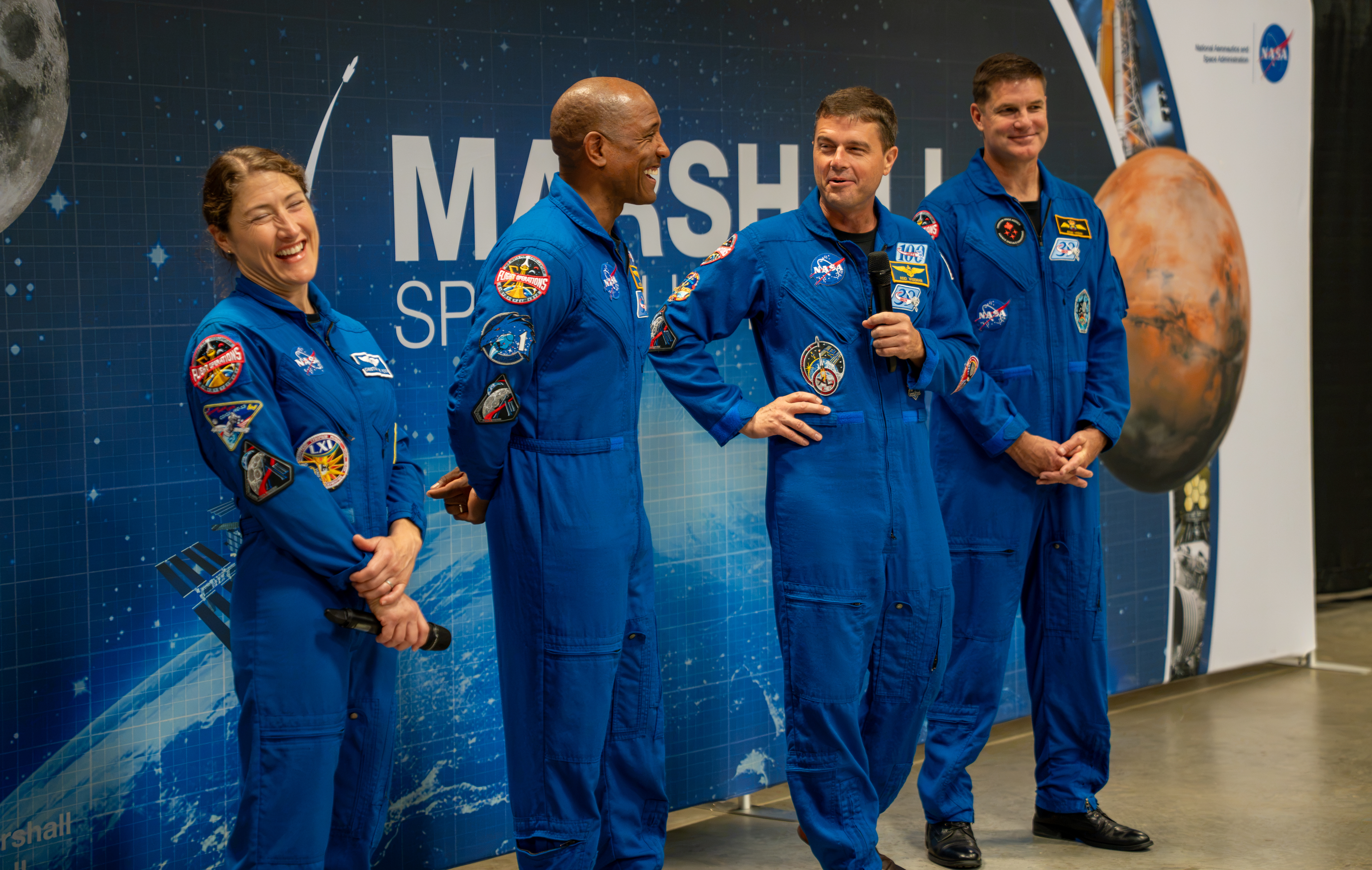
Artemis II Crew at NASA Marshall

9 September 2026 at 16:31
The Artemis II crew smile and laugh. They are wearing blue jumpsuits with patches on them. Christina Koch, left, and Reid Wiseman, second from right, are holding microphones.
NASA/Brandon Hancock

The crew of NASA’s Artemis II mission – NASA astronauts Christina Koch, Victor Glover, and Reid Wiseman and CSA (Canadian Space Agency) astronaut Jeremy Hansen – visited Huntsville, Alabama, Sept. 1, 2026, where they met with the NASA workforce at NASA’s Marshall Space Flight Center. The event gave the crew an opportunity to share firsthand experiences from their mission, reflect on their time in space, and connect with the workforce that supported the mission through an engaging question-and-answer session.

Image credit: NASA/Brandon Hancock

Reino Unido prepara lei para bloquear imagens de nudez nos telefones das crianças

9 September 2026 at 16:22

O Reino Unido quer obrigar as gigantes tecnológicas a impedir que crianças tirem ou partilhem imagens de nudez através dos seus telefones. O governo britânico considera que as medidas propostas por Apple e Google ficam aquém da dimensão do problema.

The post Reino Unido prepara lei para bloquear imagens de nudez nos telefones das crianças appeared first on Tek Notícias.

Earth May Not Be a Cosmic Fluke, New Simulations Suggest

9 September 2026 at 16:03
Exoplanet Ross 128 b Is Not Like EarthSolar system simulations starting from varied initial conditions suggest that Earth-like planets can emerge naturally from planet formation. Computer simulations of planetary systems can now begin from thousands of different starting conditions, allowing researchers to explore how worlds might emerge without assuming the final outcome. Over the past three decades, these models have advanced from [...]

The second man to walk on the Moon later dug out his old expense claim from the trip, and it turns out Buzz Aldrin was reimbursed the grand sum of 33 dollars and 31 cents, not for the rocket or the spacecraft, but for the ordinary travel expenses of getting himself to and from the launch site like any other business trip.

9 September 2026 at 16:00

The Apollo 11 mission cost NASA more than twenty billion dollars in 1969 money, or somewhere north of one hundred and fifty billion dollars in modern terms. It was one of the most expensive single scientific undertakings in human history, involving roughly four hundred thousand people across NASA and its contractor network. Everything about it was unprecedented. The Saturn V rocket had never been flown with a crew on a full lunar trajectory before. The Lunar Module had never been landed on a celestial body. The re-entry profile at the return end of the trip had never been survived. Buzz Aldrin flew on the mission as the second of three crew members and walked on the lunar surface on 20 July 1969. He returned home four days later. And when he got back to Houston he filed a routine federal government travel expense claim like any other public employee returning from a work trip. It was for thirty-three dollars and thirty-one cents.

What the voucher actually itemises

Aldrin posted a photograph of the original voucher on Twitter on 30 July 2015 to mark the forty-sixth anniversary of the moon landing. According to CBS News reporting the following day by science journalist Amanda Schupak, the voucher covers the period from 7 July 1969 through to 27 July 1969, which is a week and a half before the launch through to three days after the splashdown. What follows is probably the strangest business trip itinerary in the history of American federal expense accounting. The listed points of travel are Houston, Texas to Cape Kennedy, Florida on 7 July, then Cape Kennedy to Moon on 16 July, then Moon to Pacific Ocean on 24 July, then Pacific Ocean to Hawaii the same day, and finally Hawaii back to Houston on 27 July. The mode of transport listed for each leg is equally striking. Government Air for the two flights inside the continental United States. Government Spacecraft for the leg between Cape Kennedy and the Moon. USS Hornet, which is the aircraft carrier that recovered the crew, for the leg between the Pacific Ocean and Hawaii. And a US Air Force plane for the return to Houston.

The life of an astronaut is truly fascinating – check out the video we made on what every astronaut sees in the mirror:

The federal expense reimbursement system in 1969 did not distinguish between astronauts and any other government employee. If you were travelling on official business you filled out the same form, listed the same route, claimed the same mileage rate for personal vehicle use, and provided the same receipts for any out-of-pocket costs. Aldrin’s voucher was processed by a routine NASA finance office alongside vouchers from technicians attending conferences and administrators travelling to Washington. Nobody appears to have thought the situation odd enough to route it through any special channel. The reimbursement was paid in the normal course of business a few weeks later.

Why the amount was so small

The reason the total came to only thirty-three dollars and thirty-one cents rather than something more substantial is spelled out on the voucher itself. According to BBC Science Focus Magazine’s August 2015 write-up by Rachel Baxter, the document states in plain text that government meals and quarters were furnished for all the dates in question. That covered his food and lodging at the pre-launch quarantine facility at Cape Kennedy, aboard the Saturn V and the Apollo capsule, on the lunar surface itself, aboard the USS Hornet during the post-splashdown recovery, and inside the mobile quarantine facility where he and Neil Armstrong and Michael Collins were confined for twenty-one days after their return in case they had brought back any unknown lunar pathogens. The federal government had covered every one of those things directly, so Aldrin had nothing to claim against any of them.

What the thirty-three dollars and thirty-one cents actually covered was almost certainly the mileage rate for driving his own personal vehicle from his home in Houston to Ellington Air Force Base and back at each end of the trip. Government employees in 1969 were entitled to claim a per-mile rate when using their own car for official business. Aldrin did what everybody at NASA did. He drove to the airfield, got on the government plane, and came home the same way at the end. He submitted his mileage on the standard form. He got his check for thirty-three dollars and thirty-one cents in the mail a few weeks later.

The voucher was not the only piece of Apollo 11 bureaucratic paperwork Aldrin dug out and shared publicly in 2015. He also posted the US Customs declaration that he and Armstrong and Collins had signed on landing in Honolulu after the recovery. The declaration listed their country of departure as Moon and their flight number as Apollo 11. The cargo section listed moon rock and moon dust samples. The question about whether any crew member had been in contact with an infectious disease during the trip was answered by Aldrin in the space provided as “moon disease TBD.” A Honolulu customs inspector had counter-signed the form and accepted it as filed. The crew had cleared customs.

What the whole set of documents represents is one of the more revealing curiosities of the entire Apollo programme. NASA had achieved something in July 1969 that no human institution had ever previously come close to achieving, and the federal bureaucracy processing the paperwork for the people who had done it treated them exactly like every other federal employee returning from a work trip. That was partly because the routine forms were the only ones available. But it was also because the people at NASA didn’t consider themselves exempt from the ordinary paperwork obligations of federal employment. Aldrin filled out his expense form. He submitted his customs declaration. He collected his thirty-three dollars and thirty-one cents. And forty-six years later he still had the voucher in a drawer.

The post The second man to walk on the Moon later dug out his old expense claim from the trip, and it turns out Buzz Aldrin was reimbursed the grand sum of 33 dollars and 31 cents, not for the rocket or the spacecraft, but for the ordinary travel expenses of getting himself to and from the launch site like any other business trip. appeared first on Space Daily.

US military practices orbital dogfighting in 1st-ever 'live fly' exercise in space

United States Space Command just held its first-ever "Apollo Maneuvers" exercise, which saw spacecraft maneuvering through simulated contested environments.

U.S. Space Command combines assets and personnel from each U.S. military branch (including the U.S. Space Force) to project American military power into and from orbit. It's unclear which or how many satellites or spacecraft took place in Space Command's recent Apollo Maneuvers 2026, but the exercise involved international partners, according to a command statement. What is known is that the exercise aimed to demonstrate "dynamic on-orbit operations, validate contested logistics and advance collective space maneuver doctrine."

To put it in plain English, this means that Space Command practiced maneuvering satellites and other spacecraft in proximity to one another in a simulated conflict environment, in order to continue refining the "orbital dogfighting" that the U.S. military has been hinting at for some years.

In military terms, dogfighting refers to the close aerial combat that fighter jets engage in, pitting two or more pilots against one another in contests of flying ability and firepower.

In terms of space, this involves "objects in space maneuvering in and out and around each other in synchronicity, and in control," according to Space Force's Vice Chief of Space Operations Gen. Michael A. Guetlein.

“That's what we call dogfighting in space," Guetlein told attendees at a conference in 2025, according to Air & Space Forces, while speaking about Chinese satellite operations observed in 2024.

From statements that U.S. Space Command leadership gave about its recent exercise, it sounds like Apollo Maneuvers practiced just that, but in space.

"We will take some of our existing satellites and work with partners to demonstrate what are some of the requirements and capabilities to be able to maneuver for advantage, not just maneuver when you have to change your orbital position," Space Force Gen. Stephen N. Whiting, commander of U.S. Space Command, told reporters last month during a briefing at Redstone Arsenal in Alabama, according to Air & Space Forces.

"The side that can maneuver persistently and at scale will set the operational rhythm in orbit."

a man in a black military dress uniform speaks on a stage in front of an image of earth seen from space

Space Force Gen. Stephen N. Whiting, commander of U.S. Space Command, delivers a keynote address at the Space Foundation's 40th annual Space Symposium in Colorado Springs, Colorado on April 8, 2025. (Image credit: Space Foundation)

When it comes to space and what appears to be the inevitability of a conflict extending to Earth orbit, we're still not quite sure what that will look like. But several nations have been developing capabilities and concepts for maneuvering satellites in close proximity to other satellites with the intent to destroy or disable them, or to deny or degrade their communications or intelligence-gathering capabilities.

The U.S. Space Force, in particular, has been developing an operations framework for fighting a war in space and has held multiple training exercises aimed at practicing "orbital warfare."

But Space Force and U.S. Space Command still appear to lack many of the technologies they say they need to wage such warfare. Speaking at the Space Foundation's Space Symposium in 2025, Whiting stated that that the United States needs "orbital interceptors" to fight in space.

"And what do we call these?" Whiting rhetorically asked attendees. "We call these weapons, and we need them to deter a space conflict and to be successful if we end up in such a fight."

But U.S. Space Force has ordered and executed recent missions that have demonstrated capabilities and technologies along the lines of what Whiting described.

In June 2026, for example, a Rocket Lab Electron rocket sent one of the company's Puma satellites to orbit, where it rendezvoused with a True Anomaly Jackal spacecraft that launched a month earlier. Once both spacecraft were in orbit, they maneuvered close to one another to simulate "dynamic engagements."

The mission showed Space Force's "readiness to lean on our commercial partners to deny, disrupt and counter any adversarial advantage — no matter where they try to operate in space," according to a Space Force statement.

‘Birds Supporting Birds’ connects the Philadelphia Eagles with migrating seabirds

9 September 2026 at 16:00

As the 2026-2027 NFL season kicks off, the Philadelphia Eagles are giving new meaning to their signature “Fly, Eagles, Fly” fight song. The football team is partnering with the National Marine Sanctuary Foundation for Birds Supporting Birds, an initiative to support seabirds off the coast of Massachusetts (and in New England Patriots’ territory) this fall. 

The team is supporting NOAA’s Stellwagen Bank National Marine Sanctuary Shearwater Tagging Project, an ongoing initiative dedicated to studying the great shearwater (Ardenna gravis) and their migration. Great shearwaters are large, white-and-grey seabirds known for their epic journeys. They travel thousands of miles every year from their remote South Atlantic breeding grounds up to the cooler North Atlantic waters during the nonbreeding season. According to the National Marine Sanctuary Foundation, they fly the equivalent of over 200,000 football fields across the Atlantic Ocean every single year.

Birds Supporting Birds will help support researchers in Stellwagen Bank, an 842-square-mile marine sanctuary east of Boston, to tag great shearwaters and track their migratory routes across the Atlantic. 

“The Eagles are directly funding researchers to attach lightweight, solar-powered satellite transmitters to great shearwaters,” Joel R. Johnson, President and CEO of the National Marine Sanctuary Foundation, tells Popular Science. “These tags track the birds’ migration patterns around the Eastern Seaboard and down to the Southern Atlantic Ocean in real time.”

Lovingly known as “The Birds” by their incredibly devoted fanbase, the football team is leveraging their platform to bring attention to ocean conservation and highlight environmental stewardship. 

A major 2015 study found that the Gulf of Maine is warming faster than 99 percent of the ocean due to climate change. While the water has slightly cooled since 2021, a report published by NOAA in July found that the environment in the Gulf of Maine still remains unstable. These changes in ocean temperature, currents, and other conditions can impact the seabirds’ food supply. 

Great shearwaters are reliable indicators of an ecosystem’s health, who rely on small fish called sand lance in their diets. Whales, dolphins, bluefin tuna (Thunnus thynnus), and other key Gulf of Maine species also rely on these fish belonging to the family Ammodytidae in their diets. By studying great shearwaters and their health, researchers can better understand what is happening in the local ecosystem as a whole. 

Researchers at Stellwagen Bank National Marine Sanctuary used satellite tracking technology in 2013. These tags are lightweight and attached to the birds with degradable thread. They have small solar panels so scientists can monitor the birds’ routes over extended periods. 

Researchers have now deployed tags on Phil, Franklin, Hoagie, and Liberty, four great shearwaters with very Philly-appropriate names.

a bird wearing a small tracker on its feathers sits on the ocean
Great shearwaters can help scientists understand an ecosystem’s health. Image: National Marine Sanctuary Foundation.

“We are thrilled to invite the public to follow Phil, Franklin, Hoagie, and Liberty in real time on our interactive maps and social channels, bringing everyone along on our shared mission to protect our ocean waters and marine life,” says Johnson, who lists bald eagles (Haliaeetus leucocephalus), great blue herons (Ardea herodias), and great shearwaters among his favorite birds. 

Live interactive maps will be available soon on the Stellwagen Bank National Marine Sanctuary and National Marine Sanctuary Foundation’s website, so you can follow the great shearwater’s epic journey, while the Eagles (or your favorite team) compete on the gridiron.

The post ‘Birds Supporting Birds’ connects the Philadelphia Eagles with migrating seabirds appeared first on Popular Science.

GOG Brings Back 'Big Box' PC Games, One Printable Template At a Time

By: BeauHD
9 September 2026 at 16:00
An anonymous reader quotes a report from Ars Technica: Those who remember PC gaming in the days before Steam may have fond memories of the "big box" packaging that made those games stand out as shelf eye candy and sought-after in-home collectibles. Today, PC gaming platform GOG is hoping to reignite some of the nostalgia for those days by adding downloadable 3D models and printable, foldable high-res packaging scans for a handful of PC games on the platform. Thus far, the "Printable Big Box" collection on GOG is limited to just five games: Armikrog, Descent, Hitman: Codename 47, Myst, and Star Trek: 25th Anniversary. Players browsing those games on the GOG store will now see "3D Boxes" listed among the included "Goodies" before purchase. Owners of those games on GOG can download a ZIP file containing a version of the box art as an animated 3D object file (in an easy-to-open GLB format) and a "flat printable template" in PDF, SVG, and Adobe Illustrator formats. Those downloads allow for what GOG calls "a proper papercraft project for anyone who misses shelves full of PC game boxes." The physically focused expansion of the existing GOG Preservation Program comes through a partnership with Benjamin Wimmer's Big Box Collection website, which has grown since 2015 to include over 1,000 3D scans from his private collection of physical PC games. In an interview with GOG, Wimmer said that while he appreciates the artistry of a good old-fashioned big box, he also appreciates their evolution into the "interactive cards" on modern digital storefronts that "provid[e] us art, screenshots, gameplay videos and whatnot and that not shown as a box, [it] is just good UX." "Physical media doesn't survive the way software can -- boxes get lost, crushed, thrown out," GOG writes in today's announcement. "Scanning them, and letting you print your own, is preservation in a different shape: the same mission that keeps these games running on modern PCs, applied to the objects they used to come in."

Read more of this story at Slashdot.

❌