It’s common to find things among the sand while strolling along a beach: shells, seaglass, bits of and seaweed. But in Essex, England, a beachgoer found something quite different on the coast of Southend-On-Sea: a World War II explosive.
Southend-On-Sea’s HM Coastguard intervened over the weekend after someone reported a “shell-shaped object” less than half a mile south of a local monument called “The Crowstone.” The team first showed up early in the morning to locate the object and send pictures to the Army Explosive Ordnance Disposal teams.
The Explosive Ordnance Disposal teams decided that disposal officers should remain on the scene, but that everyone should go back at low tide to identify the object and execute a plan. When they returned that evening, Southend Coastguard Rescue Officers accompanied Explosive Ordnance Disposal officers to the suspected explosive.
“It was confirmed to be an old WWII shell that was approximately six inches in diameter,” HM Coastguard Southend On Sea explained in the social media post. “The decision was made to detonate it in situ, where it posed no risk to passing members of [the] public.”
The video in the Facebook post showcases a significant explosion in the distance, shooting a cloud of debris into the air. It’s not the first time this year that the violence of World War II makes itself known again. In the spring, experts safely detonated a 250 kilogram German explosive in Plymouth, UK. But possibly another World War II find in Indonesia had a drastically less fortunate outcome. A suspected shell killed five people when it detonated in a fishing village.
“As these items can be so dangerous, if you ever see something suspicious or out of place on the beach or in the sea, do not touch it, move it or take it home,” the post continued. “Let the experts decide if it is safe.”
Diplodocus is a famous genus of giant sauropod dinosaurs with small heads and long, whip-like tails that lived in the Late Jurassic period (155 to 145 million years ago). Since its discovery in 1878, all confirmed Diplodocus remains have been unearthed from the Morrison Formation fossil hotspot in the western United States. Now, however, paleontologists have identified Diplodocus remains in Spain.
The remains came to light in the El Castellar municipality of the Spanish city of Teruel, and represent the first evidence of Diplodocus beyond the borders of North America. They consist of 14 well-preserved tail vertebrae and several chevron bones (bony arches in the tail). Through traditional anatomical comparisons and advanced phylogenetic analyses, the researchers confidently categorized them as Diplodocus and a close cousin of Diplodocus hallorum.
“As we looked more closely at the anatomy, we began to identify a combination of features characteristic of Diplodocus species. Then, as we carried out different evolutionary analyses, they kept pointing in the same direction,” Sergio Sánchez Fenollosa, lead author of the Journal of Vertebrate Paleontology study and a graduate student in biodiversity and evolutionary biology at the Joint Paleontology Foundation Teruel-Dinópolis research foundation, said in a statement. “With each new result, the picture became clearer: we were looking at a Diplodocus.” Dinópolis is a huge paleontological museum and theme park in Teruel, about 200 miles east of Madrid.
This particular individual dates back to around 150 million years ago. Its place of death indicates that during the Late Jurassic, dinosaurs could migrate from between North America and Europe, probably making use of temporary land bridges that sometimes emerged in the proto-North Atlantic Ocean. During the Jurassic (201.4 to 145 million years ago), the ancient supercontinent Pangea started pulling apart into the Laurasia and Gondwana landmasses, and the Atlantic Ocean also started forming.
Diplodocus are a subgroup of sauropods, which were among the longest land animals to ever walk the Earth. The recent finding sheds light on Iberian Mesozoic (252 to 66 million years ago) ecosystems and sauropod dinosaur diversity in the European Jurassic, Fenollosa explained.
“The Diplodocus from El Castellar was approximately 25 meters long [82 feet] (comparable in size to its North American relatives), making it another of the giant sauropods of the Spanish Jurassic,” said Alberto Cobos, co-author of the study and managing director of the Joint Paleontology Foundation Teruel-Dinópolis. Its remains are now on display at the Aragones Museum of Paleontology at Dinópolis.
There’s nothing better than sinking your teeth into a sweet, creamy chocolate bar. Rats think so, too—and they may announce their chocolate-infused joy to the world at ultrasonic frequencies.
Researchers have previously linked ultrasonic rat vocalizations with different emotional and motivational states in the animals, such as in reaction to rewarding stimuli. For example, the rodents vocalize in this way when eating something sweet.
Now, a team of researchers in Japan have discovered that rats emit a particular ultrasonic vocalization while eating chocolate. Their findings are detailed in a study recently published in the journal eNeuro.
To come to this conclusion, the researchers compared ultrasonic vocalizations that rats emitted when they had access to chocolate, with those they made when they didn’t have access to the candy. The team also compared them with a chocolate-free control group of rats. Researchers then used AI to analyze the vocalizations’ acoustic features, identifying a distinct ultrasonic vocalization—officially 40 kHz inverted-U—strongly associated with chocolate snacking.
“When rats eat something delicious such as chocolate, they emit a distinct ultrasonic call that humans cannot hear,” Koshi Murata, a study co-author and researcher at the University of Fukui, said in a statement. “This call drops sharply when the brain’s opioid ‘pleasure’ system is blocked. This suggests that rats may be vocally expressing the enjoyment of eating, offering a new window into whether animals experience pleasure as we do.”
To see if this distinct vocalization was related to the tastiness of food or just eating in general, Murata and colleagues compared chocolate-eating vocalizations with the sounds the rats produced while eating regular food. And while the rats ate similar amounts of both, they emitted significantly more 40 kHz inverted-U USVs while eating chocolate.
In a separate food-choice test, the rats also demonstrated an obvious preference for chocolate: 15 out of 16 rats picked chocolate over the regular food (and can we blame them?). In two experiments, researchers also found that the vast majority of 40 kHz inverted-U USVs were emitted within one second of a feeding event.
“Our discovery suggests that animal vocalizations could serve as a real-time, non-invasive readout of internal emotional states—specifically, how much an animal is enjoying its food,” said Murata. “Such a tool would allow researchers to measure ‘pleasure’ more directly than current methods permit, and could accelerate research into the brain mechanisms that generate positive emotions.”
Understanding more about how the brain processes rewarding experiences could shed light on behaviors like overeating, as well as conditions like anhedonia, or the inability to feel pleasure and a common symptom of depression.
Staff at St. Louis Zoo in St. Louis, Missouri recently opened up a very special delivery in the mail: an overnight shipment of 500 adult Partula snails.
Their journey began at the Detroit Zoo in Royal Oak, Michigan, and it’s not quite over yet. The small invertebrates’ final destination is Tahiti, where they will be released into the wild as part of an international effort to reestablish wild populations of Partula snails.
“The snails are sent ‘priority overnight’ via either FedEx or UPS. The snails are carefully packed using insulating materials and special ‘phase change’ packs to stabilize the temperature inside,” Mark Vassallo, Curator of Amphibians at the Detroit Zoological Society, tells Popular Science. “Currently the Detroit Zoological Society bred snails are taking a pit-stop at St. Louis Zoo where they will be fed a special diet in order to prepare them for the wild.”
Partula snails are small, tree-dwelling native to islands in French Polynesia. In Polynesian cultural heritage, each unique Partula snail shell represents an island. When humans introduced the predatory rosy wolf snail to the region to manage another invasive snail species, it wrecked Partula snail populations.
A Partula snail is weighed and measured by keeper Tom Maunders, during the annual weigh-in at Whipsnade Zoo in England. Image: Joe Giddens/PA Images via Getty Images.
For decades, the Detroit Zoo has been breeding and raising Partulasnails and helping return them to their native habitat by the thousands in Tahiti. In fact, the 500 en route right now were all bred at the zoo. Each of their shells features an orange dot of animal-safe paint that glows in UV light, which identifies them as one of the snails released in 2026. Each year has a different color, and the dots also allow conservationists to easily monitor them in their natural habitat.
This upcoming release is part of an international recovery program that has returned 11 different Partula species formerly deemed extinct in the wild to their native environments, consisting of over 17,000 individual snails. The Audubon Nature Institute in New Orleans, Louisiana, also recently sent 200 Partula snails to Tahiti.
Orange markings on Partula nodosa snails bred at the Detroit Zoo glow under ultraviolet light. The markings will help researchers identify and monitor the 2026 release group after the snails are returned to the wild in Tahiti. Image: Detroit Zoo.
When asked what “success” looks like, Vassallo explains that, “Success for a conservation project can be defined in stages but ultimately, a self-sustaining population with consistent reproduction and very importantly, proper habitat that is protected to sustain that species to allow long term recovery and stabilization of that population.”
Some species of Partula snails are already extinct in the wild, such as Partula nodosa. In the wake of reintroductions of the species, however, experts were excited to observe offspring born in the wild.
Wild condor parents usually make a great parenting team. But when one female California condor (Gymnogyps californianus) in Pinnacles National Park in Central California found herself in the role of a single mother, park biologists stepped in to help.
The condor mother wasn’t able to provide sufficient care and food for her chick while on her own. Field biologists realized that when hunting for food, she returned to the nest less frequently. The chick needed more nutrition to grow and develop appropriately.
“Based on her behavior, she had largely abandoned the nest, and the chick was unlikely to survive without intervention,” a spokesperson for the San Diego Zoo Wildlife Alliance tells Popular Science.
Pinnacles National Park biologists took the chick when it was around one month old and sent him to the San Diego Zoo Safari Park’s California condor breeding facility. There, he’s receiving care in a specialized puppet-rearing program.
“The puppet-rearing program is a specialized care method used to raise young California condor chicks without allowing them to see or bond with human caretakers,” says the spokesperson. “Wildlife care specialists use hand-crafted puppets that resemble adult California condors and completely cover the caretaker’s hands and arms. Caretakers use the puppet’s beak to deliver food directly to the chick, mimicking the way an adult condor parent would feed its young in the nest.”
The chick was named Cayic (pronounced Chai-eech), meaning “strong” in the Mutsun language of the Indigenous people of California’s Central Coast. Thankfully, Cayic is demonstrating normal growth and development, and experts plan on returning him to the wild next fall.California condors are still considered critically endangered, after nearly going extinct.
As for the chick’s father, he had stopped returning to the nest and eventually died while receiving treatment for suspected lead poisoning. Lead poisoning is the greatest cause of death for California condors and a severe obstacle in the species’ recovery. The species is also threatened by the consumption of microtrash.
California condors, or “thunderbirds” for Native Americans, are North America’s largest flying birds. Their wingspan is almost ten feet long, but their mighty reach didn’t keep them from reaching the brink of extinction. During the 1980s, there were fewer than two dozen of them in the wild. In 1986, the U.S. Fish and Wildlife Service put them all in a captive breeding and release program, including at the San Diego Zoo Safari Park. Six years later, the program had bred enough chicks to return the first condors to the wild.
As of the end of 2025, there are 607 California condors in the world, 392 of which are in the wild. One of them is Cayic’s mom.
“The mother may go on to pair with another male, and we hope she will have another opportunity to breed during a future breeding season,” says the spokesperson.
Like humans, elephants are famously social creatures. But unlike teenage humans, Asian elephants (Elephas maximus) can think before they act.
Scientists in Thailand discovered this after 16 Asian elephants at the country’s National Elephant Institute successfully participated in a detour test. In this sort of challenge, the animal has to resist an obvious but ineffective strategy (an impulse) to get a treat and follow an effective but indirect alternative—an ability called inhibitory control.
“Although we are beginning to understand how intelligent elephants are, we still know very little about their capacity for inhibitory control,” Sydney Hope, a postdoctoral researcher at Hunter College in New York, tells Popular Science. “Understanding elephant inhibitory control will help us understand how this aspect of cognition may have evolved across species, including humans. It will also help us understand how elephants may cope with environmental—including anthropogenic—changes.”
Experiment Setup. (A) An elephant enters the “over” opening to gain access to food in a familiarization trial. (B) An elephant enters the “under” opening to gain access to food (apple) in a test trial. Photos were cropped to remove extraneous background material; the left image was mirrored. Image: Photos by Sangpa Dittakul/Hope et al., 2026, PLOS One, CC-BY 4.0.
In their new study published today in the journal PLOS One, Hope and her colleagues presented Asian elephants with a transparent box filled with fruit. The box also had small holes, so that the elephants could see and smell the goodies inside. The temptation here was to reach directly through the barrier, whose holes were presumably too small for the elephants’ trunk to fit through. The elephants could consistently resist this impulse, and instead used an opening on the side of the box, as they had previously been taught to do.
In a second version of the trial, the researchers rotated the box. Initially, the elephants gave in to the urge to reach for where the opening used to be, but then rapidly amended their behavior. This fix came slower in older elephants. That’s potentially because of cognitive decline with age, though the team says that further research is necessary on this point.
More broadly, the study shows that elephants are able to resist an impulsive, ineffective action (like reaching through a perforated, transparent barrier or continuing a no longer successful approach) in favor of e indirect effective behaviors, even if they must change a previously effective strategy. And they’re in good company—inhibitory control is important for humans’ and other animals’ decision-making and cognitive flexibility. For elephants, it might play a significant role in their famous problem-solving and socializing capabilities, according to the researchers.
“These results may also help conservation efforts,” Hope points out. “One major threat to Asian elephants is human-elephant conflict, often occurring when elephants navigate around barriers (e.g., electric fences) to enter agricultural lands. Understanding how elephants detour around barriers in controlled experiments may help with developing new techniques to mitigate conflict.”
In The Lion King, the hyenas Shenzi, Banzai, and Ed were at the evil lion Scar’s every beck and call. And while the Disney team probably didn’t spend an extensive amount of time observing lions and hyenas interacting in the wild while making the beloved movie, a zoologist and her colleagues just did—and they found something unexpected.
The long-standing assumption about the relationship between the carnivores involves hyenas following lions for their food scraps. However, male African lions (Panthera leo) are the ones going after spotted hyenas (Crocuta crocuta), who move away from the big cats. These new findings are detailed in a study published today in the journal Frontiers in Ethology.
Nancy Barker, an ecologist at the University of KwaZulu-Natal in South Africa and lead author of the study, observed lions actively tracking hyenas while she was studying brown hyenas (Parahyaena brunnea).
“When I shared my observations with other leading researchers, I was often told that I had the relationship backwards: that hyenas are the ones tracking lions, primarily for scavenging opportunities, and that what I had seen was simply a series of chance encounters,” Barker said in a statement “I felt there was more to the story.”
A young spotted hyena at Etosha National Park scopes Barker out. At the time, Barker was setting up a bait station to immobilize and collar the matriarch of the hyena clan. Image: Dr. Nancy Barker.
Barker then put GPS-collars on socially high-ranking African lions and spotted hyenas at Namibia’s Etosha National Park, as well as lions in Linyanti Conservancy in northern Botswana and northeastern Namibia, and Chobe National Park in Botswana.. The study included data from 17 lions and 14 hyenas collected across four years.
The collars mapped the animals’ movement by capturing a location snapshot every five minutes during their peak activity hours, and Barker also maintained camera traps and conducted behavioral observations for context. Barker identified 23 pairs of simultaneously tracked animals from the GPS collar data, including 10 lion-hyena pairs. Her team classified the direction of every paired animal’s movements, consequently revealing and studying thousands of interactions.
“Our GPS collar data shows that African lions and spotted hyenas leave a clear, measurable signature in the way they move around one another,” said Barker. “Spotted hyenas consistently move away from lions, while male lions tend to move toward hyenas.”
Dr. Nancy Barker with an immobilized adult male lion from a pride in the Chobe-Linyanti floodplains. Barker took morphological measurements, identification photographs, and blood, tissue and faecal samples before fitting each collar. Image: Dr. Nancy Barker.
Female lions, on the other hand, weren’t as consistent. Barker’s observations revealed that lionesses’ reactions to hyenas were based on which other pride (a group of lions) members were around, though more data is necessary to bolster this determination.
Because the study includes a limited amount of data, Barker says that some of the findings should be viewed more as trends instead of firm scientific conclusions.
“I would love to extend this approach to other members of the carnivore guild, to understand how the entire community negotiates space and risk,” she said. “Ultimately, I want to connect these movement patterns to what matters most for the animals: their survival and reproduction.”
They’re called cornflakes. These overlooked scraps of papyri (texts written on paper made from the papyrus plant) carry partial snapshots of ancient worlds.
For archeologists, cornflakes deserve care and attention as much as their complete cousins do—and that’s exactly what took place this summer, at the University of Michigan’s (U-M) Papyrus Conservation Summer Seminar. An international group of nine researchers acquired and practiced the latest papyrus preservation techniques on papyrus fragments held at the University of Michigan in Ann Arbor.
Close up of papyrus, Homer, Iliad, Book XVIII. Image: Jeremy Marble, University of Michigan News
“Most of them [the researchers] came to Ann Arbor with zero papyrus experience, but the group ended up conserving more than 150 big and small papyri in just two weeks,” Giuliano Sidro, curator of the U-M papyrology collection, said in a statement.
The university’s papyrology collection is the largest collection of ancient papyri in the Western Hemisphere. texts and documents dating back to sometime around 1000 BCE to 1000 CE, including personal letters, school primers, and sales contracts are all preserved within its walls.
One of the researchers worked on a fragment of a copy of “Against Ctesiphon,” a famous speech from an Athenian orator Aeschines delivered in 330 BCE. Another researcher connected a U-M cornflake to one from his home collection in Milan.
The seminar was led by Marieka Kaye, director of preservation services for physical collections at the U-M Library. According to the team, Kaye and Sidro’s collaboration at U-M is a unique dynamic. Usually, conservators and papyrologists work sequentially and independently, not together. The conservator restores and preserves the papyri, and then the papyrologist studies the pieces. When the two can join forces, it also helps the seminar participants understand the material they’re handling in real time.
“The papyrologist can read the texts and guide the conservator’s hand in placing complex, fragmentary puzzles, while the conservator not only makes papyri accessible and readable but also offers a material perspective that can inform, or even correct, a papyrologist’s assessment of a text,” Sidro explained.
On June 19, the Aquarium of the Pacific took in almost 500 animals in one go. Fish, marine invertebrates, and sharks were all brought into the facility in Long Beach, California, but the aquarium hadn’t just gone on some big marine shopping spree.
These animals were rescued from animal trafficking, and were in urgent need of a home. At the aquarium, the staff worked through the night to stabilize and care for them.
“Every animal that arrives at the Aquarium, whether through a carefully planned acquisition or a last-minute confiscation, receives the same high standard of care. What can differ is the condition in which those animals arrive,” Johnathan Casey, Aquarium of the Pacific curator of fish and invertebrates, tells Popular Science.
Many trafficked animals have been traveling in stressful or poor conditions, so the aquarium’s experts immediately check their physical condition, water quality, and individual needs. They usually know little about an animal’s origin or history, so the team needs to be prepared for anything. The rescued animals are also quarantined to avoid the potential spread of diseases, according to Alyssa Tillman, the assistant curator of fish and invertebrates.
Confiscated animals like this clownfish were kept in holding tanks at the Aquarium of the Pacific on Long Beach, California. Image: Josh Barber/Aquarium of the Pacific. Josh Barber
The species included brownbanded bamboo sharks (Chiloscyllium punctatum), ocellaris clownfish (Amphiprion ocellaris), and Banggai cardinalfish (Pterapogon kauderni). The IUCN Red List classifies brownbanded bamboo sharks as Near Threatened and Banggai cardinalfish as Endangered.
While the arrival of almost 500 animals was a standout event, the Aquarium of the Pacific has received rescued animals from over 30 confiscation events since September 2024. This means they saw one confiscation event every three weeks, though the first eight months of 2026 have already seen over a dozen cases. Overall, the aquarium has taken in over 3,600 rescued trafficked animals in the past two years.
The Aquarium encourages “the public to become informed consumers to help avoid wildlife trafficking of exotic pets. This includes researching the protected status of the species and ensuring purchases are through a reputable vendor,” Casey explains. “If the vendor cannot provide proof of where the animal came from, refraining from purchasing it is a way to help.”
In 2009, tourism operators in Australia spotted more and more humpback whales (Megaptera novaeangliae) “fluking,” when a whale floats upside down, holding its tail above the water. Confused by the behavior, they reached out to scientists for help, triggering a research effort that solved one of the biggest mysteries about humpback whales on the Great Barrier Reef.
The Whitsundays, where the fluking was taking place, is a region with dozens of islands between the Great Barrier Reef and Australia’s north-eastern coast.
“It was an unusual behaviour they had never seen before. Not even the whale scientists knew what it meant at the time,” Crystal Lacey, Master Reef Guides program manager, said in a statement. “So that uncertainty sparked a major research effort, which combined citizen science through the tourism operators’ observations, and scientific research. It was one of the region’s largest citizen science efforts.”
The efforts included tourism operators counting whales and calves, and scientists mapping the seafloor, monitoring water temperatures, tracking whales by satellite, and surveying the region from the air. The joint mission found that the Whitsundays is one of the Great Barrier Reef’s most important humpback whale calving areas. In other words, they’d revealed a previously unknown whale maternity ward.
“The fluking the operators observed was actually a breeding behaviour,” explained Lacey. “We discovered the Whitsundays provides the sheltered, warm and shallow waters humpback whales need to give birth and raise newborn calves.”
Their results also resolved one of the biggest enigmas associated with humpback whales on the Great Barrier Reef—the question of where they give birth. The findings ultimately led to the creation of the Whitsundays Whale Heritage Area within the Great Barrier Reef Marine Park.
Humpback whales are found in all the world’s oceans. They’re a whale-watcher favorite because they can be observed close to shore, and frequently put on a show near the surface of the water. Humpback whales mate while “hugging” face-to-face, and the gestation period of females is 11 to 12 months. When they give birth—once every 2 to three years—the calf comes out tail first.
The New England Aquarium has cause to celebrate. Their cownose ray (Rhinoptera bonasus) Mystic officially turned 27-years-old. The birthday girl’s milestone is even more exceptional in light of the fact that cownose rays in the ocean typically live around 18 to 20 years.
“With excellent care, these animals can live even longer. We aren’t sure what the upper age limit for this species is, but Mystic could be considered one of the oldest individuals in public aquariums,” Rachel Moote, manager of husbandry at the New England Aquarium, tells Popular Science. “Our dedicated veterinary and aquarist staff work to keep Mystic in excellent health. She is monitored regularly by our teams and receives hands-on exams whenever a closer look is required.”
Mystic swimming by her birthday sign. Image: New England Aquarium.
Cownose rays are migratory, open-ocean animals related to other rays. Their unique name comes from their snout, which looks a bit like a cow’s nose, and their wingspan can be up to three feet long. Cownose rays have a venomous spine behind their dorsal fins, but the species is shy. In fact, a majority of ray-caused injuries in humans occur when humans unintentionally step on their spines. They are found along the east coast of the United States, and are classified as Vulnerable by the IUCN Red List.
Mystic has lived at the aquarium for almost two decades. Following a long career in the Giant Ocean Tank, she’s currently taking a “much-deserved retirement,” at the aquarium’s Quincy Animal Care Center. Her care team in Quincy includes aquarists, volunteers, and interns. She is hand-fed a diverse diet of fish, clams, and shellfish similar to what her diet in the wild would be, and also takes vitamin supplements. For her birthday, she received a fish and shrimp cake.
Mystic’s “birthday cake” was fit for a ray. Image: New England Aquarium.
However, her care goes beyond making sure she eats appropriately.
“Our team works hard to ensure Mystic can practice her natural foraging and problem solving abilities. One way we keep her mentally stimulated is by providing her with specially prepared rubber puzzle balls filled with her regular food items,” explains Moote. Every week, aquarists also dive into Mystic’s tank to clean the habitat.
Five pups were recently born at England’s Chester Zoo, far from their homeland. But these bush dogs (Speothos venaticus) are on a mission—they’re part of a conservation breeding program protecting the future of their species.
Bush dogs are medium-sized carnivores from Central and South America, known for their chirpy sounds. The IUCN Red List classifies them as Near Threatened. While that might indicate that they don’t need major conservation efforts as much the way that other wild animals, their last evaluation was only in 2011.
Mark Brayshaw, head of mammals at Chester Zoo, tells Popular Science that a lot has changed in the past 15 years, “with the impacts of climate change, habitat loss and inter-species disease transfer growing more evident,” he explains. “It’s a sad truth that by the time a species is listed as Endangered or Critically Endangered, they will be facing a genetic bottleneck, which heightens the risk of extinction by making the survivors more susceptible to disease and other threats.”
European zoos are now working to make sure that doesn’t happen by caring for a bush dog “insurance population,” which includes the ones at Chester Zoo. Their numbers in the wild are declining, and the breeding program is basically a backup in case the species’ population might need a genetic health boost one day.
The zoo’s new born litter only recently emerged from their den, and have started investigating their habitat with their parents and older siblings. “At this stage, they’re just little furry potatoes,” Chester Zoo carnivore keeper Richard Tyson said in a statement. “They toddle around a bit, but mostly they huddle together in a pile.” They will also start eating solid food soon.
The bush dogs began to emerge from their den earlier this summer. Image: Chester Zoo. Steve Rawlins
When they were first born, the keepers left the bush dog parents Molly and Charlie alone with their new offspring, so they didn’t immediately know exactly how many pups had popped out. An early clue that all was good in the den was the pups’ vocalizations. Bush dog pups emit high-pitched chirping noises that sound a lot like birds.
Bush dogs are “a wonderfully active, engaging species to watch,” says Brayshaw. “Every individual has a different personality. They are loved by the keeper team and by the public, and the new pups are already proving popular with visitors.”
Little do the young chirpers know that they have a higher calling than simply entertainment for less-hairy visitors.
A little less than 2,000 years ago, Mount Vesuvius became the antihero of the ancient world’s most well-known tragedy. The infamous explosion covered Pompeii and Herculaneum in volcanic debris, immortalizing the final moments of the ancient Roman cities and some of their unfortunate inhabitants in stunning detail.
Now, however, visitors can witness the glory of Pompeii before it all came crashing down in 79 CE. A former game engineer from Illinois and his team have developed an application that brings sites at the Archaeological Park of Pompeii to unprecedented life via Immersive Extended Reality technology. In other words, you can now stand in the forum alongside other ancient Romans and watch in horror as Mount Vesuvius starts to rumble along the horizon.
Todd Porter, the former game engineer and now founder of the software company Histoury, went through a different kind of horror to make it happen—walking every inch of the archaeological sites to execute 155 scans under southern Italy’s blazing sun.
An idea ahead of its time
Porter founded Histoury less than three years ago, but the lightning bolt of inspiration originally struck him 15 years ago on a visit to Herculaneum, Porter tells Popular Science. It was while wandering around the archaeological sites that he had the idea of using his video game background to reconstruct his surroundings in a virtual world one could visit with their phones.
Of course, in 2012, smart phones didn’t have enough processing power to support the sort of software required for something like that. “It only took 13 years for phones to catch up to my vision,” Porter jokes.
But that vision could only manifest with the Pompeii archaeological park’s consent. Thankfully, a member of the team—a former hotel front desk employee who, after learning about the team’s project, offered to quit his job and do their business development—wouldn’t take no for an answer. He knocked on Pompeii’s door every day until, possibly out of exhaustion, the park agreed to a demonstration.
Histoury’s digital reconstructions start with two different kinds of scans—a high resolution scan and a spatial scan.
The high resolution scan creates a virtual 3D model of the site with an accuracy range of less than 2 centimeters, and involves walking around the archaeological site with an instrument called a LiDAR scanner.
“That’s just me walking around with a device that looks like a bomb,” Porter says. “It’s shaped like a giant pill with a light whirling around and it makes a noise. You hold it with one hand and you’re looking at your phone with the other.”
Todd Porter, the former game engineer and now founder of the software company Histoury, walked around with this scanner capturing every inch of Pompeii. Image: Histoury, Inc.
The resulting 3D model is then converted into 3D mesh—essentially a kind of digital model compatible with the game development software they use. Histoury’s artists then build the reconstruction directly on top of this 3D mesh, in consultation with a team of archaeologists to make sure everything is as historically accurate as possible.
The other scan—the spatial scan—employs a less powerful instrument called an Xgrid Portalcam, and serves several different purposes. The main one is to secure spatial accuracy. Traditional GPS data is largely inaccurate. Instead, Histoury’s application uses artificial intelligence to determine where the user is standing and which way they are facing within six inches of accuracy. The AI matches the image captured by the smart phone to images of known locations in its data.
The other purpose of the spatial scan is to allow artists to double check their work without having to visit Pompeii in person. “We blend the two [scans] in our tool set so that the artist can walk around and they can switch back and forth between their recreation and the real world just to triple check that everything is lined up,” Porter explains. “AI is really sloppy with a lot of things. Music, art, but the stuff that it’s really good at is the stuff we use it for, which is number crunching.”
In the final step, the team’s lead AI expert has AI agents that “walk” the entire digital reconstruction, looking in every direction. Simply put, these walk-throughs help check how accurate the spatial aspect of the reconstruction is.
“If it’s not accurate at all or less than a certain percentage, it sends the team back to the site for another spatial scan,” Porter explains. “It means we don’t have to send people on site to stand in 5,000 different places to figure out our accuracy,” says Porter. “We can do that virtually.”
The final product is a smart phone or tablet application, Portyl, that shows what Pompeii would have looked like before Mount Vesuvius’ devastating explosion wherever you point your device. The recreation is populated with people, animals, sound effects, and audio explanations. It’s about as close as you can get to strolling through Pompeii before it was demolished.
The reconstructed sites available for virtual tour currently include Pompeii’s amphitheater, large theater, small theater, quadriporticus (a space turned into a gladiator training school), House of the Citharist (a large aristocratic house), forum, and basilica. The team is also working on additional Pompeii locations. Everything is free until September 1, and the app is accessible even for people who aren’t there in person.
The amphitheater of Pompeii is one of the oldest Roman amphitheaters in the world. When you download Histoury, you can see what this massive theater would’ve looked like in its prime. Image: Histoury, Inc.
But for those who are in Pompeii, “you hold your phone or iPad up, we recognize where you’re standing usually within six inches and we know exactly where you’re facing and then we basically spawn the recreation right there,” Porter says enthusiastically.
“Like in the amphitheater, you’re walking around gladiators fighting. There’s 30,000 people in the crowd around you, and you hear the roar, and you hear the clang of the metal. Of all the things I’ve ever done in my life, this is truly one of the most magical things I’ve ever been part of. I think that’s what really gets everybody—it gets you emotionally.”
Histoury is close to signing a contract with Herculaneum and making moves in other countries, including Egypt.
Since Histoury’s Portyl users can trigger the explosion of Mount Vesuvius and then watch it erupt to the sound of screams and the sight of people running for their lives, the question perhaps stands in this case, too.
But they can also simply peer around the basilica or the amphitheater, and there’s something uniquely respectful about paying tribute to Pompeii’s former glory instead of adoring its tragic remains. And more broadly, there’s no denying the fact that a live reconstruction has the potential to make ancient history feel closer than it has ever been before, especially for people who have a hard time imagining the bygone world on their own.
Virgil once wrote, “fugit irreparabile tempus,” meaning “irretrievable time flies.” The ancient poet may have thus been surprised to learn that today, time is indeed retrievable—at least somewhat.
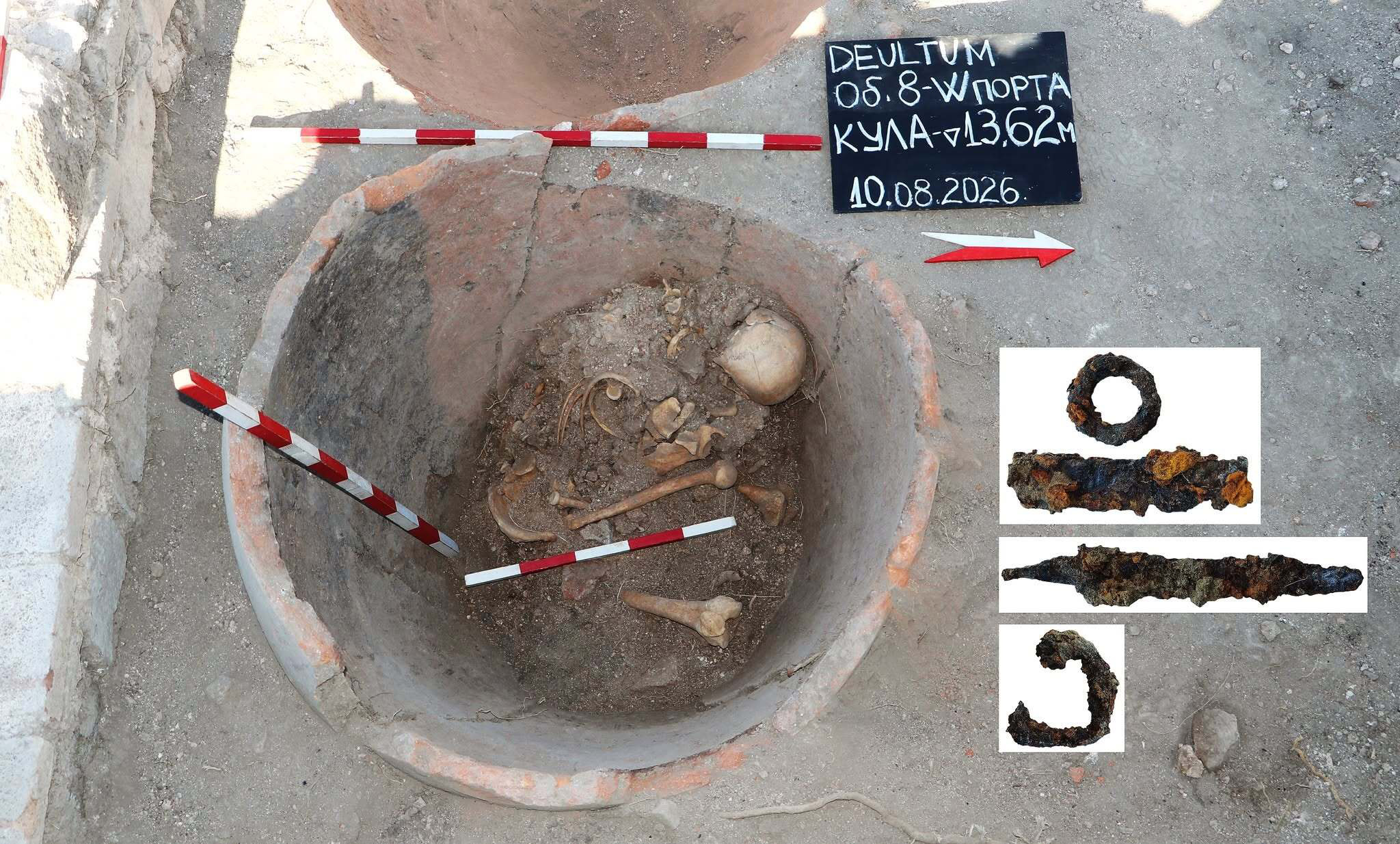
Archaeologists in Bulgaria have discovered a human skeleton inside a giant Roman jar. It's likely that the individual sought shelter in the vessel during an enemy attack over 1,600 years ago but died as a fire swept through the area.
The team unearthed the gigantic jar in a Late Roman turret, or small tower, in the Roman colony of Deultum on Aug. 10. It's unclear which battle led to the individual's death, but Deultum faced many attacks from East Germanic tribes and Huns in the fourth and fifth centuries, lead excavator Lyudmil Vagalinski, an archaeologist at the Bulgarian Academy of Sciences, told Live Science in an email.
The individual's remains were found with two iron knives and a belt inside the container, a type of jar known as a dolium. These huge vessels were the largest type of pottery in antiquity (from roughly the eighth century B.C. to the fifth century A.D.) and were used to store goods such as olive oil and wine. The largest dolia could hold more than 260 gallons (1,000 liters), although the surviving lower part of the newfound dolium was smaller, measuring approximately 3 feet (1 meter) in diameter, Vagalinski said.
Even though Vagalinski and his colleagues had been excavating the turret, which is the northern turret of Deultum's western Roman gate, they weren't expecting to find human remains there, according to Standart News, the Bulgarian outlet that first covered the finding.
"We were surprised," Vagalinski said in an email. It's very rare for archaeologists to discover human remains inside the cities of antiquity except in the case of "extraordinary circumstances" — like earthquakes, enemy attacks or volcanic eruptions, he said. Even in these cases, survivors would search for their dead to bury them beyond the city walls, but they often didn't know that there were dead bodies under the ruins.
The recent discovery seems to represent one of those "extraordinary circumstances," Vagalinski said. The team found a significant amount of burned materials around the dolium, including ashes and coals; broken bricks, tiles and shards; blackened walls; melted glass fragments; and bones from domestic animals. The likely scenario is that, upon hearing of an imminent attack, people brought their livestock into the fortress. The archaeologists also found many bronze coins that were probably lost in the chaos.
The individual, presumably a young man, was likely part of this tumult and climbed into the dolium to hide or seek shelter, Vagalinski said. And while it's unknown how the fire started, the presence of ashes under the skeleton in the dolium indicates that the individual went inside after the fire had already begun, Vagalinski said.
The individual climbed inside the giant vessel with two knives around 1,600 years ago. (Image credit: Archaeologia Bulgarica)
The team's preliminary analysis dates the event to approximately A.D. 400, though they'll have a more precise date after they process the rest of their field data, according to Vagalinski.
The young man was likely hiding from the raging fire in the empty dolium and held an iron knife between his legs to defend himself in case the attackers found him, Vagalinski explained. He had a second knife in his belt.
"In any case, he made no attempt to get out of the ceramic vessel," Vagalinski said. The team determined this based on the individual’s position, similar to that of a sleeping man. "After the attack, the inhabitants of the city leveled the ruins of the tower and covered them with a new, higher floor." They did not know that a fellow citizen was lying at the bottom of the dolium.
The skeletal remains have been moved to Sofia, the capital of Bulgaria, where they will be analyzed by a physical anthropologist, according to Vagalinski. Next summer, the team will head back to Deultum to try to unearth the entire western Late Roman gate, which dates to approximately A.D. 300. The researchers are "eager to reveal its whole plan and proper chronology," Vagalinski said. They also aim to complete the investigation of the gate's northern turret, where they found the dolium.
Earlier this year, the team discovered an older latrina, the Latin word for toilet, dating to between the second and third centuries, near the gate.
From Augustus to Nero, see how much you know about ancient Rome's famous leaders with our Roman emperor quiz!
While building a terrace in their backyard, a homeowner in Denmark discovered the treasure of a lifetime: more than 40 pounds (18.5 kilograms) of thousand-year-old silver buried in the ground. An analysis revealed that the finding is the country's largest Viking Age (793 to 1066) silver hoard known to researchers.
The hoard has approximately 700 silver objects, including silver bars, jewelry, 47 whole coins and coin fragments, and a small Thor's hammer, an object that was often interpreted as a sign of protection and a clue that its owner believed in the Norse pantheon of gods. About 320 of those objects were contained in a clay vessel, while the rest lay in the soil nearby. The treasure is nearly three times larger than the previous largest silver hoard from Denmark's Viking Age, according to a translated statement.
One of the silver bars is engraved with runes, a writing system used by people in Scandinavia during the Viking Age. The inscription might say "hutu," which may represent a person's name or an owner's mark, according to the statement.
The anonymous individual found the roughly 1,100-year-old hoard while building a terrace in the municipality of Rebild this past spring. Unexpectedly, they hit something that emitted a strange sound. "It should have just been a few hours of hard gardening work removing stubborn grass, stones and gravel for a new tiled terrace, but it turned out to be the biggest surprise of my life," they said in the statement.
The coins include two Anglo-Saxon silver pennies minted during the reign of King Edward the Elder (ruled from 899 to 924), according to the statement. This suggests that the hoard dates to sometime in the 10th century.
North Jutland MuseumsNorth Jutland Museums
There are also Islamic coins in the hoard, and together with the Anglo-Saxon coins, they offer evidence that Viking Age Denmark had strong connections with vast regions of Europe as well as with distant eastern regions, according to Torben Sarauw, cultural heritage manager at the North Jutland Museums. There is already ample evidence of the Islamic world's connections with Scandinavians during the Viking Age, including a recent discovery that Viking pennies in a hoard found in Denmark were made from melted Islamic money.
The newfound hoard sheds light on how people in Viking Age Denmark could store, organize and hide their wealth. "When we analyze the weight of the silver objects, the treasure reveals information about the economic practices of the Viking Age," Sarauw said. "The treasure does not only consist of beautiful objects. Most of them are part of a structured value system by weight."
Some of the objects discovered in the person's backyard were inside a clay vessel. (Image credit: North Jutland Museums)
In fact, all the silver bars and some of the bracelets and silver fragments can be organized into specific weight groups. This indicates that the collection represented an important storage of wealth and not a random assortment.
"The treasure so clearly shows how silver functioned as wealth and a means of payment in the Viking Age," Sarauw added in the statement. "It's like finding a safe from the Viking Age."
It's unclear why the hoard was buried. It may have been hidden close to a Viking settlement, along a now-bygone road, or placed in a more remote, secret location, according to the statement. Answering that question would require major archaeological investigations, which are impossible in the developed area where the hoard was discovered.
The hoard is now being submitted for assessment at the National Museum of Denmark.
See how much you know about ancient norsemen with our Viking quiz!
Animals sometimes get stuck in the strangest (and most terrible) of places. From a peanut butter jar to a car’s front grill, wildlife experts have certainly seen it all. But when Cape Wildlife Center in Barnstable, Massachusetts received a call about a raccoon trapped in a drain grate earlier this month, their veterinary staff had their hands full with three other emergencies.
While they couldn’t get to the trapped raccoon right away, other animal lovers were ready to step in. They physically took the raccoon—and the grate it was stuck in—to the Cape Wildlife Center. This team raccoon and drain grate removal effort involved the Bourne Department of Natural Resources, Fire/Rescue & Emergency Services, Police Department, and Department of Public Works.
“In our line of work it sometimes takes a village to do what we do and this young raccoon had so many people fighting to save him today,” Cape Wildlife Center wrote in a social media post. “When they arrived at the hospital we were ready with meds to sedate the poor raccoon. We did not know how long he had been stuck like that and could only imagine how exhausted and scared he was.”
Bourne Department of Natural Resources, Fire/Rescue & Emergency Services, Police Department, and Department of Public Works worked together to save the raccoon. Image: Cape Wildlife Center.
With the trash panda fast asleep, the team used highly sophisticated equipment to pull its head out—canola oil and plastic garbage bags. Thankfully, it took less than 10 minutes. The medical team then carried out a full exam and administered rehydrating fluids and anti-inflammation medications.
Finally, they woke up the unfortunate raccoon. In its misfortune this furry individual was pretty lucky—it doesn’t seem like he sustained any significant injuries, given that he could move his neck and limbs normally. For now, the wildlife center is keeping an eye on him while he stays in an outdoor enclosure.
The raccoon did not have any major injuries. Image: Cape Wildlife Center.
“Wildlife rescues don’t always happen with one person or one team,” the wildlife center wrote. “This one took a whole community working together, and we’re grateful to everyone who helped get this little guy the care he needed.”

 Login