Bio-Techne Corporation, a global provider of life science tools, reagents, and diagnostic products, today announced the launch of new additions to its R&D Systems™ AI-Engineered Designer Protein portfolio, designed to improve reproducibility and performance across advanced cell culture and cell therapy development workflows.
Bio-Techne launches expanded R&D Systems AI-Engineered Designer Protein Portfolio
A study reveals significant disparities in cancer screening rates among sexual and gender minorities, highlighting the need for equitable healthcare access.
Sexual and gender minority populations are less likely to receive cancer screening
The symptoms: The woman started occasionally hearing her name being called when she was alone, usually in quiet surroundings. Later, the sounds evolved into indistinct murmurs. These voices seemed to come from outside her head rather than from her own thoughts. They never spoke directly to her, commented on her actions or gave commands.
What happened next: In the next two years after she began hearing voices, the woman made several trips to emergency departments and had brief psychiatric admissions. Because hearing voices is commonly associated with psychosis — symptoms that occur when people experience a disconnect from reality — doctors diagnosed her with "unspecified psychosis" and attempted various treatments.
They first tried the antipsychotic risperidone, gradually increasing the dose, but the voices did not go away. Doctors then switched the patient to aripiprazole, but the hallucinations remained unchanged. Next, they tried haloperidol, and although the woman said the medication made her feel calmer and less distressed, the voices persisted.
As they conducted further psychiatric evaluations, the doctors noticed that the woman frequently leaned forward during conversations, cupped an ear and asked people to repeat themselves. About four to six months after her first contact with a psychiatric team, she was referred for hearing tests. These tests revealed hearing loss in both ears, ranging from moderate to severe in one ear and mild to profound in the other.
About two months later, the woman was fitted with hearing aids in both ears, which improved her hearing. The voices did not go away, however.
Brain scans showed no abnormalities, and blood tests came back normal. Neurological evaluations turned up no evidence of other explanations. Meanwhile, the woman continued working full time, managing her household and maintaining an active social life. She showed no signs of paranoia, delusions, disorganized thinking or the decline in daily functioning that doctors would typically expect to be associated with a psychotic disorder.
The diagnosis: Based on the woman's stable functioning, hearing impairment and lack of other clinical abnormalities, the doctors concluded that her auditory hallucinations stemmed from sensory deprivation caused by hearing loss.
Reduced sound input from the ears can make auditory regions of the brain unusually active, causing them to "fill in" missing sounds, the doctors explained in a report of the case. A related phenomenon is known as musical hallucinosis, in which people with hearing impairments hear songs, melodies or other forms of music that are not actually playing.
The treatment: Because neither antipsychotic medications nor hearing aids eliminated the patient's hallucinations, doctors shifted their focus toward helping the woman cope with them.
They taught her about the connection between hearing loss and hallucinations and advised her to pursue psychotherapy aimed at reducing the distress associated with the voices and improving her coping strategies for dealing with their persistence. At the time the report was published, in May 2026, she was waiting to begin this therapy.
What makes the case unique: In their report, the doctors noted that most published accounts of this phenomenon have described patients' hallucinations improving or resolving after their hearing impairment was treated. Persistent hallucinations after treatment are rare. In the woman's case, however, the voices persisted despite the use of hearing aids.
The doctors suggest that prolonged hearing loss may cause lasting changes in the brain that do not immediately reverse once hearing improves. (The case report does not note how long the woman's hearing had likely been impaired.)
The case also serves as a reminder that hearing voices does not always indicate psychosis, the doctors concluded. Because the woman's hearing loss was recognized only after years of symptoms and several unsuccessful medication trials, the report authors argued that doctors should consider running hearing assessments early in patients with isolated auditory hallucinations, especially when their insight and daily functioning remain intact.
Research highlights gaps in awareness of Australia's Black Triangle Scheme, suggesting strategies to enhance understanding and reporting of adverse drug events.
Only one in 10 Australians know the Black Triangle safety symbol
A study reveals that non-cardiovascular medications increase hospital readmission risks in heart failure patients, highlighting the need for better management.
Most hospital readmissions after heart failure are not heart-related
A systematic review and meta-analysis of 8 observational studies found that greater obstructive sleep apnea severity was associated with poorer erectile function, with higher AHI linked to lower IIEF scores and higher minimum oxygen saturation linked to higher IIEF scores. The authors caution that the evidence remains observational, heterogeneous, and low certainty, so the findings support targeted screening rather than proving causality.
Sleep apnea and erectile dysfunction share a stronger link than expected
A national NHANES analysis of 9,405 U.S. adults aged 50 and older found that any yogurt, prebiotic, or probiotic consumption was associated with about 50% lower odds of self-reported colorectal cancer. Because the study was cross-sectional, it cannot prove causation but supports further research into microbiota-targeted dietary strategies.
Yogurt, prebiotics, and probiotics link to lower colorectal cancer odds in U.S. adults
Siemens Healthineers now offers U.S. laboratories a comprehensive hematology solution that brings together automation, middleware, and remote digital slide review to help deliver time-sensitive patient results with greater consistency.
New Atellica HEMA 580 Analyzer from Siemens Healthineers helps labs deliver fast, consistent results to improve clinical decision-making
Bio-Rad Laboratories, Inc., a global leader in life science research and clinical diagnostics products, today announced the launch of the QX700 System-compatible Vericheck ddPCR Kit portfolio for critical quality control (QC) workflows in advanced cell and gene therapy development and other biopharma applications.
Early skin-to-skin contact after vaginal birth reduced newborn stress during routine vitamin K injection and improved exclusive breastfeeding rates by day 5. However, it did not significantly lower day-5 bilirubin levels, leaving its effect on neonatal jaundice uncertain.
Early skin-to-skin contact helps calm newborns but does not lower bilirubin
The CEO of Flock Safety made a comment that may have revealed more about America's growing surveillance industry than he intended. In this investigation, Lau...
A team of conservationists has discovered and restored the tombstone of Sebastian, a formerly enslaved man who died free in 1729.
"That discovery is likely one of the oldest gravestones of a free Black person in America," Michelle Wu, the mayor of Boston, said in a July 4 speech. "It's been there all along. We just had to go look and share the story."
The stone marker is inscribed with Sebastian's chosen name, Boston, and features an image common in 17th- and early 18th-century tombstones in New England: the death's head. The symbol includes a stylized skull flanked by wings, which were possibly intended to symbolize spiritual resurrection.
On the tombstone, a simple, five-line inscription reads:
Original Inscription
HERE LYES Ye
BODY OF BOSTON
AGED 70 YEARS
DECD FEBY Ye 28
1728
Modern English
HERE LIES THE BODY OF BOSTON AGED 70 YEARS DECEASED FEBRUARY THE 28 1728
In 18th-century American writing, the word "the" was often abbreviated with a Y-shaped letter form called a "thorn" representing the "th" sound. Tombstones also frequently abbreviated "deceased" and the month. Somewhat confusingly, before 1752, the American colonies regularly used the Julian calendar, as did Britain, in which the new year started on March 25. Boston's year of death is listed on the tombstone as 1728, but his February 28 death was actually in 1729 in our modern Gregorian calendar.
Kelly Thomas, the director of the Historic Burying Grounds Initiative for the Boston Parks and Recreation Department, told WBZ News Radio that she identified the gravestone during a restoration project at the Granary Burying Ground, the city's third-oldest cemetery. Established in 1660, the cemetery includes over 5,000 graves, including the final resting places of Declaration of Independence signers Samuel Adams and John Hancock; the U.S. Revolutionary War officer Paul Revere; and Crispus Attucks, a sailor of mixed African and Indigenous ancestry who is thought to be the first American killed in the Boston Massacre.
"I was reviewing the photos of headstones, and then I noticed that the stone only had one name," rather than a first and last name, Thomas told WBZ News Radio, suggesting that Boston was either enslaved or free when he died. Based on a search of historical records, Thomas determined that Boston's enslaved name was Sebastian and that he also went by Bastian.
A surprising amount of information was recorded about Boston and his wife, Jane Lake. In 1701, they had their daughter, also named Jane, baptized at First Church in Boston, where they regularly attended worship services. But while the two were married with children, they were also both enslaved and lived in different households, historian Gloria Whiting wrote in a 2016 study.
Boston was likely freed in the early 18th century, some time after the 1702 death of John Waite, who had held him in slavery. By 1708, a list of free Black people included the name Boston, and he had gained a reputation in the city as a hardworking handyman, according to Whiting's study. He had been freed for roughly 30 years when he died in 1729 and was well-known enough to have an obituary published for him in the New-England Weekly Journal, a rare occurrence for enslaved or freed Black people in colonial America.
Wu also said that, in recent weeks, archaeologists in Boston had discovered musket balls and gun flints from the infamous Battle of Bunker Hill that took place on June 17, 1775. The battle was fought by British Crown forces and New England troops in the first stage of the American Revolutionary War.
The fragile and battered remains of an infant who lived about 6,000 years in Mesopotamia may be the oldest documented case of child abuse from the Middle East and one of the oldest known cases of its kind in the world, a new study finds.
Researchers unearthed the infant's remains in Syria, but at the time the infant died, sometime between 4200 and 3900 B.C., it was buried in Tell Brak, one of the world's earliest cities. It's possible that the difficulties associated with early urbanization played a role in the child's abuse, the researchers noted.
The team determined that, based on the infant's tooth development, the child was 6 to 9 months old at death. An analysis of the remains, which were interred in a children's burial ground within a Late Copper Age workshop district, revealed that the infant had four fractured ribs near the breastbone. The right thigh bone had abnormal growth, while both sides of the skull bore active, porous lesions. These injuries point to the bones being subject to intense and repetitive external forces, and the nature of the lesions don't fit easily with an accidental fall, the researchers said.
"Ribs shouldn't break" in such a small child, study co-author Aleksandra Grzegorska, a bioarchaeologist at the University of Warsaw, told Live Science. Although rib fractures are relatively common in adults, they suggest child abuse in young infants, she said.
In the study, published May 21 in the International Journal of Osteoarchaeology, Grzegorska and her colleagues systematically ruled out other explanations for the injuries, including rickets, scurvy, birth trauma and violent coughing from illnesses such as tuberculosis. Vitamin deficiencies were unlikely, the researchers noted, given that ancient Mesopotamia had ample sunlight and fresh produce due to the fertile land between the two rivers. Birth-related fractures typically heal within weeks in infants, and bone density and growth measurements for the baby matched those of its peers from that time, indicating that the child didn't have an underlying skeletal condition.
To gauge how unusual the injuries were, the team compared the infant to other children excavated from the same burial area. None of the other youngsters with substantial rib preservation showed similar fractures, making the infant's injuries an outlier in the local population.
It appears that the infant likely experienced "caregiver-induced violence," Grzegorska said. This term is used because the evidence can't identify who caused the harm or confirm intent, Grzegorska said. "We don't want to point fingers at any specific individual," she said, noting that in many ancient cultures, multiple family members, not just parents, helped raise children.
Other clues that might shed light on the infant's injuries are missing from this case, she added. Unlike modern clinicians, bioarchaeologists can't interview a living patient or bystander, or examine soft tissue that might reveal more about the abuse. The partially healed state of the fractures suggest the infant survived for some time after the injuries were inflicted, Grzegorska found — an indication that the trauma was not immediately fatal.
Around the time the infant died, Tell Brak was transforming into a city, so the authors suggested that the stresses of early urbanization and possibly less support from extended kin could have contributed to the violence. Centuries after the infant died, upheavals related to city building appear to have led to mass deaths that were likely caused by violent conflict, Grzegorska noted.
Documented cases of child abuse remain exceptionally rare in the archaeological record, with only a handful previously identified in places such as Egypt, France and Lithuania.
For the first time, a physicist has experimentally watched time emerge from within an isolated quantum system — by creating a “mini-universe.” This bizarre experiment raises an intriguing question: If the universe has nothing outside it, where does time come from?
In a new study published June 11 in the journal Physical Review Research, Giovanni Barontini, an experimental physicist at the University of Birmingham in the U.K., used a cloud of ultracold atoms to build his mini-universe. The system was so well isolated from its surroundings that, like the universe itself, it had nothing external to use as a clock. He split that system in two and ignored one half — what he called the "dark sector" — to show that time could arise entirely from within the system.
The result offers the first experimental look on why the universe has time at all. "When you put everything together, things really start to make sense," Barontini told Live Science. "How time inside the system was speeding up or slowing down, or even stopping — this was quite surprising, how well everything came together. Very neatly, in a way. Which is something that doesn't happen that often in experiments."
The work is an experimental verification of ideas that have been floating around in quantum cosmology and thermodynamics for decades. This is not a bombshell claim that time is an illusion, but it is the first time anyone has put those ideas to a direct, quantitative test in the lab.
A universe with nothing outside
Barontini set out to look at a problem that physicists have puzzled over for nearly 60 years. The Wheeler-DeWitt equation — a central equation in quantum gravity, the field that seeks to unify Einstein’s theory of gravity with quantum mechanics — describes the universe as a whole system with no external time parameter. There is no cosmic clock ticking away outside the universe. So where does our experience of time come from?
One influential idea, called relational time, says that time doesn't exist as a fundamental ingredient of reality. Instead, it emerges from relationships inside the universe, with one part of the system acting as a clock for another. But this idea had never been tested directly in the lab.
Barontini's inspiration came from watching his son play with building toys. "I thought that it's something very similar to what we do in our labs," he told Live Science. "We play with very expensive toys. We create our own small samples of reality."
In his lab, that sample is a Bose-Einstein condensate — a state of matter that forms only at near absolute zero. In a Bose-Einstein condensate, thousands of atoms slow to a near standstill and blur together into a single quantum object, behaving as one.
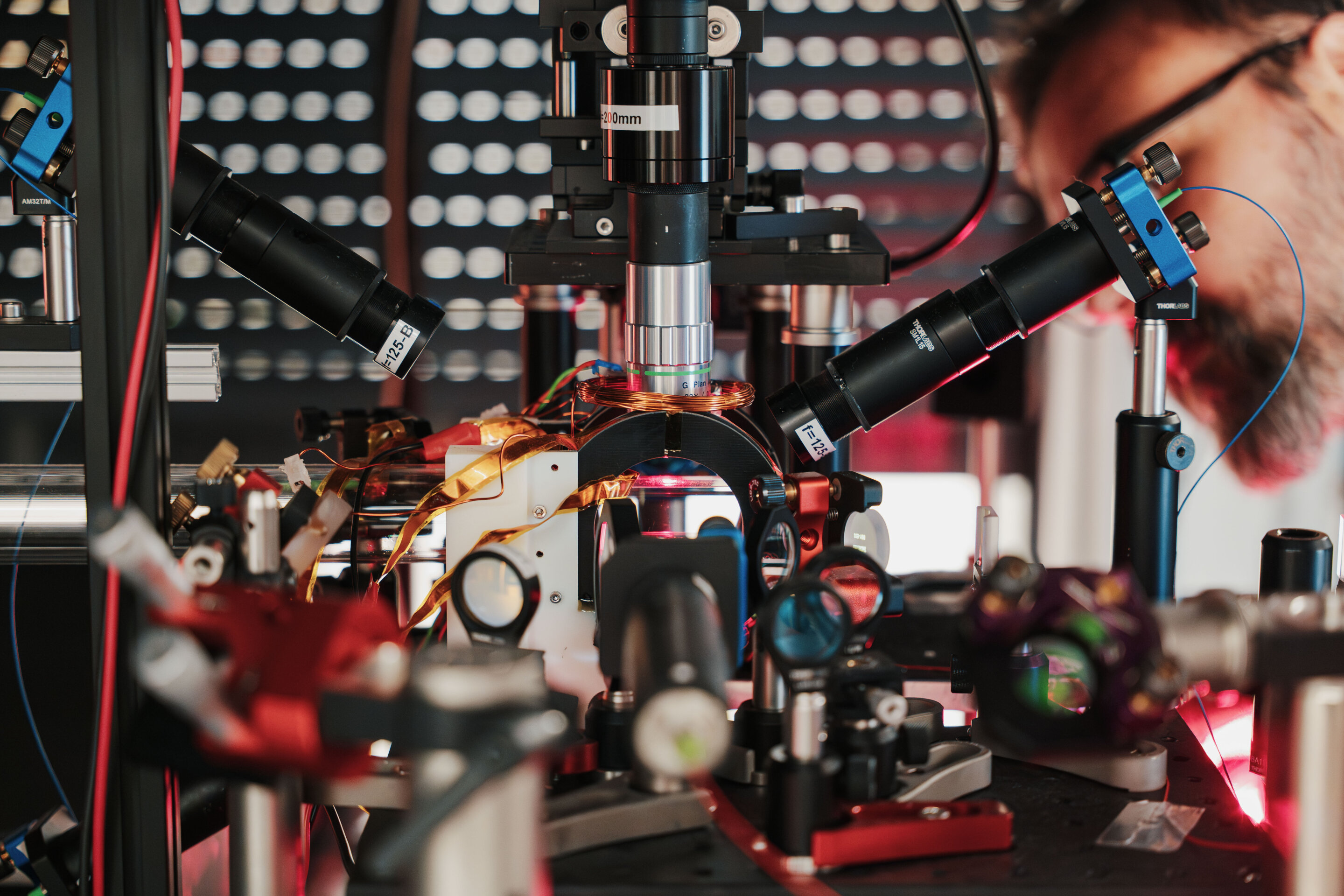
The University of Birmingham experiment to trap and cool rubidium atoms close to absolute zero — the first step in assembling the mini-universe. (Image credit: University of Birmingham)
The dark side of time
To mimic a universe with nothing outside it, Barontini placed the condensate in a trap and divided it down the middle with a thin sheet of laser light. He watched one half, the "bright sector," closely and deliberately ignored the other half, which he called the "dark sector."
The atoms in the bright sector sloshed back and forth in the trap, periodically spilling over the barrier and back again. Barontini called the moments when atoms flooded into the bright sector the "Big Bang" and the times when they drained out the "Big Crunch" (the nickname for one theory of how the universe will end, with the universe collapsing in on itself). Then, he tracked how entropy — a measure of disorder, or how spread out energy is within a system — was exchanged between the two halves as atoms crossed the barrier.
Instead of using laboratory time to order events, he built an "entropic time" — a clock defined entirely by how much entropy was flowing between the two halves of the system. If entropy was flowing, time was ticking. If no entropy was exchanged, time stopped. "The entropy exchange between the two systems could be transformed into an internal time variable," Barontini said.
Time speeds up, slows down and stops
What surprised Barontini most was how cleanly everything fit together. The internal, entropic time reliably ordered events in the bright sector. It matched the sequence seen in laboratory time, but it flowed at a different rate.
When entropy was flooding between the sectors, entropic time ran fast. When the exchange slowed, so did the clock. And when the two halves reached equilibrium (no more entropy flowing), the internal clock stopped altogether.
Both time and the arrow of time — maybe they just are born from ignorance.
Giovanni Barontini, experimental physicist at the University of Birmingham
"Time was speeding up or slowing down, or even stopping, depending on what the system was doing," Barontini said.
He then went a step further: Using this internal time, he derived a version of the Schrödinger equation and showed it accurately reproduced what he saw in the experiment. "This was quite surprising, how well everything came together," he said — "very neatly, in a way, which is something that doesn't happen that often in experiments."
Both time itself and the arrow of time — why time flows in one direction rather than the other — may arise from the same source: an observer giving up information. When Barontini chose not to look at the dark sector, he gave up knowledge of that half of the system. That act of ignorance, encoded in entropy, is what gave rise to time in the other half.
"Both time and the arrow of time — maybe they just are born from ignorance," Barontini said. "To have time and to observe, you have to give up some degrees of freedom."
Barontini sees this as just the beginning. The same cold-atom tool kit that generated a miniature Big Bang and Big Crunch in his trap could, in principle, be engineered to simulate far more exotic phenomena, such as black hole analogues, the conditions of the early universe, and what will happen at the moment of the Big Crunch itself.
"These are things we can do very simply, using the tools we already have to engineer our systems," he said.
The study is a proof of concept — a first demonstration that controlled quantum systems can serve as a test bed for some unanswered questions in physics. For now, those questions remain open.
Archaeologists in Italy have unearthed the royal tomb of a pre-Roman "warrior-prince" along with the remains of his chariot and weapons. The tomb was just one part of an extensive sixth-century B.C. burial ground and reveals new information about the funerals of elite rulers from this mysterious civilization.
The funerary complex was found in the municipality of Sirolo, a small town on the Adriatic Sea on Italy's east coast, according to a translated July 1 statement from the Superintendency of Archaeology, Fine Arts and Landscape for the Provinces of Ancona, Pesaro and Urbino.
In the sixth century B.C., an Italic group called the Piceni or Picentes lived in the area, bordered to the north by the Etruscans. The Piceni left few written records, so much of what is known about the enigmatic group comes from archaeological excavations. In 2020, a "princely tomb" complete with an iron-wheeled chariot, a cache of weapons and a helmet was discovered in the Pini cemetery. Now, archaeologists have found a second one.
At the center of a monumental circular palisade, researchers unearthed a large male burial with a wooden "currus" — a two-wheeled chariot that had been buried intact with the nobleman around 2,500 years ago. The warrior prince was also buried with a helmet and an ax, as well as several bronze vessels sealed with ceramic lids and filled with organic remains, which may represent the traces of a funeral banquet or food offerings for the afterlife.
Fragments of the two-wheeled chariot during excavation. (Image credit: Superintendency of Archaeology, Fine Arts and Landscape for the Provinces of Ancona, Pesaro and Urbino)
Next to the warrior prince was the tomb of a woman who was buried with textiles, shoes and numerous "fibulae" — ancient metal safety pins that likely fastened her clothing and burial shroud. An enormous fibula with a hunk of amber had been placed on or near her head, possibly as part of her hairstyle or a headdress. This burial is not far from the "Queen's Tomb" in the Pini necropolis, where, in 1989, archaeologists discovered a Piceni woman buried with two chariots, two mules and a large quantity of personal belongings.
While royal burials had been discovered in the Sirolo area for decades, the newly discovered cemetery surprised archaeologists because of its unprecedented shape. Previously discovered burial grounds in the territory of the Piceni were ringed with a ditch, symbolizing the separation of the dead from the living. But the newly discovered cemetery was ringed with a wooden palisade instead of a ditch, and it had been placed on a slight hill, possibly to emphasize its monumental character and symbolic value, according to the statement.
This is the the first time that archaeologists have observed "an entire aristocratic nucleus" of the Piceni, and the discovery can provide "new perspectives on the structure of the elites that led to the great Piceni center," archaeologist Stefano Finocchi, the director of the new excavation, said in the statement.
Although many of the artifacts are still being analyzed, the quantity and quality of the grave goods already recovered reveal that the "ruling groups integrated into a dense network of relationships connecting the central Adriatic with the principal centers of central Italy," Finocchi said.
From Augustus to Nero, see how much you know about ancient Rome's famous leaders with our Roman emperor quiz!
The European Space Agency's (ESA) Euclid space telescope has spotted 31 previously unknown quasars dating to the universe's earliest chapter, including the two oldest ever found.
The discoveries, described July 6 in the journal Astronomy & Astrophysics, more than double the number of known quasars from that primordial era and could help astronomers unravel one of cosmology's biggest mysteries: how supermassive black holes grew so enormous so quickly after the Big Bang.
"It's a big step towards understanding these fascinating objects on a more fundamental level," Antonio La Marca, an ESA research fellow on the Euclid team, said in a statement.
Quasars are among the brightest objects in the universe. They form when gas and dust spiral into a galaxy's central supermassive black hole, heating up and releasing enormous amounts of energy that can outshine the galaxy itself. Each of the two most ancient quasars detected in the new study shone with the light of a trillion suns, according to the researchers.
Euclid spotted the quasars while surveying the distant universe. Twelve of them have redshifts of 7 or higher, meaning their light has traveled for more than 13 billion years and dates to the universe's first 770 million years. Two of the objects, with redshifts of 7.77 and 7.69, are the most ancient quasars ever identified, shining just 670 million years after the Big Bang, when the universe was only about 5% of its current age.
"These early quasars date back to the Universe's infancy," Daming Yang, an astronomer at Leiden University in the Netherlands and first author of the new study, said in the statement. "By finding and studying them, we can better understand how these enormous systems formed and grew so quickly — one of the greatest mysteries in astrophysics."
Finding quasars from the early universe has long been difficult because they are rare and incredibly distant. Until now, astronomers had identified only the brightest examples, making it difficult to understand the broader population during this early era. Euclid's wide-field survey is changing that by detecting fainter quasars across huge swaths of the sky.
The latest discoveries represent only a fraction of what the telescope is expected to find during its six-year mission, which will cover more than one-third of the total sky once complete. Mounted with a pair of instruments that see in visible and near-infrared light, Euclid is currently assembling the largest-ever 3D map of the universe. Scientists expect the survey to uncover hundreds of similarly ancient quasars, providing an unprecedented look at how the universe's earliest galaxies and supermassive black holes evolved.
Euclid has also taken some time to study the nearby universe, revealing more than 60 million individual stars packed into the Milky Way's center in a sparkling image released in late June.
Japan’s Hayabusa 2 mission has revealed another "snowman" asteroid — a pair of asteroids attached with a narrow neck. The contact binary could help shed light on planet formation.

 Login