 Login
How to Stop a Killer Asteroid From Ending Civilization
8 June 2026 at 21:26
 From high-speed battering rams to gravity tractors, the technology exists to protect the planet. The question is whether humanity will act in time — and in concert.
 From high-speed battering rams to gravity tractors, the technology exists to protect the planet. The question is whether humanity will act in time — and in concert.By recreating a nuclear fireball, scientists uncovered unexpected chemistry that could change how radioactive fallout is understood. In the first fraction of a second after a nuclear explosion or a major reactor accident, an immense surge of energy superheats the surrounding environment. Nearby materials and air are instantly vaporized, creating a rapidly expanding fireball made [...]Long before modern cities built upward, Rome learned how to stack human lives.
NASA's Artemis II crew are the fastest people alive, and now they have the patch to prove it.
Mission Commander Reid Wiseman, pilot Victor Glover, and mission specialists Christina Koch and Jeremy Hansen (the latter with the Canadian Space Agency) spent 10 days in early April flying by the Moon. Their journey took them farther away from Earth than any humans have gone (52,756 miles [406,771 km]) and then, on the way back on board their Orion spacecraft Integrity, they sped up to about 24,664 miles per hour (39,693 k/ph) reentering the atmosphere.
Only three other people in history have traveled faster. NASA's Apollo 10 astronauts Thomas Stafford, John Young, and Eugene Cernan set the record for the highest speed attained by a crewed vehicle relative to the Earth's surface: 24,791 mph (39,897 kph) on May 26, 1969.
© Reid Wiseman/A-B Emblem/collectSPACE
A comprehensive investigation by battery researcher Ziroth, involving over 20 independent battery experts, has produced what amounts to definitive proof that Donut Lab’s “miracle” solid-state battery is actually a lithium-ion cell. The company raised approximately $25 million from over 1,300 mostly small investors based on claims that now appear to be false.
The investigation traces the battery technology back to a German company called CT Coatings, reveals a web of companies hiding behind aggressive NDAs, and presents electrochemical evidence — including voltage curves and cell expansion data — that conclusively identifies the tested cell as lithium-ion, not the revolutionary sodium-ion solid-state chemistry Donut Lab promised.
Find files, images, and graphics to use at your own Roman Space Telescope Community Events.

Registration is open for media to cover the arrival of NASA’s Nancy Grace Roman Space Telescope at the agency’s Kennedy…
Science Events
Past Events
The Nancy Grace Roman Space Telescope will settle essential questions in the areas of dark energy, exoplanets, and astrophysics.
The post Roman Community Events Files appeared first on NASA Science.
Amazon no longer faces a July 30 cutoff for deploying half its planned 3,232 broadband satellites, but the reprieve comes with a temporary loss of spectrum priority that could give SpaceX and other rivals more leverage in orbit.
The post FCC lets Amazon Leo miss deployment deadline with temporary spectrum penalty appeared first on SpaceNews.
Rocket launches this week According to tracking from Next SpaceFlight, Chinese aerospace firm Landspace’s ZhuQue-2E Block 2 is scheduled to lift off from the Jiuquan Satellite Launch Center in China at 4:20 a.m. EST on Tuesday, June 9. The ZhuQue-2E is a medium-lift rocket powered by liquid oxygen and methane — the first methane-fueled vehicleContinue reading "SpaceX and Rocket Lab set for liftoff this week"
The post SpaceX and Rocket Lab set for liftoff this week appeared first on Astronomy Magazine.
A viral video racking up hundreds of thousands of views shows a BYD electric sedan performing a tank turn in an impossibly narrow space between barriers.
It’s a striking demonstration of what independent electric motors and smart torque vectoring can do in the real world — and a feature that US automakers have only promised.

China is expanding its nuclear weapon arsenal faster than any other country, according to a report by a Swedish think tank. The Stockholm International Peace Research Institute’s (SIPRI) latest yearbook states that Beijing now has around 620 nuclear warheads.
In what could be a major cause of concern for the US and its allies, the report goes on to state that it is continuing to develop new nuclear systems. It states that China could “potentially have at least as many ICBMs as either Russia or the USA by the turn of the decade.”
Beijing displayed some of the new missile systems during its 2025 military parade.
The SIPRI report says that by January 2026, “China had loaded hundreds of missiles into three large missile silo fields in the north of the country, while working to complete 30 silos in three mountainous areas in the east.”
Moreover, the country now has 34 deployed warheads, up from 24 in 2025. The number of stored warheads has also risen from 576 in 2025 to 586 in 2026, leading to an overall number of 620 nuclear warheads in the stockpile.
It is important to note that the US and Russia still have the highest number of nuclear warheads in their stockpile. While the US has 3,700 warheads, Russia has an estimated 4,400 nuclear warheads in its military stockpile.
Even if China surpasses 1000 warheads by 2030, that will still amount to only about one quarter of each of the current Russian and US nuclear stockpiles, according to the report. However, China has shown the highest percentage growth in the production of these tools of destruction, and recent trends indicate it is not looking to stop.
The global inventory stands at an estimated 12,187 warheads – and of this, around 9,745 are in military stockpiles for use in case of a conflict. Of the total warheads in military stockpiles, roughly 4,012 are deployed with missiles and aircraft, while the rest are in storage.
There haven’t been many additions to the stockpiles of other nuclear-armed nations, such as the United Kingdom, France, and Pakistan, since 2025. India seems to have added 10 warheads, 12 of which are deployed, bringing its total count to 190.
The report goes on to add that the growth of nuclear programs will very likely be pursued by all countries in the years to come in the post-New START world. It highlights that there is a lack of strategic dialogue or direct communication among certain nuclear-armed states.
SIPRI Director Karim Haggag states that world leaders advocating nuclear weapons as a guarantee against attack by a hostile state could ‘significantly increase nuclear risks.’
“The dangers associated with nuclear weapons are growing due to advances in weapon technology, the breakdown of nuclear arms control and heightened geopolitical tensions, among a range of other factors,” Haggag said.
“Along with the reduction in transparency and the loss of diplomatic channels for crisis management, the drift towards authoritarianism in some nuclear-armed states is contributing to even greater unpredictability,” said Matt Korda, Associate Senior Researcher with SIPRI’s Weapons of Mass Destruction Program and Associate Director for the Nuclear Information Project at FAS.
The report also predicts that for the first time since the end of the Cold War, the pace of gradual dismantlement of retired nuclear warheads by Russia and the USA could slow down, leading to a situation in which the global inventory keeps rising.
There hasn’t been a significant increase in the inventories of Russia and the USA, but the modernization programs being pursued by both countries lead SIPRI to believe that they will likely “increase the size and diversity of their arsenals in the future.”
A little more than five years ago, a shiny white Falcon 9 rocket made its debut flight, boosting a Cargo Dragon spacecraft to the International Space Station. Over the next year, it would launch a pair of astronaut missions and a handful of commercial spacecraft.
But since then, this first stage booster, designated B 1067, has mostly flown Starlink missions. It has launched them one after another, always returning safely to a drone ship before undergoing refurbishment and flying again. Sometimes it has flown twice in a single month.
On Monday morning, B 1067 once again took to the skies, launching 29 Starlink Internet satellites into low-Earth orbit from Florida. Upon landing on the A Shortfall of Gravitas drone ship in the Atlantic Ocean, the vehicle completed its 35th mission overall, retaining its title as fleet leader for SpaceX.
© SpaceX
Editor’s Note: Astrobites is a graduate-student-run organization that digests astrophysical literature for undergraduate students. As part of the partnership between the AAS and astrobites, we occasionally repost astrobites content here at AAS Nova. We hope you enjoy this post from astrobites; the original can be viewed at astrobites.org.
Title: Dynamics of Planetary Rings Under Thermal Forces
Authors: Wen-Han Zhou et al.
First Author’s Institution: The University of Tokyo
Status: Published in ApJL
If you ask anyone what their favourite planet is, the answer you’ll most likely hear is Saturn. Why? Why else than the beautiful and intricate ring system surrounding the gas giant. The other gas and ice giants in our solar system — Jupiter, Uranus, and Neptune — have ring systems themselves but none quite as striking as Saturn’s. Would it surprise you to learn that astronomers’ best models have not yet totally explained why Saturn’s rings look the way they do?
In contrast, it may not surprise you to hear that people have been trying to explain the rings for as long as we have seen them with telescopes. We now know that planetary rings are collections of relatively small particles (think micrometre up to metre sized), most likely having once been the material of a larger body that was disrupted either by collisions or tidal forces. This material, due to the gravity of its local planet, is sculpted into a flat disc where more subtle interactions then lead to substructure forming within the disc such as gaps and ringlets. Many of these substructures are explained by well-understood physics — for example gaps being carved by embedded moonlets or resonances sculpting ring edges — though there remain some outstanding problems in our understanding.
The authors of today’s article set their sights on the problematic inner edge of Saturn’s A ring (Figure 1). They describe some mechanisms — namely the collisions of micrometeoroids within the rings — by which a sharp ring edge can be maintained, but there exists a gap in the understanding of how such an edge can form in the first place. All hope is not lost, though, as today’s authors reintroduce a physical process they call the “eclipse–Yarkovsky” effect, which seems to explain these phenomena.

Figure 1: A horizontally sliced image of Saturn’s rings shows the rich substructure and gaps within the various rings. Saturn, which is not shown here, would be to the left of the image. The authors of today’s article are particularly concerned with the bright and sharp inner (left side) edges of the A and B rings. Click to enlarge. [NASA/JPL/Space Science Institute]
The idea behind this process revolves entirely around light. When sunlight hits a particle within a planetary ring, non-absorbed sunlight imparts a little “bump” onto a particle, ever so slightly altering its trajectory. At the same time, some of the sunlight is absorbed into the particle, which heats it up; light is soon re-emitted via thermal radiation, which, again, can slightly change the trajectory of these tiny particles. From a point on the surface of each ring particle (see rightmost side of Figure 2), the photons from this thermal radiation are all emitted in random directions; however, across the whole surface of the particle there is a net force! These tiny particles are spinning, and so the side just near “sunset” is hottest and emitting the most thermal photons. In this way, the pressure from the sunlight plus the thermal radiation of each particle imparts a net torque on the ring itself which changes the angular momentum of the ring.
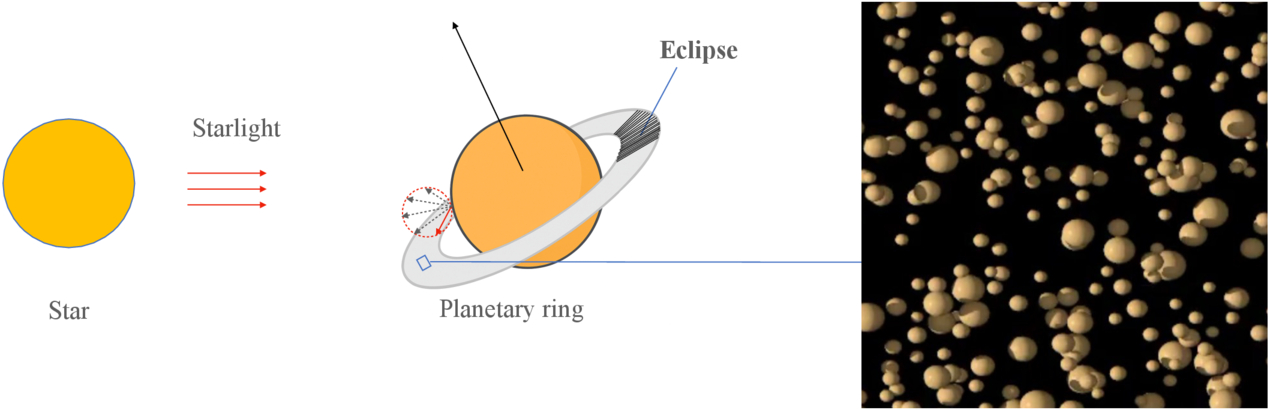
Figure 2: Starlight is the main source of light onto the particles that make up a planetary ring (right panel) though reflected light from the planet’s surface hits it too. This light “heats up” the ring and forms an asymmetry as the ring is eclipsed by the planet, which produces a net force. [Zhou et al. 2026]
After today’s authors detailed all of the math involved in this process (and there is a lot), they put it into practice to try to help explain Saturn’s curious rings. Including the eclipse–Yarkovsky effect together with other known effects that drive ring evolution allowed them to reproduce the optical depth profile (how thick the ring looks) of Saturn’s A ring better than ever before (notably the sharp inner edge in Figure 3). On top of this, the effect provides another avenue for moonlet formation in the outer edges of ring systems as the positive torque from the effect drives material out toward and away from the Roche limit.
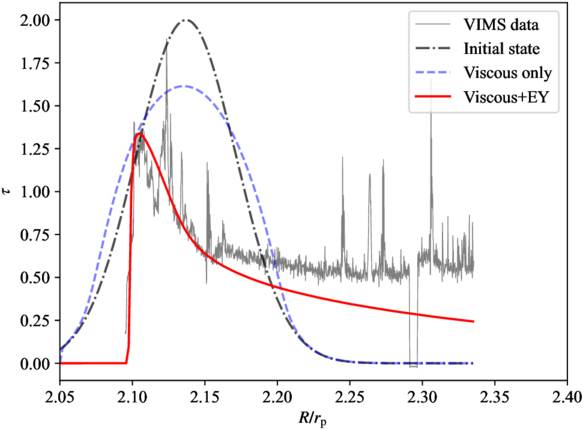
Figure 3: The authors try to explain the current structure of Saturn’s A ring by initialising it with a Gaussian profile of optical thickness versus radius (black dot-dashed line) and evolving it for 81 million years under different effects. When viscous effects are included (blue dashed line), the ring spreads out, but it’s only when the eclipse–Yarkovsky (EY) effect is included (red line) that the model closely matches the observed data (grey line). [Zhou et al. 2026]
Original astrobite edited by Wasi Naqvi.
About the author, Ryan White:
I am a first-year PhD student at Macquarie University in Australia, working mainly on binary/multiple systems with massive stars (Wolf–Rayets in particular!). Outside of study, I’m probably drinking coffee, baking, reading, or going for a run. You can also find me procrastinating on Bluesky @astroryan.bsky.social.
The post Shining a Light on the Shadowy Movements in Saturn’s Rings appeared first on AAS Nova.
Humans have always been wired for technology and AI may be the latest proof


