❌

Normal view

How to see the Orionid meteor shower 2026 peak this week β€” and when to look

16 October 2026 at 19:00

If you love watching meteors, 2026 has given you plenty to enjoy. This summer, the annual Perseid meteor shower peaked on the day of a new moon β€” and a solar eclipse β€” so moonlight stayed out of the way. And there's more to look forward to: in December, the Geminids, the year's most prolific shower, will peak after a waxing crescent moon sets early in the evening, opening the door to excellent viewing.

Right between those two headline showers, the dependable Orionids take their turn, reaching peak activity around Oct. 21-22.

So, when and where can you catch the show?

When and where to watch

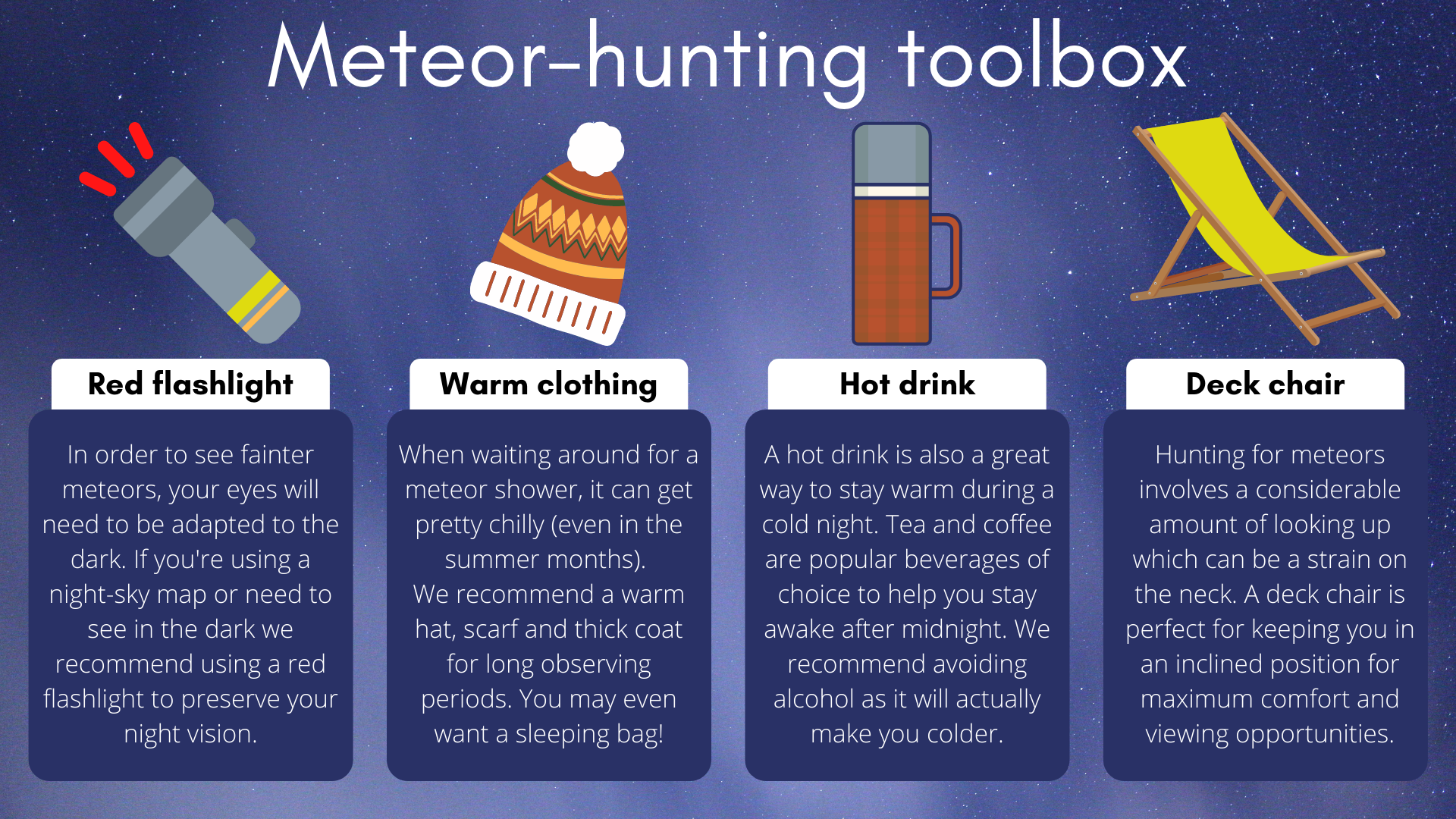
Infographic with a red flashlight, woolly hat, flask and a deck chair.

Make sure you wrap up warm for a night of Orionid hunting. (Image credit: Created in Canva by Daisy Dobrijevic)

The Orionids take their name from the spot where they seem to fan out: Orion's raised club, just above and to the left of the reddish star Betelgeuse. Orion is usually a winter favorite, so in early autumn the mighty hunter doesn't fully clear the eastern horizon until after 11 p.m. local daylight time. Don't rush outside just yet though. Wait until around 2 a.m., when Orion is well above the horizon. By about 5 a.m., just before dawn, Orion reaches its highest point in the southern sky β€” and the view should be at its best.

Orionid meteors tend to be faint, so city lights can easily wash them out. If you can, head to a safe, dark rural spot. Get comfortable in a reclining lawn chair or sleeping bag, give your eyes time to adjust, and enjoy the view overhead and toward the southern sky.

Why the moon won't spoil the show

And what about the moon? A full moon arrives October 25-26, but there's still a welcome stretch of dark sky for several mornings before Wednesday.

By Oct. 21-22, the waxing gibbous moon will be resting among the dim stars of Capricornus, reaching its highest point around 8:45 p.m. local daylight time. Here's the good news: it will set shortly after 2 a.m., leaving roughly 3Β½ hours of dark sky before dawn. In that window, one observer may spot as many as 15 to 20 Orionids per hour. Because those hours line up with the shower's peak, the moon shouldn't steal the show this year.

Halley's Comet: the source of the Orionids

So, where do the Orionids come from? Their story begins with Halley's Cometβ€”the same famous visitor behind May's Eta Aquarids.

Meteoroids are tiny leftovers from a comet's nucleus. As a comet nears the sun, frozen material on its surface turns directly into gas, a process known as sublimation. The comet becomes a kind of cosmic litterbug, sprinkling dust and debris along its orbit. Those pieces are tiny and brittle, with the consistency of cigar ash, and every swing past the sun leaves more behind.

Comets are among the solar system's oldest and most fascinating objects. They formed alongside the sun and planets about 4.6 billion years ago, yet they have changed remarkably little. Think of them as time capsules from the solar system's childhood. Far beyond the outer planets, they spend most of their time in a deep freeze, where temperatures hover just above absolute zero, -459.67Β°F (-273.15Β°C). In that extreme cold, chemical reactions largely stop, helping comets preserve material from those earliest days.

Over the past 100,000 years, Halley's Comet has probably circled the sun well over a thousand times, leaving a fresh trail of debris on every visit. Each October and May, Earth brushes close to Halley's orbit. Some of that dust meets our atmosphere at a breathtaking 41 miles (66 km) per second, lighting up as the streaks we call "shooting stars."

The Orionids have another lovely feature: about half of these meteors leave glowing trails that linger longer than those of equally bright meteors. Halley's composition may be the reason. The particles begin burning up about 80 miles (130 km) above Earth, perhaps because they're made of lightweight material from the comet's diffuse surface rather than its core.

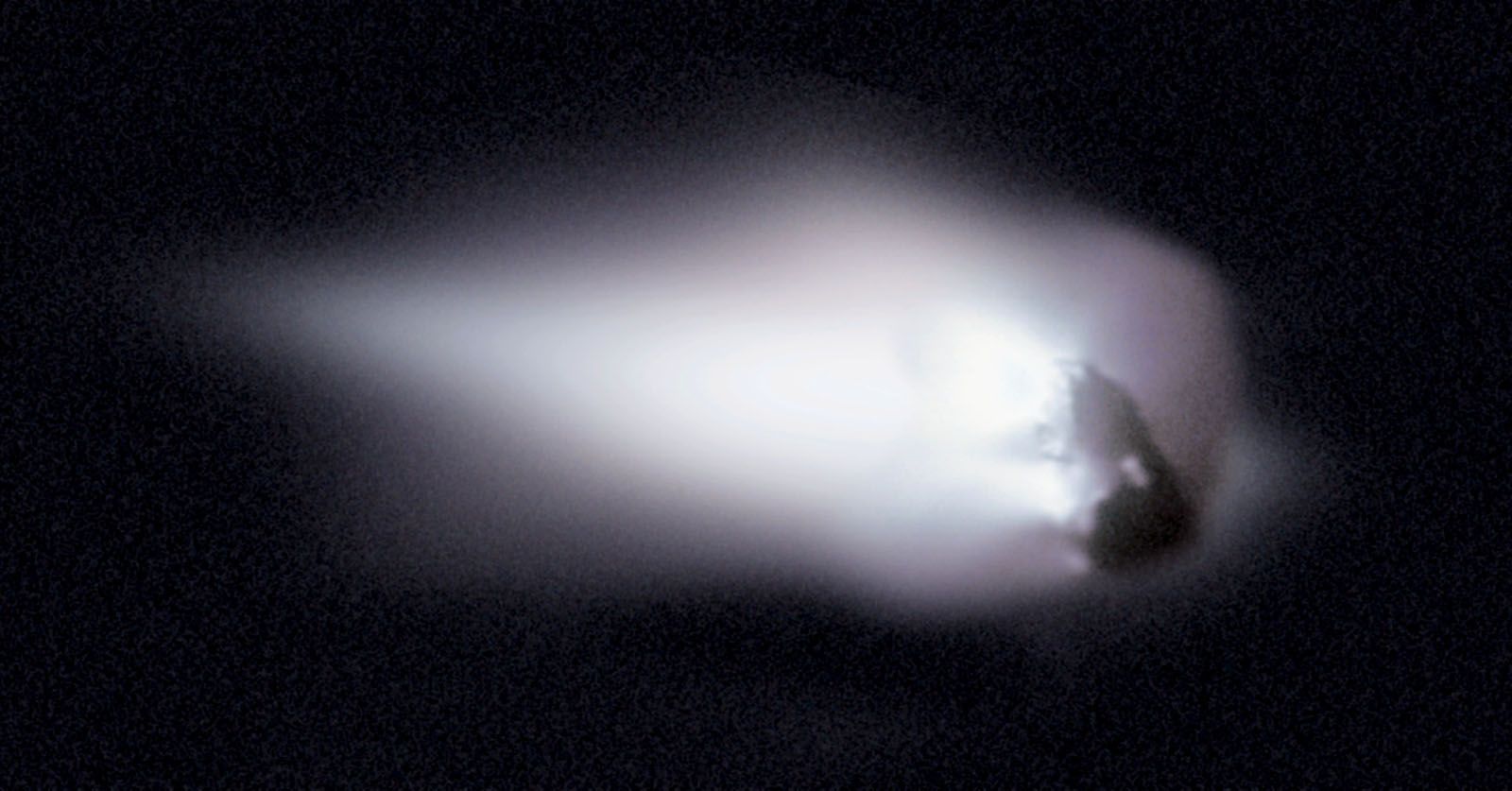
This view of comet Halley's nucleus was obtained by the Halley Multicolour Camera (HMC) on board the Giotto spacecraft, as it passed within 600 km of the comet nucleus on March 13, 1986. a large white coma is visible around a peanut shaped rock.

Close-up view of Halley's Comet captured by the Giotto spacecraft in 1986. (Image credit: ESA. Courtesy of MPAe, Lindau)

Looking backward . . . and forward

Perhaps you remember seeing Halley's Comet when it last swept through the inner solar system in late winter and early spring of 1986. With an orbital period of 75.4 years, this celebrated visitor is due back in late July or early August 2061.

For a little perspective, average life expectancy is 79.5 years in the United States, 82.2 years in the United Kingdom, and 83.4 years in Canada. So, if you were born after 1980, there's a fair chance you'll be here to welcome the "mother of all Orionids" home in 2061.

As for me, I saw Halley in 1986 at the "advanced age" of 30. The odds of another reunion are pretty long β€” you can do the math.

Until then, I'll be more than happy to step outside early on Wednesday morning and greet a few of "Halley's children." I hope you'll join me.

Joe Rao serves as an instructor and guest lecturer at New York's Hayden Planetarium. He writes about astronomy for Natural History magazine, Sky and Telescope, The Old Farmer's Almanac and other publications.

The Summer Triangle β€” 3 stars, 1 seasonal mystery

10 September 2026 at 21:00

On clear September evenings, I often find myself looking up just after dusk, expecting the sky to feel a little less like summer. Yet there, still commanding the overhead darkness, are Vega, Altair, and Deneb β€” the three brilliant stars of the famous Summer Triangle.

Their familiar pattern can make the season feel as though it is lingering above us, even as cooler nights and earlier sunsets suggest otherwise. In fact, even as late as mid-November, the Triangle is still nearly overhead soon after sunset at dusk. That contrast raises a simple but intriguing question: if this bright celestial landmark remains so prominent well into autumn, why do we still call it the Summer Triangle?

Why not simply call it the Autumn Triangle?

Why it belongs to summer

The answer lies not in the calendar, but in how the Triangle moves across the sky over the course of a summer night. The chief reason is that, at this time of year, the Triangle does not remain visible all night. By dawn, it has begun to drop beyond the west-northwest horizon. During summer, by contrast, it remains with us from dusk until dawn: already evident in the east-northeast at nightfall, near overhead around the middle of the night, and descending in the west-northwest as daybreak approaches.

A matter of distance and brightness

The stars that compose the Triangle β€” Vega, Altair, and Deneb β€” lie at very unequal distances from us, so their apparent brightness can give a misleading impression of their true luminosity.

The closest of the three is Altair, 16.7 light-years away, followed by Vega at 25 light-years. Deneb, however, is vastly farther off, at roughly 1,600 light-years, though various sources place it between 1,400 and 2,600 light-years. Even though we see Deneb by light that may have begun its journey during the last days of the Roman Empire, it still shines at first magnitude (+1.3, to be exact) because it is a brilliant blue supergiant, at least 55,000 times brighter than the sun.

But their apparent superiority is largely a consequence of distance: Vega and Altair are only a few dozen light-years away, while Deneb lies well over a thousand light-years from Earth. Compared with the stellar lighthouse of Deneb, Vega and Altair are, comparatively speaking, penlight flashlights.

How to say "Vega"

Before continuing with this discussion about the Summer Triangle, it is worth pausing briefly on the pronunciation of Vega, a point that became especially noticeable after the 1997 science fiction drama Contact. Based on Carl Sagan's 1985 novel, the film follows astronomer Dr. Ellie Arroway, played by actress Jodie Foster, as she discovers a radio signal from Vega containing a sequence of prime numbers.

Throughout the film, the star is pronounced "Vey-gah," perhaps echoing Chevrolet's Vega, the subcompact automobile sold in the 1970s. Astronomers, however, generally use a different pronunciation.

The traditional astronomical pronunciation is VΔ“-ga, with the stress on the first syllable. In professional astronomical usage, Dr. Arroway and her colleagues would almost certainly have said "Vee-ga," not "Vey-gah." George Lovi (1939β€”1993), who was widely respected for his knowledge of star nomenclature, often reminded audiences that "Vee-ga is a star and Vey-gah is a car."

Who named the Summer Triangle?

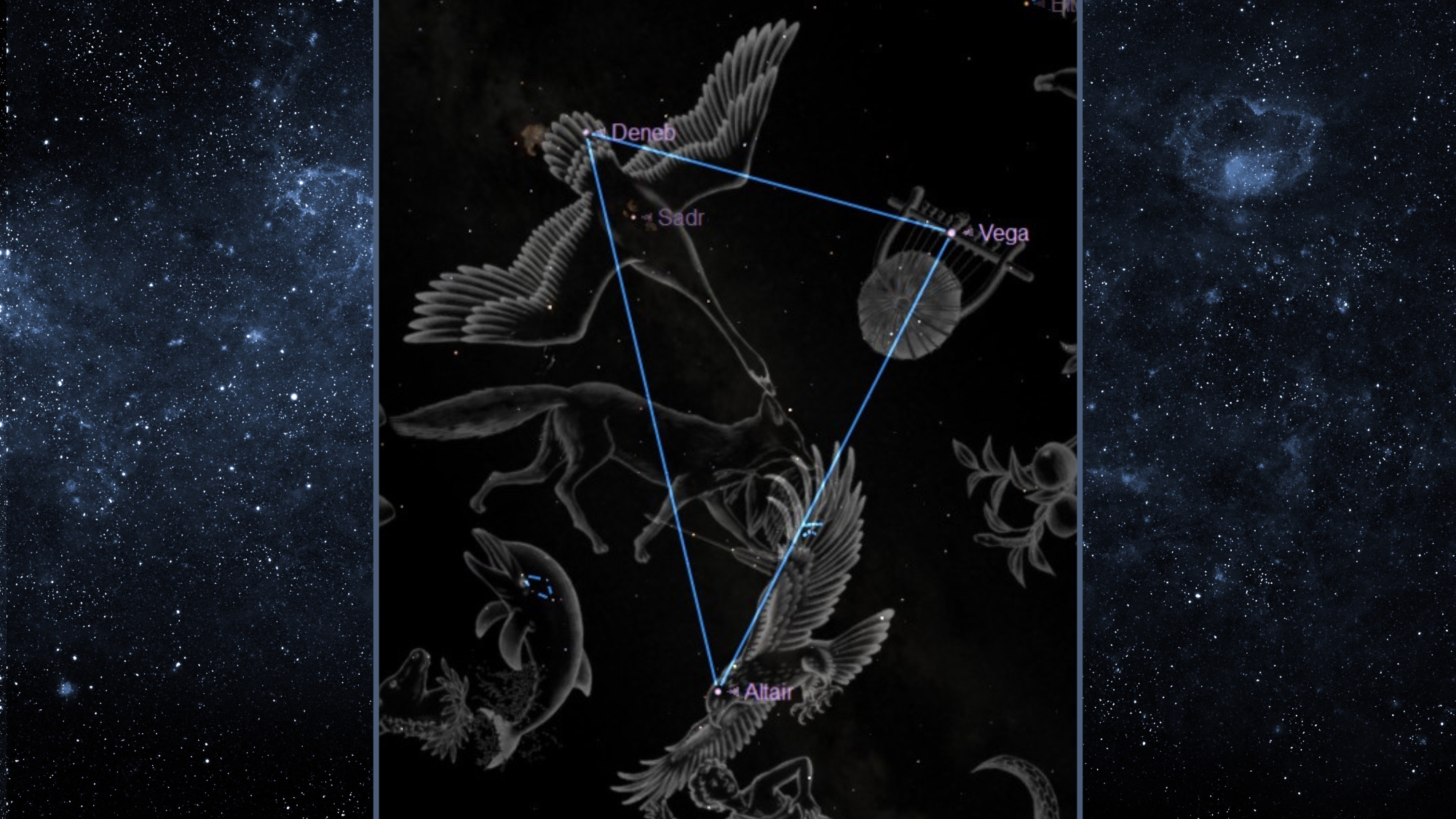
night sky graphic showing the three stars that make up the summer triangle, vega, deneb and altair.

The Summer Triangle and the allegorical figures (Cygnus, Lyra and Aquila) attributed to the three constellations it belongs to, at around 9 p.m. in mid-September.Β  (Image credit: Starry Night Pro 8.0, background added in Canva Pro.)

There has long been debate over who first christened the bright stellar trio of Vega, Deneb, and Altair as the Summer Triangle. Some credit the legendary British astronomer Sir Patrick Moore (1923β€”2012), who wrote, "During a 1958 television broadcast on the BBC, I introduced the nickname of the Summer Triangle, and everyone now seems to use the term, even though it is completely unofficial." Yet several years earlier, in his 1952 sky guide, The Stars β€” A New Way to See Them, H.A. Rey (1898β€”1977) referred to the three stars as a "right triangle," and in his 1954 children's book, Find the Constellations, Rey used the Summer Triangle moniker.

Still others believe the term was popularized through U.S. navigator training manuals during World War II. Interestingly, astronomer Oswald Thomas (1882β€”1963) described Vega, Altair, and Deneb as "Grosses Dreieck" ("Great Triangle") in the late 1920s and as "Sommerliches Dreieck" ("Summerly Triangle") in 1934.

Joe Rao serves as an instructor and guest lecturer at New York's Hayden Planetarium. He writes about astronomy for Natural History magazine, Sky and Telescope, The Old Farmer's Almanac and other publications.
The moon will hide Jupiter in broad daylight today β€” here's how to see it

7 September 2026 at 17:00

Today (Sept. 8), skywatchers can first catch a striking predawn pairing of the crescent moon and Jupiter, then β€” where conditions and location allow β€” attempt the much harder daytime occultation, when the moon hides the planet from view.

Before sunrise: Find the moon and Jupiter

Set your alarm for 5 a.m. local time on Tuesday and look low toward the east-northeast sky. Check in advance for tall obstructions that could block your view of this delicate predawn tableau. A slender waning crescent moon β€” just under 10% illuminated and resembling a "celestial smile" β€” will be immediately apparent. About 5 degrees below it, roughly half the width of your clenched fist held at arm's length, will be brilliant Jupiter.

Jupiter rises in the east-northeast shortly before 4 a.m. local daylight time, but it does not climb fairly high until just before dawn's first light. The planet is in the dim zodiacal constellation Cancer; one of my astronomy mentors at New York's Hayden Planetarium, Dr. Ken Franklin, used to call Cancer "the empty space between the Sickle of Leo and the Gemini Twins." If you set up a telescope before dawn, you can be among the first to see what became of Jupiter's tumultuous cloud belts while the planet was hidden in the sun's glare from early July through mid-August.

Later in the day: The daytime occultation

Another moon-Jupiter show awaits later in the day: a daytime occultation, when the thin waning crescent moon will hide Jupiter from much of North America. Unfortunately, a swath of the western United States β€” anywhere west and south of a line running roughly from Bellingham, Washington, to Rockport, Texas β€” falls outside the occultation's visibility zone.

The occultation occurs during the afternoon, when the moon and Jupiter will appear somewhat lower than the sun and well off to its right. Jupiter will disappear behind the moon's sunlit limb, with the moon taking roughly a minute or more to inch across the giant planet's face. Approximately 50 minutes later (give or take ten minutes), Jupiter will gradually reappear from behind the moon's dark edge.

Jupiter will vanish (going from north to south) between 2:55 and 3:30 p.m. for those in the Eastern Time Zone, 1:45 to 2:20 p.m. for the Central Time Zone, and 12:30 to 1:00 p.m. in the Mountain Time Zone.

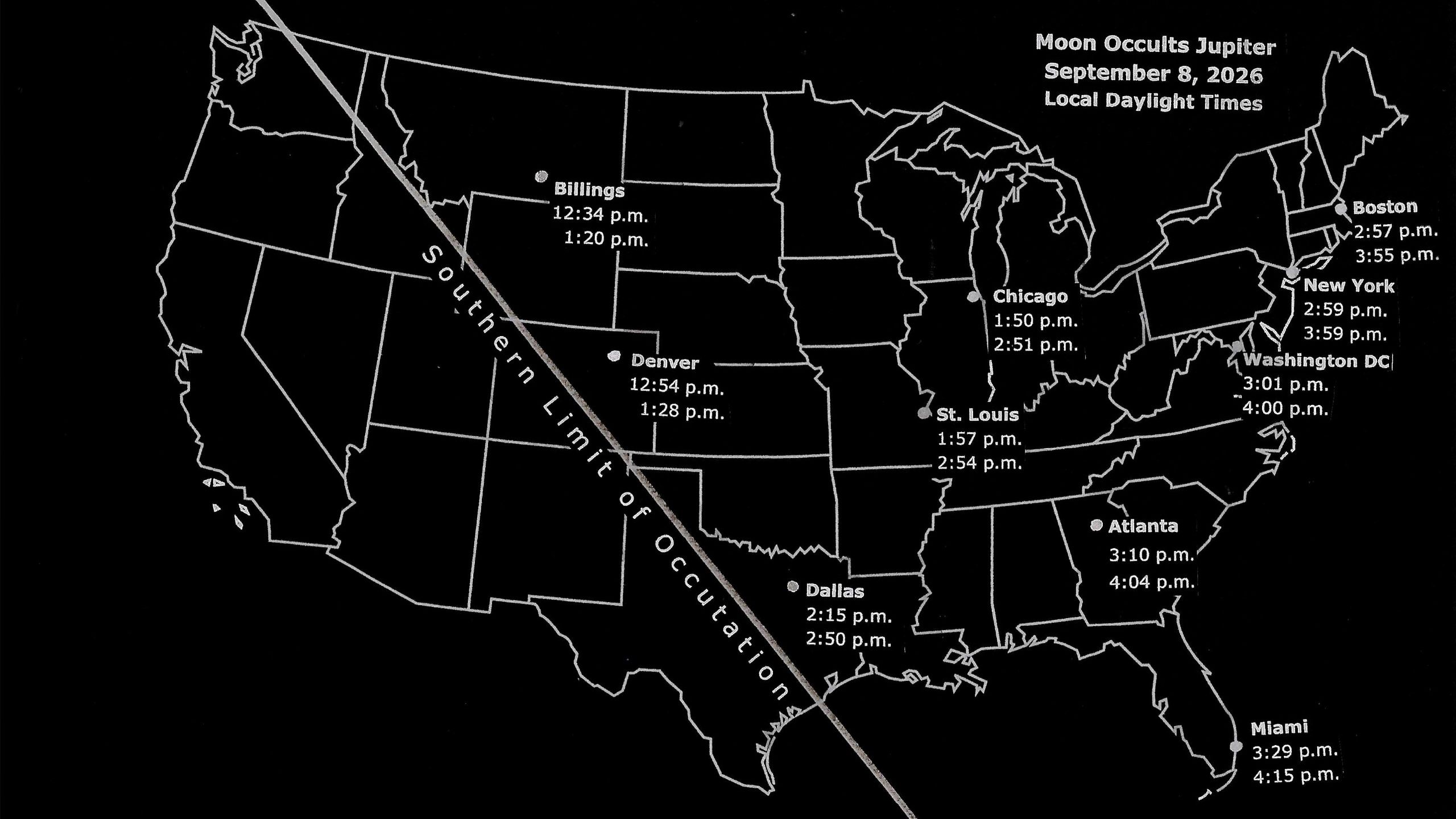
To find out when these events occur at your location, use the accompanying map. Interpolate between the ten selected cities to find the local daylight time of Jupiter's disappearance (top) and reappearance (bottom) for your site.

map of the US showing where the jupiter occultation is visible from on sept 8.

(Image credit: Joe Rao)

How to find them in daylight

The chief challenge will be finding the moon and Jupiter at all, so give yourself plenty of time. The easiest method is to locate the pair before sunrise and track them into daylight. Much will depend on the transparency of your local sky β€” how deep its blue color is. If the day is hazy, the search will be harder.

  1. Start before sunrise, when the crescent moon and Jupiter are easiest to identify.
  2. As daylight strengthens, keep tracking the pair or return to the same region of sky about 30 degrees β€” roughly four fist-widths at arm's lengthβ€”from the sun, mostly to the right and, for most locations, somewhat lower.
  3. Sweep the area with a finderscope or binoculars, remembering that the crescent moon's low surface brightness may make it hard to distinguish from the blue sky.

Once you have the moon, the next challenge is Jupiter. In a telescope, it will appear far smaller than the moon β€” about one-sixtieth of the moon's diameter β€” and it will have an even lower surface brightness. Watch for Jupiter to return along the moon's dark limb, a captivating sight as the planet seems to emerge literally from out of the blue.

If you miss it

Sighting the moon and Jupiter in daytime will be challenging, so do not despair if you fail to find them. In less than a month, on the morning of Tuesday, Oct. 6, the moon and Jupiter will have another interaction, but this time about eight hours earlier, before sunrise in a dark or twilight sky. That resultant event should be a spectacular sight, easily visible with the naked eye, binoculars, or a telescope. Space.com will provide details as the date approaches, so stay tuned!

Joe Rao serves as an instructor and guest lecturer at New York's Hayden Planetarium. He writes about astronomy for Natural History magazine, Sky and Telescope, The Old Farmer's Almanac and other publications.
Venus is disappearing from the evening sky β€” here's how to see it while you can

5 September 2026 at 16:00

Soon, the sky's most glamorous evening performer will take its leave.

Since late March, Venus has been the unmistakable "Evening Star," gleaming shortly after sunset and stealing attention from nearly everything else in the twilight. In June, it helped stage a striking three-planet lineup after sundown, outshining both Jupiter and Mercury.

Now the curtain is beginning to fall: Venus is sinking night by night and will trade its evening role for a morning one before October is over.

A familiar dance around the sun

Venus moves to a remarkably regular beat. Our nearest planetary neighbor circles the sun in an almost perfect path, completing 13 orbits in 8 Earth years. From Earth, that rhythm makes Venus appear to trace five great loops across the sky in the same span. It is a long cycle noticed by skywatchers β€” and important to the ancient Aztec and Mayan civilizations β€” and it gives each Venus year its own recognizable personality. In 2026, the pattern closely echoes 2018, differing by only about two days.

Key dates this month

Venus is about to blaze at peak brilliance, but this farewell performance comes with a challenge. All month long, the planet will slide lower in the southwest after sunset, shortening the window for a good view. If the horizon is clear and the weather cooperates, these are the evenings to circle on your skywatching calendar.

  • Sept. 7: On Labor Day, Venus sets about 1ΒΌ hours after sunset.
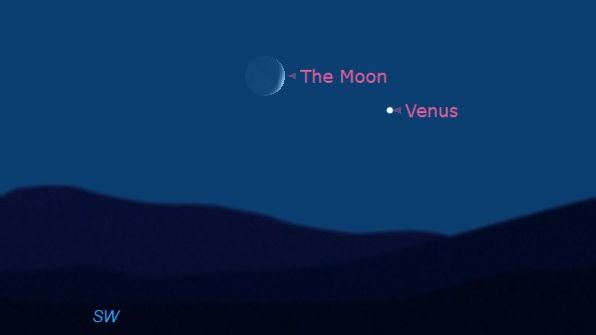
  • Sept. 14: Look low in the west-southwest 30 to 45 minutes after sunset, when a waxing crescent moon appears around 5Β½ degrees to the left of Venus.
  • Sept. 18: Venus reaches greatest brilliancy, shining at a dazzling magnitude of
    -4.8 near the horizon.
  • Late September: The planet slips quickly from view, setting just 35 minutes after sundown by month's end.

night sky graphic showing Venus shining close to the delicate crescent moon.

Venus shines near a waxing crescent moon very low in the southwestern sky, 45 minutes after sunset on Sept. 14. (Image credit: Starry Night Pro 8.0)

Why this farewell is so low-key

Ordinarily, the weeks between greatest elongation and greatest brilliancy are prime time for Venus watchers. Not this year. For evening observers, this apparition has been more frustrating than triumphant, with Venus lingering low in the glow of twilight instead of climbing into a commanding position.

The best views came back in June, when Venus lingered until around 11 p.m. Since then, it has been ducking out earlier each night. By Aug. 15, the evening of greatest elongation β€” when Venus reached its greatest apparent distance east of the sun β€” it was already setting just as evening twilight faded.

For observers at mid-northern latitudes, the finale is especially low to the horizon. Around 40 degrees north latitude, Venus will stand only about 5Β½ degrees above the southwest horizon at sunset by the end of September. That is barely more than half the width of your clenched fist held at arm's length β€” a beautiful but fleeting target in the fading light.

A crescent world in the twilight

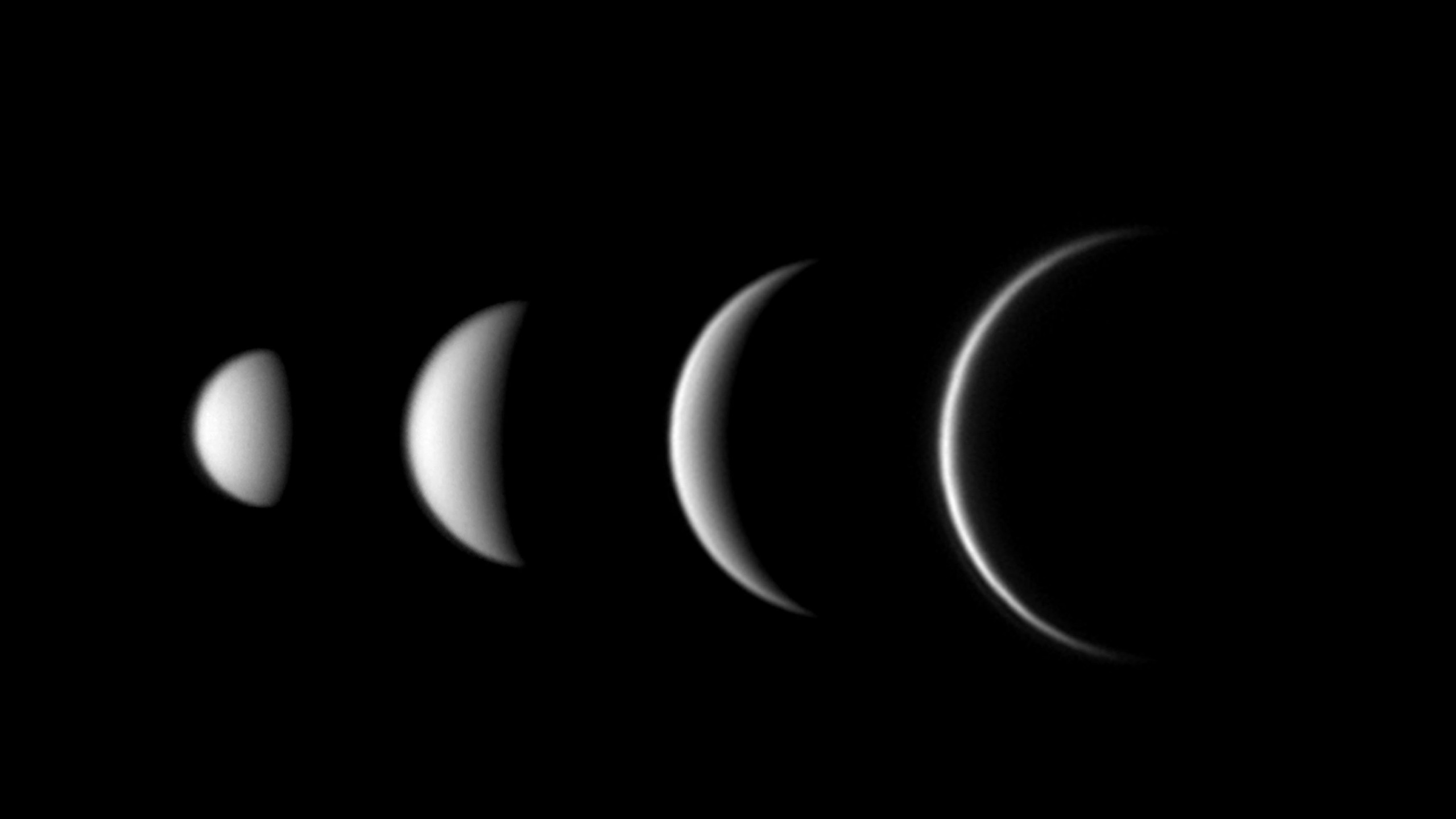
Through a telescope, Venus now shows one of its most striking faces: a narrowing crescent. As its sunlit side turns farther away from Earth, that crescent grows thinner and longer, becoming a delicate arc of brilliant light. With very steady binoculars, you may even glimpse the shape during the next couple of weeks, though the planet's low altitude will make the view shimmer and blur.

composite image showing 4 views of venus becoming an increasing crescent.

Set of images taken in 2004 show the phases and relative size of Venus as seen from Earth as it moves around the Sun. (Image credit: Photograph by Jamie Cooper. (Photo by SSPL/Getty Images))

The morning star returns

By the end of the first week of October, Venus will have slipped from the evening sky altogether. It reaches inferior conjunction on Oct. 24, passing about 6 degrees south of the sun. Around that time, spotting it on nearby evenings or mornings will be extremely difficult.

But Venus never stays away for long. In November, it reappears before dawn, opening a brilliant new morning apparition. By the winter holidays, it will shine high in the eastern sky as a fitting "Christmas Star," rising more than two hours before daybreak β€” and nearly four hours before the sun.

Joe Rao serves as an instructor and guest lecturer at New York's Hayden Planetarium. He writes about astronomy for Natural History magazine, Sky and Telescope, The Old Farmer's Almanac and other publications.
❌