For nearly 20 years, the blue-spotted bamboo shark, found only in Madagascar, went scientifically undetected and unrecorded. But researchers have now found four new records of the “lost” shark while surveying fishing villages and a Malagasy university’s fish collection. These recent records, and interviews with fishers, suggest the species may be more common than previously thought, according to a new study. The blue-spotted bamboo shark (Chiloscyllium caeruleopunctatum), so named for the blue-white spots on its brown body, was first described based on a specimen caught off Madagascar in 1914. A second record of the species came 92 years later — a photograph of a shark caught in 2006. Since then, the species largely went unconfirmed, until researchers began surveying fish markets and landing sites in Madagascar in September 2025. Study lead author Tsarahasina Fanomenzana, a young Malagasy intern from the NGO Madagascar Whale Shark Project, was showing photos of sharks and rays he’d seen at a fishing village on the east coast to shark expert and study co-author David Ebert. “One of the photos was of the blue-spotted bamboo shark,” Ebert told Mongabay by email. “He didn’t think too much of it as there were some other images of shark and ray species he thought were more interesting.” However, Ebert said he was “more than excited,” because the pictures confirmed the blue-spotted shark was still around. He was in Madagascar for the Lost Sharks project, supported by the Save Our Seas Foundation, which aims to find and raise awareness about…This article was originally published on Mongabay
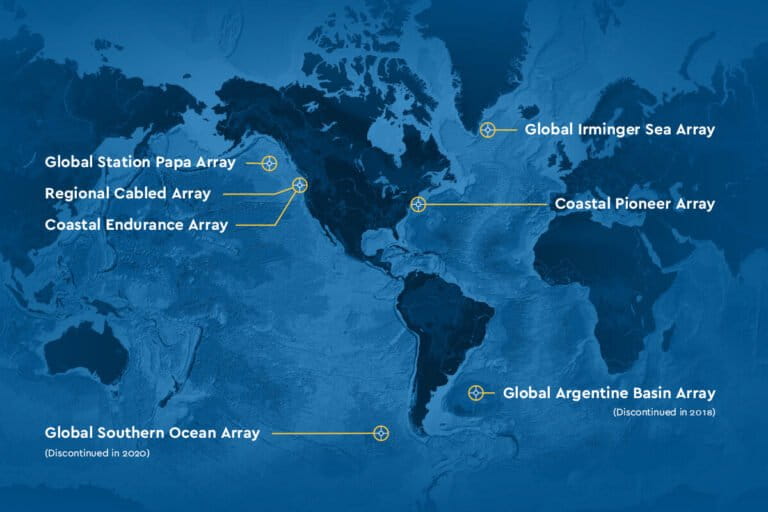
Over the next 15 months, major sensor arrays that have provided crucial, decade-long observations of the ocean, marine ecosystems and climate change will be dismantled. These sensors are part of the Ocean Observatories Initiative (OOI), a $386 million network of more than 900 instruments funded by the U.S. government’s National Science Foundation (NSF), which has provided real-time data on the world’s oceans for more than a decade. The sensors are distributed across both the Atlantic and Pacific oceans to monitor coastal environments, marine ecosystems, and ocean currents that influence the global climate. The decision to end OOI, described by the foundation as a “descoping,” will remove nearly all in-water infrastructure located off the states of Alaska, Washington, Oregon and North Carolina, and the Irminger Sea, an area between Iceland and Greenland. As the instruments are recovered, data streams from those areas will go dark, Jim Edson, principal investigator of the initiative, said in a statement. “However, all previously collected OOI data will remain accessible through the OOI Data Center.” The OOI was designed as a 25-to-30-year project specifically to capture long-term climate signals, which scientists say require at least three decades of continuous data to be meaningfully detected. The network has achieved just 10 years of observations. While satellites can monitor the ocean’s surface, the OOI arrays provided a rare look into the deep sea, measuring low-oxygen zones, carbon absorption, and currents critical to regulating weather patterns. The Associated Press (AP) reported that the removal comes at a particularly sensitive…This article was originally published on Mongabay
Small-scale gold mining is a major cause of deforestation in the Amazon, and researchers found that in Guyana it destroys dung beetle communities and prevents their recovery for decades. Gold mining causes 90% of the deforestation in the Guiana Shield, which contains a quarter of the Amazon rainforest as well as large gold deposits, according to a recent study. Most of the gold mining in this region, including in Guyana, is artisanal, driven by small-scale mining rather than large industrial mines. To understand the long-term “ecological legacy” of such mining, a team of researchers measured dung beetle communities at 16 abandoned small-scale gold mine sites in northwest Guyana. They choose dung beetles, because the insects are easily sampled and play key roles in rainforest functions like nutrient cycling, seed dispersal and pollination. For control, the team monitored dung beetle communities at five nearby intact forests. At every mining site, the researchers sampled dung beetles at three locations: the center of the mine where vegetation was regrowing, at the edge where the mine met the forest, and about 100 meters (328 feet) away into the forest. They trapped dung beetles using human feces as bait. Study lead author Sean Glynn from the University of Kent, U.K., told Mongabay by email that because they were camping remotely, they didn’t have reliable access to feces from other animals to use as bait, “however, human seems to always be the best.” The team also recorded air temperature and vegetation structure at each of the…This article was originally published on Mongabay
Researchers have found a new-to-science species of a tiny sea slug with black and yellow spots resembling “scattered sesame seeds.” Measuring just three millimeters long (0.1 inches long), the researchers have named it Thecacera sesama, according to a recent study. Study lead author Ho-Yeung Chan first spotted the sea slug during a recreational dive in the coastal waters of Keelung, northern Taiwan, in 2019. At the time, he was still an undergraduate student and did not realize the animal was unknown to science until he consulted an expert on Facebook, according to a statement. To formally identify the species, researchers collected six specimens of the sea slug during diving expeditions conducted between May 2021 and June 2025. Between May and September, typhoons can make diving risky. The research team then examined the specimens’ structure and appearance and analyzed their DNA to confirm that it was a new-to-science species. T. sesama is the seventh Thecacera species to be described, and the first one to be named in the genus in nearly three decades. Despite its small stature, T. sesama is visually striking, the researchers wrote. It has a translucent white body covered in small black and yellow spots that look like sesame seeds. While the species looks similar to another sea slug Thecacera pennigera, which has black and orange spots, T. sesama is significantly smaller and genetically distinct. The researchers found that T. sesama lives on and feeds exclusively on bryozoans, small aquatic invertebrates known as “moss animals” that live in…This article was originally published on Mongabay

 Login
Login