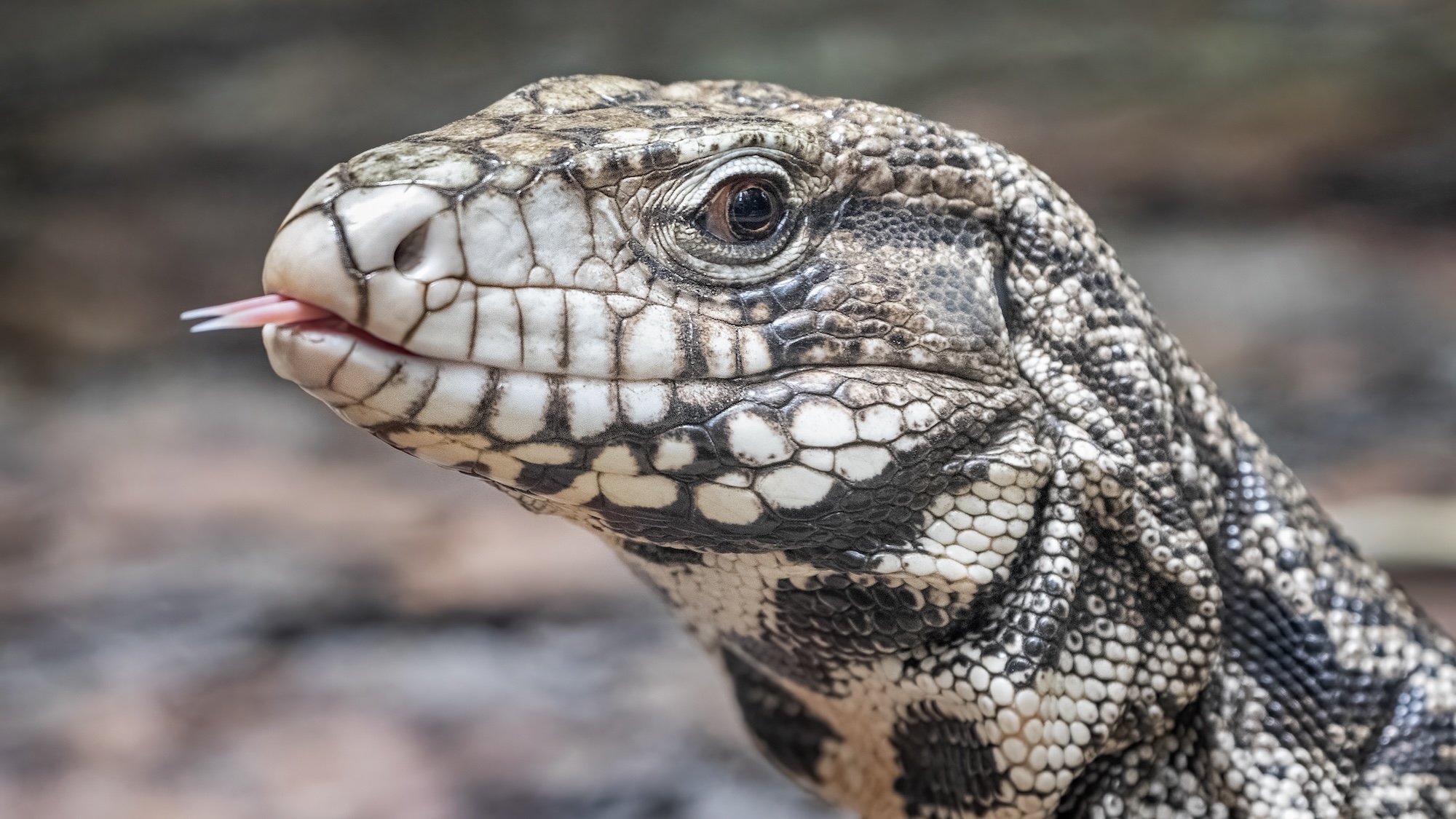
Wildlife experts in Georgia are urging locals to keep on the lookout for any four-foot-long lizards wandering around the Peach State. As its name implies, the Argentine black and white tegu (Salvator merianae) isn’t native to the United States, and it’s quickly becoming a nuisance.
Although the black and white tegu resembles many monitor lizard species, they are actually only distantly related to the reptiles. The speckled omnivores can weigh upwards of 10 pounds, largely thanks to a diet that regularly includes eggs, small animals, fruits, and vegetables. They are also extremely prolific animals, with a single female capable of producing around 35 eggs every year. These typically hatch during the summer between June and July, meaning many in Georgia have a decent chance of spotting a tegu in the near future.
It’s still unclear how the tegus were first introduced into the state, although illegal releases by exotic pet owners are the most likely explanation. Georgia’s Department of Natural Resources (DNR) first responded to reports of the rogue reptiles in 2018, with sightings spreading ever since. Tegus are currently particularly concentrated in southeastern Georgia’s Toombs and Tattnall counties, but experts fear a lack of predators means the lizard population could soon explode without concerted conservation efforts. As non-native “wild” species, trapping and hunting tegus is legal in Georgia throughout the year.
That said, the DNR still cautions hunters against coming into direct contact with the reptiles. Although not particularly aggressive or dangerous, tegus may carry exotic parasites as well as harmful bacteria including salmonella. Experts encourage people to instead contact the DNR if they see one of the lizards, either by emailing gainvasives@dnr.ga.gov or calling (478) 994-1438.
Unfortunately, Georgia isn’t the only state contending with an unwanted tegu problem. According to an ongoing mapping project from the U.S. Geological Survey and Georgia Southern University, residents across Florida, Alabama, South Carolina, and Texas have also reported sightings in recent years.
A groundbreaking discovery has reshaped our understanding of one of the most enigmatic groups in the animal kingdom: bryozoans. These tiny, colonial filter-feeders, omnipresent in today’s oceans, have long baffled paleontologists due to their conspicuous absence from the Cambrian fossil record. While the Cambrian explosion, occurring around 530 million years ago, heralded the rapid emergence of nearly all major animal phyla, bryozoans appeared to be absent until the Ordovician period, roughly 50 million years later. This puzzling gap, often dubbed the “elephant in the room” of Cambrian paleontology, may now be firmly closed thanks to the discovery of exquisitely preserved fossils from Southern China, dating back around 520 million years.
A multinational team of scientists from China, Sweden, Australia, and Germany recently unveiled a trove of fossils from the Xiannüdong Formation in southern Shaanxi Province. These fossils include detailed specimens of the previously known species Protomelission gatehousei and an entirely new genus and species, Dayingomelission hexaclitia. Both taxa thrived during the early Cambrian and provide compelling evidence that bryozoans were not only present but already exhibiting complex colony architectures at this early stage in animal evolution.
What sets these fossils apart is not solely their antiquity but the extraordinary quality of their preservation. The tiny colonies, each only a few millimeters in size, retain exquisite three-dimensional structures with internal soft tissues authentically mineralized in phosphate. This mineralization has allowed researchers to peer inside the original skeletal housing, revealing membranous sacs, minute muscle fibers, and distinctive skeletal features including diagnostic styles—unique structural spines characteristic of bryozoan anatomy. Such soft tissue detail is rarely captured in fossils this ancient, making these specimens an invaluable window into Cambrian marine ecosystems.
These findings decisively settle a long-standing debate over the affinities of these fossils. Some previous interpretations suggested Protomelission gatehousei could be a green alga or a collection of isolated, unrelated skeletal elements. However, the combination of hexagonal modular colony architecture and intricate internal anatomy makes the bryozoan affinity unequivocal. This marks an unprecedented confirmation that true bryozoans were indeed present during the Cambrian explosion, closing a perplexing gap in the fossil record.
Advanced imaging technologies played a crucial role in this breakthrough. Using state-of-the-art microscopic and tomographic techniques, researchers could visualize internal soft tissues and skeletal arrangements without damaging the specimens. This high-fidelity reconstruction allowed for a comprehensive phylogenetic analysis, clearly situating both Protomelission and Dayingomelission within Stenolaemata, one of the principal bryozoan classes still extant today. Such deep roots suggest that the bryozoan lineage originated even earlier than previously suspected—perhaps extending into the Ediacaran period, preceding the Cambrian radiation altogether.
These revelations carry profound implications for reconstructing early animal evolution. Bryozoans exhibit a highly modular colonial lifestyle in which genetically identical zooids cooperate within a shared skeleton—a key evolutionary innovation. The presence of fully developed modular colonies during the Cambrian implies that this mode of life was not a late development but a pivotal player in the Cambrian explosion itself. Consequently, the rise of complex multicellularity and functional integration within animal colonies must be reconsidered within this early evolutionary framework.
Additionally, the environmental context of these fossils offers insights into their preservation and ancient ecological niches. The bryozoans inhabited shallow, clear marine waters associated with reef settings—an environment contrasting with the deeper-water deposits typically yielding soft-tissue fossilization during the Cambrian. Such ecosystems may have fostered the radiation and diversification of early bryozoans, although their fossil record remained elusive until now due to specific taphonomic biases.
The significance of the discovery extends further: it suggests a more cosmopolitan distribution of early bryozoans in Cambrian seas. Combined with prior finds from ancient South Australian deposits, these Chinese fossils indicate that bryozoans were widespread and ecologically versatile much earlier than assumed. This cosmopolitanism hints at complex biogeographic patterns and diversification dynamics underpinning early marine ecosystems during one of Earth’s most transformative intervals.
Debunking alternative hypotheses about these Cambrian fossils not only clarifies bryozoan origins but also enhances our understanding of early marine biodiversity. A clearer timeline now places bryozoans as contemporaries of other foundational animal groups, reshaping models of early metazoan community structure. It emphasizes that the Cambrian explosion was as much about the emergence of novel ecological partnerships and colony-level complexity as it was about the appearance of individual taxa.
The ability to detect and interpret soft tissue mineralization in fossils surpasses traditional paleontological methods, underscoring technological advances that continue to revolutionize our window into deep time. These detailed anatomical insights would have been unthinkable decades ago, and they open fresh avenues for understanding evolutionary developmental biology and the genetic underpinnings of early animal form and function.
Moreover, the research highlights the synergy of international collaboration in paleontology. Combining expertise from institutions like Northwest University, the Swedish Museum of Natural History, and universities in Australia and Germany, alongside advanced imaging labs, coalesced into a breakthrough that will likely influence studies of other enigmatic Cambrian groups where fossil evidence remains scant or ambiguous.
In summation, these high-fidelity bryozoan fossils from the early Cambrian Xiannüdong Formation dramatically alter the evolutionary narrative of one of today’s most successful aquatic invertebrate phyla. By authenticating that bryozoans were indeed participants in the Cambrian explosion, this research closes a half-century-old mystery, revealing a much earlier and more complex history for these tiny, yet evolutionarily influential marine architects.
Subject of Research: Animals Article Title: High-fidelity modular skeletons authenticate a Cambrian origin for Bryozoa News Publication Date: June 3, 2026 Web References: 10.1038/s41586-026-10590-9 Image Credits: Baopeng Song Keywords: Cambrian explosion, bryozoans, Protomelission gatehousei, Dayingomelission hexaclitia, fossil record, modular colonies, early animal evolution, soft tissue preservation, Stenolaemata, phosphate fossilization, Xiannüdong Formation, paleontology
The study reveals that 23 percent of American adults report having had a near-death experience, after which they returned to normal human existence. The study also reveals that 35 percent of the individuals queried about such experiences who have not had an NDE themselves said they know someone who has.
“In an NDE, usually during a close brush with death, a person has a vivid, emotionally intense experience of lucidly perceiving the material world from a position outside the physical body and/or perceiving and interacting with beings and environments not of the material world,” said Janet Riley, executive director of the International Association for Near-Death Studies, in an email to The Debrief. “Afterward, experiencers are usually profoundly changed.”
The survey, conducted in March 2026 by Centiment and involving 2,100 Americans, looked more deeply at the effects of these experiences. Among those who reported having an NDE, 51 percent said the experience gave them a deeper meaning and appreciation for life, while 37.6 percent said they felt more connected to a “spiritual realm.”
Overall, thirty-one percent said the experience changed their life priorities; 30 percent said they were less afraid of death than before; 30 percent reported greater empathy for others; and 26 percent said they had become more generous and socially minded.
Among respondents who knew a friend or family member who had experienced an NDE, 44 percent said they became more curious about the afterlife, while 40 percent reported a stronger belief in life after death.
“This remarkable data tells us three important things: NDEs may be more common than we realized; people who have NDEs or hear about them are positively impacted, and the majority of Americans believe evidence exists to support the phenomena,” Riley said in a statement. “The survey also makes clear the importance of normalizing conversations about life, death, and what comes after. Those who have had NDEs or who research them may be some of the best teachers.”
What about those who have never had an NDE?
Additionally, the survey revealed that 27.3 percent of participants who had never experienced an NDE themselves found the evidence significant enough to change their minds, while 31.3 percent said it at least provided reliable evidence for some type of phenomenon.
The smallest category of responding participants, at 15 percent, said there was limited evidence, while 24 percent said there was insufficient evidence.
Nearly four out of five respondents (79.8 percent) said there is either some value (36.7 percent) or major value (41.1 percent) in studying near-death experiences.
A Paradigm Shift?
Culturally, perceptions about NDEs and related subjects may be changing, and mainstream attitudes may be evolving. Even in the world of pop culture, celebrity gossip columnist Perez Hilton (Mario Armando Lavandeira Jr.), known for his often controversial commentary, has spoken publicly about a near-death experience after taking flu medication without food, which led to a stomach ulcer, perforation, and severe sepsis. He ultimately spent 21 days in the hospital.
After the experience, Hilton said he was appalled by his “selfish behavior” and offered apologies, explaining that after finding God, he came to regret the fact that, as he put it, “I didn’t care who I hurt.”
The International Association for Near-Death Studies survey also asked participants whether death frightened them. Twenty-five percent said the idea of dying scared them “a little,” while 14.8 percent said it scared them “a great deal.” However, 31 percent said they felt confident that they would be in a better place after death, while only 6.2 percent worried they would be in a worse place. Another 25 percent said they had “made peace with death.”
“We were founded as a research organization, and no survey like this had occurred recently,” Riley explained. “Given the strong interest in near-death experiences, we thought a survey would be timely.”
“We also felt that communicating the results could help normalize conversations about the phenomenon, which some people are reluctant to share because they fear not being taken seriously,” Riley added.
With this high level of confidence in life after death, such beliefs may continue to spread further into the mainstream, influencing everyday life and shaping how people view themselves and the world around them.
“We also know from NDE research that those who have had the experiences feel a deep connection to others, feel more loving and spiritual, and often feel more altruistic and generous,” Riley says. “We believe connection, love, altruism, and generosity have the potential to make the world a better place.”
Chrissy Newton is a PR professional and the founder of VOCAB Communications. She currently appears on The Discovery Channel and Max and hosts the Rebelliously Curious podcast, which can be found on YouTube and on all audio podcast streaming platforms. Follow her on X: @ChrissyNewton, Instagram: @BeingChrissyNewton, and chrissynewton.com. To contact Chrissy with a story, please email chrissy @ thedebrief.org.
When it comes to reproduction, animals will pull out all the stops to attract a mate. Sending out noisy mating calls, showing off colorful wings, inflating a throat pouch, and shaking a literal tailfeather all ensure that the next generation of a species happens. Some insects will go as far as making themselves look like an entirely different living thing—leaves.
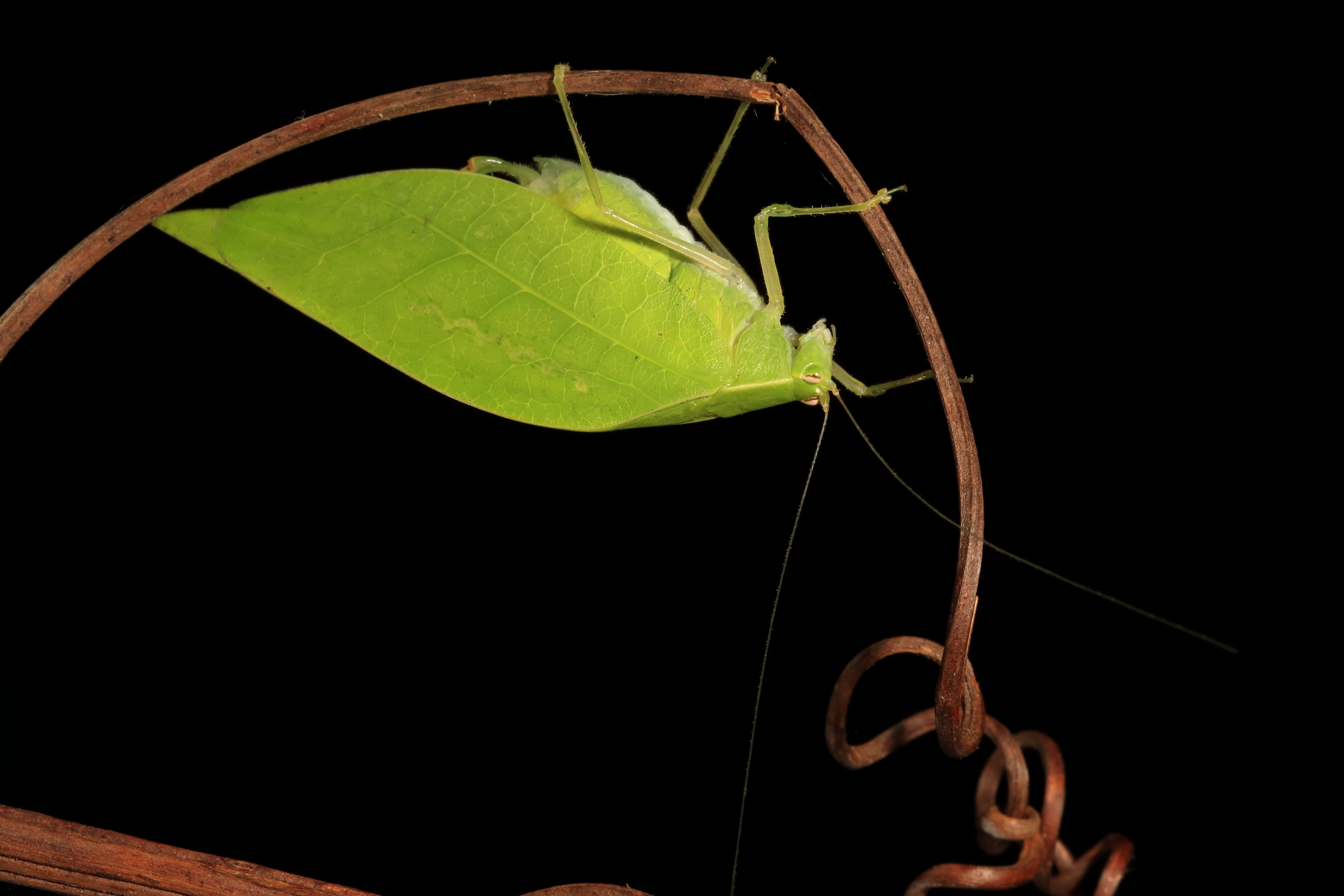
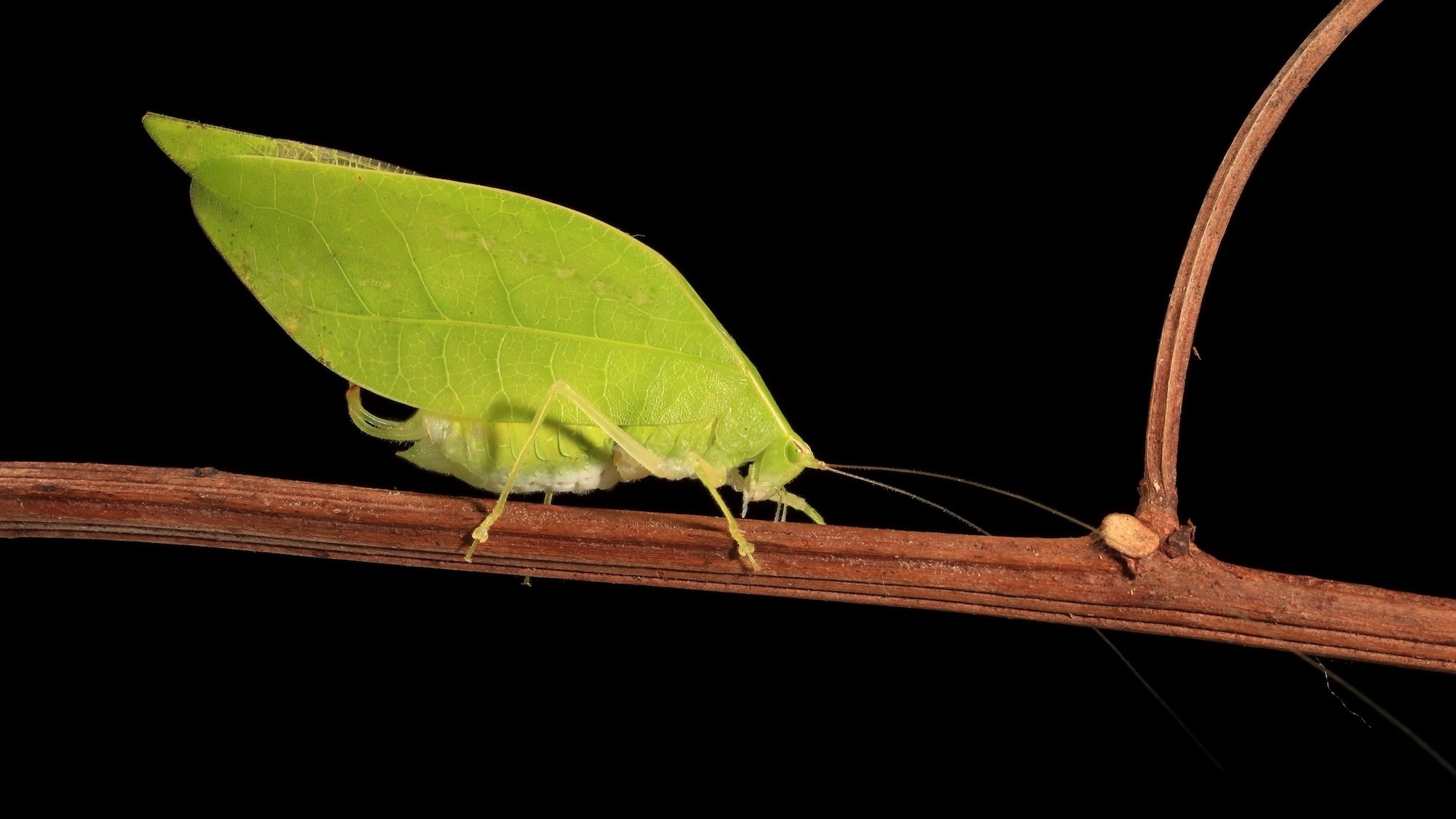
Usually used as a means of camouflage, male katydids appear to use their leafy disguise to amplify mating calls and make themselves more attractive to the opposite sex. The findings are detailed in a study published today in the journal Proceedings of the Royal Society B, and offer one of the first demonstrations of how leaf mimicry enhances a male katydids’ sexual signals.
To shield themselves from predators, various species of katydids have evolved wings with structures that look like leaves. Panama’s leaf-masquerading katydids (Arota festae) will even change from green to hot pink in order to better mimic leaves. What’s been less clear to entomologists is whether or not these leaf-mimicking structures play a role in katydid mating.
This new study looked at a species called Viadana brunneri from Barro Colorado Island, Panama. To attract mates, katydids create songs by rubbing together specialized structures on their wings. In many tropical species like V. brunneri, the portion that mimics leaves makes up the majority of their wing’s surface area.
Most of the wing structure is devoted to helping male katydids look more like a leaf. Image: Christian Ziegler.
Previously, scientists believed physical adaptations for survival and for attracting mates can function in conflict with one another, particularly if they are physically connected. A male peacock’s flashy tail feathers may help it attract a female, but it also makes it easier for predators to find them. Male katydids, on the other hand, are able to use the acoustic properties of the structures that they use for defense to their reproductive advantage. They are a rare example of how an adaptation for self-defence and reproduction can work together without necessarily putting the animal in jeopardy.
The team performed a series of bioacoustic, behavioral, and biophysical experiments, showing that these leafy structures on their wings make them more attractive to females, while also helping conceal them. After removing the leafy portions of a male V. brunneri’s wings, the pitch became higher and the volume of their songs also changed. The team then played these calls for females who preferred the lower pitch calls from males with their leafy wing sections still intact.
While male katydids do all the singing, females indicate their interest by replying to the song with clicks. The insects produce short, sporadic and infrequent calls, possibly for only two seconds in a single night. They perform these calls in ultrasounds, which our ears can’t pick up. They also found that the leafy portions of the male katydid wing will vibrate to amplify their songs, making them more detectable to females.
“Our study provides a rare example of natural and sexual selection acting in harmony, producing traits that simultaneously improve survival and mating success,” Dr. Benito Wainwright, a study co-author and evolutionary biologist at the University of St Andrews, said in a statement. “We are now extremely excited to start exploring how such an interesting interaction evolved in katydids.”

 Login
Login