Be not afraid, human. A new robot developed at Duke University isn’t intended to strike fear into the hearts of anyone who beholds it, but more closely resembles one of those terrifying biblically accurate angels than it does any other machine or living creature you’ve ever seen.
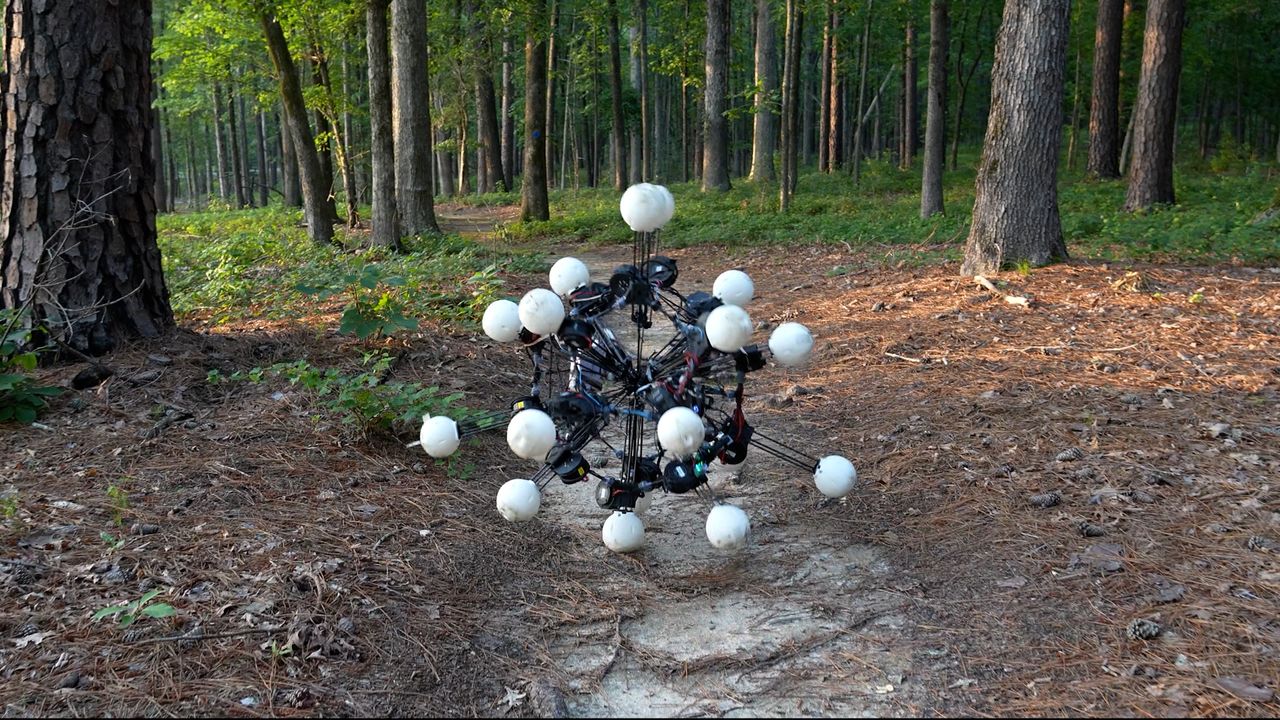
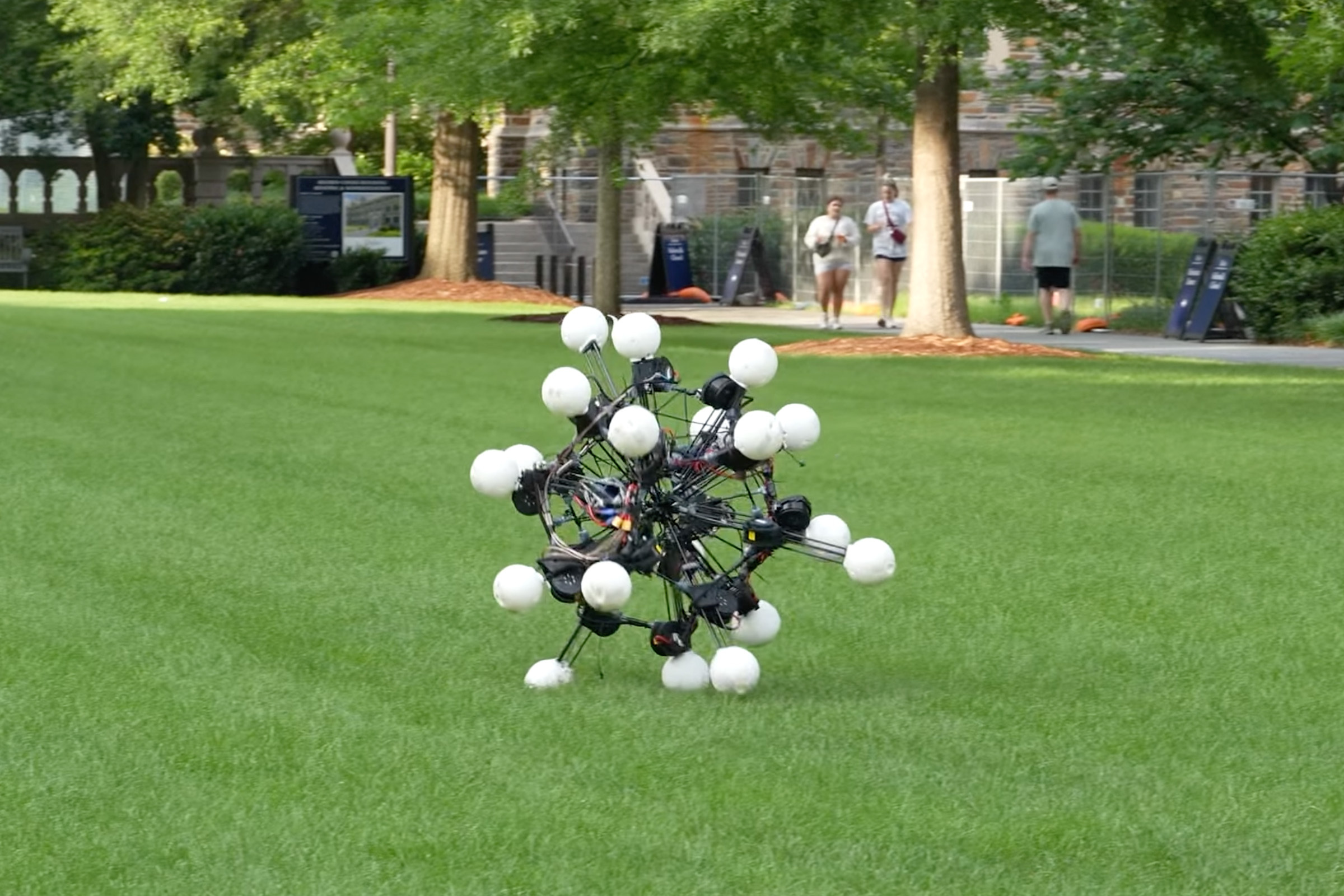
Called Argus, the robot is a rolling, virus-shaped conglomeration of twenty telescoping legs attached to a central core. And it’s completely covered in eyes that let it see in every direction, which is literally how some of the more terrifying versions of the divine creatures are described (see: ophanim.) The result is something that is not only all-seeing, but capable of moving in any direction on a dime.
Its designer Boyuan Chen, a Duke engineering professor, says his team’s goal was to think outside the box and design something that didn’t resemble humans, dogs, or other living creatures that roboticists love to ape. Instead, they focused on uniformity in action, or what Chen calls “dynamic symmetry.”
“Instead of measuring how your legs are arranged around a different part of your body, we’re measuring how fast you can move in any direction,” Chen, who coauthored a new paper published in the journal Science Robotics describing the design, told The Associated Press. “Who said, you know, if you have a robot to help us in a most effective way, it has to look like us?”
“We’re not imitating anything in nature,” Chen added. “We’re imitating everything in nature.”
Not an inch of space is wasted in Argus’ design, which is optimized for agility. The round feet attached to the end of each of its twenty legs are also where its depth sensing cameras are housed, enabling it to watch every step it takes. (It’s named after the one-hundred-eyed giant in Greek mythology.) The legs extend and retract just the right amount they need to navigate the obstacles ahead of it.
To gauge how well the robot moves, the researchers coined a new design principle called “dynamic isotropy” that measures how uniformly a robot accelerates when it changes direction. Most robots, including clumsy humanoids and flying drones, scored less than 0.6, but Argus clocked in at 0.91.
In footage taken by the researchers, Argus rolls across various terrain with aplomb. A paved street, a sandy beach, and a bumpy forest path each prove no match for the rolling robot. It can even climb up between two parallel walls, providing its most uncanny display as it quickly but smoothly bounces between them while gradually ascending. If one of these ever goes rogue, surely nothing will be beyond its reach.
“Watching Argus move is unlike watching any other robot we’ve worked with,” study coauthor Jiaxun Liu, a Duke graduate student, told the AP. “The first time we saw it navigate among trees and rough terrain, even under heavy collisions, we knew this was something different.”
Chen flipped the traditional robot-script further in another analogy.
“Instead of building a robot hand that looks like a human hand… one idea is to think about having Argus be the hand itself, and it can manipulate objects in any direction,” he told the AP. “The knowledge we can transfer to the rest of the world is much more deeper than building an existing robot or copying an existing species.”
Chen’s team isn’t the only one exploring unorthodox robot designs. Northwestern University researchers recently unveiled modular “metamachines” made of limbs that are each their own independent robot, allowing them to form a greater whole, but survive if broken apart.
Picnic, a Seattle-based startup that raised more than $53 million to develop robots capable of putting human restaurant workers out of a job — even partnering with the giant pizza chain Domino’s — has shut down.
The startup liquidated all of its assets after becoming insolvent, according to legal documents obtained by GeekWire. All its intellectual property has been sold off to an unnamed buyer.
The collapse highlights the tech industry’s struggles to automate labor in the food industry. Despite countless startups attempting to built robots designed to put hospitality workers out of a job, the tasks keeps proving trickier than anticipated, echoing similar woes plaguing other labor-intensive sectors as well.
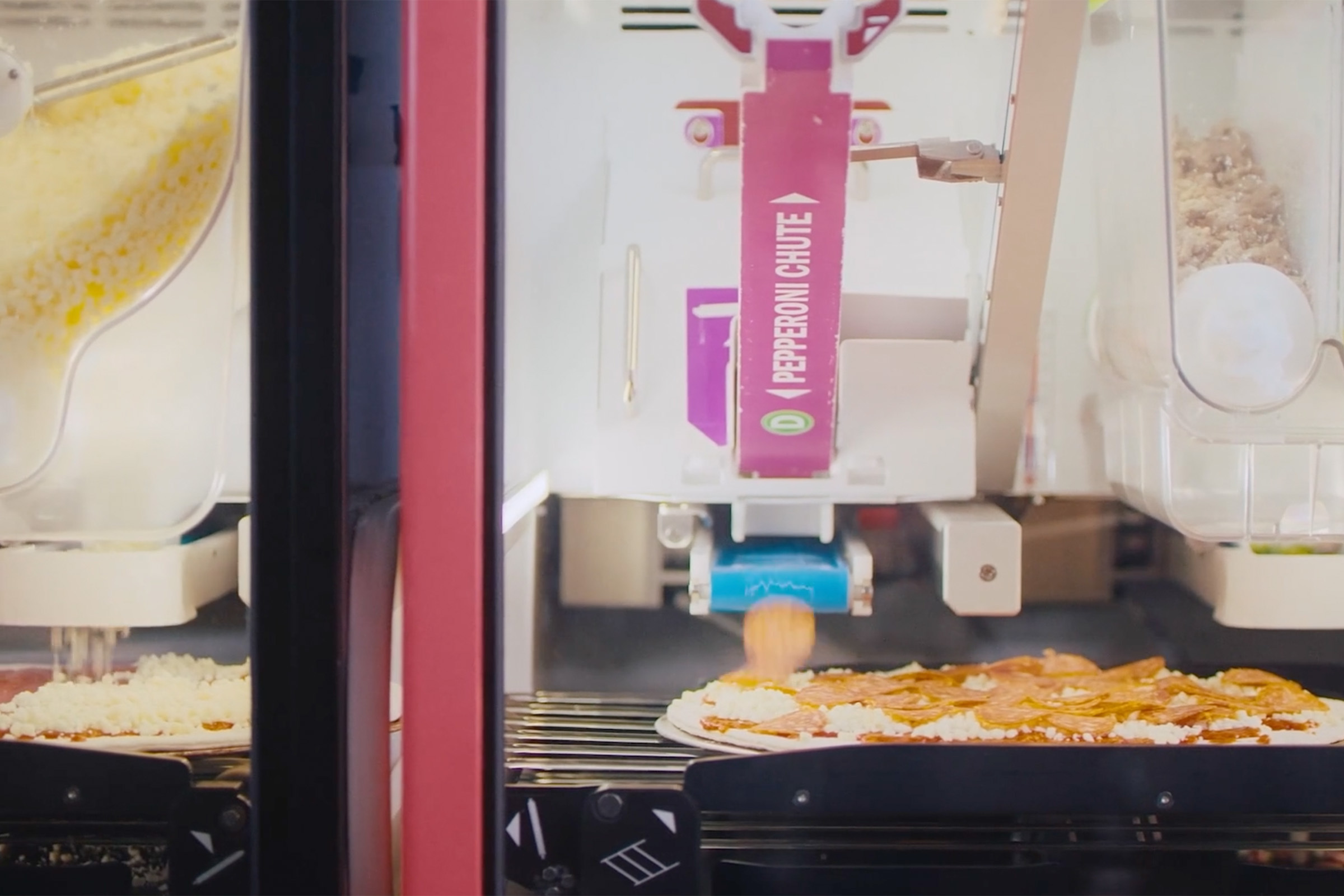
The startup’s Picnic Pizza Station, which was intended to allow a single worker to push out 100 12-inch pizzas in a single hour by robotically distributing pizza toppings, made a big splash in 2022 when the company announced a partnership with Domino’s.
The goal of a setup that allows one worker to do the work of a whole kitchen seems pretty obvious. But instead of advertising the collaboration as a way to reduce headcount, Domino’s claimed at the time that it was looking to rapidly grow its global workforce through a robot-facilitated expansion into new markets.
But warning signs soon became apparent. In 2023, Picnic was forced to lay off employees, citing the “current economic environment,” and its CEO Clayton Wood departed. His successor, Michael Bridges, left two years later as well.
It’s not the first robotics company to fail at automating pizza making. In 2023, a robot pizza startup called Zume Pizza shut down after raising almost half a billion dollars. The firm struggled for years with nagging technical issues, such as keeping melting cheese from sliding off pies that were being baked inside its moving trucks.
Meanwhile, Picnic’s most ardent supporters will now have to contend with idle robots cluttering their restaurants. Seattle-based pizza chef Lee Kindell, who owns a chain of restaurants in the city powered by the company’s tech, told GeekWire that he’s now stuck holding a $250,000 “robot aquarium” of useless machines.
“I was so pissed I started my own robot company,” he told the publication.
The rapid expansion of soft robots and smart electronic devices is driving demand for materials that can not only move and adapt, but also complete their missions without leaving behind unwanted traces. As these technologies are increasingly explored for health care, environmental monitoring, infrastructure inspection, and security applications, robots and devices are expected to operate in places where human access is limited—such as narrow pipes, sealed spaces, underground facilities, and hazardous environments.
From the shallow shores of Lake Wahlberg to the salty depths of the ocean, University of Florida researchers are dropping robots in the water and training them to communicate more efficiently in murky conditions.
SUTD researchers have developed a reinforcement-learning-based safety system that teaches a stair-traversing service robot to brace itself mid-fall, addressing one of the biggest barriers to deploying autonomous robots on staircases.
 Login
Login



 Argus defies traditional robotics by being guided exclusively by mathematical symmetry rather than biological design.