Reading view

Muon g−2 calculation sets precision record and backs the Standard Model

The most precise calculation of the muon’s anomalous magnetic moment to date has put to rest the possibility of that property revealing new physics beyond the Standard Model – at least for now. The new result, from an international team of physicists, was obtained using a new method to calculate this anomaly that is based on lattice quantum chromodynamics (QCD).

In the Standard Model (SM) of particle physics, which is currently our best theory of the fundamental forces of nature (barring gravity), the muon is an elementary particle. It belongs to the same family (of quarks and leptons) as the electron, but is more than 200 times heavier. The muon interacts with other SM particles via two of the fundamental forces – electromagnetism and the weak force.

Quarks and leptons all possess a magnetic moment that comes from their intrinsic angular momentum, or spin, and quantum theory posits that this magnetic moment is related to the spin by the “g-factor”. This quantity was originally calculated to be equal to exactly two for both the electron and muon.

Experiments over the last 50 years have detected minute deviations from this number, however. This difference, of roughly 0.1 %, is known as the “anomalous g-factor”, aµ = (g – 2)/2, and it comes from so-called radiative corrections – the continuous emission and re-absorption of short-lived “virtual particles” by electrons and muons.

Measuring such discrepancies is very important for physicists because the g-factor could point to the existence of other particles – both known and as-yet undiscovered – so hinting at physics beyond the SM. They can do this thanks to the muon. Since this particle is so heavy compared to the electron, the impact of virtual particles acting on it is significantly greater. This enhanced sensitivity means that measuring the muon g−2 is better for searching for new physics than the electron g−2.

Difficult measurements and calculations

The problem is that such calculations are not easy – all the more so because the muon’s magnetic moment also receives contributions from the strong force as well as the electromagnetic and weak interactions (even though the muon does not itself partake in strong interactions). These strong contributions come from the muon interacting with the photon, which in turn interacts with quarks that then themselves interact via the gluon — the mediator of the strong-force.

The strong force (which is responsible for binding quarks into protons, neutrons and other hadrons) is notoriously difficult to integrate into theoretical calculations, however, because it is so strong.

In the new work, the researchers overcame this problem using lattice QCD of the most uncertain theoretical contribution to the muon g−2 – the “leading-order hadronic vacuum polarization” (LO-HVP), which has been traditionally determined using experimental data. Lattice QCD, they explain, is a computational technique that simulates the strong force on supercomputers by dividing space-time into a fine grid or lattice of small cells. The equations of the strong interaction are then solved on this lattice.

To reach the level of precision required to calculate the muon g−2, the researchers improved on their previous lattice calculation using finer grids and also combined it with experimental data in the very long-distance interaction region. This hybrid approach dramatically reduced errors, so allowing for the most precise value of the muon magnetic moment ever.

“Our result together with the other contributions yields a prediction that combines three interactions (the electromagnetic, weak and strong forces), each of which require vastly different theoretical tools, into a single calculation that differs from the recent experimental measurement of aμ by only 0.5 standard deviations,” says Kalman Szabo of Penn State University in the US, who is a lead researcher on the team. “This provides a notable validation of the Standard Model to 11 digits.”

The original goal in their latest work, he explains, was to have an unambiguous and ab initio pure theoretical work to calculate the magnetic moment of the muon. “When we started, there were very strong signs that there was a tension between experiment and theory in this quantity, which would mean the presence of a new interaction.”

No tension and no new interaction

“Confirming this tension would have been – with some bias from our side – the ‘fundamental discovery of the century’”, he says. “In the end, however, our study shows that there is no tension. Thus, we did not find the new interaction but proved that quantum theory holds with an unprecedented accuracy.”

The result does not mean that new physics has been ruled out, however, he adds. Future experiments and calculations will help clarify the picture, but for now, the Standard Model holds strong.

“We now have a beautiful proof of quantum field theory and this gives credibility to any further work based on this theory,” he tells Physics World. “The accuracy is astonishing, which gives hope to answer other questions related to the strong interaction with similar or even better accuracies.

“Indeed, other groups are now racing to try to validate (or refute) our result, something that can only beneficial for the advance of our field in general.”

The research is described in Nature.

The post Muon g−2 calculation sets precision record and backs the Standard Model appeared first on Physics World.
  •  

Physicists confirm proton radius is smaller than we thought

After more than 15 years of conflicting results, two independent measurements appear to have settled the debate over the charge radius of the proton. The new measurements, which are the most precise to date and are based on protons in normal atoms, suggest that the radius is 0.8406 femtometres (10-15 m) – very close to the measured value that initiated the controversy back in 2010.

Charge radius is a measure of how far the electric charge of a particle extends into space. In protons, researchers have two main ways of measuring it. The first is by scattering electrons from hydrogen atoms, which consist of a single proton bound to an electron. The second is by analysing the Lamb shift, which slightly modifies the gap between energy levels of the hydrogen atom and arises from interactions between the electron and proton. According to the theory of quantum electrodynamics (QED), these interactions will be slightly different for electrons occupying different energy levels, so the resulting energy shift depends, in part, on the radius of the proton.

For many years, the accepted value of the proton radius – based on measurements by several groups around the world – was around 0.876 femtometres (fm). Then, in 2010, a team led by physicist Randolf Pohl at the Max Planck Institute of Quantum Optics (MPQ) in Garching, Germany performed a new measurement using muonic hydrogen. In this quasi-atomic system, the electron is replaced by its much heavier cousin, the muon. Muons are more tightly bound to the nucleus and therefore have a much higher probability of being very near – or indeed within – the proton. This makes their Lamb shift much more dependent on the proton’s radius.

Based on their measurement of the photon energy required to drive the 2S-2P transition in muonic hydrogen, Pohl and colleagues calculated that the proton’s radius was 0.8418 fm with an uncertainty of 0.0007 fm. This value disagreed substantially with previous measurements and was well outside the error bars of earlier results.

Physicists found this concerning because it implied that either QED theory had been misapplied or that the Standard Model of particle physics was somehow lacking. These concerns increased as subsequent measurements (on normal as well as muonic atoms) by various other groups produced some results that agreed with the 2010 finding, but also others that did not.

New measurements also yield a radius of about 0.84 fm

Both new studies involved placing hydrogen atoms in a vacuum and using laser light to control and measure transitions between different electron energy levels. In one of the studies, Thomas Udem and colleagues at MPQ measured the 2S-6P transition in atomic hydrogen with a precision 2.5 times higher than previous measurements, reaching the five sigma (5𝜎) threshold commonly used as a benchmark in the field. Thanks to this precision, they were able to test the Standard Model’s predictions to 0.7 parts per trillion (ppt) and the bound-state QED corrections to 0.5 parts per million (ppm).

The 2S-6P transition involves a single photon, which means it has fewer systematic corrections than the more commonly probed two-photon resonances. “Lower systematic corrections lower the possibility of making errors in those corrections,” notes MPQ team member Lothar Maisenbacher.

The downside is that the linewidth of the transition is very large compared to the precision the team needed to reach, but Maisenbacher says they were able to overcome this. “We succeeded in finding the centre of the resonance at 1 part in 15 000 of its width, which is (as far as we know) a world record for laser spectroscopy,” he tells Physics World.

The other work, by Dylan Yost and colleagues at the Colorado State University in the US, involved measuring three two-photon transitions (in 2S-ns, with n being between 8 and 10) that had not previously been studied for this purpose. Yost describes these transitions as “nice” because they are intrinsically narrow. “Generally speaking, narrower lines can be measured more precisely,” he explains. “This has us very excited that we may be able to really push our technique to higher precision with some modest additional technical improvements.”

The Colorado State researchers say that the three measurements they made were “very precise and agreed very well with each other”. By combining these results, they produced the most precise values for the proton radius to date based on two-photon spectroscopy, complementing the one-photon method used in the MPQ group’s 2S-6P measurement.

“Our new measurement, together with the new result from the Garching group and the muonic hydrogen measurements, are now the most precise spectroscopic measurements of the proton radius and all show extremely good agreement,” says Yost. “Personally, I find it remarkable that the theorists working on the required bound-state QED calculations have been able to make such accurate and reliable predictions and that these predictions have now been tested and show agreement at the parts-per-trillion level.”

The most precise spectroscopic measurements of the proton radius

According to Meisenbacher, the 2010 muonic result has now been thoroughly tested, and the proton radius puzzle has been resolved in a way that suggests that both the Standard Model and QED theory remain valid. “Our result also confirms that muonic spectroscopy is a powerful tool for studying nuclear properties,” he says. “Indeed, the community is working on extending it to heavier atoms.”

Both groups now want to repeat their measurements in atomic deuterium, where the nucleus contains a neutron as well as a proton. A similar discrepancy exists in this nuclear charge radius and measuring it precisely could reveal a hitherto undetected interaction between the electron and the neutron that is not included in the Standard Model.

The post Physicists confirm proton radius is smaller than we thought appeared first on Physics World.

  •  

Physicists spot signs of an atom-like system bound by the strong force alone

Signs of an exotic atom-like system made up of a neutral meson bound to an atomic nucleus via the strong interaction have emerged in experimental data from two international collaborations. If confirmed, this hitherto unobserved system could shed light on the origins of hadron masses and provide new insights into the fundamental symmetries of quantum chromodynamics in nuclear matter.

The strong interaction is one of the four fundamental forces of nature, alongside gravity, electromagnetism and the weak interaction. It is responsible for binding quarks into hadrons, which are three-quark particles such as protons and neutrons, and for holding protons and neutrons together within atomic nuclei. Electrically neutral mesons – short-lived particles made up of a quark and an antiquark – are likewise subject to the strong interaction, which can bind them to atomic nuclei in a way that is conceptually similar to an electron bound to a nucleus by the electromagnetic force.

Studying these meson-based nuclear systems is important because it helps us better understand the properties of the strong interaction, says study co-leader Yoshiki Tanaka of RIKEN in Japan. The eta prime meson, η′, is particularly interesting, Tanaka adds, because its relatively large mass cannot be explained by a simple quark model. “This U(1) problem, as it known, was raised as long ago as the 1970s by the physicist Steven Weinberg,” he notes.

Direct experimental access to the 𝜂′-meson mass in nuclei

Modern theories attribute the η′ meson’s large mass to the presence of chiral symmetry breaking in quantum chromodynamics, which is the fundamental theory of the strong force. These theories predict that this mass should be reduced in a nuclear system, and this is what Tanaka and colleagues set out to test.

“Spectroscopy studies of 𝜂′-mesic nuclei provide direct experimental access to the 𝜂′-meson mass in nuclei and offer a unique opportunity to investigate the underlying mechanisms of how the mass of hadrons comes about,” he explains.

In the team’s study, a beam of protons strikes a ¹²C atomic nucleus at near-relativistic speeds and removes a neutron from it. This neutron, together with a proton, forms a deuteron that propagates away in a forward direction, leaving behind a nucleus of ¹¹C in a highly energetic state. It is this excess energy that gives rise to an 𝜂′-meson.

WASA experiment
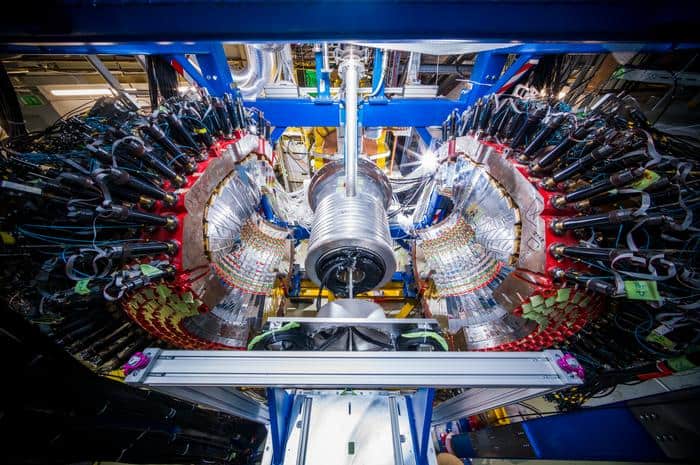
The experimental setup WASA in maintenance position. (Courtesy: J. Hosan, GSI/FAIR)

In rare cases, the researchers explain, the meson then binds to the ¹¹C nucleus, forming an 𝜂′-mesic nuclear system. But because these events are so rare, they are hard to find. “One of the major challenges we encountered in the work was the very large amount of background events we registered during our measurements,” Tanaka recalls. “These were about 100 to 1000 times higher than the signal events.”

The researchers overcame this problem by developing a new experiment that allows them to efficiently select signal events associated with the formation of 𝜂′-mesic nuclei by “tagging” the particles they decay into. This enabled them to measure not only the forward-travelling deuteron, but also the decay products of the short-lived 𝜂′-mesic nuclear state.

The researchers say that their results, which they describe in Physical Review Letters, indicate that the 𝜂′-meson mass drops by about 60 MeV in nuclear matter. “This result qualitatively supports the theoretical scenario [that attributes] the origin of the 𝜂′-meson mass to chiral symmetry breaking together with the dynamics of gluons (massless particles that mediate the strong nuclear force) in general,” Tanaka says.

Members of the team, which also includes researchers from the η-PRiME Collaboration and the Super Fragment Separator Experiment Collaboration, together with physicists from Justus Liebig University Giessen in Germany with their working groups GSI/FAIR, say they are now planning follow-up experiments to confirm that they have indeed observed 𝜂′-mesic nuclei. “We also aim to increase the significance to the 5σ level, which is required to firmly establish the discovery on new quantum states in particle and nuclear physics,” Tanaka says.

The post Physicists spot signs of an atom-like system bound by the strong force alone appeared first on Physics World.

  •  

New W boson mass measurement agrees with Standard Model predictions

Physicists have determined the mass of the W boson with the highest precision yet by analysing more than a billion proton collision events at CERN’s Large Hadron Collider (LHC). The new result confirms a prediction from the Standard Model of particle physics while refuting a comparably precise measurement made by Fermilab’s CDF Collaboration in 2022. This is significant because the older measurement, which used data from the defunct Tevatron collider, differed from the Standard Model’s predictions by seven standard deviations, suggesting that the W boson might be far heavier than the model allows.

The W boson is one of two elementary particles that acts as a carrier for the weak force (the other is the Z boson). As one of the four fundamental forces in nature, the weak force is what allows protons to change into neutrons (and vice versa), making it the driving factor behind radioactive decay and nuclear fusion. Precise measurements of the W and Z boson basses are therefore important for understanding these processes as well as for testing the Standard Model.

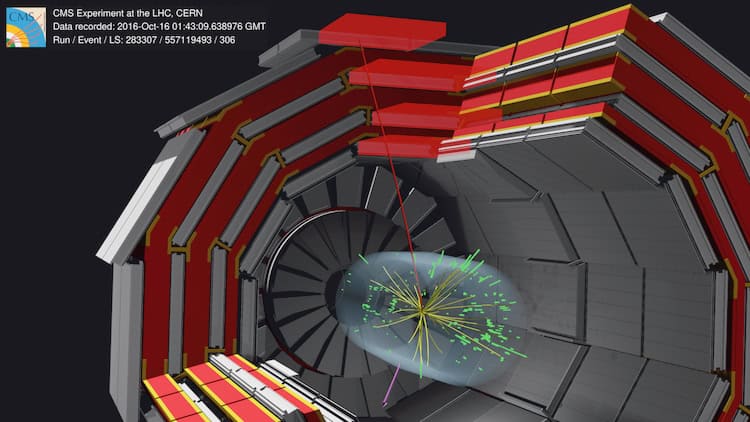
Diagram of the CMS detector during a detection event
Particles incoming: An event picture showing how the researchers present their recordings digitally to illustrate the detector readings. (Courtesy: C Paus)

While physicists have measured the mass of the Z boson to an extremely high precision of 22 ppm (or 2.0 MeV), measuring the mass of the W boson with the same exactitude has proven more difficult. The main hurdle is that the W boson cannot easily be detected in colliders such as the LHC because it decays almost instantly. Scientists can look for its decay products instead, but that, too, is awkward. In one important channel, for example, it decays into a neutrino and a muon – and neutrinos are even more elusive than W bosons.

A fading mystery

In the new work, CERN’s Compact Muon Solenoid (CMS) Collaboration studied more than a billion proton collision events produced at the LHC in 2016. Amongst these, they identified 100 million as producing a W boson that decayed into a neutrino and a muon.

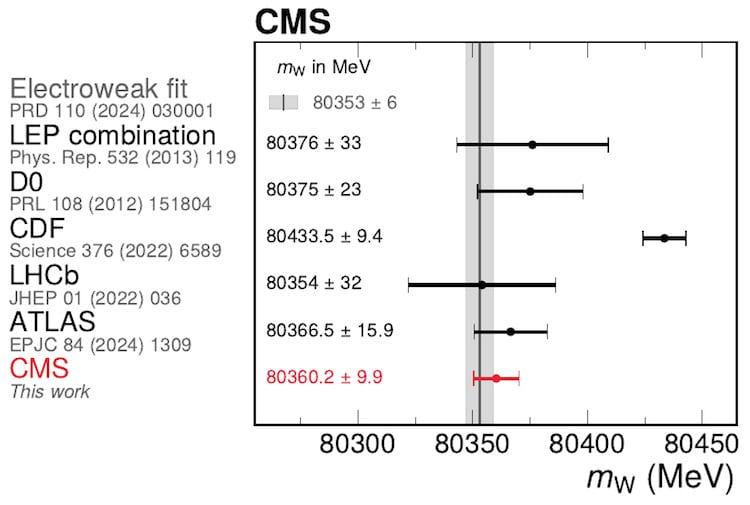
A comparison of the most recent W boson mass result split by experiments (LEP is four experiments combined). Courtesy: C Paus

By analysing these events and simulating all the possible scenarios that could produce them, they measured the mass of the W boson to be 80360.2 ± 9.9 MeV. This is significantly less than the CDF Collaboration’s measurement, but it agrees with other previous experiments. Importantly, it also lies within the range the Standard Model predicts, leaving the CDF result – the most precise measurement before this one – looking like an outlier.

“If you take the CDF measurement at face value, you would say there must be new physics beyond the Standard Model,” says Christoph Paus, a physicist at the Massachusetts Institute of Technology (MIT) in the US and one of the lead investigators of the CMS Collaboration. “And of course, that was the big mystery.”

Now that the new, even more precise measurement agrees well with predicted values for the W boson mass, that mystery is fading, Paus tells Physics World.

Some physicists may find this disappointing. However, study lead author Kenneth Long, who was a senior postdoc in MIT’s Laboratory for Nuclear Science at the time and has since moved to a research position in Lyon, France, says the new result is “just a huge relief to be honest” and “a strong confirmation that we can trust the Standard Model”.

A starting point for precision measurements

To obtain their result, the CMS researchers needed to measure the momentum of the muon and use it to infer the W boson’s mass. This is possible for two reasons. The first is that in the W’s rest frame, its decay energy is shared roughly equally between its two daughter particles (the muon and the neutrino). The second is that muons are charged leptons, and the strong magnetic field inside the CMS detector makes them travel in a path whose curvature is a function of their momentum.

“The momentum is different to the mass, of course, but is strongly correlated with it,” explains Paus. “The challenge is therefore to track the path of the muon and every possible interaction it could have with other particles and its surroundings to estimate a value for its initial momentum.”

The CMS experiment had long planned on doing such a measurement, but it took a while to set up. Now that the measurement is complete, Paus, whose MIT group joined the W boson mass analysis effort in earnest at the end of 2020, describes it as an important starting point for the collaboration. He explains that the result proves it’s possible to measure the W boson in what he calls a “high pile-up environment”, meaning one where many proton-proton collisions overlap in a single recording, without using the Z boson mass as a calibration (as was previously done in analyses at hadron colliders). “It has put the CMS experiment finally on the map for an electroweak precision measurement of this kind,” he says.

The CMS researchers are now collaborating with experimentalist colleagues at CERN’s ATLAS and LHCb detectors, as well as their theorist partners, in hopes of setting a new standard in electroweak precision physics. Their measurement is published in Nature.

The post New W boson mass measurement agrees with Standard Model predictions appeared first on Physics World.

  •  

Gap in neutrino energy spectrum raises questions about cosmic environments

A new analysis of data from the IceCube Neutrino Observatory suggests that the energy spectrum of cosmic neutrinos is more complex than was previously thought. Whereas a previous study found that the energies of these ubiquitous, nearly massless particles follow a simple power law distribution, the latest analysis reveals a knee-like bend in the spectrum at around 30 TeV. The discovery could help astrophysicists better understand where cosmic neutrinos come from and what objects and processes in the universe are producing them.

Neutrinos are subatomic particles that are around a million times less massive than electrons. They are known to come in (at least) three different “flavours” – electron, muon and tau – but they have no electrical charge, and they interact with matter only rarely, via the weak nuclear force and gravity. This means they can travel vast distances through the universe without being deflected by magnetic fields or absorbed by interstellar material along the way.

Astrophysicists think cosmic neutrinos are produced in collisions between high-energy cosmic rays and other particles. Since cosmic rays are accelerated by a range of astrophysical sources – including gamma-ray bursts, active galactic nuclei powered by supermassive black holes, and other extreme cosmic processes – the neutrino spectrum is a way of gleaning information about where these sources are and how they work.

The catch is that because neutrinos interact so weakly, they must be studied using detectors with a very large volume. For this reason, neutrino scientists often use natural structures such as deep water or expanses of ice to support their detectors. These locations also have the advantage of being shielded from muons, cosmic rays and other sources of background noise.

Measuring neutrinos since 2010

The 5000 optical sensors that make up the IceCube observatory are suspended within a cubic kilometre of Antarctic ice. They are designed to detect the telltale flashes of visible and ultraviolet light that occur whenever a neutrino interacts with a molecule of ice. During these rare detection events, the neutrino either leaves behind an elongated track or produces a “cascade” in which its energy is contained in a small, spherical volume inside the ice.

IceCube’s detectors have been operating since 2010 and the earliest data they produced suggested that the energies of the detected neutrinos followed a single falling power law distribution. Researchers were initially pleased with this result because it agreed with simple models that related cosmic neutrinos to cosmic rays, says Aswathi Balagopal V, a postdoctoral researcher at the University of Wisconsin, US, and a member of the IceCube collaboration. These models suggested that cosmic ray acceleration takes place exclusively in so-called shock environments where collision events produce neutrinos.

In the new work, Balagopal V and colleagues performed two different, independent, types of analysis on more than 10 years’ worth of neutrino observations in the 1 TeV to 10 PeV range. The first analysis involved measuring a sample of neutrino cascades and a sample of neutrino tracks in the detector. The team then combined the results of both sets of measurements to characterize the neutrino spectrum.

The second analysis used a new event sample consisting of neutrinos with “interaction vertices” inside the detector. “This sample therefore contains neutrinos of all flavours,” explains Balagopal V, “and we performed a fit to the energy spectrum using these events.”

Both analyses arrived at the same conclusion, rejecting a single power law distribution with a confidence of more than 4𝜎 (the usual maximum confidence being 5𝜎). The best fit for the data was instead a broken power law, with the spectrum of neutrino energies falling more steeply at higher energies than at energies below around 30 TeV, Balagopal V tells Physics World.

“This implies that there are fewer lower energy neutrinos when compared to what one would obtain with a simple extrapolation of the prediction from higher energies,” she says. “This changing shape of the spectrum can indicate several things: either a changing population of cosmic neutrino sources; or a change in their production mechanism.” If cosmic neutrinos come from more than one kind of astrophysical source, she adds, then each type may be accelerating cosmic rays in a different way.

A final option, Balagopal V notes, is that some theories suggest that interactions with dark matter can also produce such a spectral feature. “With these measurements, we have opened up the possibility of discoveries in any of these directions,” she says. “With more detailed analyses, we could identify if there are additional features in the energy spectrum and we are already analysing new IceCube data to this end.”

The post Gap in neutrino energy spectrum raises questions about cosmic environments appeared first on Physics World.

  •  
❌