For years, software developers on H-1B visas benefited from steady demand among US technology employers. That market is becoming more selective as companies redirect spending toward AI and rely more heavily on coding assistants.
Recent layoffs at companies including Meta and Amazon have added to the uncertainty, with engineering and software roles affected even as major technology companies continue to deepen investments in AI.
Developers and analysts say traditional engineering roles are becoming harder to land, recruiters are asking more often for AI-related experience, and workers are being pushed to keep pace with tools such as GitHub Copilot, Claude, and ChatGPT.
The shift is being driven by both AI investment and broader economic uncertainty, according to Pareekh Jain, CEO of Pareekh Consulting. Companies are changing the profile of the developers they want, hiring fewer people in some areas while paying more for AI talent.
“AI investments are changing company hiring strategy,” Jain said. “They require a different profile, fewer numbers, and also across geographies.”
This shift is colliding with a tougher sponsorship environment for H-1B developers.
Jain said companies are more selective about hiring visa-dependent workers than they were two or three years ago, especially when permanent residents and US citizens are more available in the market.
“Companies are not looking for H-1B now,” Jain said. “They are building a local workforce and preferring green card holders and citizens.”
Employers may now be more likely to consider H-1B candidates only when they have immediate project needs, rather than building a longer-term bench of visa-dependent workers.
Concerns are visible in public forums used by technology workers. In one January post on Blind, an anonymous senior software engineer with seven years of experience said she had been laid off while on an H-1B visa and was “not interview-ready,” highlighting how quickly job loss can become a visa problem for H-1B workers in the US.
Junior developers face the squeeze
The combination of AI tools and tighter hiring is hitting early-career developers hardest, said Adarsh ML, a product engineer at Ather Energy who tracks global engineering hiring trends.
“Companies are increasingly looking for specialized engineers with machine learning and data science skills,” Adarsh said. “Job opportunities for people with zero to three or four years of experience are not really there anymore.”
The shift is also changing team structures, Adarsh said. Earlier, one manager may have had two or three interns and several freshers reporting to them. Now, many of those roles are being replaced by AI agents.
“Companies now want people who understand software well enough to catch the mistakes these AI agents make,” Adarsh said.
That creates a longer-term risk for the software talent pipeline.
“If companies only want people with five years of experience to manage AI agents today, who will have that experience five years from now?” he said. “There may not be enough experienced developers left.”
AI literacy becomes baseline
The impact is not the same for every role. Sophia James, an Indian software professional based in the US who works in database monitoring, said AI has not significantly changed her team’s daily workflow. But AI literacy is becoming a management expectation.
“Managers are trying to understand whether we are keeping up with the changes happening in the market,” James said. “Recently graduated students, whether BS or MS, are finding it difficult to get jobs. But people who already have jobs, like us, are not facing that much of an issue in terms of projects continuing.”
Jain also stressed that AI literacy is now becoming a baseline expectation for software developers, even outside AI-focused roles.
“Being AI-literate is a must now, even if the role is not directly in AI development,” he said. “This is like knowing Excel even if you are not from finance in the earlier era.”
Fewer developers required
Jain said AI coding tools are likely to reduce the number of developers companies need for similar tasks, making the technology deflationary for some software work.
But Jain added the impact may not be entirely negative. Enterprises will need to invest in data, cloud, and modernization to become AI-ready, creating new work. AI could also encourage companies to build more applications internally instead of buying from SaaS providers, potentially creating opportunities for IT services firms.
The effect is already visible in hiring decisions. Nikhil Dhiman, head of engineering at CarInfo, said AI is changing the economics of early-stage software development, particularly when companies are building proofs of concept or testing new ideas.
“Some companies are very cautious now,” he said. “They want to leverage AI more and hire less. They just want to see the impact first.”
Navigating the new hiring market
Familiarity with tools such as ChatGPT and GitHub Copilot is now a baseline requirement for developers, said Sanchit Vir Gogia, chief analyst at Greyhound Research.
Developers need deeper expertise in areas such as cloud infrastructure and data engineering, as well as security and AI governance, he said. Those skills are closer to the systems enterprises need to validate and scale, rather than the routine coding work AI tools are starting to compress.
“The engineer who only produces output grows easier to replace as the output grows easier to generate,” Gogia said. “The engineer who can validate it, secure it, situate it in a real business, and stand behind the result becomes harder to replace.” For H-1B developers, he said, adaptation also requires visa planning. Developers should understand portability rules and employer sponsorship timelines before a job loss forces urgent decisions.
“A high-skilled worker has up to 60 days after a role ends, and the right to begin new employment the moment a valid portability petition is filed,” Gogia added. “The strategic error is treating that window as a safety net rather than a planning horizon.”
Tech companies seem to be falling over each other these days in firing people to either replace them with AI or to pay to build AI infrastructure. Wouldn’t it be nice if they at least waited until AI actually worked for business?
On the one hand, top tech businesses such as Amazon, Block, Cisco, Cloudflare, and Meta have all announced that they’re slashing payrolls — either because AI can do the same work as people or they need the cash to build out their AI infrastructure. Isn’t that great? All together, of the 37,638 tech job cuts so far this year, 47.9% — almost half — can be tracked back to AI.
On the other hand, despite all the AI hype and hysteria, no one has yet proven that AI is, generally speaking, really all that helpful for businesses. Oh, I know, I know. You did great things with OpenClaw vibe programming. Microsoft’s CEO, Satya Nadella, claims 20% to 30% of the company’s code was written by AI. And Nvidia assures us that 88% of its surveyed customers report AI has increased their revenues.
But really, what else would they say? “Dear Board, we just blew half a billion bucks on Nvidia GPUs, and we’re losing money hand over fist?” I don’t think so.
Now, I have to acknowledge that AI is finally becoming truly helpful in business. As a guy who knows a thing or two about programming, Linus Torvalds, creator of Linux and Git, said at Open Source Summit North America, “I’m personally 100% convinced that AI is changing programming.” He estimates that “AI will increase your productivity by a factor of 10.”
But is that reason enough to slash make workforce cuts of between 10% to 40%? (Short answer: No. Longer answer: Noooo!)
It’s not just the mass firings. Workers who are either awaiting the axe, or have escaped it for the moment, are miserable. As one Meta employee told The San Francisco Standard, “I tend to cry in the shower,” and, “A lot of my feelings about my job are about the general chaos and not just the layoffs. ”
So, explain this to me: When everyone knows AI-driven layoffs are coming, exactly how well do you expect them to work? You really think they can give their best?
Making matters worse, it’s an open secret that IBM, Google, and Meta are having their employees train their AI replacements. As a popular meme puts it, workers are now “building your own coffin.” Is it any wonder that a lot of people — 29% of all employees and 44% among Gen Z workers — are deliberately sabotaging work when the boss insists they train their AI replacements?
It also sure doesn’t help office morale when the CEO keeps saying AI will replace half of all employees. A particularly egregious example of this was when Standard Chartered CEO Bill Winters proclaimed his bank would slash thousands of jobs and replace “lower-value human capital” with AI.
He’s since backed off the claim, but come on — we all know he meant it. Just like all the other CEOs who’ve said similar things, between FOMO and the knowledge that AI job news is sure to make the stock price jump, they’re eager to cut headcounts and boast about how successful AI will make them.
What happens a few quarters down the road? Their attitude today seems to be let tomorrow take care of tomorrow. I hate to tell them, but that really doesn’t work in the long run. (Not, mind you, that a future much farther ahead than the next quarter seems to matter much anymore to business executives.)
It should. As a recent Deloitte study stated: “Most respondents reported achieving satisfactory ROI on a typical AI use case within two to four years. This is significantly longer than the typical payback period of 7seven to 12 months expected for technology investments. Only 6% reported payback in under a year, and even among the most successful projects, just 13% saw returns within 12 months.”
AI, in short, is not the miracle cure for what ails businesses that its fans claim.
Will that stop businesses? I doubt it. While I appreciate that California Gov., Gavin Newsom is trying to bandage the AI job bleedout by mandating studies on subsidizing companies to keep employees rather than replace them with AI, I doubt that will do much to staunch the wound.
At the Open Source Summit North America, Linux Foundation CEO Jim Zemlin was optimistic about AI and jobs. He pointed out that, thanks to AI becoming “pretty damn good coders,” the number of open-source projects on GitHub has led to a “surge of new code and projects.”
Zemlin also believes that while few developers will write code, “engineers will still design, review, secure, and integrate that code.” (He’s referring to what’s becoming known as forward-deployed engineers.) This, in turn, will supposedly lead to tech job growth.
I’d feel a lot better about that prediction if I believed the C-suite suits at most companies were capable of truly forward-looking thinking rather than focusing entirely on hiking the stock price by making the next quarter look good through staffing cuts.
In the long run, sure, AI will make us more productive. But, we’re not there yet. For now, companies need to keep employees happy, not shove AI down their throats — and work out carefully and thoughtfully how AI will really work for business.
In this competitive market, gen Z has started to turn to untraditional ways to land a job – including dating apps
Sibusisiwe Khupe, 26, entered the job market once again in September after a wave of unexpected layoffs at London marketing agency Wieden+Kennedy.
She knew landing her next full-time role was not going to be easy. Young workers have been hit hard by the weakening UK job market as vacancies fall and unemployment climbs to a five-year high.
Recent college grads are not very fond of commencement speakers hyping up a technology they see as a threat to their career prospects
When Jacob Pagel graduated from Middle Tennessee State University this spring, predictions about artificial intelligence already had him questioning the value of his degree. Then a music executive started preaching about AI’s transformative power during a commencement speech.
“This industry will change on you in a heartbeat. It has already changed more in the last 10 years than in the 50 years prior … AI is rewriting production as we sit here,” said Scott Borchetta, CEO of the record label Big Machine. After a few stray boos from graduates, he doubled down: “Deal with it.”
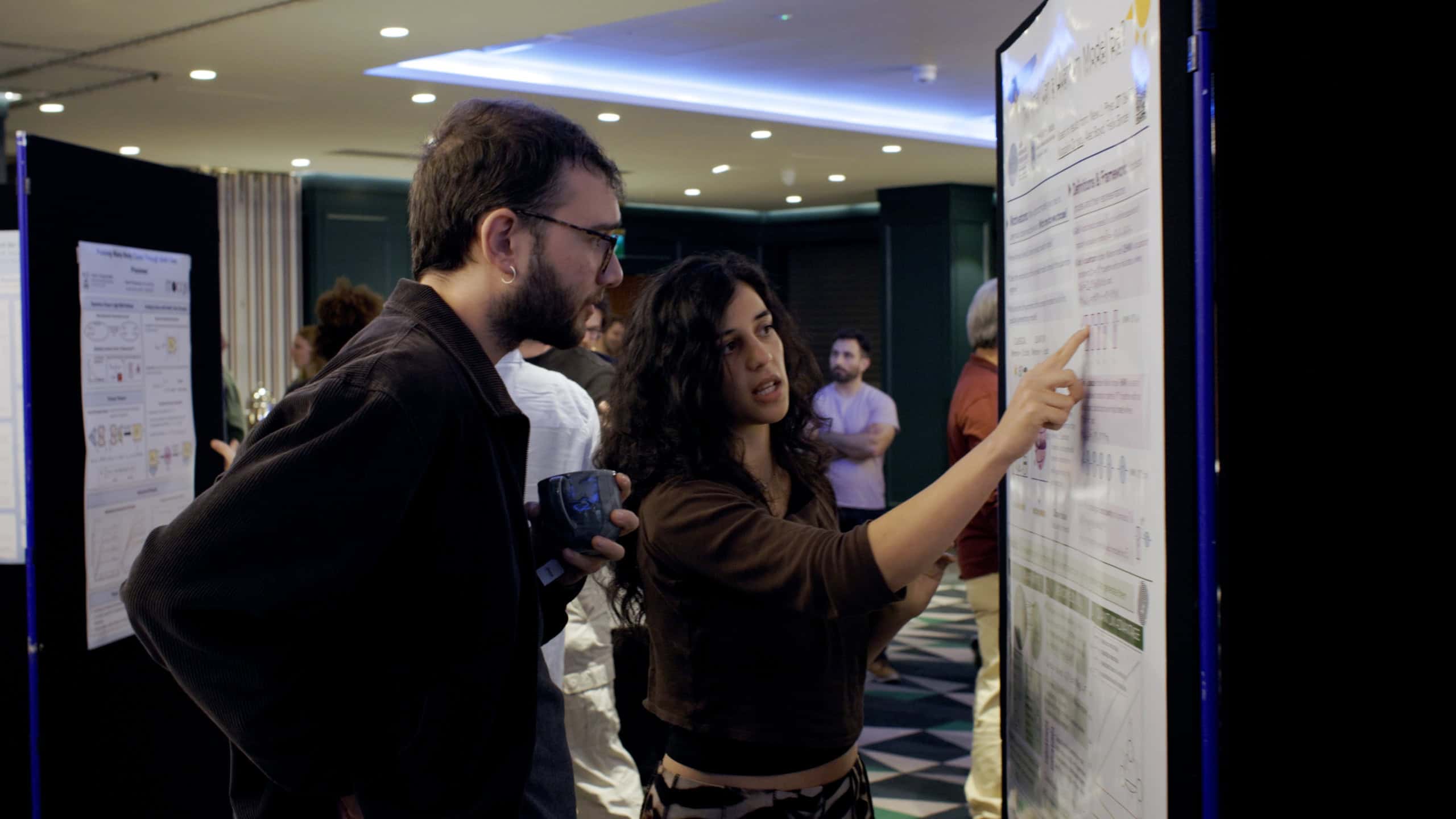
Graduate students at Trinity College Dublin. (Courtesy: Matt Boyd/Mahoo)
The impact of quantum science and technology is going to be profound, with quantum computing in particular – but also quantum sensing, simulation and communication – set to be a major driver of economic growth and sustainable development in countries around the globe.
Ireland is no exception. It is already home to some of the world’s largest technology companies, many of which are heavily investing in quantum technologies. Moreover, the country’s quantum research and innovation community demonstrates a significant level of expertise in fundamental quantum science and quantum technology.
But to ensure Ireland is not only a user of quantum technologies but an active contributor to its development long into the future requires both strong partnerships with industry and public research bodies across borders, and the consistent production of people with the talent and skill to push quantum science forward.
Transferable skills across academia and industry
Founded in 1592, Ireland’s oldest university Trinity College Dublin hosts a future-focused MSc Quantum Science and Technology programme that fits this remit perfectly. The one-year master’s course is the ideal stepping stone into a career in quantum research, whether students want to advance fundamental knowledge in academia or develop the next world-leading quantum technology in industry.
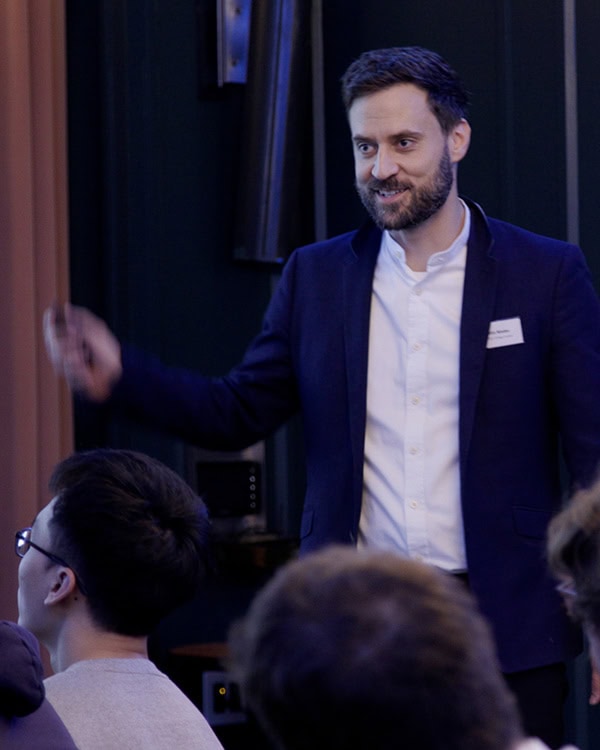
Professor Felix Binder Course Director of Quantum Science and Technology MSc, Trinity College Dublin. (Courtesy: Matt Boyd/Mahoo)
“Unlike other fields, for many of the exciting positions in industry, the skills are very similar to what would be required of a PhD student,” explains quantum information theory expert Professor Felix Binder, who directs the course. “It’s a level of scientific rigour, it’s having a broad knowledge base and coding skills, it’s being confident to independently work on a project – these are what we focus on.”
This is why the course very much leans into helping students develop the fundamentals. Topics such as quantum computation, quantum information theory and open quantum systems are covered in depth. This provides the foundation for exploring more advanced and specialized topics, like quantum materials or tensor network theory.
The combination of fundamentals and highly specialized knowledge is designed to equip students with skills that are relevant for the long term, says Binder. Though he acknowledges that now is an exciting time when many quantum technologies are maturing and being commercialized, the course generally looks beyond the latest fads.
“If students are choosing quantum as their profession, realistically they’re looking at a potential 40-year career,” he says. “As this is their last part of formal lecture-based education, we want to be sure that we set them in good stead for at least many years, and not just the immediate future.”
Career insights
In addition to preparing students with the knowledge they will need, the course also exposes students to people working at the cutting-edge of the subject, providing them with an understanding of the types of careers available and contacts to build their network and take the first steps towards their chosen quantum profession.
For instance, world-leading academic and industry experts deliver a range of short mini-modules and specialist lectures. Some of these experts come from companies involved in the Trinity Quantum Alliance. “The Trinity Quantum Alliance is a unique space on campus where fundamental quantum science and research meets real-world applications,” says the Alliance’s Director Professor John Goold. “Here, multinational companies, SMEs and start-ups come together to work on projects with Trinity academics.”
The founding industry partners are Microsoft, IBM, Moody’s, Horizon Quantum Computing and Algorithmiq. Each partner shares research and regularly presents talks to faculty and students, and most have a presence on or near the Trinity campus. This arrangement offers students direct access to the people shaping the quantum revolution, as well as potential internship opportunities.
Microsoft Ireland scholarship awardees2023/24 Srishti Nautiyal, Grainne Eager and Nana Werther. (Courtesy: Gary Ashe/SHARPPIX)
Further experts who have given guest lectures and shared their experiences are alumni. Several are completing PhDs at various universities dotted across the world, from the EU to the US and Australia. Many have gone on to become full-time researchers and even team leads in quantum companies, including Quandela, Horizon, Algorithmiq and EleQtron, as well as companies traditionally not associated with quantum technology, such as MasterCard. Others have taken positions at government labs across European countries, including a Max Planck Institute in Germany and a national research centre in the UK.
Although this alumni network may be relatively small – with the course having only been running for five years and graduating 60 students – it is extremely useful for the current cohort, showcasing the different paths potentially available to them and providing contacts who can offer support and advice on how to enter and thrive in those careers.
A quantum future for the Emerald Isle
Looking forward, Binder envisions even closer integration of the MSc degree and doctoral training into the European quantum ecosystem. This will be enabled through a new EU-wide training network: the European Quantum Academy. Trinity is one of the lead institutions of this new training academy, which was launched in May 2026. Composed of more than 70 partner institutions from across Europe, it will open new opportunities to students in Ireland in terms of industry interaction, international exchange and advanced training beyond the degree’s core modules.
In addition, there are ongoing plans for further research investment in Ireland, bringing together the different schools within Trinity, and other universities and industry players to work more closely together.
The result of these efforts should be a thriving quantum ecosystem that takes advantage of Ireland’s unique position within the EU and close ties with the US and UK to provide ever more new and varied opportunities in quantum science and technology, as Binder succinctly summarizes: “The field is young and growing – Ireland is a very exciting space for quantum right now”.
MSc students in Dublincity centre Trinity College campus, in close proximity to many of the world’s largest tech companies. (Courtesy: Matt Boyd/Mahoo)
Applications for Trinity’s MSc Quantum Science and Technology are now open for the next academic year. Find out more and apply: www.tcd.ie/physics/quantumtech/
Quantum technologies are undoubtedly going to have a large impact on our world, potentially revolutionizing everything from healthcare and the environment, boosting the economy and helping with large-scale optimization challenges. But for them to deliver on these many promises, it will be vital for many countries to train and build a quantum-ready workforce.
There are four pillars to the quantum sector – quantum computing; quantum simulation; quantum communication; and quantum sensing and metrology. But in each case there is a lack of trained individuals who can take on jobs across the board. Indeed, statistics in both the UK and the US suggest there is only one qualified worker for every three quantum jobs. With governments continuing to invest lots of money into national quantum programmes; a growing number of new quantum start-ups being launched; and ever more multi-national firms zoning in on quantum, the shortage of those with the right skills to work across the sector is expanding.
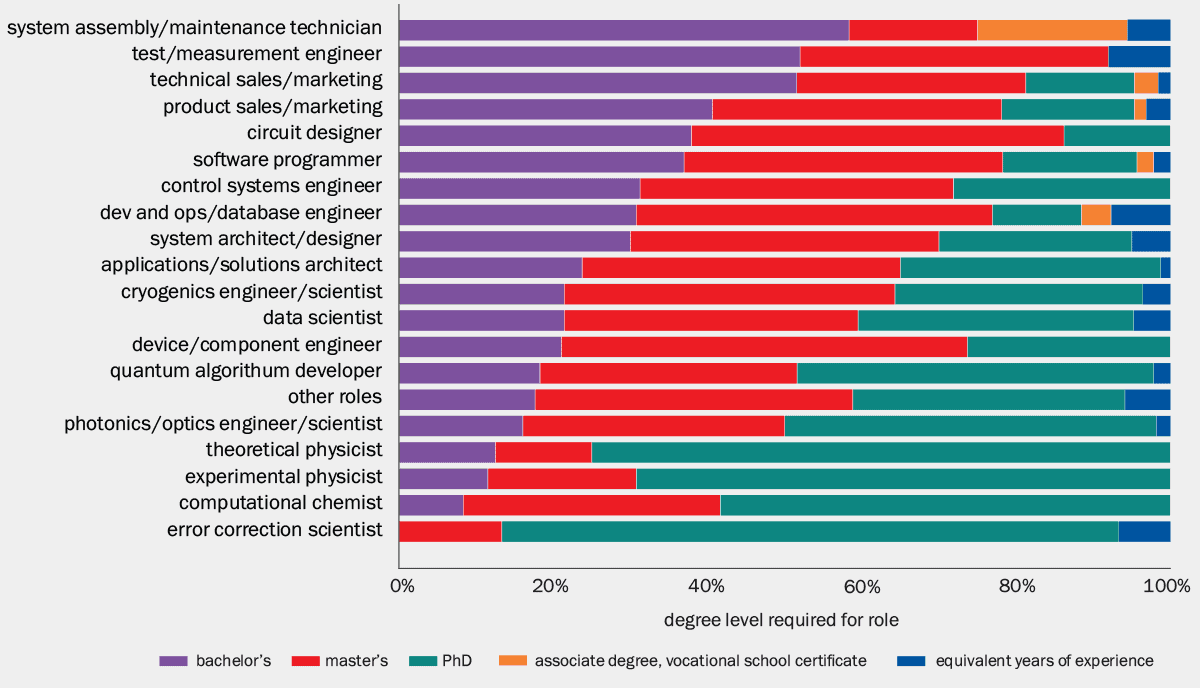
The Colorado School of Mines in the US is now trying to remedy this situation by launching the country’s first bachelor-level quantum systems engineering degree programme, due to start this autumn. An undergraduate degree specializing in quantum and systems engineering might, at first glance, seem odd. But 2021–2023 data from the Chicago Quantum Exchange show that 55% of quantum tech jobs only require a BSc or two-year associate degree. For instance, roles that ask for just a BSc include systems assembly and maintenance, measurement engineers, technical sales and marketing.
“Industry demand especially values engineers with a systems-level understanding of quantum devices, and there is also a need for quantum technicians who can build and maintain quantum hardware,” says Frédéric Sarazin, director of the quantum programme at Colorado School of Mines. As the first standalone bachelor’s degree in quantum systems engineering in the US, the programme is designed specifically to supply industry-ready graduates.
True requirements Distribution of degrees needed for different job roles in the quantum industry. (CC BY 4.0 IEEE Transactions on Education65 592)
The main focus for Sarazin and colleagues was to bring into the programme key aspects of systems engineering – which involves understanding and overseeing all aspects of a complex system, from its inception through to practical production, and even managing the final product. The goal: to help companies get their products and technologies out of the lab and into the marketplace. Rather than focusing on isolated components, systems engineers are trained to understand how complex technologies behave as integrated entities.
“A quantum computer, for example, is more than just its qubits,” says Sarazin. “It’s cryogenics, optics, electronics, control software, signal processing and the user interface, all interacting with each other.” Companies are keen to hire people who can understand and help develop their quantum product as an end-to-end system, bridging the gap between the physics and engineering aspects, as well as making sure the end product is robust, scalable and manufacturable.
The physics may be what Sarazin calls the “secret sauce” – but turning it into a device that is reliable, manufacturable and maintainable is an engineering problem “with a quantum flavour to it”. “What companies want is people who understand the product as a system, from beginning to end,” Sarazin explains.
Quantum hotspot
Colorado, in America’s mid-west, is a quantum innovation hotspot, with quantum companies employing more than 3000 people across the state. To develop the new programme, Sarazin and colleagues carried out an extensive consultation process with companies, institutions and organizations that all look to hire quantum engineers, to get a clear idea of the skills that students should have at the end of their course. They also collaborated with Elevate Quantum – a consortium of 120 organizations advancing quantum workforce development and commercialization in Colorado, New Mexico and Wyoming – to design an interdisciplinary course that will integrate physics, electrical and mechanical engineering, computer science and engineering design.
While the students will learn plenty of foundational quantum physics, they won’t cover the full curriculum of a traditional physics degree. “You’d be talking about a six-year degree if we covered everything,” says Sarazin. Certain advanced topics, such as quantum error correction, remain overwhelmingly in the domain of PhD-level jobs and so are deliberately excluded.
The lab is meant to be a signature experience. It’s where students start interacting with industry in a meaningful way
A key feature of this degree will be hands-on practical engineering experience in the lab. Plans are under way to build a dedicated quantum device laboratory for the students, allowing companies to bring in their tech and partner with the on-campus facilities. “The lab is meant to be a signature experience,” says Sarazin. “It’s where students start interacting with industry in a meaningful way.”
That connection is reinforced through internships and a year-long design project in the final year, with project topics supplied directly by quantum companies. “The junior-to-senior year is when internships really matter,” explains Sarazin. “That’s often what leads directly to a job.”
Future prospects
Although the programme is firmly industry-focused and aims to get graduates straight into the job market, students can progress to the Colorado School of Mines’ existing master’s programme in quantum engineering, launched in 2020. “At the bachelor’s level, you’re building breadth,” says Sarazin. “If students want to specialize further, they absolutely can.”
Many of the skills that the students will develop – from electronics and embedded systems to control software and algorithms – are highly transferable too. “Looking beyond the quantum sector, our systems engineering students will have acquired a set of skills that is highly applicable in other industries,” says Sarazin.
The first cohort will likely be around 15–20 students this year. Looking ahead, Sarazin has a clear benchmark for success: “a near-100% placement in industry at the end of the degree – that’s what we’re aiming for”.
Beyond that, success will mean continuously refining the programme in response to industry feedback. “This isn’t static,” Sarazin says. “If companies tell us something needs adjusting, we want to respond.” For students still hesitant to take the leap into a specialized BSc or the quantum sector, Sarazin’s message is clear: quantum careers are here to stay and the direct path into the industry is starting earlier than ever before.
It might not seem obvious at first glance, but physics and finance have much in common – especially at the frontiers of quantitative analysis. Both fields use mathematics, data and computational models to tackle complex systems. Physicists are trained to build models that test hypotheses, all while embracing the idea of inherent uncertainty and a rapidly changing environment.
Financial markets are much the same, as they constantly change and evolve as data flows in, feedback loops are formed, and fast-paced decisions are made. As a physicist, there is a natural overlap between the skills that finance firms are looking for, and your academic training and abilities.
The idea of using physics to make sense of financial markets is not even that new. It has been around for over a century, with one of the earliest examples being attributed to French mathematician Louis Bachelie developing his “Theory of Speculation” in 1900, which used the concept of a random walk to analyse fluctuations in the Paris stock exchange.
Modern quantitative finance covers a wide range of subjects, all of which involve using mathematical and statistical methods. Most physicists can therefore adapt to working in this sector, provided they have some additional training. Traditionally, “quants” – quantitative analysts working across investment, markets, research and risk – get involved in option pricing and risk, requiring stochastic calculus, Monte Carlo techniques, and solving partial differential equations. Today’s quant roles more commonly involve supporting algorithmic or systematic trading; using data analytics, machine learning, and statistical and optimization methods.
Almost every one of these roles does require coding skills, especially when implementing models and algorithms in specific areas. Furthermore, the use of generative artificial intelligence (GenAI) to drive or enhance software development is now becoming standard. Physicists in the finance sector may also end up working as software developers, traders, risk managers and investment bankers.
To get a better idea of what it means to make this move from physics to finance, Physics World caught up with five professionals who went from the lab to the trading floor – some recently, some many decades ago. Antonia Lim, Ashreya Jayaram, Han Lee, Benjamin McRoberts and Sean Chang reflect on how their careers evolved, and explain the skills they carried over from physics. They also look back on the trade-offs they encountered along the way and offer advice to today’s graduates seeking to carve out their own careers in the sector.
Antonia Lim
(Courtesy: Impact Cubed)
Antonia Lim is chief investment officer (CIO) at global investment advisory firm Impact Cubed, which she joined in 2024. With 25 years of experience transforming investments and businesses, Lim began her career at Kleinwort Benson and Dresdner Bank (now Commerzbank), before going on to become global head of quantitative research at Barclays and then head of quantamental investments at Schroders. Lim holds an MPhys (masters of physics), specializing in theoretical and quantum physics, from the University of Oxford, UK. She is also independent chair of Weatherbys Private Bank’s investment committee and board advisor, and a member of theCFA Research and Policy Centre’s technical committee.
I loved the four years I spent at Oxford, as well as the sheer intellectual breadth of physics: it trained me to move between abstract ideas, mathematical models and real-world questions, which is something that has stayed with me throughout my career. To me, physics is a wonderful mix of understanding how things really work, puzzles, maths and creativity.
The move into finance was not part of a grand plan. With hindsight, it started with my MPhys research project within a very popular part of the condensed-matter department, affectionately known at the time as the “Chaos Lab”, which was essentially the financial modelling department in physics. I was interested in the modelling and coding, and my dissertation focused on option-hedging strategies [techniques used to reduce investment risk] with transaction costs.
It was my first real exposure to the idea that methods rooted in physics could also be used within markets and decision-making under uncertainty. What appealed to me most was the modelling itself: taking a messy real-world problem, making sensible assumptions, and then testing how well the model works. After graduating, I ultimately chose to join a private bank because I thought it would be interesting and fun, though I was very close to accepting a role in defence engineering.
I’m now CIO at Impact Cubed, where we develop customized indices, analytics, tools and data capabilities with a strong sustainability focus. Although I do not use the specific content of my physics degree day to day, I use the methods and habits constantly: mathematical reasoning, structured problem-solving, comfort with complexity, and the discipline to test whether an answer is plausible before trusting it.
Physics also taught me to properly define a problem before trying to solve it. That sounds simple, but in finance it is incredibly important, whether you are building an index, designing an investment process, or challenging a model that is elegant mathematically but too far removed from the real world.
On the softer-skills side, physics gave me confidence in tackling unfamiliar problems and explaining technical ideas clearly. Over the years I have worked with people from many different disciplines, and one of the most valuable skills has been translating between technical precision and practical decision-making.
Finance can be intellectually stimulating because the problems are constantly evolving, and impact society at large. I’ve held the very serious responsibility of investing the livelihoods of millions of people. Within the quant sphere, there is a really strong community of people who enjoy models, evidence and rigorous thinking, so in that sense it can feel very familiar to physicists. Indeed, when I joined the London Quant Group decades ago, it felt like home straight away.
The pointy end of finance is shaped by market cycles and commercial pressure, which creates a degree of individual uncertainty that some can find draining. But if you enjoy solving practical problems and working at the intersection of theory, data and human behaviour it is an exciting place to build a career.
My advice to graduates looking to join finance today would be to not worry too much about making a perfectly linear plan. Physics gives you a very transferable toolkit, and there are already many physicists in finance, particularly in quantitative roles, so it is a move that can feel surprisingly natural.
Han Lee
(Courtesy: Han Lee)
Han Lee is co-founder of RLXPartners, a technology-startup venture consulting and investment firm. He has a PhD in theoretical physics from the University of Cambridge, UK, where he worked on quantum many-body problems in condensed matter. Lee has previously had numerous leadership roles in finance, most recently as global head of quantitative strategies and automated trading for the fixed income division at Morgan Stanley. Before that he was global head of quantitative analytics at RBS.
When I started in the financial sector in the early 1990s, quantitative and mathematical finance was still a relatively new field, albeit one that was rapidly growing. It coincided with a major expansion of the financial markets, in particular the increasing complexity in financial derivatives. These changes provided many opportunities and challenges, which sounded interesting to me.
At the same time, the industry was actively seeking to find quantitative analysts with physics, maths or engineering backgrounds, which made the decision for me to move into finance straightforward. The sector still looks to hire physicists and those with a scientific background, but it has become much more competitive.
When it comes to skills from my physics background, both problem solving and scientific intuition are very transferable. Having the ability to harness familiar mathematical methods or programming techniques – or quickly learning new ones – to solve problems is a core component of the work. Physics also teaches a powerful combination of rigour when required, and an understanding of how and when to use approximations and estimations. Critical soft skills include communication and teamwork.
The pros and cons of a career in finance are straightforward. People are usually aware of very high starting salaries, especially in banking and hedge funds, as compared to staying in academia. Less well-known is how quickly this can increase once you progress and gain experience.
It can also be a very exciting and stimulating work environment, and can be very rewarding to see your work leading directly to results that have immediate impact. Potential challenges or downsides are that there is a relatively intense and competitive working culture, which can bring stress and some uncertainty; which won’t suit everyone.
Furthermore, not all physics graduates and postgrads might want to move to a completely different field. Although finance can have interesting and complex problems to work on, the focus is quite different from working in academia. The latter would allow for a much higher degree of intellectual freedom, and some would consider this not only intrinsically valuable but also capable of having a significant and wider positive impact.
Ashreya Jayaram
(Courtesy: MRM Photos)
Ashreya Jayaram is a quantitative strategist in the corporate and private bank division of Deutsche Bank. She did her PhD in physics at the Johannes Gutenberg University of Mainz, Germany, focusing on the theory of biologically-inspired nonequilibrium systems. After a postdoc at the University of Stuttgart, Jayaram moved to a career in quantitative finance at Wells Fargo, before taking on her current role at Deutsche Bank.
My decision to move from physics to finance came when I realized I was not suited to an academic career and instead I began looking out for options in industry. I was looking into avenues where I could continue to build useful models that capture real-world observations, which was a part of my academic career that I most enjoyed. This led me to quantitative finance.
To understand if quantitative finance was my cup of tea, I used online resources to educate myself about financial markets and the kind of models practitioners use to describe them – and here I am today. A key skill that I developed during my physics degree that is applicable in my job now is the ability to break down complex problems into simpler and more tractable forms. It’s also important to identify the vital elements that drive the behaviour of observables of interest (for example, profits) – a skill that is systematically developed in theoretical physics.
Another useful skill is the ability to manage multiple projects simultaneously with different collaborators. I also have to communicate effectively with diverse audiences of varying backgrounds, which is an ability I developed during the course of my PhD and I believe helps me in my current role.
What excites me most about my job today is the dynamic and unpredictable nature of financial markets. Their far-reaching impact on everyday life creates a high-energy work environment, which I find both engaging and enjoyable.
If you’re looking to move into the field, my advice would be to find out more about the different roles in the financial world and the diverse range of skills they demand. For physicists with no exposure to finance, it would beneficial to read about what you might enjoy working on, and look into some self-formulated projects and internships to see if it does align with your interests.
Benjamin McRoberts
(Courtesy: Benjamin McRoberts)
Benjamin McRoberts is head of European power engineering at Citadel. He spent the last decade working at Goldman Sachs, most recently as the head of EMEA Commodities Strats. McRoberts studied mathematics and physics the University of Bristol in the UK. He also completed an MSc in financial mathematics at the University of Warwick.
During my BSc at Bristol, I realized pretty early on that I preferred the theoretical side over the practical, and I switched to the joint honours MSci mathematics and physics course after my first year. This allowed me to replace some of the experimental physics courses with more of a mathematical physics focus so I could study concepts such as applied partial differential equations, fluid dynamics and quantum information theory.
My final year master’s dissertation focused on the “weak measurement” quantum mechanical phenomenon, and while I explored the idea of doing a PhD after my master’s, I ultimately fancied a change of scenery. I also found the open-ended nature of pursuing further academic research a little bit daunting, and I wasn’t ready to commit another four years or so to something I wasn’t totally sure about.
I had a sense that finance might provide some interesting quantitative problems that I could use my educational background for, and I was likely influenced by a careers fair hosted by my university. I did consider a few other avenues such as technology consulting and teaching, but ultimately the large annual graduate intake for investment banking in London appeared to provide the most opportunity.
After applying for a series of summer internship programmes at the end of my third year, I secured an offer from the Australian investment bank Macquarie. That summer I worked within their infrastructure funds business, which raised investment capital from large asset managers and pension funds, investing it in infrastructure projects across Europe, such as airports, toll-roads and utilities. That internship led to a full-time graduate offer that I gladly accepted, kicking off my graduate career in finance.
I worked at Macquarie for a year but decided to build my skills with a master’s in financial mathematics at Warwick. While I was contemplating if this was the right path for me, I read a book by particle-physicist turned quant Emanuel Derman, titled My Life as a Quant: Reflections on Physics and Finance. It really captivated me and I still highly recommend it, especially for those with a physics background considering a career in finance.
During that degree, I built on some of the basics of probability and statistics I’d learned on my undergraduate course, to cover new topics like stochastic calculus and derivatives pricing. I also got more of a taste of computer programming, through a module focused on C++ which I really enjoyed. I quickly realized that I had made a good career choice by going back to university.
After leaving Warwick, I spent two years as a quantitative analyst at a commodities trading firm before joining Goldman Sachs in their “commodity strategies” group in London. Over the last decade I’ve worked across their commodities complex – from precious and base metals to power and gas, and oil products – covering derivatives pricing/modelling, trading tools and analytics, as well as automated trading.
Last year, I had the opportunity to join the US-based multinational hedge-fund and financial services company Citadel. I was extremely impressed by the calibre of people I met during the interview process, and similarly since joining the company. This, together with the firm’s reputation for its rigorous and sophisticated investment approach, gave me the confidence that it was the right move for me.
Since finishing my master’s, I’ve consistently made use of my technical educational background. Sometimes that’s been explicitly – using skills from linear algebra, calculus and differential equations – but sometimes indirectly from generally learning to be better at abstract problem solving and not giving up when faced with a difficult intellectual challenge.
What I’ve loved the most about working in the commodities markets is having the ability to use sophisticated mathematical techniques to solve problems in the real world. On the flip side, it’s a demanding and fast-paced environment, which requires commitment and tenacity to succeed.
What has sustained me throughout is a real passion and enjoyment for what I do. You typically get to work with a group of talented and motivated individuals. There is a strong feeling of camaraderie and shared pride in your work, which is something I’ve always appreciated.
For physics graduates looking to get into the finance, remember that physicists typically make great quantitative finance professionals. I’ve worked with and hired many and they tend to do very well – partly thanks to their willingness to find creative and varying solutions to any problem. Your formal scientific training coupled with an appreciation for a whole swathe of real-world applications gives physicists a fantastic foundation for such a career.
Sean Chang
Sean Chang is a quantitative researcher at Citadel Securities. Chang completed a PhD in condensed-matter physics at the University of British Columbia, Canada before moving into the financial sector.
My PhD focused on low-dimensional condensed-matter theory, and while I enjoyed the research, my advisor was not very supportive, and I decided not to take on a postdoc. While I was struggling to find what to do after I graduated, I met someone from my department who had graduated the year before.
He introduced me to the idea of being a quantitative analyst, as the role mostly involved solving partial differential equations. He recommended some books I could read on the topic and then offered me a job at a local financial software company FINCAD (now Numerix) as a quant. After a few years at the company, I spent the next decade or so at Citibank and later at Bank of America Merrill Lynch. Six years ago, I joined my current company, Citadel Securities in the UK.
The whole quant industry changed profoundly after the 2008 financial crisis. Before the crisis, it was mainly about how to price a complicated financial contract using fancy models. But now the industry has moved towards algorithmic electronic trading on simple vanilla products. So at the beginning of my career, there was a lot of focus on pricing theory. Now it’s more data analysis and how we can improve algorithms.
I don’t use any technical skills from my physics degree in my day-to-day job (although maybe one day we will find some practical quantum field theory application to finance). Most of my work instead involves software engineering, which I didn’t learn much about during my physics degree. But the skills that are much more useful and transferable revolve around scientific thinking and the ability to tackle a hard problem.
Many people think that a job in finance is stressful and that we have a bad work/life balance. I personally feel it’s a lot less stressful and much better balance for me personally – in fact, I realized soon after my first job that most of us don’t work during the weekend, which was great.
If you’re considering a career as a quant, I would recommend doing your research to find out more about the whole sector in general and see if it aligns with your abilities and your needs. And never stop learning!
Gwenaëlle Lefeuvre studied physics at Sorbonne Université in Paris, France, before moving to Université Paris Cité to do a PhD in experimental particle physics. After postdocs at Syracuse University in the US and the University of Sussex in the UK, she left academia and worked for 10 years at the UK company Micron Semiconductor Ltd. Here, Lefeuvre set up a business unit dedicated to designing and manufacturing CVD diamond sensors.
Lefeuvre now works as the network coordinator for Photonics Bretagne – a non-profit association in Brittany, France. As an innovation hub, the organization supports the development of the photonics ecosystem across industry, research and education in Brittany, and helps integrate photonics technologies into other sectors.
What skills do you use every day in your job?
When it comes to skills I need for my role, my scientific background is just the starting point. I am the contact point between the Photonics Bretagne team, our members, our European partners, and any other parties interested in what photonics have to offer. While my background gives me credibility, what I really use is the inquisitive spirit that a physics education imprints in us. I ask a lot of questions, all the time and to everyone, so I can better understand what people work on, what they need, and how their products can be used in different situations.
Of course, this means that communication and networking are also crucial. Representing my member companies, for example, means that I must be able to translate what they are offering so it’s understandable for people who might work in a very different sector, such as mobility, agriculture or cosmetics.
Finally, being flexible is a must. I wear different hats depending on the task at hand, and need to be able to switch them around quickly.
What do you like best and least about your job?
I love many aspects of my role, but top of the list is having the opportunity to keep learning about new technologies and applications. The breadth and depth of knowledge my co-workers and our members possess is as humbling as it is inspiring. While I am more of a “generalist physicist” myself, I have worked on many different types of experimental systems so can appreciate the expertise at play.
I also enjoy the diversity of my work, which makes my days fun and varied. I might be meeting with members and looking for ways to support them; organizing a delegation visit with my European partners; or advocating for photonics in cross-sector events – and that’s just naming a few of my responsibilities. There is never a dull day.
With the diversity of my role and my enthusiasm to find out more comes the challenge of prioritizing. There are so many things I would love to be doing, but we are a small team and we must focus our efforts on those actions that can best serve our community. And of course, the administrative and reporting tasks are never loved by anyone and take up more valuable time than I would like. They are a constant in every job though, and can be managed through good planning.
What do you know today, that you wish you knew when you were starting out in your career?
Three things come to mind. The first is that it’s helpful to know whether you will enjoy becoming a highly specialized researcher, or if you would thrive in a more general role. Higher education in physics is designed around gaining a finer and finer degree of specialization. I realized during my postdocs that I was not enjoying staying in one given field (neutrino physics, in my case) as much as I expected to. What I loved was working hands-on with different types of sensors, which is a more transversal specialization, so to speak. Not everyone is built to be a specialist and there is nothing wrong with that. Many career options are open to those who embrace remaining curious about everything, provided they have a strong background to back it up.
There are so many ways to work in, with or for the physics community – the main limiting factor for my younger self was probably my own imagination
Secondly, it’s worth remembering that people change, and ambitions do too. It has been said many times in this column, but life isn’t linear and neither is a career. It is important to account for the person you will become, so that you don’t make choices today that will make your future self unhappy or stuck. There are so many ways to work in, with or for the physics community – the main limiting factor for my younger self was probably my own imagination. Luckily, many degrees now include broadening experiences like semesters abroad or entrepreneurship classes.
Finally, I wish I had realized earlier that people love it when we ask them questions about their work. Doing so does not showcase our ignorance but our interest – it’s a true win-win.
Under the microscope Ian Griffiths has worked with electron microscopes as a researcher then a technician in academia, and now as a sales executive in industry. (Courtesy: Ian Griffiths)
Following a brief period at the South West Nuclear Hub, Griffiths moved back to Oxford as a support scientist in the David Cockayne Centre for Electron Microscopy, where he managed and trained users on the high-end TEM, and supported electron microscopy research in the Department of Materials. In 2023 Griffiths joined microscope and spectrometer provider JEOL UK as a sales executive, supporting the electron microscope business across the south of England.
What skills do you use every day in your job?
Working in a sales role for a multinational company specializing in high-end microscopy equipment often involves collaborating with a wide range of users and customers. Communication and listening are key to ensuring the correct instrument is configured and offered to a customer.
Having been in academia specializing in physics and materials analysis, it’s easy to see electron microscopy as a technique for studying traditional metallic or semiconductor samples. In my current role, however, I interact with a whole spectrum of samples, from geological to future battery anodes to cryogenically cooled biological materials. It is important to be able to adapt my perception of the technology and also see the similarities between the techniques.
Above all, the main skill I use every day is to be approachable and understanding. The nature of the instruments I offer to customers means they are large value items that will form the basis of their work or research for years to come, and they have often put in a personal commitment to the project and are invested in finding the best solution to their problem.
What do you like best and least about your job?
The best aspect of my job is visiting a user to see their new instrument installed at their facility. It’s the culmination of a long process – from initial discussions, to visits and demonstrations, to ordering – and the excitement from the customer as they talk about future work they’ll be doing is great to see. Being part of their journey and helping them achieve it is a huge positive for me.
Another great part of my job is going to conferences and exhibitions to meet users and hear about the latest research. I’m lucky enough to sit on the organizing committee for the Royal Microscopical Society’s annual UK and Ireland electron microscopy meeting. The event aims to not only present the latest community updates, but also highlight the work of research technical professionals and facility staff in academia to give them greater recognition for the work they do in supporting students and researchers.
One of the parts I like least is discussing projects with users who are constrained with budgets and funding, and hearing about university departments that are sadly struggling for funds and being forced to reduce staff levels. Central facilities – both electron microscopy and other analytical techniques – are often key to the research output of a department but are also hard to maintain without effective central support.
What do you know today that you wish you knew when you were starting out in your career?
I wish I’d known earlier in my career that the most important aspect of a role is to enjoy it. If you find yourself no longer being challenged, look for something new to motivate you. I’ve enjoyed the different challenges and roles I’ve done since starting my physics degree, and while changing jobs is a daunting task, it has always been worthwhile.
On another note, I think I underestimated the role and progress that technology and AI would have in everyday aspects of our jobs. These will continue to change and progress, and it’s a good idea to be up to date on the latest innovations in your area.
Quantitative trading plays an ever-increasing role in the global financial markets. Automated algorithms analyse millions of financial instruments simultaneously, while mathematical models anticipate price movements on nanosecond timescales.
Susquehanna is a proprietary trading firm, meaning it invests its own capital in the markets. Susquehanna’s quantitative researchers – or “quants” – collaborate with traders and technologists to drive the company’s success. Quants design and implement the complex models and algorithms the firm needs to make rapid, well-informed pricing and trading decisions.
The quant advantage
(Courtesy: Susquehanna)
Lyubo Panchev, a quant at Susquehanna with seven years at the firm, describes how quants collaborate across a wide range of instruments and problem types. “Our quants are all trying to mathematically understand the world and the financial markets,” he says, “and then we use that information to determine whether we want to make a trade or not.” While the challenges vary considerably across the firm’s different trading desks, that shared mathematical mission is what unites them.
The details of this work can differ from quant to quant, from devising new pricing approaches for financial instruments, to finding patterns in data to turn into trading signals, to developing specialized software to implement new trading strategies.
However, specialist knowledge in specific fields is not what Susquehanna is primarily interested in when hiring a new quant. Instead, the firm is looking for the types of transferrable skills that PhD students in STEM fields often possess. “We want to hire people who can reason through first principles and feel comfortable working in an uncertain environment with open-ended questions to which answers sometimes might not even exist,” says Panchev. “So that’s why we like to hire PhDs.”
A physicist, for instance, brings the skills and intuition for modelling systems with incomplete information – whether that’s modelling interactions in a complex system or inferring signal from noise in a vast dataset. The mental frameworks used by a theorist studying quantum field theory or an experimentalist analysing data translate surprisingly well to pricing derivatives or spotting anomalies in market behaviour.
Life outside academia
Panchev – a three-time International Mathematical Olympiad medallist with a PhD in pure mathematics from MIT – says that the most satisfying part of working at Susquehanna for him is that it preserves what he loved about academia, while at the same time addressing some of the shortcomings.
“The freedom to work on what you want is a unique advantage in academia, over pretty much any industry,” says Panchev. “But what quant researchers do at Susquehanna is close to that spirit.”
Though he enjoyed focusing on challenging questions surrounded by like-minded people, he found working on hyper-specialized academic problems during his PhD a slow, lonely slog. At Susquehanna, quants work on challenging problems, but never in isolation. Quantitative trading problems are invariably interconnected, requiring close collaboration between researchers, traders, technologists and many other experts, to connect all the pieces together.
What’s more, the environment is highly dynamic. “The impact is much more immediate, sometimes instantaneous,” he adds. “You can be looking at the data and then decide to make a change to your algorithm, tweak a few things, and five minutes later, you’re already getting data that’s from the change you just made – it’s a very fast feedback loop.”
When you add a highly desirable salary, benefits package, career development opportunities, and a company culture that values strategy games like poker to hone decision-making skills and apply them to complex financial markets, it is clear to see why a STEM PhD student might choose Susquehanna over a career in academia.
From toy problems to market mastery
To earn a seat at this table, applicants are put through their paces. The first and perhaps greatest challenge they face is getting through the interview process. Quant skills – like original thinking, intuition, and problem-solving – are not easily described in a CV or interview, they need to be demonstrated. But how can an applicant demonstrate those skills in an interview?
“We build interesting toy problems that are representative of what we do,” explains Panchev. “And then we give them time to think and work on it on their own, before reconvening to see how they approached the problem, and what they found out.”
The internship builds solid foundations in finance domain knowledge, machine learning, programming and data analysis
Successful applicants who are hired on immediately participate in a comprehensive 10-week internship – the first step in an intensive front-loaded education program at the company. This internship builds solid foundations in finance domain knowledge, machine learning, programming, data analysis, as well as what Susquehanna’s different quant groups do and how their work all fits together.
Panchev says that a typical direct full-time hire requires five months or more of very structured education, over time, however, the quant will be faced with more open-ended problems and need to chart their own way, free to explore their own ideas and methods.
“There’s a long, steep learning curve but at the end you become an expert,” he adds. “In a way, it’s very similar to how a PhD is structured.” This means that, while the barrier to entry is fairly high, the support system is robust, with a well-organized education program that ensures that everyone is equipped with the tools that they need to succeed.
For the successful STEM PhD student assessing their career options, Susquehanna offers a compelling proposition – the chance to remain a scientist, but on a stage where the stakes are higher, the collaborations deeper and more dynamic, and the results play out in real-time and have real-world impact.

 Login
Login