The Trump administration’s violent deportations and crackdown on protestors against Immigration and Customs Enforcement have set an ominous tone for the upcoming FIFA World Cup, which is taking across a number of North American host cities this month.
Both human rights and football fan groups have voiced concerns over the militarization of law enforcement and presence of ICE agents during the lead-up to the tournament, which is expected to draw many millions of international visitors.
Vice president JD Vance hasn’t exactly helped the situation, warning foreign visitors in chilling comments last year that they should “go home” after the event, or else “they’ll have to talk to [former secretary of homeland security Kristi] Noem.”
So it shouldn’t come as a surprise then that sightings of Boston Dynamics’ Spot robot dogs at the AT&T Stadium in Arlington, Texas, raised surveillance fears in the state, as Chron reports. Rumors that the robots were using facial scanning technology on passersby spread like wildfire on social media. However, a Boston Dynamics spokesperson told Chron that the robots “do not have facial recognition capabilities” and will be used to “assist security personnel with investigating things like suspicious packages or other potentially hazardous materials.”
The dogs are part of a broader “Security Spot” initiative by Boston Dynamics owner Hyundai. On its website, the company claims it’s “deploying its largest and most advanced mobility fleet to date and, through its collaboration with Boston Dynamics, becoming the first and only official partner to provide robotics for the tournament.”
“As part of this effort, Security Spot, a four-legged patrol robot, will support on-site security operations, helping contribute to a safer tournament environment,” the website reads.
Nonetheless, netizens were left unsettled by the sight, drawing comparisons to the “Black Mirror” episode titled “Metalhead,” which is set in a post-apocalyptic wasteland in which a woman is relentlessly hunted by an advanced, autonomous robot dog.
“Well, that puts a chill down my spine,” one Reddit user responded to a video of a robot dog cocking its head back and forth while glancing at the person filming, giving the impression of scanning their face.
“I can’t get over how they made it dance while it performs techno-authoritarian surveillance,” another user wrote.
Mexico, which is hosting matches across three venues for the World Cup, will also be patrolling grounds using four robot dogs, called “K9-X,” which function as a kind of first responder, as Wired reported earlier this year. (Authorities did not disclose who makes them or other technical details.) Officials told the publication that the robots will intervene in the event of a fight or drunken debauchery to protect officers’ safety — which, given the reputation of soccer fans, probably isn’t unlikely.
Human hands exhibit unparalleled complexity and dexterity, revealing the mastery of their Creator. Despite advancements in robotics, replicating the nuanced movements and strength of human hands remains a significant challenge. Companies like Proception are striving to develop robotic hands, yet authentic human hand functionality remains unmatched, highlighting the intricacies of divine design.
Imagine working at a warehouse or office sometime in the near future, and you're asked to help a new trainee learn the basics of their job. The catch: It's a robot. To teach them, you might want to play a game of "show and tell"—that is, physically showing how to do something a few different ways, while also explaining what you're doing.
Scientists from the Advanced Robotics Research Center at the Korea Institute of Machinery and Materials (KIMM) have developed a new process to weave ultra-thin fibers of shape-memory alloy (SMA) into fabric artificial muscles, enabling wearablerobotic clothing that tests have shown can increase the wearer’s strength and reduce muscle load by up to 40%.
Although wearable robots designed with the new fabric-weaving process are currently limited to the laboratory phase, the KIMM research team behind the breakthrough method is already working on prototype designs for individuals suffering from strength and mobility limitations, with the ultimate goal of finding a commercial partner to bring their super-strength fabric manufacturing process to the wider marketplace.
Current Wearable Robot Technologies Face Severe Limitations
In an email to The Debrief, Dr. Cheol Hoon Park, Principal Researcher at KIMM’s Advanced Robotics Research Center and the leader of the wearable robot project, explained that many countries are entering a “super-aged” phase of society, and the demand for wearable robot technology that can increase strength and mobility is expected to dramatically increase.
However, Dr. Park noted that for such technologies to become more widely available, the limitations of current technologies must be overcome.
“They must be lightweight, comfortable to wear, and affordable,” the project leader explained.
For example, conventional wearable robots designed to provide strength and support to multiple joints, such as the shoulder, elbow, and wrist, rely on heavy, noisy motors or pneumatic actuators. The research team noted that these components make systems bulky, expensive, and uncomfortable to wear, especially during extended use. The answer has been an increased reliance on simpler, single-joint, wearable robots. Still, assisting large, complex joints like the shoulder has remained a major obstacle.
Now, Dr. Park and the KIMM team said they’ve created a system for weaving fabric muscles into fabric, resulting in a scalable method for mass-producing wearable-robot clothing that is quiet, streamlined, easy to use, and consumes very little power.
Heat From a Battery Pack Causes Artificial Muscle Fibers to Contract
Instead of air-powered actuators or bulky electric motors that add power to human muscles and joints, Dr. Park’s team created fabric muscles using small fibers of a material called shape-memory alloy. SMAs are materials that regain their original shape when exposed to elevated temperatures or pressures.
For this application, the team used an SMA wire with a diameter of 25 μm, or roughly one-fourth the width of a human hair. Next, the KIMM team processed the individual wires into coil-shaped ‘yarn.’ Like traditional yarn, this SMA yarn can enable the continuous weaving of fabric muscles.
Dr. Cheol Hoon Park, principal researcher at the Advanced Robotics Research Center of KIMM, operates the automated muscle-fabric weaving machine. Image Credit: Korea Institute of Machinery and Materials (KIMM).
When asked by The Debrief how their fabric muscle wearable robot works, Dr. Park explained that the SMA coil fibers that make up the muscles contract when heated to “about 40–50 °C.” However, he notes, the user is unlikely to notice the material being heated, so it can exert a directional force to assist muscle movement and reduce joint load, “thanks to an insulating fabric layer.”
“Like human muscles, the fabric muscle contracts as it heats up and relaxes as it cools down,” Dr. Park told The Debrief. “Cooling fans are not required when the user simply holds a load, but for repetitive lifting tasks, faster cooling is needed, so the fans help accelerate the process.” Park added that fans can be integrated in future consumer versions of the jacket, “depending on the use case.”
The wearable robot is powered by a 200 g battery pack mounted on the back of the jacket, which also includes a compact controller to change settings. Park said that the contraction force exerted by the fabric muscles can be altered by changing “the amount and duration of electric current” supplied to the system’s SMA fibers.
Depending on the setting level the user selects and their activity level, Dr. Park told The Debrief that the system “can typically operate for about four hours on a single charge.”
Tests Show 40% Reduced Muscle Effort and 57% Increase in Range of Motion
According to the team’s announcement, the KIMM team’s prototype wearable robot, a jacket with the SMA fiber muscles built in, was able to simultaneously assist the wearer’s elbow, shoulder, and waist. Tests showed that the less-than-2-kilogram jacket reduced muscle effort by more than 40% during repetitive physical tasks. Notably, the 10g of wearable robot fabric at the core of the system can light 10-15 kilograms (22-33 lbs.)
A more complex shoulder-assist, wearable robot weighing just 840 grams (less than 2 pounds), tested in clinical trials at Seoul National University Hospital (SNUH) on patients with muscular weakness, including those with Duchenne muscular dystrophy, improved average shoulder movement range by over 57%.
When discussing the next phase of development, Dr. Park told The Debrief that they are currently “developing and evaluating a prototype of the clothing-type wearable robot in the form of pants.”
“We expect that it could help people who have difficulty walking on slopes or stairs, or standing for long periods of time,” the project leader explained.
Wearable Robot Clothing Could Reach the Market Within 1-2 Years After Agreement
Although the current version of the wearable is not yet commercially available, Dr. Park noted that the core technology for weaving SMA fibers into fabric muscles was developed at a non-profit research institute, “so it will need to be transferred to an industrial partner for commercialization.”
We have already developed both the manufacturing equipment for mass-producing the fabric muscle — the core component — and a working prototype of the wearable robot,” he added.
Principal Researcher Dr. Cheol Hoon Park (right) at the Advanced Robotics Research Center of KIMM. Image Credit: Korea Institute of Machinery and Materials (KIMM).
Although there is no pending agreement with a commercial partner to date, Dr. Park told The Debrief that once they transfer their technology to a commercial partner, they expect it could reach the commercial market “within one to two years.”
Although there are potential uses for the team’s fiber muscle-weaving process, including enhanced strength “super soldiers,” Dr. Park told The Debrief, “We hope that the fabric muscle we developed—and the clothing-type wearable robot based on it—will help make wearable robotics more accessible and ultimately improve the quality of life for many people.”
Christopher Plain is a Science Fiction and Fantasy novelist and Head Science Writer at The Debrief. Follow and connect with him on X, learn about his books at plainfiction.com, or email him directly at christopher@thedebrief.org.
A San Francisco robotics startup is being taken to court by an Airbnb host who claims the company’s “robotic prototype testing” caused extensive damage to his home.
In the lawsuit filed on May 26, 2026, Sean Donovan is seeking more than $12,000 in damages from the Bay Area startup The Bot Company. The court case was first reported by SFGate, which also interviewed Donovan about the unprecedented mess he encountered after the startup’s employees supposedly rented his former childhood home through Airbnb.
The first clue that the guests were not typical tech startup employees needing a temporary crash pad came when Donovan was taking care of the trash during the guests’ stay. He told SFGate about seeing “bundles of wires” throughout the house and a robot he described as a 6-foot-tall “Roomba with treads” that also resembled the cybernetic Borg from the Star Trek universe.
A San Francisco robotics startup is being taken to court by an Airbnb host who claims the company’s “robotic prototype testing” caused extensive damage to his home.
In the lawsuit filed on May 26, 2026, Sean Donovan is seeking more than $12,000 in damages from the Bay Area startup The Bot Company. The court case was first reported by SFGate, which also interviewed Donovan about the unprecedented mess he encountered after the startup’s employees supposedly rented his former childhood home through Airbnb.
The first clue that the guests were not typical tech startup employees needing a temporary crash pad came when Donovan was taking care of the trash during the guests’ stay. He told SFGate about seeing “bundles of wires” throughout the house and a robot he described as a 6-foot-tall “Roomba with treads” that also resembled the cybernetic Borg from the Star Trek universe.
Intel is invading the physical AI space with a reentry into the robotics market it quit many years ago amid financial struggles.
The robotics strategy is part of the company’s larger plan to establish AI on the “edge,” in which devices have the computing capability to run AI locally. Many devices lack AI capabilities and have to offload processing to the cloud.
The chipmaker said its Intel Series 3 processors are now in 130 edge AI and robotics designs. It also had a design win with SensoryAI, which provides technology for robots that include Ella, a robotic barista made by Crown Digital.
The company’s Core Ultra Series 3 processors are derivatives of chip designs intended for laptops. But Intel has achieved a level of power efficiency for long battery life that allows those chips to be adapted for handheld devices and laptops.
Intel also said it can build advanced robotics chips thanks to its latest manufacturing technologies.
For example, many robotic functions, such as computer vision and real-time controls, can be integrated into a single chip. Previously, functions like graphics and movement and control were distributed among different cores in a chip.
SensoryAI, for example, has a chip architecture that provides the robotic barista — which is more like a robotic arm — with AI capabilities, Intel said.
The main “Avatar” agent handles customers as the main “Ella” agent reasons and executes the task. If Ella encounters errors, it passes on the issue to a Guardian agent, which helps with the recovery. Some issues could include making sense of an order, or cups that might be stuck.
The three agents are embedded in a single piece of Core Ultra Series 3 silicon.
Intel is displaying some of those robots at the Computex trade show in Taiwan. The company shared a video of a humanoid-style robot from the floor in a X.com post
This is not Intel’s first attempt at the robotics market. Intel sold robotics chips and kits when it was a dominant chip player in the field, but curtailed efforts in 2021 after Pat Gelsinger took over as CEO and restructured the company to focus on manufacturing.
Robotics is now back on the menu under new Intel CEO Lip-Bu Tan, who replaced Gelsinger last year. He has restructured to company to focus on high-growth areas that can generate high returns.
A Morgan Stanley study last year indicated the robotics market could be worth $5 trillion by 2050 — and more than 1 billion humanoid robots could be in operation.
However, challenges remain. There isn’t yet enough real-world data to train robots to do targeted work. And the AI models — generally called world models — they will need are still under development.
Training robots to do a specific job requires a sequence of events to happen in succession without any errors. Companies are still training robots to spot and understand errors, analyze possible resolutions, and take the right corrective action.
After outliving Booker T. Bones, their second service dog, Brenda and Brian Marquis still needed help with some of the more difficult parts of daily life.
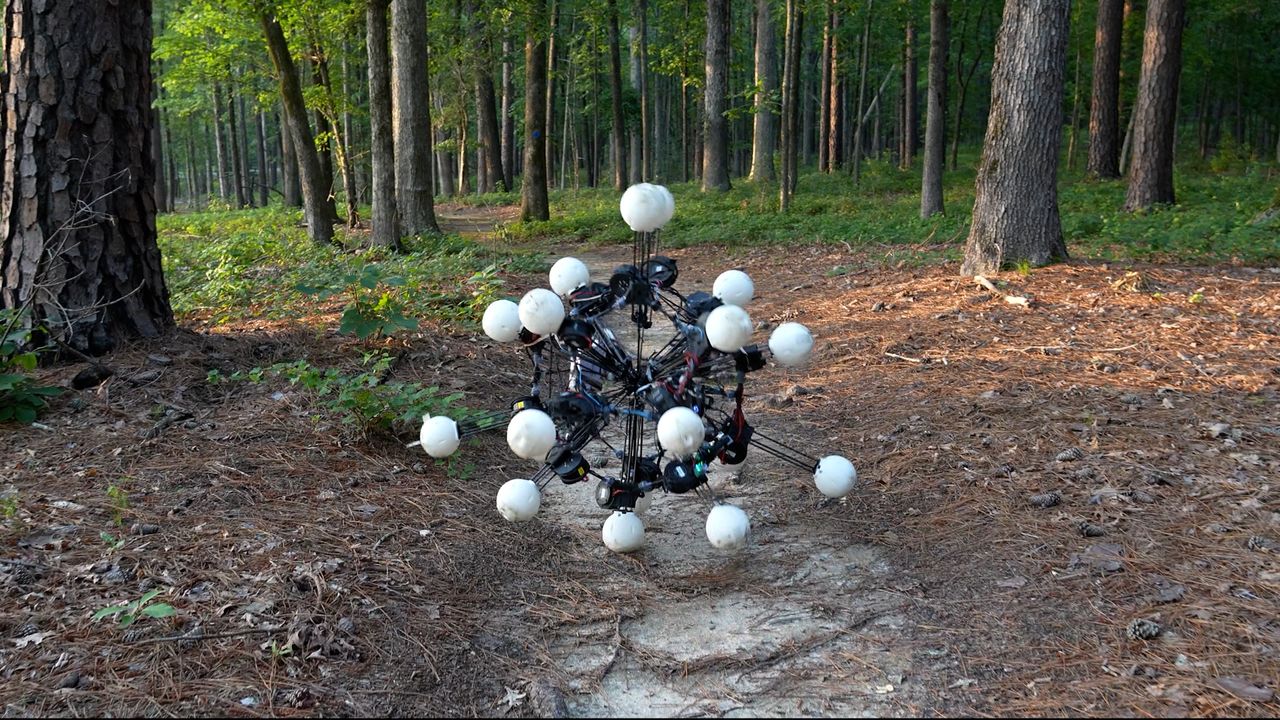
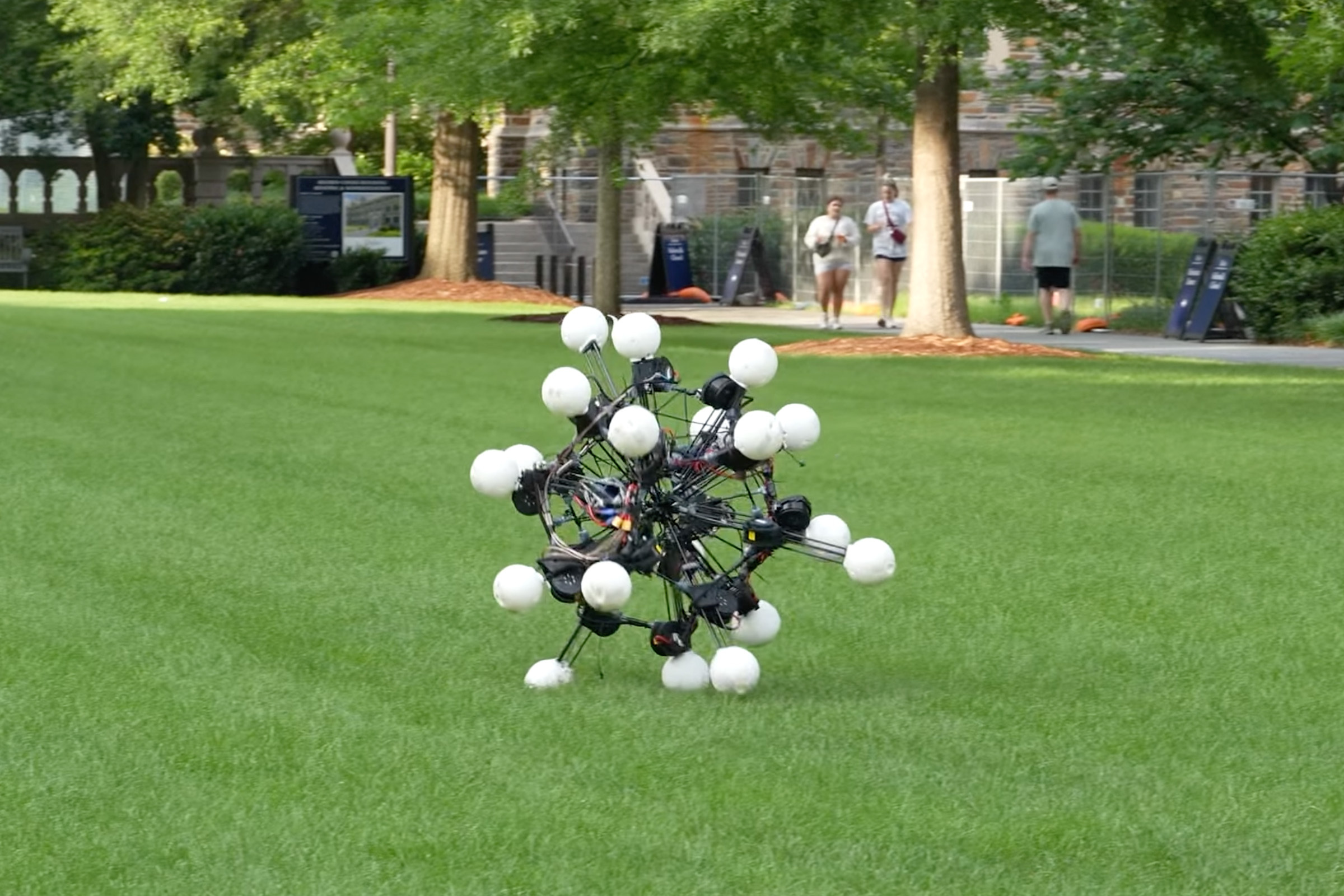
Be not afraid, human. A new robot developed at Duke University isn’t intended to strike fear into the hearts of anyone who beholds it, but more closely resembles one of those terrifying biblically accurate angels than it does any other machine or living creature you’ve ever seen.
Called Argus, the robot is a rolling, virus-shaped conglomeration of twenty telescoping legs attached to a central core. And it’s completely covered in eyes that let it see in every direction, which is literally how some of the more terrifying versions of the divine creatures are described (see: ophanim.) The result is something that is not only all-seeing, but capable of moving in any direction on a dime.
Its designer Boyuan Chen, a Duke engineering professor, says his team’s goal was to think outside the box and design something that didn’t resemble humans, dogs, or other living creatures that roboticists love to ape. Instead, they focused on uniformity in action, or what Chen calls “dynamic symmetry.”
“Instead of measuring how your legs are arranged around a different part of your body, we’re measuring how fast you can move in any direction,” Chen, who coauthored a new paper published in the journal Science Robotics describing the design, told The Associated Press. “Who said, you know, if you have a robot to help us in a most effective way, it has to look like us?”
“We’re not imitating anything in nature,” Chen added. “We’re imitating everything in nature.”
Not an inch of space is wasted in Argus’ design, which is optimized for agility. The round feet attached to the end of each of its twenty legs are also where its depth sensing cameras are housed, enabling it to watch every step it takes. (It’s named after the one-hundred-eyed giant in Greek mythology.) The legs extend and retract just the right amount they need to navigate the obstacles ahead of it.
To gauge how well the robot moves, the researchers coined a new design principle called “dynamic isotropy” that measures how uniformly a robot accelerates when it changes direction. Most robots, including clumsy humanoids and flying drones, scored less than 0.6, but Argus clocked in at 0.91.
In footage taken by the researchers, Argus rolls across various terrain with aplomb. A paved street, a sandy beach, and a bumpy forest path each prove no match for the rolling robot. It can even climb up between two parallel walls, providing its most uncanny display as it quickly but smoothly bounces between them while gradually ascending. If one of these ever goes rogue, surely nothing will be beyond its reach.
“Watching Argus move is unlike watching any other robot we’ve worked with,” study coauthor Jiaxun Liu, a Duke graduate student, told the AP. “The first time we saw it navigate among trees and rough terrain, even under heavy collisions, we knew this was something different.”
Chen flipped the traditional robot-script further in another analogy.
“Instead of building a robot hand that looks like a human hand… one idea is to think about having Argus be the hand itself, and it can manipulate objects in any direction,” he told the AP. “The knowledge we can transfer to the rest of the world is much more deeper than building an existing robot or copying an existing species.”
Chen’s team isn’t the only one exploring unorthodox robot designs. Northwestern University researchers recently unveiled modular “metamachines” made of limbs that are each their own independent robot, allowing them to form a greater whole, but survive if broken apart.
Picnic, a Seattle-based startup that raised more than $53 million to develop robots capable of putting human restaurant workers out of a job — even partnering with the giant pizza chain Domino’s — has shut down.
The startup liquidated all of its assets after becoming insolvent, according to legal documents obtained by GeekWire. All its intellectual property has been sold off to an unnamed buyer.
The collapse highlights the tech industry’s struggles to automate labor in the food industry. Despite countless startups attempting to built robots designed to put hospitality workers out of a job, the tasks keeps proving trickier than anticipated, echoing similar woes plaguing other labor-intensive sectors as well.
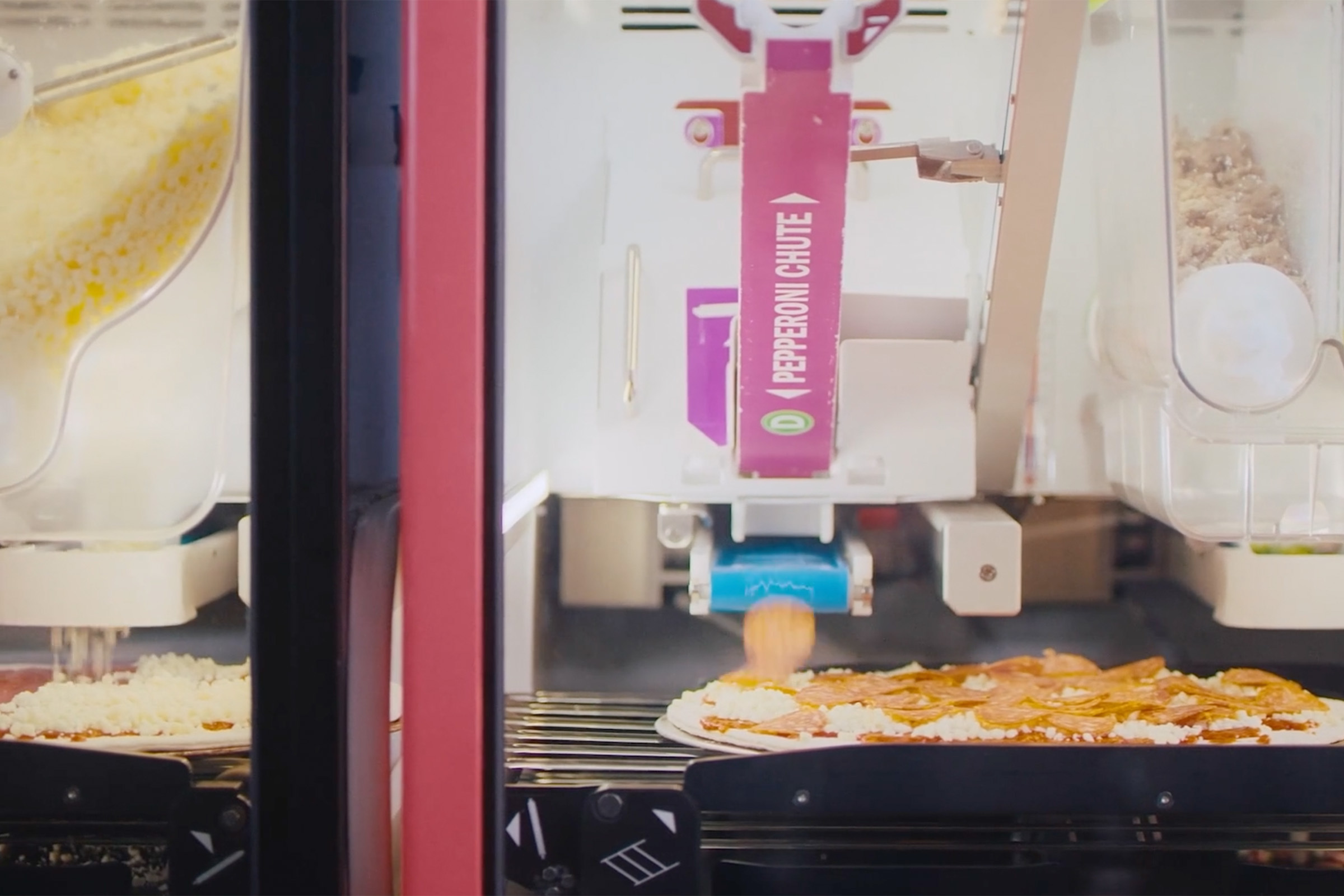
The startup’s Picnic Pizza Station, which was intended to allow a single worker to push out 100 12-inch pizzas in a single hour by robotically distributing pizza toppings, made a big splash in 2022 when the company announced a partnership with Domino’s.
The goal of a setup that allows one worker to do the work of a whole kitchen seems pretty obvious. But instead of advertising the collaboration as a way to reduce headcount, Domino’s claimed at the time that it was looking to rapidly grow its global workforce through a robot-facilitated expansion into new markets.
But warning signs soon became apparent. In 2023, Picnic was forced to lay off employees, citing the “current economic environment,” and its CEO Clayton Wood departed. His successor, Michael Bridges, left two years later as well.
It’s not the first robotics company to fail at automating pizza making. In 2023, a robot pizza startup called Zume Pizza shut down after raising almost half a billion dollars. The firm struggled for years with nagging technical issues, such as keeping melting cheese from sliding off pies that were being baked inside its moving trucks.
Meanwhile, Picnic’s most ardent supporters will now have to contend with idle robots cluttering their restaurants. Seattle-based pizza chef Lee Kindell, who owns a chain of restaurants in the city powered by the company’s tech, told GeekWire that he’s now stuck holding a $250,000 “robot aquarium” of useless machines.
“I was so pissed I started my own robot company,” he told the publication.

 Login
Login