 Login
Login
Rocket launches are turning the upper atmosphere into an accidental climate experiment
 A new study finds pollution from satellite megaconstellations could account for 42% of the space sector’s climate impact by 2029.
  A new study finds pollution from satellite megaconstellations could account for 42% of the space sector’s climate impact by 2029.
Satellites are creating a massive pollution problem, according to University College London researchers, who say the growing atmospheric carbon source has a 500 times greater climate impact than ground-based emissions, potentially blocking the Sun.
In a recent paper published in the journal Earth’s Future, researchers demonstrate that satellites are driving a significant rise in upper-atmosphere pollution, raising concerns related to the ongoing climate crisis. By the end of this decade, almost half of this pollution will come from satellite megaconstellations launched since 2019, the researchers claim.
While satellites do emit some exhaust when they engage their thrusters, this is not the primary source of pollution they produce, according to the University College London researchers.
Instead, they point to rocket launches, as they generate a massive amount of carbon soot when discarded rocket bodies and dead satellites burn up on reentry into the Earth’s atmosphere. This carbon is particularly problematic, remaining in the upper atmosphere for an extended period and generating a 500-fold climate impact compared to ground emissions.
The team also investigated other forms of launch-related pollution, noting that chlorine released into the atmosphere by these launches harms the ozone layer, which blocks harmful UV rays; however, this impact is far less severe than the carbon soot. Even projecting out to 2029, the team seems confident that rocket launches, accounting for under a tenth of ozone depletion, and some organizations, such as Blue Origin, will be conducting launches that release no chlorine at all.
This is nonetheless important to monitor, they argue, as China’s space launches typically do release chlorine and are expected to grow in the coming years.
Data for the research were sourced from satellite deployments and rock launches conducted between 2020 and 2022, which found that circulation patterns in the upper atmosphere move very slowly, allowing soot particles to linger for extended periods. In the lower atmosphere, rain and other weather systems remove such particles from car and factory exhaust much more rapidly. With this longer atmospheric life span, each particle in the upper atmosphere has a much greater impact on the environment.
Air pollution from launches and reentry is accumulating in the atmosphere at such a rate that by the end of the decade, it could block as much sunlight as artificial geoengineering projects aimed at reducing global warming. However, the actual cooling effect produced would likely be far below the expected temperature rise due to global warming over the same period, the study authors say.
“The space industry pollution is like a small-scale, unregulated geoengineering experiment that could have many unintended and serious environmental consequences,” said Professor Eloise Marais, the project’s leader and a researcher at UCL Geography. “Currently, the impact on the atmosphere is small, so we still have the chance to act early before it becomes a more serious issue that is harder to reverse or repair. So far, there has been limited effort to effectively regulate this type of pollution.”
Their data indicates that megaconstellations, which the team sees as a significant concern, accounted for 35% of the climate impact of these events, and they expect this to grow to 42% by the end of the decade.
Recent years have seen exponential growth in satellites in near-Earth orbit, primarily driven by the rise of megaconstellations composed of hundreds of thousands of objects. The most well-known of these, SpaceX’s Starlink, accounts for 12,000 individual satellites. Megaconstellations are now consuming over half of the rocket fuel expended, as launches rose from just 114 a year in 2020 to 329 in 2025.
The researchers note that real-world megaconstellation launches between 2023 and 2025 have outpaced their projections based on 2020 to 2022 data, suggesting their predictions may actually underestimate the scale of the problem.
“The cooling effect from the reduction in sunlight that we calculate with our models may sound like a welcome change against the backdrop of global warming, but we need to be extremely cautious,” Professor Marais warned.
“Rocket launches are a unique source of pollution, injecting harmful chemicals directly into the upper layers of the atmosphere and contaminating Earth’s last remaining relatively pristine environment,” lead author Dr. Connor Barker, also with UCL Geography, noted.
“Though this soot’s impact on climate is currently much smaller than other industrial sources, its potency means we need to act before it causes irreparable harm,” Barker says.
The paper, “Radiative Forcing and Ozone Depletion of a Decade of Satellite Megaconstellation Missions,” appeared in Earth’s Future on May 14, 2026.
Ryan Whalen covers science and technology for The Debrief. He holds an MA in History and a Master of Library and Information Science with a certificate in Data Science. He can be contacted at ryan@thedebrief.org, and follow him on Twitter @mdntwvlf.
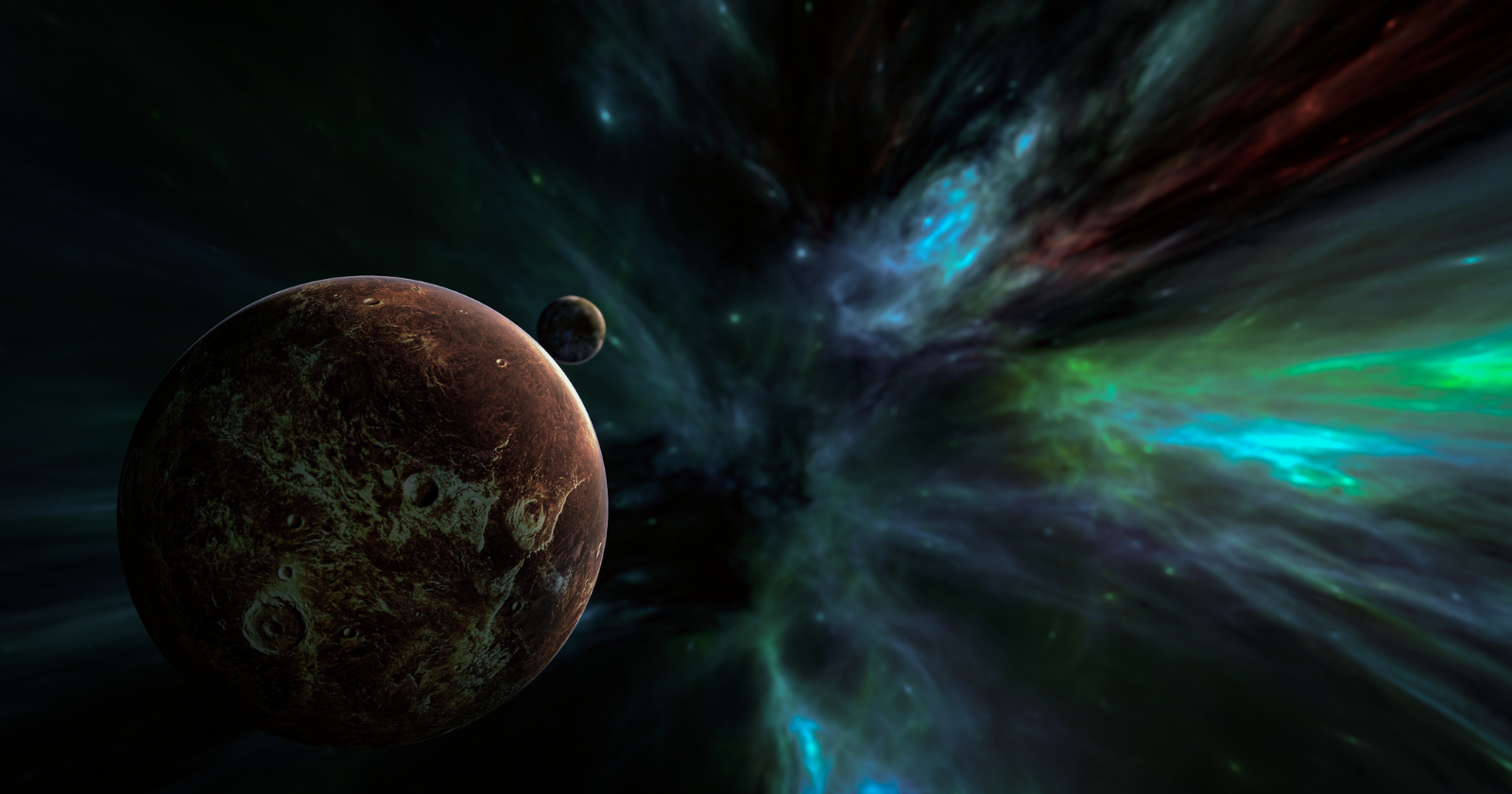
Drifting through the Milky Way may be billions, and on some estimates trillions, of rogue planets: worlds bound to no star, some flung out of the systems where they formed, others perhaps never attached to a star at all. They are also called free-floating, nomad, or starless planets. The reason the figure spans such a wide range is simple. We have confirmed very few of them, and counting things you cannot see is hard.
Microlensing searches have produced fewer than ten likely low-mass free-floating planet detections, according to a survey of the field by IEEE Spectrum. Direct-imaging surveys of young star-forming regions have turned up many more planetary-mass candidates, though their formation history is harder to classify. Almost everything beyond that handful is inference and modelling, and the gap between a small number of firm detections and a projected population in the billions is the real state of play.
A planet with no sun emits almost nothing a telescope can catch directly. The main way these objects are found instead is gravitational microlensing, which does not see the planet at all. It sees what the planet’s gravity does to the light of a star behind it.
When a rogue planet passes almost exactly between Earth and a distant background star, its gravity bends and briefly magnifies that star’s light. The star appears to brighten, then fade, and for a planet-sized lens the whole event is short. The first credible detection of an Earth-mass candidate came this way: an event designated OGLE-2016-BLG-1928, reported in 2020 by Przemek Mróz of the University of Warsaw and colleagues, with a brightening timescale of about 41.5 minutes, the shortest then recorded and only caught because the data were taken at high cadence. The object was estimated at roughly 0.3 Earth masses. It remains a candidate rather than a confirmed rogue, because the data cannot rule out that it sits very far from a host star rather than being truly unbound.
The strength of the method is that it can find low-mass objects nothing else can reach. The weakness is built into it. Each event happens once and never repeats, which makes the mass of any single object hard to pin down, and makes the whole population something you reconstruct statistically rather than observe one by one.
The headline estimates rest mainly on this statistical reconstruction. A 2023 analysis of a nine-year survey by the Microlensing Observations in Astrophysics collaboration, led by Takahiro Sumi at Osaka University, concluded that free-floating planets are far more common than earlier work assumed, and supported the idea that the galaxy holds more such objects than it has stars.
It is worth being clear about what that is. It is not a tally. It is an extrapolation from a small number of brief lensing events, folded through models of how often such events should occur. One NASA-backed estimate puts the Milky Way’s rogue planets at roughly twenty per star, or trillions of worlds in total. Other modelling work lands much lower, closer to one free-floating planet per star over the mass range considered. The honest conclusion is not that anyone has counted them. It is that the population could be enormous, and the uncertainty is still enormous too.
There are two broad accounts of how a planet ends up with no star, and they are not exclusive.
One is ejection. A planet forms in orbit around a star, then gets thrown out, usually by a gravitational shove from a larger planet or a passing star in a crowded cluster. Simulations of dense star-forming regions, such as work modelling the Orion Trapezium cluster at Leiden, produce rogue planets this way in large numbers.
The other is that some of these objects never had a star. They may have formed directly from collapsing gas, the way stars do, but with too little mass to ignite. The International Astronomical Union has suggested the term sub-brown dwarf for objects formed like stars but below the mass needed for fusion, which blurs the line between a small failed star and a large free-floating planet.
A recent wrinkle came from the James Webb Space Telescope. Observing the Orion Nebula, Samuel Pearson and Mark McCaughrean reported around 540 planetary-mass candidates, of which about nine per cent appeared to be in wide pairs, which they nicknamed JuMBOs, for Jupiter-mass binary objects. Pairs are awkward for the ejection story, since it is hard to throw two objects out of a system together and keep them bound to each other. The result is strange enough that it remains contested, with later analyses questioning how many of the pairs hold up and whether the objects should be called planets at all.
The instrument expected to move this from extrapolation toward a census is NASA’s Nancy Grace Roman Space Telescope, now targeted for launch no earlier than September 2026, with a commitment to launch no later than May 2027. Roman will run a dedicated microlensing survey from space, staring at a strip of sky toward the galactic centre for months at a time, above the atmospheric blurring that limits ground-based work.
The expectations have grown as the modelling has improved. An earlier estimate put Roman’s likely haul at around 50 Earth-mass rogue planets. A 2023 study led by Naoki Koshimoto at Osaka University raised that to roughly 400. Japan’s PRIME telescope in South Africa is intended to make simultaneous ground-based observations, which would help measure masses rather than just count events. A 2025 paper by William DeRocco and colleagues, posted to the arXiv, works through how Roman’s data could be used to reconstruct the free-floating planet mass function, the distribution of how many of these worlds exist at each mass.
There is also the prospect of pairing Roman with the European Space Agency’s Euclid, already in orbit. A joint survey, according to BBC Science Focus, could turn up more than 100 rogue planets in its first year.
The useful thing about Roman’s survey is that it has a clear way to be wrong. The models predict hundreds of detections. If Roman finds far fewer, or none, the population estimates and the detection methods both come back under review.
For now the honest position is that rogue planets are real, that a handful have been firmly detected, and that whether they number in the billions or the trillions, and how they mostly form, are open questions a single mission is now built to narrow. The figure to watch is not the trillion. It is the first few hundred, and whether they show up.
The post Drifting through the Milky Way may be billions — perhaps even trillions — of rogue planets: worlds with no sun of their own, some flung from the systems where they formed, now wandering the galaxy in darkness. appeared first on Space Daily.
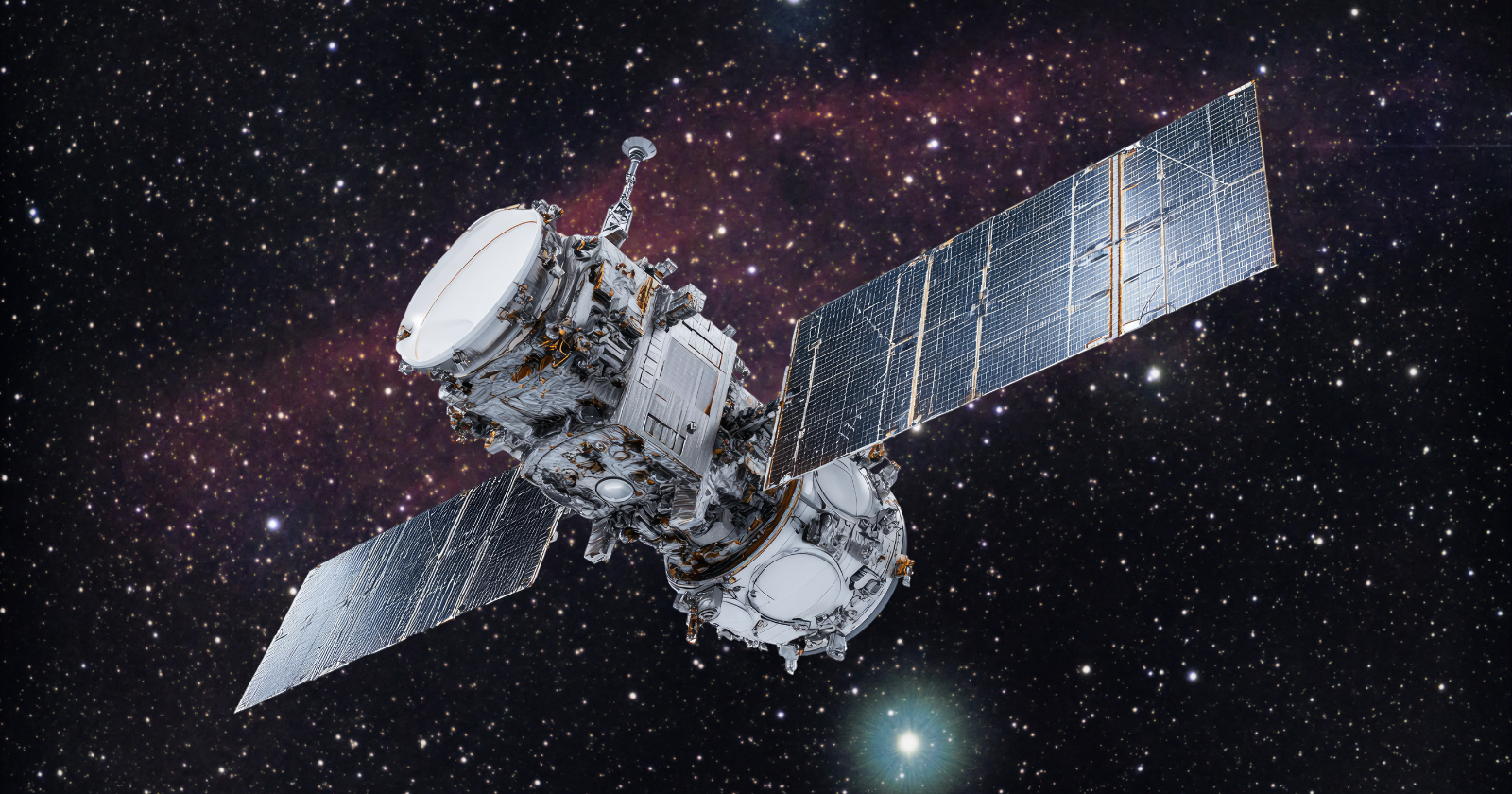
Between 2014 and 2016, the European Space Agency’s Rosetta spacecraft flew alongside Comet 67P/Churyumov-Gerasimenko and analysed the gas streaming off it. The list of compounds it found reads like a catalogue of unpleasant smells: hydrogen sulphide (rotten eggs), ammonia (a horse stable), formaldehyde, hydrogen cyanide (bitter almonds), and several others. In the same gas were molecules that bear on the question of how life began.
Both halves of that are true.
Both are also easy to oversell. The comet would smell foul if you could smell it, and you could not. The chemistry is genuinely interesting without being proof of anything about life’s origins.
The measurements came from an instrument called ROSINA, the Rosetta Orbiter Spectrometer for Ion and Neutral Analysis, led by Kathrin Altwegg at the University of Bern. ROSINA is a pair of mass spectrometers, which sort molecules by mass, not by odour. The “smell” is a translation: a way of describing which compounds were present by naming what they would smell like at a high enough concentration.
In an October 2014 post, the ROSINA team described the mix as rotten eggs from hydrogen sulphide, horse stable from ammonia, a suffocating note of formaldehyde, a faint bitter almond from hydrogen cyanide, alcohol from methanol, vinegar from sulphur dioxide, and a sweet trace of carbon disulphide.
The honest qualifier sits in the same post. These compounds are trace constituents. The bulk of the coma, the cloud of gas around the comet, is water, carbon dioxide and carbon monoxide, all odourless, and the whole thing is so thin it is closer to a vacuum than to any atmosphere you could breathe or smell. The “perfume” is a vivid way to report a mass spectrum, not an experience anyone could have had.
The finding with real weight came later. In 2016, Altwegg and colleagues reported in Science Advances that ROSINA had detected glycine in the comet’s coma, along with phosphorus and two molecules, methylamine and ethylamine, that can act as precursors to glycine.
Glycine is the simplest of the twenty amino acids that make up proteins. Phosphorus is part of the backbone of DNA and RNA and a component of cell membranes. Detecting both around a comet is why this result drew attention, rather than the smell.
The team called it the first unambiguous detection of glycine at a comet. That wording matters. Hints of glycine had appeared before in samples returned from Comet Wild 2 by NASA’s Stardust mission, but because those samples came back to Earth, contamination was difficult to rule out, and the cometary origin had to be argued from carbon isotope ratios. Rosetta measured 67P directly, in space, while flying through the comet’s coma.
The detections were repeated, strongest near the comet’s closest approach to the Sun in August 2015, and correlated with dust, which suggests the glycine was released from icy grains as they warmed. That is what lifted it from “probably cometary” to a direct measurement.
That does not mean the comet carried life. It does not even mean comets created life on Earth. It means a comet preserved and released some of the simple chemical pieces that life uses: an amino acid, a biologically important element, and precursor molecules that point to possible routes for making them.
The finding supports a hypothesis, advocated for decades, that comet and asteroid impacts could have delivered such molecules to the early Earth. The ESA team framed it that way, as comets having the potential to deliver key molecules for prebiotic chemistry. ESA itself flagged the catch in the same breath: a huge evolutionary gap separates delivering ingredients and life taking hold.
One amino acid out of twenty is a long way from a protein, and a protein is a long way from a living cell. The detection narrows the question of where prebiotic molecules could come from. It does not answer how life started, which remains unsolved.
That is enough to be interesting without turning the comet into a frozen seed of biology.
Rosetta ended in September 2016, set down onto 67P in a controlled descent. Its archive is still being worked through, and later analyses have added detections, including phosphorus in solid grains rather than gas.
Rosetta’s comet was not a dirty snowball full of life. It was a cold, ancient body releasing a thin cloud of gas and dust, carrying sulphur compounds, carbon compounds, nitrogen compounds and at least a few molecules that matter for prebiotic chemistry.
The smell line is the hook. The real story is quieter: comets can preserve primitive chemistry for billions of years, then release it when sunlight warms them. Whether that chemistry helped life begin on Earth remains an open question.
Rosetta showed that the raw material was there.
The post When Rosetta sniffed the gas around Comet 67P, it found a cloud that would have smelled of rotten eggs, ammonia and bitter almonds — and hidden in that cosmic stink were some of the chemical ingredients that may have helped life begin on Earth appeared first on Space Daily.
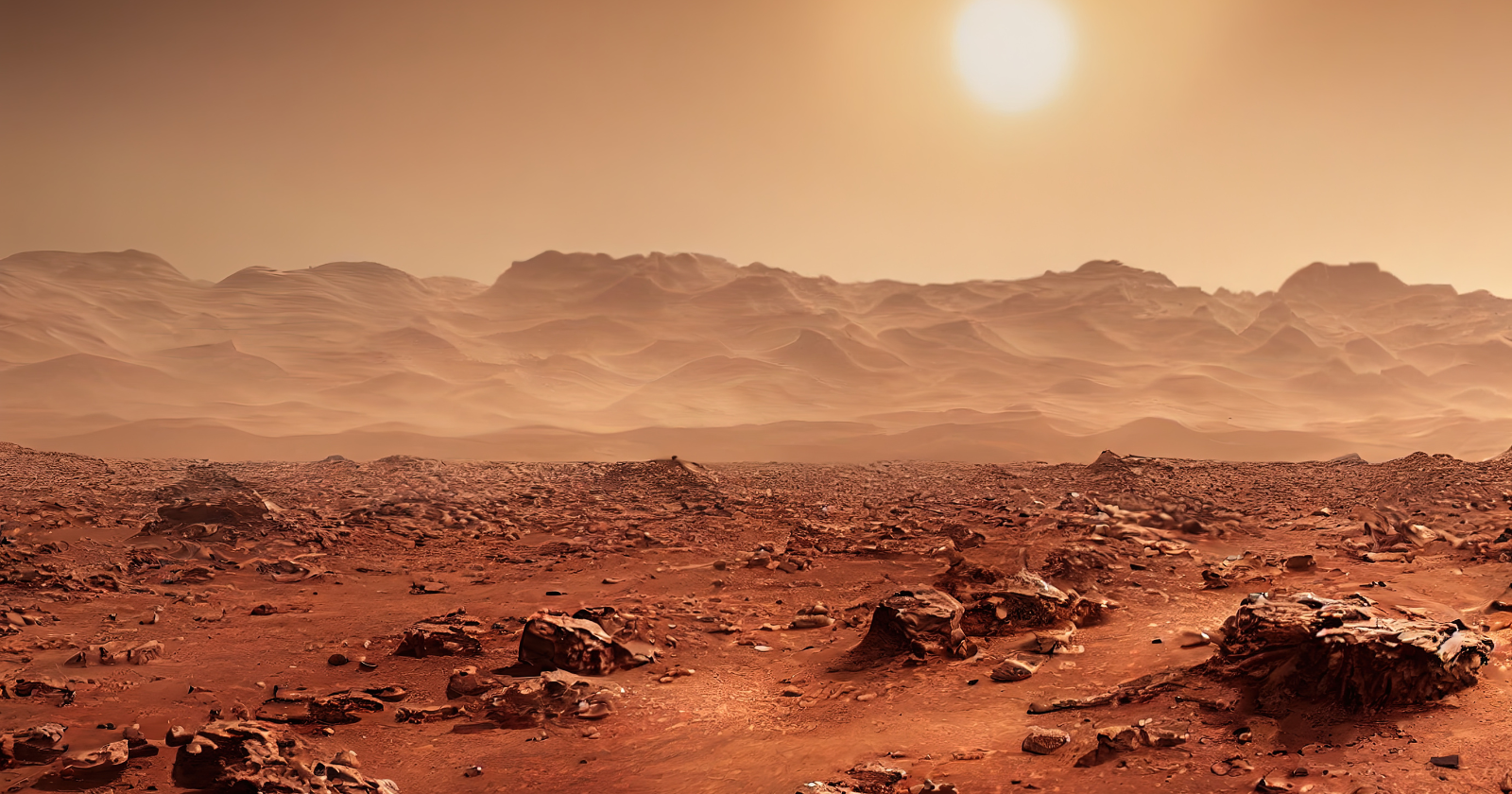
The familiar version goes like this. Early Mars was a warmer world with rivers and lakes and a thick atmosphere. Its internal dynamo died, the planet lost the magnetic field that had shielded it, and the solar wind stripped the air away over billions of years, leaving the cold desert we see now.
The outline is broadly right. The water was real, the dynamo did fail, and the solar wind does strip the atmosphere. But several links in that chain are less settled than the clean telling suggests, and a recent finding shows that not all the missing air went to space.
The strongest part of the story is the water. Dried river valleys, lake beds, deltas and water-formed minerals across the older Martian terrain make it clear that liquid water flowed on the surface, at least intermittently, before roughly 3.5 billion years ago.
That much is not in serious dispute.
Whether the planet was warm is another matter. Keeping early Mars warm is difficult in climate models, because the young Sun was fainter than it is today. One camp argues for a persistently warm and relatively wet climate held up by a dense carbon dioxide atmosphere and extra greenhouse gases. Another argues for a mostly cold and icy planet, frozen for long stretches and warmed only in episodes. The geological and climatological case for a warmer, wetter early Mars has been made in detail, and the cold-and-icy alternative has been modelled just as seriously. The argument has run for decades and is not resolved. “Once warmer” is a reasonable shorthand, but it papers over a real disagreement.
Mars no longer has a global magnetic field, but it clearly had one. The crust carries magnetic imprints locked in when ancient rocks cooled, which means a core dynamo was running early in the planet’s history and then stopped. The usual estimate places the shutdown somewhere between about 4.2 and 3.7 billion years ago, around the same era the atmosphere appears to have thinned.
The timing is not pinned down. Palaeomagnetic work led by Sarah Steele at Harvard, published in Science Advances in 2023, argues the dynamo may have lasted longer and behaved in a more complex way than earlier reconstructions assumed.
The death of the field is real. Exactly when, and how cleanly, is still being worked out.
The clearest evidence comes from NASA’s MAVEN mission, which has orbited Mars since September 2014. MAVEN was built to measure how fast gas escapes the upper atmosphere and what drives it. It found that the solar wind does strip ions from Mars into space, and that the rate jumps sharply during solar storms. A strong storm in March 2015 served as a natural experiment, with escape rates spiking while the spacecraft watched.
Measurements of argon isotopes point the same way. Argon is useful because it is not recycled through rocks and volcanoes the way carbon dioxide is, so its isotope ratio records loss to space fairly directly. On the MAVEN team’s reading, the argon ratio implies that most of Mars’ atmospheric loss happened upward, to space. Carbon dioxide is more complicated, because some of it could also be locked into rocks.
This is the part most often stated too confidently. It is tempting to treat the sequence as simple cause and effect: field on, atmosphere safe; field off, atmosphere gone. The physics is not that tidy.
A planetary magnetic field deflects some of the solar wind, but it can also open channels along which charged particles escape, and in some configurations a field may speed up loss rather than prevent it. Venus is the standing complication. It has no internally generated magnetic field and sits closer to the Sun, yet it holds a dense atmosphere. The match in timing between Mars losing its dynamo and losing its air is suggestive, and the protective reading is the leading one, but the causal claim is not established. Some researchers have argued that a longer-lived dynamo might even have helped Mars lose water rather than save it.
There is also the question of where the carbon dioxide went. If early Mars had a thick carbon dioxide atmosphere, large amounts of carbonate rock should have formed as the gas reacted with water and stone, and for years orbiters did not find nearly enough of it.
In 2025, a team led by Benjamin Tutolo reported in Science that the Curiosity rover had found abundant siderite, an iron carbonate, in the sulphate-rich layers of Gale crater. Scaled across similar deposits, the team estimated the rocks could hold the equivalent of a few to several tens of millibar of atmospheric carbon dioxide. That is a genuine reservoir, and part of the missing inventory, though it falls well short of the roughly one bar thought necessary to warm the surface. Some of the buried carbon also appears to have been released again, which would make it a partial, imbalanced carbon cycle.
So the air left by more than one route. Some was stripped to space, as MAVEN shows is still happening. Some was locked into the crust as rock.
What remains open is the balance between those routes, the true early climate, and how much the dying magnetic field actually mattered. Better palaeomagnetic dating of the dynamo, and missions that sample more of the sulphate layers, are the things likely to narrow it. The cold desert is the settled part. The path it took to get there is still being filled in.
The post Mars was once a warmer world of rivers, lakes and a thicker atmosphere, but after its internal dynamo died and the planet lost the magnetic shield that helps protect an atmosphere, the solar wind stripped much of its air away over billions of years, leaving the cold desert we see today appeared first on Space Daily.
A new study finds pollution from satellite megaconstellations could account for 42% of the space sector’s climate impact by 2029.
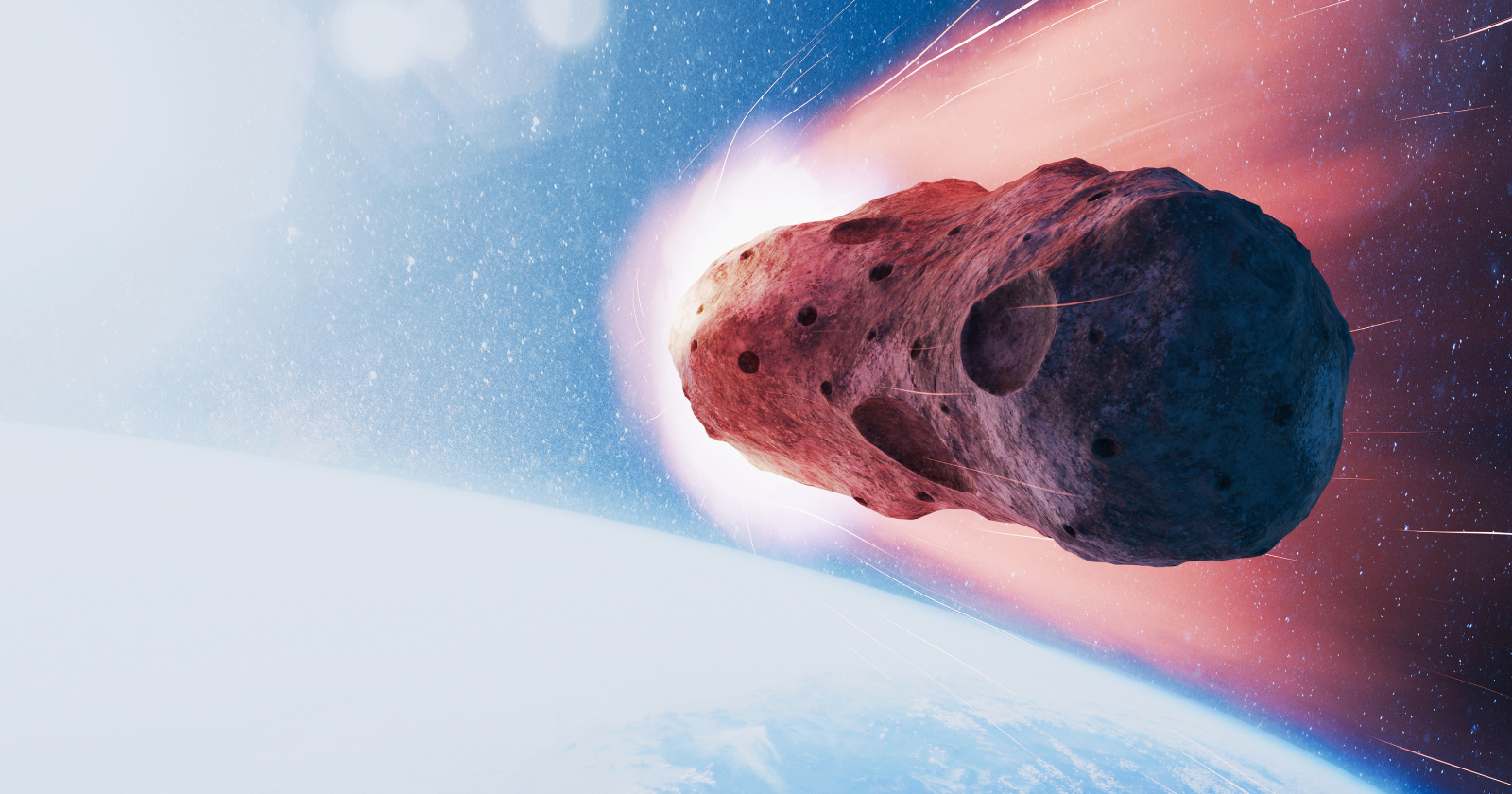
In October 2017, a survey telescope on Maui caught a faint, fast point of light that did not belong here. The object was moving too quickly, on the wrong kind of orbit, to have formed around our Sun. It had come from somewhere else, passed close to the Sun a few weeks earlier, and was already on its way back out.
The object was found on 19 October 2017 by Robert Weryk, working with the Pan-STARRS1 telescope run by the University of Hawaii and funded through NASA’s near-Earth object program. The International Astronomical Union later gave it the designation 1I/2017 U1, the “1I” marking it as the first confirmed interstellar object on record. The Pan-STARRS team named it ‘Oumuamua, Hawaiian for a messenger from afar arriving first.
It was a genuine first. What it was, exactly, is a question that has not fully closed.
‘Oumuamua was found late and seen briefly. By the time anyone noticed it, it had already passed perihelion, its closest approach to the Sun, on 9 September 2017, and was heading away. Astronomers had roughly a fortnight of useful observation before it faded.
From that short window, a few things were established. Its orbit was steeply hyperbolic, with an eccentricity near 1.2, far outside the range of anything bound to the Sun. Its incoming interstellar speed was about 26 kilometres per second, and after swinging past the Sun it was moving far faster. Its brightness swung dramatically as it tumbled, which pointed to an extreme elongated shape, though whether it was closer to a cigar or a flattened disc has never been resolved. Estimates put its longest dimension at a few hundred metres.
By colour and surface it looked broadly like the icy nuclei of comets. It did not behave like one in the way that mattered most.
In June 2018, a team led by Marco Micheli of the European Space Agency reported in Nature that ‘Oumuamua’s path could not be explained by gravity alone. As it left the inner Solar System it carried a small extra push directed away from the Sun. The deviation was tiny, but the orbit had been measured carefully enough to be confident it was real.
For a comet, this would be unremarkable. Comets warm as they near the Sun, ices turn to gas, and that escaping material acts like a weak, off-centre thruster. The trouble was that ‘Oumuamua showed no sign of doing this. No tail. No coma. No dust. Repeated searches found nothing being shed.
So there was a force consistent with outgassing, and no outgassing anyone could see.
That is the puzzle that has kept the object in the literature for years.
Most of the serious proposals try to keep ‘Oumuamua natural while accounting for an invisible push. One line of argument is that it was venting something hard to detect. Nitrogen ice was suggested, with the idea that the object was a fragment of a nitrogen-rich body. Hydrogen has also been proposed.
In 2023, Jennifer Bergner and Darryl Seligman published a hydrogen-based explanation in Nature. Their model argues that radiation in interstellar space could produce trapped molecular hydrogen inside water-rich ice, which is later released as the object warms near the Sun, giving a push with no visible dust tail. It is a plausible mechanism. It is also one model, built to fit a single object whose data is limited, and it has not been tested against a second case.
A separate and far more contested suggestion came from Harvard astronomer Avi Loeb, who argued the acceleration might point to an artificial origin, such as a thin, sail-like structure pushed by sunlight. Most researchers working on the object do not accept this. The natural explanations, unsettled as they are among themselves, remain the mainstream reading, and there is no direct evidence the object was anything other than a strange natural body.
The honest limitation is the data. ‘Oumuamua was caught on its way out, observed for a short time, and is now far beyond reach. No spacecraft visited it. No sample exists. Every explanation is being fitted to one faint, fast, briefly seen object, which is why no single account has won.
What has changed since is the company it now keeps. In 2019, a clearly cometary interstellar object, 2I/Borisov, passed through and behaved exactly as a comet should, complete with a visible tail. In July 2025 a third, 3I/ATLAS, was found, and it too shows ordinary cometary activity. The Vera C. Rubin Observatory, which recorded 3I/ATLAS in commissioning data ten days before its official discovery, is expected to turn up many more now that its decade-long survey has begun.
That is the value of more cases. If interstellar objects prove to be a varied population, ‘Oumuamua may simply have been an unusual member of it, seen at a bad angle and too late. If others show the same quiet push without a tail, the hydrogen and nitrogen models gain real support rather than a single fit.
For now, the first interstellar object remains the least explained of the three. The next ones, caught earlier and watched longer, are the ones likely to settle what ‘Oumuamua could not.
The post In 2017, astronomers spotted the first object ever confirmed to have come from another star system passing through our own: a strange, elongated visitor called ‘Oumuamua that seemed to accelerate as it left, in a way scientists are still debating appeared first on Space Daily.
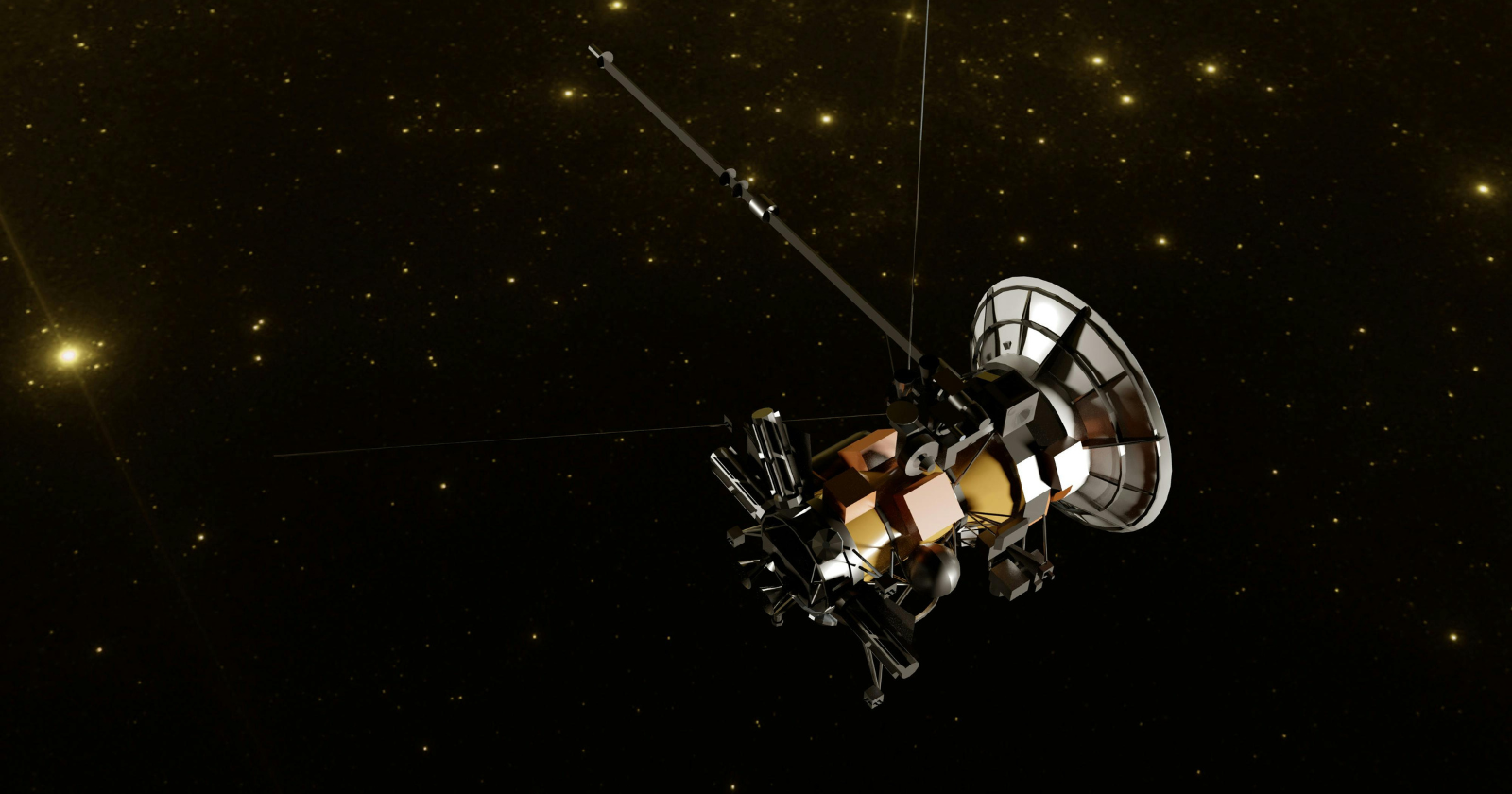
Bolted to the side of Pioneer 10 is a gold-anodised aluminium plaque, about 152 by 229 millimetres, engraved with the figures of a man and a woman and a set of symbols meant to mark where and when the spacecraft came from. The craft that carries it has been silent for more than two decades. It is still moving, coasting outward beyond the planets on a path that points in the general direction of the star Aldebaran, in Taurus.
The message was not NASA’s idea, or even Carl Sagan’s. As the Smithsonian National Air and Space Museum recounts, the science writer Eric Burgess suggested during the mission’s planning that Pioneer should carry a greeting to any civilisation that found it. Sagan took up the idea, designed the plaque with Frank Drake, and had the human figures drawn by Linda Salzman Sagan. Its best-known feature is not the figures but the diagram beside them: a radial pattern showing the Sun’s position relative to fourteen pulsars, each line marked in binary with that pulsar’s frequency. The idea was that any finder able to identify those pulsars could triangulate the Sun’s location, and read the frequencies as a rough timestamp, since pulsars slow at known rates. It is a map home, and also a clock.
Pioneer 10 launched on 2 March 1972 and became the first spacecraft to cross the main asteroid belt and the first to fly past Jupiter, which it reached in December 1973. Its routine science mission ended on 31 March 1997. After that, NASA kept tracking its weakening signal as a test of deep-space communication.
The power was the limit. Pioneer 10 ran on radioisotope thermoelectric generators, which produce less electricity as their plutonium decays. According to NASA’s account, the last telemetry came back on 27 April 2002, and the final faint signal, carrying no data, was detected on 23 January 2003. A contact attempt on 7 February 2003 found nothing, and a last try in March 2006 also failed. The spacecraft did not break or crash. Its RTGs had likely fallen below the power needed to keep the transmitter operating.
The line repeated in most accounts is that Pioneer 10 is heading for Aldebaran and will take about two million years to get there. NASA uses the same framing, putting Aldebaran at roughly 68 light-years away and the trip at more than two million years.
Two qualifications matter. The first is that the two-million-year figure assumes Aldebaran stays put. It does not. The number is calculated as if the star had zero velocity relative to the spacecraft, which is a convenient simplification rather than a prediction. Over two million years both the star and Pioneer 10 will have moved, so the figure describes the crossing time to Aldebaran’s current position, not a genuine rendezvous.
The second is that “heading for” overstates the aim. Pioneer 10 is drifting in the broad direction of Aldebaran, not on course to reach it. Nothing is steering. The plaque and the trajectory have become a single object now, a labelled probe on a fixed coast, and the star is a marker on the horizon rather than a destination.
The spacecraft itself may not remain recognisable forever. Across millions of years of travel, micrometeoroid impacts and cosmic-ray erosion will slowly wear at the structure. The plaque was mounted on the antenna support struts partly to shield it from interstellar dust, and gold-anodised aluminium was chosen with durability in mind, but durability here is relative, and no one can say with confidence how legible it would be to a finder in the far future.
The more honest point is about audience. The plaque was never likely to be read by anyone. The nearest stars are light-years apart, the space between them is mostly empty, and the chance of any object the size of a car being intercepted is vanishingly small. Sagan understood this. The plaque worked at least as well as a message to the people who made it, a statement in 1972 that a species capable of building the probe was also capable of imagining who might one day find it.
Pioneer 10 is no longer the most distant human-made object. Voyager 1 passed it on 17 February 1998, at a distance of about 69 astronomical units, and has remained farther out since. Pioneer 10 continues outward regardless, unpowered and untracked, likely somewhere around 140 astronomical units from the Sun by now depending on how the estimate is framed, and receding by roughly 2.5 astronomical units a year. Without a signal, that position is inferred from its trajectory rather than measured.
There is nothing left to wait for from it, no next contact and no milestone NASA is tracking. What remains is a quiet piece of bookkeeping: a 1972 spacecraft, its last word logged in January 2003, still carrying a map of where it came from on a path that points, for now, at a red star in Taurus.
The post Bolted to Pioneer 10 is a plaque showing two humans and a cosmic map back to Earth, while the spacecraft itself is now a silent ghost ship drifting toward Aldebaran, a star it will not pass for another two million years. appeared first on Space Daily.
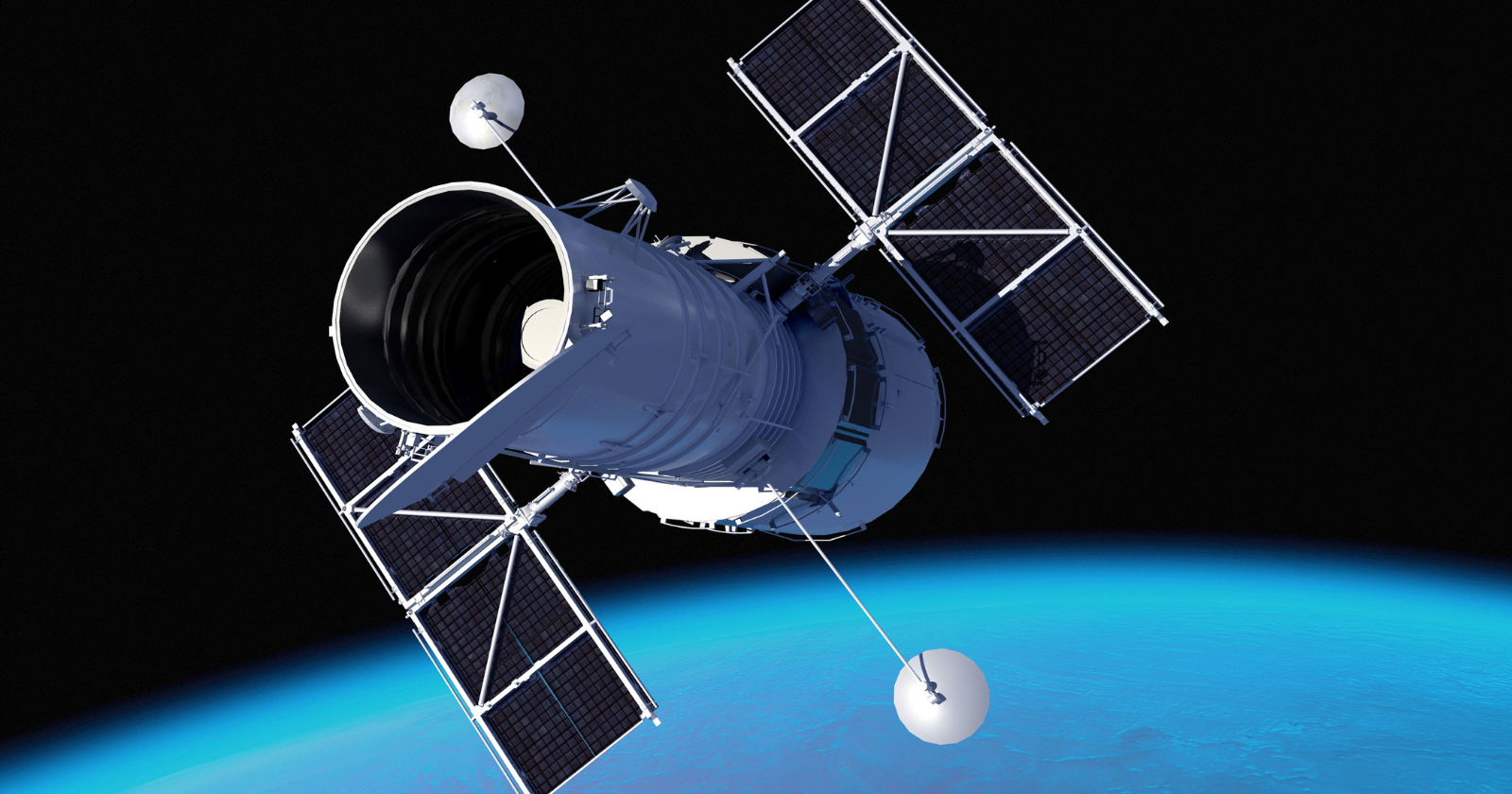
Japan’s Hayabusa probe returned to Earth on 13 June 2010, breaking apart in a bright streak over the Woomera Test Range in South Australia. About three hours before that final reentry, it had released a 40-centimetre capsule, which parachuted down into the outback intact. Inside were the first samples ever returned from the surface of an asteroid. The mission had taken seven years and very nearly did not make it back at all.
The spacecraft, known as MUSES-C until it was renamed Hayabusa just before its launch on 9 May 2003, was built by what is now the Japan Aerospace Exploration Agency primarily as an engineering demonstration. Its target was 25143 Itokawa, a near-Earth asteroid roughly 550 metres long, which Hayabusa reached in September 2005. The headline that survives is the clean one: first asteroid sample return. The actual story is messier, and more interesting for it.
The list of failures is long enough that the return reads less like a plan executed than a plan salvaged. As Space.com summarised at the time, the probe suffered a fuel leak, repeated communications breakdowns, and malfunctions in its ion engines, problems that together added about three years to the journey. A small hopping lander called MINERVA, meant to bounce across the surface taking pictures, was released during a descent and drifted off into space without ever reaching the asteroid.
Then there was the sampling system itself, which is the part most worth dwelling on.
Hayabusa was designed to collect material by touching a horn-shaped device to the surface and firing a five-gram tantalum projectile into the asteroid at about 300 metres per second. The fragments thrown up by that impact would be funnelled through the horn into a sealed canister. Tantalum was chosen deliberately, because it is rare in meteorites and so would not be confused with the asteroid material.
The projectiles never fired. JAXA’s own account notes that during the first touchdown the spacecraft detected a possible hazard and issued an abort, and the abort command also cancelled the firing. The paper reporting the touchdowns in Science, led by JAXA’s team, recorded that the pyrotechnic control device gave no indication the projectiles had completed firing. Hayabusa touched down twice on a smooth patch named the Muses Sea on 19 and 25 November 2005, but the mechanism that was supposed to generate the sample did not work as intended either time.
What saved the science was the asteroid’s almost negligible gravity. When the horn made contact with the surface, the touchdowns themselves disturbed the regolith, and a small amount of dust drifted up into the collection area and stayed there. According to NASA, examination of the capsule later revealed roughly 1,500 dust particles from Itokawa, presumed to have been kicked into the catcher during the contacts rather than collected by the intended firing.
The grains were tiny, mostly tens of micrometres across, smaller than the width of a human hair. Confirming they were asteroid material rather than terrestrial contamination took JAXA several months of analysis. In November 2010 the agency reported that at least 1,500 grains had been identified as rocky particles, most of extraterrestrial origin and traceable to Itokawa.
The payoff was not the quantity but a specific scientific question the grains could answer. Researchers had long debated whether the common S-type asteroids, the stony bodies that dominate the inner asteroid belt, were the parent objects of the most common meteorites found on Earth, the ordinary chondrites. The spectra did not quite match, and the suspected reason was space weathering, the gradual alteration of an airless surface by solar wind and micrometeorite bombardment.
The Itokawa grains, described across a set of papers in the 26 August 2011 issue of Science, closed much of that gap. The mineralogy matched a class called LL chondrites, tying a specific meteorite type directly to a specific asteroid for the first time using returned material rather than inference. That is the result the seven-year ordeal delivered: not a large sample, but a clean link between the rocks that fall to Earth and the bodies they come from.
Hayabusa’s value turned out to be as much procedural as scientific. The mission proved that a sample could be retrieved from an asteroid and brought home, and it gave JAXA a hard education in everything that could go wrong doing it. The successor, Hayabusa2, launched in 2014 to the asteroid Ryugu with a redesigned sampling system, collected surface material in February 2019 and subsurface material that July, and delivered its capsule, this time with the collection mechanism working as designed, to the same Woomera range on 6 December 2020.
The richest comparison now comes from NASA’s OSIRIS-REx, which delivered material from asteroid Bennu on 24 September 2023. Bennu is a carbonaceous asteroid rather than a stony one like Itokawa, and early analysis of its sample has reported amino acids, nucleobases, and evidence of ancient salty water, the kind of organic and aqueous chemistry the dry Itokawa grains were never going to carry. That work is ongoing, and the Itokawa and Ryugu samples are increasingly read alongside it as the catalogue of directly sampled asteroids grows.
The post After a crippled seven-year journey Japan’s Hayabusa probe limped home in 2010 and burned up in the sky over Australia, but not before releasing the first asteroid samples ever returned to Earth. appeared first on Space Daily.
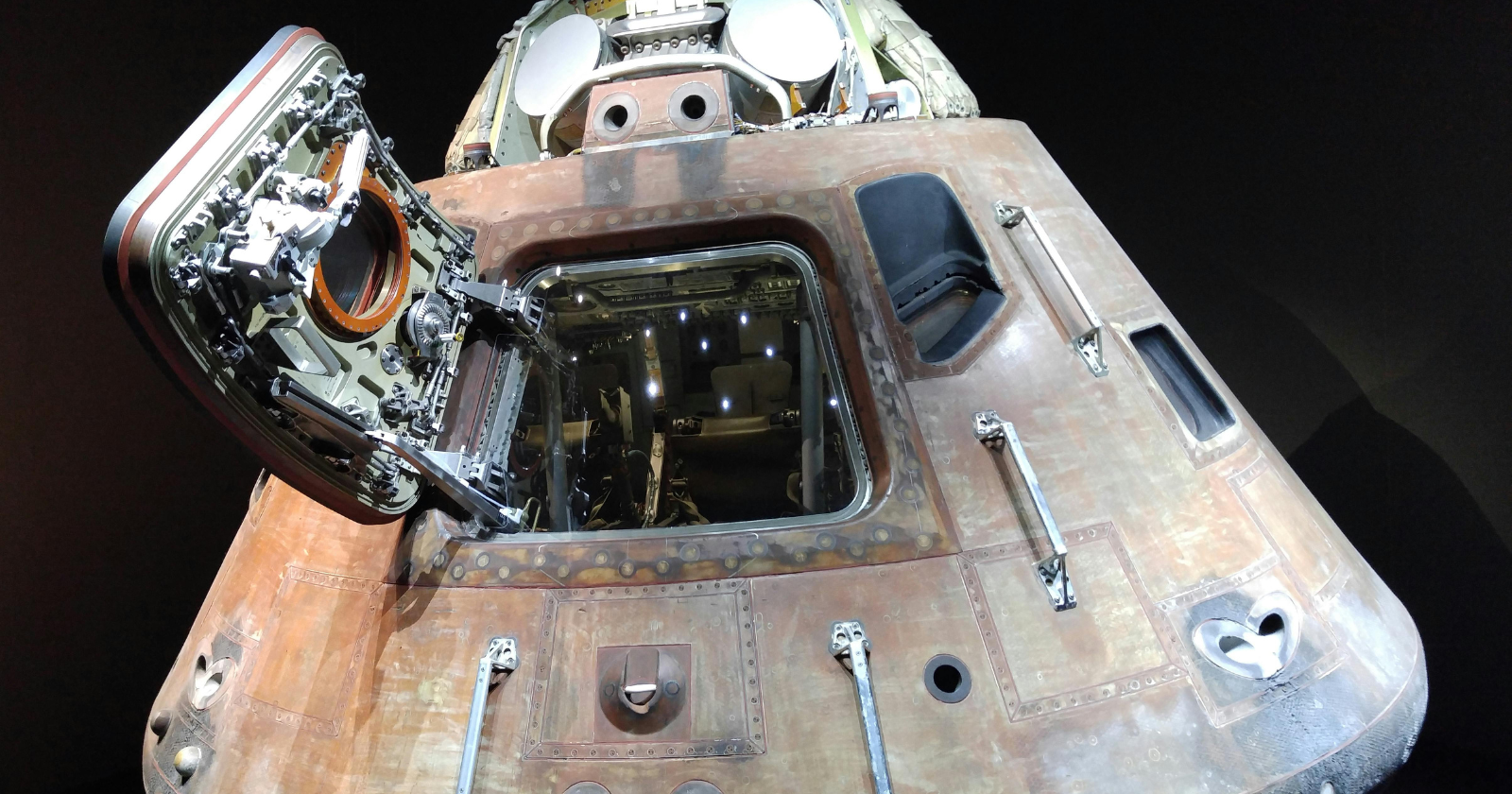
After their first moonwalk, Aldrin and Neil Armstrong were back inside the Eagle, attempting to rest before the ascent. Aldrin noticed a small black plastic object on the floor. On inspection, it was the broken-off switch from the engine arm circuit breaker, marked ENG ARM on the panel. That breaker fed power to the ascent engine. Without that breaker closed at the right point in the checklist, the normal procedure for arming the ascent engine would not work. The command module was still above them, but their own route back to it now depended on a broken plastic switch.
The popular version of the story compresses everything that followed into a single dramatic beat. Aldrin pulls out a felt-tipped pen, jams it into the panel, the engine fires, and the moon launch proceeds on schedule. The actual sequence is less cinematic and more interesting.
The lunar module was an extreme weight-reduction exercise, and its cramped cabin left many controls and circuit breakers exposed. In a pressurised suit with a Portable Life Support System backpack on, the cabin became a hazard course of protrusions waiting to be bumped.
That is what happened. Either Aldrin or Armstrong, manoeuvring in the cramped space after the moonwalk, had caught the engine arm breaker switch with the PLSS pack and snapped it off the panel. Neither noticed at the time. The first sign of the problem was a piece of plastic on the floor.
Aldrin reported the broken breaker to Houston. The astronauts then tried to sleep. They did not sleep well.
This is the part most retellings omit. The decision to push the breaker in with a pen was not a desperate field repair. It was one option being considered alongside others. The night between the moonwalk and the ascent was spent, on the ground, with engineers and controllers working through alternative procedures for arming the ascent engine if the breaker could not be closed.
William Barry, then NASA Chief Historian, has been clear about this in interviews. As History.com quotes him: had the felt-tip pen not worked, Mission Control and the crew would have continued working to find other ways to close the circuit so the ascent engine could be fired. The men were not, in the operational sense Apollo used the word, stranded. They were in trouble. There is a difference.
That difference matters because the popular framing turns the pen into the only thing standing between two astronauts and a slow death on the lunar surface. The pen was the first thing that worked. The list of things that might have worked next was not empty.
Aldrin’s stated reasoning, in his memoir Magnificent Desolation, is the part the lede gets exactly right. He decided against using his finger because the circuit was electrical. He decided against anything with metal at the end for the same reason. He had a felt-tipped pen in the shoulder pocket of his suit, which he had brought along to write on a rendezvous chart. The pen had a plastic body. He inserted it into the opening where the switch had been, and the breaker held.
The pen was a Duro felt-tip marker, not a Fisher Space Pen. The Fisher pen story, which crops up in roughly half the retellings, is a separate piece of Apollo folklore involving a different pen, different mission requirements, and a different commercial backstory. Both the Duro pen and the broken switch were later donated to the Museum of Flight in Seattle, displayed together as physical evidence of a particular kind of engineering moment.
The technical legacy of the incident was small and immediate. On subsequent Apollo missions, the engine arm breaker and other critical breakers in the lunar module cabin were given guards. The vulnerability had been identified by snapping it off in flight, and the fix took the form of a small piece of metal that prevented a backpack from finding the switch by accident.
This is the unglamorous version of how spacecraft hardware evolves. Find the failure mode in flight. Patch it on the next vehicle. The Apollo programme accumulated many such fixes between missions, most of which never surfaced in public memory because they corrected problems that did not become near-disasters.
The engine arm breaker became part of public memory because Aldrin kept the broken switch, kept the pen, wrote about both, and donated them to a museum.
What we find useful about the felt-tip pen story is not the dramatic version, which treats it as a near miss saved by quick thinking. The more interesting version is what it shows about how a working spaceflight programme actually handles problems.
A piece of plastic ends up on the floor of a lunar module. Two crew members notice it, identify it, and report it. Mission Control begins working alternatives without panicking. The crew sleeps badly. In the morning, the simplest possible fix is tried first. It works. The mission continues. The vehicle design is updated for the next flight.
That is what a functioning operations culture looks like, and it is the part of the story that gets compressed when the pen is asked to carry all the drama on its own. The pen did the job. So did the system around it.
The broken switch and the Duro pen were later displayed together in Seattle, and the engine arm breaker on subsequent lunar modules was protected by a guard.
The post When the Apollo 11 crew prepared to leave the Moon, they found the circuit breaker that armed their ascent engine had snapped off after a bulky backpack knocked it, and Buzz Aldrin pushed it back into place with a felt-tip pen rather than risk putting metal into a live electrical circuit. appeared first on Space Daily.
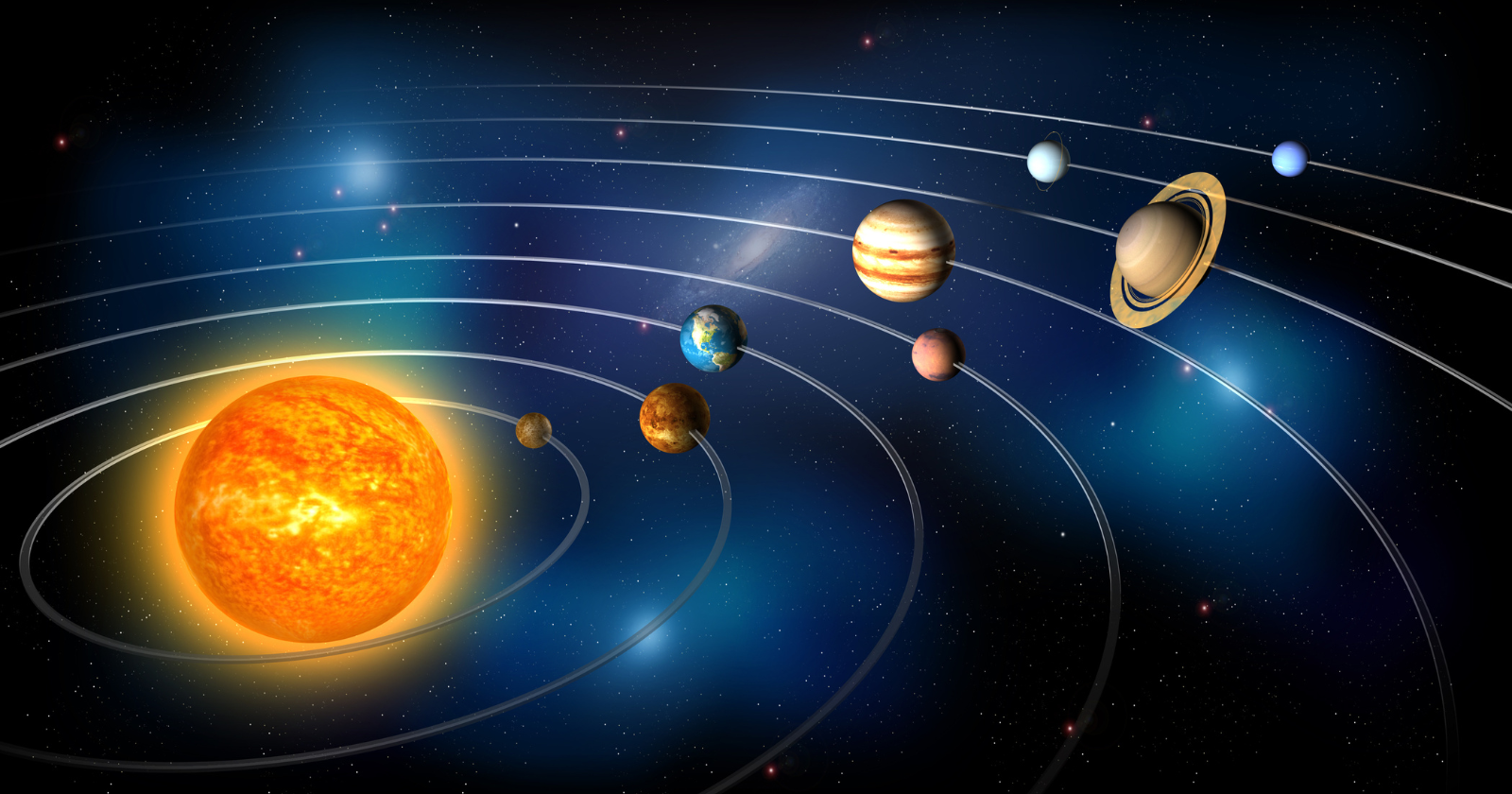
The Sun is not fixed in space. It carries the entire Solar System around the centre of the Milky Way, completing one lap in roughly 230 million years. One galactic year ago, Earth was in the Late Triassic, and the first dinosaurs were only just beginning to appear in the fossil record.
The image is tidy and the underlying facts hold up reasonably well. But both numbers carry more uncertainty than the neat pairing suggests, and the idea that we have come back to the same place is, on closer reading, not quite right.
The Sun’s orbital period around the galactic centre is not pinned to a single value. Estimates run from about 225 to 250 million years, with 230 million the figure most often quoted. Keith Hawkins, an astronomer at the University of Texas at Austin, put it at around 220 to 230 million years and made the point that this so-called galactic year is specific to our position in the galaxy: stars closer to the centre orbit faster, those further out more slowly.
The numbers underneath are better constrained than the period itself. The Sun sits roughly 26,000 light-years from the galactic centre and moves through its orbit at about 230 kilometres a second, a figure the National Radio Astronomy Observatory gives alongside a period of about 226 million years. Data from the European Space Agency’s Gaia mission has since tightened the rotation curve and nudged the favoured period towards the lower end of the range. So when anyone says 230 million years, the honest reading is a figure good to within a few tens of millions of years, not a precise count.
The dinosaur half of the claim survives scrutiny. One galactic year ago lands in the Late Triassic, in the stage palaeontologists call the Carnian. The oldest dinosaurs that are confidently identified as dinosaurs come from the Ischigualasto Formation in northwestern Argentina, dated to around 230 to 233 million years ago: small bipedal animals such as Eoraptor and Eodromaeus, and the larger predator Herrerasaurus.
What the popular version tends to leave out is that these animals were not yet the rulers of anything. The Natural History Museum in London, drawing on the work of dinosaur researcher Paul Barrett, notes that the first definite dinosaurs around 230 million years ago were rare members of the fauna, overshadowed by crocodile-line reptiles. Their dominance did not begin until the end-Triassic extinction about 201 million years ago cleared the field. The coincidence with the galactic year works as well as it does partly because two independently uncertain dates, the orbital period and the first-dinosaur date, happen to fall in the same window.
The phrase that does the heavy lifting in the original observation is “this far around the galaxy,” and it implies a return to the same spot. We have not returned to the same spot.
Several things get in the way. The galaxy rotates differentially, so there is no single rigid sweep that carries everything around together. The spiral arms are not solid structures made of fixed stars; they behave more like wave patterns moving through the disc, which means the arm we sit near now is not the arm we sat near in the Triassic. The Sun also bobs up and down through the galactic plane, crossing it every few tens of millions of years, with a full vertical cycle of roughly 60 to 70 million years. Over hundreds of millions of years it drifts in galactic radius as well.
Put together, one lap brings the Sun back to a similar distance from the centre and a similar angular position, while the actual neighbourhood, the nearby stars, the gas clouds, the arms, is entirely different. The clock comes back around. The place does not.
The tempting next step is to treat galactic position as a cause of what happens on Earth, and there is a real line of research that flirts with exactly this. In 1984, Schwartz and James proposed in Nature that an apparent periodicity in mass extinctions might track the Sun’s oscillation through the galactic plane, the suggested mechanism being that plane crossings disturb the outer comet cloud and send impactors towards the inner Solar System.
The idea has been revisited and challenged repeatedly in the decades since. The main objections are that the plane-crossing interval does not cleanly match the claimed extinction period, and that the extinction periodicity itself is disputed. It remains an unconfirmed hypothesis, not an established link. The galactic year is a useful way to feel the depth of geological time. On the available evidence it is not a lever on terrestrial biology.
The figure will keep moving as Gaia data accumulates and the Milky Way’s rotation curve is measured more precisely. The defensible version of the dinosaur line is the modest one: roughly one trip around the galaxy ago, by a clock we can only read to within tens of millions of years, the first dinosaurs were small, rare, and a long way from inheriting the planet.
The post The Sun is not standing still. It is carrying the entire Solar System around the centre of the Milky Way, and one lap takes roughly 230 million years. The last time we were this far around the galaxy, Earth was in the Triassic Period and the very first dinosaurs were only just beginning to walk. appeared first on Space Daily.
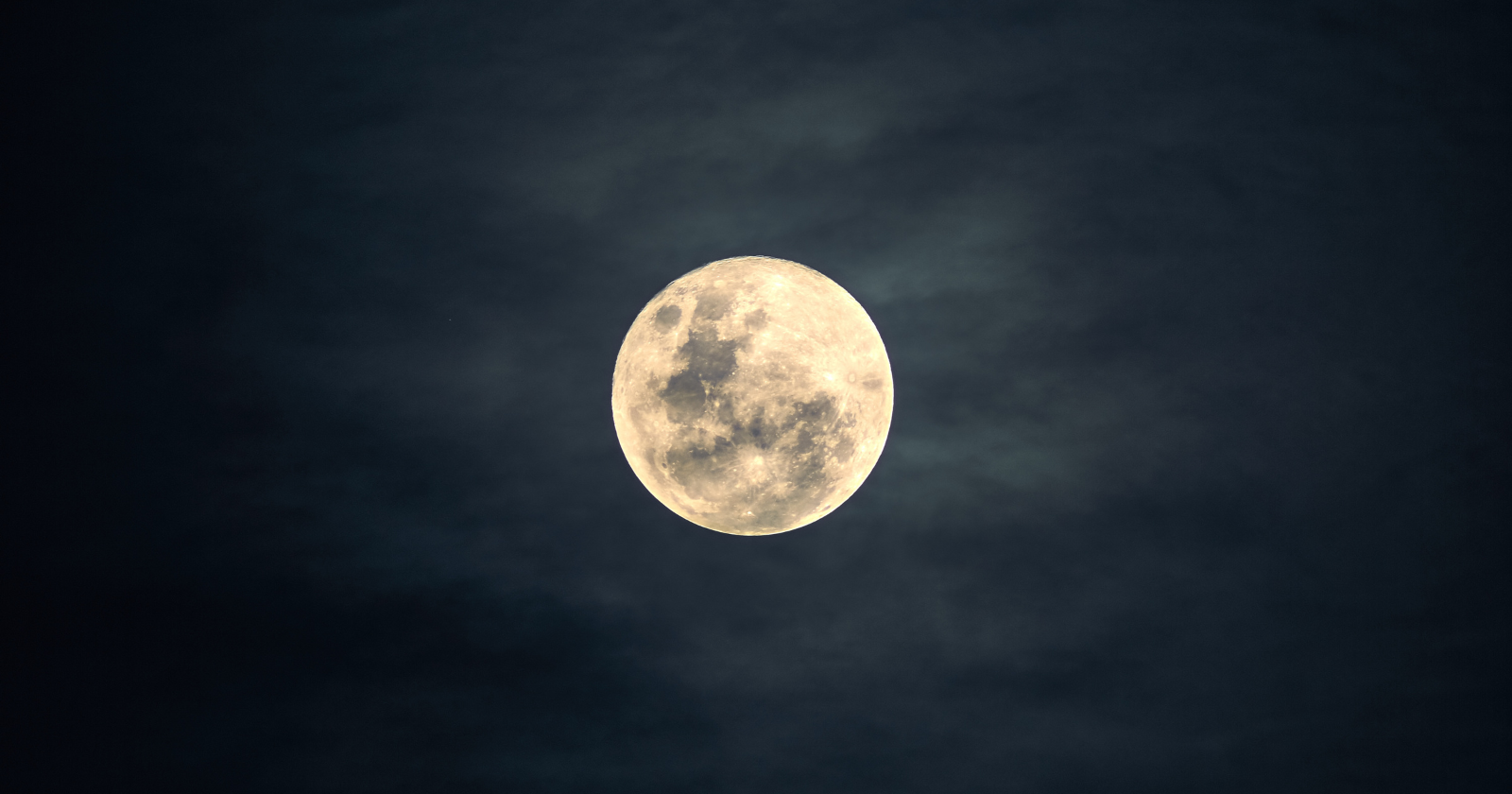
The leading account of where the Moon came from is a collision. Early in the Solar System’s history, a young planet roughly the size of Mars, given the name Theia, is thought to have struck the proto-Earth a glancing blow. The debris thrown into orbit gathered into the Moon. This is the giant-impact hypothesis, and it has been the mainstream view among planetary scientists for decades.
A 2023 study added a striking idea to it: that Theia did not simply vanish into the young Earth, and that two continent-sized masses sitting near our planet’s core may be what is left of it. The idea is well argued and genuinely interesting. It is also a single modelling study proposing a hypothesis, not a settled finding, and the two deserve to be kept apart.
The giant-impact model earned its place because it explains several things at once. It accounts for the Moon’s large size relative to Earth, for the Earth-Moon system’s angular momentum, and for the Moon having only a small iron core, which fits an object assembled mostly from the rocky outer layers of two bodies after their metal had sunk to the centres.
It is the leading hypothesis rather than the only one. It also carries an unresolved problem worth stating plainly: the Earth and the Moon are almost identical in the isotopes of several elements, far more alike than the model easily predicts if the Moon were built largely from a separate impactor with its own distinct composition. The match is close enough that researchers have called it a significant puzzle for prevailing Moon-formation models. Various fixes have been proposed, from a more violent and thoroughly mixed impact to alternative formation models, and the question is not closed. The impact hypothesis is the best account available, not a proven event.
The two masses near the core are not in doubt. Seismologists identified them in the 1980s by watching how earthquake waves slow as they pass through the lowermost mantle, and they have a formal name: large low-velocity provinces, or LLVPs. One sits beneath Africa, the other beneath the Pacific. Each is continent-sized, and they appear to differ in composition from the mantle around them.
What has never been settled is where they came from. They could be accumulations of dense oceanic crust dragged down over billions of years of plate tectonics. They could be material left over from an early magma ocean. They could be a primordial layer that never mixed in. The blobs are an observed feature of the deep Earth with several competing explanations, and that was the state of the question before 2023.
The new proposal came from a team led by Qian Yuan, then at Arizona State University and Caltech, published in Nature. Its claim is specific. If Theia’s mantle was richer in iron than the proto-Earth’s, then fragments of it would have been denser than the surrounding rock. Some of that dense Theian material, rather than being flung into orbit or fully blended in, could have sunk through the young Earth and settled atop the core, where it could clump and survive for billions of years as the LLVPs we detect today.
The team supported this with simulations: models of the impact itself, then models of how dense blobs would move through the mantle over time. In those runs, material around 2 to 3.5 per cent denser than the surrounding mantle sank and gathered into piles resembling the LLVPs. So the study offers a physical pathway by which the blobs could be Theia, and shows that pathway is consistent with the physics. The authors’ own framing is careful. In the paper they write that the LLVPs “may represent” buried relics of Theia, not that they are.
This is where the popular version tends to outrun the research. A simulation that produces LLVP-like structures from Theian material demonstrates that the idea is possible and self-consistent. It does not, on its own, confirm that this is what happened.
No piece of Theia has been held in a hand or measured directly. The blobs sit roughly 2,900 kilometres down and cannot be sampled. The case rests on the impact hypothesis being correct, on assumptions about Theia’s composition that are themselves inferred, and on models rather than physical evidence. Other explanations for the LLVPs have not been ruled out. A coherent model that links two of the deepest puzzles in Earth science, the Moon’s birth and the blobs near the core, is an elegant result and a reason to take the idea seriously. It is not the same as having found the impactor.
The interesting work now is whether the link can be tested rather than only modelled. If the LLVPs really are Theian, they might carry a chemical signature distinguishable from ordinary mantle, and traces of deep material brought toward the surface by mantle plumes are one place researchers look for it. Independent lines of evidence about the Moon’s composition, and refinements to the impact models, will also bear on whether the iron-rich-Theia assumption holds.
For now the honest summary is layered. The Moon most likely formed from a giant impact. Two real, continent-sized anomalies sit near Earth’s core. One well-argued study proposes that the second is the leftover of the first. The first claim is mainstream, the second is observed, and the third is a hypothesis worth following rather than a closed case.
The post The leading explanation for how the Moon was born is that a world the size of Mars called Theia slammed into the young Earth and flung out the debris that became the Moon, and recent research suggests Theia itself never fully left, with two continent-sized blobs buried near our planet’s core possibly being the last remains of the world that struck us. appeared first on Space Daily.
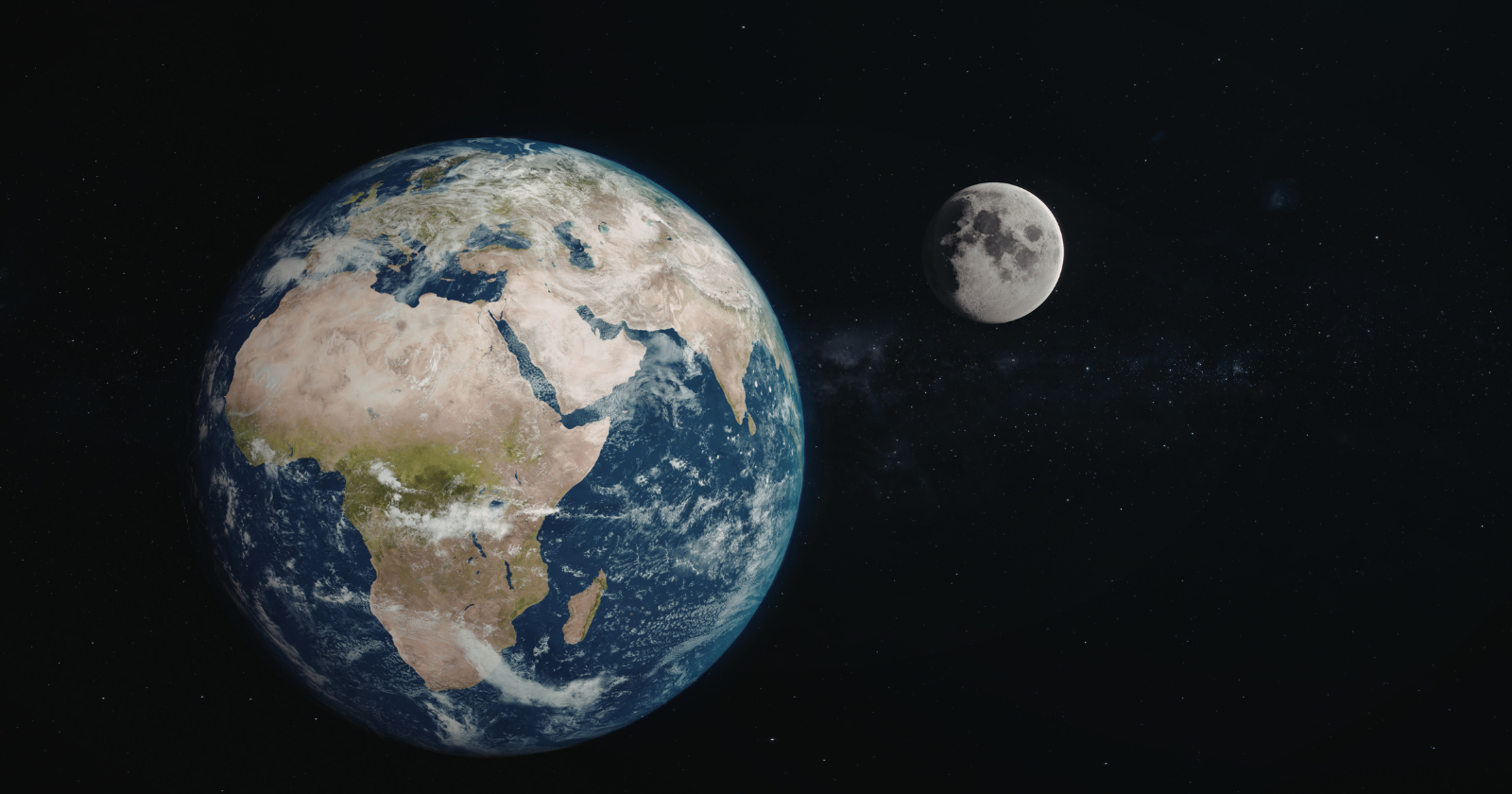
Earth’s spin is slowing, the day is getting longer, and the Moon is drifting outward at about 3.8 centimetres a year, a figure measured by bouncing lasers off the reflectors the Apollo missions left on the surface. Two things in the popular telling are worth correcting, though, because both make a careful process sound more dramatic, and stranger, than it is.
The Moon is not stealing anything. And the day did not stretch from 19 hours to 24 in the order that phrasing implies.
The “stealing time” image is vivid, but it describes a straightforward transfer rather than a theft.
The Moon raises tidal bulges in Earth’s oceans. Because Earth rotates faster than the Moon orbits, our planet’s spin drags those bulges slightly ahead of the line between the two bodies. The displaced water pulls gravitationally on the Moon, and the Moon pulls back. The result is a brake on Earth’s rotation and a push that nudges the Moon into a higher, wider orbit.
What ties the two together is a conservation law. The total angular momentum of the Earth-Moon system stays constant. As Earth’s rotation loses angular momentum, the Moon’s orbit gains exactly that amount, which is why it moves away. Nothing is lost from the system and nothing is taken from outside it. The “theft” is bookkeeping: one column falls, the other rises by the same figure. A less colourful description, but the accurate one is a transfer, not a heist.
The bigger problem with the popular version is the timeline. It suggests the day began at 19 hours and has been climbing steadily to 24 ever since. The real sequence runs the other way at the start, and includes a long pause in the middle.
Soon after the Moon formed, roughly 4.5 billion years ago, Earth was spinning far faster than now. Estimates for that early day run well under 19 hours, somewhere in the region of 10 hours or less. The day then lengthened over time as tidal braking did its work. So 19 hours is not the beginning of the story. It is a point partway through.
And it is a striking point, because the day appears to have stalled there. A 2023 study in Nature Geoscience by Ross Mitchell and Uwe Kirscher found that Earth’s day held at roughly 19 hours for about a billion years during the mid-Proterozoic, between around two billion and one billion years ago. This is one study built on a compilation of geological constraints, not a settled count, but the mechanism it proposes is elegant. Lunar ocean tides were slowing Earth’s spin, as always. At the same time the Sun’s heating of the atmosphere drove atmospheric tides that pushed the other way, speeding the spin up. For roughly a billion years the two effects came close to cancelling, and the day stopped lengthening.
So the honest version is almost the reverse of the slogan. The day began far shorter, lengthened over time, then appears to have paused near 19 hours for roughly a billion years before the slow climb toward 24 hours resumed.
The present-day half of the claim, that the Moon is still moving away, is the part we can measure most directly, and the method belongs on a page about space.
Three Apollo missions and two Soviet landers left arrays of corner-cube reflectors on the lunar surface. Observatories on Earth fire laser pulses at them and time the round trip. Multiplying by the speed of light gives the Earth-Moon distance to within a few centimetres, and tracking it across decades shows the Moon receding at about 3.8 centimetres a year, close to the rate a fingernail grows.
One caution about that number. It is the present rate, not a constant, and it cannot simply be run backwards. Project 3.8 centimetres a year into the past and the Moon would have been touching Earth around 1.5 billion years ago, which is impossible given that it formed some three billion years before that. The recession rate depends on how the continents and ocean basins are arranged, and today’s layout, with an Atlantic close to a tidal resonance, makes the braking unusually strong. In the deep past the rate was slower. The Moon is leaving, but not on a straight line drawn from today’s speed.
Earth’s spin is slowing, the day is lengthening by a couple of milliseconds a century, and the Moon is edging away, all driven by tides and all measured rather than guessed.
The two refinements worth carrying are quieter than the slogan. No time is being stolen, because the angular momentum Earth loses is precisely the amount the Moon’s orbit gains. And 19 hours was not a starting line but a thousand-million-year pause, a stretch when two tides held the day still before the slow lengthening resumed.
The post The Moon is stealing time from the Earth, and it has been getting away with it for billions of years. Our planet spins so much slower than it once did that a single day has stretched from just 19 hours to the 24 we live by, and the Moon is still creeping away from us right now. appeared first on Space Daily.
