
 Login
Login
Pluto takes about 248 Earth years to circle the Sun, which means it still hasn’t completed a single orbit since we found it — and won’t finish that first lap until the year 2178
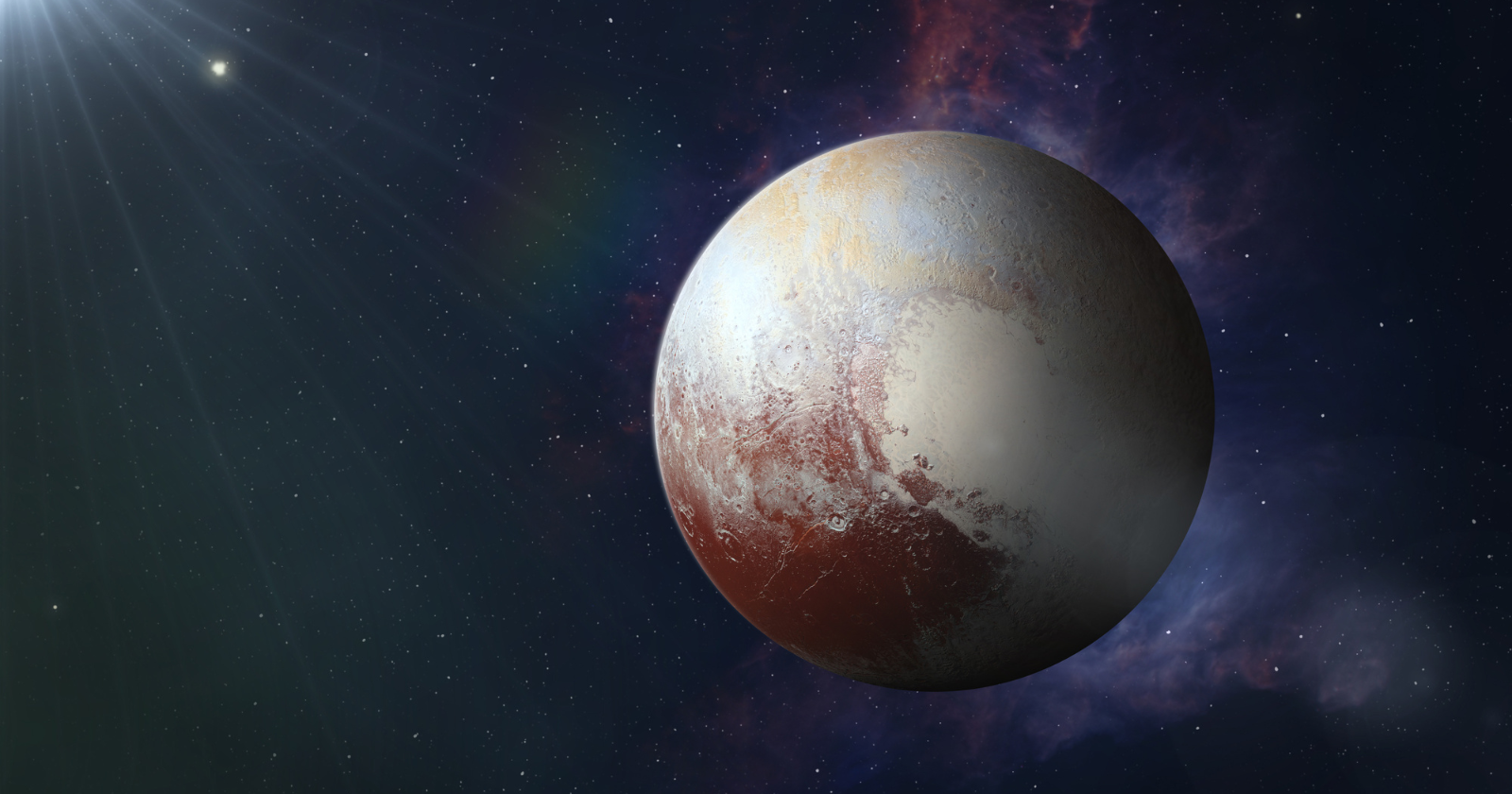
On 18 February 1930, a young man named Clyde Tombaugh sat at a blink comparator in Flagstaff, Arizona, and noticed a faint point of light that had shifted position between two photographic plates. The plates had been taken on 23 and 29 January. That shift was Pluto, and the moment it was logged, a clock started running that no living person will see finish.
The discovery was announced publicly on 13 March 1930, a date chosen to coincide with Percival Lowell’s birthday and with Herschel’s discovery of Uranus. Pluto was hailed as the ninth planet. What nobody could mark on a calendar that day was how long the new world would take to go once around the Sun.
What one Plutonian orbit actually looks like from the inside
A single Plutonian year runs to roughly 248 Earth years. That number sits so far outside human timescales that it stops feeling like a year and starts feeling like a span of history.
The orbit is not a tidy circle. According to NASA, Pluto’s oval-shaped path can take it as far as 49.3 astronomical units from the Sun and as close as 30. One astronomical unit is the average Earth-Sun distance, so Pluto swings between roughly 30 and 49 times farther out than we are. The path is also tilted about 17 degrees to the plane the major planets share.
That eccentricity does something strange. NASA notes that from 1979 to 1999, near the closest point in its orbit, Pluto was actually nearer the Sun than Neptune. It reached perihelion, its closest approach, on 5 September 1989. Pluto will not reach the far end of its current lap, aphelion, until around 2114.
Why 2178 is a number worth sitting with
Dated from Tombaugh’s discovery, Pluto will complete its first full observed orbit on Monday, 23 March 2178. The orbital mechanics are precise enough to name the day. Nobody alive when Pluto was found will be alive when it crosses back to where it started.
The interval has already swallowed one of Pluto’s defining facts. The International Astronomical Union reclassified Pluto from planet to dwarf planet in 2006, which means it lost its planetary status without completing a single orbit as a planet. Between the 1930 discovery and that 2006 vote, Pluto had covered only about three-tenths of its journey around the Sun.
There is a quieter coda. When NASA’s New Horizons spacecraft flew past Pluto on 14 July 2015, it carried about an ounce of Tombaugh’s ashes. The man who found the point of light got to ride out to it, decades after his death, before the world he discovered had gone even once around its star.
What the incomplete lap tells us about scale
The flyby reframed Pluto from a smudge on a plate into a detailed world. Alan Stern, the mission’s principal investigator, reflected that “Tombaugh’s discovery was so much more than just the discovery of the ninth planet.” Stern added, “I only wish that Clyde had lived to see all that New Horizons discovered and how stunningly beautiful Pluto is.”
For NASA’s Thomas Zurbuchen, the find opened a wider door. As he put it, “What Tombaugh didn’t know then was that Planet X would launch the era of exploration in the third zone of the solar system.” That zone, the cold reaches beyond Neptune, is now known to hold thousands of icy bodies. Pluto was the first of them anyone saw.
The roughly 248 years Pluto needs for one lap is about as long as the United States has existed. It comfortably contains the entire span from the telegraph to the smartphone. A child born the year Tombaugh squinted at his plates would need to live past 248 to watch Pluto return to the same position, and no human has come close to that age. The first full orbit we have ever tracked is one none of us will witness from start to finish.
The clock that started in 1930 is still running, with more than a century left on it. When it finishes, on 23 March 2178, the people watching will not be the people who started counting.
The post Pluto takes about 248 Earth years to circle the Sun, which means it still hasn’t completed a single orbit since we found it — and won’t finish that first lap until the year 2178 appeared first on Space Daily.
