Reading view

A Hidden Arctic Ocean Crisis Is Unfolding Beneath the Melting Ice

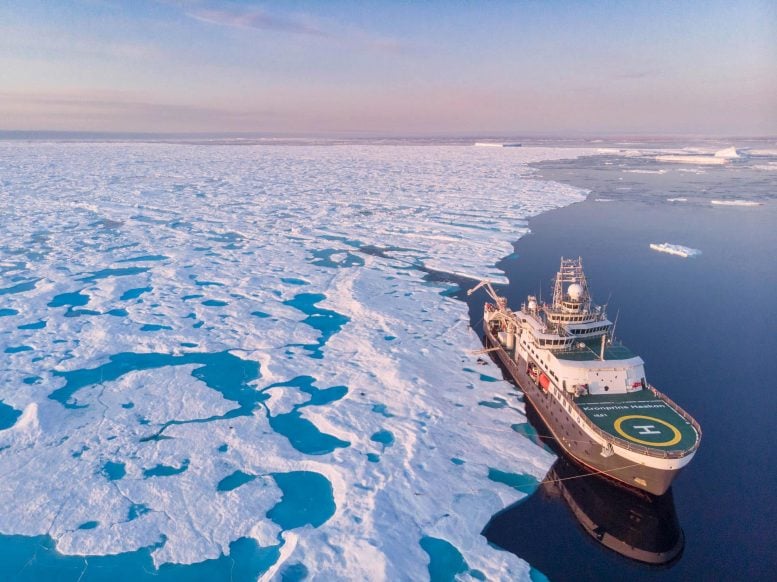
Polar Research Vessel RV Kronprins Haakon Fram Strait Arctic OceanScientists say melting sea ice may have pushed the Arctic Ocean past a tipping point, triggering changes that could reshape marine life for decades. Scientists have identified what appears to be a major and potentially irreversible change in the Arctic Ocean. According to a new study, climate-driven sea ice loss has altered the region’s chemistry [...]
  •  

Plants changed the chemistry of magmas

About 400 million years ago, the population of plants with vein systems for transferring water and nutrients, called vascular land plants, exploded. Soon thereafter, rocks from some continental magmas showed notable shifts in their chemical compositions. Geologists have suggested that these magma changes happened worldwide, but some argue that the data might be biased because some geographic regions have more samples to analyze than others. A new research team recently tested whether these magmatic changes occurred on a global scale, versus in isolated mountain belts or volcanic islands. 

Geologists use the chemistry of rocks formed from magma to understand a magma’s history. In particular, a mineral called zircon that forms from cooling magma preserves chemical clues about where the magma came from and what it interacted with. To test whether magma changes were global or local, the authors needed data ranging from the equator to the poles. Continents have shifted over the past 400 million years, so scientists use the latitude a rock had when it formed, called its paleolatitude, to compare samples from different parts of ancient Earth. To understand magma histories worldwide, the team used publicly available chemical data from zircons in magmatic rocks that formed across a wide spread of paleolatitudes.

Chemical elements with the same number of protons but different numbers of neutrons are called isotopes with different masses. To discern how plants influenced magma, the researchers analyzed 2 different isotope signals preserved in the zircons. The first isotope signal comes from the ratio of the heavy to light oxygen isotopes, which increases when sediment mixes into magma. Scientists refer to this value as δ18O, pronounced “delta 18-O.” 

The second isotope signal comes from the element hafnium, denoted Hf. Geologists use hafnium to estimate how long ago magmas melted and separated from the mantle. Zircon contains 2 Hf isotopes, one of which is stable and one of which is produced by radioactive decay. Because this decay happens over billions of years, the ratio between the 2 Hf isotopes over time shifts only slightly. Geologists express these tiny differences using a shorthand called εHf, pronounced “epsilon hafnium,” which shows how much a magma’s Hf signature has changed from Earth’s original mantle. Lower εHf values indicate magmas that incorporated older crustal rock, while higher εHf values reflect mantle sources.

The researchers found that δ18O values increased as εHf values decreased in these zircons. They concluded that this trend indicates increasing amounts of land-derived sediment in magmas, corresponding with the evolution of land plants. They suggested that land plants altered the ancient landscape, changing how sediments weathered and moved over land. 

To explore this pattern in detail, the team focused on the Andes Mountains, a region that preserves a long history of magmatic activity across a long span of space and time. Using a database, they accessed isotope data from zircon samples collected in the Andes Mountains by dozens of other research groups. These samples covered 32 degrees of modern latitude and 520 million years of Earth’s history, offering a broad window into how magma chemistry changed during that time.

They found that zircons older than 450 million years had no relationship between their εHf and δ18O values. However, in zircons younger than 450 million years, δ18O increased as εHf decreased. The researchers saw this pattern in magmas that formed along the edge of the continent, where one tectonic plate sinks below the other, called a subduction zone. They also saw this pattern in magmas that formed inland, away from the subduction zone, around 200 million years ago during the breakup of the supercontinent Pangaea.

 They found similar results in published zircon isotope data from igneous rocks in China, the Caribbean, Antarctica, Madagascar, and Tasmania. Zircons from each region showed the same relationship as zircons in the Andes. Since paleolatitude can also reflect ancient climate, the researchers compared the ratio of εHf and δ18O, written as εHf/δ18O, with paleolatitude to test whether ancient climate zones influenced magma chemistry. They found no link between paleolatitude and εHf/δ18O. 

With these results in mind, the researchers concluded that the relationship between εHf and δ18O shifted worldwide after vascular land plants evolved. They argued that as plants spread across the continents, their roots accelerated the breakdown of rocks. This accelerated weathering produced large amounts of sediment that washed into ocean basins and was eventually subducted into the mantle, forever changing the chemistry of magma formed there. They suggested that this chain of events illustrates how life on Earth’s surface can drive changes deep within the planet. 

The post Plants changed the chemistry of magmas appeared first on Sciworthy.

  •  

Does the Arctic Ocean regulate or amplify global warming?

Greenhouse gases trap heat within the atmosphere. One such gas that exists beneath the ocean floor is methane. Ice-like substances on the seafloor that contain methane, known as methane hydrates, can break apart or melt, releasing methane gas into the ocean, risking further global warming. Melting permafrost, active tectonics, daily tidal patterns, and changing sea levels can similarly trigger methane’s escape from sediments. However, scientists don’t understand how these triggers will respond to future climate change.

A team of researchers hypothesized that future global warming could actually accelerate methane’s escape into the ocean. To investigate this hypothesis, they focused on an ancient global warming event approximately 56 million years ago, called the Paleocene-Eocene Thermal Maximum or PETM. Arctic Ocean temperatures at times exceeded 20°C (68°F) during this event. These elevated temperatures serve as an analog for today’s rapidly warming conditions. 

Once methane enters seawater, its fate is largely determined by 2 sets of biological processes. Today, 90% of methane released into the ocean from the seafloor is consumed by tiny organisms called microbes via a process known as anaerobic methane oxidation. During this process, microbes consume methane alongside sulfate, producing a solid iron-sulfur mineral, pyrite. Anaerobic methane oxidation prevents methane from escaping into the atmosphere by trapping it in minerals. In this case, the ocean becomes a reservoir, or sink, for methane. 

Despite this, too much methane could overwhelm the sulfate-dependent cycle. If that occurs, a different set of microbes consumes methane alongside oxygen in a process known as aerobic methane oxidation. Aerobic methane oxidation produces carbon dioxide, a potent heat-trapping greenhouse gas that escapes from the ocean. Aerobic oxidation accounts for 10% of methane consumption in oceans today, though this could have been different in the past. 

To determine how much anaerobic versus aerobic methane oxidation occurred during the PETM, the team extracted data from sediments retrieved from the Arctic Ocean floor. As sediment piles up on the seafloor, it compacts. Scientists can drill deep into the seafloor to extract a cylindrical sample, or core, of this compacted sediment. 

The age of sediments in a core increases with depth. Therefore, younger sediments exist at the top of the core, and older sediments exist at the bottom. For this project, the team used a previously extracted core from the Arctic Ocean that contained sediments dating back 100 million years. They found 56-million-year-old sediments from the PETM at a depth of 386 meters, or 1,266 feet, in this core. 

The researchers explained that microbes leave behind unique carbon-based molecules called organic biomarkers when they decompose. These organic biomarkers accumulate in seafloor sediments. The 2 different types of methane-consuming microbes leave behind 2 different biomarkers, one for anaerobic methane oxidation and one for aerobic methane oxidation. This team measured the amount of each biomarker in the sediment core to determine which microbes were dominant during the PETM. 

The biomarker left behind from microbes performing aerobic methane oxidation is called hop(17)21-ene. The researchers noticed that the amount of hop(17)21-ene increased by a factor of 4 during the PETM. At the same time, the biomarker left behind from microbes performing anaerobic methane oxidation, called glycerol dialkyl tetraether, decreased to half. They interpreted these trends to reflect the rise of aerobic methane cycling and the shutdown of anaerobic methane cycling, respectively. They attributed this transition to the release of enough methane to overwhelm the sulfate-dependent methane cycle under warming conditions.

To estimate the amount of carbon dioxide produced by aerobic methane oxidation during the PETM, the researchers located another biomarker in the sediment core, called phytane. Phytane is produced by organisms that consume carbon dioxide during photosynthesis, and its structure preserves clues to the amount of carbon dioxide available at the time. The researchers found that during and well after the PETM, the concentration of carbon dioxide in the Arctic Ocean was 4 times greater than modern levels. They concluded that the Arctic Ocean became a prolonged source of carbon dioxide to the atmosphere, even after the PETM.

The team suggested that the uptick in aerobic methane oxidation during the PETM serves as an analog for the modern Arctic Ocean, which continues to warm rapidly in the face of modern climate change. Their results highlight how the transformation of methane into carbon dioxide poses a threat. More carbon dioxide in the atmosphere warms the air, which heats the oceans, causing more methane to escape from the seafloor and eventually be converted into additional carbon dioxide. When triggered, this feedback would continue to amplify and could become difficult to recover from.  

The post Does the Arctic Ocean regulate or amplify global warming? appeared first on Sciworthy.

  •  

Why the 2023 El Niño broke records

The years 2023 and 2024 were the warmest on record, coinciding with a powerful Pacific climate event known as El Niño. El Niño is the warm phase of a natural climate cycle in which surface waters in the eastern Pacific are unusually warm, bringing record-breaking heatwaves in the Amazon and heavy rainfall in the southern USA. Its counterpart, La Niña, is the cool phase that brings wetter conditions to the Northern USA. 

In a typical El Niño, warm water in the eastern Pacific weakens the winds blowing westward across the tropical Pacific, known as trade winds, allowing more warm water to flow eastward – a self-reinforcing cycle that amplifies the event. However, the 2023 El Niño differed because the ocean warmed intensely, but the trade winds remained strong. Researchers from the Scripps Institution of Oceanography, led by Qihua Peng and Shang-Ping Xie, recently investigated how and why this unusual event occurred.

First, the researchers tracked how air pressures changed across the Pacific during the event using a metric calculated by NOAA, known as the Southern Oscillation Index. When the eastern Pacific warms during an El Niño, the difference in air pressure across the Pacific typically decreases. In 2023, they found that temperatures in the eastern Pacific rose to more than 3°F (2°C) above normal, yet the drop in air pressure was only about 31% as strong as they expected. They also calculated that changes in wind speed and direction could only account for about 30% of the warming. So why was the 2023 El Niño so strong?

To answer this question, the research team then looked beyond the Pacific, analyzing sea surface temperatures from NOAA satellite data. They found that the North Atlantic and Indian Oceans also experienced record-breaking heat in 2023, with temperatures in the North Atlantic exceeding 2°F (1°C) above normal – the warmest in recent history. This suggested that El Niño events can develop in response to ocean conditions worldwide, not just those in the Pacific.

Next, the team used a computer program that simulates how the atmosphere responds to ocean temperatures, called the Community Atmosphere Model, to examine how heat from other oceans affects the Pacific. They found that heat in the North Atlantic and Indian Oceans generated large columns of hot air rising over those regions. This air cooled at high altitudes and then sank over the central Pacific, strengthening a large-scale loop of rising and sinking air that drives trade winds westward. Strengthening this circulation worked against El Niño by keeping trade winds blowing westward about 30% more strongly than Pacific warming alone would have. If the trade winds remained strong, why was the eastern Pacific so warm in 2023?  

To answer this question, the researchers studied 3 consecutive La Niña years between 2020 and 2023, analyzing ocean temperature and sea level data from NOAA’s Global Ocean Data System. During those years, strengthened trade winds transported heat into the western Pacific. As the seawater got warmer, it expanded, a process known as thermal expansion. Over those 3 years, thermal expansion and constant wind created a “pile” of warm water in the western Pacific, which reached its highest level of stored heat since 1982. When the trade winds eventually relaxed as La Niña faded, this piled-up warm water surged eastward, setting the stage for the El Niño event.

To test whether this stored heat alone could drive an El Niño, the team used a computer program that models oceanic and atmospheric interactions, called a coupled general circulation model. They input observed ocean temperatures from April 1, 2023, when La Niña ended, but removed all wind changes after that date. Their model successfully reproduced 87% of the warming observed between June and December 2023, which suggested that trade winds contributed just 13%. Stored heat was carried eastward by massive underwater waves traveling along the equator. As these waves reached the Eastern Pacific, they pushed cold water deeper, allowing surface water to warm. The researchers concluded that this oceanic process drove the 2023 El Niño to develop without the usual wind-driven feedback.

The team suggested that in a warming world, large heat reservoirs in the western Pacific will likely become more common, leading to more frequent strong El Niños. However, because their analysis focused on a single event, it remains unclear how often El Niños develop through oceanic processes alone. Ultimately, their study showed that the ocean can be more than a passive partner in El Niño – it can be the driving force.

The post Why the 2023 El Niño broke records appeared first on Sciworthy.

  •  
❌