
Reading view

In 2026, Kovi Rose traced a 1.3-hour radio pulse and matching X-ray flicker to ASKAP J1745-5051, a white-dwarf system so tight that the orbit itself appears to become the clock

Astronomers spent years blaming neutron stars for the strangest radio pulses in the sky — a Ph.D. student just proved the real culprit is a pair of dead-and-dying stars dancing too close

ASKAP J1745-5051 pulses in radio light every 1.345 hours, and its X-rays flicker on nearly the same clock.

That clock is not the spin of a solitary neutron star. In a Nature Astronomy paper published on June 1, 2026, Kovi Rose and colleagues identify the source as an accreting white dwarf binary, a compact pair in which a dense stellar remnant is drawing material from a lower-mass companion.

The system is named ASKAP J174508.9-505149, shortened by the team to ASKAP J1745-5051. It was found with CSIRO’s Australian SKA Pathfinder, or ASKAP, and then followed up in radio, optical, ultraviolet and X-ray light.

The result does not solve every long-period radio transient. It does something narrower and more useful: it gives astronomers one confirmed physical system that can be compared against the rest of the strange class.
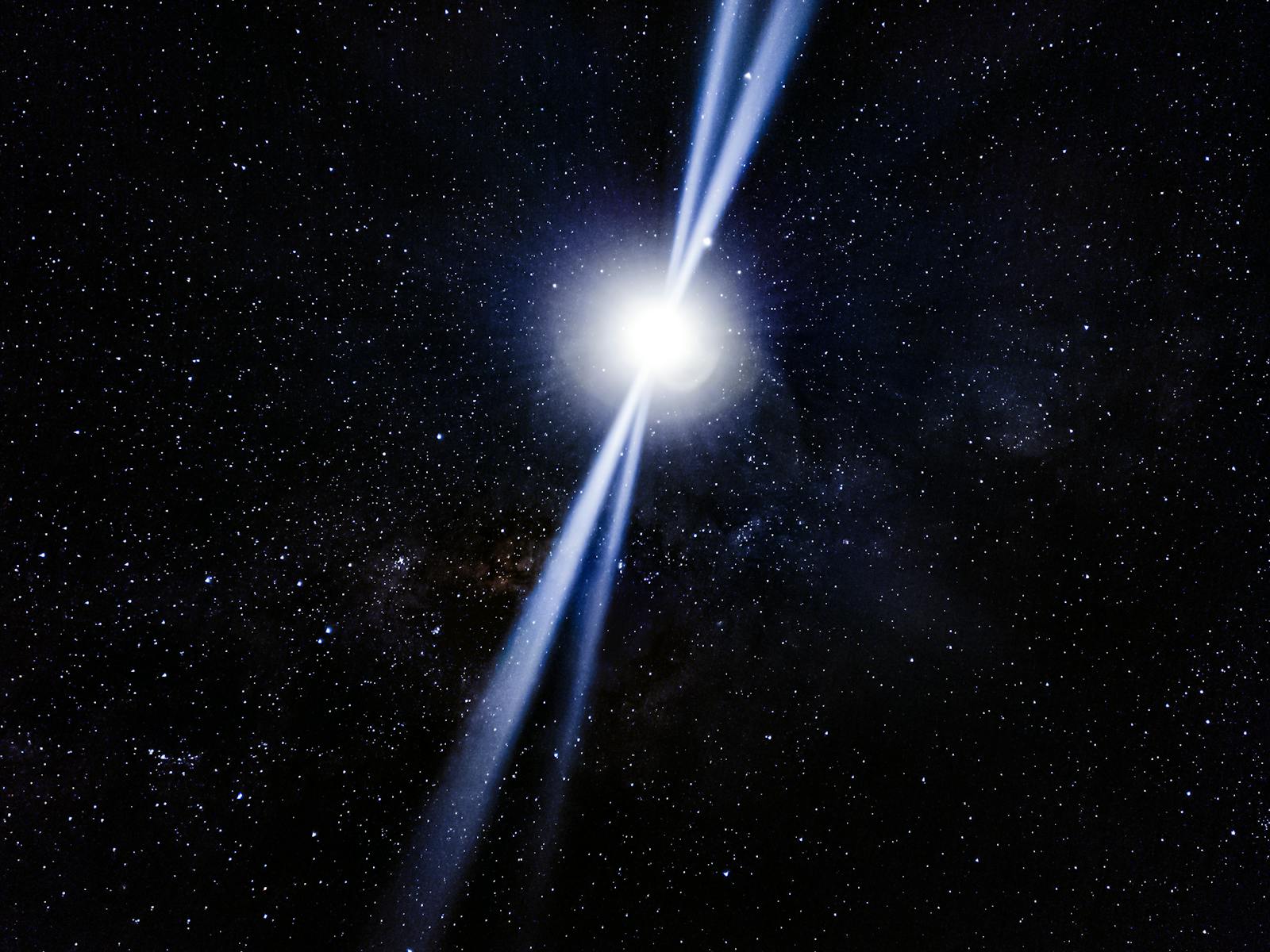
artist impression of a white dwarf binary emitting radio and X-ray signals

The pulse was tied to an orbit

Long-period radio transients are coherent bursts of polarized radio emission that repeat on timescales of minutes to hours. That is what made them so awkward.

Ordinary radio pulsars are neutron stars rotating far faster, often on timescales of milliseconds to seconds. Thomas Gold’s classic 1968 Nature paper argued that pulsating radio sources could be rotating neutron stars with beamed magnetospheric emission, a model that became one of the foundations of pulsar astronomy.

The newer long-period objects sit uneasily beside that model. Some proposed explanations involved ultra-slow neutron stars or magnetars, but others pointed toward compact white dwarf binaries.

ASKAP J1745-5051 lands firmly in the second camp. Rose’s team measured a spectroscopic orbital period of 1.368 hours and a radio pulse period of 1.34497 hours, close enough to show that the radio signal is locked to the binary system rather than to a freely spinning isolated object.

The source is a magnetic cataclysmic variable

A white dwarf is a dead stellar core, roughly Earth-sized but with a mass often comparable to the Sun. In ASKAP J1745-5051, that compact remnant is paired with a red dwarf companion in an orbit so tight it completes a circuit in just over an hour.

Follow-up spectra showed strong hydrogen and helium emission lines, the signature of a magnetic cataclysmic variable. In that kind of system, gas pulled from the companion does not simply fall inward in a quiet stream.

The white dwarf’s magnetic field shapes the flow. Material is guided through magnetized plasma and can crash down near the white dwarf’s magnetic regions, producing high-energy emission.

The University of Sydney announcement described the system as a rare white dwarf binary and said the smaller, dense star is accreting material from the larger but less dense companion. It also described the discovery as a “Rosetta Stone” for understanding these mysterious signals.

The X-rays made the case stronger

The radio pulses alone would have been suggestive. The X-rays made the system much harder to dismiss.

The team found X-ray emission varying with a period of 1.32 hours, within the uncertainties of the orbital and radio periods. The X-ray flux also changed by more than an order of magnitude, behavior consistent with variable accretion in a compact binary.

That matters because ASKAP J1745-5051 is only the third long-period radio transient detected at X-ray wavelengths, after ASKAP J1448 and ASKAP J1832-0911. The Nature Astronomy paper says the detections fall in the range expected for accretion-generated X-rays in cataclysmic variables.

It is still not a universal answer. The authors state that the result strengthens the link between at least some long-period transients and white dwarf binaries, not that every object in the class has the same origin.

Why the old neutron-star answer became less tidy

The neutron-star idea did not appear from nowhere. Neutron stars are the established engines behind many pulsing radio sources, and magnetars can produce extreme bursts of energy.

But long-period transients stretch that picture. Their periods can run from minutes to hours, and several models struggle to produce bright coherent radio emission from an isolated compact object rotating that slowly.

ASKAP J1745-5051 changes the argument by giving the pulse a mechanical clock. The orbit itself appears to organize the radio and X-ray behavior.

That puts it beside another important case, ILT J1101+5521, which emits minute-long radio pulses every 125.5 minutes. In that system, the pulse period is also tied to the orbital period of a white dwarf and M dwarf binary.

ASKAP found the blip and made it local

The instrument is part of the story. CSIRO says ASKAP has 36 dish antennas in Western Australia, each 12 metres wide, working together across about six square kilometres.

ASKAP’s wide field of view and survey speed make it unusually good at finding radio sources that vary or appear unexpectedly. Its science archive also turns those detections into a searchable record rather than a one-off glimpse.

Once ASKAP localized ASKAP J1745-5051, the team could bring in other telescopes. Optical spectroscopy with SOAR and Magellan identified the cataclysmic-variable signature, while Swift and Einstein Probe observations supplied the ultraviolet and X-ray pieces.

That chain matters because a radio transient without a counterpart is only a strange flash. A radio transient with spectra, X-rays and a measured orbit becomes a physical system.

The rest of the class is still unsettled

ASKAP J1832-0911 shows why the problem is not finished. A 2025 Nature paper reported radio and X-ray emission from that object on a 44.2-minute period, with properties unlike any known Galactic object.

Some models treat objects like that as possible magnetars. Others invoke white dwarfs, accretion, magnetic interaction or even more exotic engines.

The cleaner conclusion is that long-period transients may not have one parent population. Some may be white dwarf binaries. Some may be magnetars or other compact objects. Some may remain stranger until better timing, polarization and multiwavelength follow-up pins them down.

For ASKAP J1745-5051, the clock is now visible. Every 1.3 hours, the radio source brightens, the X-rays answer, and a pair of stars too faint to see with the naked eye marks time by stripping matter across a space smaller than many stellar systems ever become.

The post In 2026, Kovi Rose traced a 1.3-hour radio pulse and matching X-ray flicker to ASKAP J1745-5051, a white-dwarf system so tight that the orbit itself appears to become the clock appeared first on Space Daily.


  •  

JWST found a fully formed galactic bar where theory said one couldn’t possibly exist yet — and it quietly rewrites how the universe’s earliest giants stopped making stars

JWST found a fully formed galactic bar where theory said one couldn't possibly exist yet — and it quietly rewrites how the universe's earliest giants stopped making stars

Astronomers using the James Webb Space Telescope have spotted a fully formed stellar bar inside a massive galaxy that existed when the universe was barely a tenth of its current age, a structure that current models say should not be possible. The find locates the bar inside a galaxy at high redshift, viewed in the early universe.

Bars are long, cigar-shaped concentrations of stars that cut across the centers of disk galaxies. The Milky Way has one. So do a significant fraction of nearby spirals. They are supposed to be slow-cooked features, products of billions of years of gravitational settling inside a dynamically cold, stable disk.

GN20 did not get the memo.

barred spiral galaxy JWST

A structure that defies three predictions at once

The bar stretches several kiloparsecs from end to end, comparable in scale to the bar in the present-day Milky Way. Its existence collides with three separate theoretical expectations.

The first: bars of that size should collapse under their own gravity unless embedded in a sufficiently massive, kinematically cold stellar disk. Young galaxies were thought to lack that scaffolding.

The second: simulations have long suggested bars need billions of years to organize. GN20 simply hasn’t existed long enough.

The third, and perhaps the most damaging: high gas fractions, which dominate early galaxies, were believed to suppress bar formation by disrupting the orbital resonances that hold a bar together.

Observations suggest all three problems dissolve under a single condition: the presence of highly turbulent gas across the inner disk at high gas fraction.

Confirmation from a second instrument

The JWST detection does not stand alone. The stellar bar structure aligns with independent dust mapping carried out by millimeter-wave observations. Two instruments operating at radically different wavelengths see the same elongated structure cutting through the galaxy’s interior.

That agreement matters. JWST is sensitive enough to occasionally pick up structures that turn out to be artifacts of dust geometry or projection. Independent views of the cold dust distribution close that escape hatch.

A cosmic funnel feeding a monster

GN20 is one of the most extreme star-forming galaxies in the early universe, producing more than 1,000 solar masses of new stars per year. For comparison, the Milky Way forms stars at a much lower rate.

The bar appears to be part of the reason. Bars act as gravitational conveyor belts, torquing gas out of stable orbits and channeling it toward the galactic center. The high star formation rate is likely being driven by the bar funneling gas and dust into the center, where it triggers an intense nuclear starburst in the gas-rich disk, and fuels the potential active galactic nucleus.

That last clause carries weight. If a bar is dumping fuel into a nascent supermassive black hole at high redshift, it offers a mechanism for the rapid black hole growth JWST has been documenting across the early cosmos. Astronomers have struggled to explain how black holes built up to billions of solar masses so quickly after the Big Bang. A turbulent, bar-driven feeding system is one answer.

Why dead galaxies might owe their death to bars

The most provocative implication of the find concerns galaxies that are no longer forming stars at all. Massive elliptical galaxies in the present-day universe are red, quiet, and effectively dead. They burned through their gas early and never recovered.

How they died has been an open question for decades. Recent work on post-starburst systems suggests the shutdown is abrupt rather than gradual. Post-starburst galaxies represent a small fraction of all galaxies and show signs of having recently hosted enormous bursts of star formation before falling silent. These galaxies carry substantially less molecular gas than their still-active counterparts.

A bar like GN20’s offers a plausible mechanism for that depletion. Channel gas inward fast enough, light it on fire in a nuclear starburst, feed an active galactic nucleus, and a galaxy can exhaust or expel its cold gas reservoir within a cosmologically short window. What remains is a quenched elliptical.

GN20 may be a snapshot of exactly that process in motion. The bar is not just an unexpected structure. It may be the murder weapon.

What turbulence changes

The theoretical wrinkle is turbulence. Standard bar-formation models treat the gas-rich interior of a young galaxy as fundamentally unstable terrain. Cold, smooth disks form bars. Hot, chaotic ones do not.

But the GN20 observations imply something else. Turbulence at high gas fraction may actually stabilize the bar by providing internal pressure support, preventing the runaway collapse that would otherwise unwind the structure. The same turbulence that should make bar formation impossible might be what makes it possible at this epoch.

If that interpretation holds, simulations of early galaxy evolution will need substantial revision. Many existing models do not resolve turbulent gas dynamics at the scales required to capture this physics.

A growing pattern of early maturity

GN20 fits inside a broader JWST trend: the early universe keeps looking more mature than it should. Webb has now spotted bars within the first two billion years after the Big Bang, host galaxies of quasars at extreme redshifts, and disk structures that classical models said could not yet exist.

The pattern is consistent enough that it has stopped being a series of one-off anomalies. Early galaxies appear to have built recognizable structure faster, brighter, and more efficiently than pre-Webb theory allowed.

What happens next

Follow-up work will likely concentrate on resolving the kinematics inside GN20’s bar in greater detail, ideally with ALMA or further millimeter-wave campaigns that can clock the gas velocity field. If the turbulent-stabilization hypothesis is right, the gas should display velocity dispersions far above what is seen in nearby barred spirals.

For theorists, the GN20 result is uncomfortable in a useful way. It points to a specific, testable physical ingredient that current models underweight. Hydrodynamic simulations that properly resolve turbulent, gas-rich disks at high redshift are now the obvious next step.

For everyone else, GN20 is one more reminder that the early universe was not a quiet, formless place waiting to grow up. It was already building the bones of the galaxies we recognize today, and doing so in ways the textbooks did not predict.

The post JWST found a fully formed galactic bar where theory said one couldn’t possibly exist yet — and it quietly rewrites how the universe’s earliest giants stopped making stars appeared first on Space Daily.

  •  
❌