 Login
Login
Alphabet’s record-breaking $85B raise for Google’s AI business is a helluva good signal
If Alphabet's record-breaking $85 billion stock sale signals investor appetite for AI-related offerings, we can see that investors are ready to chow.

John Hill has become director of the Brookhaven National Laboratory in Long Island, New York, after serving as interim lab director since September. Hill will now oversee Brookhaven’s 3000-strong team of scientists, engineers and technicians as well as manage the lab’s annual $900m budget.
Brookhaven opened in 1947 as one of the first three US national labs, the others being Argonne and Oak Ridge. Brookhaven carries out a wide range of research in the physical, biomedical and environmental sciences and is home to seven Nobel-prize-winning discoveries.
Brookhaven operated the Relativistic Heavy Ion Collider (RHIC) until it shut down in February. RHIC collided heavy nuclei such as gold and copper to produce a quark-gluon plasma – a state of matter thought to have been present in the very early universe.
In 2020, Brookhaven was chosen to host the next-generation Electron-Ion Collider (EIC). Costing about $2bn, the EIC will smash together electrons and protons to probe the strong nuclear force and the role of gluons in nucleons and nuclei.
Building the EIC involves revamping the RHIC accelerator as well as adding an electron ring and other components with the first experiments starting the 2030s.
As well as RHIC and the EIC, Brookhaven is also home to other big-science projects including the National Synchrotron Light Source II, which opened in 2015 at a cost of $912m.
With a PhD in physics from the Massachusetts Institute of Technology, Hill joined Brookhaven as a postdoc in 1992 before leading the lab’s X-ray scattering group from 2001 to 2013.
He then became deputy associate laboratory director for energy and photon sciences until becoming the lab’s deputy director for science and technology from 2023 to 2025.
In September 2025 he became interim director following the resignation of the theoretical physicist JoAnne Hewitt.
In the role, Hill will also become president of Brookhaven Science Associates – a partnership between Stony Brook University and the science and tech firm Battelle – that manage and operate Brookhaven on behalf of the US Department of Energy.
Hill notes that he is “very excited” to lead the lab in the coming years. “Brookhaven is entering a defining decade, and I’m honoured to take on this role at this time,” he says. “The vision we have for our future is a powerful one, including delivering the nation’s next particle collider and advancing science across a range of critical areas.”
The post Physicist John Hill takes the helm at Brookhaven National Laboratory appeared first on Physics World.
The lines between separate scientific disciplines are becoming more blurred. Solving today’s problems often requires teams of scientists from a range of specialisms. But multidisciplinary collaboration also has challenges, in particular the need to “speak the same language”, ask the “right” questions and be familiar with techniques and knowledge that exist in other fields.
To see the importance of finding a common language look no further than the rapid uptake of large language models (LLMs) such as ChatGPT. LLMs can be convenient research aids, but the information provided by them is not always accurate. We can ask LLMs questions about another field, but without existing domain knowledge we cannot always tell if the answers are reliable.
Getting up to speed with a new research field can be tricky – it’s difficult to understand everything fully, but tempting to think that you do. There’s a parallel with sport where it might sound reasonable, say, to assume that mixed martial arts (MMA) fighters can easily become boxers. However, the evidence suggests that MMA fighters often struggle against professional boxers even though fist fighting uses a subset of the skills needed to be successful in MMA.
Back in academia, it’s common to get pushback from “real experts” whenever grant proposals or papers drift too far outside one’s own comfort zone. Nevertheless, discipline mixing is needed more than ever. Today’s problems often straddle different scientific disciplines: how to treat large, complex datasets, for example, is a common challenge in many different fields.
We realized this recently in our work at Queen’s University Belfast, which has been pushing for researchers to share their data analysis strategies with colleagues in other fields. In our case, we had been collaborating with Yicong Li at the Institute for Global Food Security on infrared and ultraviolet-visible spectroscopy and machine-learning models for monitoring the freshness of fish, which required only a few samples for analysis.
However, many food studies need hundreds or thousands of samples to be analysed and class imbalances can quickly arise in which some types of foodstuff have more examples than others. This can then lead to training datasets that do not produce predictive models. One example is tea, which Li has been investigating recently, again via spectroscopy and machine learning, using many samples from all over the world.
Li was trying oversampling, which creates synthetic data to equalize class imbalances. Yet over in the Queen’s physics department, we discovered another strategy was being used to classify problems in astrophysics. Matt Nicholl and PhD student Xinyue Sheng had been working on predicting the classes of energetic cosmic explosions, based on an image of the galaxy where they occurred. They wanted to train their model to find particularly rare classes, so their training set had the same problem: there were only a handful of examples of some classes of interest.
In addition to oversampling, they were also using a “weighted loss function” in their training, in which weights were inversely proportional to the number of examples in a given class. Their approach led to a substantial improvement in their astrophysics application, but it turns out the basic idea is completely general in nature and can be just as easily applied to tea.
Knowledge exchange does not only concern data, but sometimes a whole set of ideas. An interesting study of citation metrics in 2015 by researchers at Indiana University found that there is a class of papers that receive very little attention for years before suddenly shooting skywards with a deluge of citations. Notably, these “sleeping beauty” papers include Albert Einstein, Boris Podolsky and Nathan Rosen’s work in 1935 examining non-locality in quantum mechanics, which led to John Bell’s theorem in 1964 and ignited significant interest in the original “EPR” paper.
Such citation trends can arise because the papers’ findings are adopted by researchers in a different field. Other similar instances include work in the 1930s and 1940s on hydrophobic theory, which describes how certain substances minimise their contact with water. Yet perhaps the sleepiest of sleeping beauties is the principal component analysis (PCA) work by Karl Pearson, which slumbered for over 100 years before “awakening” in the early 2000s.
PCA – a technique that simplifies complex datasets by reducing the number of variables while minimizing information loss – had already been gaining traction during the 1980s and 1990s when matrix calculations became easy for computers alongside the development of statistical software packages and open scripting environments. In research papers published today it would be unusual not to see PCA used as an exploratory tool for multivariate dataset analysis.
As these examples show, it’s crucial that communication channels are open between varying fields. However, too many academic researchers can get siloed. Interdisciplinary science hubs are one way to break down barriers, acting as spaces to exchange ideas between scientists.
One example that we have been involved with is Smart Nano NI, which is a consortium of universities and photonics-based companies in Northern Ireland. It recently released TITAN, a bio-process analysis system based on gold nanostructured chips, for real-time bio-analysis. Smart Nano NI is now moving from benchtop to backpocket, looking to develop fully miniaturized sensing devices by integrating different kinds of photonic components like lasers, filters and detectors, all on the same chip.
Elsewhere, centres for doctoral training – such as the Photonic Integration and Advanced Data Storage programme with the University of Glasgow – bring together groups of PhD students to work on various projects under a common theme. These schemes not only foster new ideas with the student cohort but bring together academics to bridge different parts of research. Either way, we are getting people talking and interested in emerging scientific questions.
So if you are sitting on a problem, there might be a chance that someone in a different field has solved it or at least offered the tools to do so. As our sky-gazing friends might say, “There is nothing new under the Sun.”
The post Why interdisciplinary science is needed more than ever appeared first on Physics World.
The prestigious Cavendish Laboratory at the University of Cambridge in the UK has an iconic status in the history of science.
The university’s physics department was initially based in central Cambridge. It is where Francis Crick and James Watson famously worked on the double-helix structure of the DNA molecule.
Yet in 1974 – 100 years after its foundation – the Cavendish moved to a new home on the outskirts of the city.
The building was built in a drab style, covered in grey-brown pebble dash, and featured a maze of interconnected blocks. It was home to generations of physicists, and many thousands of students over the last 50 years.
But the outdated and crammed structure is no longer deemed fit for use and in October last year the lab moved to the nearby larger, brighter and airy purpose-built Ray Dolby Centre. The new centre has been designed to encourage meetings and exchanges with a single entrance, common foyer and centralized café, which are also open to the public.
The move to the Dolby Centre took almost a year to complete, during which time about 180 truckloads moved 3000 m3 of research equipment, crates and furniture belonging to the lab’s 31 research teams.
This included specialized equipment such as 47 cryostats, 98 optical tables, various molecular beam epitaxy set-ups as well a teaching laboratory and museum collection, which includes the model of DNA created by Watson and Crick as well as the cathode ray tube that was used to discover the electron.
Pending chemical and asbestos decontamination, the old building will now be demolished by third-party contractors.
Once complete, the site will host a cycle route until plans are developed for the future use of the site.
Physics World visited the old building in February and this article presents a selection of images from the site.
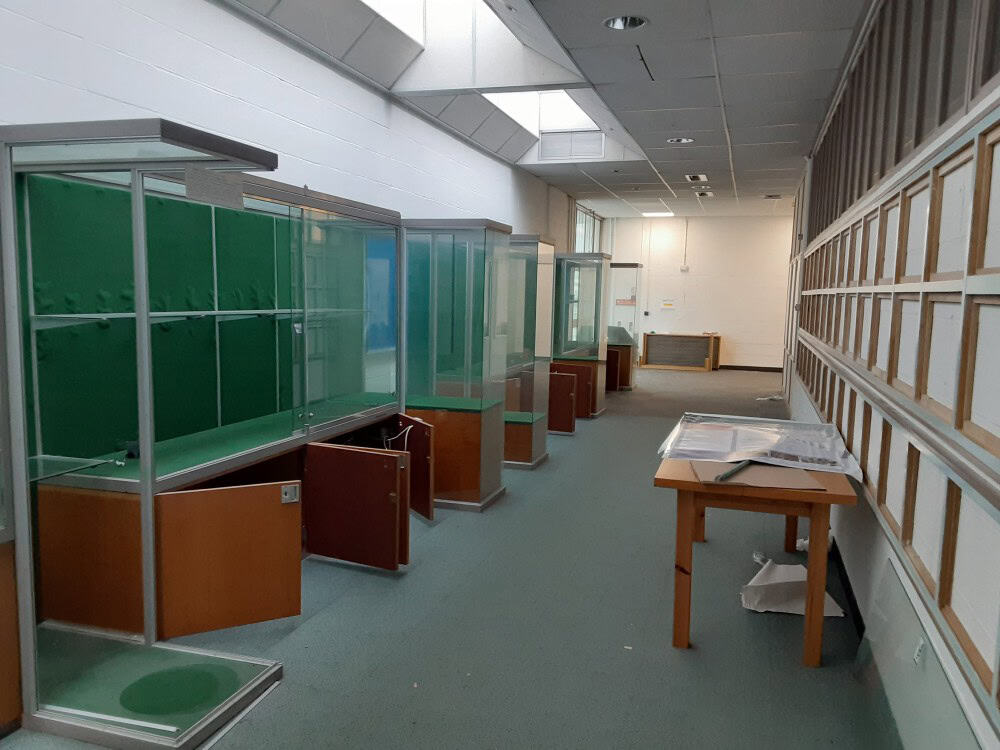
Following the move to the state-of-the-art Dolby Centre, it’s unlikely that the old building of the Cavendish Laboratory will be missed, except perhaps for its picturesque park and pond.
When I visited the building in February, a few bikes clung to the racks to be disposed of if unclaimed, while a sooty barbecue stood in a corridor.
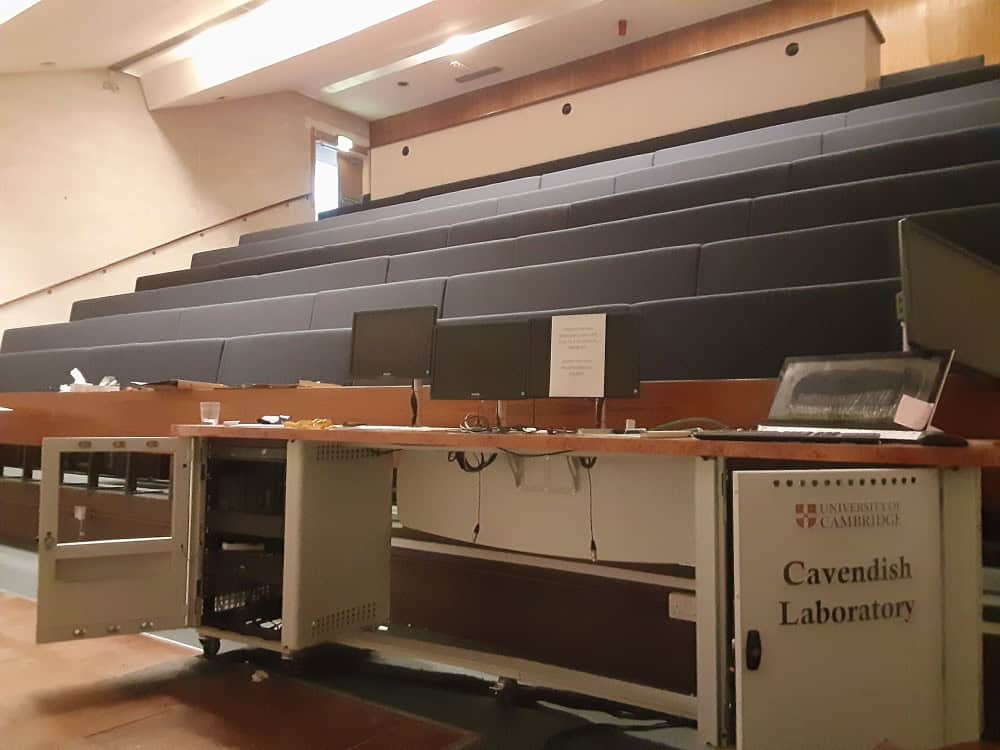
The silent, empty library and still glowing “lecture in progress” sign in a long-abandoned lecture theatre lent an eerie atmosphere to the place.
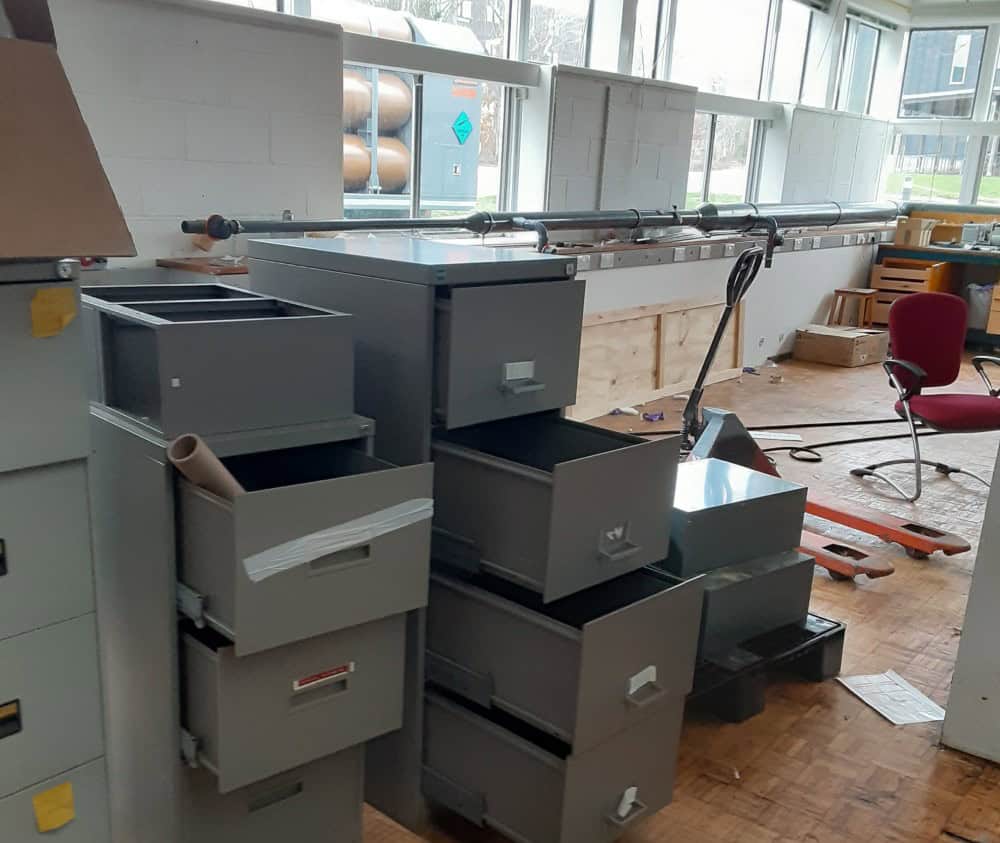
Among the emptied, abandoned labs a few areas seemed untouched by the move.
Some offices were still adorned with books, pictures and lab coats, while white boards were filled with equations.
Some of the old equipment left by researchers has been donated to schools and charities, with remaining materials destined for the skip that is placed at the main entrance.
A couple of areas were wet, with water dripping from the ceiling – an indication that it is time to move on.
As I entered a communal area, half-empty liquor bottles line up on a windowsill, a reminder that good times were once had.
Mićo Tatalović
The post Final look inside the Cavendish lab’s 50-year home before demolition appeared first on Physics World.
