
Reading view

FAU Researchers Harness AI to Detect Prey Species from Predator Chewing Sounds

In the hidden depths of coastal ecosystems, the dynamic interplay between hard-shelled marine mollusks and their predators unfolds silently yet profoundly influences the health of these environments. Organisms like clams and snails, essential for stabilizing shorelines, filtering water, and supporting biodiversity, face mounting threats from ocean acidification and burgeoning populations of mobile shell-crushing predators. Despite their importance, deciphering the rapid and often submerged interactions that govern these predator-prey relationships has long posed a formidable scientific challenge.

The primary obstacle in studying these underwater predation events lies not only in their elusive locations but also in the fleeting nature of the encounters. Predators such as the whitespotted eagle rays (Aetobatus narinari) forage silently in subtidal zones where direct visual observation is hindered by light availability and water clarity. Consequently, the critical ecological process of mollusk consumption remains difficult to quantify in natural settings, leaving a significant knowledge gap in coastal marine ecology.

Unexpectedly, these predation events broadcast distinct acoustic signatures through the water. The fracturing and crushing of clam and snail shells generate unique sounds—transient acoustic signals rich with ecological information. Employing passive acoustic monitoring techniques coupled with autonomous recording devices, researchers can now “listen in” on these feeding behaviors as they happen in situ, capturing data inaccessible through visual surveys alone. Nonetheless, the challenge remains to reliably isolate these faint shell-crunching sounds amid the cacophony of underwater noise.

Addressing this, a team from Florida Atlantic University (FAU) has created an innovative machine learning framework designed to enhance the detection and classification of these subtle shell-crushing acoustic events. Through controlled aquarium trials featuring whitespotted eagle rays—a species renowned for their shell-cracking feeding strategy—the researchers built and trained an AI system adept at distinguishing feeding sounds from ambient oceanic noise, vastly advancing the capability to monitor predator-prey interactions acoustically.

This framework employs a sophisticated, multi-tiered approach. Initially, it processes extensive underwater audio recordings to identify potential predation events via acoustic pattern recognition. Subsequent analytical layers refine these detections by using machine learning classifiers to minimize false positives, thereby filtering actual shell-crushing events from environmental background sounds with high precision.

Beyond mere detection, the system also categorizes the type of mollusk prey consumed during these events. This is achieved by integrating traditional classification algorithms such as random forests with advanced deep learning architectures, including long short-term memory networks (LSTMs) and convolutional neural networks (CNNs). Each method is fine-tuned to recognize nuanced features in the acoustic structure of shell-crushing sounds, enabling detailed insights into prey identity.

Significantly, the study, recently published in the journal Ecological Informatics, demonstrates that complex AI architectures are not always essential for robust performance. Simplified models leveraging gammatone feature cepstral coefficients (GTCCs)—a biologically inspired auditory filterbank approach—proved nearly as effective as deep learning models in detecting shell-crushing sounds, while demanding significantly less computational power. This finding holds promise for scalable, long-duration deployment in challenging marine environments where energy and processing capacity are constrained.

As Laurent Chérubin, Ph.D., a research professor at FAU’s Harbor Branch Oceanographic Institute and lead author, emphasizes, these acoustic signals reveal substantial ecological information beyond mere occurrence. Passive acoustic monitoring represents a transformative tool, offering unprecedented access to predator-prey dynamics in otherwise inaccessible ocean habitats, enhancing our understanding of marine ecosystem functionality.

The implications for coastal ecosystem management are profound. By remotely detecting and classifying predation events, the new technology enables quantification of predator impacts on mollusk populations at ecosystem-wide scales—a methodological leap beyond fragmented, location-specific observations. This ability not only enriches basic ecological knowledge but also equips managers with actionable insights into shellfish populations vital for habitat restoration and commercial aquaculture.

The system’s effectiveness extends beyond controlled laboratory settings. Tested in real-world conditions, including data from animal-borne acoustic tags and fixed underwater sensors, the AI framework reliably identified feeding events and prey types in natural habitats. Its resilience when trained exclusively on tank data yet performing accurately in the field demonstrates robust generalizability, critical for widespread application.

Further intriguing is the framework’s capacity to elucidate predator behavior. According to Dr. Matt Ajemian, senior author and director of the Fisheries Ecology and Conservation Lab at FAU Harbor Branch, the acoustic signatures not only reflect prey species but also reveal handling techniques and processing durations. This opens potential avenues for scientists to distinguish between individual feeding strategies and even estimate prey size categories from subtle variations in shell-crushing sounds.

As global investments in shellfish aquaculture and coastal restoration intensify, tools that effectively monitor predator-prey interactions grow increasingly vital. Considering the diverse prey types analyzed range from buried filter feeders to agile mobile shellfish, this AI-powered acoustic monitoring system emerges as a versatile instrument for tracking mollusk mortalities and ecosystem health across heterogeneous coastal environments.

Finally, the computational efficiency of GTCC-based detection models is especially advantageous for deployment on autonomous underwater platforms constrained by limited power and processing resources. This capability supports extensive, real-time ecological monitoring in remote marine areas where traditional sensor networks are impractical, heralding a new era in marine ecology research.

The research represents a collaborative effort among scientists at Florida Atlantic University, including Ph.D. candidates and faculty from the College of Engineering and Computer Science, highlighting the power of interdisciplinary approaches to address complex ecological challenges with innovative technological solutions. Funded partially by the National Science Foundation and institutional grants, this work exemplifies how AI and acoustic technologies can transform environmental conservation, providing a vital toolkit for safeguarding marine ecosystems under increasing anthropogenic pressure.


Subject of Research: Animals

Article Title: Evaluation of a signal processing and machine learning framework to detect and classify shell-crushing predation events

News Publication Date: 7-May-2026

Web References:

References:

  • DOI: 10.1016/j.ecoinf.2026.103795

Image Credits: FAU Harbor Branch, Cat Nickell and Conrad Pfalzgraf

Keywords

Artificial intelligence, aquatic animals, natural resources conservation, sustainability, wildlife management, engineering, technology, acoustics, sound, underwater acoustics, wildlife, predators, marine conservation, ecological restoration, ecosystem management
  •  

Unlocking Fungal Secrets: From Spider Silk to Scientific Discovery

In a groundbreaking exploration of the subtle intricacies woven into agricultural ecosystems, recent scientific research has unveiled an extraordinary role for spider webs as natural, non-invasive reservoirs of fungal life. This pioneering study, conducted by a team from Thammasat University alongside collaborators at Thailand’s National Center for Genetic Engineering and Biotechnology (BIOTEC), delves into the largely unappreciated function of spider orb webs in capturing and preserving living fungal communities. This discovery not only challenges conventional sampling methodologies but also opens new avenues for biodiversity assessment and environmental microbiology.

Spider webs, especially those constructed by the orb-weaving species Cyclosa mulmeinensis, were traditionally studied for their architectural marvel and predatory function, yet they stand out as natural particulate collectors in agroecosystems. This particular species is famed for its “trashline” decorations—linear arrays of assorted environmental debris including vegetation fragments, insect remnants, and dust particles—which inadvertently act as adhesive traps for airborne biological entities. The researchers hypothesized that these intricate silk matrices could be exploited to isolate and culture viable fungi, thus providing a non-destructive sampling platform to study microbial biodiversity in paddy fields.

The setting for this investigation was the tropical rice agroecosystems of Thailand, with webs harvested from embankments across multiple provinces including Pathum Thani, Nakhon Nayok, and Phetchaburi. Employing meticulous sterile collection techniques, the team ensured that the fungal samples obtained were not contaminated by external sources. Once the web material was transferred to laboratory conditions, researchers successfully cultured 112 fungal isolates. This process, unlike molecular DNA sampling that may detect dead or fragmented organisms, prioritized the recovery of living fungi, thus allowing for detailed phenotypic and genotypic assessments.

The diversity uncovered was remarkable. Isolates spanned 23 taxa within six fungal genera, notably Alternaria, Aspergillus, Cladosporium, Fusarium, Penicillium, and Talaromyces. Each of these genera holds ecological and agricultural significance, ranging from plant pathogens to beneficial decomposers. Intriguingly, certain genetic lineages, especially in Cladosporium and Talaromyces, showed no matches in existing genetic databases, indicating potential new species or cryptic diversity that have yet to be documented. This revelation underscores the webs’ potential as untapped reservoirs of microbial novelty.

One of the most compelling facets of this work is the demonstration that fungal propagules intercepted on spider silk retain viability to an extent that permits culturing. This crucial finding offers a methodological advantage over conventional techniques often reliant on environmental DNA analysis. DNA-based detection methods, while comprehensive in breadth, cannot discriminate between dormant, dead, or viable organisms. In contrast, culturing permits the isolation of active fungal cells, facilitating downstream experimentation including pathogenicity tests, resistance profiling, and ecological functional studies.

Conventional fungal biodiversity monitoring typically involves soil, air, and plant tissue sampling, or molecular-based surveys. These procedures may prove logistically demanding, invasive, or insensitive to viable organism status. By harnessing the natural particle-retentive capacity of spider webs, this innovative method introduces a supplementary, low-impact tool capable of continuous environmental sampling as spiders rebuild their webs. Because only fragments of webs were collected, the spiders themselves were unharmed, ensuring an ethical balance between scientific inquiry and ecological preservation.

Beyond the practical implications for microbial ecology, the study brings to the fore a hidden dimension of biodiversity surveillance. The notion that a seemingly ephemeral, delicate structure such as a spider web can harbor and maintain viable microbial assemblages is profound. It challenges assumptions about the limits of biological sampling surfaces and highlights everyday natural structures as rich, overlooked archives of microscale life.

This research also has far-reaching implications for agriculture. Rice fields, vital food-producing ecosystems, are vulnerable to pathogens and ecological imbalances caused by microbial factors. The ability to non-destructively monitor fungal populations via spider webs could enable earlier disease detection, inform integrated pest management strategies, and contribute to sustainable farming. Moreover, unraveling previously undocumented fungal diversity may lead to novel biotechnological or agricultural applications.

While this initial study focused on a single spider species within specific geographic regions, the principle it elucidates promises broader applicability. The universal adhesive properties of spider silk and the widespread presence of orb-weaving spiders in various ecosystems suggest that spider webs could be systematically employed to survey microbial diversity across diverse habitats globally. Further research will be crucial to optimize sampling protocols, characterize seasonal and spatial variations, and explore correlations with environmental factors.

The natural lifecycle of spider webs, characterized by periodic dismantling and reconstruction, provides a dynamic temporal dimension to sampling. This cyclical renewal means webs can continuously accumulate freshly airborne particles and associated fungi, making them living archives and potential indicators of temporal changes in microbial community composition. The adaptability and ubiquity of spider webs thus position them as potent natural biosensors for environmental monitoring.

Dr. Thanakron Into, the lead student researcher, underscores the transformative potential of this approach, emphasizing that spider webs themselves act as subtle yet intricate biological samplers. The study bridges biology and materials science, showing how engineered silk properties extend beyond prey capture to encompass ecological monitoring capabilities. This synergy between form and function exemplifies nature’s inherent ingenuity and its relevance to modern scientific challenges.

Ultimately, the revelation that something as common as a spider’s web can yield vast reservoirs of living fungal diversity reframes our understanding of microhabitat complexity. It compels scientists, ecologists, and agronomists alike to broaden their investigative horizons and reconsider how we tap into the hidden biodiversity around us. As research advances, spider webs could become vital tools in the continuous quest to document, understand, and preserve the microscopic players crucial to ecosystem health and resilience.


Subject of Research: Fungal biodiversity sampling using spider webs in agricultural ecosystems
Article Title: Spider webs as reservoirs of culturable fungal diversity: evidence from orb-weaving Cyclosa mulmeinensis spider in Thai rice agroecosystems
News Publication Date: 20-Apr-2026
Web References:

  • Biodiversity Data Journal: https://bdj.pensoft.net/article/187035/
  • DOI: http://dx.doi.org/10.3897/BDJ.14.e187035
    References: Thanakron Into et al., 2026, Biodiversity Data Journal
    Image Credits: Thanakron Into et al., 2026
    Keywords: spider silk, fungal diversity, microbial ecology, orb-weaving spider, Cyclosa mulmeinensis, agricultural ecosystems, biodiversity monitoring, culturable fungi, environmental sampling, rice fields, fungal isolation, tropical agroecosystems
  •  

Why the Arctic’s Rivers Are Turning Rusty

Scientists have uncovered the twin mechanisms behind the alarming transformation of once-pristine Arctic rivers into rust-colored waterways burdened with toxic iron particles that threaten aquatic ecosystems. A groundbreaking study published in Communications Earth & Environment has provided conclusive evidence linking permafrost thaw to widespread contamination and deterioration of river water quality across Alaska’s remote Brooks Range. This research not only confirms long-suspected processes but also elucidates how warming temperatures trigger distinct geochemical and microbial pathways that release iron and other harmful substances into river systems.

The Arctic’s permafrost, a thick subsurface layer of soil frozen solid for millennia, is thawing rapidly as global temperatures rise. This thaw initiates chemical reactions and biological activity previously locked in stasis, drastically altering water chemistry at both high and low elevation zones. Earlier work pointed toward permafrost thaw as the root cause of river discoloration and toxicity; the new findings decisively close gaps by demonstrating precisely how and where these processes unfold, and how they collectively degrade river environments.

At the higher elevations of the Brooks Range, pyrite-bearing bedrock—a mineral also known as fool’s gold—has remained chemically inert due to being locked in frozen ground. However, thawing activates a well-documented process called acid rock drainage, typically associated with mining operations. As pyrite interacts with water and oxygen, it undergoes oxidation, releasing iron and sulfur compounds while generating sulfuric acid and sulfate ions. These reactions impart the water with high concentrations of dissolved metals and acidity, causing the iron to precipitate out as bright orange rust particles visible throughout the riverbed.

In contrast, the lower elevation wetlands present a radically different picture. These zones, characterized by waterlogged and oxygen-poor soils, harbor microbial communities that respire using iron rather than oxygen. As thaw progresses, these microbes mediate the conversion of solid-phase iron into soluble forms that leach into streams. Once exposed to oxygenated surface waters, this dissolved iron oxidizes, producing suspended rust-colored particles. Unlike acid rock drainage, this microbial iron mobilization does not generate sulfate or sulfuric acid, underscoring a crucial geochemical distinction between the two iron release mechanisms.

The comprehensive multi-scale approach adopted by the research team allowed them to link large-scale landscape patterns to localized geochemical dynamics. By studying a broad swath of the mountain region, focusing on specific river systems, and examining minute creek-level processes, the scientists painted a detailed picture of how permafrost thaw acts as the ultimate driver of iron release. This integrative methodology revealed not only active zones but also anticipated sites poised for contamination, signifying that the rusting phenomenon is far from isolated.

Moreover, the study identified a temporal lag between peak soil thaw depth and river contamination peaks, opening a window for predictive modeling. Iron trapped within the active soil layer during summer thaw can become mobilized and transported to streams in subsequent seasons. By analyzing long-term ground temperature profiles alongside water chemistry data, the researchers demonstrated that monitoring subsurface thermal dynamics offers a reliable way to forecast future metal influxes into river networks, providing valuable early warnings.

Partnerships with mining operations at the Red Dog zinc mine supplied deep borehole temperature measurements and long-term stream chemistry records, enhancing the team’s ability to correlate underground warming with surface water quality changes. These data were pivotal in confirming that the rusting and toxicity are natural but directly caused by anthropogenic climate change through permafrost thaw, rather than localized pollution sources. This revelation underscores that even the most remote Arctic streams are vulnerable to global warming’s silent impacts.

The ecological repercussions of iron-enriched waters are profound and multifaceted. Fine iron particles persist suspended for tens of kilometers downstream, imparting a cloudy orange hue to the rivers. This turbidity smothers periphytic algae critical for aquatic food webs, disrupts insect populations fundamental to ecosystem function, and compromises fish respiratory health by clogging gills. In Alaska and adjacent Canadian territories, these combined stresses jeopardize salmon and other keystone species dependent on clear spawning grounds and healthy aquatic vegetation.

Alarmingly, the phenomenon is not limited to Alaska’s Brooks Range. Similar permafrost-rich regions with sulfide-laden geology exist throughout northern Canada, the European Alps, and the Andes, where analogous rusting of waters is expected or already occurring. Early evidence from Russia corroborates this expanding threat, demonstrating the global reach of permafrost thaw-driven iron release as a new facet of climate change’s multifarious environmental impacts.

Unlike point-source contamination typical of mines, this rusting process is diffuse and challenging to mitigate, occurring across vast wilderness expanses devoid of direct human disturbance. The study’s co-author Tim Lyons emphasized the paradox that the Arctic, often considered a pristine refuge, is now becoming a bellwether signaling planetary ecological upheaval without safe havens. This emergent crisis compels a reassessment of how remote natural systems are monitored and conserved in an era of rapid environmental change.

Nonetheless, the newly established capacity to anticipate water quality declines through ground temperature monitoring offers some hope. By forecasting where and when rusting rivers will appear, scientists and policymakers can prioritize the protection of vulnerable habitats and support subsistence communities reliant on clean water and fisheries for sustenance and cultural heritage. Communication of these risks may enable preemptive action to safeguard critical wildlands and aquatic species before irreversible damage occurs.

In summary, this landmark research elucidates the physical, chemical, and biological mechanisms by which climate-driven permafrost thaw mobilizes iron and toxic metals into Arctic rivers, turning clear waters into hazardous rusty flows. These insights broaden our understanding of climate change’s cascading impacts on freshwater resources and ecosystem health. As global warming accelerates, the urgent need to incorporate permafrost thaw effects into environmental management strategies becomes paramount to protect the future resilience of Arctic landscapes and communities.


Subject of Research: Impacts of permafrost thaw on iron flux and water quality in Arctic river ecosystems

Article Title: Permafrost thaw controls iron flux from wetlands and sulfide-bearing rocks to Arctic rivers and streams

News Publication Date: 27-May-2026

Web References:
https://www.nature.com/articles/s43247-026-03450-x

References:
Lyons, T., Dial, R., Sullivan, P., et al. Permafrost thaw controls iron flux from wetlands and sulfide-bearing rocks to Arctic rivers and streams. Communications Earth & Environment, 27-May-2026.

Image Credits: Tim Lyons/UCR

Keywords: Permafrost thaw, Arctic rivers, iron flux, acid rock drainage, microbial iron reduction, water quality, climate change impacts, Brooks Range, freshwater ecosystems, toxic metals, ecological consequences, environmental prediction

  •  

Two Decades of Data Reveal Climate Change Transforming Biscayne Bay, Study Finds

Two Decades of Monitoring Reveal Alarming Climate-Driven Transformations in Biscayne Bay

For over twenty years, scientists have meticulously monitored Biscayne Bay, Florida’s largest estuary along the Atlantic Coast, unveiling striking evidence that climate change is reshaping this critical marine environment. As data accrued from 2001 to 2021 reveal, the bay has undergone substantial shifts in its fundamental physical and chemical properties—including temperature, salinity, and acidity—profoundly altering the ecosystem dynamics and jeopardizing the natural heritage and economic resources upon which South Florida relies.

This longitudinal study, conducted by researchers at the University of Miami’s Rosenstiel School of Marine, Atmospheric, and Earth Science in collaboration with Miami-Dade County’s Department of Environmental Resources Management, confirms a worrying trajectory: Biscayne Bay’s waters are progressively warming, becoming saltier, and demonstrating increased acidification. Published in the esteemed journal Estuarine, Coastal and Shelf Science, these findings underscore the profound and multifaceted consequences of accelerating climate change and rising sea levels on coastal estuarine systems.

The intricate observations span 34 strategically located monitoring stations distributed throughout the bay, capturing monthly measurements of salinity, temperature, dissolved oxygen, and pH levels. By analyzing these parameters over two decades, the researchers discerned robust climate-driven trends transcending spatial and temporal scales, thus delivering a comprehensive understanding of the bay’s evolving environmental baseline. The integration of long-term datasets allowed for the detection of subtle yet persistent shifts indicative of systemic ecological change.

Among the most significant results was the marked increase in salinity observed in numerous regions, particularly proximal to canal mouths, where researchers detected pronounced saltwater intrusion penetrating the bay’s bottom waters. This phenomenon reflects the complex interplay between rising ocean levels and altered freshwater inflows, reshaping the estuarine salinity gradients essential for maintaining aquatic biodiversity. The resulting shift proposes a gradual displacement of historically brackish, estuarine conditions towards more marine-like environments.

Concurrently, sea surface temperatures across Biscayne Bay have risen consistently, with the northern sectors experiencing the greatest warming trends. Over the latter decade of study, median water temperatures escalated by approximately 0.5 degrees Celsius—a seemingly modest increase with substantial ecological implications. Elevated temperatures impose physiological stress on aquatic organisms, disrupt reproductive cycles, and can catalyze harmful algal blooms, thereby destabilizing the intricate food webs sustaining the bay ecosystem.

Accompanying these changes is a decline in pH levels across much of the bay, signaling an intensification of ocean acidification effects. Reduced alkalinity compromises the calcification capacity of shell-forming organisms such as mollusks and corals, undermining structural habitat complexity and biodiversity. This acidification dynamic, driven by increased atmospheric CO₂ absorption, poses a grave threat to the bay’s vital seagrass meadows, coral reefs, and associated fauna, further exacerbating the vulnerability of marine communities already pressured by rising temperatures and salinity.

The combined consequences of these environmental stressors—unprecedented warming, elevated salinity, and increasing acidity—signal a fundamental alteration of Biscayne Bay’s ecological identity. Transitioning from a historically fresher estuarine system to one increasingly akin to open ocean conditions has far-reaching repercussions for native species adapted to specific salinity and pH ranges. Such transformations could precipitate shifts in species distributions, disrupt fisheries, and impair vital ecosystem services that local human populations depend upon.

Biscayne Bay’s ecological significance cannot be overstated; spanning approximately 429 square miles, the bay supports a diverse array of habitats crucial for regional biodiversity, recreation, fisheries, and economic vitality. Notably, recent research highlights the bay’s indispensable role as a nursery habitat for the critically important juvenile great hammerhead sharks. The estuary’s extensive seagrass beds furnish essential shelter and nutrition for myriad fauna including invertebrates, fish, sea turtles, manatees, and marine mammals, forming a foundation for the broader trophic networks.

Moreover, the bay contributes substantially to coastal resilience in Miami-Dade County, serving as a buffer against storm surge and sea level rise impacts. However, the documented increases in salinity and temperature compound existing environmental pressures, potentially diminishing the bay’s capacity to provide these protective ecosystem services. As climate change intensifies, the urgency of understanding and mitigating these stressors becomes paramount to safeguarding both natural habitats and human communities.

The research team emphasizes the vital importance of sustained, systematic environmental monitoring to elucidate local climate impacts and inform adaptive management strategies. Comprehensive datasets enable resource managers and policymakers to anticipate future changes, optimize restoration initiatives, and implement coastal protection efforts with scientific rigor and foresight. Strategic interventions based on robust empirical evidence can enhance the bay’s resilience against ongoing and future climate challenges.

This seminal study, entitled “Climate Change Influence on Salinity, Temperature, Dissolved Oxygen and pH in Biscayne Bay (Florida): Two Decades of Observations (2001–2021),” represents a critical advance in estuarine science, integrating long-term observational data to decode complex climate-related dynamics in a vulnerable coastal system. The collaborative research effort, authored by Valentina Caccia, Elizabeth Marie Janz, Maria Estevanez, and M. Josefina Olascoaga, exemplifies interdisciplinary approaches essential for addressing pressing environmental issues at the nexus of climate science, marine ecology, and resource management.

As Biscayne Bay transforms amidst the inexorable forces of global change, the insights gleaned from this study underscore a broader imperative to confront climate impacts with urgency, innovation, and informed stewardship. The subtle yet persistent alterations documented herein are harbingers of ecological shifts echoing throughout the world’s coastal estuaries, highlighting the need for intensified research, adaptive governance, and robust conservation to ensure the vitality of these indispensable ecosystems for generations to come.

Subject of Research: Not applicable

Article Title: Climate change influence on salinity, temperature, dissolved oxygen and pH in Biscayne Bay (Florida): Two decades of observations (2001–2021)

News Publication Date: 9-Apr-2026

Web References:
– https://www.sciencedirect.com/science/article/pii/S0272771426001563
– http://dx.doi.org/10.1016/j.ecss.2026.109861
– https://ocean-sciences.earth.miami.edu/index.html
– https://news.miami.edu/rosenstiel/stories/2025/06/juvenile-great-hammerhead-sharks-rely-on-south-floridas-biscayne-bay.html

References:
Caccia, V., Janz, E. M., Estevanez, M., & Olascoaga, M. J. (2026). Climate change influence on salinity, temperature, dissolved oxygen and pH in Biscayne Bay (Florida): Two decades of observations (2001–2021). Estuarine, Coastal and Shelf Science. https://doi.org/10.1016/j.ecss.2026.109861

Keywords:
Climate change effects, Estuarine transformation, Biscayne Bay, Ocean acidification, Salinity increase, Temperature rise, Coastal ecosystems, Marine ecology, Long-term environmental monitoring, Seagrass habitats, Juvenile shark nursery, Coastal resilience

  •  

Radar identifies insect species via reflections from wingbeats

Pollinating insects form a vital part of any ecosystem, enabling the biodiversity that we see on Earth today. However, biodiversity is in rapid decline around the world, and monitoring insect species is a difficult task that often requires some insects to be killed. To support the conservation of biodiversity, which is critical to ensure the sustainability of human civilization, more robust monitoring is required. In a study published in PNAS Nexus, researchers have developed a new method to identify and classify individual insects, based on radar imaging and machine learning.

Radar has long been used to study migrating insects that fly at high altitudes and in large numbers, but such systems typically perform wide-area, long-range monitoring. However, thanks to a combination of millimetre-wave radar and machine learning, narrow focused identification is now possible, by detecting changes in the radar reflection of insects caused by the flapping of their wings.

“Having a background in antenna engineering, there was always the question of whether this technology can be used to address some of the environmental challenges that we’re facing,” says co-lead author Adam Narbudowicz from the Technical University of Denmark. “Some five or six years ago, we started talking with [co-author] Ian [Donohue] about those possibilities, and eventually the idea of micro-Doppler emerged, which seemed feasible from an engineering point of view and could provide some useful data on biodiversity.”

The approach taken in this study doesn’t focus on morphological features of the insects, as these are difficult to detect with radar. Instead, it uses the harmonic patterns generated by the micro-Doppler effect of an insect beating its wings as a detection strategy. Millimetre-wave radar can provide insight into biomechanical characteristics not visible with cameras, and these characteristics are encoded in the harmonic patterns of the wingbeat.

The team used machine learning to improve the accuracy of the identification and incorporated a SHAP (SHapley Additive exPlanations) analysis – an explainable AI tool that interprets and explains key outputs and prioritizes key features – to identify which signal features are the most critical for differentiating insect species. The SHAP analysed each insect across the full spectrum of micro-Doppler harmonics, extracting key features including fundamental wingbeat frequency, energy distributions, cepstral coefficients (sound signals) and how quickly an insect’s wing movement change. These data were then used to train the machine learning model.

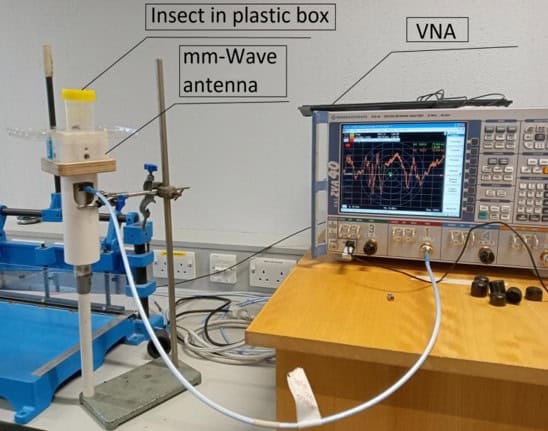
Training the model The radar system used to collect data from insects. (Courtesy: Linta Antony)

The actual process of obtaining this data from the insects involved capturing insects at the Trinity College Dublin campus and placing them in a plastic box on top of a millimetre-wave antenna that recorded their radar signatures. The researchers then released the insects back into the wild. After data capture, the relevant micro-Doppler features were extracted from the data for model training.

The model allowed non-invasive monitoring of different insects and could distinguish between bees and wasps with 96% accuracy. The model also classified five key pollinating insect species – red-tailed bumblebee, buff-tailed bumblebee, moss carder bumblebee, western honeybee and common wasp – with an accuracy of 85%.

“I think the most impressive thing is that we can detect and classify them with such an accuracy. From a biological point of view, it’s impressive how different species beat their wings in different manner, and from an engineering point of view it’s fascinating how different wingbeats affect harmonics of radar micro-Doppler reflections,” says Narbudowicz. “Those differences are of course impossible to see just by looking at spectrograms, but it appears that a sufficiently trained machine learning algorithm can see them.”

Narbudowicz points out that the current study used precise lab-grade transceivers and a relatively controlled set-up, and that the natural next step is to move this technology to outdoor field deployment. “This requires a number of steps,” he explains. “Firstly, the device needs to be miniaturized, and battery operated; the transceiver will be less accurate than the one used in the lab, but a big problem is the ground truth verification, since in the field it can be difficult to verify exactly which species flew over the sensor.”

Despite the greater challenge with deploying the technology in the field today, the researchers suggest that this radar reflection approach could be utilized in the future in a fly-through device, which would make it much easier and cheaper to achieve non-lethal monitoring of insect biodiversity in different environments.

The post Radar identifies insect species via reflections from wingbeats appeared first on Physics World.

  •  
❌