
 Login
Login
The light from the Andromeda Galaxy — the most distant object visible to the naked human eye — left its source about 2.5 million years ago, which means when you look at it on a clear night, you are seeing light that began its journey to Earth around the time the first members of our genus, Homo, were learning to use stone tools
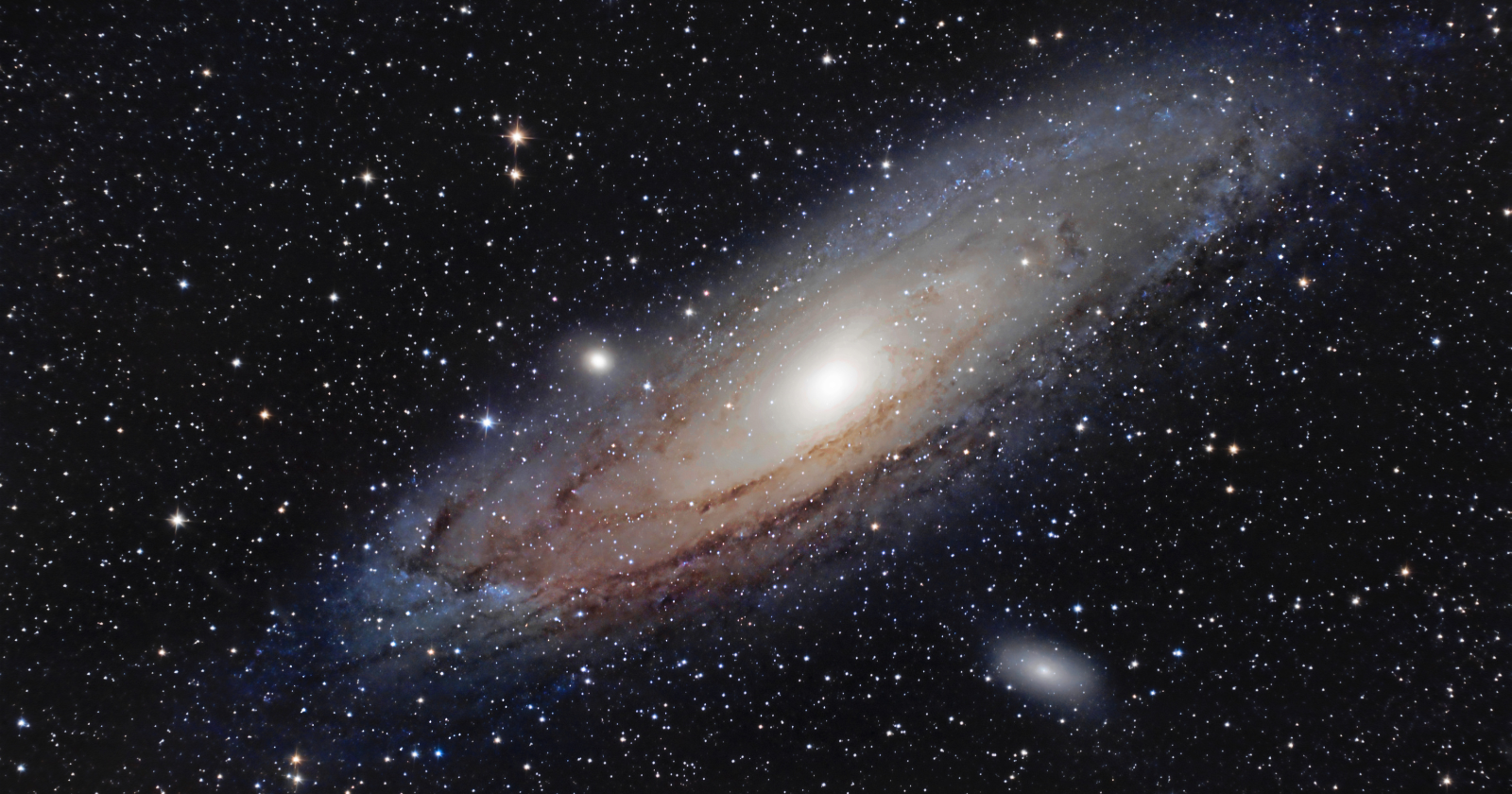
On a clear, moonless autumn night, away from city lights, the patch of sky between the constellations Andromeda and Cassiopeia contains a faint, fuzzy smudge that looks like a slightly out-of-focus star. The smudge is not a star. It is the Andromeda Galaxy, designated M31, the nearest large galaxy to our own and the most distant object that an unaided human eye can see. The light reaching your retina from Andromeda has been travelling for approximately 2.5 million years. It started its journey across intergalactic space at a moment when, on Earth, the first members of the genus Homo had recently appeared in East Africa and were beginning to chip the earliest stone tools out of pebbles. The light is older than our genus’s mastery of the rock.
According to NASA’s Hubble Messier Catalogue reference on M31, Andromeda lies at a distance of 2.5 million light-years, contains an estimated trillion stars, and spans roughly 260,000 light-years across — about twice the diameter of the Milky Way’s main disk, depending on how each galaxy’s outer halo is measured. It is the largest member of our Local Group of galaxies, a small cluster of about 80 galaxies bound together by gravity that includes the Milky Way, the Triangulum Galaxy, the Magellanic Clouds and a few dozen smaller satellite galaxies. Andromeda and the Milky Way are the two heavyweights of the group, separated by 2.5 million light-years of nearly empty space and approaching each other at roughly 110 kilometres per second. In about 4.5 billion years, the two galaxies are predicted to merge.
What “2.5 million light-years” means
A light-year is the distance light travels in one year, moving at 299,792 kilometres per second through a vacuum. It works out to roughly 9.46 trillion kilometres. The “year” in “light-year” therefore refers to the time the light takes, not to the date when the light was emitted. A galaxy “2.5 million light-years away” is 2.5 million light-years’ worth of empty space distant, meaning that the light from it requires 2.5 million years to cover the gap.
The implication is the one that makes astronomical observation a form of time travel in reverse. Any observation of a distant object is necessarily an observation of that object’s past, by the amount of time the light has taken to reach the observer. When you look at the Sun, you are seeing it as it was about eight minutes ago. When you look at Proxima Centauri, the nearest star outside the Solar System, you are seeing it as it was about four years ago. When you look at the brightest stars of the constellation Orion, you are seeing them as they were a few hundred to a few thousand years ago, depending on the specific star. When you look at Andromeda, you are seeing it as it was 2.5 million years ago. The galaxy has continued to evolve in the meantime. Whatever has happened in M31 since the light left, no observer on Earth can see yet.
The poetic version of this fact is sometimes used by NASA’s own science-communication team. NASA’s “Catch Andromeda Rising” guide for night-sky observers phrases the framing succinctly: M31 is “so far away that the light you see left M31’s stars when our earliest ancestors figured out stone tools.”
What was happening on Earth then
The corresponding moment in Earth’s history is well documented in the palaeoanthropological record. According to the Smithsonian Institution’s Human Origins Program, the genus Homo — the group containing our species and our closest extinct relatives — appears in the African fossil record from about 2.8 million years ago. The earliest known specimen, called LD 350-1, was discovered at the Ledi-Geraru site in Ethiopia’s Afar region in 2013 and dated to roughly 2.75-2.8 million years ago. According to the Becoming Human project at Arizona State University’s Institute of Human Origins, the LD 350-1 mandible is “one of the best fossil representatives from this poorly understood period of human evolution,” giving researchers their clearest single window into the emergence of our genus. By the time the light from Andromeda that is now reaching Earth was just beginning its journey, the genus Homo had been in existence for perhaps 200,000 to 300,000 years.
The same period saw the appearance of the first deliberately produced stone tools in the archaeological record. The earliest stone tools, the Oldowan industry, date to about 2.6 million years ago, with cut-marked animal bones from the same period showing that early humans were using sharp stone flakes to butcher carcasses. Homo habilis, the species whose Latin name literally translates as “handy man,” lived from about 2.4 million to 1.65 million years ago, and was given the name specifically for its association with these early stone tools.
The light that reaches your eye from Andromeda tonight began travelling toward you during the early phase of this period. While the first photons were crossing the gap between M31 and the Milky Way, a small number of early hominins in East Africa were taking the first reliably documented steps toward the technology that would, two and a half million years later, build the telescopes capable of imaging the galaxy the light came from.
Why Andromeda is the visible limit
The reason Andromeda is the most distant naked-eye object, despite being roughly the size of six full Moons in angular extent across the sky, is that it is also extremely faint. Most of the galaxy’s surface brightness is spread thinly across a large area, with only the bright core visible to the unaided eye. Under truly dark skies, observers report being able to see fainter portions of the disk extending well beyond the bright nucleus, but in practice most casual observers see only a small, slightly elongated smudge a few times brighter than the surrounding sky background.
Other galaxies are technically visible to keen observers under exceptional conditions. The Triangulum Galaxy, M33, lies at about 2.7 million light-years and is sometimes claimed as a naked-eye object by experienced amateurs at very dark sites. M81, in Ursa Major, is much further at 12 million light-years and has been reported by a small number of naked-eye observers under perfect conditions. These observations are at the absolute limit of human visual capability and require dark adaptation, perfect transparency, and skilled averted vision. For practical purposes, Andromeda is the conventional and widely-accepted “most distant naked-eye object.” Anyone who can see it without a telescope is, in the strict sense, seeing further than any other unaided human observation.
The galaxy looks unremarkable from Earth because of the distance. Up close, M31 contains roughly a trillion stars, dozens of satellite galaxies, supermassive black holes, supernovae, and the same vast structural complexity that the Milky Way contains. Hubble’s most recent high-resolution survey, released in 2025, assembled the largest photomosaic ever made by the space telescope: 2.5 billion pixels stitched together from 600 overlapping snapshots taken over a decade of observations, capturing the glow of about 200 million individual stars — roughly one fiftieth of one percent of M31’s total stellar population. From 2.5 million light-years away, the entire galaxy appears as a faint patch of haze, smaller in subjective impression than a moonbeam. The light has been on its way since before any human ancestor knew what a tool was.
The post The light from the Andromeda Galaxy — the most distant object visible to the naked human eye — left its source about 2.5 million years ago, which means when you look at it on a clear night, you are seeing light that began its journey to Earth around the time the first members of our genus, Homo, were learning to use stone tools appeared first on Space Daily.
