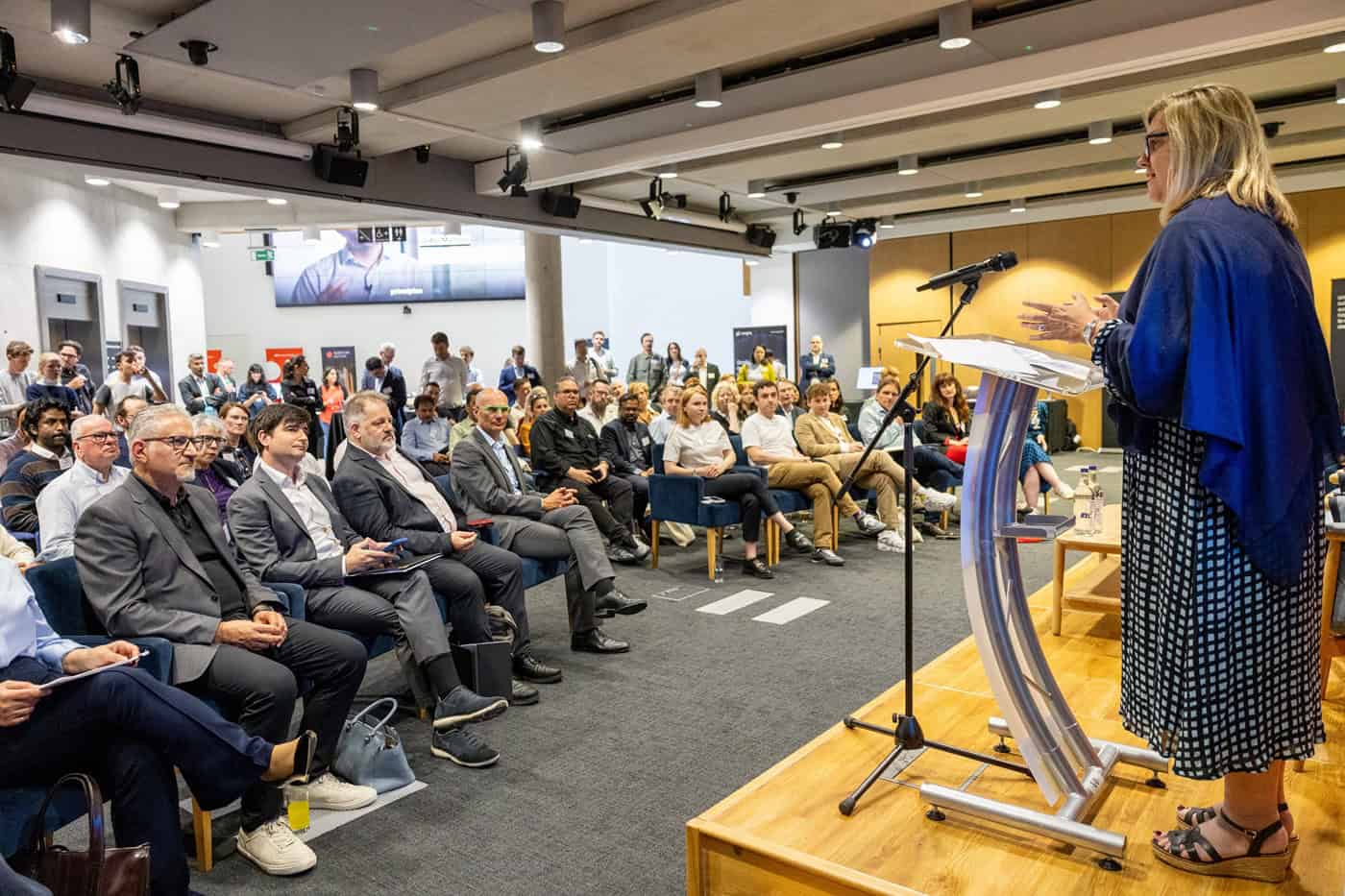
Capital connections Janet Coyle from London and Partners addressing delegates at a meeting at the Institute of Physics to mark the first anniversary of the London Quantum Cluster. (Courtesy: Carmen Vilano)
“There are two types of people when it comes to quantum,” joked Howard Dawber, deputy mayor of London for business and growth at a meeting at the Institute of Physics last night to celebrate the first anniversary of the London Quantum Cluster.
“There are those who understand quantum mechanics. There are those who don’t. And there are those who are in superposition of understanding and not understanding until they are observed.”
It was a light-hearted remark that matched the mood of what was essentially an evening of boosterism for quantum technology in London ahead of London Tech Week next week.
As chair of London and Partners – the growth agency for London – Dawber told the gathering of more than 100 “quantum influencers” that the organization was “100% behind the London Quantum Cluster”.
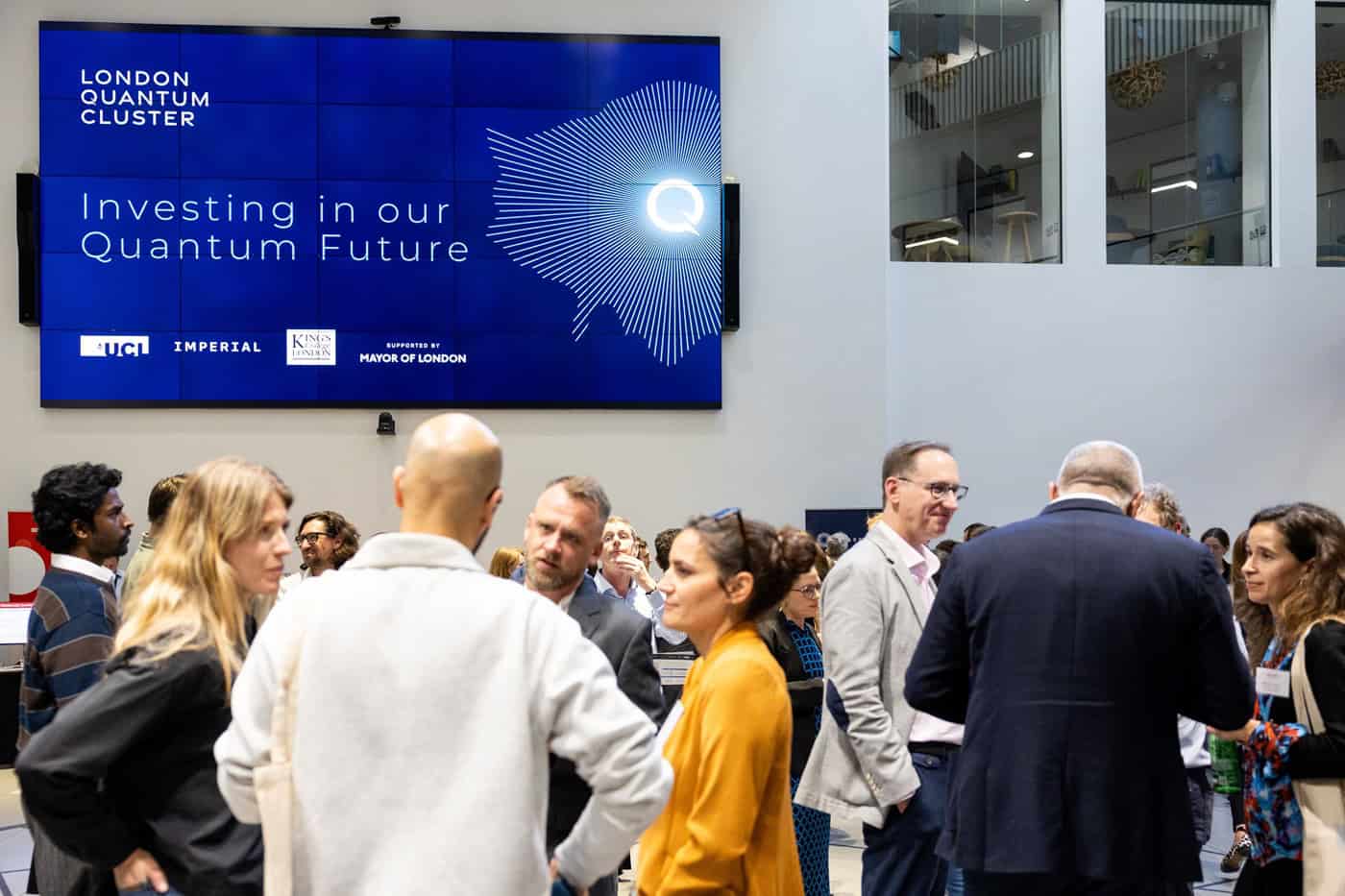
Founded in 2025 by University College London, King’s College London and Imperial College London, with support from the Mayor of London and the UK government, the cluster seeks to establish the capital as a powerhouse of quantum tech.
Georgia Siora from Warwick Economics and Development presented data to show that London is already doing well in the sector, being home to more than 160 quantum companies, with seven of the top 10 UK quantum firms based in the city. Small- and medium-sized quantum firms in the capital, she added, contribute an estimated £153m annually to the economy.
Happy anniversary The London Quantum Cluster is now one year old. (Courtesy: Carmen Vilano)
“Quantum and deep tech are at the heart of the capital’s 10-year growth plan,” added Janet Coyle, managing director of London and Partners.
Geraint Rees, vice-provost for research, innovation and global engagement at UCL, said his aim was “to make London the best place on the planet for serious quantum companies”. He pointed to UCL spin-out Quantum Motion, which has just won $160m of venture-capital funding, as an example of the kind of firm making a name in the city.
The evening ended with a panel debate chaired by Jess Wade from Imperial College London, featuring Maria Maragkou from Nu Quantum as well as Richard Murray, founder of ORCA Computing, who drew a distinction between universities being all about expanding the frontiers of knowledge, whereas for start-ups “the aim is to win”.
Also on the panel was physicist Alejandro Montblanch – head of quantum communication and networking at banking group HSBC – who made it clear that what he wanted to know was: “How can your quantum company help HSBC make more money?”
A welcome note of caution came from London-based venture-capital investor Eloisa Angeles, who pointed out that while the UK has a good track record of government-funded research, the UK is weak at “follow through”, with the government not focused on procurement and not having the end customer of the research in sight.
From heatwaves to extreme rainfall, the impact of climate change is rapidly becoming a reality in our daily lives and a danger to our planet. But physicists are in a great position to help, with physics-based research bringing about practical, real-world solutions, whether it’s more efficient solar cells, better climate models, or novel materials for capturing carbon dioxide from the atmosphere.
There are huge economic and commercial benefits from such work too. A 2023 report from the Institute of Physics (IOP), entitled Physics Powering the Green Economy, estimates there are almost 1800 companies in the UK and Ireland taking green technologies to market with a combined turnover of £750bn.
Last year a follow-up IOP Impact report entitled Unleashing Physics to Power the UK Energy Sector identified the most promising physics technologies for transforming the UK’s energy system. These fall into three main areas: energy generation (nuclear power, photovoltaics), storage (batteries) and transmission (high-temperature superconductors).
The clean-energy revolution will not be easy, however. As the IOP report points out, the UK has a strong research base, good international collaborations, and a growing pipeline of spin-out and early-stage companies. But the country doesn’t invest enough in technology scale-up facilities, faces critical skill shortages, and isn’t great at recycling either.
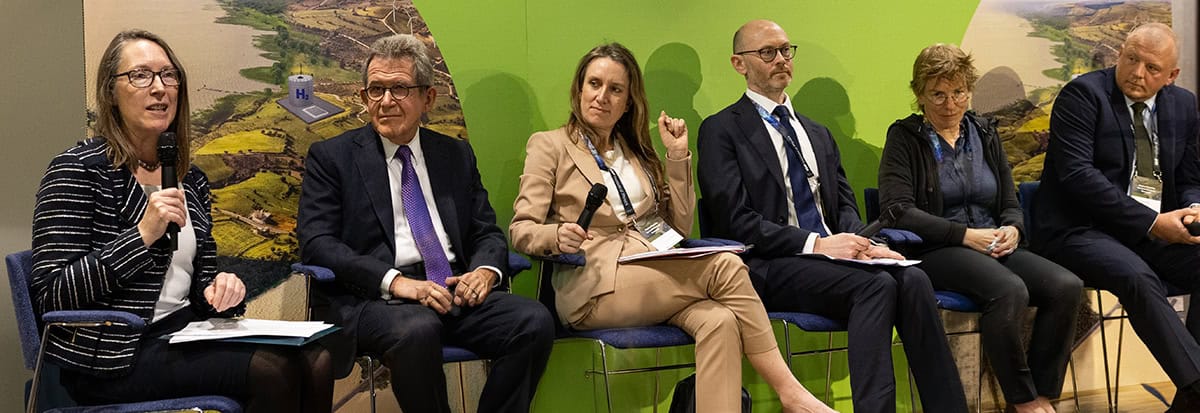
To discuss how physicists are supporting the green economy – and what more they can do – a panel debate was recently held at the IOP in central London. Attended by Prince Edward, the Duke of Edinburgh, as well as about 100 business leaders, policy chiefs, senior physicists, and IOP and IOP Publishing staff, it was chaired by Tara Shears, the IOP’s vice-president for science and innovation.
The panel featured ex-BP boss John Browne, who now works in green energy, Emily Nurse from the UK’s Climate Change Committee, former Sizewell C energy-strategy director David Cole, solar-cell physicist Jenny Nelson from Imperial College, and Nellie Technologies founder Stephen Milburn. The following is an edited extract of the discussion.
Physicists for a greener future
Green game-changers Tara Shears (far left) chairing the panel debate at the Institute of Physics in London on how physics can support the green economy. It featured (from left to right) John Browne, Emily Nurse, David Cole, Jenny Nelson and Stephen Milburn. (Courtesy: Carmen Valino)
John Browne is chair of BeyondNetZero, a climate-growth equity venture firm. He was group chief executive of energy giant BP from 1995–2007, having joined the firm in 1966 after studying natural sciences.
Emily Nurse, who was originally an experimental particle physicist, is the director of net zero at the UK’s Climate Change Committee, which advises the UK government on reducing emissions and adapting to the impacts of climate change.
David Cole, an engineer by training, was at the time of the discussion director of energy strategy at the Sizewell C nuclear-power plant, which is being built in Suffolk in the UK. When complete, it is expected to meet up to 7% of the UK’s total electricity demand. He is now executive president, consulting, at energy firm Wood.
Stephen Milburn is a physicist who is founder and chief executive of the firm Nellie Technologies in South Wales. It removes carbon dioxide form the atmosphere using biomass, which can then be used as animal feed or construction material.
What role are physicists currently playing in our quest for a greener economy?
John Browne: I made a wonderful decision 60 years ago, when I was 18, which was to read physics. After graduating, I became an engineer, but over the last 30 years physics has come back in to my life as I’ve found myself doing something very important – trying to get to net zero. Physics, you see, touches absolutely everything.
All that I’ve ever done – whether it’s renewable energy or “old energy” [fossil fuels] in my old life – starts with physics. Whether you’re involved in chemistry, biology, electronics or engineering, it could not exist without a much deeper understanding of physics. We have to make sure everybody knows that – but I don’t think people currently do. They tend to think engineering is the only enabler for commercialization, but physics is there.
Emily Nurse: I started out as a particle physicist working at CERN on the Large Hadron Collider but for the last four years, I’ve been involved in climate policy and now work with the UK’s Climate Change Committee. We are the UK government’s official advisers on its climate targets – and assessing progress towards meeting those targets. As we celebrate global decarbonization to date, we need to remember it’s all underpinned by physics.
Take the rise of solar power for example, which has been the fastest growing source of global electricity generation for the last 20 years in a row. Solar installations in 2024 were double those in 2022. Along with wind, solar has led to a reduction in electricity from fossil fuels. We’re seeing the costs of solar plummeting and they just keep falling further.
In the UK, solar power has been growing more slowly, but it’s starting to pick up and is going to be a really important part of the electricity mix. We’ve also got a lot of wind here in the UK – it’s a very windy island after all. I would also like to give a shout out to heat pumps: as a physicist, how can you not love their efficiency?
David Cole: I am an engineer, not a physicist, but I’ve spent my career in lots of different sectors and been fascinated with the role that energy plays in creating a better society. What’s really interesting at Sizewell C is the ownership structure, which involves both state and private investment. It’s the first time private investment has been used for a new nuclear build in the UK.
I hope it leads to a virtuous circle, in which the more plants we build, the more we can reap from that investment
David Cole
Getting this hybrid financial structure over the line was not trivial – it took a lot of effort – but I think it will drive great performance. We’re also trying to use as much UK content in the plants as possible, whether that’s materials, skills or technology. I hope it leads to a virtuous circle, in which the more plants we build, the more we can reap from that investment. Sizewell C will, in other words, bring down energy costs, which is fundamental to economic growth.
Jenny Nelson: I have been active in research into solar photovoltaic (PV) materials and devices for over 30 years and we should celebrate how much has happened in the field during that time. In the last 10 years, we have seen capacity increase globally by more than a factor of 10, we’ve seen the efficiency of solar cells increase, and we’ve seen the cost come down almost by a factor of eight, all of which is remarkable.
Those innovations are firmly rooted in physics – whether it’s changes in device structure… or of the optical properties of materials
Jenny Nelson
The cheapest form of electricity globally, in other words, is now from solar PV, which was not the case 30 years ago. These developments have come partly from economies of scale and partly from technological innovations that have now fed through into production. Those innovations are firmly rooted in physics – whether it’s changes in device structure due to our understanding of semiconductor physics or new developments in the optical properties of materials.
The next generation of PV cells, which are likely to be silicon-based tandem devices, will also depend on scientific breakthroughs and innovations.
Stephen Milburn: I’m chief executive of Nellie Technologies, which is based in South Wales on the site of a former chemical-weapons storage facility. We’re using biomass waste for removing atmospheric carbon dioxide, and if you visit us, you’ll see all kinds of activity: in one corner there’s chemistry, in another engineering and in the next there’s biology and biochemistry. But physics is at the heart of the technology. Physicists are a bit arrogant when we say we think we can do everything, but the fact is we probably can.
But we should also celebrate the work that has gone on to create a market in which carbon-emission credits can be bought and sold. Trading carbon credits has been a bit of a dark activity over the last 10 years, with double counting and bad things happening purely by firms wishing to make a profit. However, the market does have the power to regulate itself – in fact the alignment we’re starting to see between the UK and the EU will help greatly.
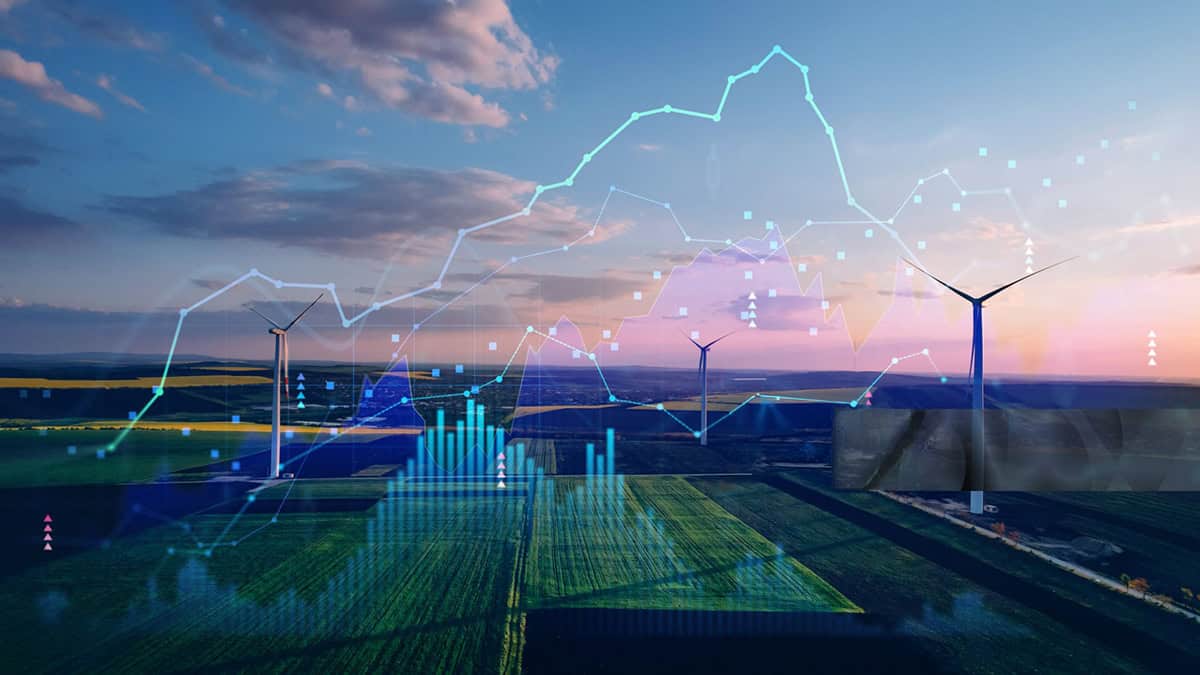
Challenging times Technologies to store, generate or transmit energy are rooted in physics. (Courtesy: iStock/Galeanu Mihai)
What are the biggest growth opportunities for the green-economy sector?
John Browne: First, we can do much more with what we’ve already got – for example we could increase our offshore wind or rethink whether we should go back into onshore wind. Second, we can improve what we’re doing – for instance, by increasing the efficiency of solar panels to their theoretical maximum, which would make rooftop solar economically attractive. Third, there are new opportunities, such as metallic organic frameworks and nuclear fusion.
What we do here in the UK needs to move the needle globally, which means thinking about how to scale and finance it properly
John Browne
However, the UK needs to avoid doing things that others are doing much better. The race for the best battery in the world is, for example, probably going to be won elsewhere. What we do here in the UK needs to move the needle globally, which means thinking about how to scale and finance it properly. The UK shouldn’t end up as a secondary player.
Emily Nurse: The UK has made a lot of progress in our quest to reach net zero by 2050. Since 1990, for example, we’ve halved our carbon emissions, mainly by decarbonizing electricity – phasing out coal, reducing gas generation, while significantly increasing wind, solar and other renewables. Electricity generation now accounts for only around 7% of UK emissions, which are dominated by transport (cars and vans) and heating (oil and gas boilers).
Reducing emissions still further will predominantly come from moving to electric technologies, including electric vehicles and heat pumps, and by further decarbonizing the electricity supply. There will be a backbone of wind and solar, but to ensure a secure supply, we’ll need nuclear, carbon capture and storage, hydrogen and batteries. We’ll have to reduce emissions from agriculture and land use too.
A report from the Confederation of British Industry (CBI) last year estimated that the net-zero economy grew by 10% in 2024, which is three times faster than the rest of the UK. But we’ll need more innovations to continue to bring costs down – and we’ll also need to provide incentives to boost the take-up of electric technologies. If we do that, there’ll be an overall saving to the UK economy in about 15 years’ time, our analysis suggests. There are huge opportunities for green growth to come from this investment.
David Cole: I agree that for the UK to be competitive, the cost of energy has to come down – not just for domestic customers but businesses too. In fact, there are two main opportunities First, we have to adopt a “whole-systems” approach. If we’re building a power station, for example, can we use every bit to its maximum potential?
Let’s say I’m running a direct air-capture plant operating at 25–30 ºC – can I use the waste flow from my coolant system to encourage new industries? Can it support nearby hydrogen generation plants or companies making, say, synthetic aviation fuel? Those questions involve thinking about physics and engineering as well as materials science, which is also super important.
Whichever way you look at it, we’re talking about building a lot of hardware, which involves materials. How much energy per unit mass are they using? Can we recycle those materials? What can we do with the waste products? Ultimately, what is really important is energy security: where does your energy come from, who made it and what impact does it have on the environment?
Jenny Nelson: The net-zero economy is growing significantly faster than the rest of the economy and I think that will continue. But decarbonizing the power sector only addresses part of the problem and we’re going to see a big transition across the rest of industry, agriculture and elsewhere that will generate a wide range of opportunities and stimulate the economy too. I’m not just talking about rolling out more renewables, but about integration – bringing together the generation and storage of energy, ensuring that we are managing demands and have the right infrastructure.
As for my area of photovoltaics, we’ve seen great ideas and technologies come out of the UK that are very likely going to be developed outside the UK because the manufacturing capacity isn’t here. Nevertheless, those ideas and innovations can still benefit the country through licensing, partial manufacturing and new technology.
One thing to remember about solar power is it’s distributed. You can have solar generation without being connected to the grid. That not only opens some markets for certain applications where you want to generate electricity locally, but it also provides a route to energy security through back-up generation, towards which solar power will be an important part.
Stephen Milburn: Having a strong green-technology manufacturing base is a huge opportunity for the UK. My company is based in South Wales, where we have lots of highly skilled people who used to work in traditional industries but now don’t have many places to go. Yes, there’s a fantastic semiconductor industry here, but when it comes to deploying green technology we cannot outsource that responsibility to other parts of the world.
Green tech needs to be deployed in the UK’s industrial heartlands… if we don’t nurture jobs and skills here there’s a real risk they will be gone forever
Stephen Milburn
Green tech needs to be deployed in the UK’s industrial heartlands to take advantage of the skills we already have, but which we are at risk of losing. In fact, if we don’t nurture those jobs and skills here there’s a real risk they will be gone forever. Having a strong green-technology manufacturing base is a huge opportunity for the UK.
Deep thinkers Combining analytical minds with great problem-solving skills, physicists are well placed to tackle the challenges of climate change. (Courtesy: iStock/MTStock Studio)
What needs to happen so that these opportunities can be put into practice?
Stephen Milburn: Many science graduates leave university equipped with solid academic rigour and a great scientific understanding, but they often lack practical green-technology skills. This summer my company is therefore hoping to launch a climate apprenticeship programme, which will allow graduates to pick up those skills. We need to build green-tech skills in the real economy, in particular those that will deal with climate change.
Jenny Nelson: The UK must do more to support its own innovations. We need better regulations to avoid unnecessary bottlenecks. We need to invest in infrastructure like the grid. We should completely avoid subsidizing fossil fuels and instead divert any subsidies into alternative economies. Finally, we need to train and educate people, showing the public the potential of green technology so that they become part of the transition, for example by generating their own electricity.
David Cole: We need to integrate our policies on industry, energy, land use and AI so that we can invest in them all as growth areas. In particular, I’d like to see a long-term nuclear programme in which we build a fleet of new reactors all of the same design, which will drive down costs by letting us replicate a particular technology. It’s also vital that we get a high proportion of UK content and technology into these reactors, which will lead to a virtuous circle, with money coming back into the economy that we can re-invest in industrial and academic partnerships.
Emily Nurse: What’s vital is consistency in policies; we need certainty. In the UK, we are fortunate to have world-leading climate legislation in the form of the 2008 Climate Change Act, which does not just make it a legal requirement to reach net zero by 2050 but also gives us targets along the way. It means we know what we need to do in both the medium- and long-term, which gives certainty to investors, businesses, innovators and consumers.
What’s really important is communication – supporting communities through the transition and making sure they realize the benefits
Emily Nurse
So the first thing we need to do is keep the Climate Change Act. Then, of course, we’ve got to address barriers to delivery, including having the right incentives to electrify the economy. And what’s really important is communication – supporting communities through the transition and making sure they realize the benefits, not just in terms of reducing carbon production but of having cleaner, better and more efficient technologies too.
John Browne: First, we must never stop investing in people who can discover things and translate them into real commercial products. Second, we need to understand how to scale things, which means focusing on the winners and getting rid of things that are “nice to have” but aren’t going anywhere. That’s not easy because you have to push people to say, “You’ve done great work, but you’ll have to stop”.
What’s more, to scale new technology, people have to learn what it takes. When I’m in the US, I often speak to chief executives who can explain their technology to the financier who’s supporting it, whereas here in the UK that often doesn’t happen.
Third, we need to maintain confidence in what we’re doing. I often talk to people who think that it’ll be really expensive to get to net zero, but in fact estimates suggest that each household would only have to spend an average of about £150 a year to get there. So it’ll be less than the cost of a TV licence to get to net zero.
Of course the investment needed will be “lumpy” – it’s not as simple as just levying a fee – but the point about governments is that they can smooth things out. That is what they have done in the past and it’s what they should continue to do.
For more information about the IOP’s work on the green economy, click here. You can also keep up to date with the all latest research in the field through IOP Publishing’s series of open-access Environmental Research Journals at this link.
The quantum-technology sector is burgeoning, but challenges remain when it comes to creating viable commercial products. While quantum sensors show great promise, some technologies rely on ultrahigh vacuum (UHV) – which is difficult to achieve in compact, portable devices.
My guest in this episode of the Physics World Weekly podcast is Florence Concepcion, who focuses on the miniaturization of UHV systems for practical quantum sensors and other devices. She is a senior quantum engineer at Aquark Technologies – a UK-based company that is developing cold-matter quantum technologies.
In 2025 Concepcion was awarded a £1.9m Innovate Future Leaders Fellowship by the UK government. She explains how that money will be spent over four years to develop vacuum systems for quantum technologies.
Before joining Aquark, Concepcion did a PhD on a topic at the intersection of astronomy and atomic physics. She talks about her transition from academia to industry and we chat about careers for physicists in the quantum sector.
SmarAct proudly supports this episode of Physics World Weekly. The company advances breakthroughs in science and technology through high-precision positioning, metrology and automation. Discover how SmarAct shapes the future of innovation at smaract.com.
The quantum revolution is no longer a distant dream. It is unfolding right now, promising to shake up computing, communication and security on a global scale. The race to harness these transformative technologies will not, however, be determined by who succeeds in manipulating qubits – but by who can secure the ideas that make this technology possible.
Intellectual property (IP) is the currency of innovation, and in the quantum era, it will determine whether breakthroughs become valuable assets or lost opportunities. Quantum physics has already made a huge contribution to global economic growth: just think of the billions of transistors in the smartphones that we carry around in our pockets.
But the “quantum 2.0” revolution, which will exploit phenomena such as superposition and entanglement, is set to bring us entirely new kinds of devices. In fact, quantum computers are already developing so fast that they will soon complement (even if they probably won’t entirely replace) the classical computers we all take for granted.
Given the huge potential, it’s hardly surprising that many countries around the world have national quantum research programmes. The UK, for example, recently announced unprecedented levels of grant funding in this area as it enters a second – and hugely ambitious – 10-year quantum initiative. Bringing together entrepreneurs and inventors from diverse fields to develop scalable qubit architectures and quantum-secure networks, the programme is well placed to deliver a strong return on the initial investment.
Another sign of the UK government’s commitment to quantum technology, despite well-publicized cuts to other areas of physics research funding, is the SpeQtre satellite. Launched late last year as a collaboration between the Science and Technology Facilities Council, RAL Space and Singapore’s SpeQtral, it will test how “encryption keys”, based on entangled particles, could lead to ultra-secure space-based communication.
IP assets are important, being essentially government-awarded prizes that encourage innovation
For too long, though, the UK has pioneered groundbreaking achievements, but failed to turn those accomplishments into economic benefits. That’s why IP assets are so important, being essentially government-awarded prizes that encourage innovation.
When it comes to patenting quantum technologies, however, companies in the UK and the rest of Europe are falling behind competitors in the US and China. There is still time to catch up. But we risk losing out – even in our own markets – if UK businesses fail to protect their quantum innovations.
Patent protection
Despite being so counter-intuitive, quantum technologies need to satisfy the same patentability requirements as any other type of invention. They must, in other words, be new, inventive, industrially applicable, not excluded from patent protection, clearly defined and sufficiently explained.
Patent laws around the world are these days largely harmonized, although there is some divergence in how different countries assess whether an invention should be excluded from patentability. In the UK and Europe, for example, there are ways to get around patent exclusions for innovation that relates to discoveries, scientific theories, mathematical methods, business methods and computer programs.
Patent law is continually developing as it catches up with emerging science, especially in areas such as quantum computing, artificial intelligence (AI) and smart technology. The UK Supreme Court, for example, recently handed down a judgement that brought UK law up-to-date regarding how the patentability of inventions is assessed, especially those related to AI software.
Quantum algorithms can be patented by demonstrating technical effects that have been achieved
When it comes to assessing patentability, quantum computing is held to the very same standards as classical computing. Quantum algorithms, for example, can be patented by demonstrating technical effects that have been achieved. What’s more, guidance provided by the UK Intellectual Property Office explains that aspects of superconducting and/or photonic circuits for controlling processing and measuring qubits would likely escape exclusion.
Developments in quantum theory can be protected too, although to obtain patent protection, the patent application will need to explain how those quantum effects could be implemented by bringing together hardware that is already available today. It is worthwhile as well for patent applications that cover quantum innovation to set out the commercial opportunities that are envisaged.
Audit your assets
But it’s not all about patents. If you are looking to launch a business in the quantum sector, there are some other IP rights that are worth bearing in mind too. Registered designs, for example, can protect the appearance of products that you have created. Semiconductor topography rights can protect the design of integrated circuits, while trade marks can protect your brand, so that your business stands out from the rest of the market.
Building a robust IP portfolio is paramount for persuading investors that they should take the opportunity to support the deployment of quantum solutions
An IP audit by a patent attorney will help to identify the variety of ways to commercialize your quantum innovation, while also highlighting the risks as well as the potential opportunities too. Building a robust IP portfolio is paramount for persuading investors that they should take the opportunity to support the deployment of quantum solutions.
Remember though, that if you intend to pursue patent protection, you’ll need to file your patent application before your innovation is revealed to anyone who is not obliged to keep it confidential. Before you publish quantum physics research, you should therefore seek advice from a patent attorney, to ensure that your IP strategy aligns with your commercial objectives.
As theoretical and experimental quantum science matures into commercial applications and government industrial strategies, physicists will continue to make a vital contribution in shaping how their discoveries are to benefit our society. Together we will build a successful quantum economy.
The physicist and venture capitalist Alexandra Vidyuk is our guest in this episode of the Physics World Weekly podcast. She is the chief executive and founding partner of Beyond Earth Ventures, which provides funding and support to early-stage companies in deep-tech sectors including space, robotics and energy.
In conversation with Physics World’s Margaret Harris, Vidyuk explains how her BSc in applied mathematics and physics and her early career in banking and fintech set her on a path to deep-tech venture capital.
Vidyuk talks about the specific challenges facing deep-tech entrepreneurs and reveals what she looks for when deciding which companies to fund. She also emphasizes the importance of building an organization that understands its customers and can communicate effectively with them.
A couple of months ago I wrote about whether it’s possible to teach the art of entrepreneurship or if it’s a skill that’s innate to individuals. My article led to some invaluable feedback, notably from one reader who said that, yes, of course it can be taught. Not, they said, from formal lectures but mainly through mentoring by people who’ve learned the art of entrepreneurship themselves.
That idea got me thinking about the wider benefit of “giving back” one’s experience to others who could gain from that wisdom. All professional scientists and engineers will have benefited at one time or another from the generous guidance of other people – be they teachers, lecturers, or work colleagues. So perhaps we should think about how we can do the same.
The value of a professional interaction, however small, should not be overlooked
It’s easy to imagine our lives are so inconsequential that we have nothing to teach – and even if we do have something to say, we certainly haven’t got the time to tell others about it. But the value of a professional interaction, however small, should not be overlooked. A timely moment at any career stage can make all the difference to an individual’s professional impact and future success. The scope of opportunity for giving back is broad.
Volunteering and internships
In my experience, local schools are always grateful for career guidance from professionals. Staff at my company, for example, often give career talks at their children’s schools. We take part in events such as assemblies, career evenings or careers weeks and we are currently keen to provide work experience for 16- and 17-year-olds in year 12. If we go ahead, I am sure pupils will be eager to snap opportunities up.
I have also seen the benefit of scientists and engineers developing videos, workbooks and other materials for primary-school children to learn about concepts in science and technology. It is important to make an impact at the earliest possible stage, which is where the talent pipeline starts. Once students are in their teens and have made their subject choices, it becomes hard – if not impossible – to influence them.
Internships are another great way of giving back. For the last eight years, I have been running a data-science internship programme at GE – and I just wish I’d started it sooner. Initially, we offered summer-long placements, but after a year we added year-long roles to the mix. I will be honest, colleagues were hugely sceptical about how much value these roles would bring, but their worry proved unfounded.
The vast majority of our interns have been extremely productive under our guidance and, after finishing, have gone on to secure graduate positions within GE or other tech firms. It’s vital, however, that interns are properly supported. As well as being given comprehensive induction and training, interns must be part of an established project team, whose members are always on hand to give guidance, answer questions, and provide the interns with clear tasks and goals.
It’s also important to set expectations of professionalism when at work. We are fortunate in GE that interns are taken on as regular employees and so have access to a wide range of employee and company benefits. Interns therefore find it easier to feel part of the company and adopt its ethos. Remember too, that the benefits work both ways. Interns bring you new perspectives and fresh ideas, while also keeping the rest of the team stimulated.
Professional societies and professorships
Being a member of a professional body is also a great way to give back to the community. The Institute of Physics (IOP), for example, has an active volunteer community, along with special interest groups and regional and national branches that are all run by member volunteers, with help from IOP staff. Becoming an IOP volunteer also gives you the chance to influence and help shape the physics community.
By meeting like-minded colleagues, you can build your network and give back to the community at the same time
You could, for example, get involved with running lectures, seminars, webinars and career outreach events. By meeting like-minded colleagues, you can build your network and give back to the community at the same time. There are some great examples, notably Deborah Phelps, a physicist in engineering who ended up launching the IOP’s girl-guiding badge.
For more experienced industrialists, another way to give back is to become a visiting professor. Being fortunate enough to hold such a position myself, they let you go back to university and share your knowledge and experience with current students. It’s invaluable for universities too, allowing students to learn what real-life careers look like and what skills they might need beyond the technical knowledge gained during a degree.
Visiting professorships tend to be awarded directly by universities. But competitive awards exist too. The Royal Academy of Engineering, for example, runs a scheme that brings engineers, entrepreneurs, consultants and other industry insiders into UK universities to boost undergraduate engineering education. Covering areas that would appeal to physicists, such as energy, materials and electronics, the scheme lets experts deliver face-to-face teaching, mentoring and curriculum development for three years.
The Royal Society, meanwhile, runs an entrepreneur-in-residence scheme that’s been taken up by people like Fiona Riddich, who originally studied maths and physics before joining the energy industry. She’s mentored students at the University of Edinburgh and developed a project called Energy@Edinburgh to raise awareness of researchers’ work, promote interdisciplinary exchange, grow staff understanding of the energy market, and encourage innovation and translation of research.
I have only scratched the surface of what can be done for the good of our scientific and engineering community, but there is plenty of opportunity and few, if any, barriers to entry. I can’t emphasize enough the importance of doing this, especially for growing our pipeline of technical breakthroughs and developing talented people for the future.
My challenge to you is to tell your colleagues what you’re already doing to “give back” – and why. And if you’re doing nothing to give back, now is the perfect time to get started.

 Login
Login