NASA’s Parker Solar Probe captured the first visible light images of Venus from space. The images, taken during two recent flybys, show a faint glow from the surface, revealing features like continents, plains, and plateaus. The images could help scientists learn about Venus’s geology and mineral make-up and understand why it became inhospitable while Earth […]
NASA is holding a news conference on Wednesday, January 18th to announce its next steps for the Sustainable Flight Demonstrator project. The project aims to develop a new generation of lower-emission single-aisle airliners and to validate green technologies related to the project. The conference will be led by NASA Administrator Bill Nelson and other agency […]
Astronomer Jessica Dempseyhas become director-general of the Square Kilometre Array Observatory (SKAO), which will be the world’s largest and most sensitive radio telescope when it opens next year. Dempsey will now serve a five-year term as director-general and succeeds Philip Diamond, who held the role since 2012.
Three decades in the making, the SKAO is based in South Africa and Australia and consists of 197 dishes and 131 072 antennas to study how galaxies form, the nature of dark matter, and whether life exists on other planets.
The Australian side, known as SKA-Low, will focus on low-frequency obervations, while South Africa’s SKA-Mid will observe mid-range frequencies.
The headquarters of the organization is based in the UK at Jodrell Bank and SKAO has 13 full members, which includes China, Germany and India.
From film star to the stars
Dempsey studied both astrophysics and theatre and film science as an undergraduate at the University of New South Wales before becoming an actor in the late 1990s.
Dempsey then did a PhD in astronomy at UNSW, graduating in 2007 before working at the James Clerk Maxwell Telescope at Mauna Kea Observatory in Hawaii, becoming operations manager in 2012 and then deputy director of the telescope in 2016.
In 2022 Dempsey became director of the Netherlands Institute for Radio Astronomy and throughout her career has championed more equitable opportunity and experience for women and all underrepresented individuals in science, in 2023 becoming professor of ethics in astronomy at Radboud University.
Dempsey says it is “humbling” to lead the organization and is “passionately dedicated” to its success.
SKAO is currently preparing for the start of “science verification”, in which astronomers will gain access to the first SKAO data. This is due to begin for the SKA-Low telescope in Australia in the second half of 2027.
“As someone who loves nothing more than building and running telescopes, there is not a better time to be asked to take up this role – we are just getting to the cool stuff,” adds Dempsey. “This is a daring project, unprecedented in scale and scope, and it will need the skills of every single team member on three continents and all the support of our broad global partnership to see it come to light.”
Diamond, meanwhile, noted that the observatory is in “very good hands” with Dempsey’s appointment.
“This is a demanding role, with the need to balance scientific, political, diplomatic, financial and many other considerations,” adds Diamond. “I have full faith in [Dempsey’s] ability to lead this extraordinary organization through its next chapter.”
More than half a century after the final Apollo mission, humans are returning to the Moon. The latest episode of Physics World Stories reflects on Artemis II – the April 2026 mission that flew four astronauts around the Moon, travelling further from Earth than anyone before them.
The mission marks a major step towards returning humans to the lunar surface and paving the way for a future mission to Mars. It also marked an important societal milestone, as the crew included the first woman, the first person of colour, and the first non-US citizen to fly to the Moon.
Ambre Trujillo of the Planetary Society discusses the excitement surrounding humanity’s return to lunar exploration. In conversation with host Andrew Glester, Trujillo reflects on witnessing her first rocket launch and explains why she sees the Artemis programme as every bit as significant as Apollo for a new generation. Looking ahead, Artemis III in 2027 will test the rendezvous and docking capabilities needed between Orion and commercial landing systems, before Artemis IV aims to return humans to the lunar surface in 2028.
Targeting greener spaceflight
The episode also examines the environmental impact of spaceflight with Alexis Normand, whose company Greenly specializes in carbon accounting. Normand argues that while the space industry’s overall footprint remains relatively small, its ambition and global visibility give it enormous power to inspire wider technological change. Liquid hydrogen was critical in powering Orion’s liftoff and later thrusting it towards the Moon, and could one day help transform aviation into a low-carbon industry. But that hinges hydrogen production itself becoming greener through renewable-powered electrolysis and broader electrification.
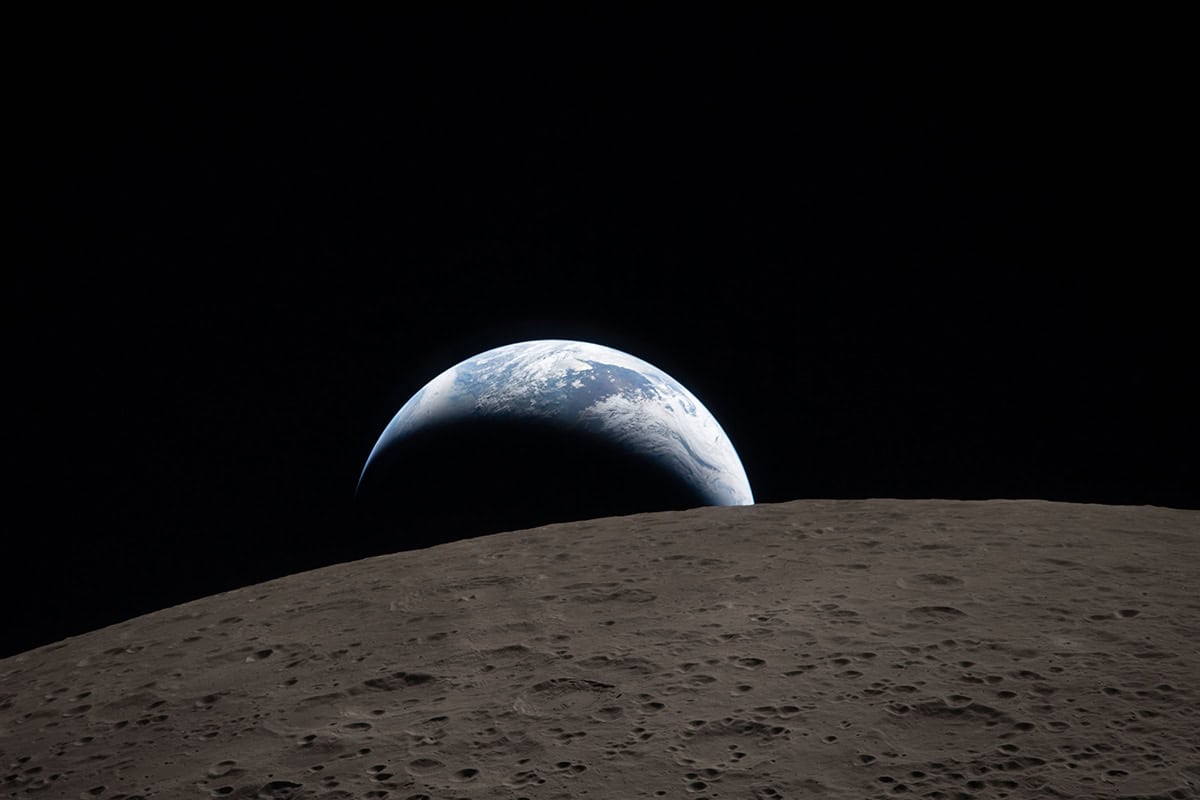
Earthset The Artemis II crew captured this view of Earth as they flew around the Moon. (Courtesy: NASA)
Blending lunar ambition with climate innovation, the episode explores how missions to the Moon could help shape the future both in space and here on Earth.
Find out more about the Artemis II mission in this Physics World feature by science writer and astronomer Keith Cooper
In the arena of public engagement, astronomy holds one distinct advantage over other areas of physics: the ability to generate an endless supply of pretty pictures. But not all astronomers benefit equally from this superpower – when it comes to capturing the punter’s imagination, it is optical astronomy that reigns supreme. Whether it’s the latest image of the Horsehead Nebula from the Euclid telescope or Voyager’s “Pale Blue Dot” photograph, this narrow band of the electromagnetic spectrum dominates public discourse on outer space.
Chapman takes us on a cosmic tour, starting with planet hopping across our solar system, before diving through the spiral arms of the Milky Way to explore black holes, neutron stars and the origin of our universe. At each stop, our tour guide outlines all that radio wavelengths have taught us about these phenomena, with humour and endearing appreciation. She also highlights some of the uphill battles for recognition fought by radio astronomers over the years.
Throughout the book, Chapman effectively outlines distinct advantages of radio waves over the visible spectrum. For starters, they are unattenuated by Earth’s atmosphere and dust in the intergalactic medium. This allowed radio astronomers to see further into both space and time; and with less expensive instruments. Moreover, a radio telescope’s ability to make observations is not hampered by bad weather – indeed, they can happily continue collecting data at day or night.
As Chapman explains, many of humankind’s biggest achievements are indebted to the radio wave. When astronauts first walked on the Moon in 1969, they relied on radio communications to keep them on course, while their safe landing site had already been selected from detailed maps of the lunar surface assembled by radar (radio detection and ranging).
As we fly with Chapman through the inner solar system, some of radio’s biggest strengths are highlighted in contrast to other means of exploration. Take Venus. Scientists in the Soviet Union admirably sent wave after wave of space probes (14 in total) as part of the Venera programme (1966–1982). Each one lasted mere minutes or hours on the surface before being crushed by the hellish pressures and temperatures of the Venusian atmosphere. Meanwhile, radar facilitated far more efficient surveys of the surface by both Russian and US spacecraft in orbit around the planet.
Chapman also explains how, in 1956, radio astronomers provided the first realistic (and apocalyptic) picture of life on Venus. This was in stark contrast to the earlier infrared-based measurements, which had suggested a tranquil and potentially life-supporting environment. It was later clarified that the infrared waves originated from the top of the Venusian atmosphere, whereas the longer wavelengths of radio revealed the nightmarish conditions below.
Chapman goes on to outline in astonishing detail all that radio waves have taught us about the best places to set up camp on Mars. Radar surveys of the Red Planet have uncovered secret caverns below the surface, which will provide future colonisers with access to subterranean water deposits and shelter from high-energy solar particles. Her coverage of this topic, in particular, is a masterclass in making science engaging, with Chapman playing the role of a Martian real-estate agent – “Valles Marineris is a very up-and-coming area, don’t you know?” – and I for one think she could be up for employee of the month.
A consistent and thought-provoking theme that emerges in Radio Universe is “seeing is believing”. On several occasions in history, we find radio-based discoveries requiring confirmation with some other “more visible” means of investigation as a prerequisite for widespread acceptance by the field. For example, it was not until we saw the first waveform of a gravitational wave detected by the LIGO detectors, in 2016, that these predictions of general relativity were considered confirmed. This was despite the indirect detection of gravitational waves through radio observations of pulsars more than four decades earlier.
Chapman highlights the emotional impact on the astronomy community, and the world as a whole, of the first image of a supermassive black hole, assembled with radio interferometry and unveiled in 2019 by the Event Horizon Telescope. Even with all of the faith we as scientists place in Einstein’s theory of gravity, the photographic proof of these unimaginable phenomena still resonated. As Chapman aptly puts it, “a picture tells a thousand equations”.
The book also highlights the ideological battles fought by radio practitioners over the years, from confirming the temperature of Venus to validating the Big Bang theory itself. One can’t help but wonder if this visible-centric view of the world is to blame for the apparent “radio scepticism”. Or is just a case of new kid on the block, given that radio astronomy only began in the mid 20th century, while optical imaging dates back much further?
Whatever the reason, this optical astronomer comes away from Chapman’s latest book with a newfound respect and appreciation for the longer wavelengths. And as far as Martian real-estate ventures go, sign me up for one of the new builds on Utopia Planitia. After all, the property prices can’t be as bad as inner-city UK living, can they?
After 54 years, numerous failed starts and countless abandoned dreams, earlier this year humanity finally returned to the Moon in an epic 10-day flight that gripped the planet. The Artemis II mission and its four astronauts – mission commander Reid Wiseman, pilot Victor Glover and mission specialists Christina Koch and Jeremy Hansen – gave us something to smile about during a dark time of global geopolitical turmoil.
The primary objective of the mission was to fly a crew around the Moon, to demonstrate and test the systems needed to support astronauts in deep-space exploration. In doing so, Wiseman, Glover, Koch and Hansen ventured farther from our planet than any human has ever gone and saw things on the lunar surface that no human eye has seen before.
That the crew did not land and walk on the Moon did not diminish the enthusiasm for the mission. Through today’s online world, the astronauts were able to share their own excitement with the millions watching from Earth with such relatability that the popularity of the mission was cemented in the history books.
Moreover, their voyage and safe return has paved the way for future Artemis missions. These will not only see astronauts set foot on the lunar surface for the first time since 1972, but also include building a permanently crewed outpost at the lunar south pole.
The astronauts of Artemis II
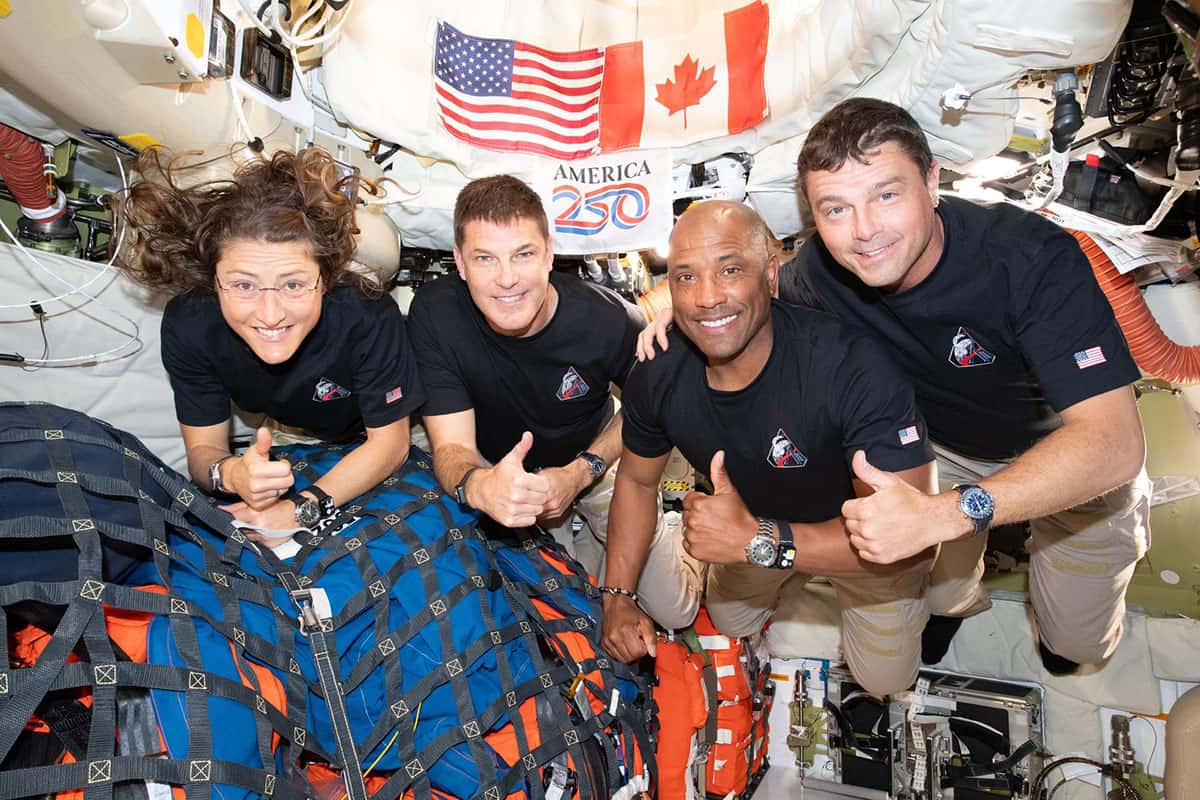
Thumbs up The crew of Artemis II. From left: Christina Koch, Jeremy Hansen, Victor Glover and Reid Wiseman. (Courtesy: NASA)
The Artemis II crew broke records by travelling further from Earth than any humans had before. But they also made history by including the first person of colour, the first woman and the first Canadian to go beyond low Earth orbit, and to travel around the Moon. Here’s who they are:
Reid Wiseman – mission commander
A former US Navy fighter pilot and test pilot, Wiseman was selected as an astronaut by NASA in 2009 and flew to the International Space Station (ISS) in 2014 as part of Expedition 41, where he took part in space walks. He was chief of the Astronaut Office between 2020 and 2022 before being made mission commander on Artemis II. A crater on the Moon seen by the crew of Artemis II has been named after his late wife, Carroll.
Victor Glover – pilot
Having joined NASA’s astronaut corps in 2013, Glover’s first venture into space was as pilot on the first post-certification flight of SpaceX’s Crew Dragon capsule to the ISS. As part of Expeditions 64 and 65, Glover performed four space walks during his time on the station. Like Wiseman, he is also a former US Navy pilot and test pilot.
Christina Koch – mission specialist
In 2019 Koch spent 326 days onboard the ISS as part of Expeditions 59, 60 and 61, setting the record for the longest continuous spaceflight for a female astronaut. During this time she also participated in the first all-female spacewalk. Prior to being chosen as an astronaut in 2013, Koch worked as an electrical engineer at NASA’s Goddard Space Flight Center, and spent time in Antarctica at the Amundsen-Scott South Pole Station and Palmer Station.
Jeremy Hansen – mission specialist
A colonel in the Royal Canadian Air Force, Hansen became an astronaut for the Canadian Space Agency in 2009. His training included taking part in the European Space Agency’s CAVES programme – spending time living underground in Sardinia – and NASA’s NEEMO 19 seven-day undersea mission. Artemis II was Hansen’s first flight into space.
The journey begins
On 1 April 2026 spectators on the ground, millions online and even the crew of the International Space Station (ISS) watched as Artemis II blasted off from pad 39B at the Kennedy Space Center in Florida at 6.35 p.m. EDT.
At launch, the four crew members were safely enclosed in their home for the next 10 days – the Orion spacecraft they had named Integrity. In turn, Integrity sat atop NASA’s gigantic Space Launch System (SLS), a rocket more powerful than the mighty Saturn V. Standing 98 m tall, the SLS was driven by four RS-25 liquid propellant engines and supported by two solid-rocket boosters, producing in excess of 39,000 kN of thrust at lift-off.
It was only the second flight of the SLS following 2022’s Artemis I, an uncrewed Moon-orbiting mission to test the SLS rocket and Orion spacecraft. Yet the Artemis II launch was flawless, with the thunderous roar deafening spectators and astounding the assorted news media present.
As the rocket left the atmosphere, the solid-rocket boosters, protective panels and launch abort system (there in case of ascent emergencies) were all successfully jettisoned, followed by the core stage of the SLS. Next, using the interim cryogenic propulsion stage (ICPS) or upper stage – fuelled by a liquid hydrogen/oxygen mix and powered by a single RL10 engine providing 110 kN of thrust – the mission performed a series of manoeuvres to raise its altitude, reaching an orbital elevation of 74,000 km.
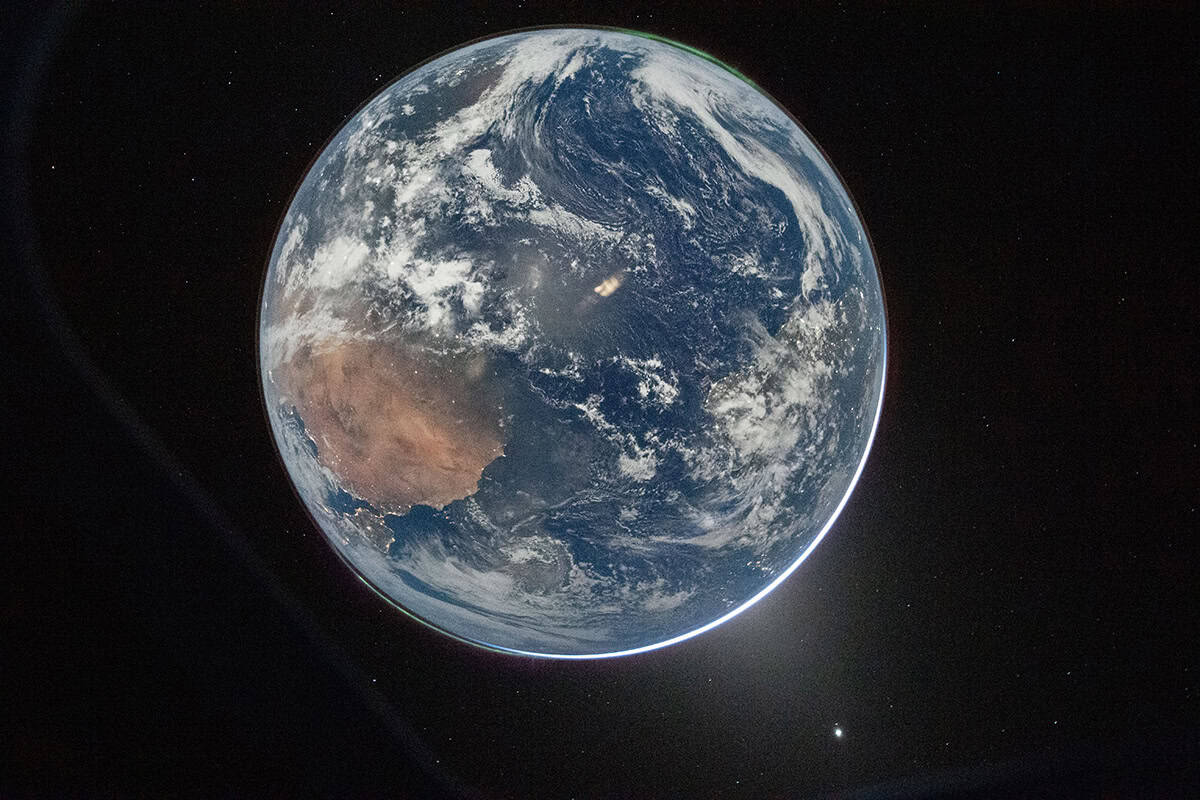
Hello, world A backlit Earth photographed from the Integrity capsule by mission commander Reid Wiseman. Aurorae can be seen at top and bottom. (Courtesy: NASA)
Following that, the upper stage was separated; but before leaving it (and Earth) behind, the astronauts used it as part of their demonstration tests, which included showing they could manually pilot Integrity. While in high orbit, the mission also deployed four cubesats – one each from Argentina, Germany, Saudi Arabia and South Korea – designed to study the effects of space radiation from the Sun and in Earth’s Van Allen radiation belts, and how electrical systems perform in such radiation-drenched environments.
With all that done, it was time to leave Earth’s orbit. On day two, the engine of the service module (constructed by the European Space Agency (ESA)) performed the trans-lunar injection burn – firing for almost six minutes to propel the capsule and crew out of Earth orbit and towards the Moon. Artemis II would not orbit the Moon, but swing around it and head back to Earth, following a flight path known as a free-return trajectory. This means that after the trans-lunar injection burn, Integrity coasted for four days through space with only occasional minor course corrections to keep the Moon dead ahead. No further engine burns were required in order to get home (hence “free”) – their trajectory used lunar gravity to naturally slingshot them around the Moon while Earth’s gravity drew them back home. On a diagram, Integrity’s trajectory looks like a figure 8, which follows gravitational gradients between the Earth and the Moon.
Close encounter
On 6 April the mission flew round the Moon just once, giving the crew a seven-hour fly-by observation period of both the near and far sides.
The astronauts’ view of the lunar surface was “amazing” in the words of mission commander Wiseman. “The four of us have looked at the Moon our entire lives and the way we are responding to what we’re seeing out the window is just like we’re a bunch of kids up here. We cannot get enough of this,” he radioed back to Earth.
For much of the fly-by, the four astronauts were like space paparazzi, taking it in turns to photograph the Moon. Although lunar science wasn’t part of the mission, they had a list of 35 targets to find and record that had been selected by the Artemis II science team led by Kelsey Young from NASA’s Goddard Space Flight Center. Among them were impact craters with radial streaks of ejecta that can help planetary scientists understand how craters evolve over time; and a bright swirly feature known as Reiner Gamma that contains a magnetic anomaly and is a possible future landing site for robotic explorers.
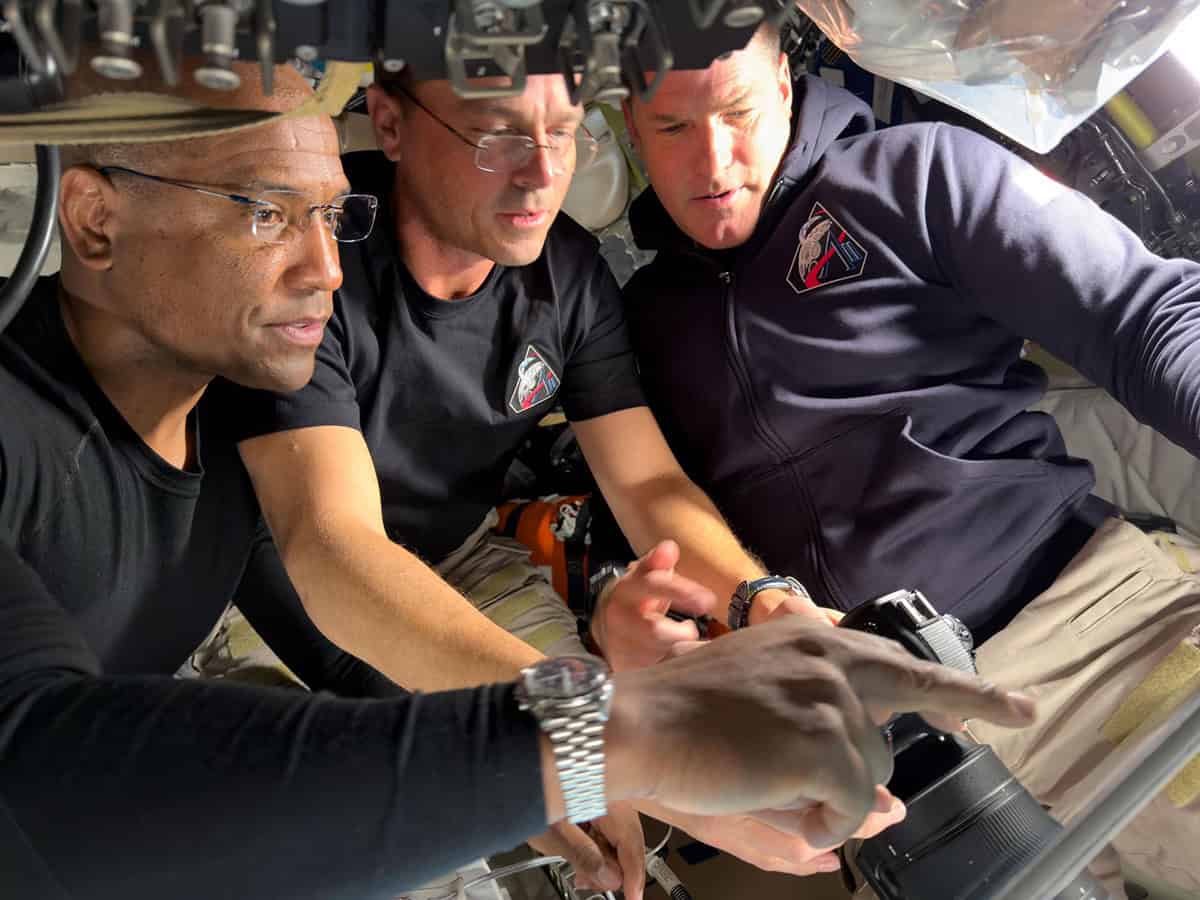
Science ready (From left) Victor Glover, Reid Wiseman and Jeremy Hansen prepare for their journey around the far side of the Moon by configuring their camera equipment shortly before beginning their lunar fly-by observations. (Courtesy: NASA)
The astronauts also targeted parts of the far side that had never before been seen by human eyes because they had been in darkness during the Apollo missions. They were aided in their efforts by a custom-designed app, called the Lunar Targeting Plan, which contained information on the targets, what features to look out for, and how to correctly photograph them – there were even prompts for discussions about what they were seeing.
Some have suggested that the crew’s efforts were more about aesthetics than science, since the entirety of the Moon has previously been mapped by past missions. These include Japan’s Kaguya orbiter, the spacecraft in India’s Chandrayaan programme and Europe’s SMART-1 mission back in 2003. Indeed, none have mapped the Moon as comprehensively as NASA’s Lunar Reconnaissance Orbiter (LRO), which launched in 2009 and to this day continues to map the entire lunar surface to 100-metre resolution, and in some places reaches an unprecedented half-metre resolution.
However, Amanda Hendrix, who is director of the Planetary Science Institute (PSI) in Arizona and who works on LRO, disagrees that lunar science wasn’t a part of the Artemis II mission.
“I think there was science to do on the fly-by,” she says. While LRO’s cameras catch a lot on the lunar surface, particularly how features seem to change with the shortening and lengthening of shadows throughout the lunar day, there’s something very crucial that is missing. “LRO’s instrumentation is limited,” explains Hendrix. “Its cameras don’t have that many filters, so we don’t get that much colour information.”
As it turns out, the Moon isn’t just a boring silver-grey sphere, but a world of many subtle colours, which Apollo 17 astronaut and geologist Harrison Schmitt discovered in 1972, when he found orange regolith made of volcanic beads rich in titanium.
“What the Artemis II crew brought is the spectral coverage that they could see with their eyes that we don’t have with LRO,” says Hendrix. “Plus, we could hear the astronauts talking about how impressed they were with the change in lighting geometry as the spacecraft went around behind the Moon, and how the day/night terminator moved across the surface. So I do think there is new scientific information there.”
The far side
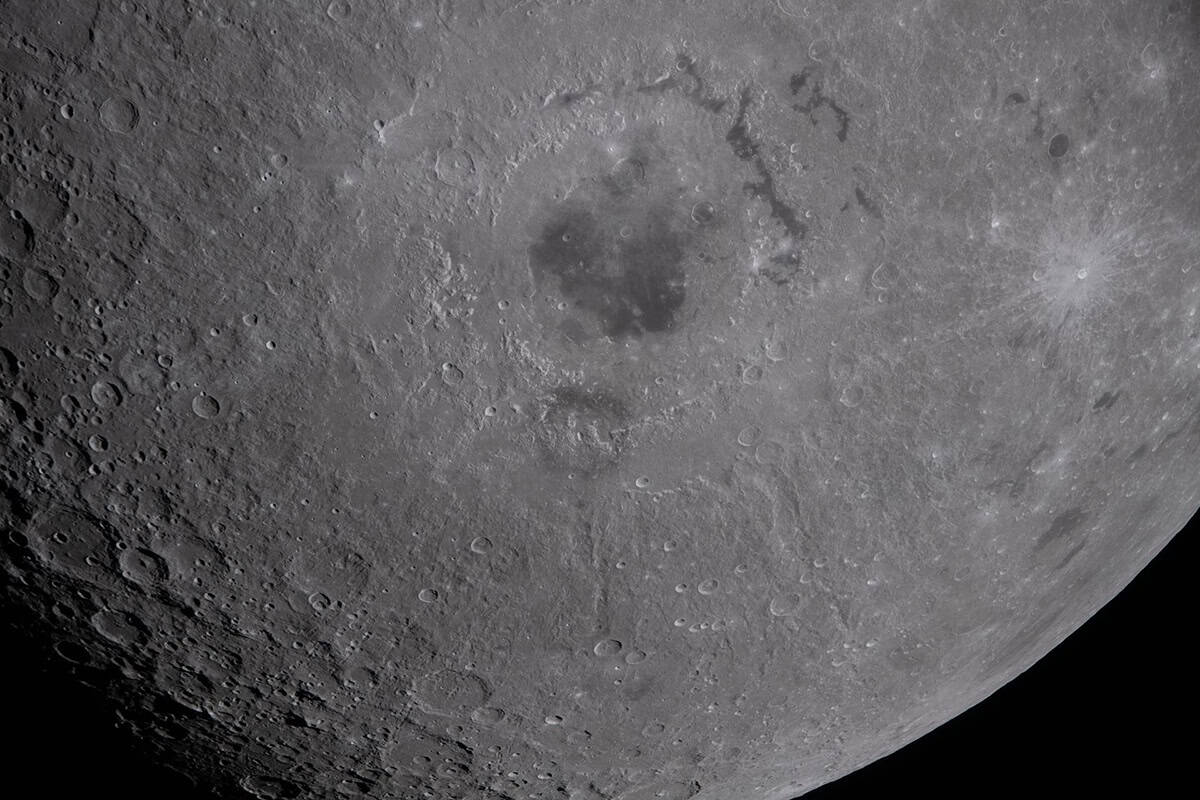
Most of the science targets were found on the far side, including the mighty Orientale impact basin, which is located on the limb of the Moon as seen from Earth. (The limb is what we call the edge of the Moon when we look at it in the sky, but we can’t call it an edge since the Moon, as a sphere, doesn’t have an edge. Features on the limb are foreshortened because of perspective as the lunar surface curves away from us.) Thought to be the youngest of the Moon’s large impacts, Orientale features a lunar sea (known as a mare) at its centre, and a stunning double-ring structure at its edge. The exterior ring has a diameter of 930 km, making it one of the largest impact sites in the entire solar system.
Moonwatch The double-ringed structure of the Orientale basin, with Mare Orientale in the middle. (Courtesy: NASA)
“What really struck me is that this was the first time that humans themselves saw so much of the Moon and I think a lot of people don’t really appreciate that,” says Jeffrey Andrews-Hanna, a planetary scientist at the University of Arizona’s Lunar and Planetary Laboratory. “A great example is the Orientale impact basin. We have an incredible amount of data from orbiting robotic spacecraft, but humans had never actually laid eyes on so much of it until now. The Artemis II astronauts had a prime view looking on the surface and seeing the basin in its entirety.”
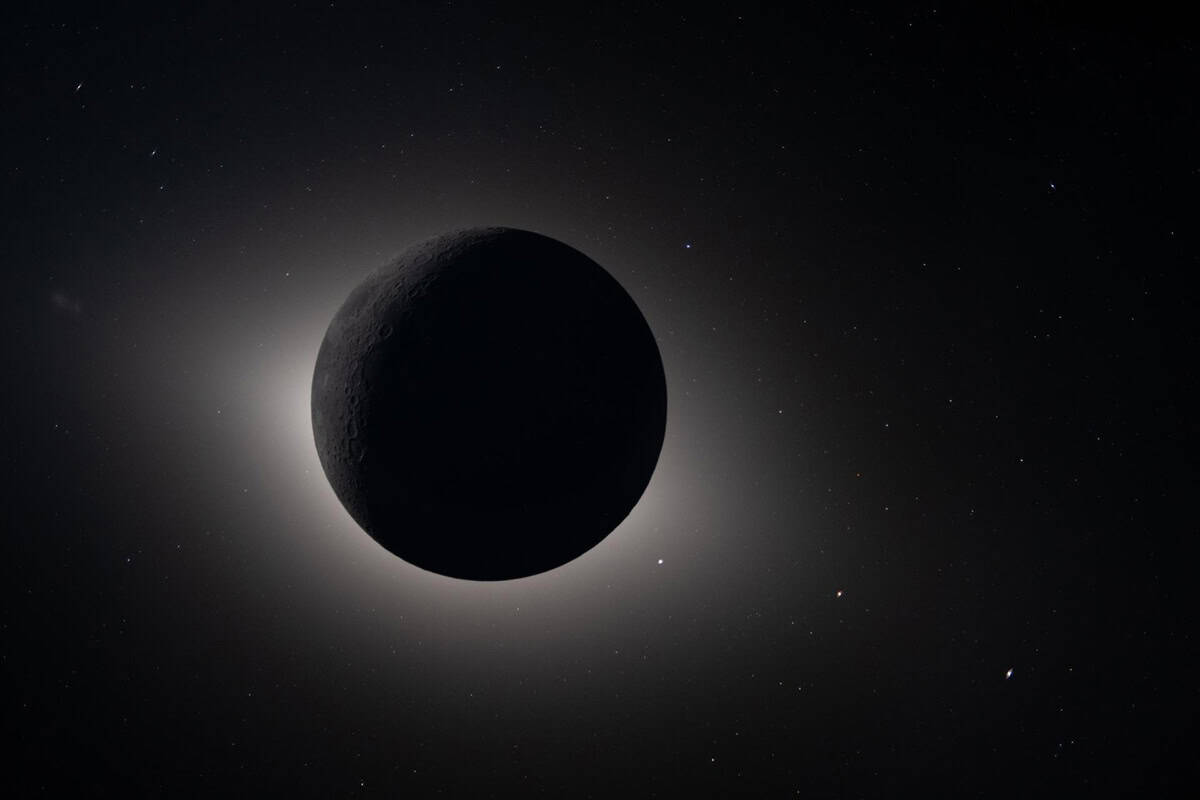
At one point shortly after the closest approach – which saw the astronauts get to within 6545 km of the lunar surface – they witnessed the Sun spectacularly fall into total eclipse behind the Moon. Then, as Integrity was cast into the Moon’s shadow, the crew saw five remarkable events – flashes of light as meteorites slammed into the surface, gouging out small new craters. The flashes were so fast that the crew were unable to catch them on camera, but they knew to be on the lookout for them nevertheless.
Lunar impacts have been sporadically witnessed before by spacecraft and amateur astrophotographers, but this was the first time it has been possible to ascertain the rate of impacts occurring on the Moon.
Eclipse The crew of Artemis II witnessed a 54-minute-long total solar eclipse from the far side of the Moon. The origin of the halo of light remains unclear: is it caused by the solar corona, the zodiacal light, or a combination of the two? (Courtesy: NASA)
“To have seen five of them during that short time frame tells you the rate at which they must be happening all over the Moon, whether you can see them or not,” says Hendrix. “That’s important for telling us how much material is still out there impacting not only the Moon but also Earth, or at least the top of our atmosphere.”
Looking to future Artemis missions that will land on the Moon (currently planned from 2028), Andrews-Hanna sees a way in which the study of meteorite impacts can be enhanced by seismometers placed on the surface. “Understanding the impact flux is important,” he says. “And there’s a lot that can come from linking an impact that is seen with the seismic waves that are measured.”
A seismometer can give some indication of the size of the impacts, providing information about the mass of the meteorites impacting the Moon as well as their frequency. The seismic waves can even be used as probes into the Moon’s interior structure.
Back to Earth
The farthest that Integrity got from Earth was 406,771 km, breaking Apollo 13’s distance record of 401,171 km. While behind the Moon, the crew were out of contact with Earth for 40 minutes (as planned), far from home and completely alone.
That perfect isolation would not last long, and soon Integrity was embarking on the journey home, to arrive on Friday 10 April. Yet even if NASA and the Artemis II crew didn’t show it, there was some nervousness ahead of that return.
During Artemis I the heat shield on the empty Orion capsule suffered serious damage, cracking to the point that large chunks of the heat-resistant Avcoat material ripped dangerously away in temperatures of 2760 °C while plummeting through Earth’s atmosphere. Upon investigation, NASA scientists found that the problem was triggered by the skip guidance entry technique they had used to return Orion to Earth, which involves dipping the capsule in and out of the atmosphere so that atmospheric drag helps slow the re-entry.
In ground tests to simulate the technique, the scientists had used heating rates that had allowed a permeable char layer to form and ablate, releasing gases produced by the Avcoat layer. But in reality, dipping in and out of the atmosphere resulted in less severe heating and slower char formation. Gases accumulated in the Avcoat layer and could not escape, causing cracking.
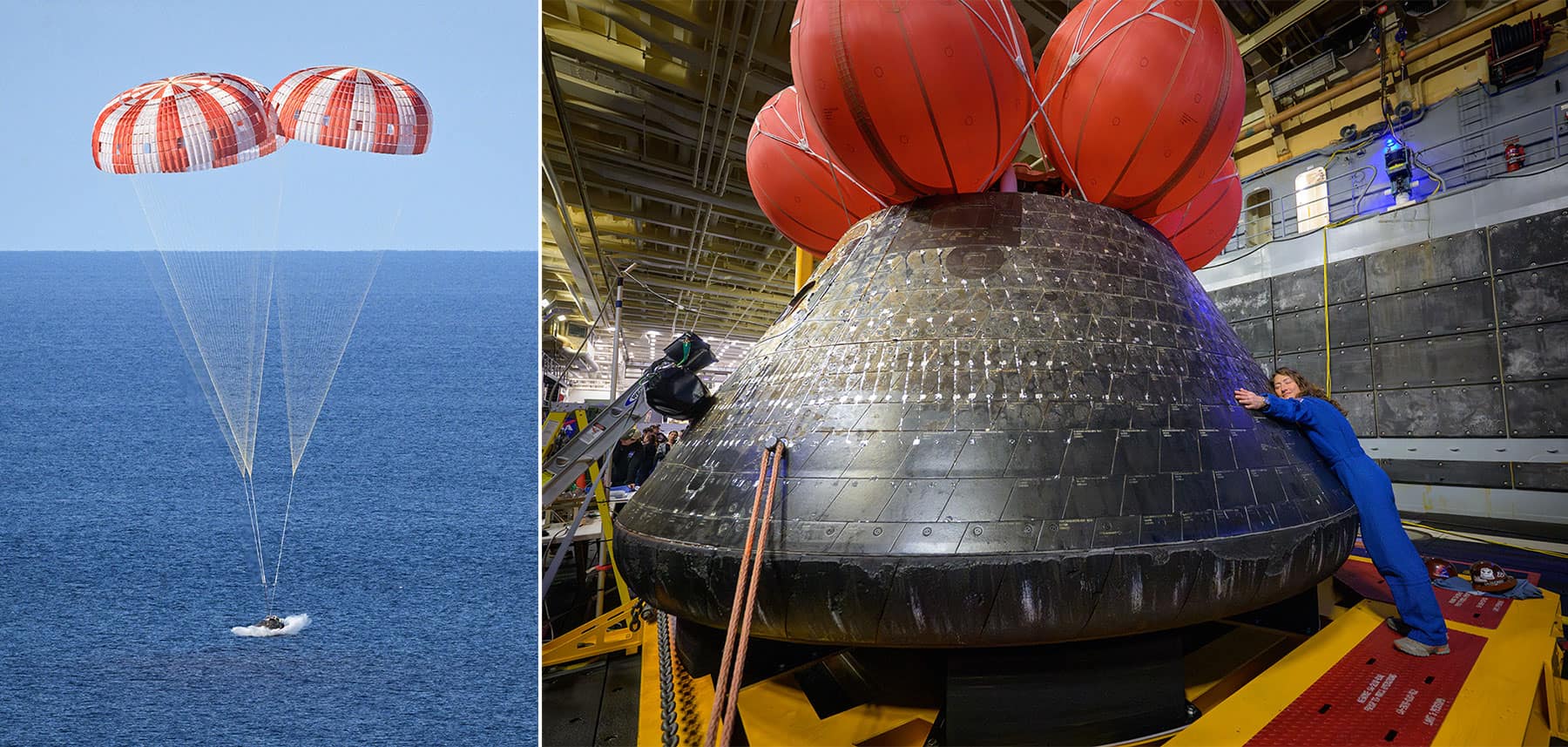
Safe return (left) Integrity splashes down safely into the Pacific Ocean. (right) Christina Koch, Artemis II mission specialist, hugs the Orion spacecraft in the well deck of USS John P Murtha on 11 April 2026. (Courtesy: NASA/Josh Valcarcel; NASA/Bill Ingalls)
Obviously, something needed to be changed for Artemis II. Rather than modify the heat shield that had already been built, NASA decided to change the re-entry profile. Integrity’s trajectory was made steeper, reducing time spent in the part of the atmosphere where Artemis I had problems – however, this would make it the fastest atmospheric entry ever attempted by a crewed spacecraft.
During the 13-minute fall from the sky, the heat shield held up well, staying hot long enough to release the gases. Eleven parachutes in total were deployed, slowing the capsule from 40,230 km/h while 120 km above the Earth, to 523 km/h at 8 km altitude. By the time the main parachute unfurled, Integrity was gently drifting down at less than 32 km/h for a successful splashdown in the Pacific Ocean near San Diego.
From II to V
Artemis II was a success, proving that we can send humans back to the vicinity of the Moon. Artemis III was originally planned to finally land on the lunar surface again, but it has now been repurposed for practising docking and rendezvous procedures in low Earth orbit, just as Apollo 9 did following Apollo 8’s triumphant flight around the Moon. Artemis IV, planned for early 2028, is currently the mission that will land, and hopefully later that year Artemis V will begin construction of a lunar outpost at the South Pole–Aitken Basin, among permanently shadowed craters that harbour water-ice.
After Artemis II, landing on the Moon doesn’t feel as far away as it did
After Artemis II, landing on the Moon doesn’t feel as far away as it did. Certainly, Wiseman is more optimistic now than he ever was. “I’m going to eat these words, but [landing on the Moon] is not the leap I thought it was,” he told journalists at a media conference in Houston a week after splashdown. “Once we were around the Moon in a vehicle that was handling great, if you’d given us the keys to a lander, we would have taken it down and landed on the Moon. It’s going to be extremely technically challenging, but it is absolutely doable, and doable soon.”
Visiting our orbiting companion
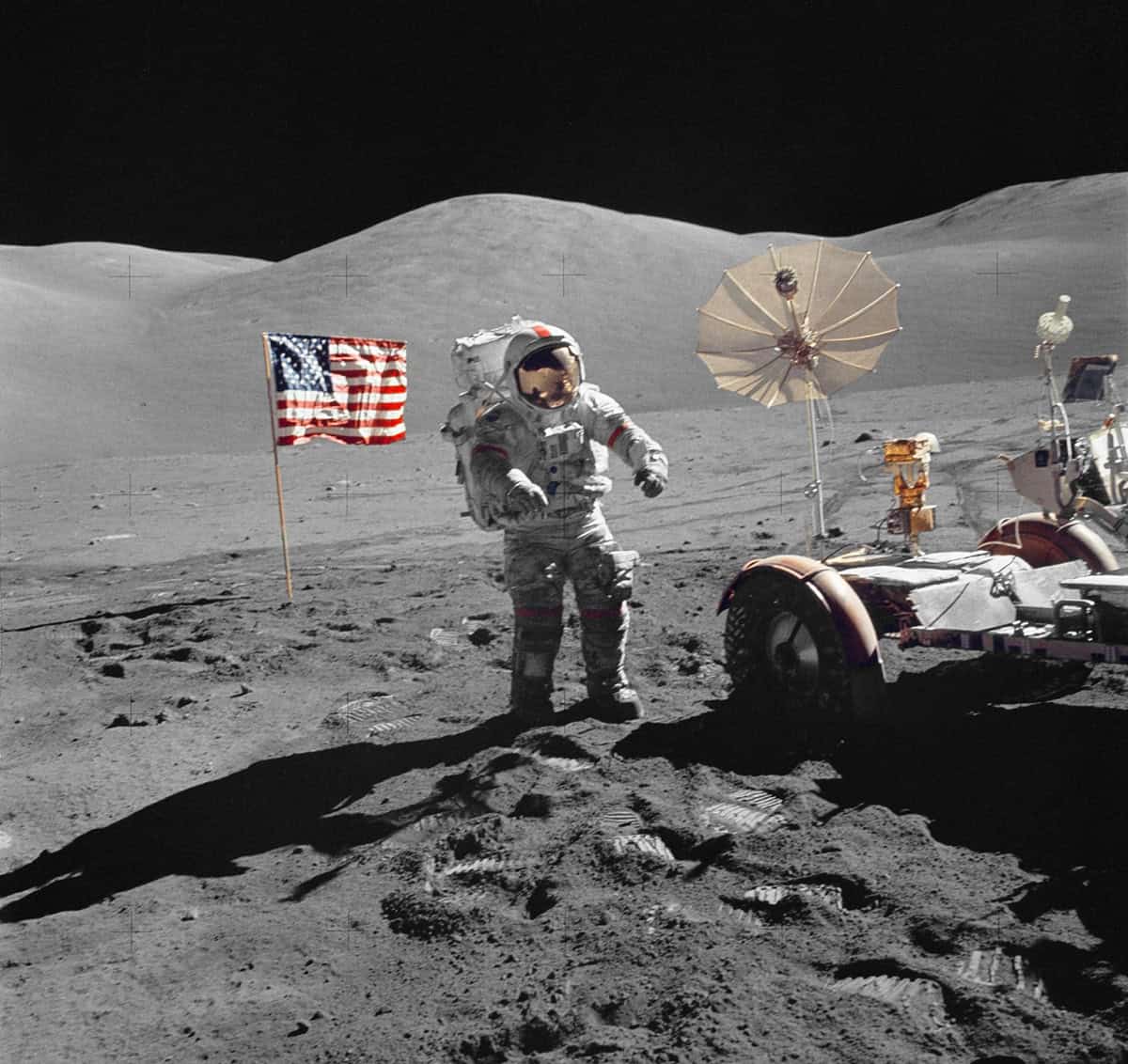
Last man on the Moon Gene Cernan walks on the Moon in December 1972 during the Apollo 17 mission, of which he was mission commander. (Courtesy: NASA/Harrison Schmitt)
The first crewed mission to the Moon took place in December 1968 when NASA’s Apollo 8 entered lunar orbit. Over the next four years, the US sent another eight crewed spacecraft, including the historic Apollo 11 mission that saw Neil Armstrong take humanity’s first steps on the Moon.
But we then stopped sending people to our rocky satellite. The Apollo missions were cancelled due to budget costs and changing political priorities, while the Soviet Union’s efforts to land cosmonauts on the Moon stalled on the launchpad with the failure to develop their N1 heavy lift rocket. Many uncrewed missions from around the world have impacted, orbited, flown by or landed on the Moon, but – until now – none have had human passengers, leaving Gene Cernan as the last person to set foot on the Moon on 13 December 1972 as part of the Apollo 17 mission.
While science was not the priority for Artemis II, the scientific community is already positioning itself to make the most of returning to the Moon. Hendrix points out that three researchers from PSI have been selected as participating scientists for Artemis IV. Meanwhile, tangential to the Artemis programme is the Commercial Lunar Payload Services (CLPS), in which NASA is working with private contractors to build small landers that can take scientific experiments to the Moon. Although their success in landing has been somewhat mixed so far, it opens the Moon up to a wider range of scientists.
That’s important, says Hendrix, because there’s less grant money coming from NASA, which has seen its budget remain more or less the same while shouldering the burden of more large-scale missions.
“There is concern in the planetary science community that opportunities have been shrinking and it is because the budget hasn’t increased enough over the past couple of decades to accommodate all the programmes that are happening,” says Hendrix. There is also great uncertainty in the US science community around funding and budget changes under the current administration. “Planetary scientists can at least do some science on the Artemis missions as part of the landing science team, and they can be part of the science teams for instruments on CLPS missions, and those are the bulk of the opportunities now.”
The US is not the only country with its sights set on the Moon. China is also hoping to send astronauts – or taikonauts – by 2030. They will travel in the Mengzhou seven-person spacecraft, which is currently scheduled to do its first orbital uncrewed test flight in September 2026. The corresponding lunar lander, called Lanyue, is also under development. In the meantime, China has been sending regular robotic missions to both the near and far side of the Moon, and has brought precious lunar samples back to Earth. These missions have involved some – albeit limited – international co-operation, particularly with European scientists who have had experiments flown on the missions.
Inspiring the world from the Moon
Since the safe return of the Artemis II crew, the reaction has been as philosophical as it has been admiring of the technical feats of the mission. This was especially notable during the astronauts’ press conference, in which they discussed not the sights they had seen, but the way the mission had brought the whole world together in support.
“When we came home, we were shocked by the global outpouring of support, of pride, of ownership of this mission,” admitted Wiseman. “The four of us wanted to go out and do something that would bring the world together.”
Public interest is vital if the Artemis programme is to continue being funded, explains Hendrix. “The whole of planet Earth was brought along with them, as we watched on our screens,” she says. “Getting everybody on Earth behind these missions is important, especially the people who make the budget.”
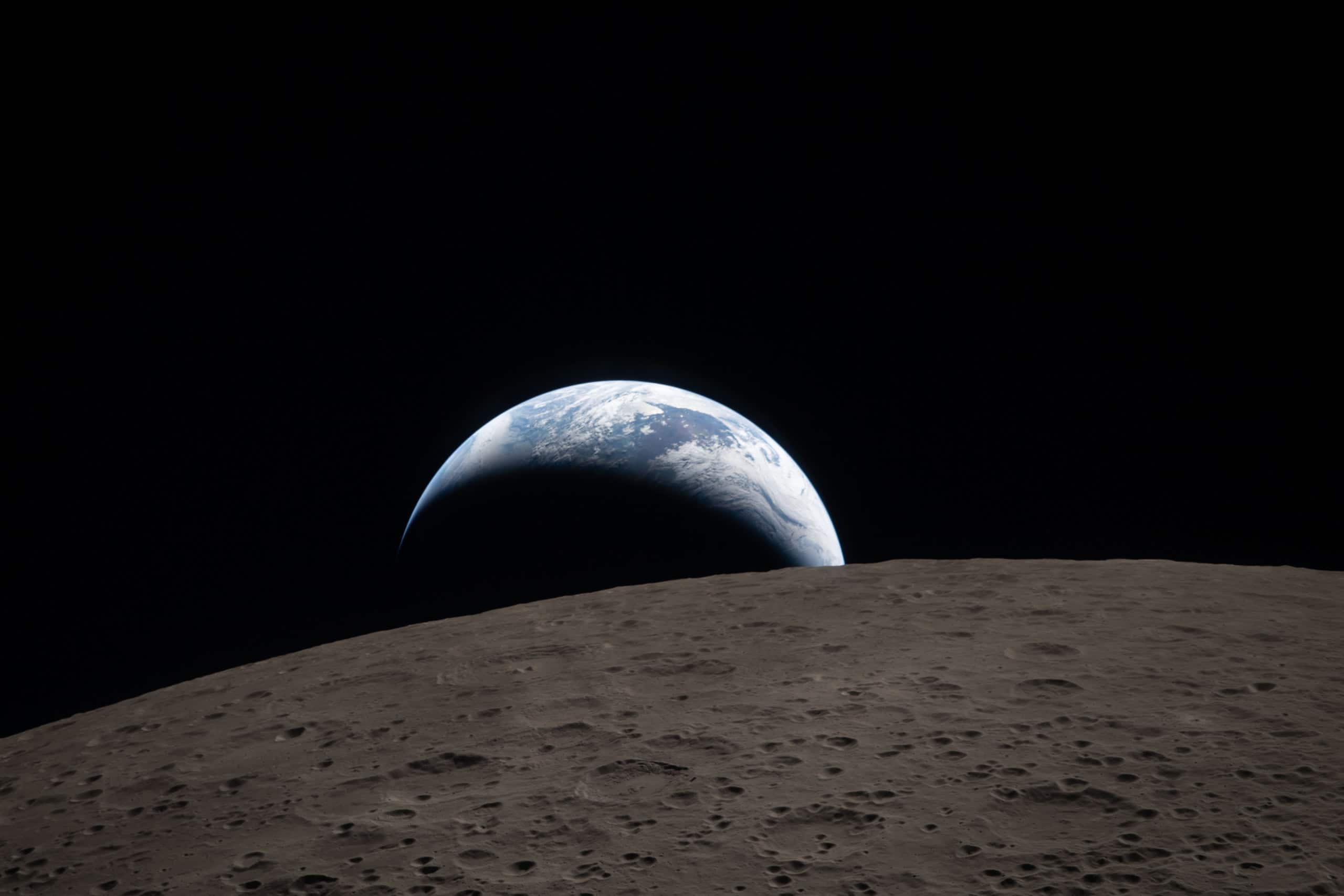
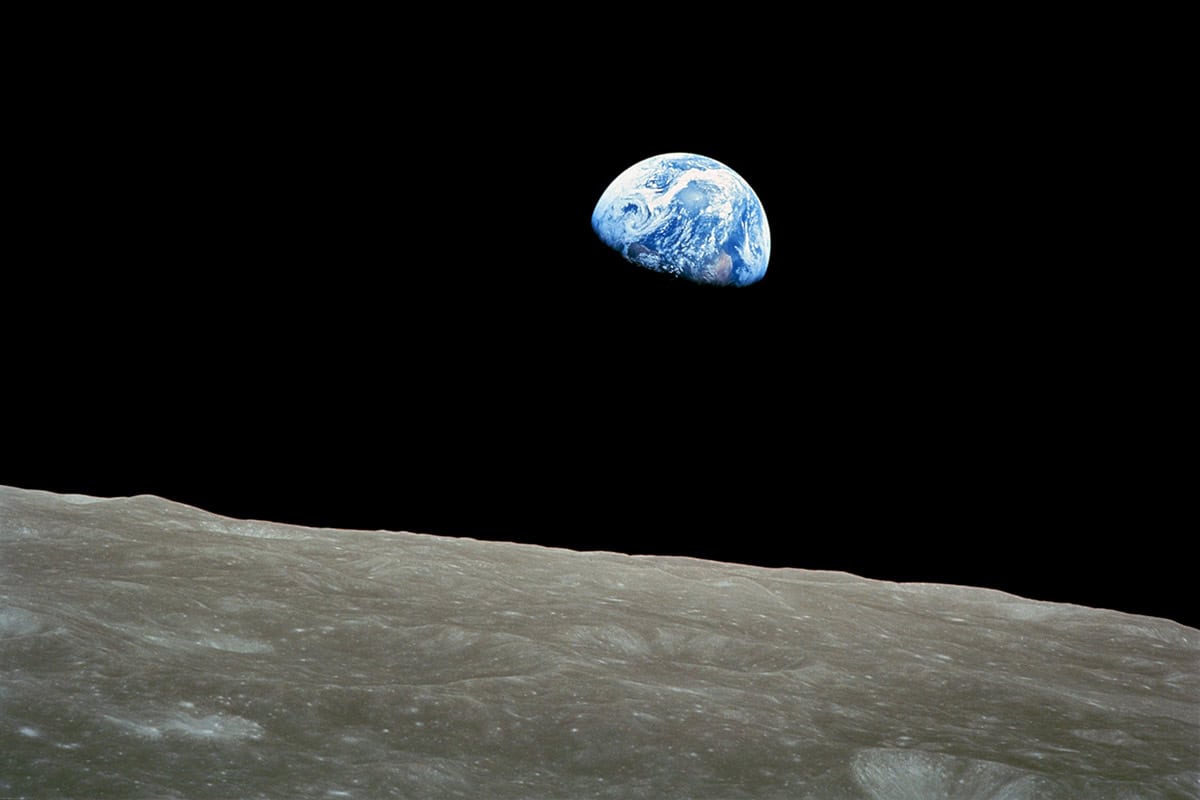
Earthrise This famous photograph of Earth with the Moon as foreground was taken on 24 December 1968 during the Apollo 8 mission. (Courtesy: NASA/Bill Anders)Earthset On 6 April 2026 the Artemis II crew photographed the crescent Earth slipping behind the limb of the Moon as Integrity prepared to loop around the far side. (Courtesy: NASA)
When Apollo 8 took three astronauts around the Moon for the first time during Christmas week of 1968, it brought the American public together during a time of national strife because of the Vietnam War. The famous “Earthrise” photograph taken during the mission also became a rallying cry for the burgeoning environmental movement.
The global circumstances around the time of Artemis II’s launch were not dissimilar, with wars in South-West Asia and Ukraine continuing against a backdrop of impending environmental disaster and social and political strife. Perhaps our return to the Moon will help bring people back on Earth together once again.
Newton’s and Einstein’s theories of gravity apply across distances of hundreds of millions of light–years. That is the conclusion of an international team of scientists, whose measurements of the gravitational acceleration of galaxy clusters have been made over the largest distances ever studied.
The study supports the Standard Model of cosmology, which invokes the gravitational effect of dark matter to explain the large-scale structure of the universe. As a result the team claims that its observation is at odds with alternative theories of gravity such as modified Newtonian dynamics (MOND).
“We’re seeing a clear pattern: these alternative models of gravity are running out of room to manoeuvre,” the study lead, cosmologist Patricio Gallardo of the University of Pennsylvania in the US tells Physics World.
However, an astronomer who studies MOND argues that the result – and the conclusion – is not clear cut. “I’m not convinced that they’re testing MOND,” says Stacy McGaugh, a professor of astronomy at Case Western Reserve University in the US.
Vast distances
The debate revolves around dark matter, which is a hypothetical substance that the majority of astronomers believe is responsible for the “extra gravity” observed in the universe that cannot be explained by the presence of visible matter alone. But the evidence for dark matter is circumstantial and this leaves room for theories such as MOND – which suggests that a small modification to gravity at low gravitational accelerations precludes the need for dark matter.
To probe the nature of gravity over large distance scales, Gallardo’s 40-strong team measured the gravitational acceleration between pairs of galaxy clusters (pairwise clusters) separated by distances ranging from about 100–750 million light–years.
They used the kinematic Sunyaev–Zel’dovich (kSZ) effect to provide information on the motions of the clusters. This involves the cosmic microwave background (CMB) radiation, which comprises photons left over from the Big Bang. As these microwave photons pass through a galaxy cluster, they scatter off free electrons and receive an energy boost that the team detected using the Atacama Cosmology Telescope in Chile.
Gravity tends to pull these clusters together and this Doppler shifts the kSZ energy boost. This subtle effect was detected for the first time in 2012.
A statistical method called the pairwise kSZ estimator determined the average infall velocity of cluster pairs.
Clean comparison
“This estimator gives us a clean way of comparing the theoretical predictions made by cosmologists of the pairwise accelerations under the influence of gravity,” says Gallardo.
Gravitational acceleration on the length scale of interest was then determined by combining the infall velocity observations with the distribution of galaxies as mapped by various surveys. They found that gravity follows an inverse-square law with regards to distance, just as predicted by the gravitational models of Newton and Einstein.
Gallardo argues that if MOND is correct, then the observed fall in gravitational acceleration would not be as steep as the inverse square.
“Even if an alternative theory of gravity predicts the distributions of galaxies, it will still fail to predict the pairwise velocities without introducing a component of invisible dark matter,” says Gallardo.
However, not all astronomers agree with this conclusion.
“It appears that they’ve worked out what they expect conventionally, then projected this onto what they imagine MOND would do, [but] it isn’t actually a MOND calculation,” says McGaugh.
Galaxy distributions
McGaugh questions how well the pairwise velocities can be isolated from the gravitational tugs of all the other galaxy clusters around them.
Gallardo counters, “It is right that everything pulls on everything, but that is precisely the beauty of this technique”. At its basis is the correlation function of galaxies, which describes the probability that two galaxies will be within a given distance of each other. At its the heart is the distribution of matter in the universe, as laid out in the Big Bang and described by the Standard Model of cosmology.
“If clusters are too close to each other, then the details of how they are placed will matter, but as distances grow and the universe looks more and more isotropic, the averages tend to smooth out and the equations governing the evolution of the distribution of matter take over,” says Gallardo.
McGaugh argues that something else, called the external field effect, happens at large distances. This is a concept in MOND where the gravitational acceleration produced by all the other objects in the universe is non-negligible and can affect smaller systems, such as a pair of galaxy clusters.
Background acceleration
“Once one gets far enough out, this takes over when the background acceleration of everything else is greater than that between any two objects,” McGaugh says.
McGaugh cites a paper in The Astrophysical Journal on which he was co-author. It describes how the gravitational acceleration field in the local universe can be calculated from the known distribution of galaxies. He describes that field as “a mess” and that the approach of Gallardo’s team averages over the subtleties.
Nevertheless, Gallardo remains bullish. “When we look at different scales and tracers of the gravitational potential such as anisotropies of the CMB, the polarization of the CMB, the baryon acoustic oscillations, the lensing of the CMB and galaxy lensing, they all seem to favour the existence of dark matter and disfavour modifications of gravity,” he says.
However, MOND has its own accomplishments, such as being able to predict the gravitational acceleration curves of galaxies, explain the plane of dwarf galaxies found around the Milky Way and Andromeda galaxies, and even the orbits of wide binary stars. But while Gallardo acknowledges that MOND “has partial successes in some regimes,” it “fails to provide a unified and consistent view of how gravity influences the history of the universe.”
In response McGaugh feels that crucial elements of MOND are being papered over and ignored.
“They’re basically reinventing the wheel without knowing a better wheel was already in the literature,” he says.
DESI, which began collecting data in 2021, is mounted on the Nicholas U Mayall 4-m Telescope at the Kitt Peak National Observatory in Arizona. It comprises 5000 robot-controlled optical fibres that send light to an array of spectrographs.
This allows DESI to make an extensive map of galaxies and quasars with the spectroscopic data providing a measure of how fast a galaxy is moving away from us, which is determined by a galaxy’s redshift.
By comparing how galaxies clustered in the past with their distribution today, researchers can trace dark energy’s influence. Work published in 2024 found hints that the acceleration of the expansion of the universe has not been constant.
DESI will now use the expanded dataset to further test whether the “cosmological constant” could be evolving over time with the results expected to be published next year.
DESI director Michael Levi, who is based at the Lawrence Berkeley National Laboratory, says the survey has been “spectacularly successful and is “incredibly exciting”.
“The instrument performed better than anticipated,” he says, “We’re going to celebrate completion of the original survey and then get started on the work of churning through the data, because we’re all curious about what new surprises are waiting for us.”
DESI will now continue observations into 2028 and further expand the map by about 20% to include parts of the sky that are more challenging to observe.
NASA has successfully launched four astronauts on a 10-day mission to the Moon. The crew – Reid Wiseman, Victor Glover, Christina Koch and Jeremy Hansen – were aboard the Orion spacecraft that was launched yesterday by a Space Launch System rocket from NASA’s Kennedy Space Center in Florida.
The mission is the first crewed lunar flyby in more than 50 years but it also represents a number of significant firsts with Koch, Glover and Hansen set to be the first woman, Black person and Canadian, respectively, to travel to the Moon.
Following launch, the Orion capsule was put into Earth orbit and after five hours into the flight, the craft deployed four CubeSats – from Argentina’s Comisión Nacional de Actividades Espaciales; the German Aerospace Center; the Korea AeroSpace Administration; and the Saudi Space Agency – that will conduct scientific investigations and technology demonstrations.
The craft is now set to carry out a six-minute rocket firing that will send the spacecraft towards the Moon.
During a lunar flyby on 6 April, the astronauts will take photographs and provide observations of the Moon’s surface being the first people to see some areas of the far side.
Some four days later, the craft will then return to Earth and splash down in the Pacific Ocean.
This mission follows the Artemis I mission, which carried a simulated crew of three mannequins wired with sensors, that completed a flyby of the Moon in 2022.
Artemis III, meanwhile, is currently ear-marked for launch in 2027, planning to be the first crewed lunar landing since the Apollo missions in the 1960s and 70s.
Will the Artemis programme instil the same sense of awe as the Apollo missions?
In the summer of 1969 I was four years old and I have a very distinct memory of my mother calling me and my brother in from the garden to watch something on television. That something had to do with NASA’s Apollo 11 mission to the Moon.
For years, I thought that I had watched Neil Armstrong take his first steps on the Moon on live TV. I now realize that the timing was all wrong. I was in Montreal and it was daytime – whereas the walk occurred at about 11 p.m. EDT, well after my bedtime. So I was (probably) not one of the estimated 500 million people worldwide (including Pope Paul VI) who witnessed this momentous event as it happened.
Regardless of whether I watched it live or not, the first human steps on the Moon made a great impression on me – and who knows, maybe that early exposure to the cutting edge of science and technology encouraged me to pursue a career in physics.
I could be wrong, but I don’t think that the Artemis missions will instil the same awe in people as did the Apollo missions. I didn’t watch the Artemis II launch and I had a distinctly “been there, done that” feeling when I heard about its success.
Indeed, I have been left wondering exactly why the US has decided to return to the Moon now. Is it for reasons of science and exploration (possibly setting the scene for a human mission to Mars), or is this more about nationalism and colonialization? I hope it is the former, because for me sending humans to the Moon and beyond is akin to blue-sky research in physics – probing the universe to expand knowledge, with the confidence that this will result in a better world.
Hamish Johnston is an online editor of Physics World
What happens when hard science fiction collides with big-budget cinema? The latest episode of Physics World Stories delves into the ideas within Project Hail Mary – a new film about a science teacher (portrayed by Ryan Gosling) who finds himself alone on a spacecraft with the job of saving humanity from a star-dimming threat.
Host Andrew Glester talks to science-fiction author Andy Weir, whose 2021 novel inspired the production. Weir, also known for The Martian and Artemis – both adapted for the screen – has built a reputation for scientific rigour, sometimes spending days perfecting calculations for the smallest plot details. In the interview, he reflects on how his writing has evolved over time, with a growing focus on character development alongside the hardcore science.
Also in the episode is astrophysicist and science communicator Becky Smethurst, who gives her take on the film’s science. From the treatment of relativity to its refreshingly plausible take on alien life, Smethurst loves how Project Hail Mary avoids many familiar sci-fi clichés. She also shares some of her favourite recent science fiction.
Smethurst, who runs the popular YouTube channel Dr Becky, recently released a series about Project Hail Mary. It’s well worth checking out the entertaining interviews with Weir, Gosling and directors Phil Lord and Christopher Miller – all grappling with the challenge of bringing complex physics to the screen.

 Login
Login