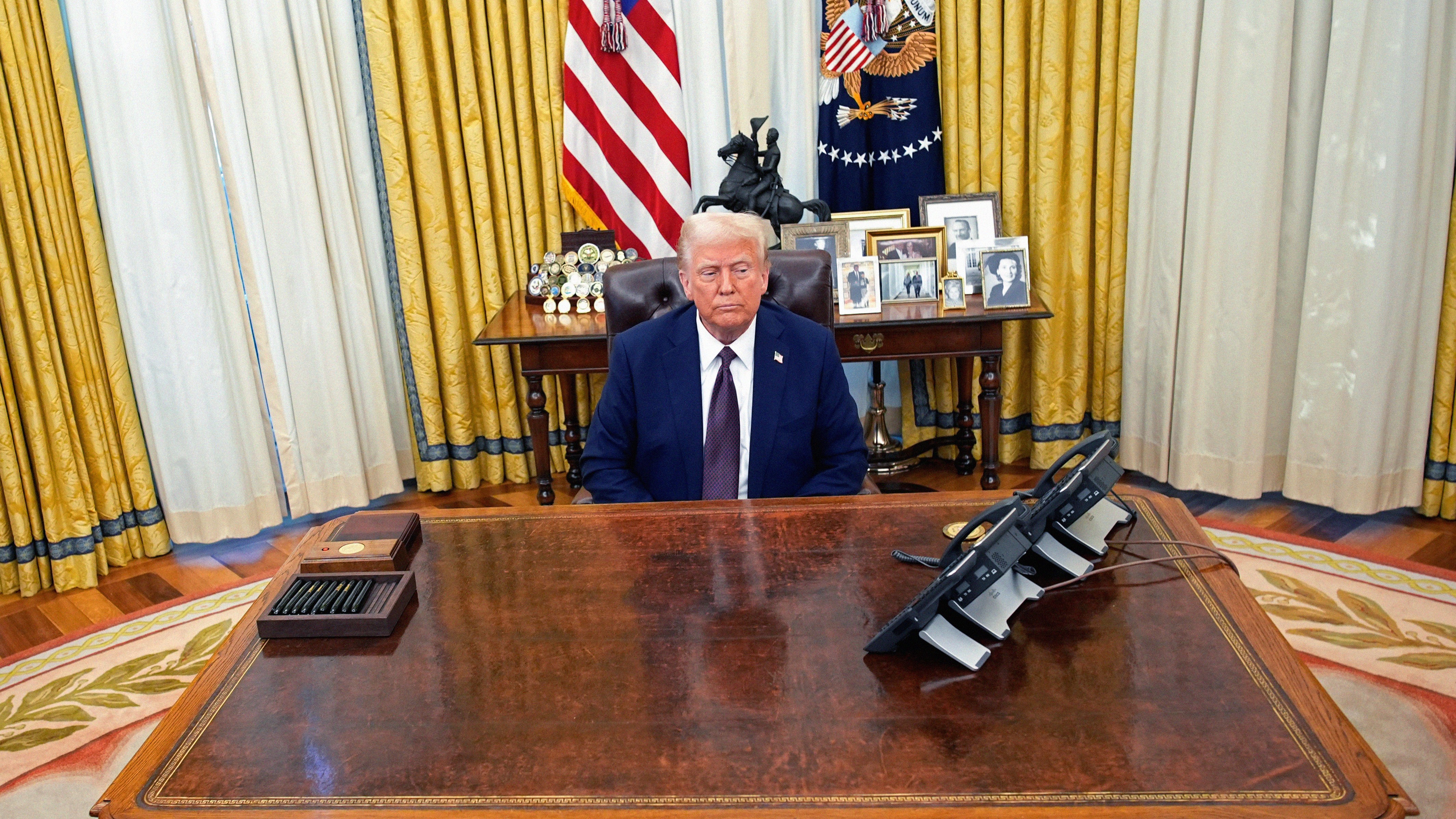
For months now, the White House has hinted that it may try to rein in the AI industry. Just two weeks ago, the nation’s top tech executives—including Sam Altman and Dario Amodei—were invited to attend a ceremony for the signing of a long-anticipated executive order on AI. But just hours before the ceremony, Donald Trump scrapped it. America is leading the world in the AI race, the president told reporters at the time, “and I don’t want to do anything that’s going to get in the way of that lead.”
Apparently, Trump has changed his mind again. Earlier today, the president signed an executive order that will create a process for top AI companies to voluntarily share certain upcoming models with the government for safety testing up to one month before wider release. OpenAI, Anthropic, and the like will also be asked to work with the government to shore up federal, state, and local cyberdefenses. The White House spokesperson Liz Huston told us that the policy reflects a “common-sense approach of collaborating with industry to balance innovation and security.”
The order itself is relatively toothless: Even before today, the major AI firms already had agreements in place that allowed the government to preemptively test their models for safety risks. The new rule “effectively formalizes what has already been happening between the US government and the leading AI companies,” Daniel Remler, an AI expert at the Center for a New American Security, told us.
But the executive order is meaningful in that the president is doing something—anything—about AI. At the start of his second term, Trump signaled to tech companies that he would stay out of the way. Last January, he rescinded a set of modest Joe Biden–era policies, calling the rules “dangerous” and a “barrier” to American AI leadership. Even the preamble of today’s executive order celebrates that Trump “unleashed tremendous technological growth” by “slashing the bureaucratic constraints that the prior administration placed on America’s AI developers.” Yet core components of those supposedly dangerous Biden-era AI regulations—voluntary agreements to share information about advanced AI models with federal agencies, for instance, as well as federal programs to leverage AI for cyberdefense—are strikingly similar to today’s new AI executive order. Dean Ball, a former AI adviser to the Trump administration, wrote that the policy “is considerably more intrusive” than Biden’s executive order.
Today’s order still could have been much more forceful. When the White House first started previewing the possibility of regulatory action in May, one administration official suggested that AI models would be reviewed “just like an FDA drug.” Even the leaked draft text of the version that Trump had originally planned to sign last month would have been more burdensome for tech companies. After David Sacks, the White House’s former AI czar, reportedly called the president to complain, Trump canceled the signing ceremony. Today, after the new order was announced, Sacks declared the watered-down provisions a “game changer” on X—despite the fact that the new government-review process is not so different from what he had originally opposed. This means that two former libertarian AI advisers to the White House—Ball and Sacks—disagree about whether this order is a good thing.
At the same time, joining Sacks in praising the rule is Steve Bannon, Trump’s former chief strategist and a leading critic of AI on the right. “It’s not perfect,” he told us. “But directionally, it is pretty damn good.” As Bannon sees it, despite the fact the order is weaker than earlier versions, codifying rules is a step in the right direction.
The entire, chaotic saga—a wishy-washy White House, confused statements from populist and tech-elite Trump whisperers—is only the latest in a long string of strange, often contradictory AI-policy positions. Trump’s approach to AI has been inconsistent, if not incoherent, almost since the day he retook office. Consider that, for all the talk of cybersecurity, this administration has also gutted the Cybersecurity and Infrastructure Security Agency, the government agency that aims to protect the nation against hackers. CISA also happens to be one of the main federal agencies tasked with implementing today’s executive order.
Or take the White House’s relationship with Anthropic. On the one hand, Anthropic likely triggered the executive order in the first place. In April, the company announced Claude Mythos Preview, a new model with advanced hacking capabilities that has ignited concern over the growing power of AI companies. Ever since, the president has seemed to cozy up to Anthropic. Dario Amodei, the firm’s CEO, visited the White House that same month for conversations over the future of the government’s relationship with the company. “I like high-IQ people, and they definitely have high IQs,” Trump later told reporters of Anthropic’s leadership.
On the other hand, the Trump administration appears to be fighting in court to bar Anthropic from doing most national-security work. In February, the Pentagon designated Anthropic a “supply chain risk” after a high-profile contract dispute over the use of AI in warfare, essentially declaring it a national-security risk for the military to even touch Anthropic products. In late April, when Anthropic tried to grant Mythos access to more companies for cyberdefense—very in line with today’s executive order—the White House appears to have, inexplicably, blocked the move. (An Anthropic spokesperson pointed us to a post on X in which the company called today’s executive order “an important step in strengthening America’s leadership in AI.”)
Then there’s the administration’s attitudes toward China. Trump has repeatedly emphasized the need to deregulate the AI industry in order to stay ahead of China. Meanwhile, he has also permitted Nvidia to sell some of its most advanced AI chips to Chinese companies, lifting an export control the Biden administration put in place precisely to waylay Chinese AI development. (Anthropic, by the way, denied a Chinese think tank access to Mythos.) Trump has, in the name of beating China, pushed to remove regulatory constraints on data-center construction: “Build, baby, build,” he said last July. But once uproar emerged about data centers hiking up electricity bills, the White House announced a voluntary pledge for AI companies to take a number of measures that would prevent everyday people from paying for data-center electricity. Build, baby, but prudently.
Indeed, at least some of the vacillations seem to be driven by public opinion. Over the past several months, as AI models have improved, attitudes toward the technology have soured. Today’s order allows the administration to look as if it is undertaking more robust AI regulation—but it doesn’t actually require the industry to do very much, if anything. Trump is trying to score points with both the public and Silicon Valley. But in doing so, he’s not saying or doing anything substantive at all.
AI spending is consuming the U.S. economy, people are afraid of losing their jobs to AI, and communities across the nation are gathering to protest data centers. Political figures as divergent as Bannon and Bernie Sanders are expressing concern over AI and the concentration of power among the industry’s executives. This would seem to be a clarion call for the president of the United States, and a populist one at that. Instead, the White House spent weeks prevaricating on an executive order that rests on the voluntary cooperation of the AI industry. With Anthropic, OpenAI, and their competitors becoming major economic and geopolitical powers, the window for any one government to seriously regulate AI is rapidly closing. Hopefully, it is not already gone.
Basically every recent, high-profile accusation of someone passing off AI-generated writing as their own has started in the same way: with a tool called Pangram. In March, when a horror novel from a major publishing house was pulled just days before its scheduled U.S. release date, it was in part because Pangram, an AI-detection program, had identified the text as AI-generated. Other people have fed text into Pangram to suggest that chatbots have been used to write articles in major newspapers including The New York Times, multiple short stories awarded a prestigious literary prize, and most recently, significant chunks of Pope Leo XIV’s encyclical warning about the dangers of AI. The tool is also used by universities to vet student work and scientific associations to scan research papers. As panic builds over AI-generated writing, Pangram is at the foundation.
Just a few years ago, it seemed like it might never be possible to instantly and reliably determine whether a piece of text was written by a bot or a person. In 2023, one detection tool, ZeroGPT, declared the U.S. Constitution to be AI-written; the same year, OpenAI abandoned its AI detector altogether owing to a “low rate of accuracy.” And that was when the quality of ChatGPT’s writing was markedly worse than it is today. But detection tools have gotten much better of late—and Pangram, in particular, has emerged as the gold standard: Paste a chunk of text into Pangram, and the model appraises what portions were “AI Generated,” “AI Assisted,” or “Human Written.”
Yet an AI detector that is mostly reliable might in some ways be more dangerous than a broken one. While Pangram is accumulating the power to end reputations and careers, the tool does make mistakes, perhaps to a greater extent than is currently understood. In turn, AI accusations could very quickly spiral into a witch hunt.
Pangram says its algorithm is so accurate that it incorrectly identifies text as an AI output only about one in every 10,000 times. “There is a great responsibility, a huge weight” in saying something is AI-generated, Max Spero, Pangram’s CEO, told me. “The only reason we do so is because we’re extremely confident.” Several independent analyses have also confirmed that it is quite good. One paper, from the University of Chicago, found that Pangram had almost no false positives on some 3,000 sample texts of roughly 500 to 1,000 words.
But Pangram’s ability to guarantee something was written by a human is shakier. Spero pointed me to a test showing that Pangram’s false-negative rate, or how frequently the model incorrectly labels text as human, is closer to one-in-70 (although some other assessments say it is more accurate than that).
Part of the problem is that Pangram is in an arms race with the major AI labs, which have an interest in making the writing of ChatGPT and Claude sound as natural and human as possible. And at the same time, Pangram has to deal with AI “humanizers”—programs designed explicitly to disguise AI text as your own. Reddit users rave about a humanizer called Walter Writes AI, which I decided to test out for myself. I had ChatGPT and Claude write brief articles, then pasted them into Walter Writes AI. The program, like other humanizer tools, does some anodyne rewording, swaps one clunky transition clause for another, and introduces grammatical oddities. For instance, ChatGPT’s “The numbers are no longer small enough to ignore” became “The sheer size of these usage figures can no longer be ignored.” When I pasted any output from Walter Writes AI into Pangram, it invariably told me that the twice-baked AI article was human-written. (It’s worth mentioning that The Atlantic forbids using AI-generated text unless labeled as such, and that I do not use AI for research.)
Pangram, in other words, can only provide so much insight. A teacher at a public high school in New York City told me that he has “run some of my students’ papers through Pangram, and it shows up as 100 percent human. And I don’t think it is.” He knows what his kids are capable of and, especially for those with a history of cheating with AI, has ample reason to doubt Pangram. (I agreed not to identify the teacher by name so that he could speak freely about how he suspects his students are using AI.) But on the flip side, accusing a student of getting undisclosed help from a chatbot with circumstantial evidence is high stakes: The student will either fail or, if exonerated, be bitter and resentful. “The stakes are so high,” the teacher said, “but our way of assessing what is AI-generated is still so unformed.”
Further complicating matters are the opaque ways in which Pangram and similar tools are designed. The model was trained by feeding it mountains of examples written by a human and by a bot—a book review in an actual magazine, then a review about the same book in the style of the same magazine, but produced by ChatGPT—until it can tell the two apart. This is akin to feeding millions of photos of cats and dogs into an image-recognition algorithm until it learns to spot the differences. Pangram cannot point to much specific evidence or patterns in diction, phrasing, or punctuation to support why it deems something AI or human. (I do not, for instance, understand why “these usage figures” was more human than “the numbers.”) Moreover, while Pangram distinguishes between “lightly” and “moderately AI-assisted,” these broad categories can mean just about anything short of copy-pasting from Claude—using AI for research, coming up with counterarguments, as a thesaurus, for a grammar check. The algorithm’s inner workings are “pretty uninterpretable,” Spero said, and although he wants to make Pangram’s “AI-assisted” label more granular, he is also “still not sure how possible it is.” Amid concerns of overreliance on AI chatbots, we risk simply layering on dependence on yet another black-box algorithm.
Spero told me that Pangram should “never be the ending arbiter” but instead a starting point for a more thorough investigation, and that the company looks into every reported error its model makes. He also noted that all sorts of detection technology we rely on—smoke detectors, TSA scanners—have base error rates too. On some level, in all these cases the biggest problems lie not in the technologies themselves but in what they’re trying to detect. It’s a problem that buildings catch on fire. It’s a problem that AI is seeping haphazardly into every facet of written communication.
As AI-writing accusations continue to escalate, though, there will only be greater reliance on Pangram—or whatever AI detector can dethrone it—to convict or exonerate. Consider that Pangram can connect to Canvas, the popular education platform, allowing teachers to use it to scan student submissions. There are more than 10 million high schoolers in the United States and some 20 million undergraduates, each of whom likely submits many dozens of written assignments every year. At that scale, Pangram would produce plenty of false accusations even with a one-in-10,000 error rate.
Nor is it guaranteed that Pangram will improve or even maintain its current ability to spot AI prose. As chatbots and AI humanizers adjust, AI detection “will wax and wane in its effectiveness for reasons we can’t predict, at times we can’t predict,” Tim Requarth, a neuroscientist who teaches science writing at NYU and has written extensively about AI detection, told me. Even as schools, publishers, scientific institutions, and the like come to rely more on AI detection, any third-party assessments of Pangram’s accuracy will be from weeks, if not many months, in the past—which in the accelerating world of AI renders them all but obsolete. Basing any AI rules or norms on the reliability of AI detection is like building a sandcastle at low tide.
All of this seems like a disaster in the making. The murkiness and ambiguity of AI detection create room to launch or deny accusations of nearly any sort. Earlier this month, the technology journalist Taylor Lorenz was accused on X of using AI to write a story for Vanity Fair, which she vehemently denied. Spero investigated and, as he detailed on X, found that Pangram had erred. “Thank god for edit history,” Lorenz told me. The experience heightened Lorenz’s concerns about such allegations: “I’m so paranoid,” she said.
“AI-generated” and “AI-assisted” can be easily confused, by accident or in bad faith. James Taranto, an editor at The Wall Street Journal, recently called Pangram a “defamation machine” and claimed it had falsely flagged three op-eds in his newspaper as AI-generated; two of the implicated authors admitted to using AI to revise some of their work, which Taranto wrote is “inaccurate and unfair to characterize” as “AI-generated.” One of the people who first used Pangram to analyze Pope Leo’s encyclical noted that, because only some sections seemed AI-generated or AI-assisted, perhaps it was not the pope himself but some senior Vatican officials who had used AI while drafting portions of the text. That didn’t stop headlines such as “Did the Pope Use AI to Write About the Dangers of AI?” (The Vatican did not respond to a request for comment, although a writer who covers the Vatican said on X that the AI allegations are “100 percent false” and that Leo actually drafted the encyclical with pen and paper.)
All of this recalls another recent moral outrage over alleged writerly misconduct: The plagiarism wars of 2023 and ’24, when right-wing activists such as Christopher Rufo mobilized to accuse high-profile academics and university leaders of plagiarism—most notably leading to the resignation of then–Harvard president Claudine Gay. Many of these accusations were spurious and likely based on the assessments of plagiarism-detection algorithms that, as my colleague Ian Bogost judged at the time, were fairly useless. The AI-detection wars to come may be even more contentious.
Pangram, to be clear, is not useless. But this is exactly the problem: It’s too easy to twist and contest Pangram’s conclusions, especially when nobody really agrees on which uses of AI are or aren’t ethical. Just like chatbots, AI-detection tools have become effective enough for widespread use, but not reliable enough to fully trust. In this way, Pangram and other detectors are mirror images of the AI products they are hunting for.
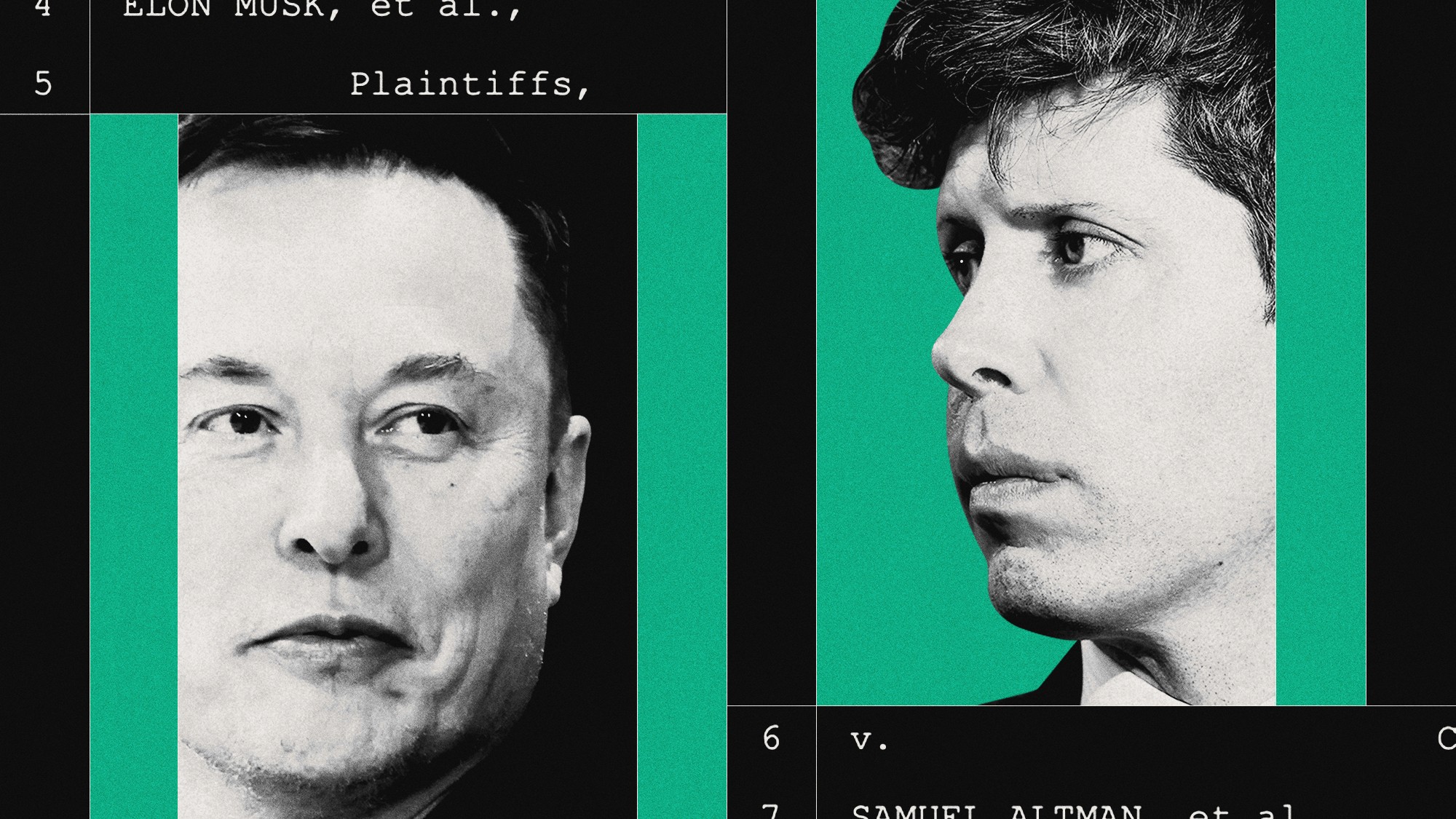
Sam Altman did not seem to be having a good time. During the many days that he spent inside an Oakland courtroom, the normally cheery CEO of OpenAI—a guy who tends to be chipper even when declaring AI’s existential risks to humanity—appeared anxious, even distraught. When he listened to the proceedings in Elon Musk’s lawsuit against him, a weekslong trial that threatened to remove Altman from OpenAI’s board and functionally destroy the company, he frequently concealed his mouth with his palm, fidgeted with a water bottle, and leaned forward and stared at the floor. He kept looking back at the rows of reporters behind him. On the witness stand Tuesday, Altman repeatedly noted how Musk’s actions had “annoyed” him.
Musk, who helped form OpenAI as a nonprofit in 2015, alleged that Altman and OpenAI had violated the organization’s founding principles by seeking profits. He was requesting, among other remedies, more than $150 billion in damages, which Musk said he would donate to the OpenAI nonprofit. This morning, a nine-person jury delivered a unanimous verdict after less than two hours of deliberation: Whether or not OpenAI had done something wrong, Musk sued outside the statute of limitations, two to three years depending on the charge. And Musk could have known of any alleged wrongdoing, the jury found, well before. Altman has been granted some respite: OpenAI and the AI industry will continue along, unfazed, at least until Musk appeals the decision. (A second portion of the case, related to claims that Musk made under antitrust law, remains unresolved, although the presiding judge has said that his are “not very good claims.” Neither Musk’s lawyers nor OpenAI immediately responded to a request for comment.)
OpenAI swept the legal argument. But in another sense, basically everybody involved in Musk v. Altman came away looking petty, short-sighted, deceptive, or ignorant. During the dozens of hours I spent in the courtroom, sometimes lining up as early as 5 a.m. to secure a seat, there wasn’t much substance to be found. Frankly, at the end of it all, everyone had good reason to be annoyed.
Musk came off the worst in this trial, by far. The question before the jury was whether OpenAI’s for-profit arm had somehow broken a legal promise the organization made to Musk at the organization’s founding: “It’s not okay to steal a charity,” as Musk told the jury on the first day. This was a farcical notion based on any number of pieces of evidence and testimony presented at trial, not least of which being that in 2017, Musk himself was involved in discussions for OpenAI to raise more money by making a parallel for-profit arm. Coming into the trial, this was already an uphill battle for Musk and his lawyers. But even by those low expectations, the entire affair was a debacle.
As a witness, Musk was impish. When asked simple questions by William Savitt, one of the attorneys representing OpenAI, Musk rambled and avoided the issue at hand. When the lawyers asked for a yes or no, he bristled: “The classic reason why you cannot always answer a yes-or-no question,” Musk said from the witness stand, “is if you ask a question, ‘Have you stopped beating your wife?’” (“We’re not going to go there,” U.S. District Judge Yvonne Gonzalez Rogers interjected.) Later, Musk accused Savitt of asking improper questions, after which Gonzalez Rogers sharply cut in, telling the world’s richest man, “You’re not a lawyer.” Musk conceded but, after a pause, grinned and added, “Well, technically I did take Law 101.”
When Musk answered questions, he argued that OpenAI had sacrificed safe and responsible AI development by prioritizing profits. But when cross-examined about AI safety, Musk was unable to articulate any coherent arguments. Savitt noted that Musk’s xAI, a competitor to OpenAI, is a for-profit company, and asked if xAI presents identical dangers. “Yes,” Musk said, “I think it creates some safety risk.” Savitt then asked about basic AI-safety measures. Musk, who earlier had testified that he wants to avoid an AI “Terminator outcome,” was clueless. Asked about safety cards, for instance, Musk responded, “Safety card? Why would it be a card?” These are years-old, widely used, industry-standard documents that anybody who has worked at an AI company in the past five years should be intimately familiar with.
The following day, in a particularly withering exchange, Savitt went down the list of Musk’s other enterprises. Did he think that Tesla was making the world better? “Yes,” Musk said. And is Tesla a for-profit company? “Yes.” Savitt then asked these two questions about SpaceX, Neuralink, and X. For each of his businesses, Musk responded yes and yes. The same man who has a trillion-dollar compensation package from Tesla and may receive another from SpaceX was suing OpenAI for trying to make a lot of money. I wondered to myself, What are we doing in this courtroom again?
Despite winning in court, Altman didn’t come off all that much better. The first question from Steven Molo, one of Musk’s lawyers, to Altman was “Are you completely trustworthy?” With a puzzled look, the OpenAI CEO responded, “I believe so.” Molo asked if he had misled business partners, and Altman, after a pause, said, “I believe I am an honest and trustworthy business person.”
Altman’s evasive answers were significant because he has a long history of being accused by colleagues and business partners of being deceptive. Ilya Sutskever, a co-founder and former chief scientist of OpenAI, testified that during his time at the company, he had felt that Altman created an “environment where executives don’t have the correct information,” which is not conducive to AI safety. Multiple former OpenAI board members testified to similar effect in explaining why, in late 2023, they briefly fired Altman. (For his part, Altman wrote in a recent blog post that he is “not proud of handling myself badly in a conflict with our previous board that led to a huge mess for the company.”) When the judge excoriated OpenAI’s legal team for making contradictory arguments in separate lawsuits that she is hearing, Musk smiled and nodded. Musk’s legal team essentially hung its case on impugning Altman’s integrity, and Molo told the jury in his closing argument to imagine that they were walking over a bridge: “The bridge is built on Sam Altman’s version of the truth,” he said. “Would you walk across that bridge?”
The many texts, emails, and internal documents released because of the lawsuit, and the sworn testimony of current and former OpenAI executives, were hardly flattering for the firm— depicting a treacherous company culture that has nonetheless made its staff fantastically rich. Sutskever said that his stake in the company is worth some $7 billion, and Greg Brockman, OpenAI’s president and another defendant in the lawsuit, said that his equity is worth some $30 billion. Altman, who previously told the Senate that he has no direct equity in OpenAI, testified that through an investment fund run by the start-up incubator Y Combinator (which Altman used to be president of), he has an indirect financial stake in the firm.
The trial surfaced and produced countless other shenanigans: Musk apparently called an OpenAI employee a “jackass” for wanting to prioritize safety over speed, after which that employee was given a satirical trophy depicting a donkey’s butt. (During his own testimony, Musk denied yelling at someone and said he would have used such a word only in jest.) In a diary entry, Brockman had written that it would be “wrong to steal the nonprofit from” Musk and that doing so would “be pretty morally bankrupt, and he’s really not an idiot.” Sutskever, a Yoda-like figure in the AI world, described AI progress from 2018 to now as “the difference between an ant and a cat.” At the beginning of the trial, the judge had asked Musk to refrain from posting on social media about the trial as it unfolded, and he did show restraint. Immediately after the verdict, though, Musk posted on X: “The ruling by the terrible activist Oakland judge, who simply used the jury as a fig leaf, creates such a terrible precedent.”
To the extent that the trial could have actually been about the best way to develop AI for the benefit of humanity, and about whether OpenAI is honoring its founding pledge to do so—well, it simply wasn’t. For the most part, Musk and Altman—billionaires who are perhaps the two most influential tech CEOs in the world—were in essence asking their attorneys to debate whether making ungodly sums of money was acceptable. In a remarkable exchange during closing arguments, Gonzalez Rogers excoriated one of Musk’s lawyers for misleading the jury: Molo, after attacking the bridge “built on Sam Altman’s version of the truth,” said that Musk is not asking for money from OpenAI. The district judge pointed out that he, in fact, was asking for money. “You need to retract that statement, or you need to drop your claim for billions of dollars,” the judge said. Musk’s lawyers did not drop the demand.
AI has ascended to the role of main character. When Donald Trump traveled to Beijing for a historic summit last week, AI was one of the central topics of his discussions with Xi Jinping. As the two nations remain locked in a technological arms race, the president brought along some of the United States’ most powerful AI executives, including Elon Musk and Nvidia’s Jensen Huang. A continent away, the European Union has been unsuccessfully petitioning Anthropic to grant access to its advanced cybersecurity model, Mythos. Back in the United States, millions of students and teachers are dealing with the fallout of a devastating ransomware attack on the software platform Canvas—a hack that was likely aided by AI tools. And on Thursday, Cisco became the latest major company to justify layoffs by pointing to AI.
The past six months have marked a sea change in the reach and influence of AI. For most of 2024 and 2025, there was talk of AI progress slowing down or even stopping altogether. Even as the technology began to infiltrate schools and reshape financial markets, AI was relatively easy to compartmentalize from other major, more pressing issues in American life.
No longer. Now the technology has become regarded as a matter of the greatest economic, political, and global consequence. The most important issues in U.S.-China relations? Tariffs, Taiwan, and AI, apparently. Political leaders and pundits including Bernie Sanders and Steve Bannon have put AI center stage, and the backlash against data centers is loud and inescapable. The specter of AI-driven layoffs hangs heavy—as does the threat of advanced hacking bots capable of taking down electrical grids and breaking into banks. All manner of once-speculative concerns about AI have become pressing matters. There is no longer a distant AI future so much as the mess we are all forced to confront today.
The newly chaotic and inescapable state of AI is the result of two inflection points. The first came at the start of the year, when AI agents exploded in popularity. Products such as Anthropic’s Claude Code and OpenAI’s Codex don’t just talk to you; they can do things on your behalf—code, trade stocks, analyze spreadsheets, generate slide decks, and even create Amazon listings. The technology’s once-questionable economic value became very clear, very quickly, to a large number of businesses, which have clamored to incorporate agents alongside, or in lieu of, their human employees. As agents have swarmed the workplace, nearly three-quarters of employed Americans think AI will decrease overall job opportunities and 30 percent of Americans are concerned that AI will make their own job obsolete.
The second shift began in late February. First, a high-profile contract dispute between Anthropic and the Pentagon revealed how essential AI has become to national security. Then, in early April, Anthropic announced Mythos, a model with the ability to rapidly find and exploit bugs throughout the internet. (Shortly after, OpenAI came out with an analogous model.) In tandem, these events suggest that some of the most catastrophic fears about AI could come true: Several independent cybersecurity experts have told me that these models are approaching the abilities of the most elite human hackers. Anthropic and OpenAI have not released these cybersecurity models to the public, out of fear they will be used by criminals or terrorists; meanwhile, companies and government bodies alike are hungering for access so they can use the tools to patch any bugs. As a result, AI labs have become major geopolitical actors in their own right.
Spurred by the threat of massive AI cyberattacks, the Trump administration is now reportedly weighing the possibility of testing or even licensing the most powerful AI models before their public release—moves the White House once called “dangerous” and “onerous.” White House Chief of Staff Susie Wiles is said to be spearheading Trump’s AI policy and has written a rare post on X vowing to keep Americans safe from AI cyberattacks by ensuring “the best and safest tech is deployed rapidly to defeat any and all threats.” (A White House official told me that “any policy announcement will come directly from the President.”) This month alone, dozens of members of Congress have signed letters to the White House on AI regulation.
It’s hard to overstate the extent to which AI has crept into contemporary life, even for people who aren’t commonly using the technology. A poll this spring showed that, for Americans, AI is growing in importance faster than any other issue. AI wasn’t a focus for campaigns in 2024, but several races coming up this year are poised to involve heated debates over the technology. Data centers in particular have gone from basically invisible to a divisive issue that cuts across party lines: 70 percent of Americans oppose the construction of an AI data center in their community. These centers’ voracious demand for natural resources might be showing up in your electrical or water bill or your receipt at the gas pump. Data centers have also become objects of military and political violence. Last month, the home of an Indianapolis city councilman was shot up after he voted to approve a data center. And these buildings have been targeted or threatened by Iranian, U.S., and Israeli forces during the war in the Middle East.
There will never again be a graduating class that experienced even a year of college without ChatGPT. On Instagram, Facebook, and X, influencers preach about how to use Claude and ChatGPT to make your life easier. Recent leaps in deepfake tools make it harder than ever to assume that any given post on social media is human-made. As if AI had not already eaten the economy, Anthropic and OpenAI are racing to be listed on stock markets in what will likely be two of the largest public offerings in history. This will dramatically warp the public-investing landscape and affect, for better and worse, basically anybody with any sort of savings—a college fund, a 401(k), a pension.
All of which is to say, basically anything that is American seems tangled up with AI: the war in Iran, gun violence, the midterms, NIMBYism, falling test scores, class inequality, the stock market, housing, gas prices. None of these issues are necessarily determined or superseded by AI—far from it—but rather, this technology and industry are now directly, unavoidably implicated in them all. And the experience of this AI-saturated present is a bewildering one. Partisan lines on AI are scrambled and confused. The influx of cash into data centers has propped up the U.S. economy, making it impossible for economists and policy makers to fully understand the effects of tariffs and the war with Iran. More and more companies are citing AI for mass layoffs, but whether this is a genuine justification or a convenient excuse to downsize is anybody’s guess. Whether AI is going to empower or rot all our brains, too, will only become evident many years from now. All these questions and tensions are hard to make sense of, let alone resolve, but they can no longer be deferred.
The path here was not the inevitable result of some technological, scientific, or economic law. Nor is continuing down it. To the extent we are already living in the AI future, it is the result of a series of calculated decisions by the biggest tech firms and their investors. Silicon Valley has spent ungodly sums on AI and data centers: Microsoft, Amazon, Meta, and Google alone have already spent more on data centers since the launch of ChatGPT than the federal government spent to build the entire interstate highway system. Those expenditures are set to grow, even as consensus opinions on whether all this spending constitutes an economic bubble fluctuate every few months. Meanwhile, AI companies have been hard at work partnering with local and federal government agencies, major colleges and research universities, Fortune 500 companies, and media organizations to weave their products into everyday life.
All of this spending and all of these partnerships were set in motion years before the technology was actually capable or reliable enough for widespread usage. Now these same companies are barreling forward to consummate their technological revolution. For everyone else, the AI future is beginning to feel less like something you participate in and more like something that happens to you.
Elon Musk and Sam Altman are two of the most influential people in Silicon Valley, if not the world. Between the two of them, Musk and Altman run technology companies worth many trillions of dollars that promise to reshape civilization. But this morning, both sat under fluorescent lights in a courthouse in downtown Oakland, suffering through all manner of technical glitches as their respective attorneys kicked off the long-awaited trial in Musk v. Altman.
As Steven Molo, a lawyer for Musk, began his opening argument, confused looks swept the courtroom. “We can’t hear you,” Judge Yvonne Gonzalez Rogers said. Someone fixed his microphone. Later, as Molo began to call into question Altman’s integrity, his microphone cut out again, and his presentation disappeared from screens in the room. (“We are funded by the federal government,” Gonzalez Rogers joked. “The judiciary is happy to take more funds.”)
Musk is suing Altman and OpenAI, among others, demanding legal and financial remedies that would effectively destroy OpenAI as we know it. The fight stretches back to 2015, when Musk partnered with Altman to create OpenAI out of concern, as they told it, that Google DeepMind could not be trusted to create artificial general intelligence. Corporate greed would get in the way of societal progress, they claimed, so OpenAI would be a nonprofit. After a falling out with Altman and other co-founders, Musk left in 2018. All of this was before OpenAI added a for-profit entity, and before ChatGPT became the fastest-growing consumer app in history. In 2024, Musk sued, alleging that by putting profits above its founding mission, OpenAI had violated its founding charter and misused Musk’s initial charitable donations. “It’s very simple,” Musk testified today. “It’s not okay to steal a charity.” Also named in his complaint are the OpenAI co-founder Greg Brockman and Microsoft, a major investor in the company.
Musk is asking that Altman be removed from OpenAI’s board, that the company convert back to a nonprofit, and for the return of allegedly “ill-gotten gains”—some $150 billion—which Musk says would go to OpenAI’s charitable trust. Outside legal experts say that Musk is unlikely to win all or even much of this. His argument is confusing: OpenAI has certainly evolved from a nonprofit lab to a revenue-chasing, consumer behemoth, and a chorus of critics has alleged that it has deviated from its original mission of ensuring that AGI benefits humanity. But Musk himself appears to have insisted that OpenAI couldn’t keep up as a nonprofit—for instance, in early 2018, he wrote an email to OpenAI leadership saying that merging the firm with Tesla “is the only path that could even hope to hold a candle to Google.” And even before he sued, Musk launched a rival for-profit company, xAI. “Mr. Musk’s lawsuit is a pageant of hypocrisy,” William Savitt, a lawyer for OpenAI, told the jury today, later adding that Musk had “sour grapes.” (OpenAI, which declined to comment, wrote yesterday that the lawsuit is “a baseless and jealous bid to derail a competitor.” Musk’s legal team did not respond to a request for comment.)
The substance of these claims is important to the AI industry as a whole. The ramifications of this lawsuit go beyond any company or executive: The conflict between Musk and Altman has itself directly shaped the course of the AI industry. It is, in effect, the AI boom’s founding feud. The next few weeks of the trial will illuminate tensions about the development of AI that have grown only more urgent—between profit and social good, and over who can be trusted with this technology.
Already, the pretrial process produced no shortage of drama. Both sides published internal communication between Musk and OpenAI leadership. OpenAI shared texts suggesting that Musk had used a former member of OpenAI’s board to keep tabs on the company. (That board member, Shivon Zilis, has multiple children with Musk, and in her deposition said that she is in a romantic relationship with him; asked about Zilis today, Musk said she was “my chief of staff and uh, well, yeah,” smirking.) Musk’s alleged ketamine use during important OpenAI negotiations, which he has said he does not recall, became a key issue until, in a recent pretrial hearing, Gonzalez Rogers deemed this line of inquiry irrelevant.
The trial makes the AI boom seem sordid and small. In his sworn deposition, Altman wrote that Musk used to message him complaints that he wanted more credit for the success of OpenAI and took offense at not being included in an anniversary photo. Altman has also said, of Musk and his lawsuit, “Probably his whole life is from a position of insecurity. I feel for the guy.” In the courtroom, Altman sat stone-faced next to Brockman and departed right before Musk took to the witness stand.
Musk, for his part, has said that he would drop his lawsuit if OpenAI changed its name to “ClosedAI.” Yesterday, as jury selection began, Musk began furiously posting on X and repeatedly called his co-founder “Scam Altman.” Before the start of opening arguments today, Gonzalez Rogers admonished Musk and Altman for their social-media use, asking them to limit their “propensity” to post about the trial; both meekly assented, “Yes.”
Now we are all living in the fallout of Musk and Altman’s vendetta. Disagreements over the direction of Google DeepMind led to the creation of OpenAI, and then more disagreements led Musk to found xAI. Similarly, a few years ago, Dario Amodei and six other OpenAI employees split off to form a competing AI company, Anthropic, themselves trusting neither OpenAI’s structure nor its leadership to prioritize the benefit of humanity over financial gain. And there’s Mark Zuckerberg, whom Musk asked about joining forces to purchase OpenAI in 2025, according to texts released in pretrial discovery. (Meta previously declined to comment.) Zuckerberg has since spent tens or even hundreds of billions of dollars overhauling the AI team at Meta in a bid to catch up in the AI race. The very sort of AI schism that started with Musk and Altman keeps recurring.
A more cynical description of this dynamic is that the AI boom is shaped by a very small group of men, nearly all of whom claim to be the best steward of humanity while being largely dismissive of their competition. At the same time, the goal of creating an organizational structure, whether nonprofit or corporate, to provide a check on a CEO has all but withered away. An independent board was supposed to govern OpenAI, but the company has basically been Altman’s fiefdom—just as Anthropic is Amodei’s and xAI is Musk’s. Grok has at times explicitly aligned its responses with Musk’s political views by mimicking his social-media posts.
Both sides have made the issue of concentration of power—that no one company or person should control such a transformative technology—central to their arguments. “If you have someone that’s not trustworthy in charge of AI,” Musk testified, “I think that’s very dangerous to the whole world.” The defense, meanwhile, said that “one person having control wasn’t consistent with OpenAI’s core mission.” Apparently, the irony was lost on everyone.
This trial will offer the clearest glimpse into an elite circle whose bickering is shaping the most expensive infrastructure buildout in human history in the name of a technology that could upend the labor market, spell the end of education as we know it, and reshape the geopolitical order. That is, as long as the microphones keep working.
OpenAI does not like to be left out. The week after Anthropic announced Claude Mythos Preview—an AI model that has put governments around the world on edge because of its potential ability to hack into banks, energy grids, and military systems—OpenAI shared a program that is uncannily similar. And just like Anthropic did with its model, OpenAI has, for cybersecurity purposes, restricted access to this new bot, called GPT-5.4-Cyber, to a small group of trusted users.
This sequence has become something of a pattern: First Anthropic will make an announcement, and then OpenAI will follow suit. Last year, Anthropic launched Claude Code, an AI coding tool. A couple of months later, OpenAI came out with its own version, Codex. When Claude Code had a breakout moment in January, OpenAI responded with two major updates to Codex alongside a press blitz for the product. And earlier this month, OpenAI released a version of Codex that allows it to use other apps on your desktop—similar to an existing Anthropic tool called Claude Cowork.
Until recently, Anthropic—founded by a group of former OpenAI employees in 2021—played the role of younger brother. OpenAI kicked off the entire AI boom with the release of ChatGPT, and has had more users, funding, and name recognition ever since. But Anthropic has been riding high on the explosive popularity of Claude Code and booming sales of its AI models to large corporations. The firm’s showdown with the Pentagon has also helped vault it into the public eye. In early April, Anthropic said its revenue rate had hit $30 billion a year—appearing to surpass OpenAI’s.
In its public messaging, OpenAI has been indifferent or even somewhat derogatory toward Anthropic. Last week, when OpenAI released its newest model, GPT-5.5, the announcement was paired with direct and veiled references to how it beat out Anthropic’s latest, Claude Opus 4.7. But internally, the firm is seemingly on edge. In a recent leaked company-wide memo, Denise Dresser, OpenAI’s chief revenue officer, felt the need to address one particular competitor: “Here are a few things worth keeping in mind, especially on Anthropic.” The rival firm’s product offerings are narrow, Dresser wrote, and “their story is built on fear,” referencing Anthropic’s loud messaging about the dangers of AI. “Our positive message will win over time.” (OpenAI, which has a business partnership with The Atlantic, did not respond to a request for comment. Anthropic also did not respond to a request for comment.)
If imitation is the sincerest form of flattery, OpenAI’s actions are especially telling. At every turn, OpenAI has appeared eager to copy the success of its rival. For starters, as Anthropic’s explicit focus on mitigating the risks of AI has apparently won the trust of many consumers, OpenAI has imitated many of its rival’s safety initiatives. In early 2026, after Anthropic published a major update to Claude’s “Constitution,” a document that tells the AI model how to behave, OpenAI launched a major campaign around its equivalent document.
But OpenAI’s most important, Anthropic-esque pivot has been in its business model. Early on, these two companies made fundamentally different bets on how they would eventually make money. OpenAI positioned itself as a consumer behemoth, hoping to capitalize on ChatGPT’s hundreds of millions of users. Last fall, the company launched the AI-video app Sora and an AI-powered web browser. OpenAI has made forays into e-commerce and is testing ads in ChatGPT. Every now and then, the company teases the AI device that it is developing with the former Apple designer Jony Ive. Anthropic, meanwhile, has focused on the less flashy goal of selling its AI tools to businesses and software engineers.
Despite OpenAI’s numerous advantages, Anthropic’s focus on code and business customers seems to be winning. Although OpenAI is worth more based on the most recent fundraising rounds, Anthropic now has a higher valuation—more than $1 trillion—in some private markets. Anthropic’s explosive growth is particularly important as the two companies both race to go public, in turn accessing a huge pool of new investors, and try to prove they will eventually be profitable. (Both companies still have a long way to go in that regard.)
OpenAI is now eager to catch up. In December, OpenAI hired Dresser, a former CEO of Slack, to pursue more business customers. In late January, Altman gathered several major executives for a lavish dinner in San Francisco to preview all of the business offerings his company was planning, according to The Information. The company has since made a blitz of announcements around coding tools and enterprise AI offerings, including a new set of “Frontier Alliances”: partnerships with several of the world’s premier consulting firms, including McKinsey & Company and Boston Consulting Group, to accelerate enterprise adoption of ChatGPT. In mid-March, another internal OpenAI memo reportedly stated that the company needed to eliminate “side quests” and focus on the enterprise and coding markets. Anthropic’s success in those areas, the memo stated, should be a “wake-up call” for OpenAI. The firm also scrapped Sora and has been aggressively advertising and messaging about Codex for months now. “I am happy everyone is switching to Codex,” Altman wrote on X earlier this month.
OpenAI’s pivot to its enterprise business has not been total. It did, for instance, recently shell out reportedly hundreds of millions of dollars to acquire a niche tech podcast. And Anthropic, for its part, has had to take some cues from OpenAI—notably by making big and expensive data-center deals, such as an expansion in its partnership with Amazon Web Services. Anthropic’s CEO, Dario Amodei, has previously insinuated that OpenAI has made such deals “because it sounds cool.”
Which company will win the AI race is anybody’s guess. Regardless, OpenAI’s embrace of the Anthropic business model makes one thing abundantly clear: For all the wonder and change that generative AI brings as a technology, there hasn’t been any real innovation in the business models of Silicon Valley. For decades, most tech companies have succeeded by either selling ads (the route of Meta and Google) or selling enterprise tools (like Salesforce and Slack). One day OpenAI or Anthropic might cure cancer and remake the world, but for now they still have to pay the bills.
AI companies are beginning to entertain the possibility that they could cease to exist. This notion was, until recently, more theoretical: A couple of years ago, an ex-OpenAI employee named Leopold Aschenbrenner wrote a lengthy memo speculating that the U.S. government might soon take control of the industry. By 2026 or 2027, Aschenbrenner wrote, an “obvious question” will be circling through the Pentagon and Congress: Do we need a government-led program for artificial general intelligence—an AGI Manhattan Project? He predicted that Washington would decide to go all in on such an effort.
Aschenbrenner may have been prescient. Earlier this year, at the height of the Pentagon’s ugly contract dispute with Anthropic, Secretary of Defense Pete Hegseth warned that he could invoke the Defense Production Act (DPA), a Cold War–era law that he reportedly suggested would allow him to force the AI company to hand over its technology on whatever terms the Pentagon desired. The act is one of numerous levers the Trump administration can pull to direct, or even commandeer, AI companies. And the companies have been giving the administration plenty of reason to consider doing so.
Future bots could help design and carry out biological, nuclear, and chemical warfare. They could be weaponized to take down power grids, monitor congressional emails, and black out major media outlets. These aren’t purely hypothetical concerns: Earlier this month, Anthropic announced it had developed a new AI model, Claude Mythos Preview, capable of orchestrating cyberattacks on the level of elite, state-sponsored hacking cells, potentially putting a private company’s cyber offense on par with that of the CIA and NSA. In an example of Mythos’s power, Anthropic researchers described how the model used a “moderately sophisticated multi-step exploit” to work around restrictions and gain broad internet access, then emailed a researcher—much to his surprise—while he was eating a sandwich in the park.
Washington is getting antsy about the power imbalance. Over the past year, multiple senators have proposed legislation that would order federal agencies to explore “potential nationalization” of AI. Murmurs of possible tactics abound—including more talk within the administration of the DPA after Anthropic’s Mythos announcement, one person with knowledge of such discussions told us. Meanwhile, Silicon Valley is watching carefully. In recent weeks, Elon Musk, OpenAI’s CEO Sam Altman, and Palantir’s CEO Alex Karp have publicly spoken about the possibility of nationalization. Lawyers who represent Silicon Valley’s biggest AI firms are paying attention.
So what if nationalization actually happens?
In the most extreme scenario, top researchers from across the AI companies would be forced to work out of SCIFs in the basement of the Pentagon and report to Hegseth. Computational capacity, too, would be centralized under one nationalized mega-operation. The work would be locked down, and the focus would be primarily on defense applications, as opposed to the products made for businesses and individuals—ChatGPT and the like—that dominate the market today.
All of this would constitute full nationalization, an absolute takeover of the industry that would hollow out the commercial businesses of its three leading players: OpenAI, Anthropic, and Google DeepMind. Based on a dozen conversations we’ve had with former Pentagon and Trump-administration officials, AI-policy experts, and legal scholars, such a situation is, in all likelihood, not going to happen.
For starters, it’s probably illegal, according to Charlie Bullock, a senior research fellow at the Institute for Law & AI: The Constitution generally prevents the government from seizing private property without paying, and the government is unlikely to easily produce the trillions of dollars that the industry is collectively worth. The top American AI labs might immediately lose a fair portion of their research staff as well, because of restrictions on foreigners who can work on the most crucial defense-related technologies.
If AI firms were forced to focus primarily on defense applications, there would be the inevitable question of what to do with the massive consumer businesses these companies run. Would people use ChatGPT.gov, like buying a sundae from Cuba’s state-run ice-cream parlor? And if the goal of nationalization is to keep a competitive edge over China, it’s hard to imagine that Hegseth’s Pentagon could run an AI company more efficiently than Altman or Dario Amodei, the CEO of Anthropic.
But consider another possibility—slightly less extreme, though still capable of remaking the industry as we know it. The government could regulate AI companies like it does utilities. In the 1900s, as electricity went from a luxury good to a necessity, state and federal governments saw a need to regulate how much energy companies charge and to impose requirements around service reliability. In much the same way, the government could pass new laws regulating AI firms’ commercial activities. The companies could be prevented from charging more than it costs to generate images and text, for instance, or required to provide a basic level of model speed and capabilities to all customers, a sort of AI net neutrality.
A hard pivot to government control would likely entail both new state and federal laws, as well as heavy cooperation from tech companies—which, given the nation’s sclerotic politics and Silicon Valley’s libertarian leanings, could pose insurmountable barriers. But the notion is not so far-fetched. Some corners of Silicon Valley itself seem to be at least partially open to it. Altman has described a future in which “intelligence is a utility like electricity or water and people buy it from us on a meter.” Jensen Huang, the CEO of Nvidia, recently said that just as “every country has its electricity, you have your roads, you should have AI as part of your infrastructure.”
Such talk serves AI companies’ own interests—in part because being classified as a service provider can be, as the era of social media has demonstrated, an excellent way for companies to avoid liability for harmful or inaccurate information on their platforms—but it’s certainly possible that AI could become so entrenched that elected officials come to see it as an essential resource. Already, just as the federal government uses regulatory incentives and investment to spur the construction of new power plants and transmission lines, both the Biden and Trump administrations have undertaken initiatives that are essentially industrial policy for AI, using federal dollars and regulatory authority to accelerate the construction of AI infrastructure on American soil.
OpenAI has already flirted with the notion of a “Right to AI,” suggesting in a recent policy document that the government should consider making a “baseline level of capability broadly available, including through free or low-cost access points.” Similar regulations already govern many aspects of digital communication. “Your internet-service provider, cable, telephone services, these things are considered so essential that the government basically says how the providers” can do business, Dean Ball, a former AI adviser to the Trump administration, told us. AI could be next.
For years, AI companies have insisted they need to be regulated—but only as theysee fit. Should the federal government ever take AI regulation seriously, the utility route would be among the most aggressive approaches available. But, really, the AI industry would be getting what it asked for.
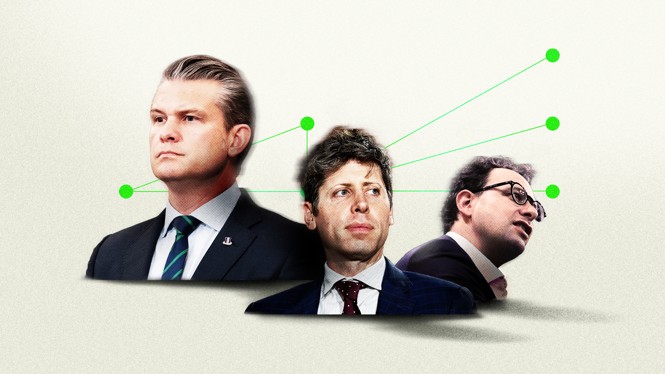
Illustration by The Atlantic. Sources: Daniel Heuer / Bloomberg / Getty; Krisztian Bocsi / Bloomberg / Getty; Mark Schiefelbein / AP.
Before we get into other conceivable futures, an important caveat. A full-blown nationalization effort may be unlikely, but that changes if a major global war breaks out or the economy collapses. During an emergency of historical scale, Ball reminded us—especially an emergency under the Trump administration—anything is possible. Drastic measures become easier to justify, both legally and politically.
Imagine that over the next year President Trump continues his game of imperialist roulette: America is further eroding the trust of its international partners, NATO keeps crumbling, and a new geopolitical reality continues to take shape. Say that in the midst of this, China decides to invade Taiwan. The conflict escalates fast, drawing in the U.S. and reluctant allies. The ensuing war is a major one. The Pentagon, already drastically short on munitions after its forays in Iran, wants to apply the latest AI capabilities to its wartime efforts, and Hegseth demands that Anthropic allow the Pentagon unrestricted access to Claude, reigniting the dispute first set in motion earlier this year.
Because there is active conflict, Anthropic is more willing to engage with the government’s demands than they were previously, but the firm asserts that it requires continuous oversight into how the Pentagon is using Claude. The company fears that in an effort to crack down on espionage, the Defense Department might create monitoring capabilities that supersede even the Chinese Communist Party’s, sliding America into an autocratic AI regime. Lest this sound speculative, it’s merely a restatement of Anthropic’s own position: Amodei has warned of a near future where “a powerful AI” scans “billions of conversations from millions of people” to “gauge public sentiment, detect pockets of disloyalty forming, and stamp them out before they grow.”
The spat from earlier this year looks mild by comparison. Amodei remains stubbornly principled despite repeated requests from the Defense Department made under emergency laws. Hegseth responds by sending his troops to descend upon the company’s headquarters in San Francisco. Amodei is forcibly removed and replaced with a deferential Army general. The situation is exceedingly unlikely, but not without precedent: Soldiers once carried the chair of one of America’s largest retailers out from his Chicago office after he failed to comply with federal demands during World War II.
Throughout American history, efforts to take control of industry have been rare, and limited mostly to times of crisis: President Woodrow Wilson nationalized the railroads during World War I, and Fannie Mae and Freddie Mac were placed under conservatorship during the financial crisis. Today, there are all kinds of possible emergencies. If a global financial crash leads AI companies to insolvency, the administration might swoop in to provide life support, as it did for many banks and car companies during the Great Recession. On the flip side, should AI models displace large swaths of the labor market, such that a handful of companies run most of the economy, “then some kind of nationalization becomes potentially imperative,” Samuel Hammond, the acting director of AI policy and chief economist at the Foundation for American Innovation, told us—to distribute wealth and simply ensure the proper functioning of society. Both Anthropic and OpenAI have already suggested possible versions of such redistributive measures.
Advances in AI could be their own kind of disrupter: Imagine a Sputnik 2.0 moment where the White House decides that American companies need to consolidate resources if the U.S. wants to win the AI race against China. By exerting more control, America becomes more like China in the very race to beat it.
The thing about nationalization, though, is that it need not be all or nothing. Nationalization “has layers,” Hammond said. “Like an onion.” Perhaps the most likely fate for American AI companies is a future of soft nationalization—a world in which the government doesn’t fully control AI labs and their models, but instead enacts an escalating series of policies and established close partnerships with private companies to shape the technology.
By some measures, soft nationalization has already begun. The Trump administration has already taken a 10 percent stake in Intel, a major semiconductor manufacturer, providing the White House with (some) direct financial leverage over the company. OpenAI has appointed the retired general and former NSA director Paul Nakasone to its board. Meanwhile, the Army recently established a new detachment for senior tech leaders, and its first four recruits included executives from Meta, Palantir, and OpenAI.
The top AI companies are coordinating with government officials as their products’ military and intelligence implications advance. OpenAI, which scooped up a contract with the Pentagon after Anthropic’s fell apart, has said it will deploy its own engineers to work alongside the military. The firm has also been briefing governments—at the state, federal, and international levels—on the capabilities of a new OpenAI cybersecurity model. Google is reportedly negotiating its own Pentagon contract to allow Gemini to be used in classified settings. And even Anthropic is coming back around. The company is fighting the Pentagon in court over a “supply-chain risk” designation that Hegseth slapped on them amid their dispute. But after Anthropic announced its Mythos model, a group of tech executives including Amodei spoke with Vice President Vance and others to discuss the risks, and Amodei took a trip to the White House. Last week, President Trump said a possible Pentagon deal with Anthropic might still be on the table.
The White House, OpenAI, and Anthropic all paid lip service to the value of cooperation when we reached out to them. The Trump administration is “working with frontier AI labs to discuss opportunities for collaboration,” a White House official told us. A spokesperson for OpenAI said: “As AI systems become more capable, it is only going to become more important for industry to work with governments.” And an Anthropic spokesperson told us that Amodei’s recent visit to the White House was “productive” and that the firm believes that governments must play a central role in addressing the technology’s national-security implications. (Google DeepMind and the Pentagon did not return repeated requests for comment.)
This campfire ethos could easily fall apart. And clearly, tensions exist. But so long as it’s in both the AI firms’ and Trump’s interests to please each other, we may see the leading AI companies partnering even more closely with the U.S. military to accelerate the development of defense applications, analogous to what contractors including Palantir, Boeing, and Lockheed Martin have done for years. As a protective measure, the White House might ask AI companies to increase their security practices to prevent espionage and exfiltration of the most capable versions of the technology (consider that a handful of unauthorized users have reportedly gained access to Mythos). The government could even designate certain research as classified and subject technologies to export controls, and federal employees could embed inside the companies to oversee various safety measures and run their own, independent evaluations. Every nuclear power plant in America has at least two on-site government inspectors who check daily to confirm compliance with federal safety requirements. So why not AI companies too?
If such partnerships persist, one could imagine private companies resisting certain government demands. But even without new legislation, the White House can easily exert greater authority over industry. “There’s quite a lot of power that the federal government can wield,” Paul Scharre, an executive at the Center for a New American Security who previously did policy work at the Department of Defense, told us. “And even more so if you have an administration that’s willing to stretch the bounds of executive power.” Anthropic’s supply-chain-risk designation—a label that effectively bars the military from doing business with the company, and that is typically reserved for companies with ties to foreign adversaries—was a clear example of the government flexing its muscles. So was the Biden administration’s decision to block Nvidia from selling its most advanced AI chips to China in 2022. (The Trump administration has since relaxed restrictions, claiming that selling to China was the better strategy for winning the AI race.)
One of the most salient tools available remains the Defense Production Act, the law that Hegseth threatened Anthropic with before pursuing the supply-chain-risk designation. The act has been used over the decades to support the manufacture of military equipment such as bombers and tanks, though in recent years, it has been used more expansively. Both the first Trump and the Biden administrations used it to accelerate pandemic safety measures, and Biden relied on the law in a since-repealed executive order to compel AI companies to share certain information about model training and evaluations with the government. Last week, Trump invoked the act to fund new energy projects. Actually pursuing the DPA as a general tool for controlling AI companies would raise a host of thorny legal issues, but that hasn’t exactly stopped the Trump administration in the past.
Such reins on an industry that has billed itself as capable of extinguishing humankind are, theoretically, in everyone’s interest. It would seem to clearly benefit the American people to have democratically elected institutions—rather than corporate executives—overseeing a set of technologies with huge implications for the nation’s security and well-being. It’s also historically anomalous for a private industry to dictate the deployment of such a powerful, general-purpose technology. With the announcement of Mythos, Anthropic has been effectively functioning as a geopolitical actor, briefing ally governments on the model’s capabilities. The European Commission, for instance, has met with Anthropic thrice since Mythos was announced—although as of Wednesday, the company had not yet given European Union officials access.
The government should play a role in dictating the terms of how AI transforms the world. But the ongoing fracturing of American politics, and especially the capricious and authoritarian-leaning tendencies of the current administration, complicates everything. Entrusting the future of generative AI entirely to Altman and Amodei or Trump and Hegseth seem like two very different and similarly disastrous outcomes—a “Scylla and Charybdis” dynamic, as Bullock put it, between the tremendous concentration of power in government or in a small cadre of companies.
The impossible truth is that no private company should be trusted to unilaterally steer the future of AI development, but Americans should also have serious questions about whether government control is in their best interest—not least of all under an erratic and norm-shattering Trump administration. The Manhattan Project coordinated the efforts of scientists, private companies, and America’s leaders. What if instead, Boeing and DuPont had been racing against each other to develop the atomic bomb while Hegseth and Trump led the military? We are diving headfirst into the 21st-century equivalent of such a situation. Our political dysfunction is about to ram into Silicon Valley’s immeasurable power.

 Login
Login