Nuclear fusion powers the Sun, and scientists and engineers have long been trying to harness the process to generate clean energy. While much progress has been made, the commercially-viable generation of fusion energy remains elusive.
One important challenge is developing a range of specialized materials that can contain an extremely hot, radiation-emitting plasma in close proximity to ultracold superconducting magnets.
Our guest this week is Jacob John of the UK Atomic Energy Authority, who studies how radiation damages materials. In conversation with Physics World’s Matin Durrani, he talks about the near-oxymoronic materials requirements for fusion reactors and how they can be met.
Gwenaëlle Lefeuvre studied physics at Sorbonne Université in Paris, France, before moving to Université Paris Cité to do a PhD in experimental particle physics. After postdocs at Syracuse University in the US and the University of Sussex in the UK, she left academia and worked for 10 years at the UK company Micron Semiconductor Ltd. Here, Lefeuvre set up a business unit dedicated to designing and manufacturing CVD diamond sensors.
Lefeuvre now works as the network coordinator for Photonics Bretagne – a non-profit association in Brittany, France. As an innovation hub, the organization supports the development of the photonics ecosystem across industry, research and education in Brittany, and helps integrate photonics technologies into other sectors.
What skills do you use every day in your job?
When it comes to skills I need for my role, my scientific background is just the starting point. I am the contact point between the Photonics Bretagne team, our members, our European partners, and any other parties interested in what photonics have to offer. While my background gives me credibility, what I really use is the inquisitive spirit that a physics education imprints in us. I ask a lot of questions, all the time and to everyone, so I can better understand what people work on, what they need, and how their products can be used in different situations.
Of course, this means that communication and networking are also crucial. Representing my member companies, for example, means that I must be able to translate what they are offering so it’s understandable for people who might work in a very different sector, such as mobility, agriculture or cosmetics.
Finally, being flexible is a must. I wear different hats depending on the task at hand, and need to be able to switch them around quickly.
What do you like best and least about your job?
I love many aspects of my role, but top of the list is having the opportunity to keep learning about new technologies and applications. The breadth and depth of knowledge my co-workers and our members possess is as humbling as it is inspiring. While I am more of a “generalist physicist” myself, I have worked on many different types of experimental systems so can appreciate the expertise at play.
I also enjoy the diversity of my work, which makes my days fun and varied. I might be meeting with members and looking for ways to support them; organizing a delegation visit with my European partners; or advocating for photonics in cross-sector events – and that’s just naming a few of my responsibilities. There is never a dull day.
With the diversity of my role and my enthusiasm to find out more comes the challenge of prioritizing. There are so many things I would love to be doing, but we are a small team and we must focus our efforts on those actions that can best serve our community. And of course, the administrative and reporting tasks are never loved by anyone and take up more valuable time than I would like. They are a constant in every job though, and can be managed through good planning.
What do you know today, that you wish you knew when you were starting out in your career?
Three things come to mind. The first is that it’s helpful to know whether you will enjoy becoming a highly specialized researcher, or if you would thrive in a more general role. Higher education in physics is designed around gaining a finer and finer degree of specialization. I realized during my postdocs that I was not enjoying staying in one given field (neutrino physics, in my case) as much as I expected to. What I loved was working hands-on with different types of sensors, which is a more transversal specialization, so to speak. Not everyone is built to be a specialist and there is nothing wrong with that. Many career options are open to those who embrace remaining curious about everything, provided they have a strong background to back it up.
There are so many ways to work in, with or for the physics community – the main limiting factor for my younger self was probably my own imagination
Secondly, it’s worth remembering that people change, and ambitions do too. It has been said many times in this column, but life isn’t linear and neither is a career. It is important to account for the person you will become, so that you don’t make choices today that will make your future self unhappy or stuck. There are so many ways to work in, with or for the physics community – the main limiting factor for my younger self was probably my own imagination. Luckily, many degrees now include broadening experiences like semesters abroad or entrepreneurship classes.
Finally, I wish I had realized earlier that people love it when we ask them questions about their work. Doing so does not showcase our ignorance but our interest – it’s a true win-win.
Physicists who go into politics are a rare breed. Most famously there was Angela Merkel, who was chancellor of Germany for 16 years. Climate physicist Claudia Sheinbaum Pardo was elected Mexican president in a landslide win in 2024. Alok Sharma, meanwhile, was business secretary in the UK government and president of the COP-26 climate summit.
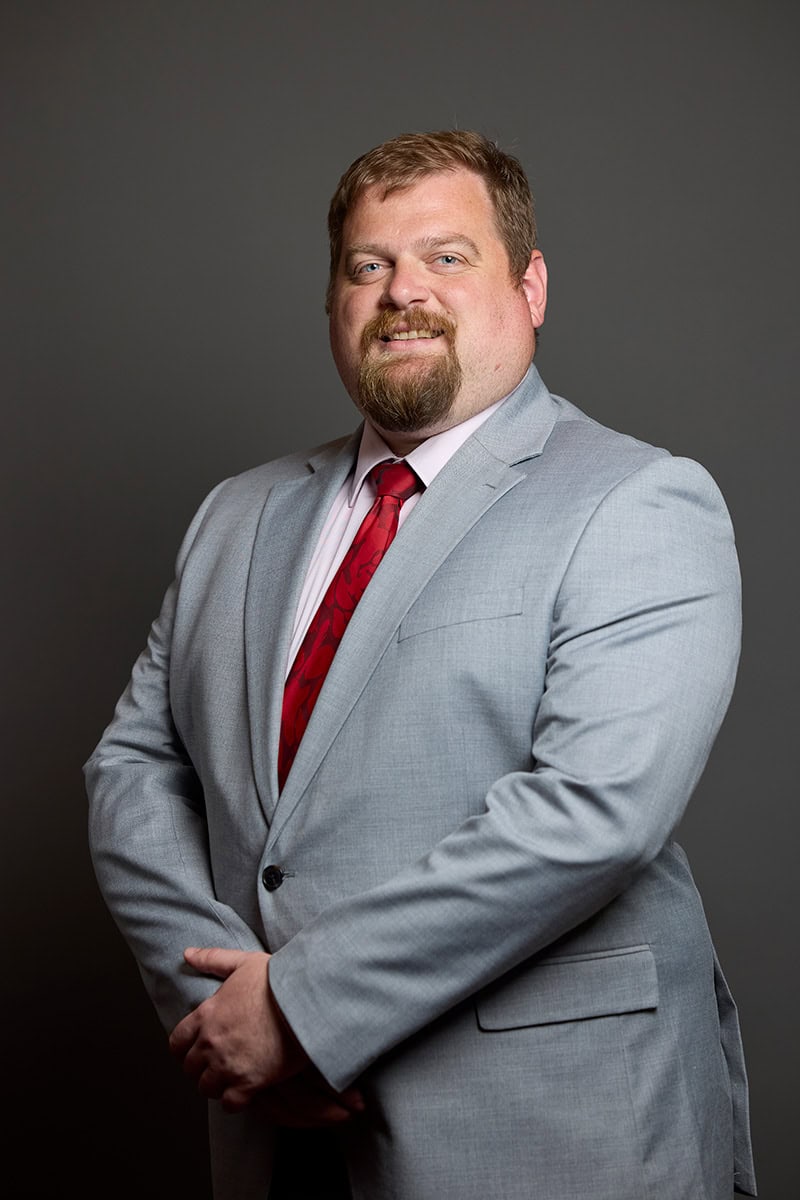
But Dave Robertson is even more unusual. Having originally studied physics at the University of Liverpool in the UK, he worked as a physics teacher in Birmingham for almost a decade. After spells in the trade-union movement and local politics, Robertson has been the Labour Member of Parliament (MP) for Lichfield, Burntwood and the Villages since 2024.
He’s not the only physicist currently serving as an MP. Others include Layla Moran – another former physics teacher – who’s been Liberal Democrat MP for Oxford West and Abingdon since 2017. There’s also shadow home secretary Chris Philp, who’s been Conservative MP for Croydon South since 2015.
But Robertson is the only physics-teacher-turned-MP in the current Labour government, which came to power at the 2024 general election. It won a 174-seat landslide majority, though Robertson’s own victory was wafer-thin. He squeaked home by just 810 votes over his Conservative rival Michael Fabricant, who had been Lichfield’s MP for more than 25 years.
In an interview with Physics World, Robertson admits he had little idea of what the job of MP would involve (see box). Describing the British parliament as “a truly bonkers and bizarre workplace”, he divides his time between Lichfield and London. “I try to do four days in my constituency a week and four days in parliament. That doesn’t add up, but if can split my Mondays, I can just about make it work.”
Dave Robertson MP: what happened after I got elected
Dave Robertson recalls the immediate aftermath of his victory in the UK general election on Thursday 4 July 2024.
When you win an election, they give you this envelope. I was expecting a proper, thick A4 envelope, but all they gave me was a single sheet of A4 paper folded in half. It was 4.30 in the morning, I’d had no sleep and I’d been on my feet since 7 a.m. or something stupid. And I thought “I’m not opening this now. I’m going to take it home.”
When I opened it in the morning, it basically said “Congratulations, phone this number.” So I rang and someone said “Oh, when are you coming down to parliament?” And my reaction was “I thought you’d tell me that!” In the end, I went down on the Sunday after the election and I remember walking into Westminster Hall for the first time with the person who was showing me round and she said, “So when was the last time you were in parliament?”
As I put my hand on the door, I had to admit I’d never been in the building before: it was literally the first time I’d ever been there. And it’s nothing like I expected. It is a truly bonkers and truly bizarre workplace. It’s unique and so different to everything else. That comes with its frustrations, but it is also an absolute privilege to be involved – and long may it continue.
Into the classroom
Brought up in Lichfield, Robertson began his physics degree at Liverpool in 2004. Saying he “loved every second” of his time there, Robertson particularly enjoyed nuclear physics. But it was a science-communication course, which Robertson admits he only took because he thought it would be easy marks, that made him realize how much he liked taking complicated concepts and explaining them to non-experts.
After graduating in 2007 and taking a year off, Robertson returned to the Midlands to do a teacher-training degree at the University of Birmingham. The course was largely practical, with Robertson spending most of his time getting hands-on teaching experience at various schools in Birmingham, including one – Great Barr School – that he ended up working at.
Roberston spent seven years as a physics teacher at Great Barr, which was then one of the largest secondary schools in the UK. With about 2500 pupils, it had as many as 16 classes in each year group, from age 11 to 16. Great Barr was also able to offer physics to 17 and 18 year olds who stayed on to do A-levels. “We’d always have one physics group or occasionally two in year 12.”
Rather than just focusing on the syllabus, Robertson would try to make his lessons “loud and engaging” to emphasize the excitement and sheer bizarreness of physics. Claiming he has good control of his voice, Robertson says he would also “put on accents and do silly voices” to keep pupils entertained.
He particularly enjoyed teaching a course called “Science in the news”, where pupils would look into the impact of a particular topic in the syllabus on the wider world. “That was wonderful,” Robertson recalls. “It was effectively a literature review, which let us teach a lot of the skills that we want to see kids developing when they’re learning sciences. It was fascinating.”
Not all pupils enjoyed physics. “For some kids, physics wasn’t their thing – it’s not what drove them,” he says. But he regarded it as “an absolute privilege” to teach students who were engaged with the subject, especially those who went on to study physics at university. One ex-pupil even contacted Robertson after he became an MP to say she’d just passed her PhD. “She’d dropped a note into her thesis thanking Mr Robertson for being an inspiring physics teacher.”
Political moves
Robertson’s time at Great Barr came to an end in 2016 when the school was making job cuts and he accepted voluntary redundancy. After doing supply teaching for about a year, he got wind of a post at the NASUWT teachers’ trade union, which he’d been school rep for at Great Barr. “It was one of those jobs I’d have regretted if I didn’t apply for it,” he says.
It was while working for the NASUWT that Robertson got involved in local politics. He joined the Labour Party and in 2019 was elected to Lichfield District Council, which was then run by the Conservative Party. He also stood in that year’s UK general election, but was beaten by Michael Fabricant, losing by more than 23,000 votes. “I don’t talk about that result,” Robertson jokes.
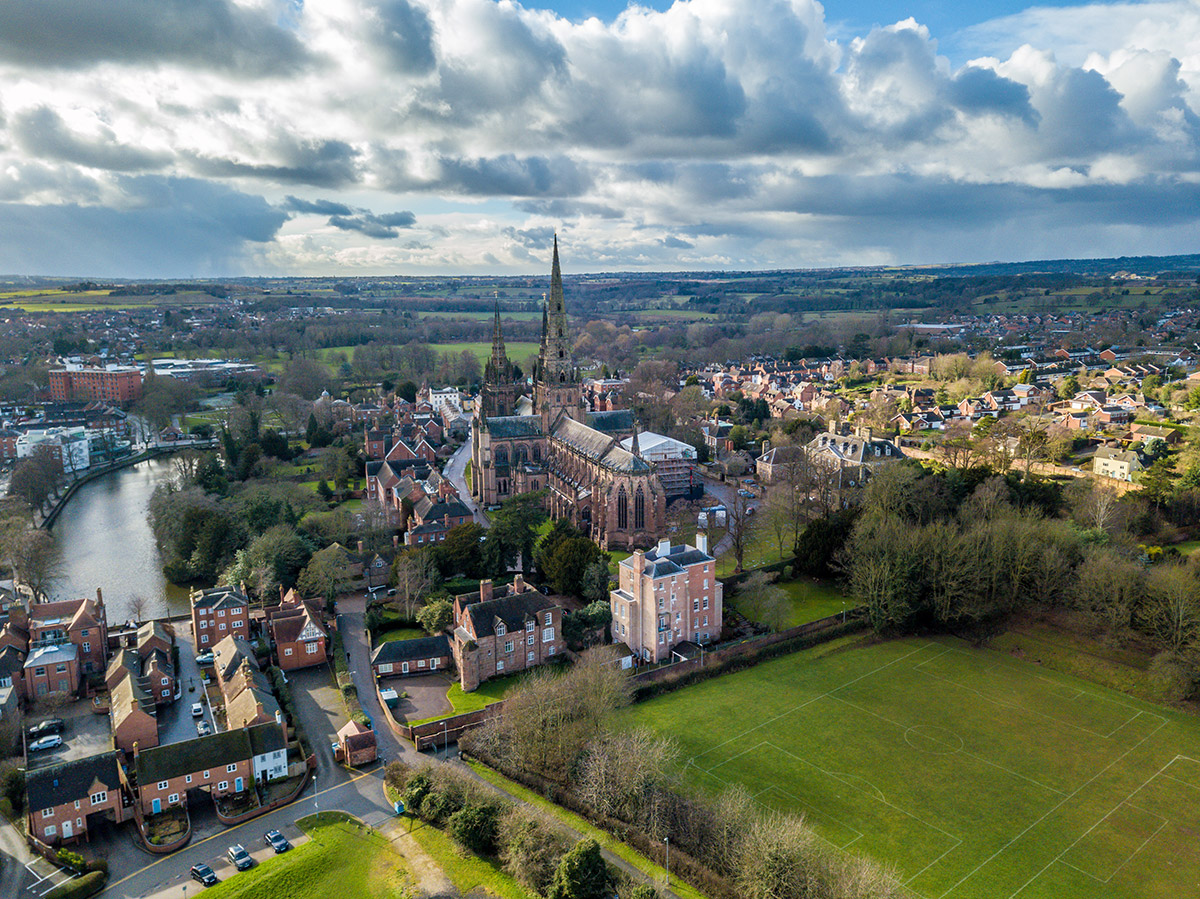
Heart of the country Dave Robertson was elected as Labour Member of Parliament for the Staffordshire seat of Lichfield, Burntwood and the Villages at the 2024 UK general election, beating the sitting Conservative MP Michael Fabricant by just 810 votes. The former physics teacher serves a semi-rural constituency centred on the cathedral city of Lichfield (pictured). Lying about 30 km north of Birmingham, the constituency also includes farmland, villages and the town of Burntwood. (Courtesy: iStock/Nicholas E Jones)
Robertson is now one of more than 400 Labour MPs and spends most of his time on local Lichfield matters. “My number one focus is very much what’s going on in my constituency, and that will always be the case,” he says. “But I’m very fortunate to be one of a very small number of parliamentarians who’ve got a science background, let alone a physics background.”
That interest saw Robertson host an exhibition in the Houses of Parliament, organized by the Institute of Physics (IOP), in June 2025 to support the International Year of Quantum Science and Technology (IYQ). “Every MP and member of the Lords would have been able to walk past and see that it was the IYQ,” he says. The exhibition was, for him, a great opportunity “to show decision-makers that the UK is one of the world leaders in quantum”.
That month Robertson also hosted a hands-on display of quantum technology for MPs and members of the House of Lords, again organized by the IOP. At the end of 2025 he sponsored another parliamentary reception, this time for physics-based companies that had won IOP Business Awards. “The event was absolutely wonderful,” says Robertson. “Seeing some of the cutting-edge science from companies on show was astonishing.”
Robertson’s focus on science extends to his membership of various cross-party parliamentary groups, including ones about nuclear energy and space. He is also chair of a new group he has set up devoted to quantum science and technology. As a backbench MP, Robertson cannot dictate or implement policy, but he says such groups “can help build up a critical mass of interest in parliament to drive an agenda forwards”.
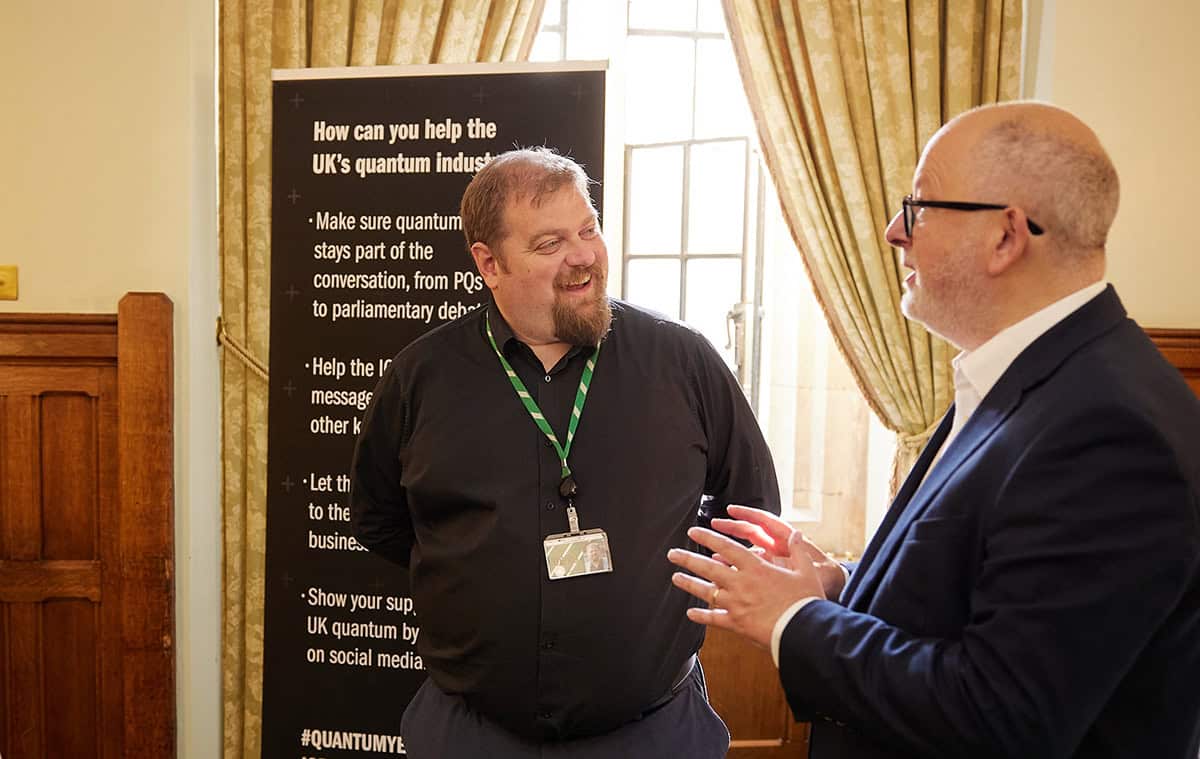
Spreading the word Dave Robertson (left) at an Institute of Physics event that he sponsored at the Palace of Westminster in June 2025 to inform parliamentarians, including fellow MP Steve Yemm (right), of the commercial applications of quantum science. The event formed part of the International Year of Quantum Science and Technology. (Courtesy: Barry Willis Photography)
With his background in teaching, Robertson is also keen to highlight the UK-wide shortage of physics teachers. While at Great Barr School – now rebranded as Fortis Academy – he was lucky. “I remember having a physics group meeting,” he says, “where there were six of us around the table and thinking ‘This is more [physics teachers] than most cities have’.”
As a 2025 IOP report pointed out, a quarter of state schools in England have no specialist physics teachers. In fact, more than half of physics lessons for 14–16 year olds are taught by teachers who never studied a physics-related subject beyond the age of 18. Despite some improvement, only 31% of the government’s target number of physics teachers have been recruited, while 44% of new physics teachers quit within five years.
It’s the responsibility of me and other MPs with a scientific background to spark an interest in physics
Dave Robertson MP
Robertson admits that getting the lack of physics teachers on the radar is an uphill battle. “There are 650 MPs but have they all thought about the importance of getting more physics teachers in the classroom? Probably not, if I’m honest. That’s why it’s the responsibility of me and other MPs with a scientific background to spark an interest in physics and unearth the next Paul Dirac or Isaac Newton.”
Robertson would also like to get on the influential science innovation and technology select committee to spread the message about the importance of physics. But he is wary of spending too much time in parliament with other MPs with a scientific background. “It’s more helpful if all of us have tentacles that spread out into other groups and parties and sections of parliament.”
Spreading the message
For the wider physics community, Robertson believes that physicists need to speak out more strongly about how they can tackle many of the world’s problems, notably climate change. “It’s the biggest issue at the moment and a lot of the solutions are going to come from physics,” he says. “Getting more physicists engaged with decision-makers will not only be good for the future of the economy but ultimately for the future of the planet.”
As for Robertson’s own future, he knows that a career in politics is precarious. Voters rarely hold politicians in high regard and will often boot them out on a whim. It’s therefore hard for any MP to have a predictable career path or plan too far ahead. Robertson himself admits to having “no big aspirations” to be a cabinet minister, which is perhaps just as well given that his majority at the last election was so thin.
With the next general election not due to take place until 2029, Robertson is for now focusing squarely on his role as a backbench constituency MP. “The job I have is just about the most wonderful in the world,” he says. “I want to keep doing it because there’s some wonderful things I can do for my community, whether it’s physics, quantum or football.” But if Robertson did get kicked out, at least he can go back into the classroom.
“Rumour has it, we could do with a few more physics teachers.”

 Login
Login