
Reading view

The Download: China’s brain implant ambitions

This is today’s edition of The Download, our weekday newsletter that provides a daily dose of what’s going on in the world of technology.

China has approved the world’s first invasive brain-computer chip—here’s what’s next

Sitting in the courtyard of his house in China’s Henan province last October, Dong Hui decided to try holding a pen. Six years after a car accident left him paralyzed from the neck down, he slowly wrote his name, “Thank you,” and the date.

The breakthrough was made possible by a brain implant called NEO. In March, it became the world’s first invasive brain-computer interface approved for use beyond clinical trials. The approval is expected to accelerate China’s push to become a global leader in brain implants.

Read the full story on how China reached this milestone—and what it means for the future of brain-computer interfaces.

—You Xiaoying

The must-reads

I’ve combed the internet to find you today’s most fun/important/scary/fascinating stories about technology.

1 Nvidia is launching its first AI chip for personal computers
The RTX Spark will power laptops from Dell, HP, Microsoft, and others. (BBC)
+ They’re being designed specifically to run AI agents. (WSJ $)
+ The first devices are set to launch on Windows PCs in the fall.
(CNBC)
+ The move marks a challenge to Apple and Intel.
(FT $)

2 The US is stopping exports of AI chips to Chinese firms abroad
It’s closed a loophole allowing exports to Chinese subsidiaries. (Reuters $)
+ Which may have enabled unlicensed access to Nvidia chips. (Al Jazeera)
+ Export curbs have led China to redesign its chip industry. (MIT Technology Review)

3 Surgeons have transplanted pig liver and kidneys into a living person
The clinically dead recipient’s organs worked for almost five days. (Nature)
+ Pig organs could ease transplant shortages. (Guardian)
+ Putin says organ transplants could grant immortality. (MIT Technology Review

4 The US, Australia, and UK will defend seabed cables with underwater drones
They’re developing the vehicles via the trilateral AUKUS defense ⁠pact. (CNN)
+ Undersea internet cables face growing threats. (BBC)

5 A new study has revealed chatbots’ manipulative ‘dark patterns’ 
It found they prey on emotions to encourage harmful behavior. (404 Media)
+ They can also sway voters better than political ads. (MIT Technology Review)

6 Apple plans to disrupt the traditional glasses market
Its smart glasses target the broader spectacles industry. (Bloomberg $)
+ Smart glasses are also gaining traction in warfare. (MIT Technology Review)

7 AI super PACs are dueling over the midterms
Split between Anthropic and OpenAI, they’re fighting to shape AI regulation. (NYT $)

8 SoftBank has overtaken Toyota as Japan’s most valuable company

The AI boom pushed SoftBank’s market value above $305 billion. (Bloomberg $) 

9 A botnet of more than 17 million devices has been dismantled in Europe
Dutch authorities linked the network to a Russian proxy service. (Ars Technica)

10 Tech leaders are uniting around a transhuman vision for AI
They’re working toward a post-human agenda. (Guardian)

Quote of the day

“It’s just been shoved down their throats in secrecy. And that makes them upset.” 

—Legendary environmental activist Erin Brockovich tells “The Jim Acosta Show” why citizens are angry about data centers expanding into their communities.

 One More Thing
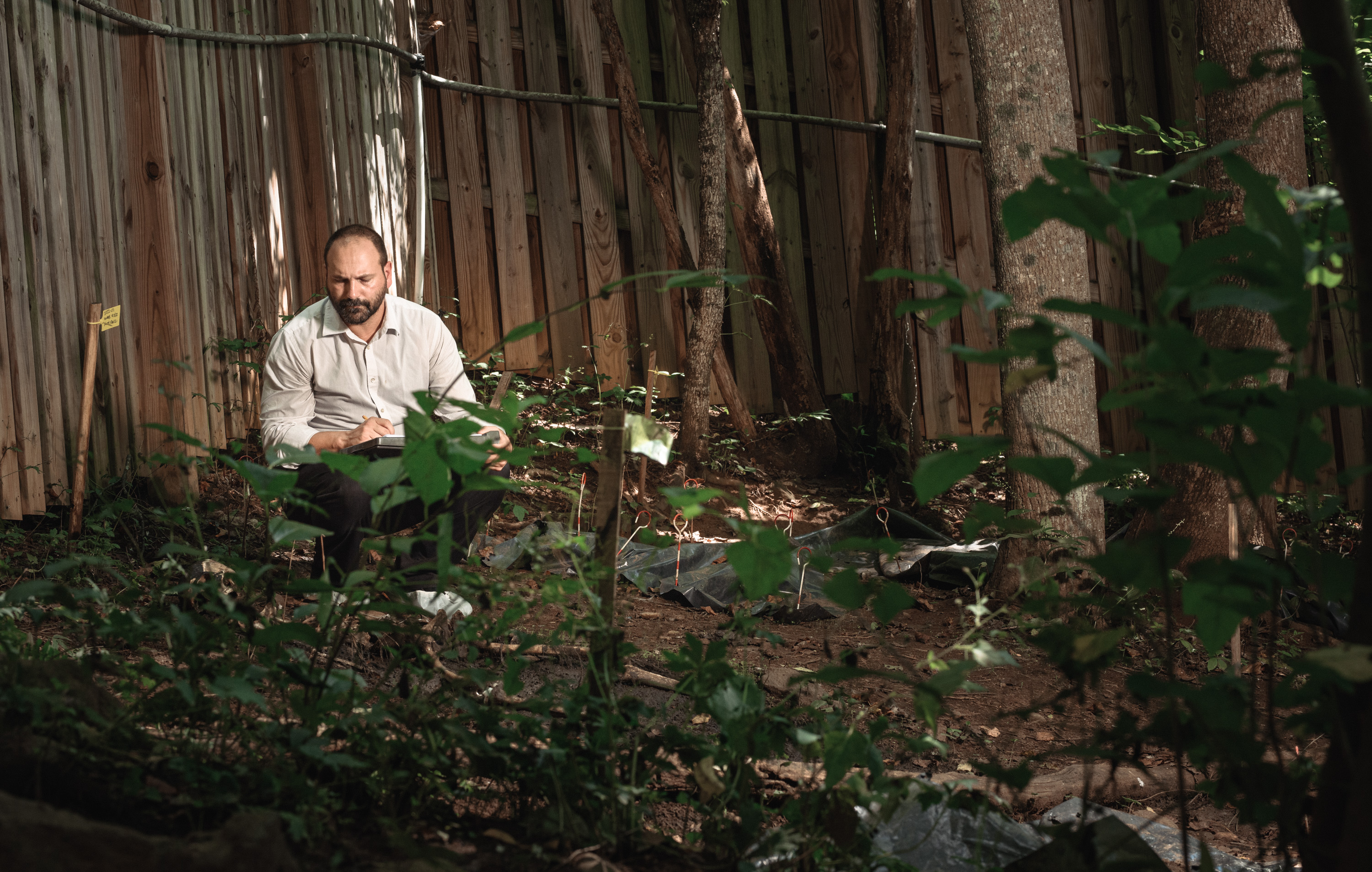
Dr. Nicholas Passalacqua, Forensic Anthropology Facilities Director at Western Carolina University observes a body at the decomp facility.
MIKE BELLEME


What happens when you donate your body to science

Rebecca George doesn’t mind the vultures. At Western Carolina University’s body farm, forensic anthropologists monitor donors—sometimes for years—as they become nothing but bones.

Around 20,000 people donate their cadavers to scientific research and education each year. At anatomy labs and body farms, they help train doctors, advance research, and teach scientists more about the human body long after death.

But what actually happens after a body is donated? Read the full story to find out.

—A.W. Ohlheiser

We can still have nice things

A place for comfort, fun, and distraction to brighten up your day. (Got any ideas? Drop me a line.)

+ This map of moments turns the planet into a shared diary.
+ Let editors curate your ideal podcast moments with this app.
+ Architecture lovers will enjoy this encyclopedia of famous buildings.
+ Get in touch with your emotions through this map exploring more than 100 feelings.

  •  

China has approved the world’s first invasive brain-computer chip—here’s what’s next

One day last October, sitting in the courtyard of his house in China’s Henan province, Dong Hui decided to see if he could hold a pen to write. 

Dong, 39, had sustained spinal cord injuries in a car accident six years earlier that left him paralyzed from the neck down. Slowly but determinedly, he wrote his name, “Thank you,” and then the date. This was the result of an 11-month-long rehabilitation enabled by an implant in his brain. Before that process, Dong could move his arms slightly but wasn’t able to use his fingers.

“I couldn’t believe I was able to write again. I was so excited I even missed a stroke in my name,” he told MIT Technology Review on a video call. 

In November 2024, Dong became one of the first people in China to be given an invasive brain-computer interface (BCI) through brain surgery. He had signed up for a clinical trial with the device’s developer one month after seeing on TV how a BCI had apparently enabled another paralyzed Chinese man to hold his granddaughter. 

This March, the implant Dong uses became the first invasive BCI product in the world to be approved for use beyond clinical trials. It’s now available to some patients with paralysis in their limbs due to spinal cord injuries. We spoke to a range of experts to understand why the device was able to reach this global milestone, what makes this moment so significant, and what to expect next. 

A world first

Dong’s brain implant is a coin-size device called NEO. It was developed by Neuracle Technology, a Shanghai-based startup, together with researchers at Tsinghua University in Beijing. 

During a procedure that took just over an hour and a half, the device’s sensors, which collect Dong’s brain signals, were placed on his dura mater, the tough outer layer of tissue that covers and protects the brain. The signals are transmitted to a computer by an implant placed on Dong’s skull. The computer then translates the signals into commands for a soft robotic glove Dong wears during the 2.5-hour training sessions he completes each day to help him learn to grab. 

Dong started his rehabilitation around a week after surgery. “On the ninth day of my training, my right hand successfully grabbed a ball without the glove,” he says. “That was a miraculous moment.” 

Now he continues with his training at home. He wants to be able to control his hands better in order to put on clothes, eat, and do other daily tasks without troubling his aging parents. 

A growing number of people with traumatic injuries in China are now poised to tread a similar path thanks to NEO’s recent approval. According to China’s National Medical Products Administration, the bureau responsible for drug supervision, the product is suitable for patients between 18 and 60 who have paralysis in all limbs due to spinal cord injuries but still have some residual function in their arms. 

NEO beat several other BCIs to approval, including one from Neuralink, a California-based company founded by Elon Musk. Since October 2023, Neuracle has conducted 36 clinical trials using NEO, including the one on Dong. Thirty-two of them took place in the space of a few months in 2025, with the details about one of the four first in-person trials published in a preprint paper last July. Neuracle did not reply to a request for comment from MIT Technology Review.

One reason for NEO’s fast approval could be that it has a “relatively less invasive” design than counterparts such as Neuralink’s N1 brain chip, says Avinash Singh, a BCI researcher at the University of Technology Sydney. NEO’s eight sensors sit on top of the brain’s protective membrane while Neuralink’s N1 chip directly penetrates the cortex, the outermost layer of the brain itself. Neuracle’s device faces fewer regulatory constraints because it presents a lower risk of hemorrhage, glial scarring, and long-term signal degradation, Singh says.

China’s strong support for its BCI industry also means that NEO was put on an expedited regulatory pathway; in comparison, the approval process of the US Food and Drug Administration can take several years, Singh adds.

A big boost for BCIs

NEO’s approval is hugely important for the global BCI industry, says Wang Shouyan, a neuroscientist at Fudan University in Shanghai who was not involved in research or trialing for NEO. Even though research and development on BCIs has taken place for several decades, most of it happened in the lab. The news means that BCIs are now ready for large-scale manufacturing and clinical use in China, Wang says. 

For Dong, however, it means something much more personal. “Now, it will be able to help not only me, but also thousands and thousands of other patients suffering from spinal cord injuries in China who are tortured by despair each day,” he says of NEO. “It will bring them hope and change their lives.” 

Days after NEO was approved, China started incorporating it into the country’s health insurance system by assigning it a unique code. This is one of the first steps toward a future where eligible Chinese patients pay a certain percentage of the BCI’s price if they need it during their treatment.

The growth of China’s BCI industry is expected to accelerate thanks to the government’s policy support and financial backing. The country’s latest five-year plan, published on the same day Neuracle received its approval, lists BCI as one of six key industries important to China’s future tech competitiveness, alongside quantum technology, humanoid robots, and others. Several Chinese startups, including NeuroXess and StairMed, have already worked in the field for many years. 

“China’s decision to double down on becoming a global leader in the field owes in part to what these companies have already accomplished,” says Meicen Sun, an information scientist at the University of Illinois Urbana-Champaign who studies information and technology policy. 

But, Sun says, the biggest advantage China may have is that Chinese people, particularly patients like Dong, tend to welcome this technology and are genuinely enthusiastic about it. In comparison, in the US and Western Europe, testing technologies on human bodies elicits an “ick factor,” triggering concerns and even resistance, she says.

Cooperation in a cold climate 

NEO has become the world’s first invasive BCI to go commercial, but scientists interviewed by MIT Technology Review caution against comparing Chinese and US efforts through the lens of a race

A race implies an endpoint, but it is hard to say where that is for the development of BCIs, says Nick Ramsey, a neuroscientist at Radboud University Nijmegen in the Netherlands. Also, the US and China have fundamentally different visions, Sun says. The US is primarily concerned with being the first to do something and achieving state-of-the-art performance, while winning to China means capturing more consumers and using technology to deliver solutions on a societal scale. 

“Being exceptional and being accessible are two diametrically opposed definitions of winning,” Sun says. 

In fact, neurotechnology has emerged as a rare tech sector where US-China collaboration is still happening despite geopolitical tensions. The US company Axoft,  based in Cambridge, Massachusetts, says it has teamed up with a Chinese company and a hospital in Shanghai to test its BCI on four patients in China and has plans to expand its trials in the country. 

Looking forward, China’s BCI industry is expected to speed up its growth over the next five years thanks to strong government support. “There is no comparable national-level ambition or coordinated map elsewhere in the world at the moment,” says Singh.

More BCIs are also in the pipeline for domestic approval in the country, including Beinao-1, developed by the Chinese Institute for Brain Research in Beijing and its affiliated startup, NeuCyber NeuroTech. The device, which sits on the dura mater, is designed to help those who have movement and speech difficulties due to spinal cord injuries or amyotrophic lateral sclerosis. These candidates could get the green light as early as 2028, Singh says. 

  •  
❌