A group of 57 nations mostly from the Global South, describing themselves as “coalition of the willing” intent on making the Transition Away From Fossil Fuels, or TAFF, convened in the Colombian city of Santa Marta, from April 24-29, 2026, for the inaugural TAFF summit. Also referred to as the “Santa Marta Coalition,” this group of countries met to discuss and develop frameworks and pathways for nations to phase out fossil fuel dependency. Joining the Mongabay Newscast this week is Mamphela Ramphele, a medical doctor, activist and member of the Planetary Guardians, a network of experts advocating for the planetary boundaries as a measurement framework. Ramphele explains the highlights of the conference, which included the unveiling of a dedicated scientific panel to advise nations on developing road maps to transition off fossil fuels. The science panel includes experts such as Carlos Nobre from Brazil and Johan Rockström from Sweden, who pioneered the planetary boundaries concept. The conference also saw the establishment of “workstreams” to help nations connect their phaseout road maps to their emissions reduction targets as part of their U.N. climate commitments; leverage support to change their financial systems for the transition; and reform trade systems. Two nations in attendance, Colombia and France, announced their own phaseout road maps at the conference. Ramphele, from South Africa, suggests that as countries in the Santa Marta Coalition develop and implement their own road maps, other nations not yet on board will eventually be pressured to follow. Until a legally binding agreement, such…This article was originally published on Mongabay
At a time when climate politics in the United States and globally remain deeply polarized, Will Hackman, a climate advocate and political operative, argues that the climate movement needs a new language — one rooted less in doom, guilt and abstract planetary crisis, and more in people’s everyday lives, health, safety, costs and communities. In his new book, Radically Reframing Climate Change: A Guide to Saving Ourselves, he makes the case that climate advocates have too often spoken to those who already agree with them, while failing to reach people who may be cautious, doubtful or simply disconnected from the issue. The challenge, he says, is not only scientific or technological. It is political, cultural and communicative. In the United States, climate change remains politically polarized, with surveys showing that Republicans are less likely than Democrats to view it as an urgent threat, making climate messaging particularly challenging across ideological divides. Mongabay spoke with Hackman over video call about climate messaging, grassroots activism, fossil fuels, political polarization, and why he believes the climate movement must rebuild, creating a broader and more hopeful constituency. Mongabay: You write in your book that much of climate messaging has been framed around fear, guilt and apocalypse. Is that still the right way to talk about climate change? Will Hackman: I think the nature-based messages — polar bears, melting glaciers, “there is no planet B,” “save the planet,” “world on fire” — work for people who already care about climate change. But they do not…This article was originally published on Mongabay
Physicist Stephen Volz had been working with colleagues at the U.S.’s National Oceanic and Atmospheric Administration for nearly 10 years to produce a new generation of geostationary satellites — instruments that would provide critical observations about atmospheric conditions, climate patterns and weather. But when Donald Trump returned to office in January 2025, this long-term project was thrown into disarray. “This administration canceled three of the five instruments on that program,” Volz, the assistant administrator for NOAA’s National Environmental Satellite, Data, and Information Service, who has been on administrative leave since July 2025, told Mongabay. The cancellations applied to instruments that measured air pollutants, tracked lightning to forecast hurricanes and tornadoes, and monitored ocean color to detect events such as algal blooms, sargassum seaweed surges and salinity changes, according to Volz. “They said, ‘those are all wasted money, they’re climate alarmist, I don’t need air quality, I don’t need ocean color,’” Volz said about the administration’s decision. The axing of this project is just one example of what experts describe as a broad, long-term effort by the Trump administration to weaken NOAA. The long-standing scientific and regulatory agency within the U.S. Department of Commerce has historically been responsible for everything from forecasting the weather and monitoring the climate to managing fisheries and protecting marine mammals. The White House did not respond to Mongabay’s request for comment. NOAA’s GOES-19 satellite, which tracks hurricanes and tropical storms in the Atlantic Ocean basin, as well as monitor severe weather, atmospheric rivers, wildfires, volcanic eruptions…This article was originally published on Mongabay
When a scientist says, “We don’t know yet,” it can sound like a shrug. In reality, it often means the opposite: We are worried enough to be careful. The public can reasonably ask why some climate risks, especially tipping points, don’t arrive with alarm and immediate action. George Monbiot recently voiced a frustration many people feel: Why has the possibility of an Atlantic Meridional Overturning Circulation (AMOC) shift not prompted a bigger political and media response? Climate scientists are trained to avoid overclaiming and, instead, to communicate what the evidence shows, what it suggests, and what remains unresolved. That approach underpins my team’s recent research on ocean acidification, supported by the Frontiers Planet Prize. In that work, published in Global Change Biology, we found that large parts of the global ocean have already crossed into a “zone of risk” for ecosystem change. That caution can serve to downplay the threat, but the latest research on the AMOC should be understood as a warning sign: The potential outcomes could be even more severe than projected, and the uncertainty around timing and thresholds is not a reason to delay, but an argument for action now. Ocean life depends on AMOC The AMOC is often described as a giant conveyor belt of Atlantic currents. Warm, salty surface waters flow north from the tropics to the subpolar North Atlantic. On its way, the water releases heat to the atmosphere, so that by the time it reaches the subpolar region, it has cooled and become…This article was originally published on Mongabay
JAKARTA — A group of Indonesian citizens affected by the late-2025 Sumatra floods and landslides have filed a lawsuit with a court in Jakarta in an effort to hold the Indonesian government accountable for what they describe as an “ecological disaster.” The disasters claimed more than 1,200 lives and damaged more than 600,000 buildings across three provinces, resulting in more than 100 trillion rupiah ($5.6 billion) in estimated economic losses. The plaintiffs argue the damage from Cyclone Senyar was amplified by decades of policy failures, including deforestation, extractive concessions, degraded watersheds, weak zoning, poor environmental enforcement and the absence of an effective early-warning system. Through the lawsuit, the plaintiffs are effectively asking the court to determine whether the catastrophe transcended a natural calamity and could be categorized as a foreseeable failure of governance linked to environmental degradation and state inaction. The lawsuit combines elements of Indonesia’s citizen lawsuit mechanism with a challenge to alleged unlawful government administrative inaction under a 2014 law on public services. Alfi Syukri, a lawyer with the West Sumatra chapter of the Legal Aid Institute (LBH), who is representing the plaintiffs, noted that Indonesia’s meteorological agency, the BMKG, had repeatedly warned authorities about the potential for extreme weather linked to Cyclone Senyar before the disaster intensified. “So in Aceh, North Sumatra and West Sumatra [provinces], the head of BMKG Region 1 had already issued warnings eight days before [the Nov. 25 landfall], then repeated them four days before, and again two days before,” BMKG chief Teuku…This article was originally published on Mongabay
Wildlife monitoring in Australia could get a boost from a new platform that uses AI and computer vision to speed up the processing of millions of camera trap images being collected across the country. The national initiative named the Wildlife Observatory of Australia (WildObs) is a way to collect, store and share camera trap data at scale, while improving collaboration between scientists, governments and environmental groups, according to the WildObs website. The platform is being developed by researchers at the University of Queensland (UQ), with backing from the Australian Research Data Commons, Queensland Cyber Infrastructure Foundation and the Terrestrial Ecosystem Research Network. Camera traps are commonly used to monitor wildlife globally: they’re easy to set up and can be left at locations for long periods, providing an invaluable window into the natural world. Across Australia, thousands of projects collect millions of images, Matthew Luskin, associate professor at the UQ School of the Environment and director of WildObs, said in a statement. However, processing the images and identifying species takes time, money and computing power. WildOBS plans to speed it up. “In conservation, timing matters and detecting problems early can mean the difference between recovery and extinction,” Luskin said. WildObs requires users of the platform to upload images, which get stored and processed in the cloud. The platform’s models have been trained specifically to identify species found in Australia and can help track biodiversity trends, monitor invasive species and identify conservation priorities, according to the UQ statement. “In one collaborative space,…This article was originally published on Mongabay
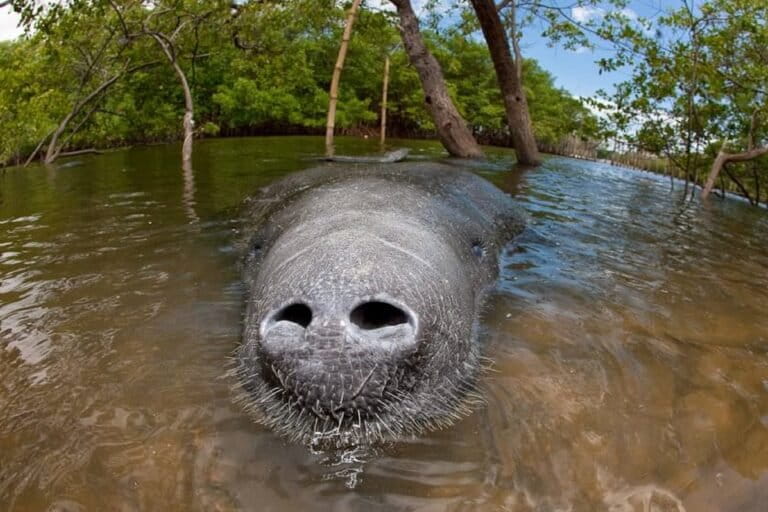
In October 2025, Brazilian state oil company Petrobras began drilling in the seabed where the Amazon River empties into the Atlantic Ocean, following a long, controversial environmental licensing process. At the center of the debate were concerns about the unique wildlife living here, on the shores of the states of Amapá and Pará, and about the company’s capacity to rescue these animals in the event of an oil spill. The potential victims range from marine birds and turtles to the recently discovered Amazon reef system. One endangered marine mammal, however, has prompted particular concern because of the extra challenges to rescuing it in the event of a disaster: the West Indian manatee (Trichechus manatus), a species that grows to a length of around 3.5 meters (11.5 feet) and weighs an average of 700 kilograms (more than 1,500 pounds); some individuals reach up to 1,600 kg (more than 3,500 lbs). “Handling and transporting animals of this size requires complex logistics and large-scale equipment,” said marine biologist Fábia de Oliveira Luna, coordinator at the National Center for Research and Conservation of Aquatic Mammals (CMA), which is part of Brazil’s environmental ministry. With a population estimated at only 1,047 individuals in Brazil and a reproduction rate of one calf every four years, “every individual removed undermines the survival of the population,” Luna told Mongabay. According to scientists, the oil project also jeopardizes a unique genetic code shared only by animals from this region, a result of the interbreeding between the marine manatee and…This article was originally published on Mongabay
Peatlands are boggy wet ecosystems found from boreal forests in the Russian Arctic to the tropics of central Africa. Typically, when vegetation decomposes it releases carbon dioxide into the atmosphere. However, when that same organic matter falls in a bog and is covered with water, carbon gets trapped and becomes sequestered there, sometimes for millennia. This makes peatlands essential for the world’s carbon balance. Even though they cover just 3% of the Earth’s terrestrial surface, they store nearly a third of the world’s carbon. On this World Peatland Day, June 2, here’s a look at some of Mongabay’s recent peatland reporting: ‘Ancient’ carbon leaking from Congo Basin lakes The largest tropical peatland in the world, located in Africa’s Congo Basin, was only mapped about a decade ago. Scientists believe the Cuvette Centrale peatlands are roughly the size of England and hold some 30 billion metric tons of carbon. Researchers recently found some lakes in the Cuvette Centrale are slowly releasing ancient carbon. Using statistical modeling they estimated that much of the carbon being emitted locally is between 2,000 and 3,500 years old. “[I]t surprised us that almost half was coming from ancient peat carbon,” lead author of the study Travis Drake told Mongabay’s John Cannon. Scientists don’t yet know if the released carbon is a natural phenomenon or a result of something altering the system. Preserving Arctic peatlands with Indigenous knowledge In the frigid Arctic, melting permafrost from climate change is a big driver of carbon emissions from peatlands. Now,…This article was originally published on Mongabay
“I think the international community really does need to put more pressure on Australia to do better,” says Euan Ritchie, a professor of wildlife ecology and conservation at Deakin University in Australia, in a recent episode of Mongabay’s Newscast. From animals like kangaroos, koalas and platypuses, to plants like waratah, kangaroo paw and climbing heath, Australia has exceptionally high biodiversity, with a unique assemblage of wildlife found nowhere else on the planet. The Australian government claims the country is on track to meet many of its targets under the Kunming-Montreal Global Biodiversity Framework, the landmark agreement that aims to halt and reverse the decline of biodiversity, and ensure the sustainable use of biodiversity equitable sharing of benefits, among other goals, by 2050. However, Ritchie, who’s also the president of the Australian Mammal Society and a councilor for the country’s Biodiversity Council, argues that “Australia is failing miserably” on all those measures. This is despite Australia being one of the wealthiest nations on Earth in terms of GDP per capita, with a “huge number of really knowledgeable scientists,” he tells Newscast host Mike DiGirolamo. “If we look at the number of threatened species in Australia, it’s more than 2,200 now, and that list continues to increase,” Ritchie says. “We have ecosystems that are collapsing, 17 in total within Australia and two more further south into sub-Antarctic and Antarctic regions that are collapsing.” The iconic koala (Phascolarctos cinereus) is also now endangered in the states of Queensland and New South Wales, and…This article was originally published on Mongabay
Nepal is preparing to relocate 18 blackbucks from the country’s west to its south central region, near the popular Chitwan National Park. Officials say the translocation will help establish a population of the antelope in a new habitat and safeguard the species against localized disasters or disease, but conservationists question the choice of habitat and considerations of predation risk, reports Mongabay contributor Bibek Bhandari. According to the translocation plan, six male and 12 female blackbucks (Antilope cervicapra) will be moved from Shuklaphanta National Park and Blackbuck Conservation Area in Bardiya to an enclosure in Tikauli, a corridor forest near Chitwan. While blackbucks are not listed as globally threatened on the IUCN Red List, they are considered to be critically endangered within Nepal. Conservation efforts have helped revive the blackbuck population in Nepal from just nine known individuals in 1975 in Bardiya to more than 500 today. At Tikauli, the blackbucks will be housed in a roughly 20-hectare (50-acre) enclosed area within a protected forest. However, ecologists are concerned about the suitability of Tikauli. Amar Kunwar, a community ecologist who has researched blackbuck conservation, told Mongabay that the mammals prefer hot, arid regions with short grasslands. Chitwan’s monsoonal climate is humid and prone to flooding, and its grasses can reach heights of 4.5 meters (15 feet), which limits food availability and hinders the animals’ ability to detect predators. Chitwan also supports high tiger and leopard densities. “As blackbucks roam the area once translocated, they are likely to attract leopards,” said Bishnu…This article was originally published on Mongabay
BOGOR, Indonesia — In a village bordering Gunung Halimun-Salak National Park on the Indonesian island of Java, local people browse a row of fabrics carrying impressions of plants and the silhouette of the forest’s silvery gibbon. They are made by the women-led Ambu Halimun collective, whose name translates to “mothers of Halimun” in the local dialect. The project focused on boiling and pressing distinctive local plants into motifs on fabric, which drew women like Mirna Maharani into closer observation of the vegetation surrounding the village of Citalahab. Species once overlooked, even dismissed as weeds, have since acquired new value as sources of color, pattern and identity, Mirna explained. “Now, we are preserving them,” said Mirna, 30, a mother of two. Formed in 2020 during the challenges of the coronavirus pandemic, the goal of Ambu Halimun was to engage women in conservation while providing an arena to uplift economic agency and professional development. Ambu Halimun is a women’s empowerment group that produces eco-friendly textiles in Bogor, West Java. Image by Falahi Mubarok/Mongabay Indonesia. Primatologist Rahayu Oktaviani, co-founder of the Kiara Foundation, which came up with the Ambu Halimun initiative, said she wanted to seed an original approach to conservation that would benefit women in Citalahab. “The forest isn’t something that is separate to them,” Rahayu told Mongabay Indonesia. “That’s why we’re building a sense of ownership.” Last year, Rahayu received the Whitley Award in recognition of her organization’s grassroots conservation work with Java’s silvery gibbon (Hylobates moloch), which included the work…This article was originally published on Mongabay

 Login
Login